To help me to assess the progress that I have made to date towards the completion of my Parallel project I felt it would be useful to present the paintings together. At this time, early September 2020, I have around three months before I need to prepare my submission for Assessment in January 2021.
I have completed nine paintings to date of which I feel that two are outside of the scope of the project. These are:
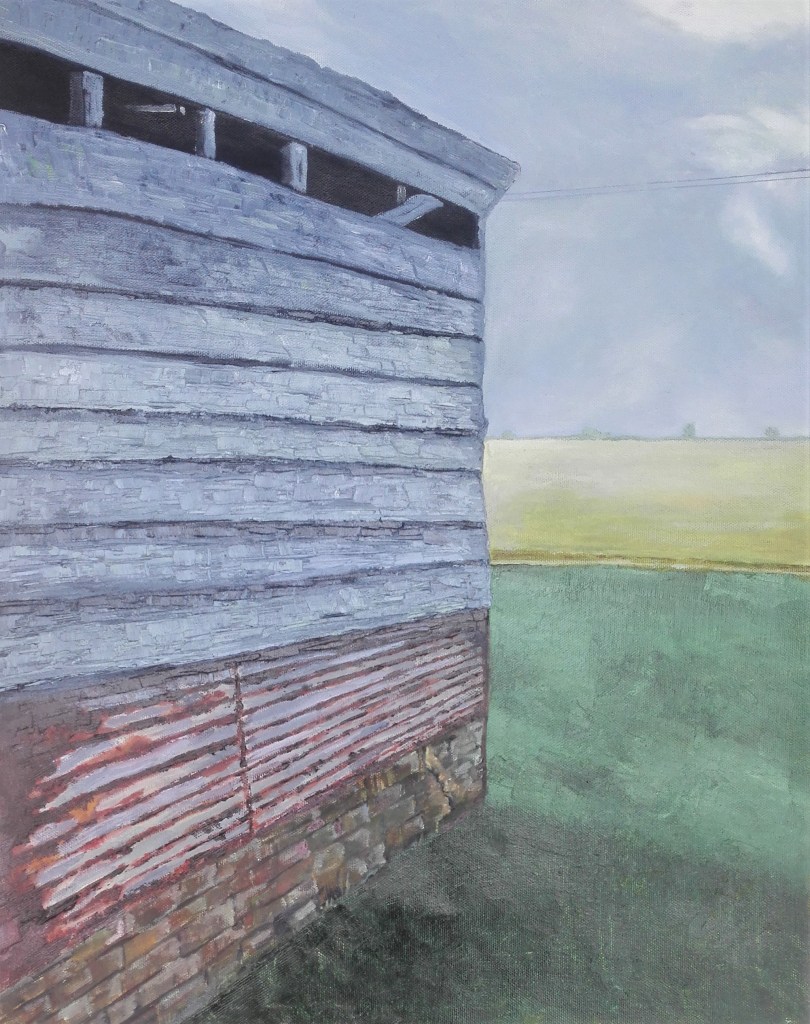
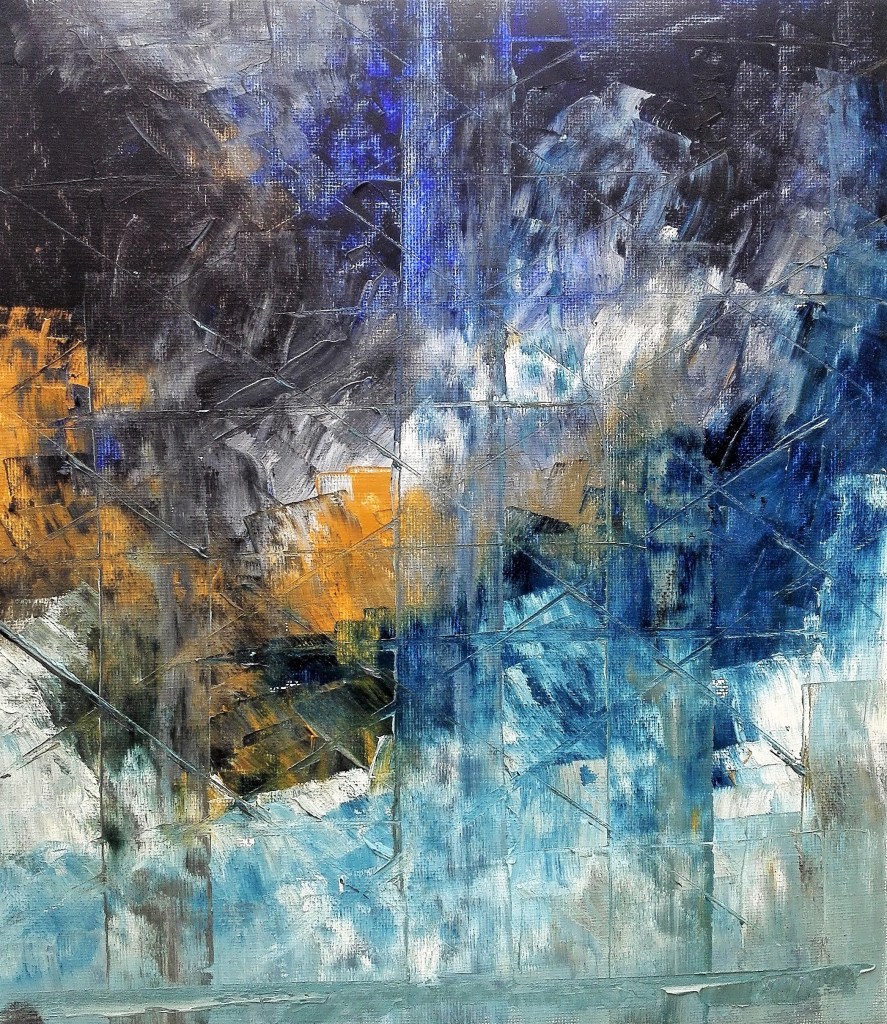
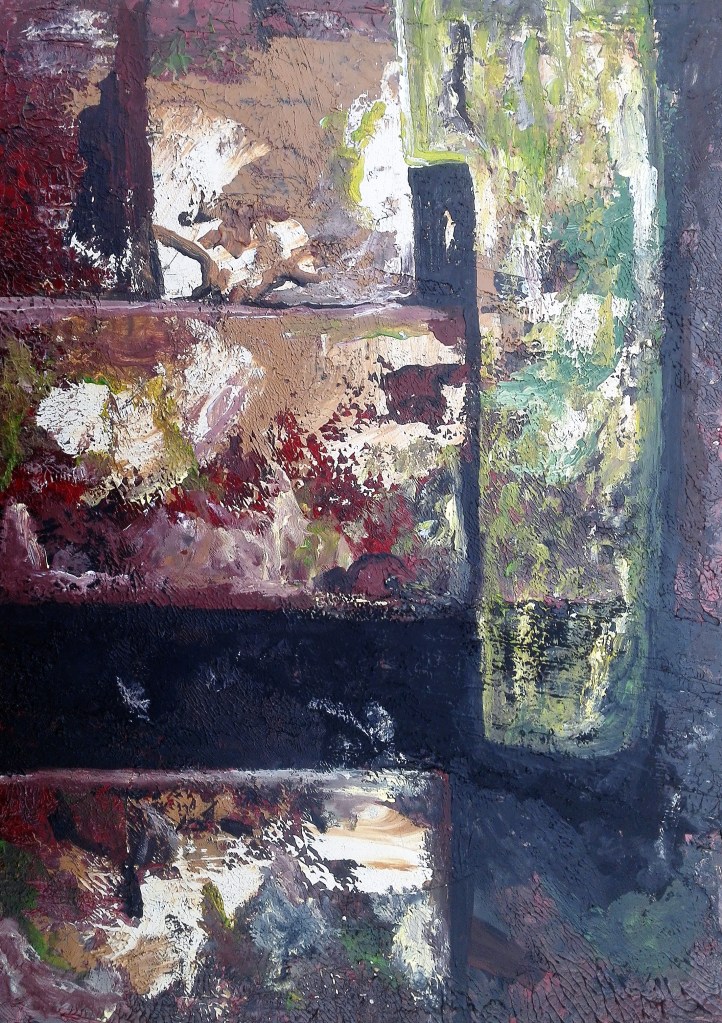
1. Derelict Out Building & 2. Abstract
The seven paintings that are currently in contention are:
When viewed collectively I see a narrative emerging which is my intention. My aim is to examine this theme further over the coming months and hopefully a realised result will emerge.
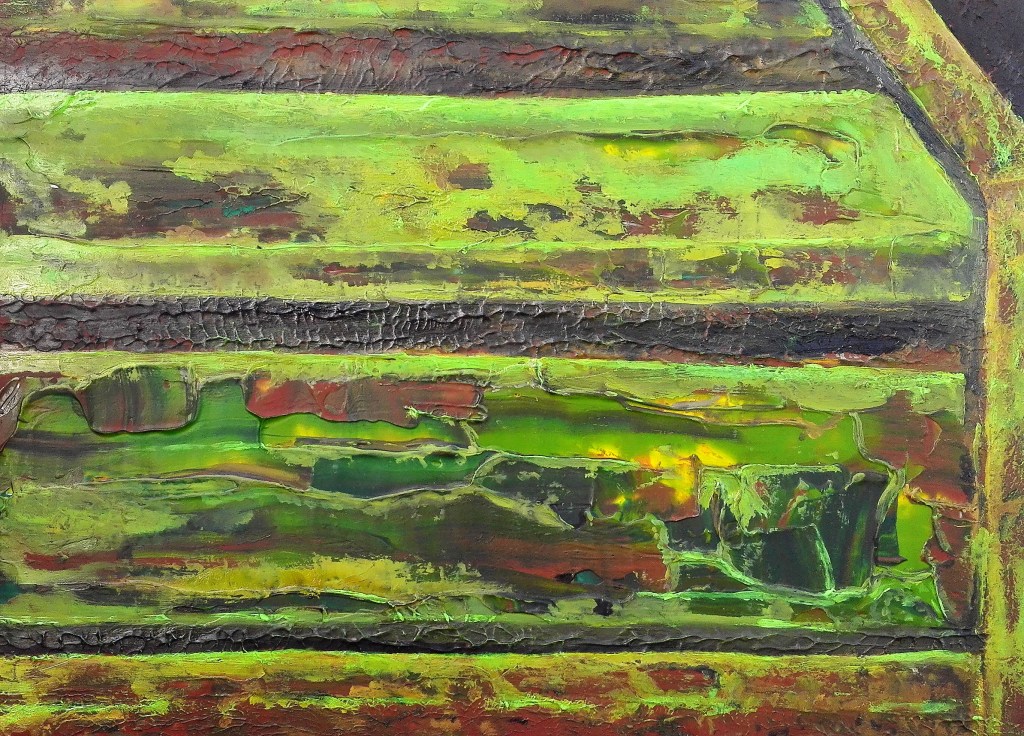
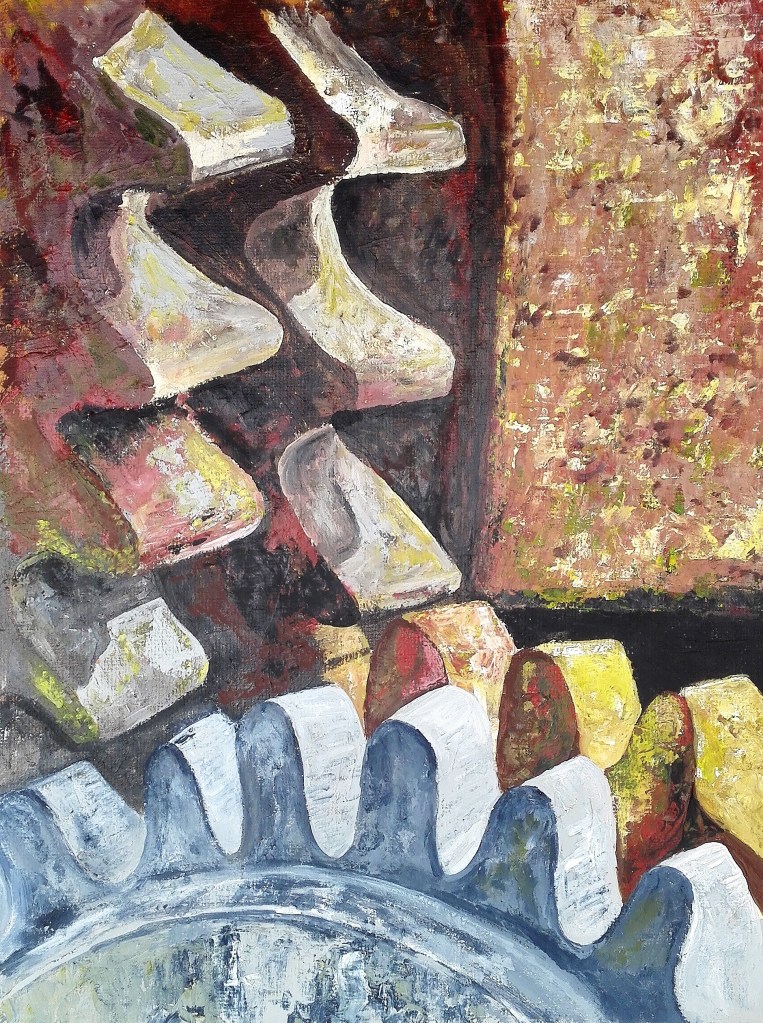
A further two paintings which examine the impact of time passing on painted machinery. With both of these paintings I have tried to interpret the image in my own way. I have toyed with the texture of the paint to create interest in the surface of the painting. Zooming into the subjects has created abstract images which have a form without revealing their identity. I am finding that this juxtaposition of form, paint and colour is resulting in paintings that are both challenging and interesting to explore.
The first painting is on canvas paper, 25 x 20 cm painted using Aqua oils.
Farm Machinery, Aqua oils on canvas, 25 x 20 cm
The second painting is on acetate, 20 x 29 cm, painted with both acrylic and aqua oils.
Machine Part, Acrylic and aqua oils, 20 x 29 cms
The focus of my Parallel project has moved in a direction that I wouldn’t have originally predicted. I await feedback on this.
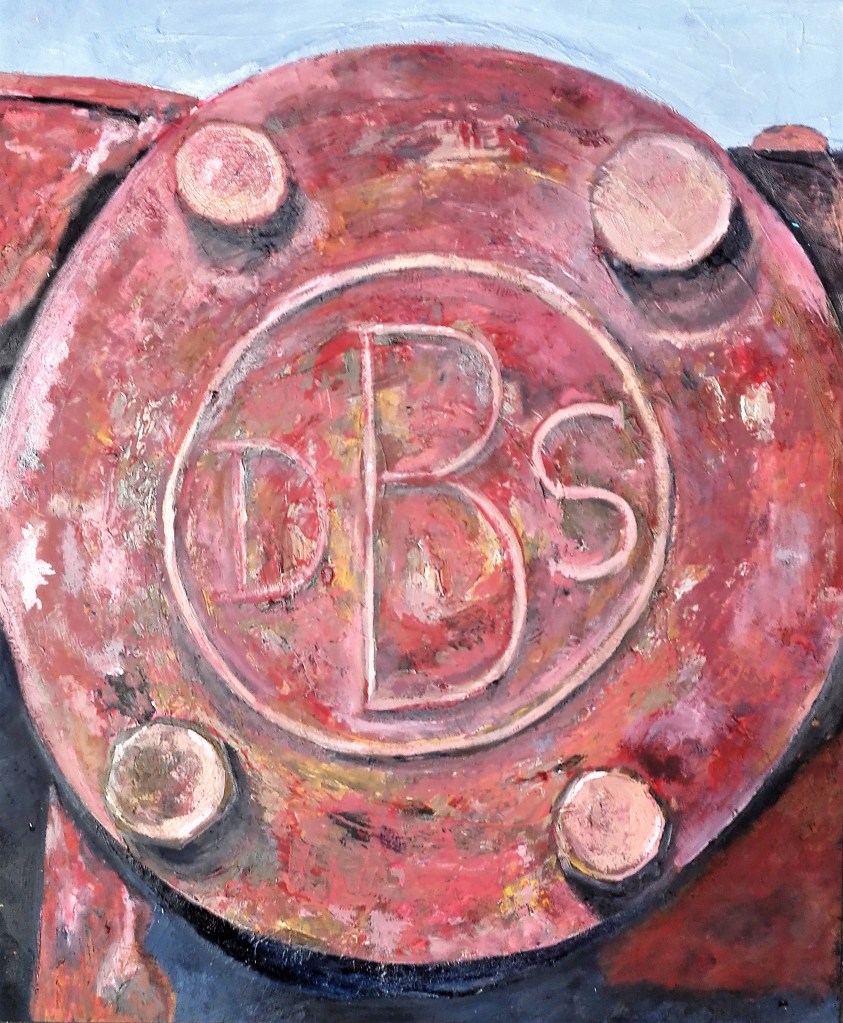
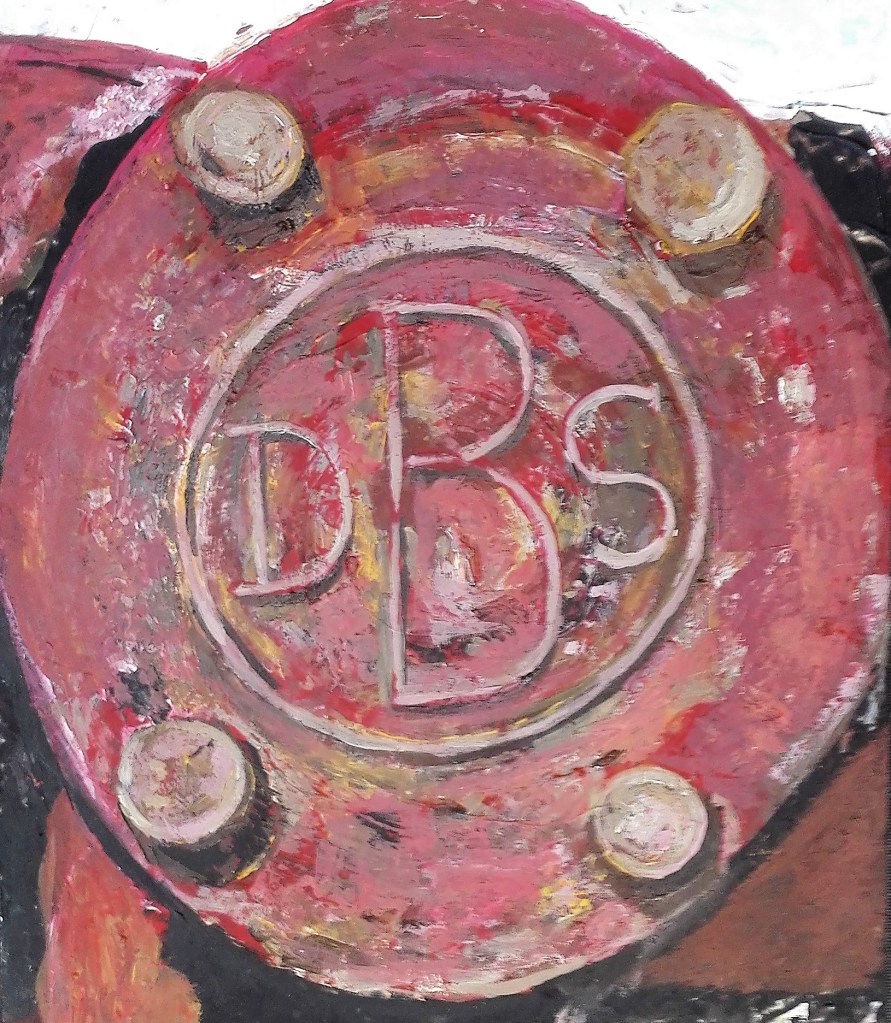
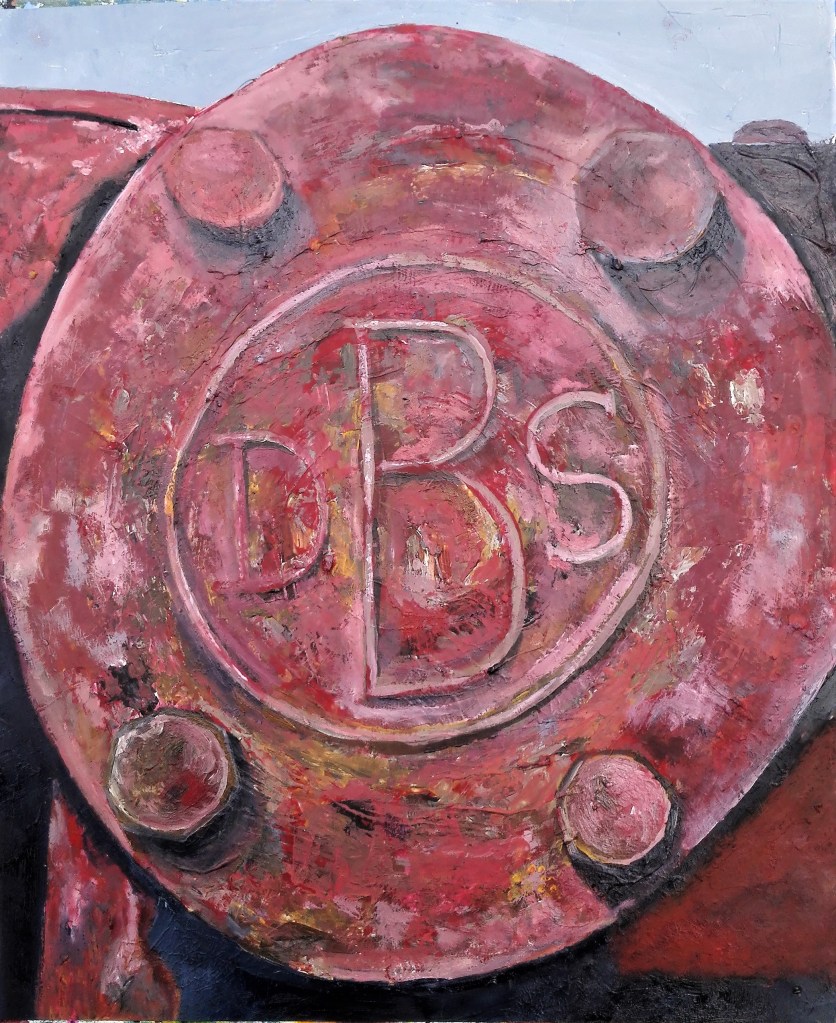
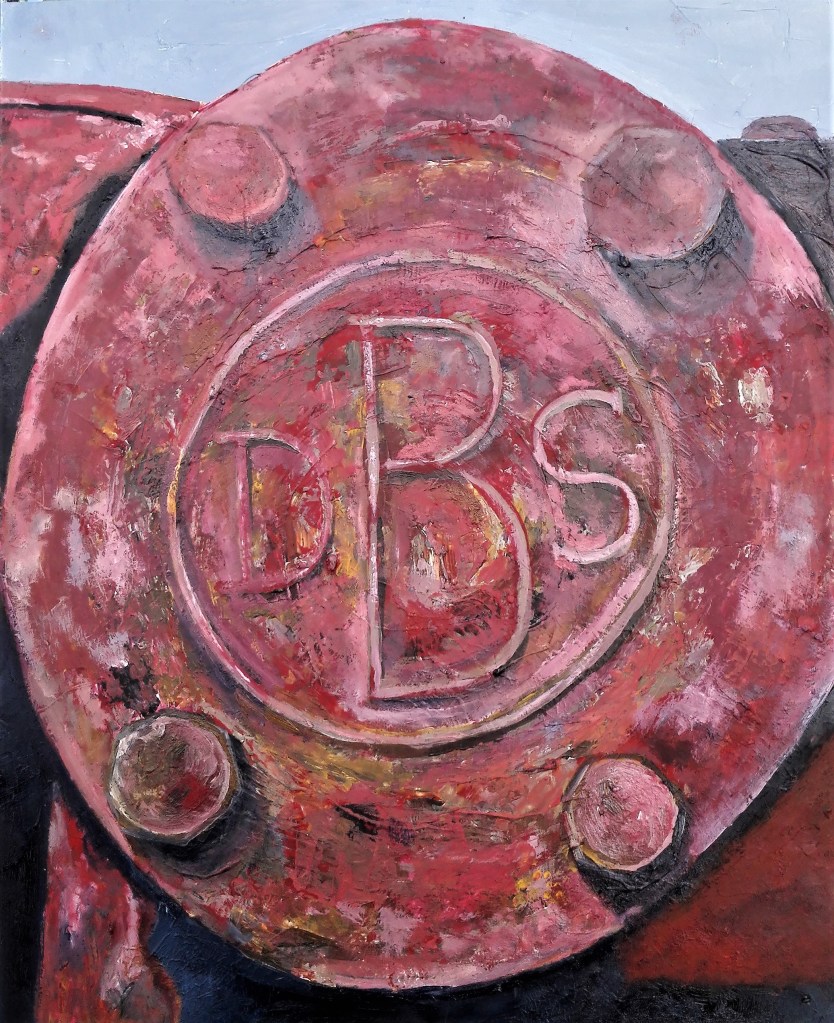
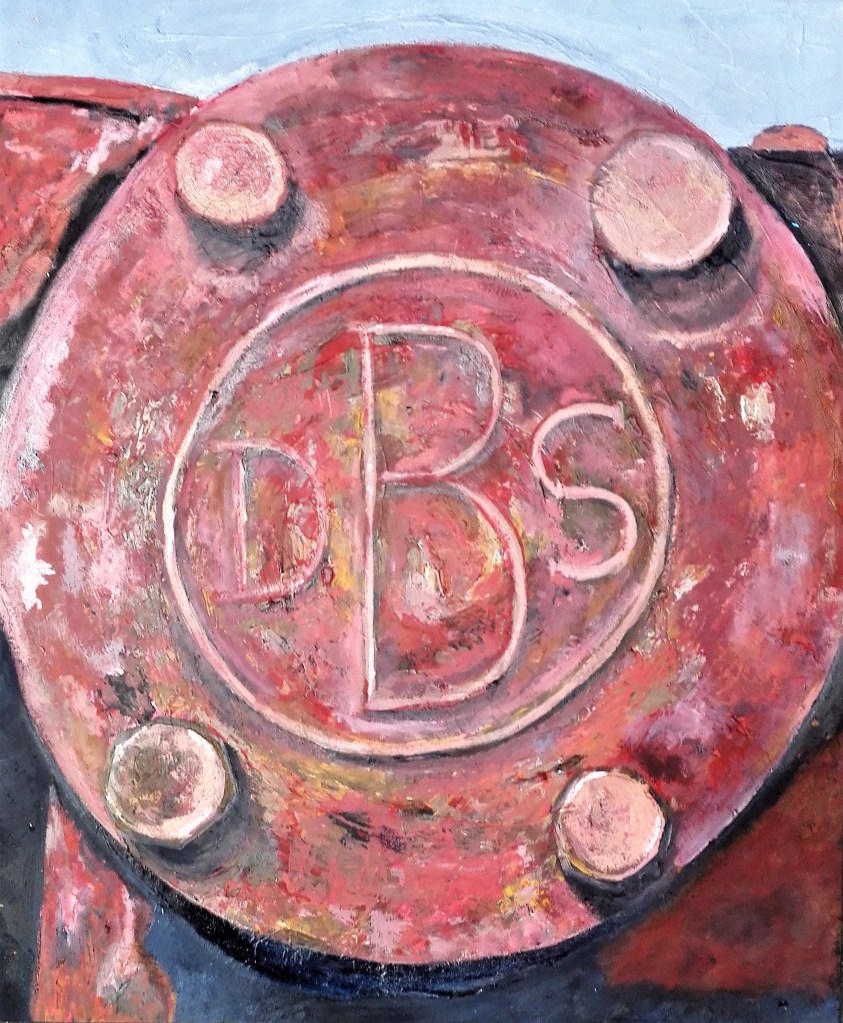
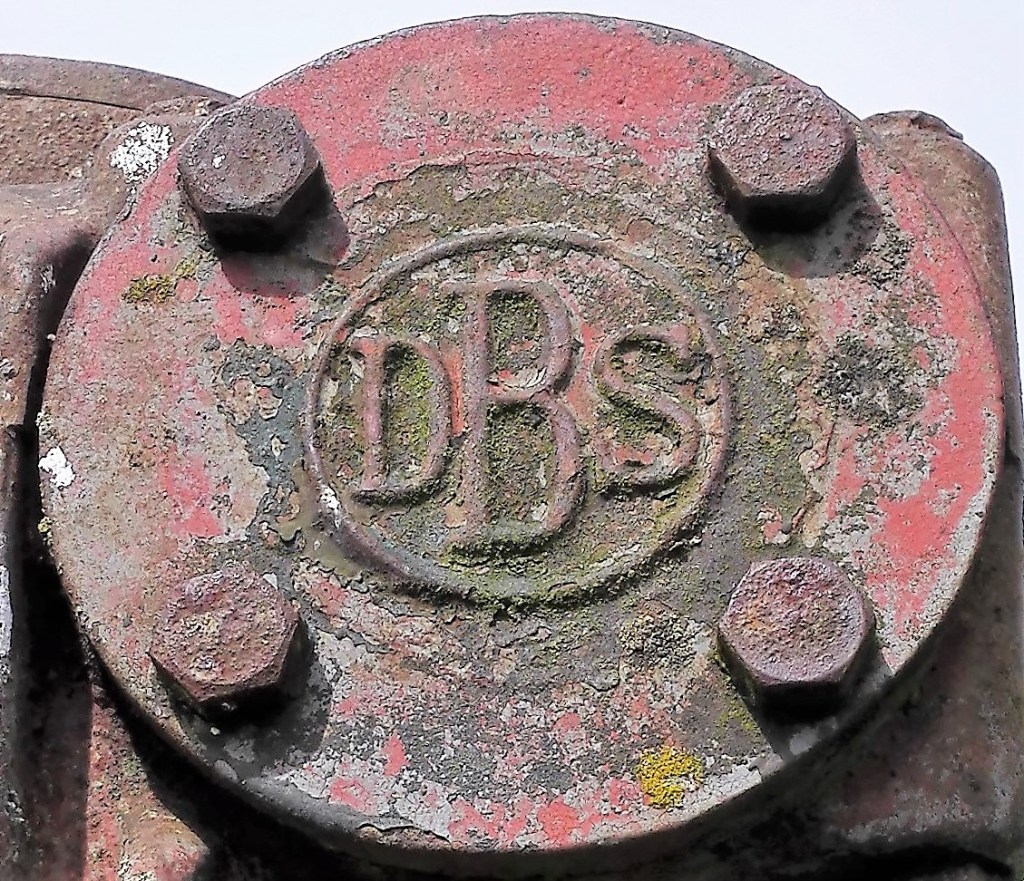
For this painting I return to the old pump and this time focused on a close-up of the name plate. I was drawn to this image for two reasons. The dulled red colours, obviously faded by years of sunlight, and how they contrasted and complimented the brown rust and dark shadows. The composition was rather obvious being a circular in a rectangle. I felt that it worked. For the first time in this series I would introduce Aqua oils to the painting mediums. The underpainting was in acrylics as these adhere well to the acetate support and provide an excellent surface to apply the Aqua oil to.
I took a few photographs of the work in progress, below.
Work in progress
The painting is reproduced below in two formats. The first is photographed against a normal background and the second is against glass which allows some light to pass through.
Pump Plate – Normal background
Pump plate – Against glass (backlight)
I enjoy the contrasting ways of displaying or hanging the painting and the varied impact that it has on the painting. When backlit the whole painting appears darker. The light which permeates the thinner areas of painting becomes where the eye is initially drawn to. Whereas the whole painting is lighter when the light from behind is not present. This is the truer reflection of the subject.
I have now completed four paintings that have used the old pump as the subject matter. They are coming together as a series of works that have a common theme and feel to them. My focus has moved from the original focus of derelict or dilapidated buildings. I will now try to incorporate the feel of the old pump paintings into some building paintings and look to move these to another level.
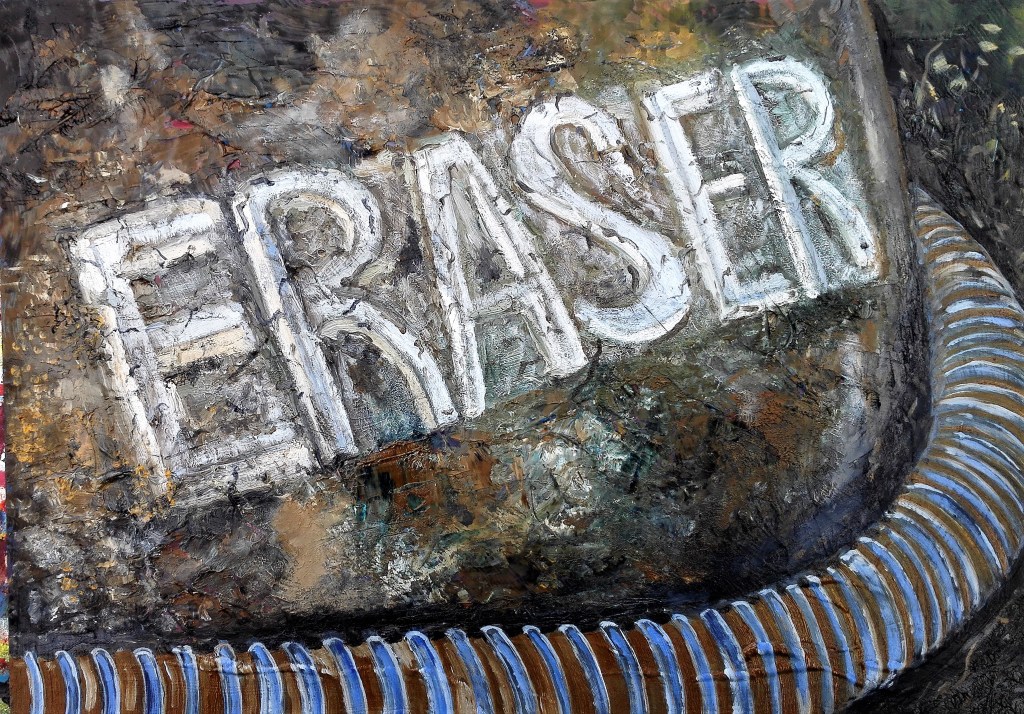
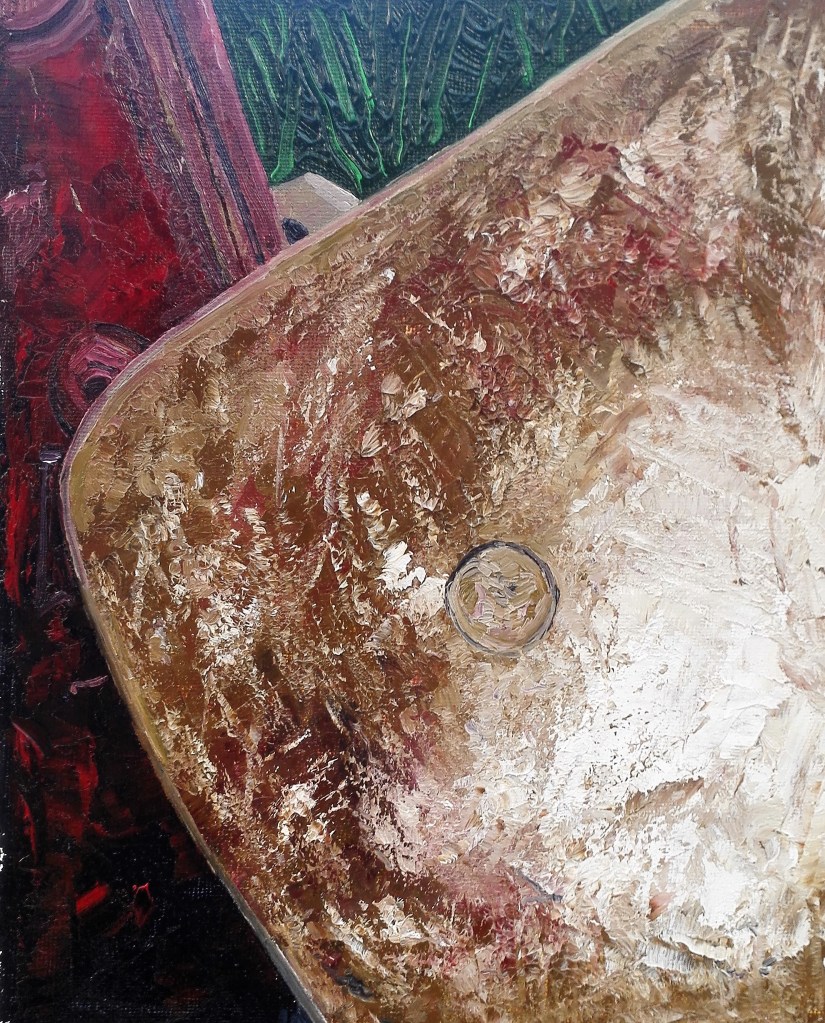
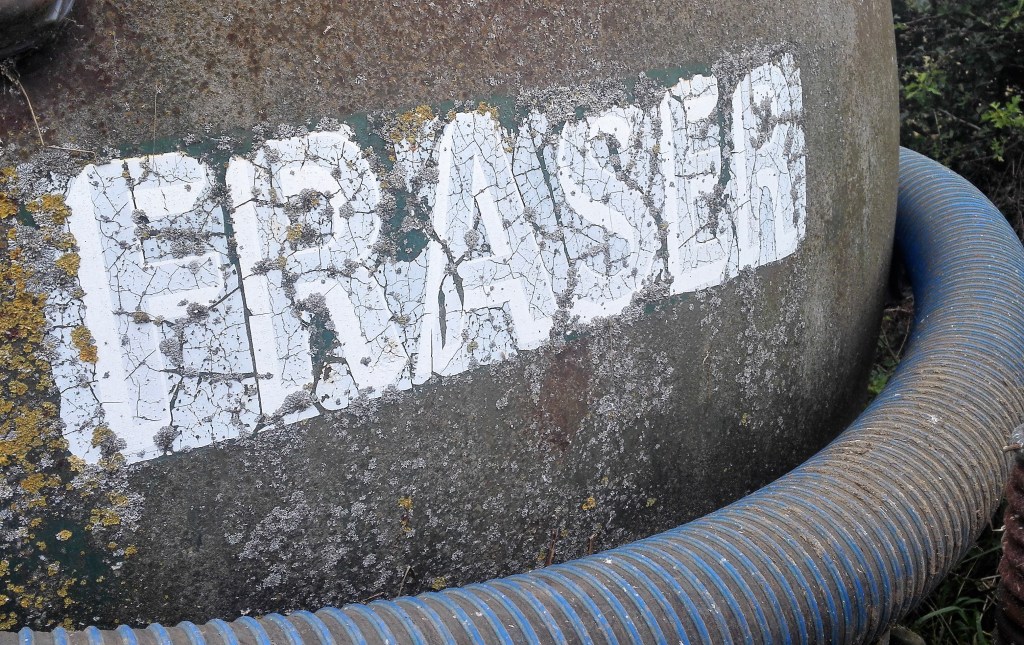
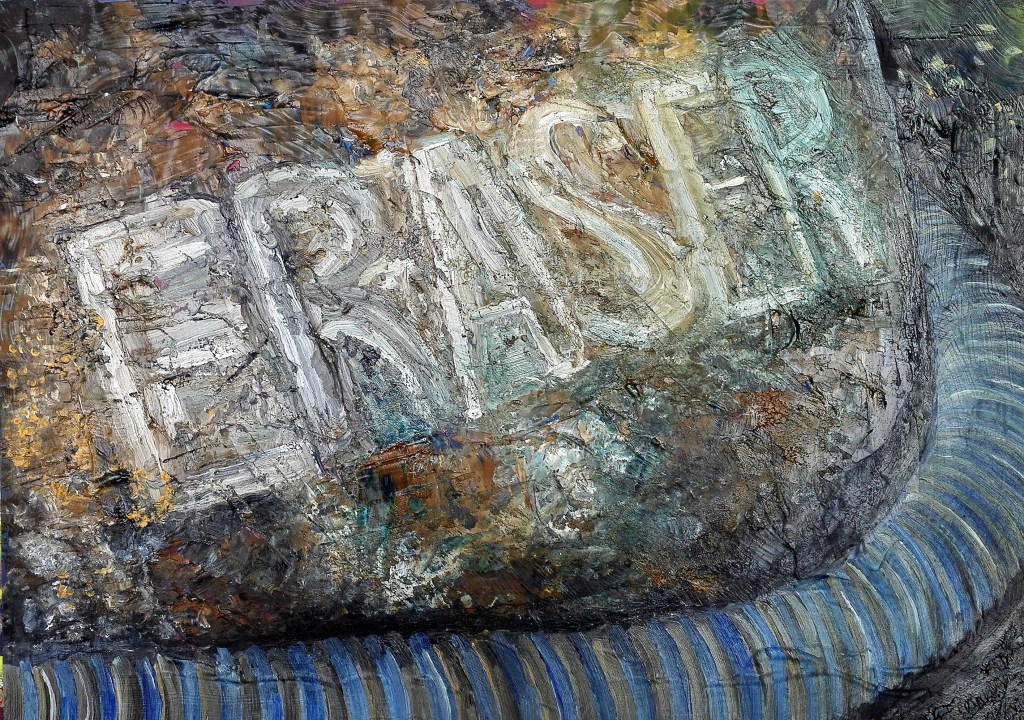
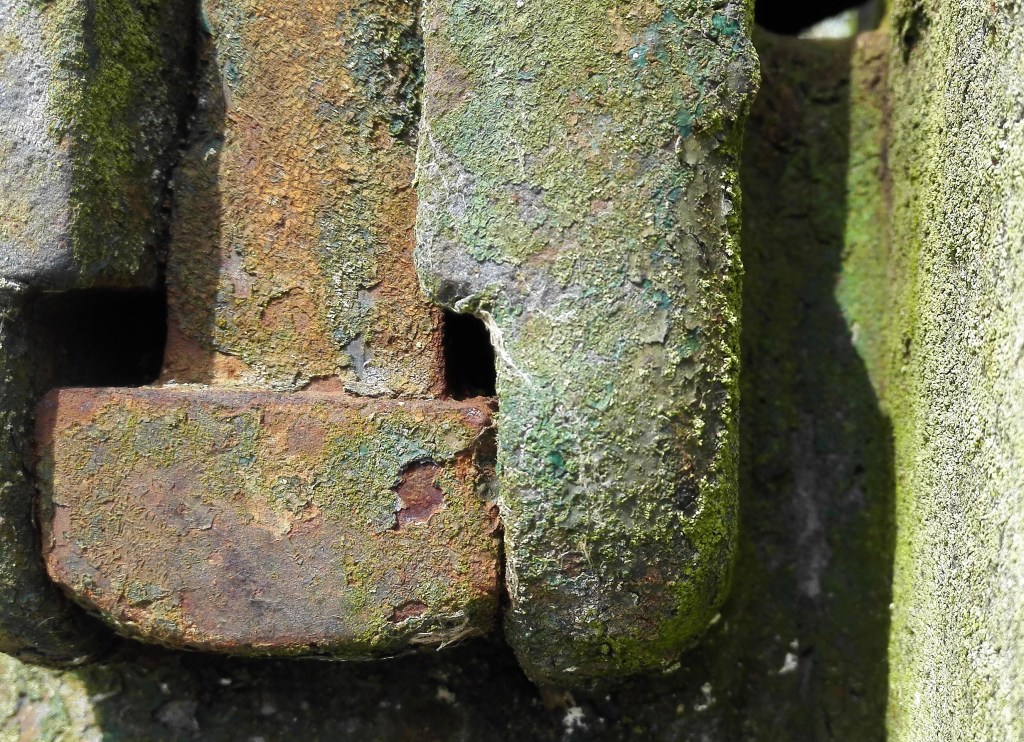
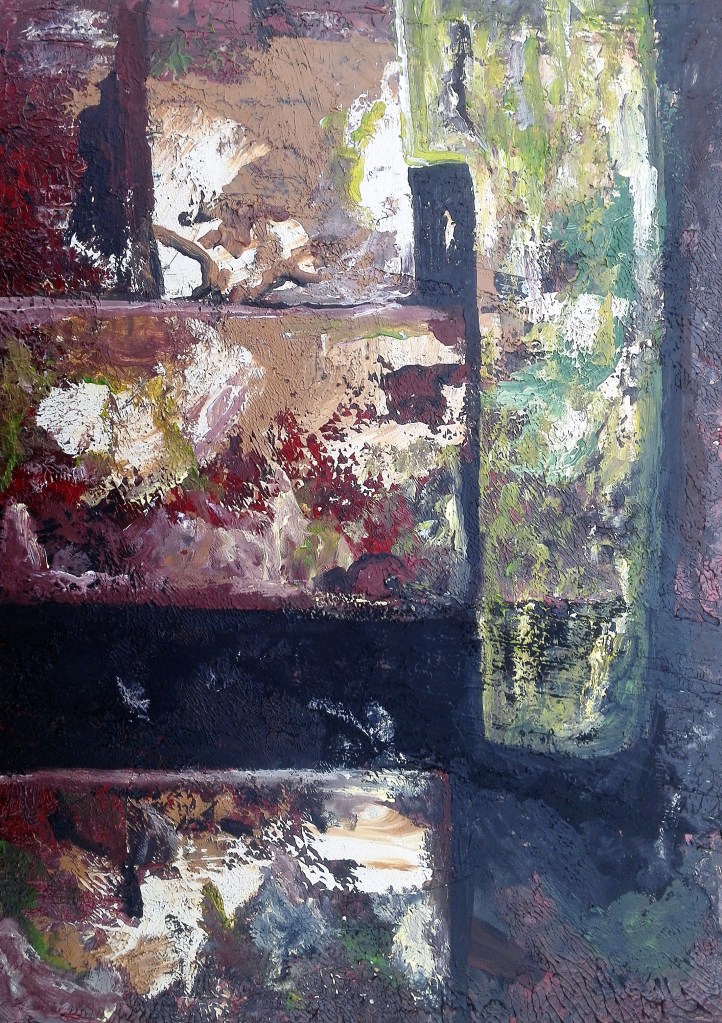
Additional painting completed 26th August 2020. Further to the above I completed another painting for this series of exploratory works. As previously the painting used a 21 x 29.5 acetate as the support and was painted using Aqua oils. Working from detailed section of a photograph taken during a recent trip to North Yorkshire the painting was built up in three distinct layers. A rough underpainting to get basic colour and paint onto the support, an intermediate stage and a final detail / refinement stage.
Below is the photograph, the second stage and the finished painting.
The photograph
Work in progress
Finished painting – Eraser
This is a good addition to this growing project. The techniques used in these paintings is developing in a way that pleases me. The subject matter is hidden, not obvious. To me, this is not the point of the paintings which are more about uncovering the textures, colours and tones and presenting them in a way that is pleasing to look at. At stated before I shall now look to scale up these works.
It hasn’t escaped my notice that Part 5 of the course is titled working with words and the the last two paintings have included words and letters in them.
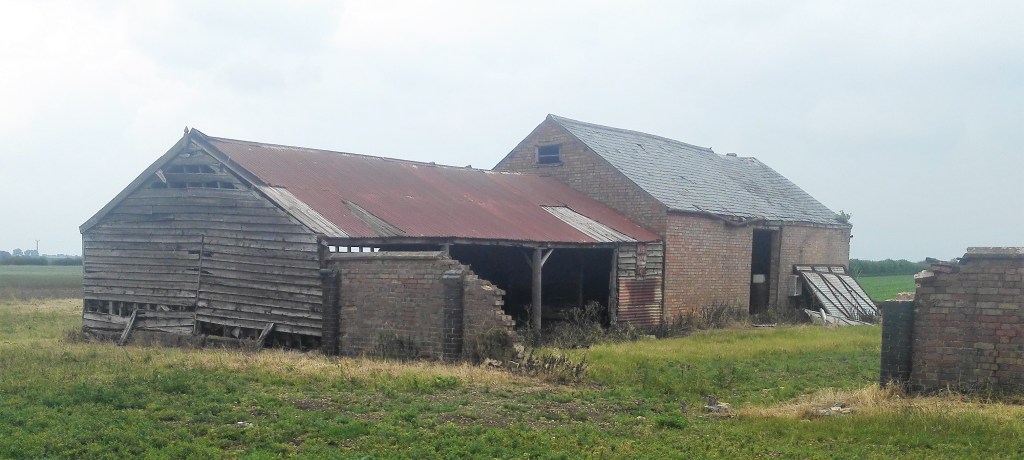
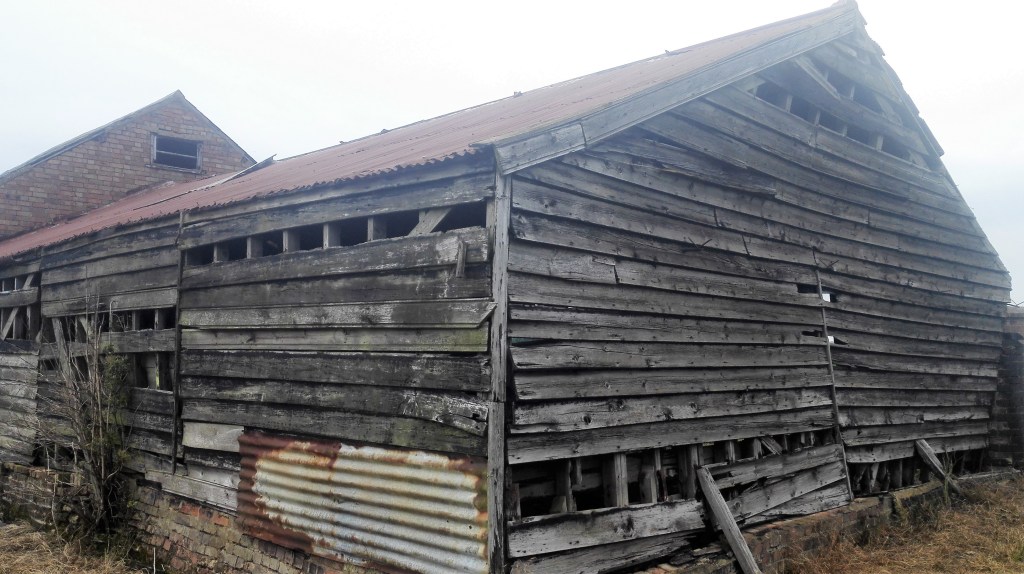
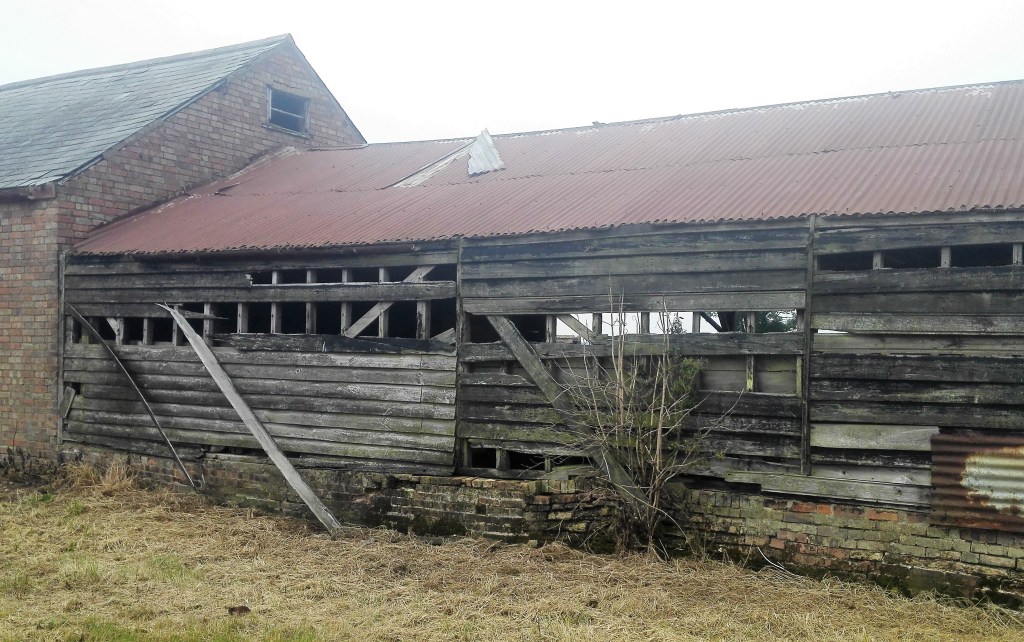
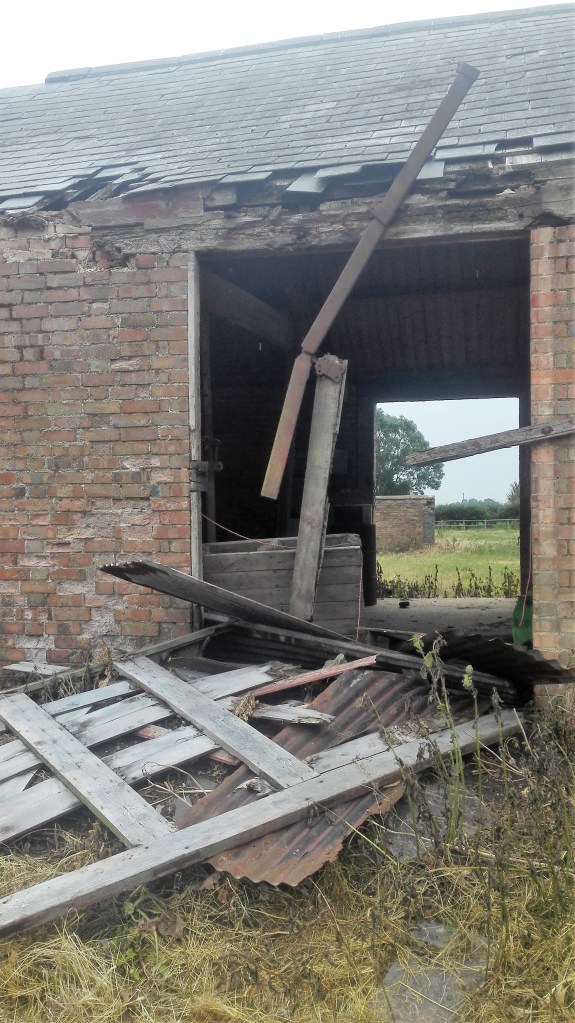
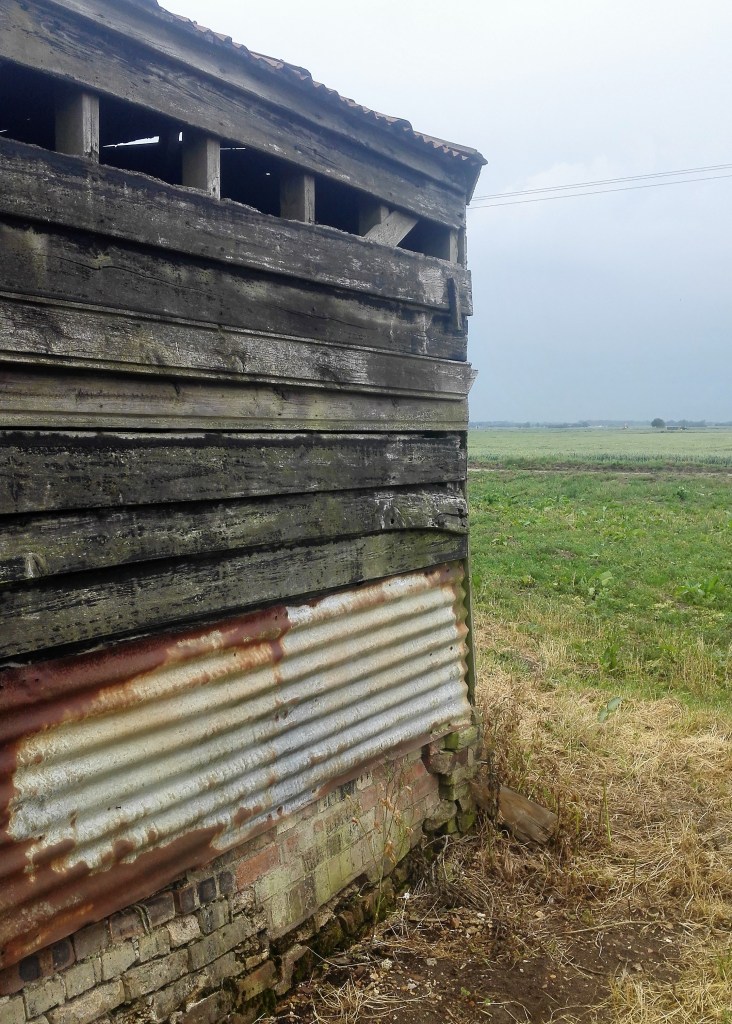
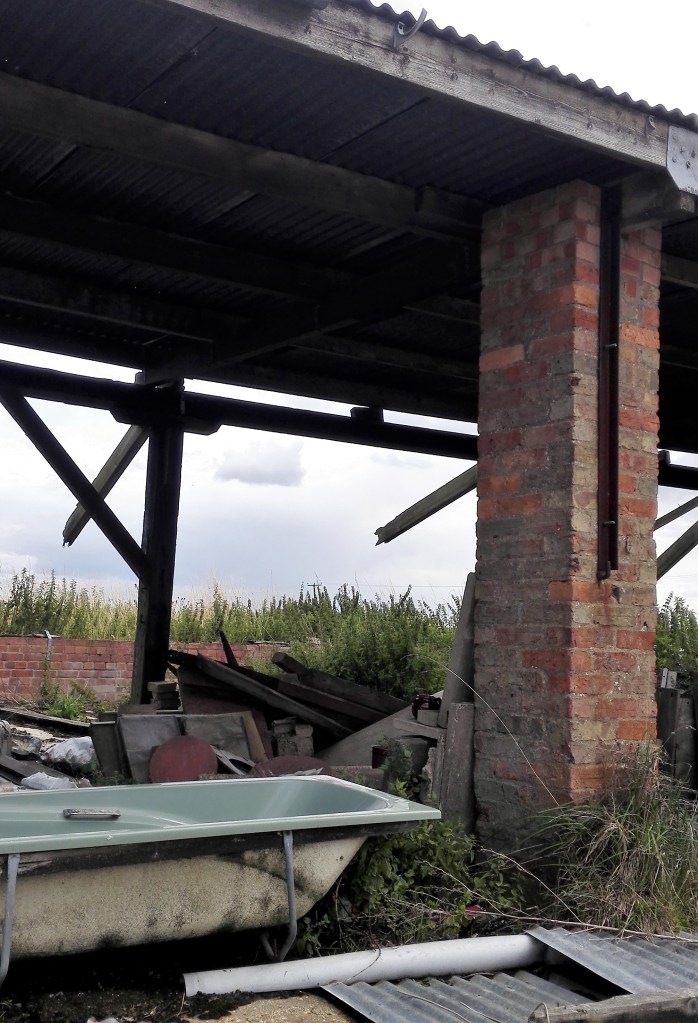
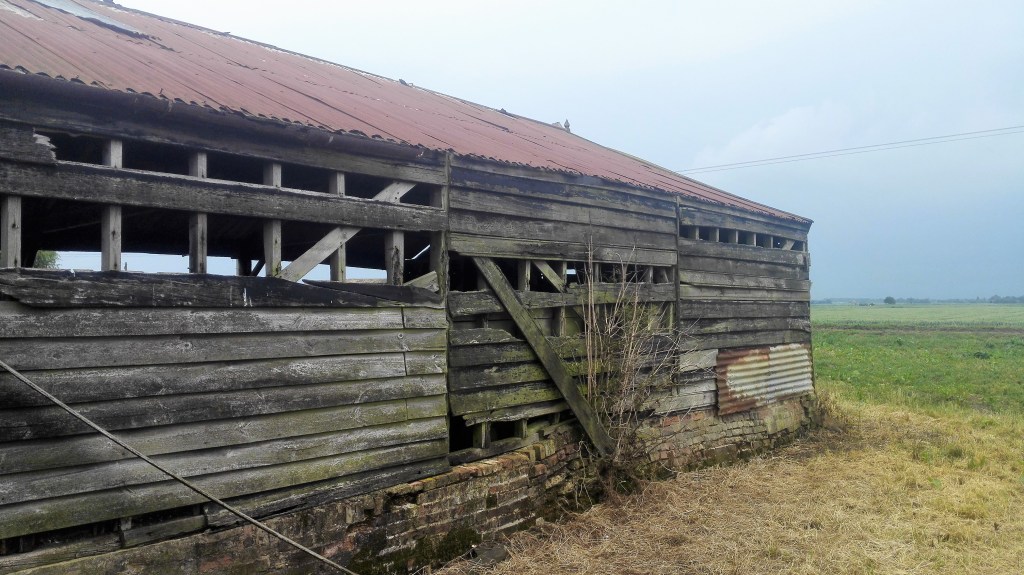
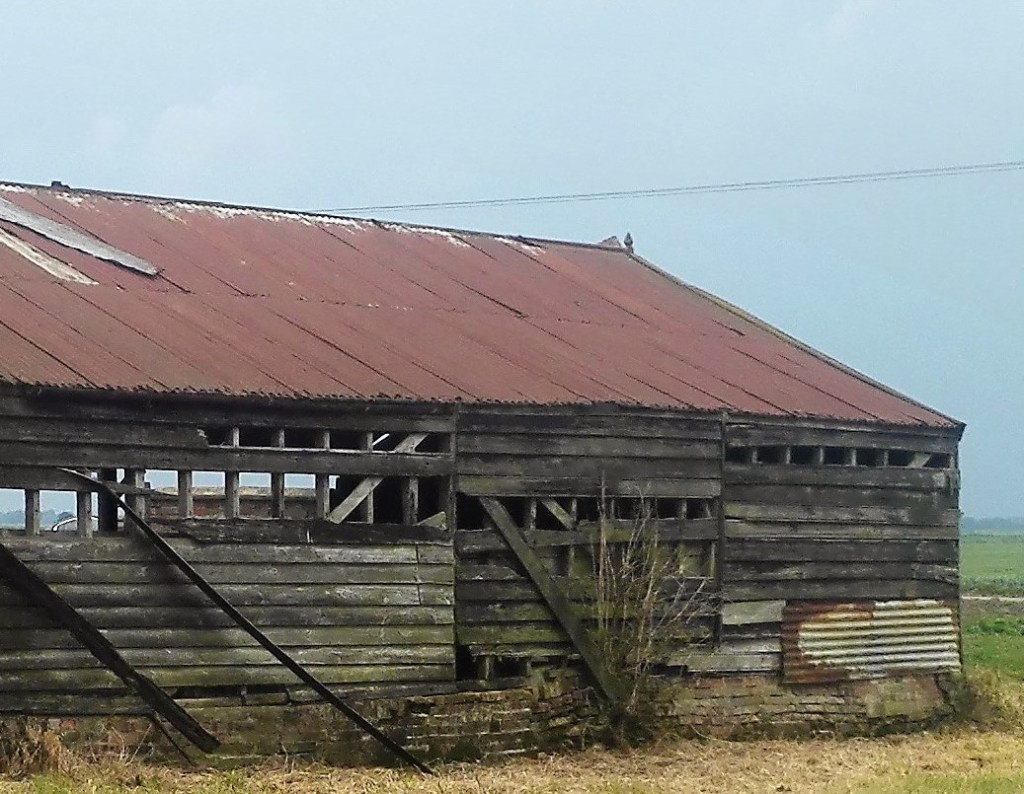
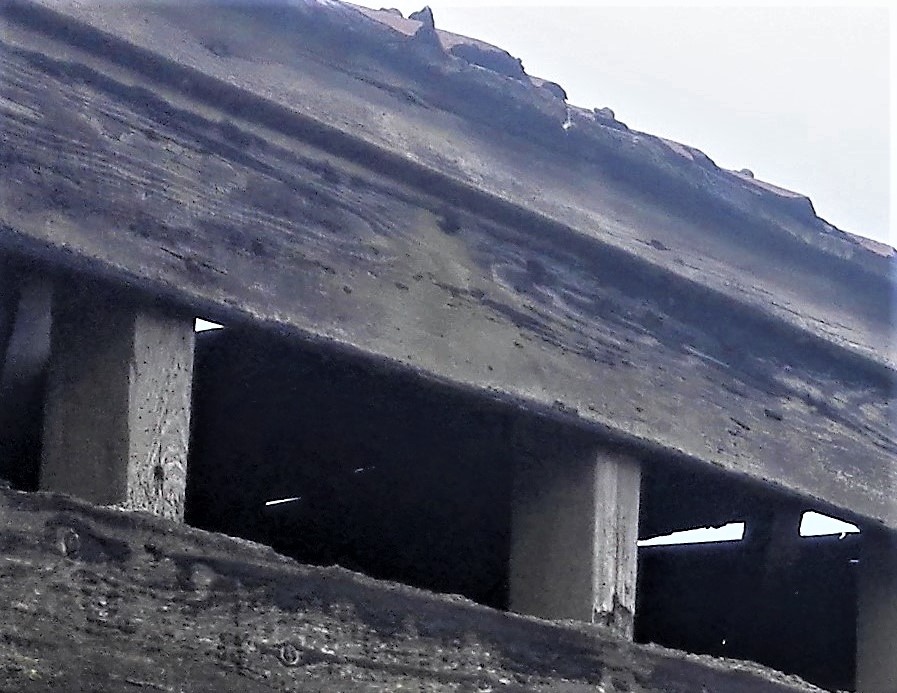
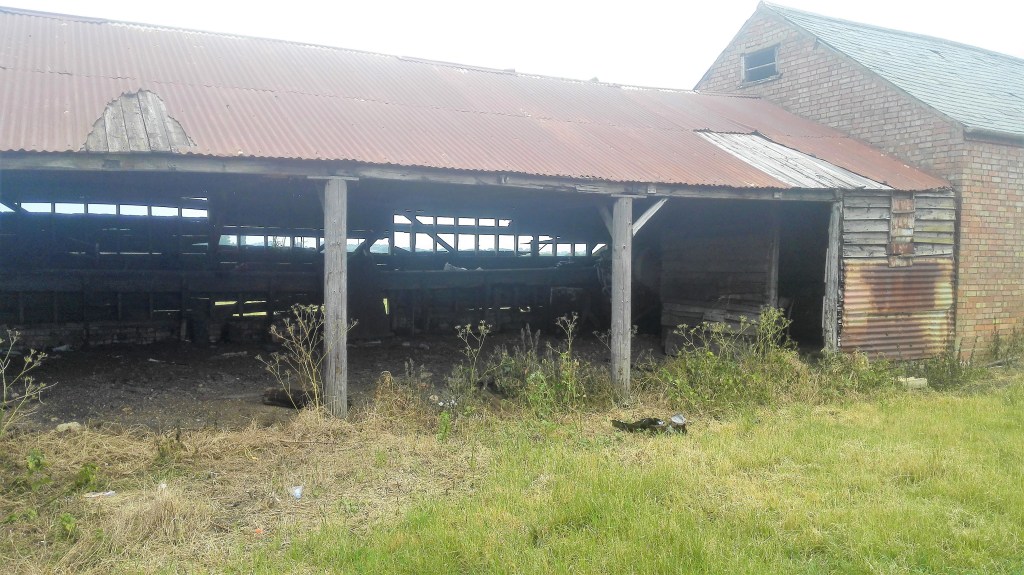
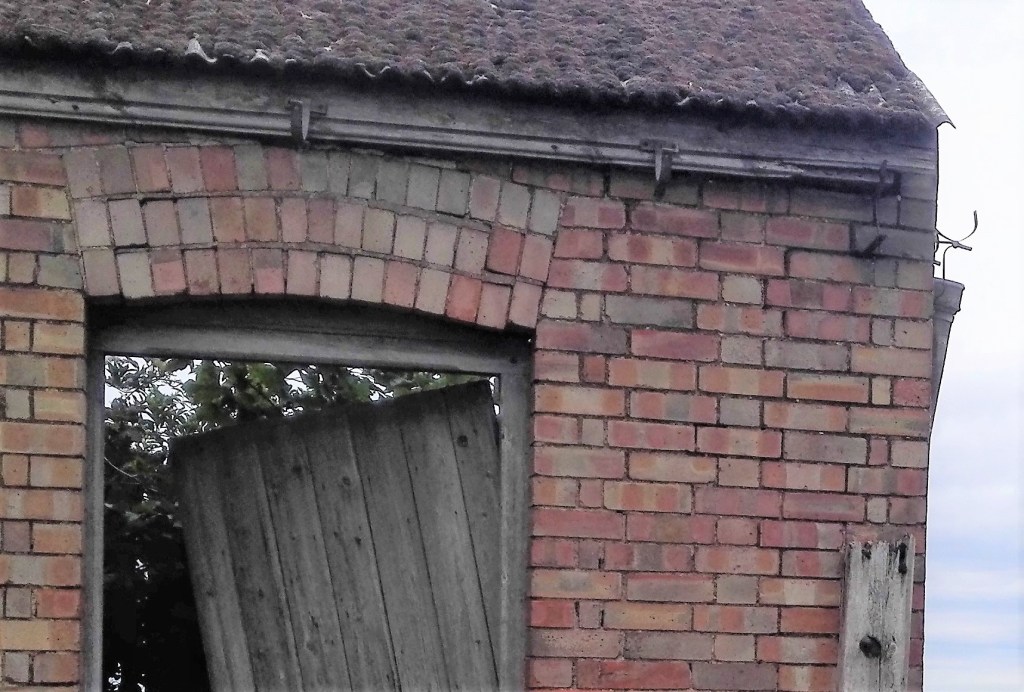
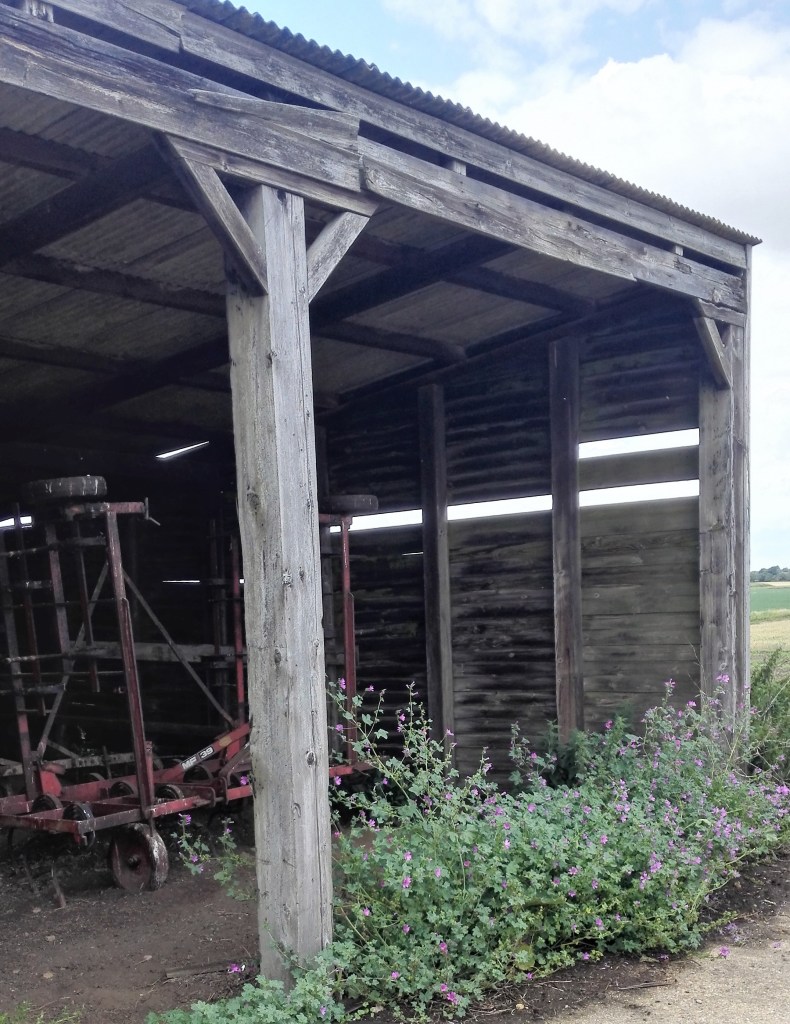
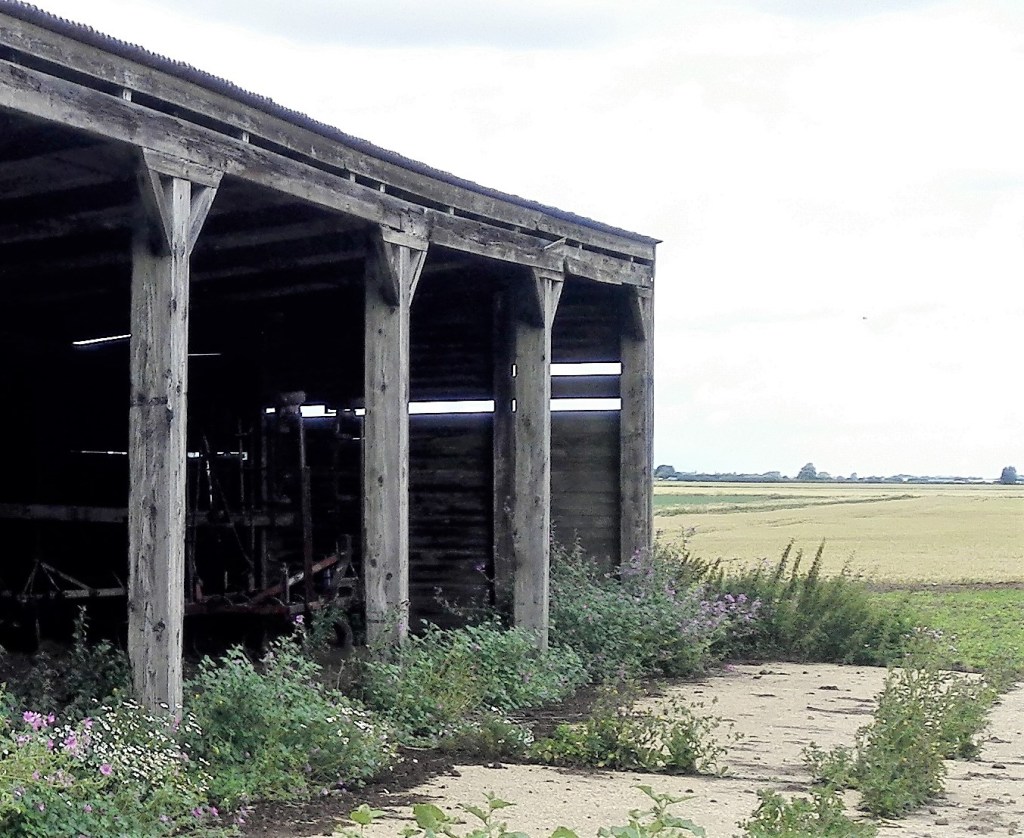
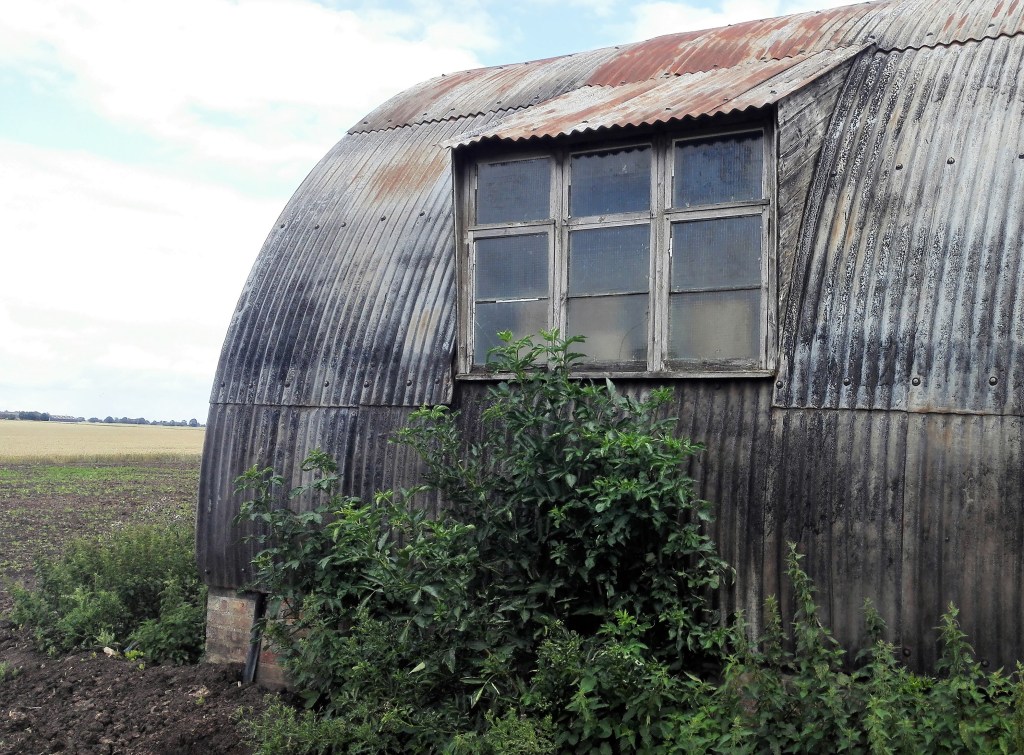
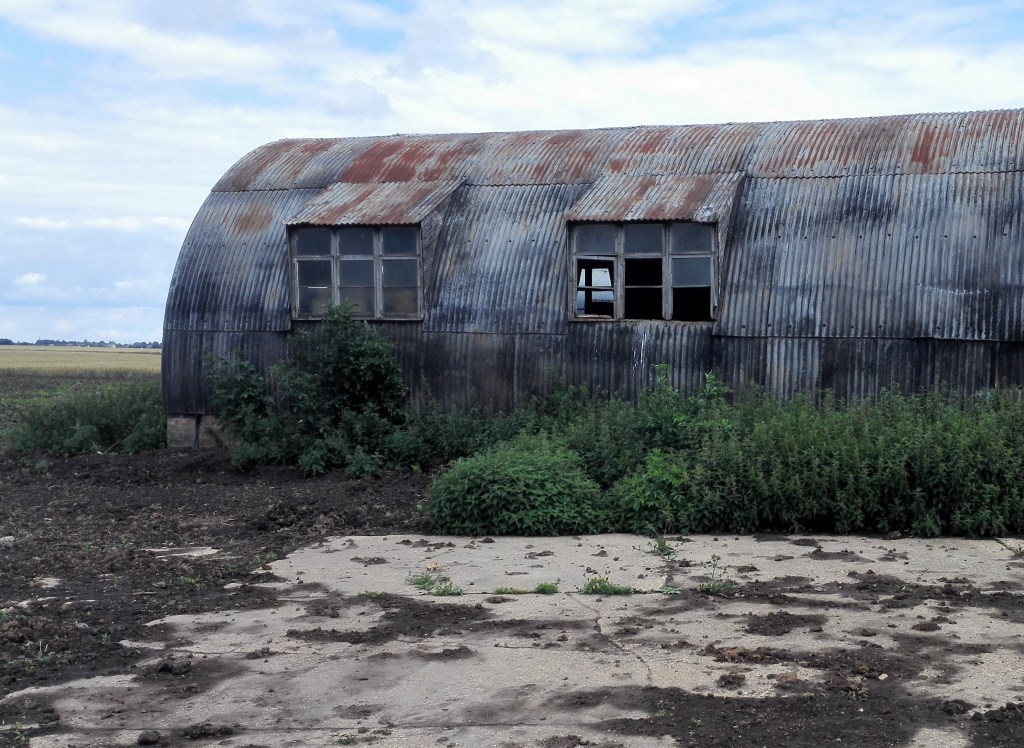
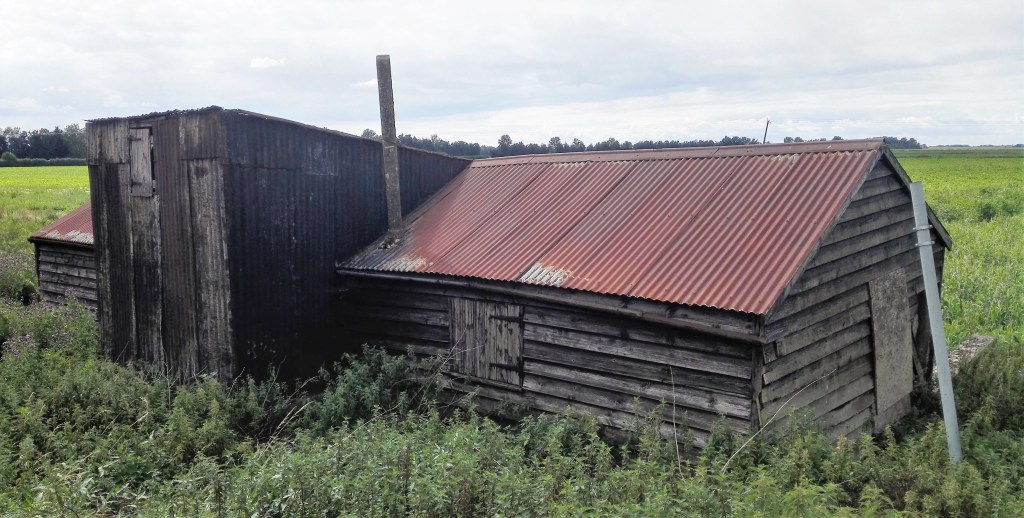
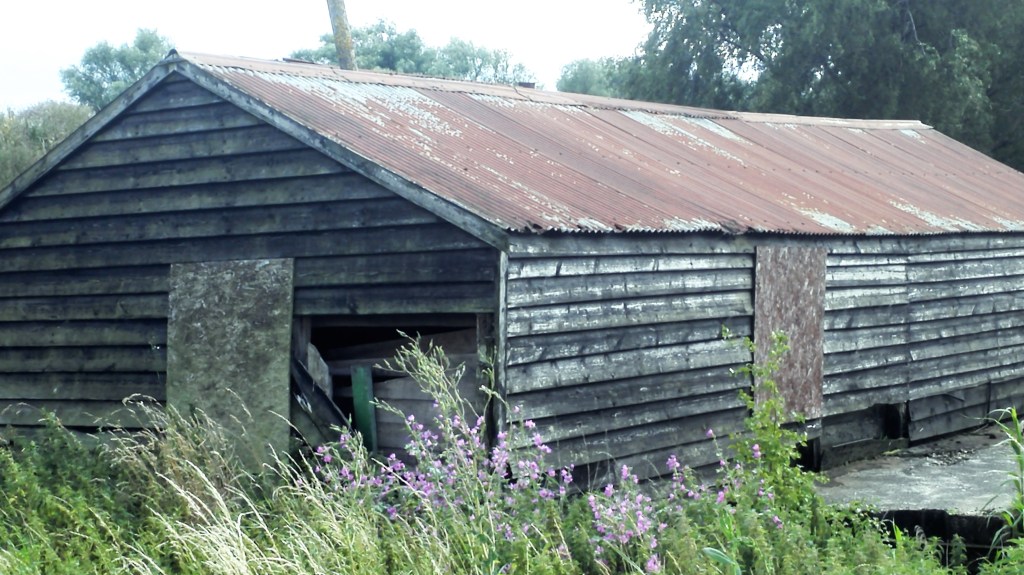
Having discussed my idea for potential topics for my Parallel project, during my Part Three assignment review, it was time for these ideas to be put into my blog. It had always been my intention to use the Fenland landscape in some form as the subject matter. My quandary was how to represent it in a series of paintings in which I could focus in and make connections between the paintings. My idea was to look at abandoned, decaying and delipidated farm buildings. These would become the subject matter. The next step was to try and look at ways of representing these buildings in a way that emphasises the passing of time, the loss of purpose, the neglect and at the same time making the paintings interesting to look at.
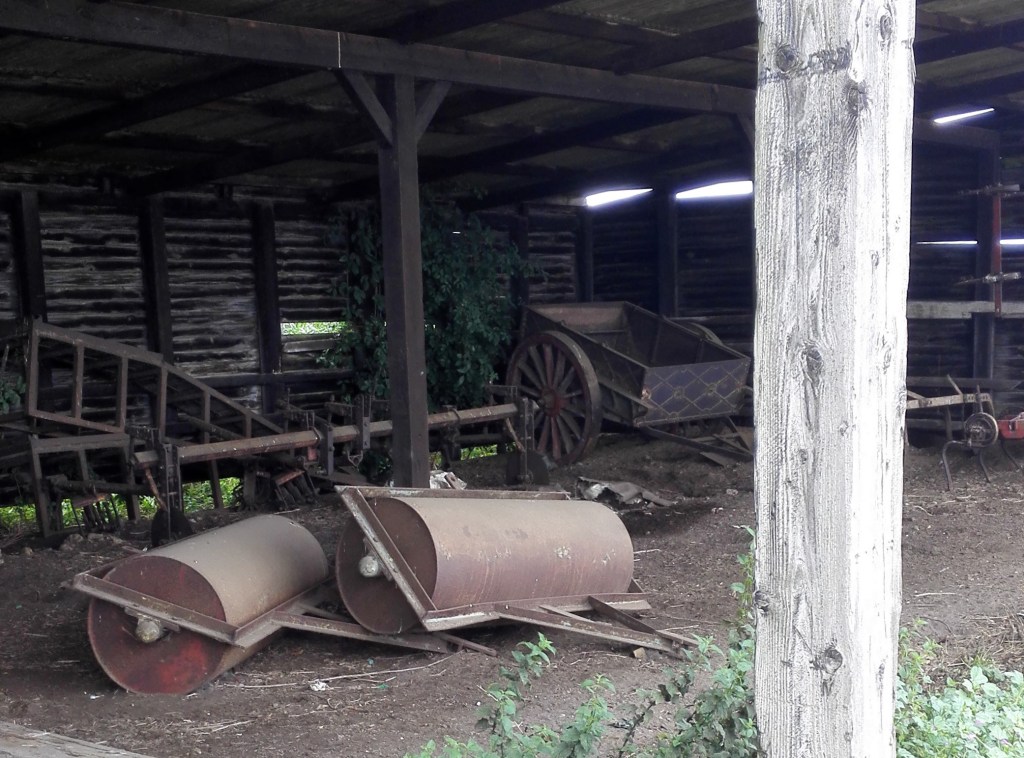
My starting point was to travel around my local habitat and take photographs of these buildings. I would try to up close and personal. Look for unusual angles, colours and tone but at the same time try to retain a sense of place. The atmosphere and the recreation of it would, I felt, be a key ingredient in making a successful set of paintings.
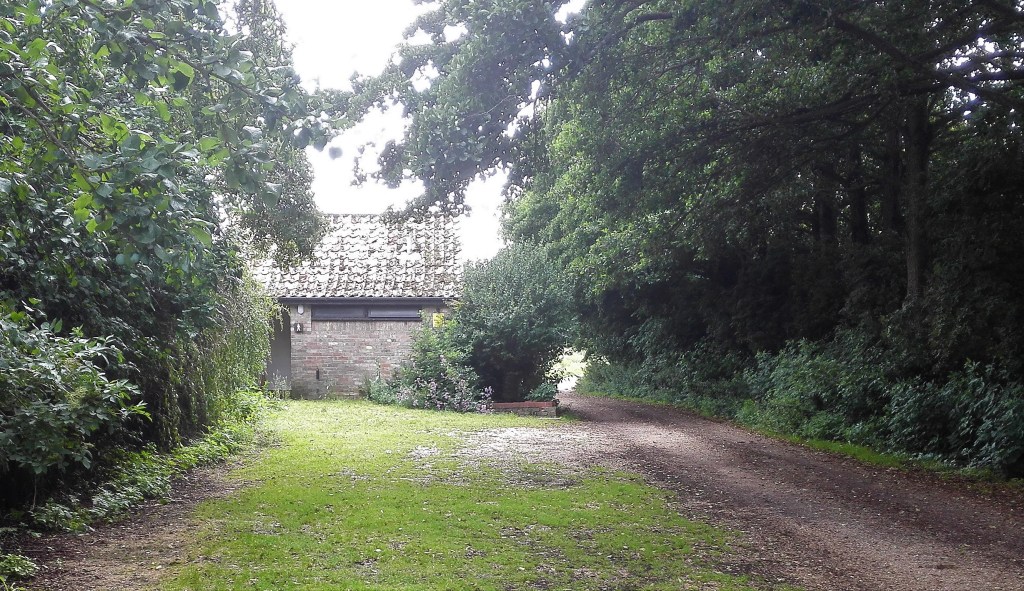
Below is a selection of photographs that I have collected together so far.
40 photographs
These photographs and others would be edited, some of the above already have been, to look for exciting things to paint which also fit with the project goals.
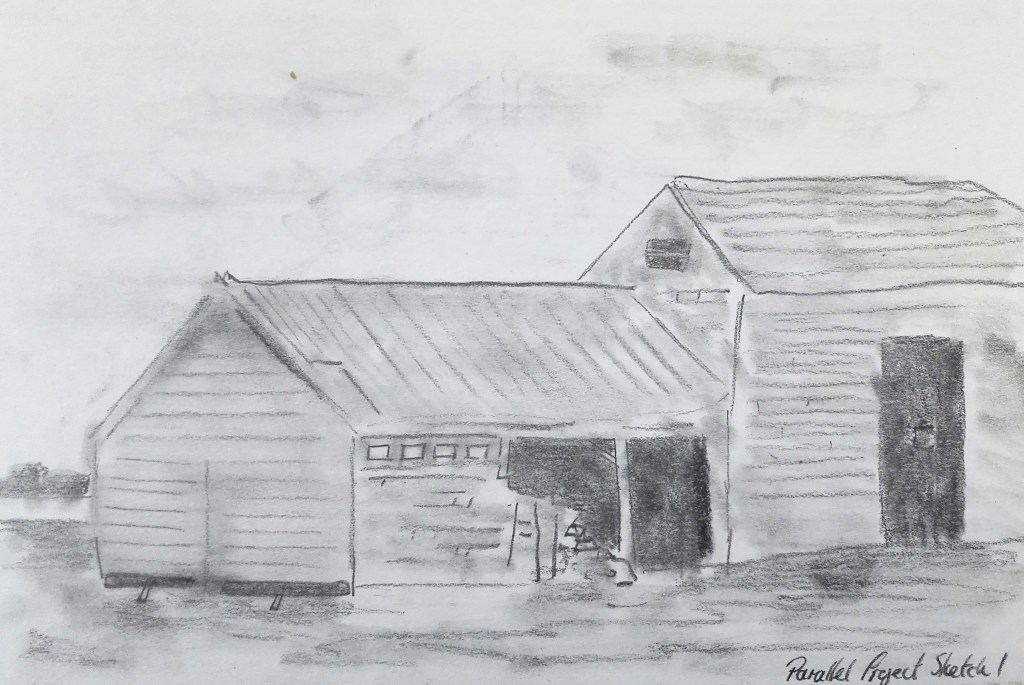
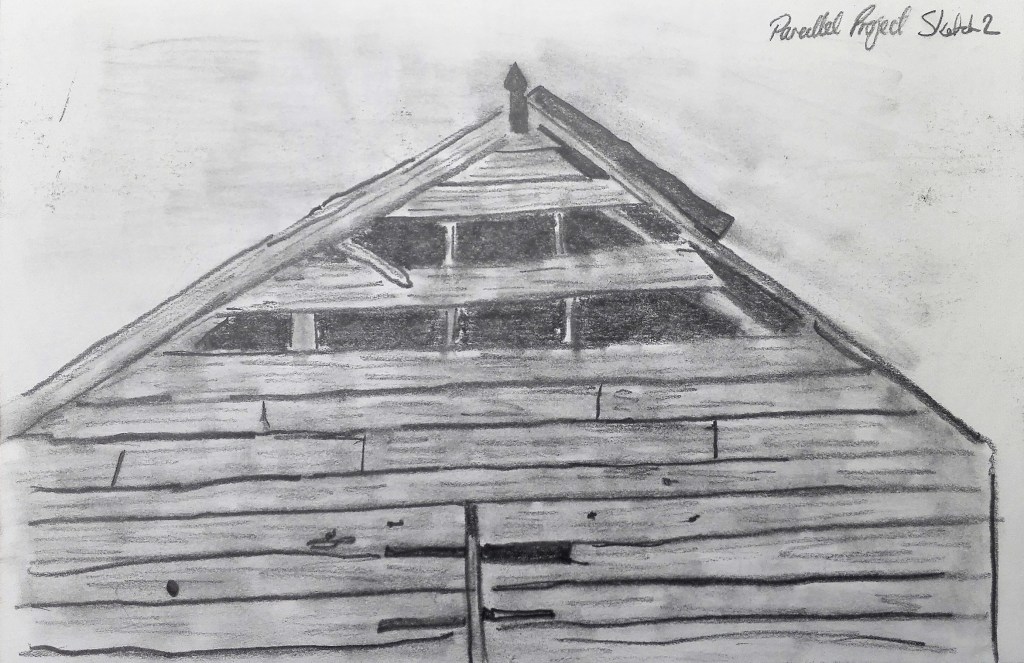
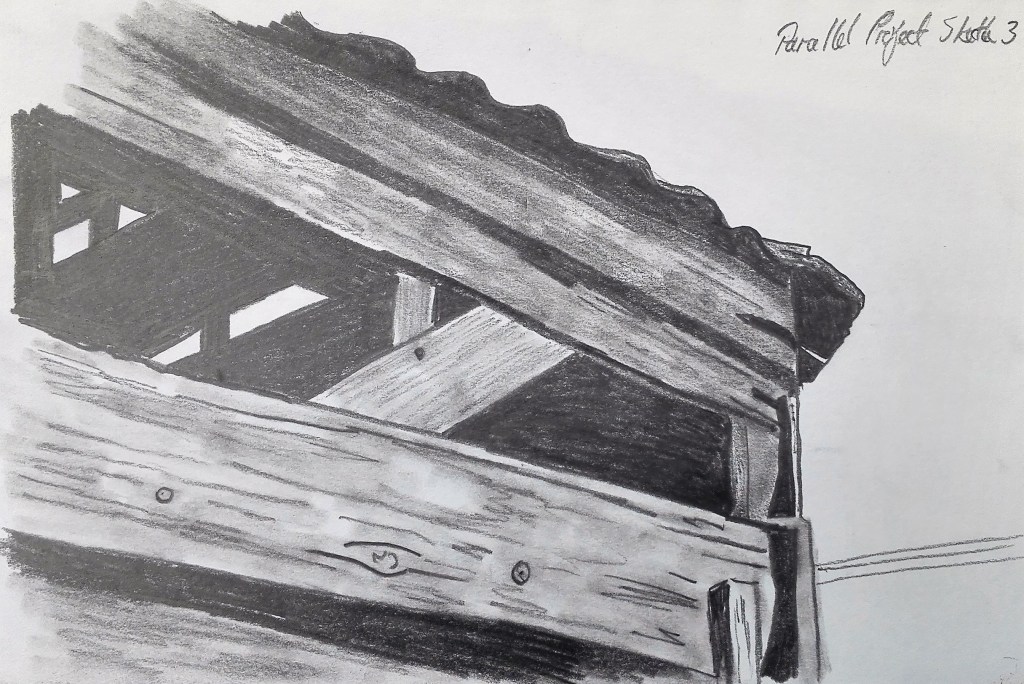
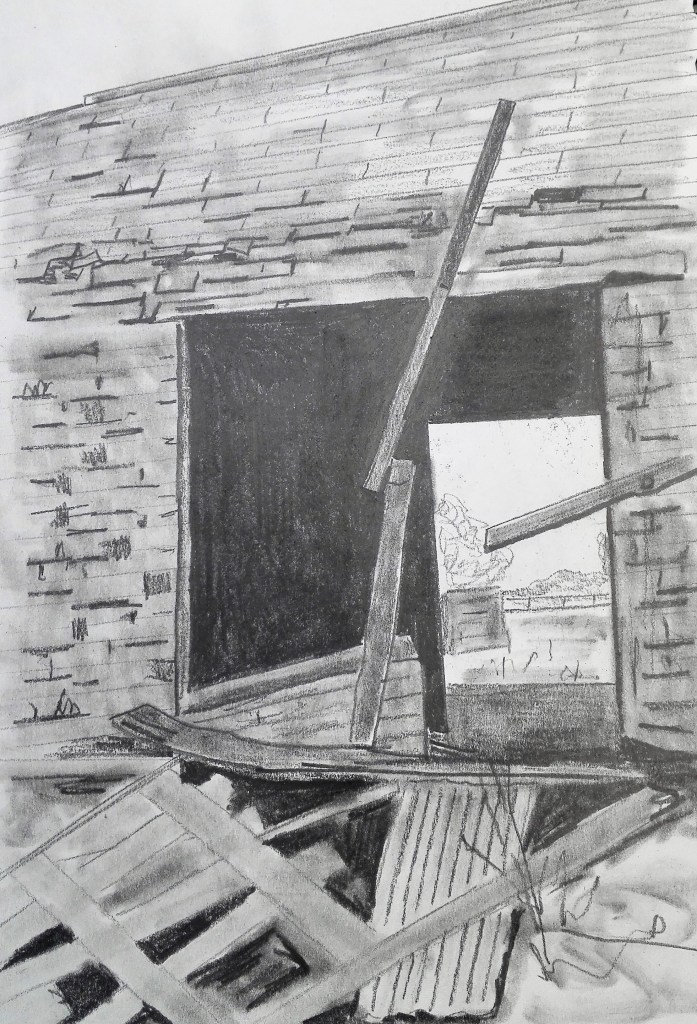
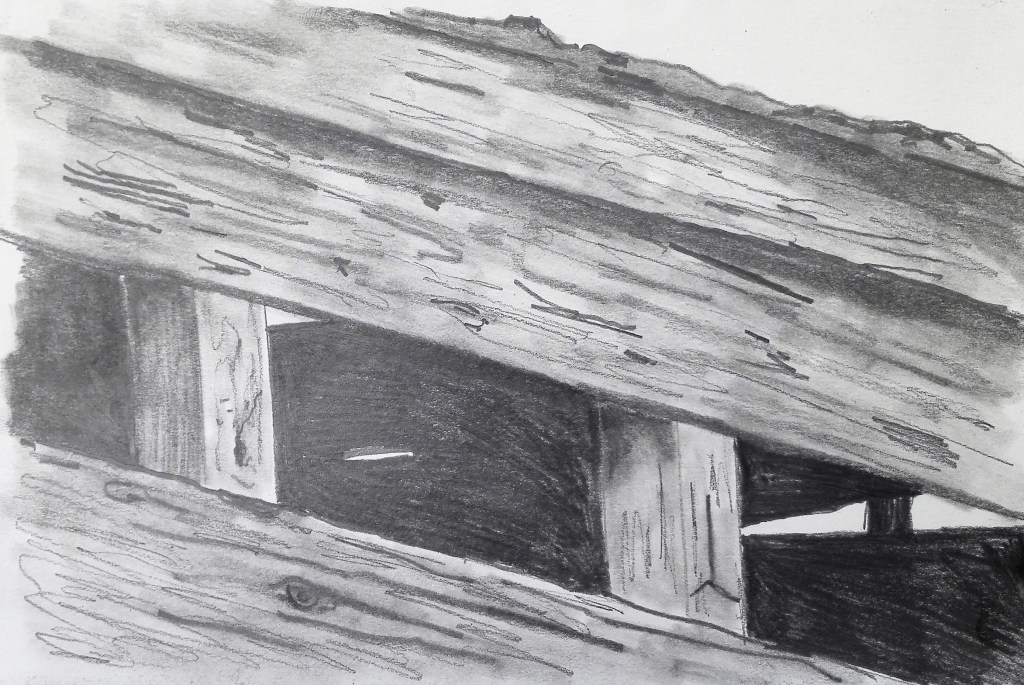
I looked to start my explorations by making an initial set of six sketches. Using what making these sketches told me about the subject I would then look to paint a first study.
Initial 6 sketches
The best sketch from this initial batch is number 5. I would bear this one in mind for a future painting. For now I would look focus on aspects of sketches 3 and 6 but would expand the view.
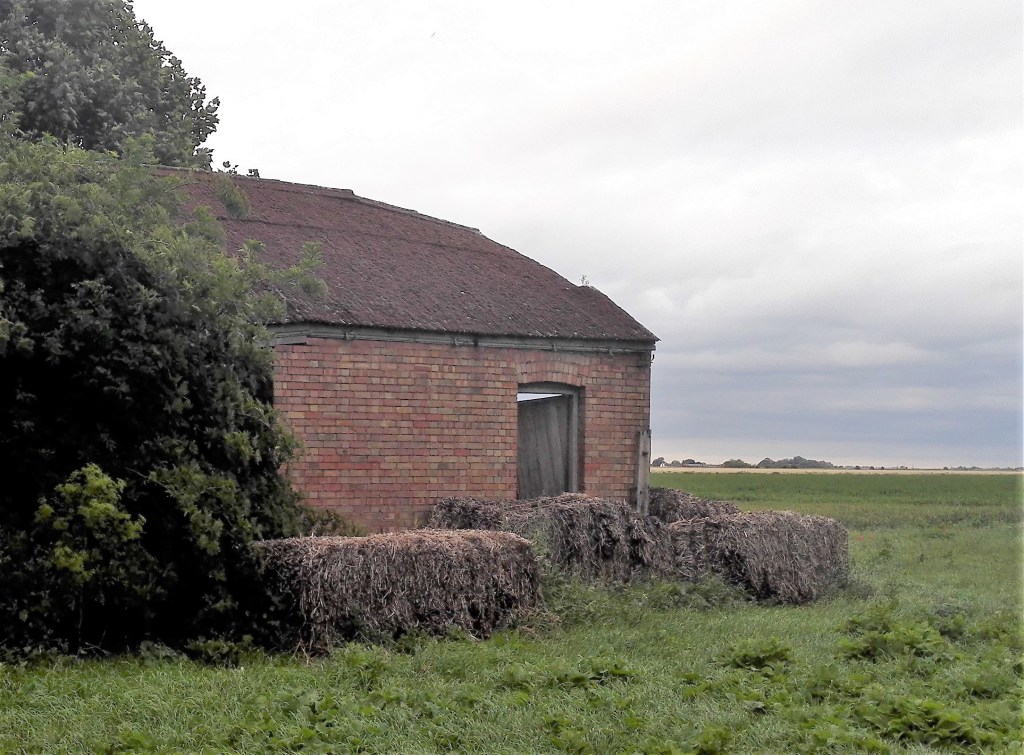
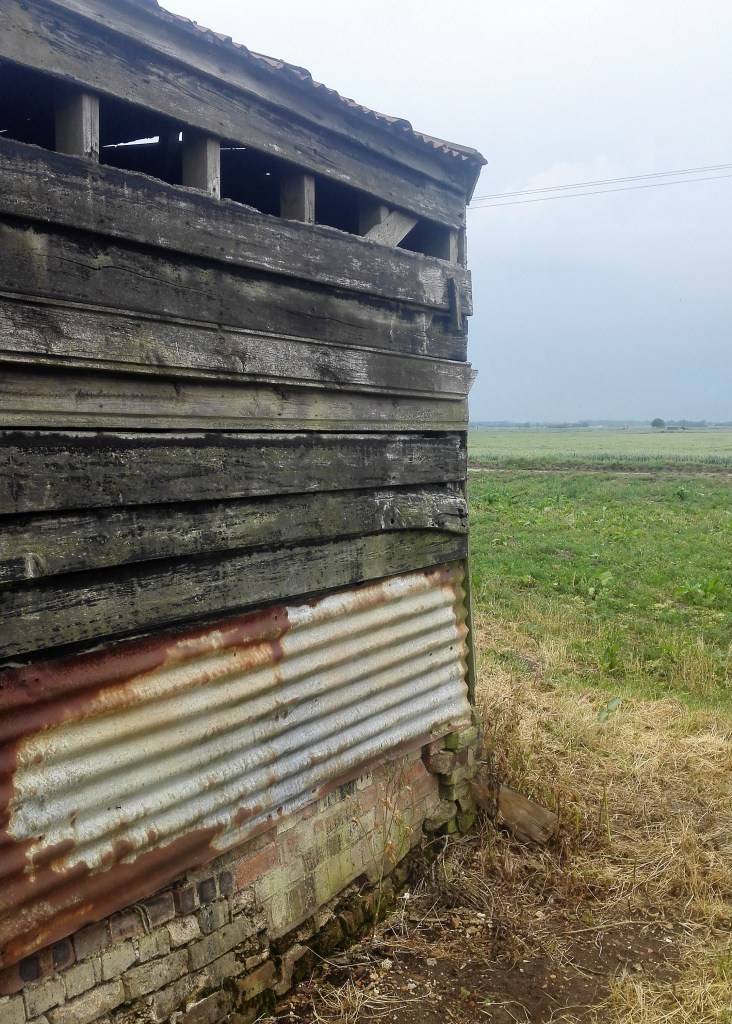
The photograph that suggested itself for this study was this one. The interest would be provided by the varied construction materials, brick, corrugated iron and wood panels. The view into the distance providing aerial perspective.
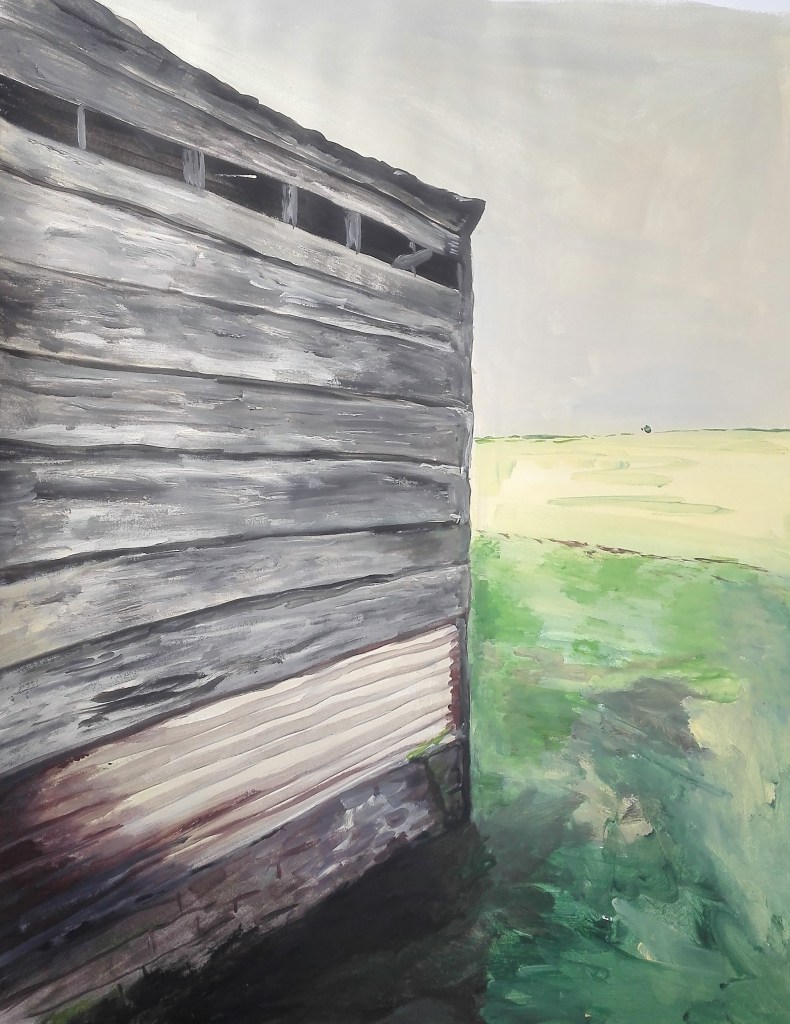
A quick colour study was painted prior to commencing work on the actual painting.
Colour study – Acrylic on light cardboard, 59 x 40 cm
I followed this by completing a more thorough study. The resultant painting is shown below.
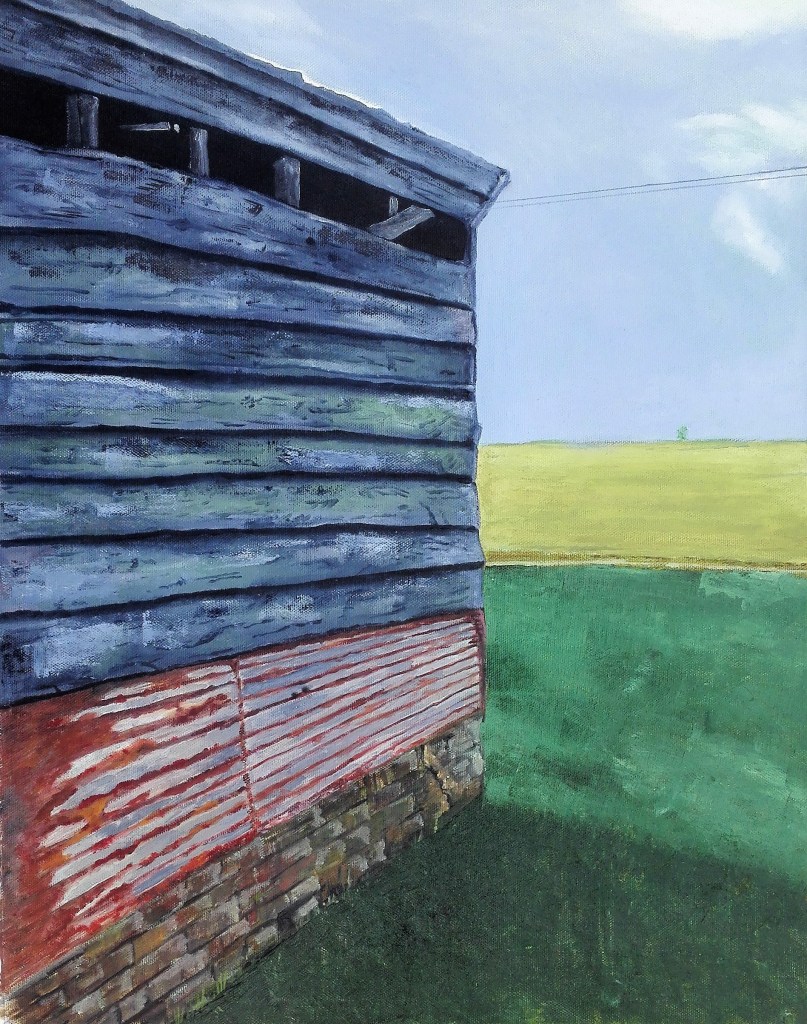
Derelict Out-building
My thoughts having completed the painting and hung it near to where I paint and study is that it is a competent painting. I have successfully captured a pictorial representation of the scene from the photograph. There are some small issues with perspective particularly with the wall at the bottom of the building but this is not what I find disappointing with the work. The painting says nothing about where it is or what it felt like to be there. It lacks a sense of place. Part of the issue, I feel, is to do with the composition which is too contrived. In looking for an interesting angle, zooming in, and obscuring much of the landscape the sense of the buildings place in the landscape is lost. Alternatively I could have gone further in and dispensed with the landscape altogether. In doing this I could have focused upon the nature of the deterioration itself. The painting is stuck somewhere between these two alternatives and suffers by not being one thing or another. Additionally the application of paint is very controlled and inexpressive. Whilst this conveys the scene it doesn’t add to it. It lacks any sense of feeling.
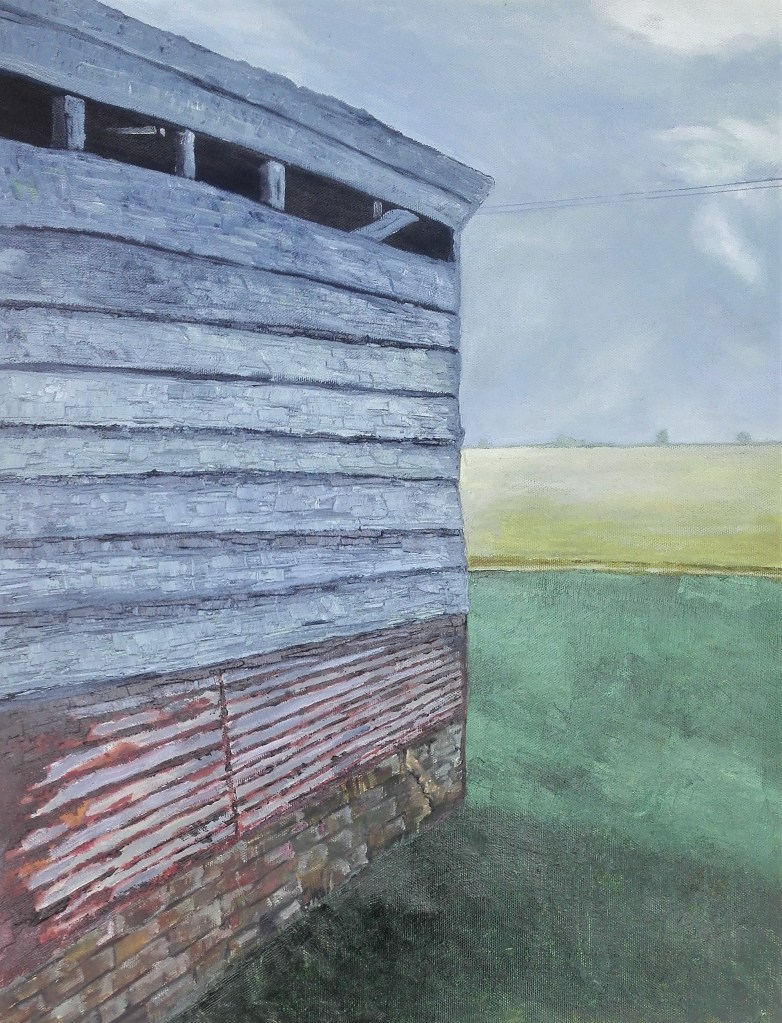
Post script 11/8/2020, I returned to this painting and reworked it. Not dramatically but enough so that I feel more comfortable with the result. It still lacks any sense of drama. It doesn’t tell of the state of the building but I now feel that it is located in the landscape. It sits more naturally against the fields which I have toned down and enhanced the aerial landscape perspective.
Derelict Out-building (Reworked)
The positive learning that I gained from this initial study is that I need to be bolder in my choice of composition. A good photograph is often not a good choice for a painting as everything about the scene has already been captured and there is not much more to be said or communicated. I also need to be bolder in how I apply paint. This I have done in much of my experimental work. I now need to try to incorporate these experiments and techniques into my compositional paintings. I expect that there will be an element of trial and error in this process but I must embrace this to enable myself to break through this barrier.
I had occasionally worked on A4 size acetates during the course and had found that these were a good support on which to smear paint. In doing this it created fascinating colour mixes, gradations of tone, layers and texture. The next step would be to use this as a foundation to for a more considered painting. To move it back from abstraction by adding form whilst maintaining the random elements.
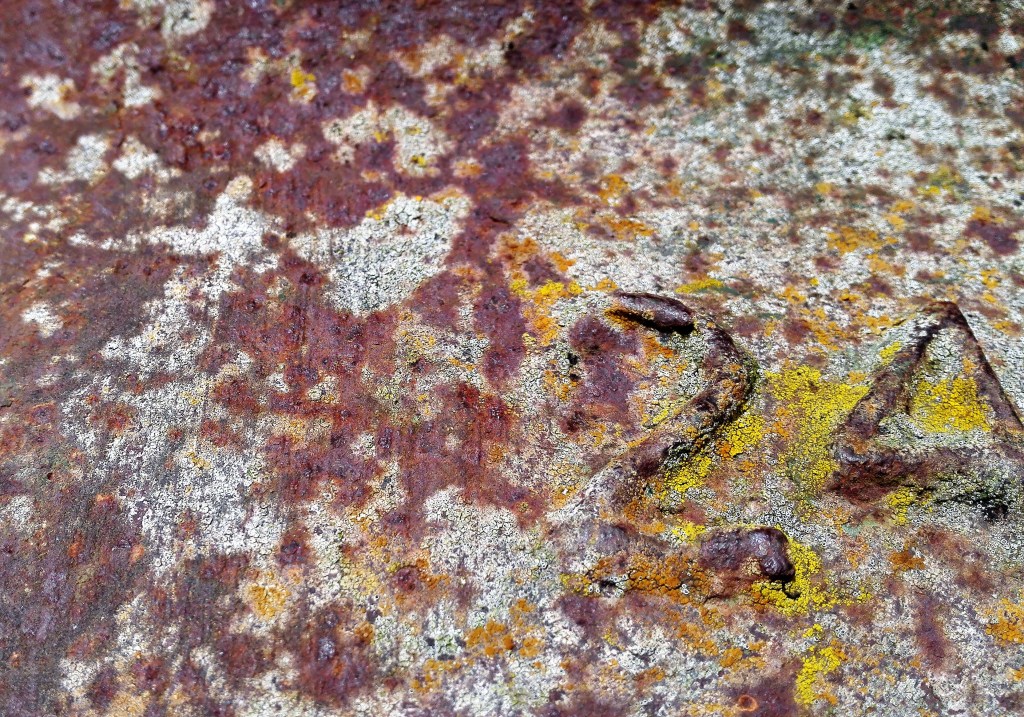
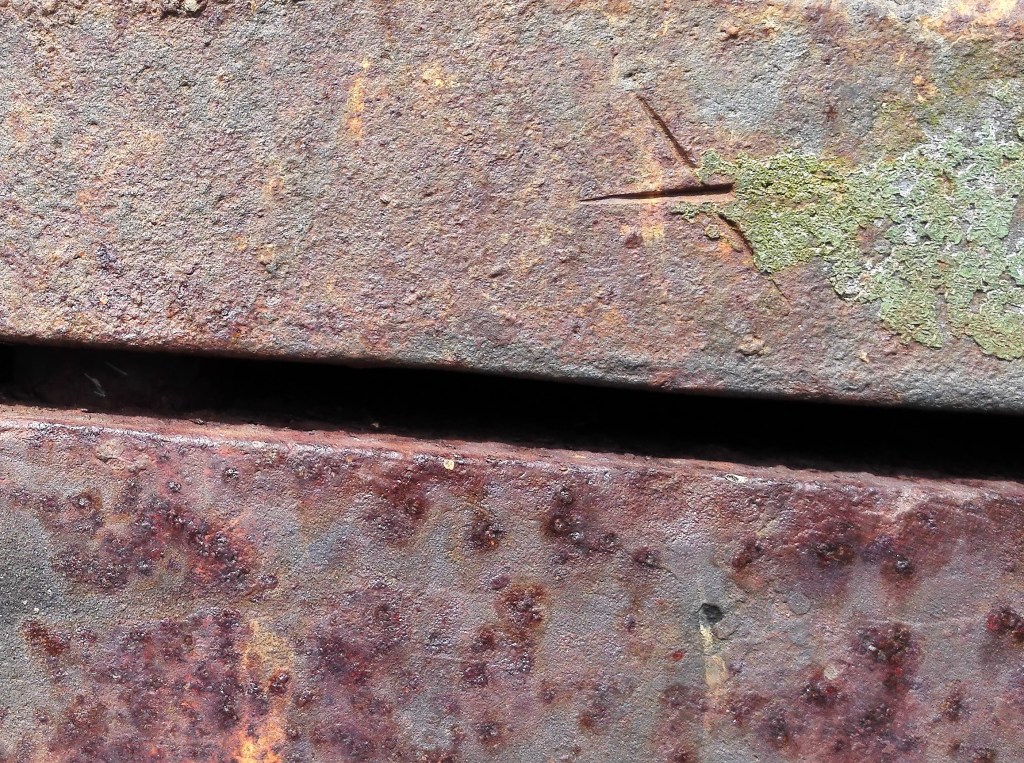
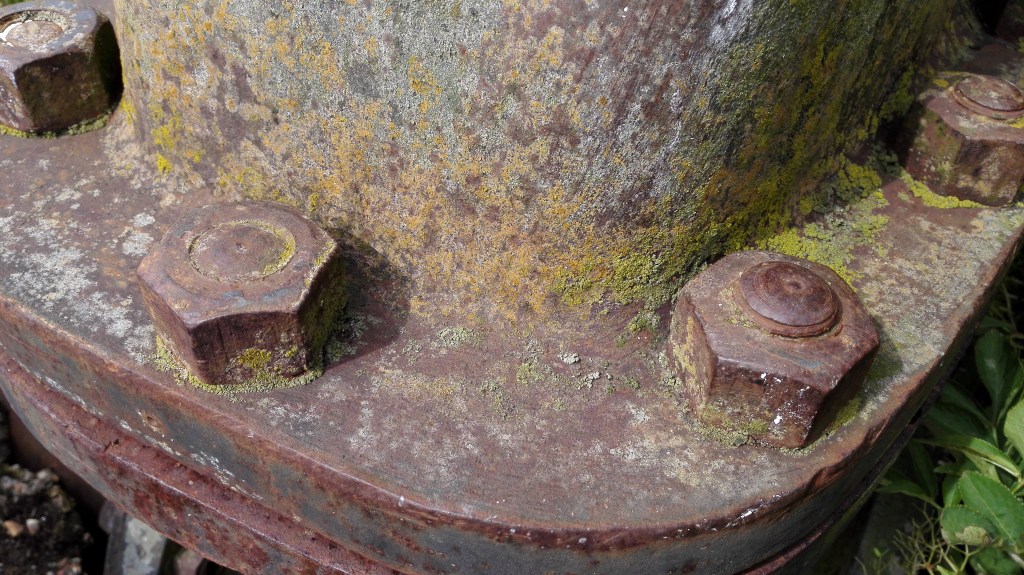
With these thoughts in mind set about making two paintings on A4 size acetate. I would loosely base the paintings on two photographs where I zoomed in on old iron work from a disused pumping station. The photographs were used to guide both my colour palette and to provide form and structure, composition. No preliminary work, I suppose all of the above is preliminary work that has lead to this point, just straight into application of paint to support.
The photographs
Both paintings were made using acrylic paint which was applied by both palette knives and brushes. Painting 1 below. Although I worked on these paintings concurrently this is the one that I completed first.
Painting 2 – Old Pump 1
I am pleased with the result. The subject of the photograph is not apparent, it is an abstracted image. In the painting I have taken the rough structure of form and created a painting which compels the viewer to look at. It does not matter what it is or what it wants to be, it suggests. The colours are well balanced and muted. The tonal variations are quite stark from the black lower third to the near white highlights. The overall effect is of ageing, corrosion and the effect of time passing.
Painting 3 – Old Pump 2
In this second painting which I am also pleased with the subject matter is more apparent. This is true of the photograph too. Although what it is remains unrevealed. The interest lies in the shapes and colours. In the painting the colours are exaggerated but not to the point where they become unbelievable. As in the previous painting they sit together comfortably. The suggestion of light hitting the surface of the iron against the darker shaded parts gives the form strength and depth. It looks like it has stood against the elements for a number of years and will remain doing so for many more. The corrosion is only colouration. The perspectives of the four bolts are not harmonious in respect of each other but they do allow the eye to stop and focus on different parts of the painting.
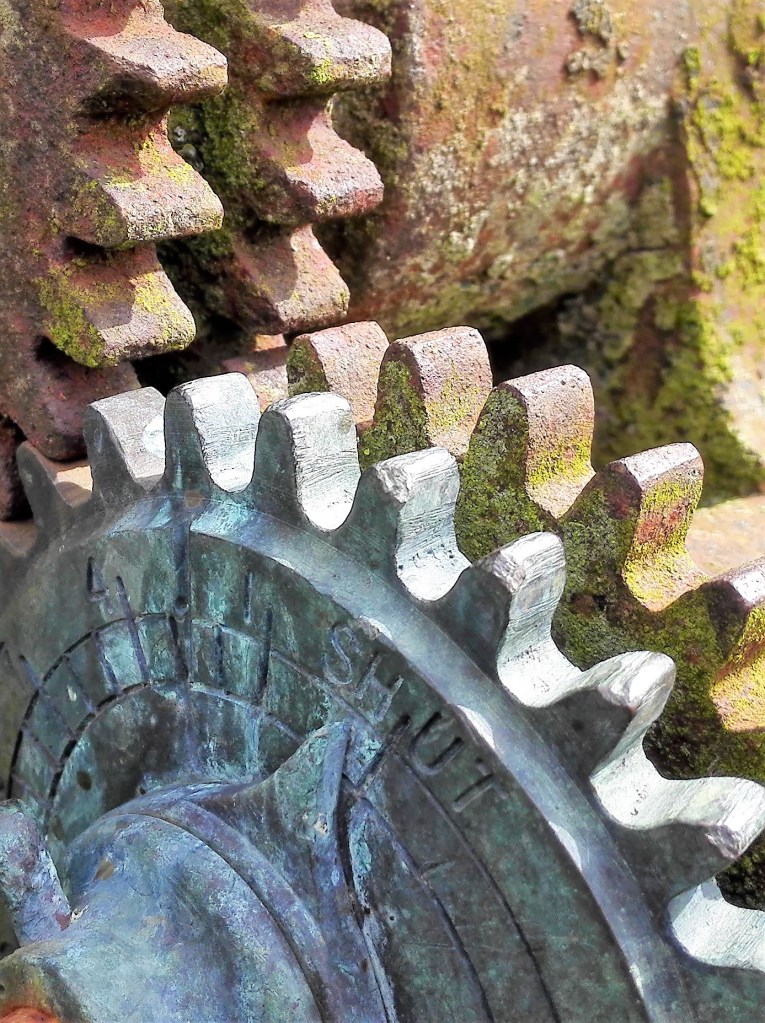
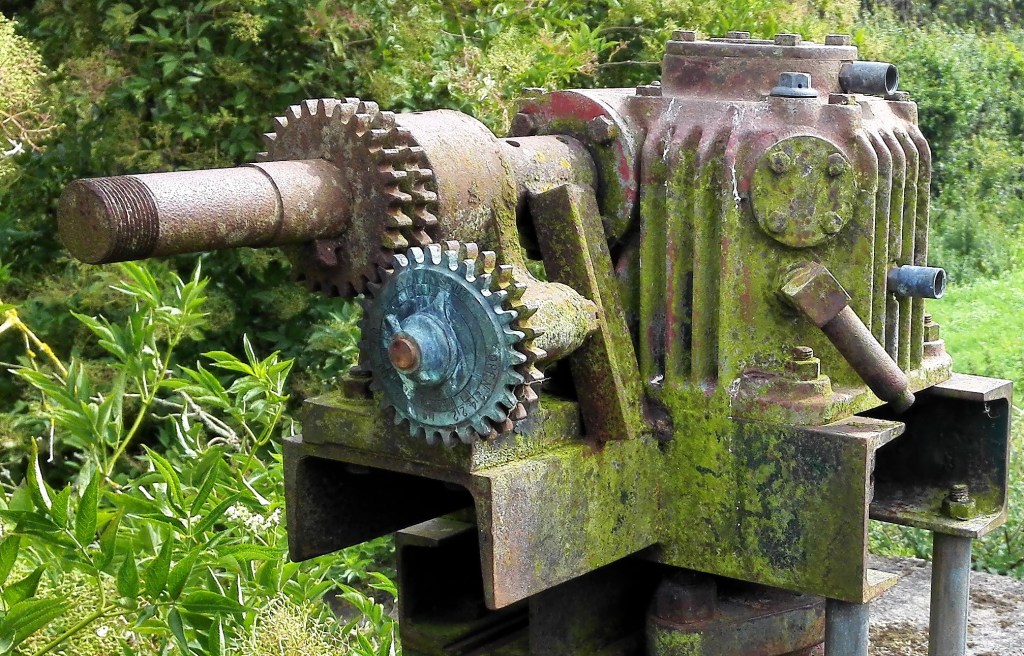
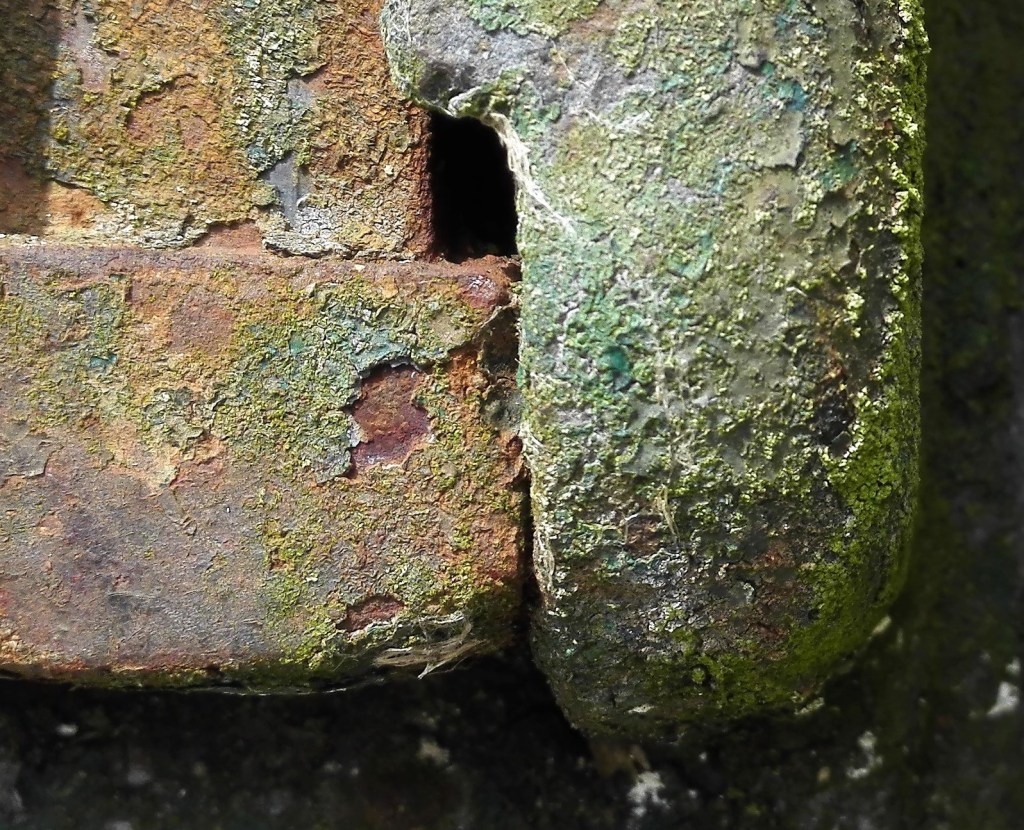
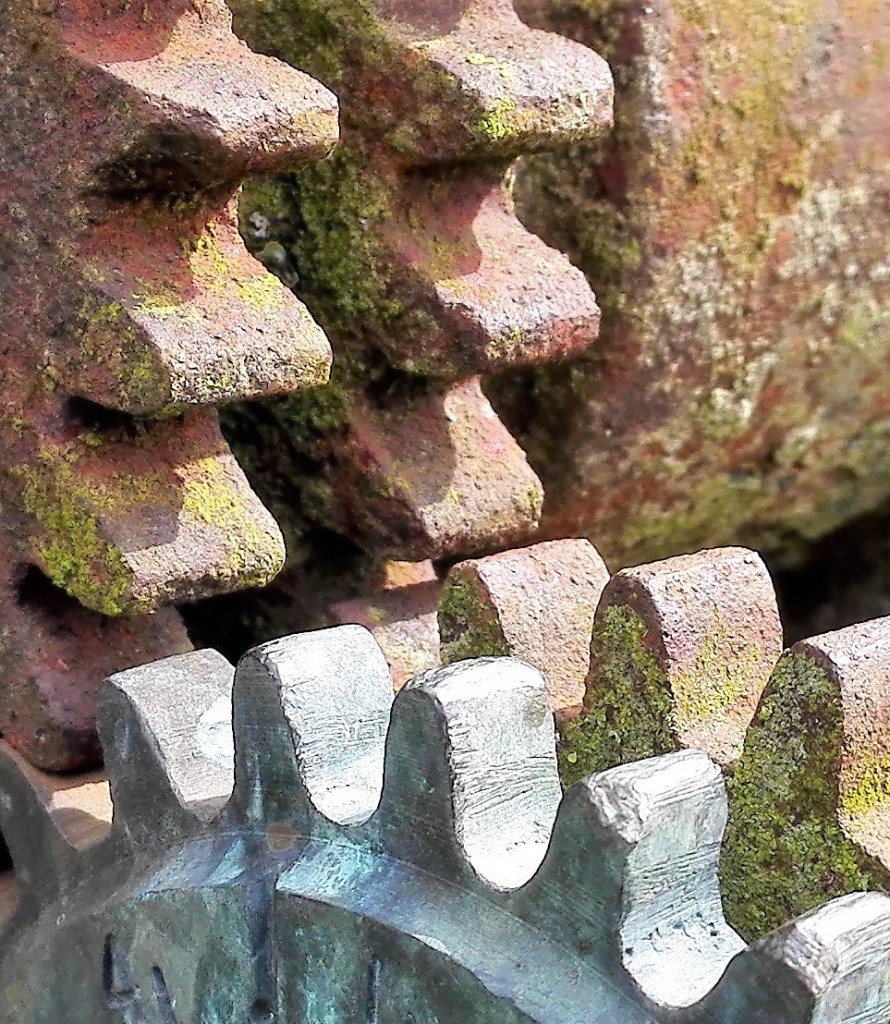
Moving on from these two paintings I used similar techniques to paint my next work. For this I would again zoom in on a aspect of the derelict pump. The photograph that I would use for this study is below.
Photograph for Painting 4
Using acrylic paints with brush and palette knife on 30 x 40cm handmade linen board I laid down a rough layer of mixed browns, Payne’s grey, greens and grey and then built up the painting. The result is below.
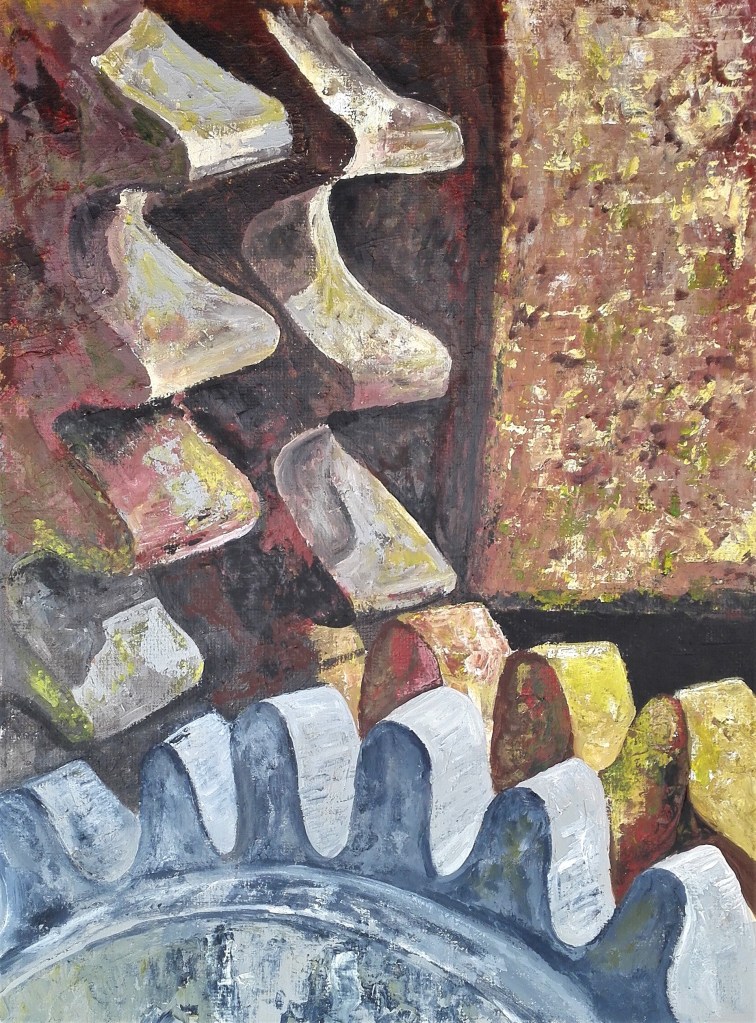
Painting 4 – Cogs, Acrylic on linen board, 30 x 40cm
The key to this painting is the contrast between dark and light which are quite dramatic. The light is clearly coming down from right to left and casting deep shadows on the rusted iron work and in the foreground the cleaner metal. The act of zooming in close to the cogs removes the identity of the larger object. This is important for the composition of the painting as the viewer is forced to examine the cogs. These have been degraded and discoloured by the passing of time but have retained their form. The observer is asked to wonder what these cogs were used to drive? When were they last in use? Where are they? The answers are not revealed.
At this point I decided to post this blog. It will be followed up with further blogs as I continue to work on my Parallel project. As I reflect on my work to date and the direction I am heading in I can see a step change in my approach. I have refined my original ideas and focused in on the subject. I anticipate that I will make further twists and turns as I progress with the project.










 Mark Taylor 'Studio Practice'