List of names for colour in which I noted that a number were flowers or plants. I particularly liked Garrulous, Yearning, Insolence, Indignant and Abstinence although I have no idea what colours these would be.
As a bit of fun I came up with names for the colours on my 3D colour chart.
Working from left to right and top to bottom these are the names that I came up with.
Tender
Bruised
Clay
Stormy
Rust
Bleak
Slippery
Dowdy
Fall
Cautious
Coffee
Tepid
Bridesmaid
Cocteau
Deep
Wine
Slate
Dread
Leveller
Smile
Raw
Fresh
Scum
Devil
I challenged Marian to match the name to the colour, it wasn’t a great success.
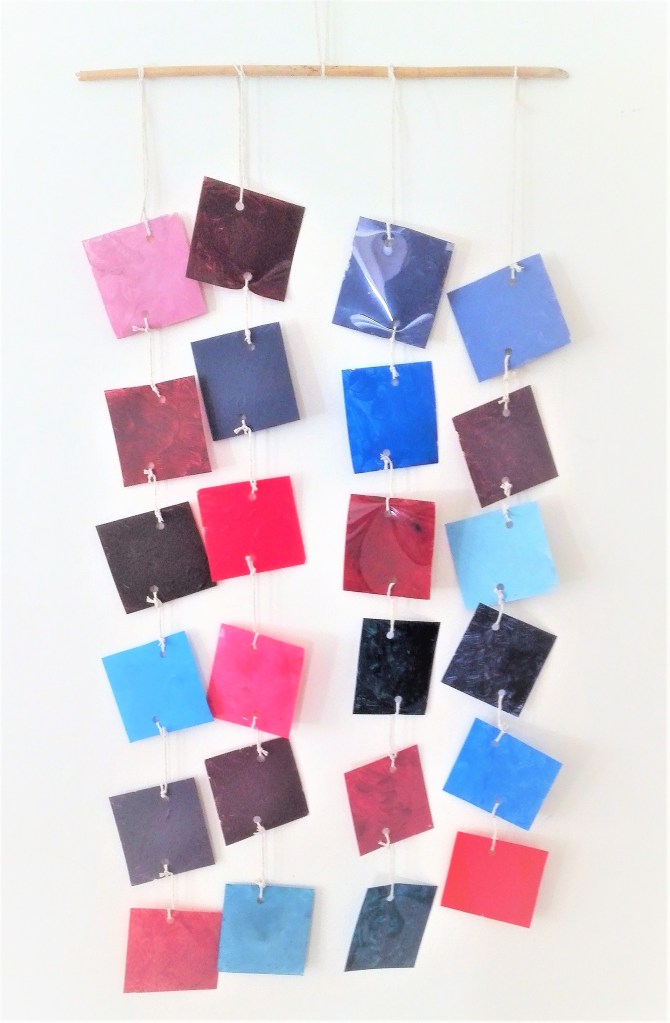
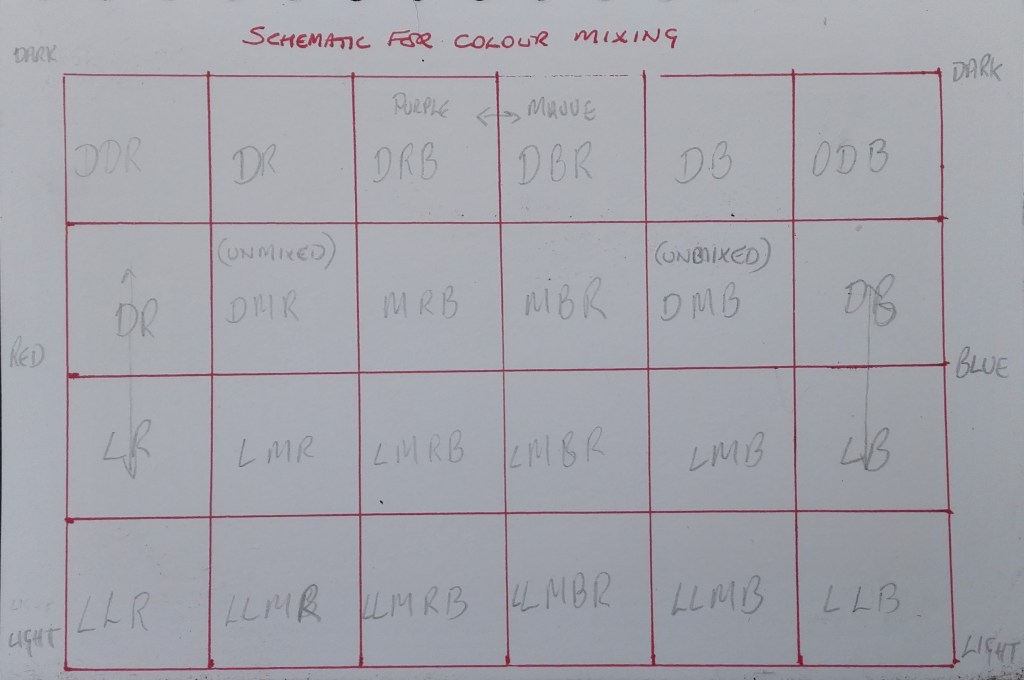
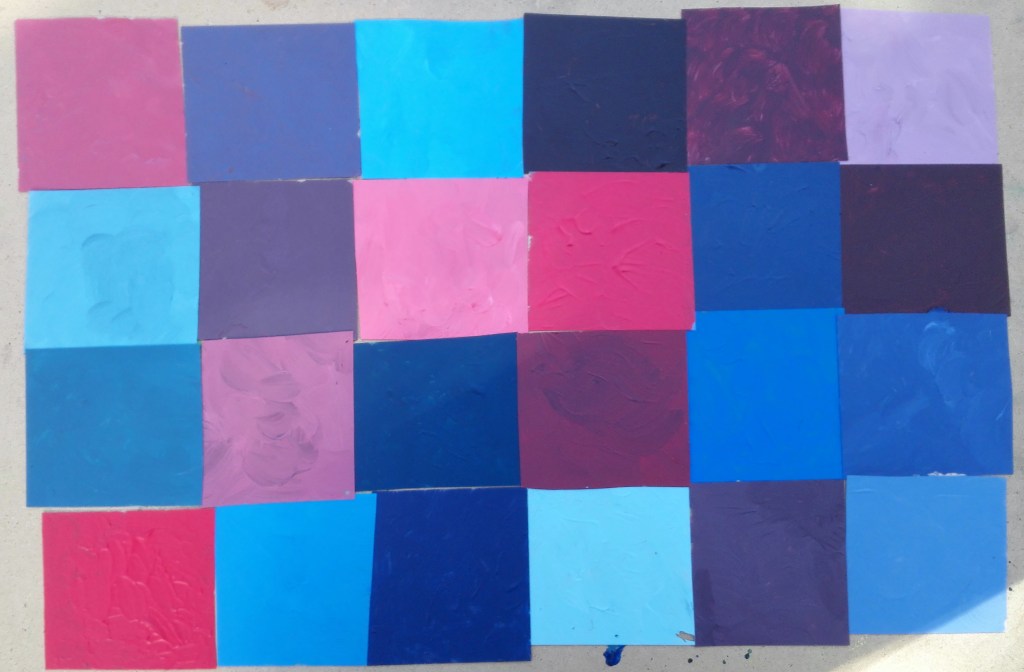
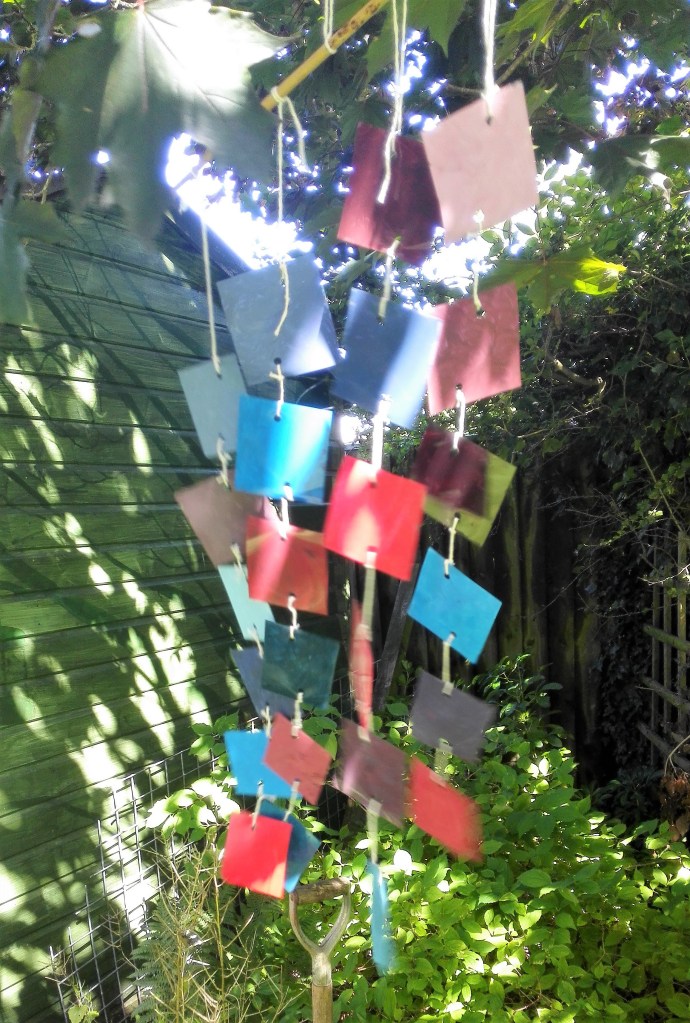
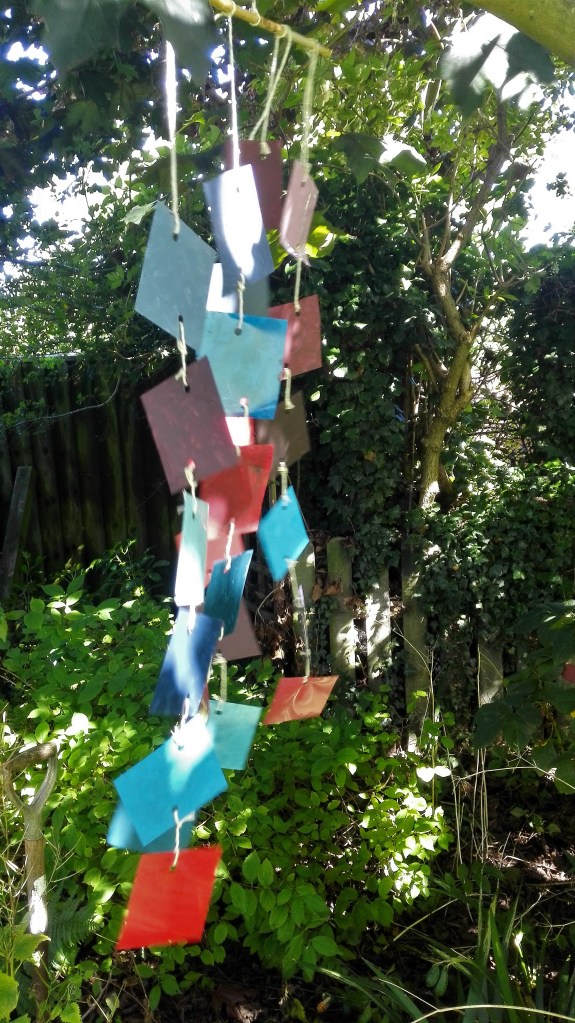
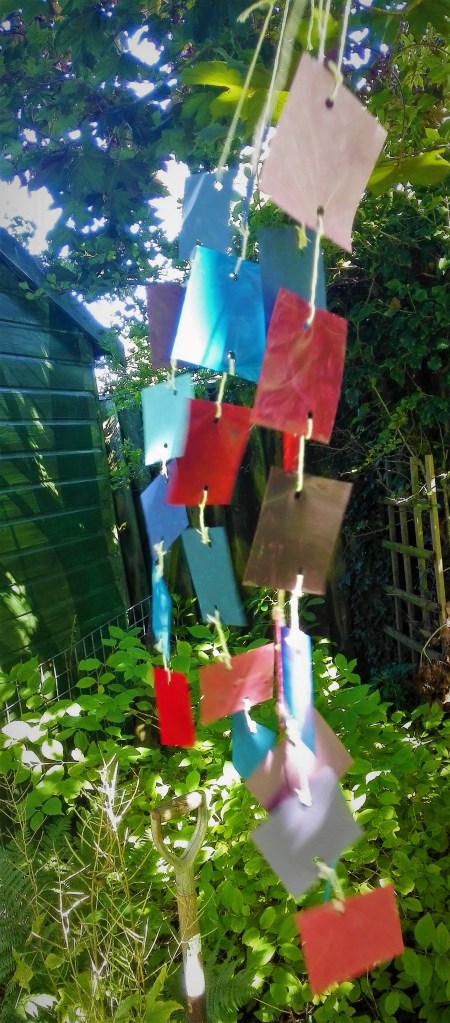
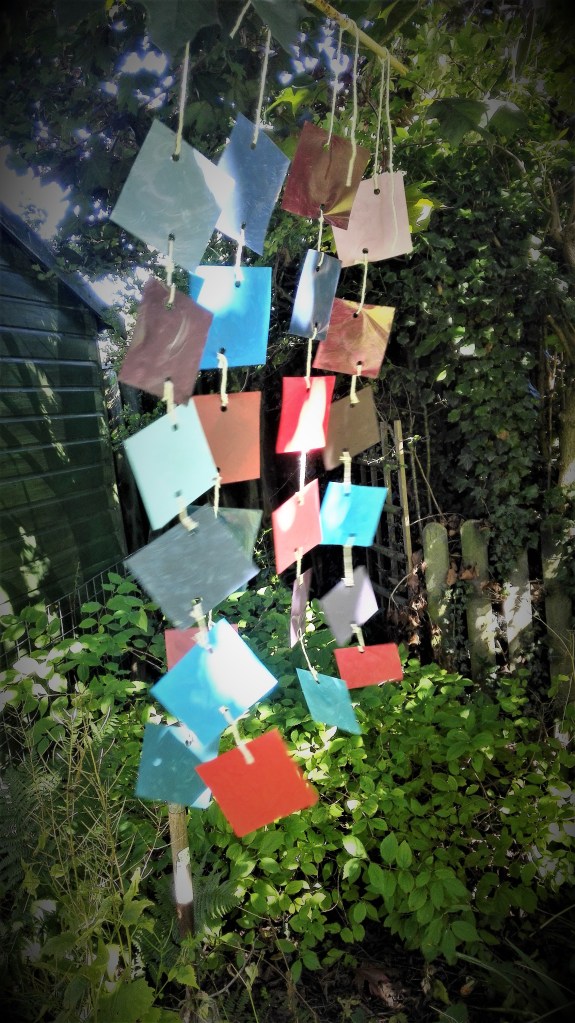
Following on from the previous blog on Part 1 of this exercise. I had already planned how I was going to try to replicate and represent the colours recorded in the photographs on acetates. My main consideration now was how I was going to display the chart. The idea that occurred to me was to try to suspend the coloured acetates by hanging them via some sort of mobile. Before doing this I devised a way of creating the various colours and tones from dark to light. To do this I used the schematic shown below. This took the two primary colours, Red and Blue, from dark to light and various mixes of the two colours with the addition of white or black.
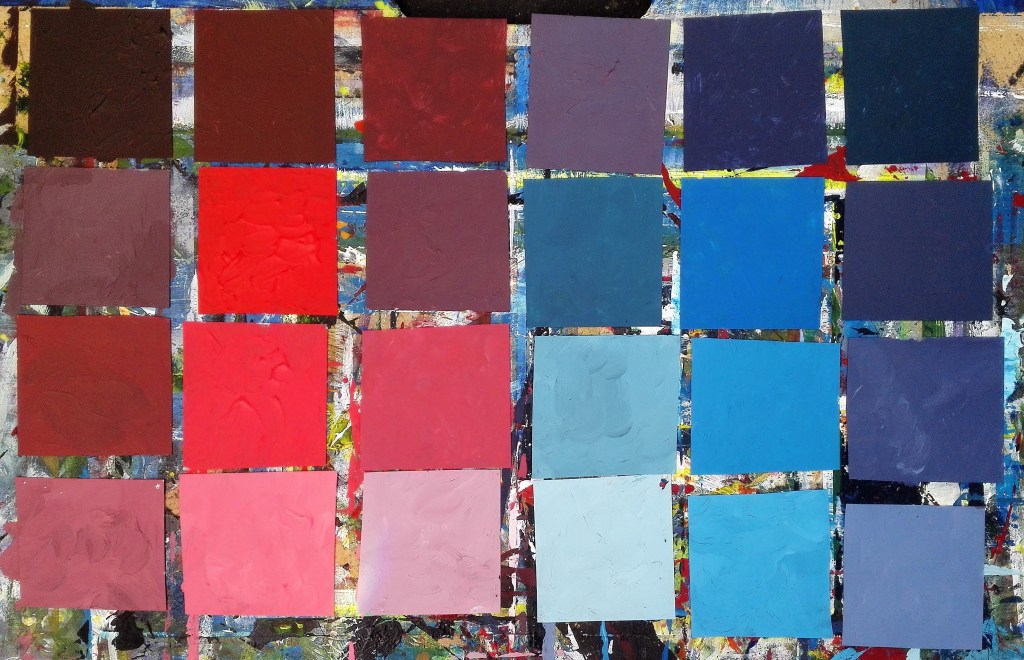
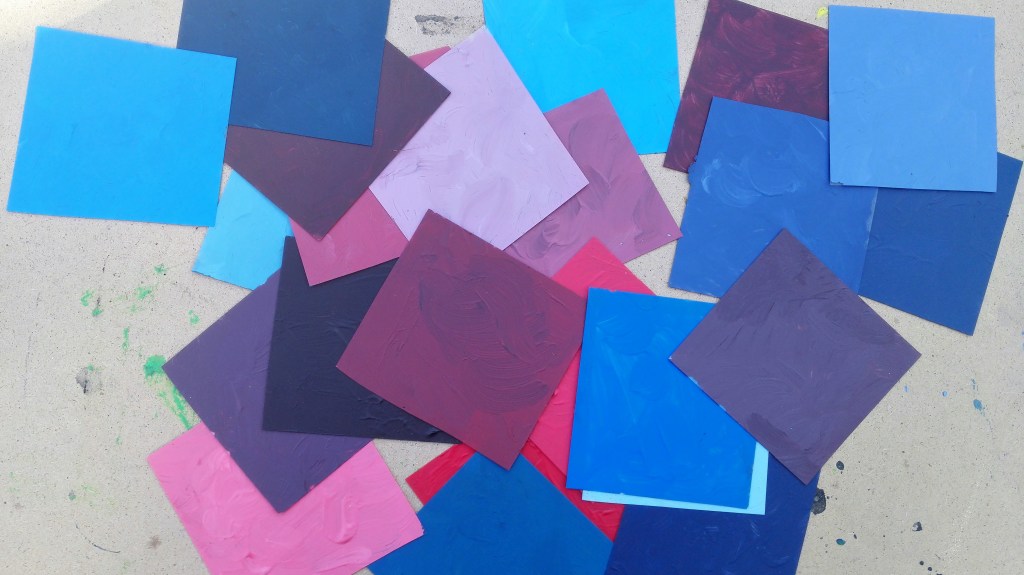
The next step was to cut up the acetates into the required number of squares and to paint them. The result is shown below.
Coloured acetates as per schematic
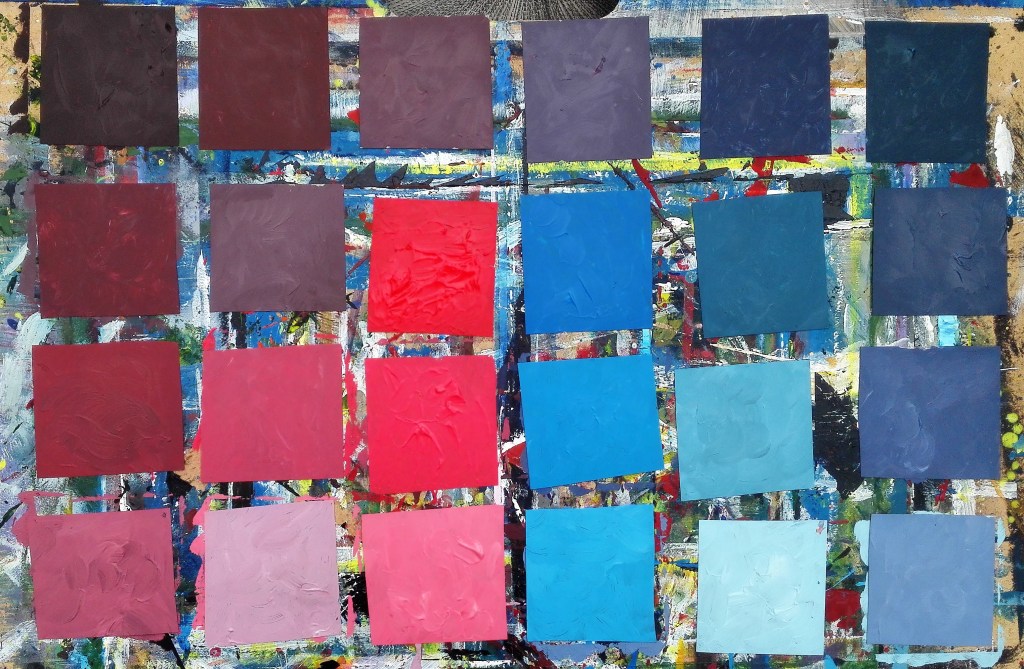
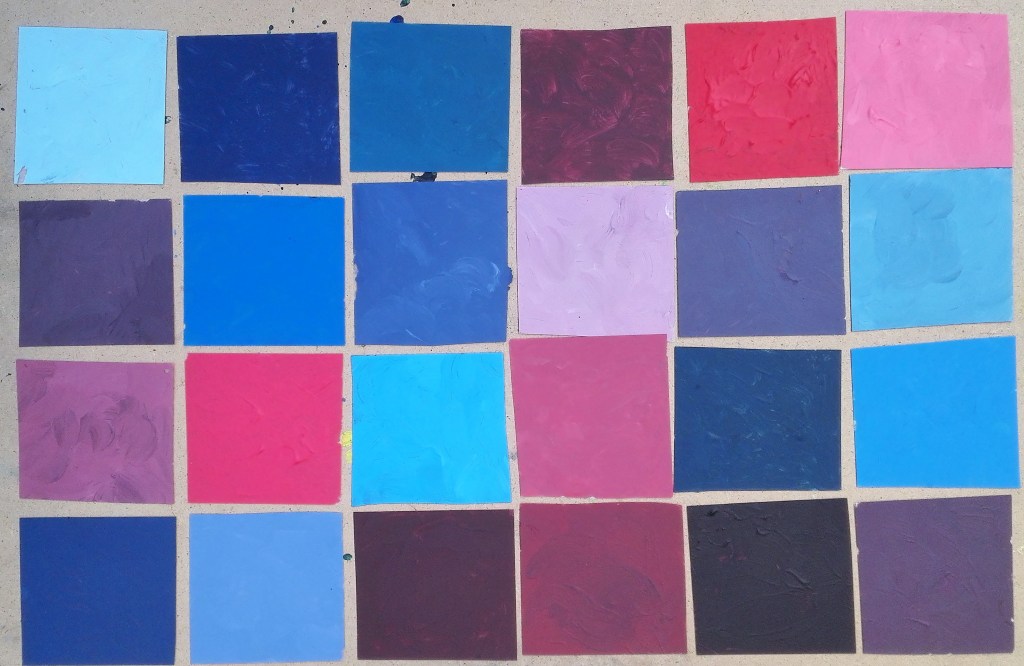
Once the squares were arranged I challenged the order that they should be displayed. It wasn’t clear that the colours ran from dark to light and from red to blue. I was also noticeable that I hadn’t mixed a purple colour that was near to the colour of the purple lid. Partly, I feel, this was due to the red paint that I used which was towards the pinker end of the reds rather than the orange end. First I tried a couple of slightly altered arrangements before dispensing with any sense of order. After shuffling the squares I arranged them in random order until I happened upon an order that pleased me.
Slightly re-arranged order
Shuffling
Random orders 1- 4
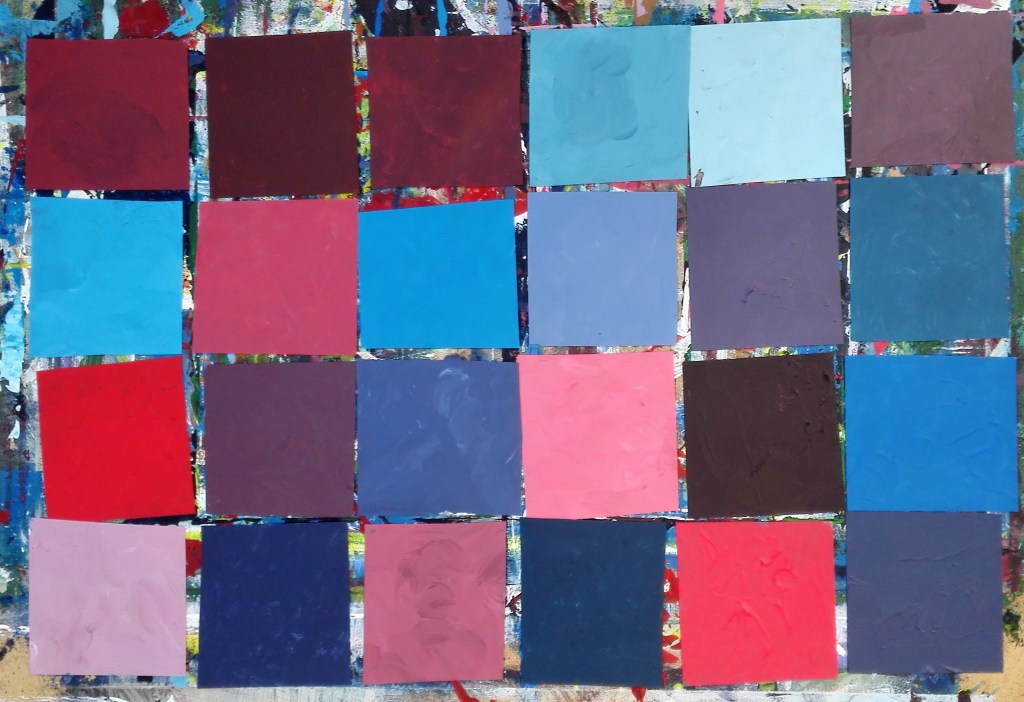
I finally settled on the random order that can be seen in the image below. .
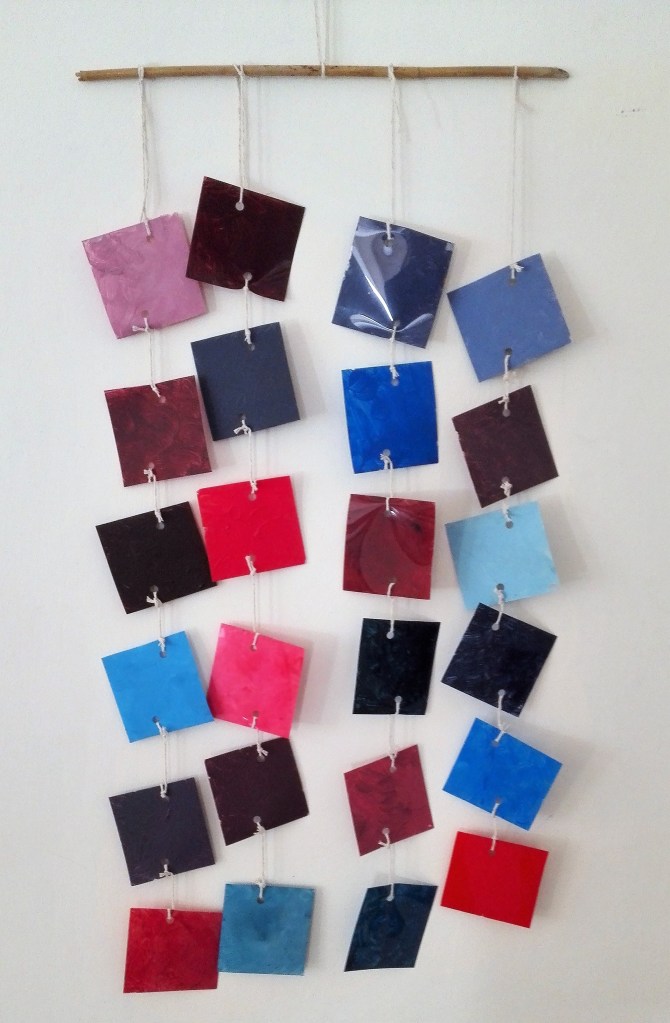
The individual squares would be joined with string in four lines working from right to left. The squares at the right would be at the top of the display.
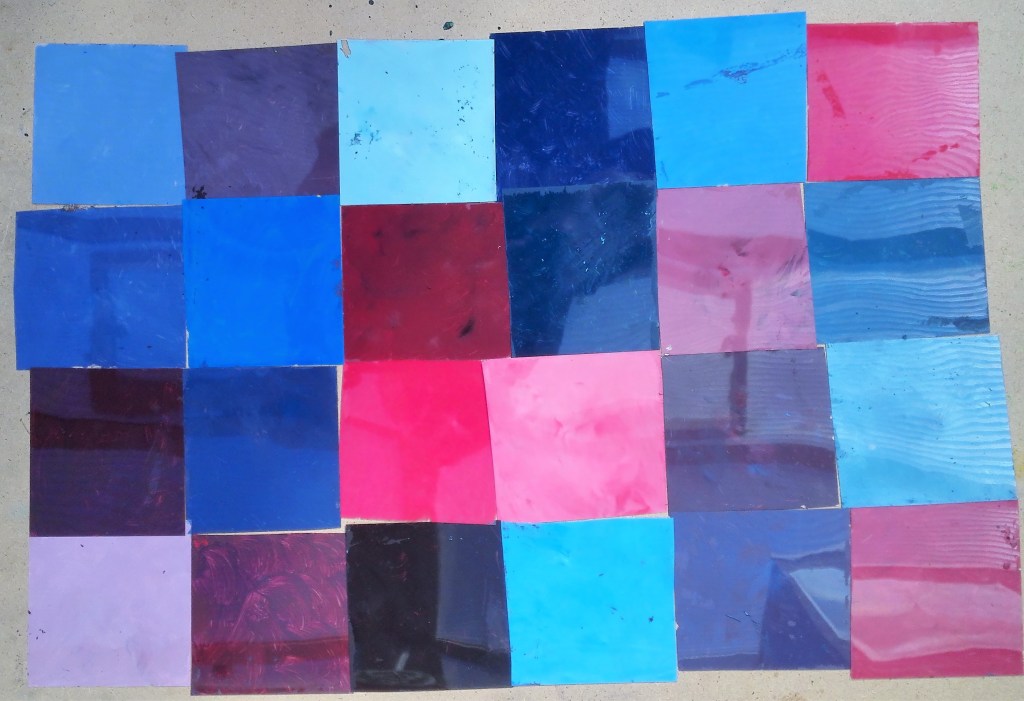
The resultant mobile display is best seen in the photograph below where it has been hung against a pale wall.
3D Colour chart – hung against a pale background
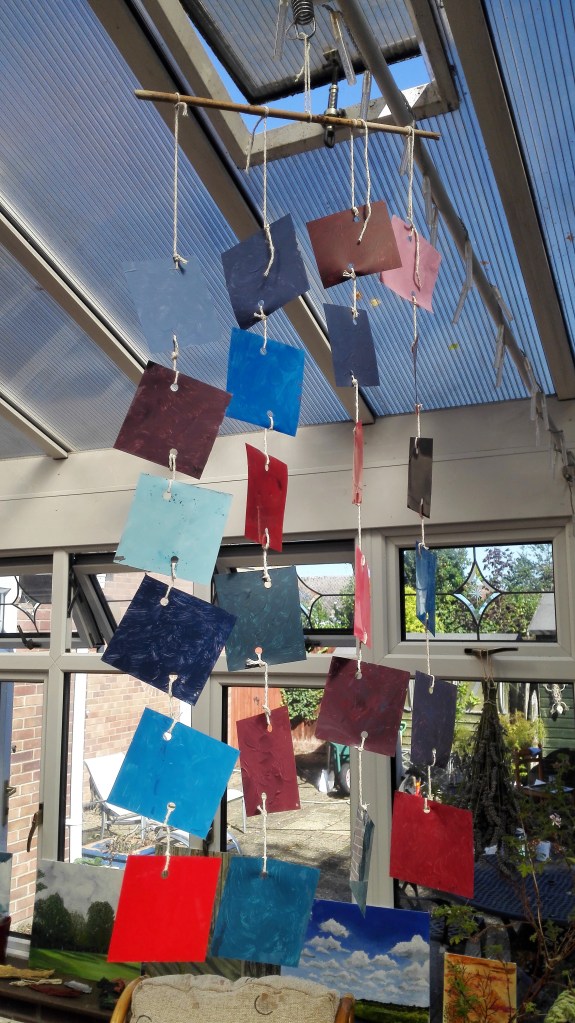
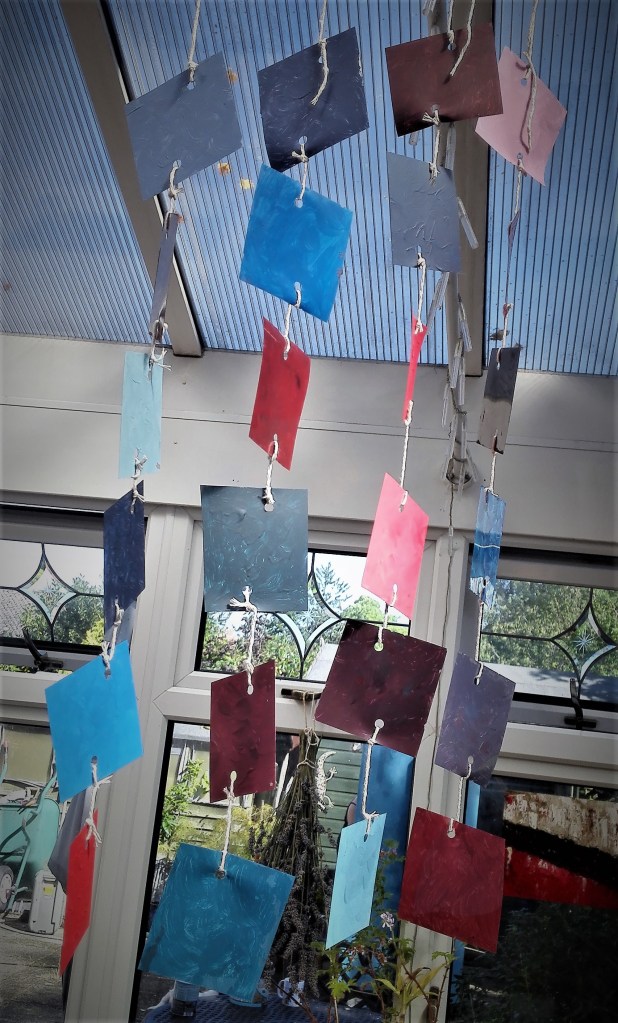
I tried hanging the mobile in various locations around the house and also in the garden. Its rather delicate nature meant that the garden locations were limited.
3D Colour chart – in various locations 3D Colour chart – Final location
I also made four videos of the 3D colour chart, see blow. These are followed by my reflections on the process and the resultant work.
Summary and reflection
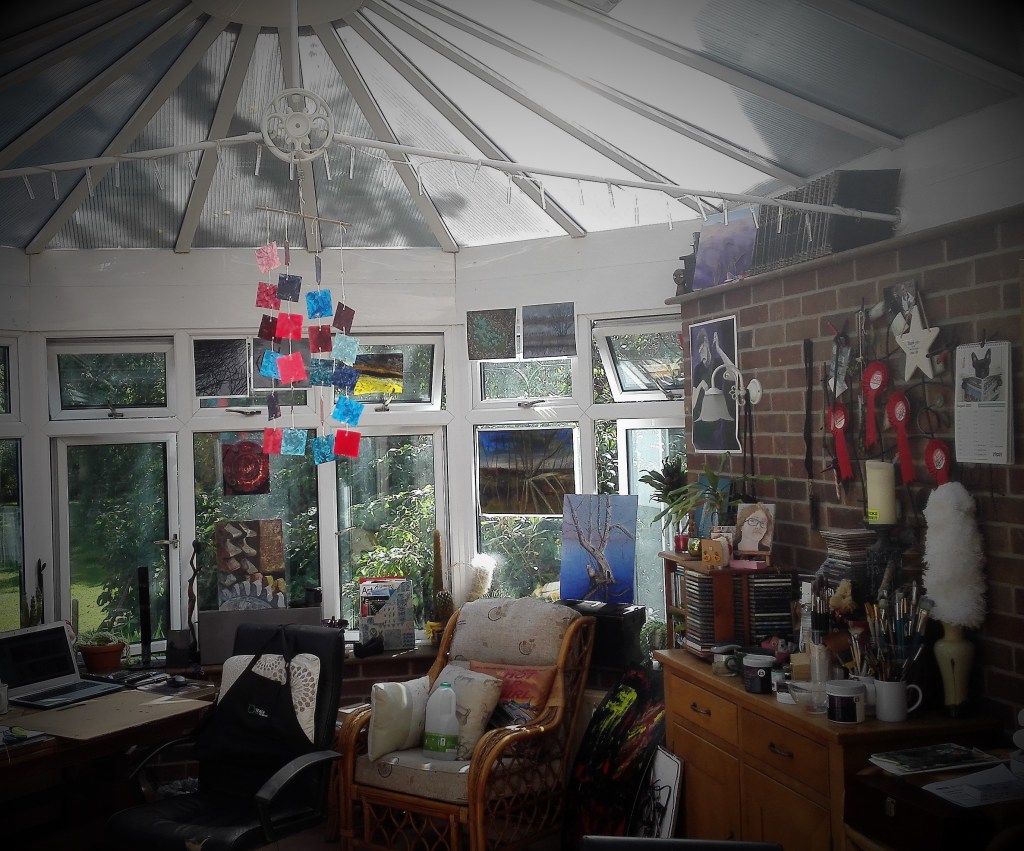
The result of this exercise is that I have an interesting addition to my studio. The 3D colour chart is proudly rotating and the reflections from the shiny side of the acetates are creating splashes of light across the surfaces of the room. At present this is quite distracting but is temporary as the sun will change direction before long. So from the viewpoint of creation of a piece of artwork the exercise has been a success. However that was not the point of the exercise. The main focus was on the observation of colour and how it changes in differing backgrounds, differing light conditions and the surface it is on. Throughout the task I have been aware that my knowledge of colour is reasonably well educated. I would not profess to be a student of colour but I do feel that I have gained knowledge over the years, and particularly throughout my OCA studies, of the how colour is impacted by different conditions. I realise that this learning is never ending. The exercise has taught me to continually be aware of the relationship between colour, tone and surface and consider this in my work. The choice of the limited colour palette that I used for this exercise was advantageous in that it allowed the focus to be on the subtlety of tonal variation rather than clashes of colours opposite each other on the colour wheel. It is this knowledge that I will look to take forward when constructing paintings. It will help me in the creating more harmonious compositions.
I thought that I would try to use this exercise to make further use of my utilisation of acetates as supports for paintings. Having read the requirements of the exercise I envisaged that it I could use the acetates for the rectangular planes of colour. My thinking that I would only need to apply paint to one side.
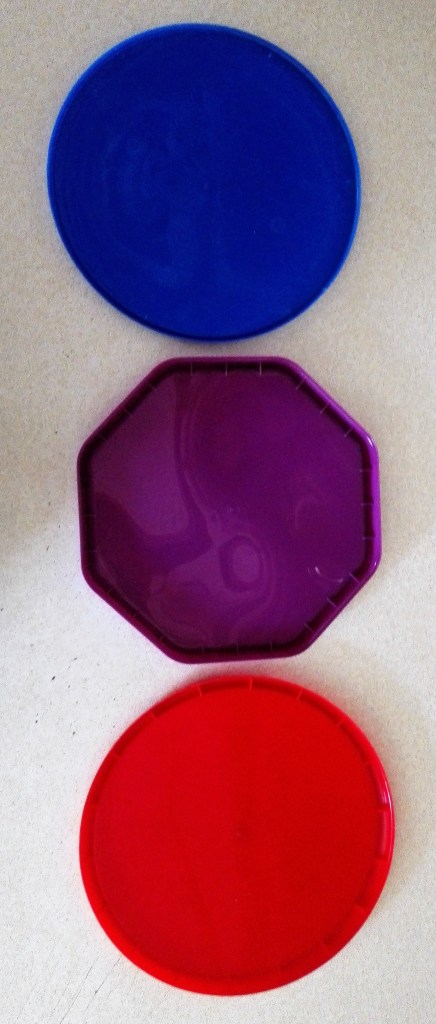
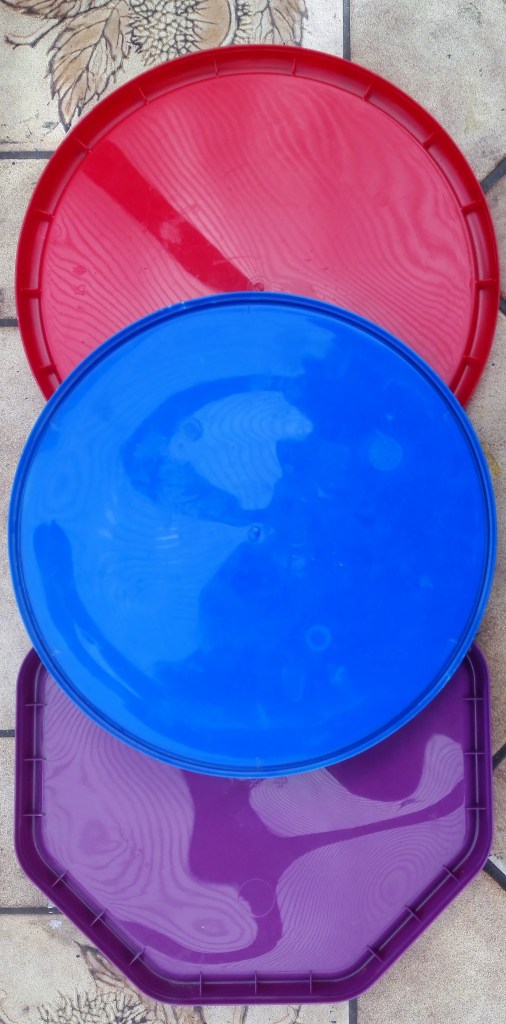
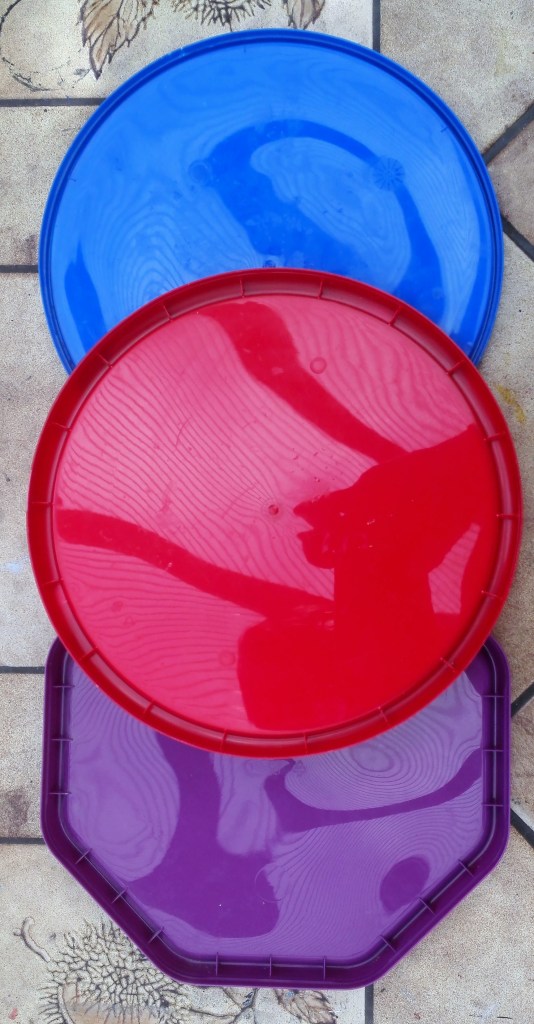
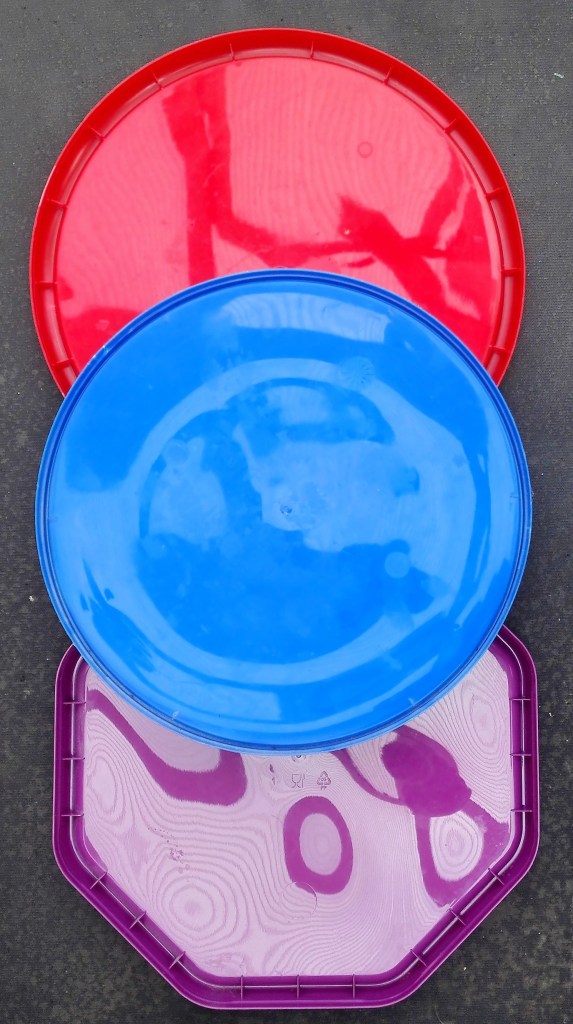
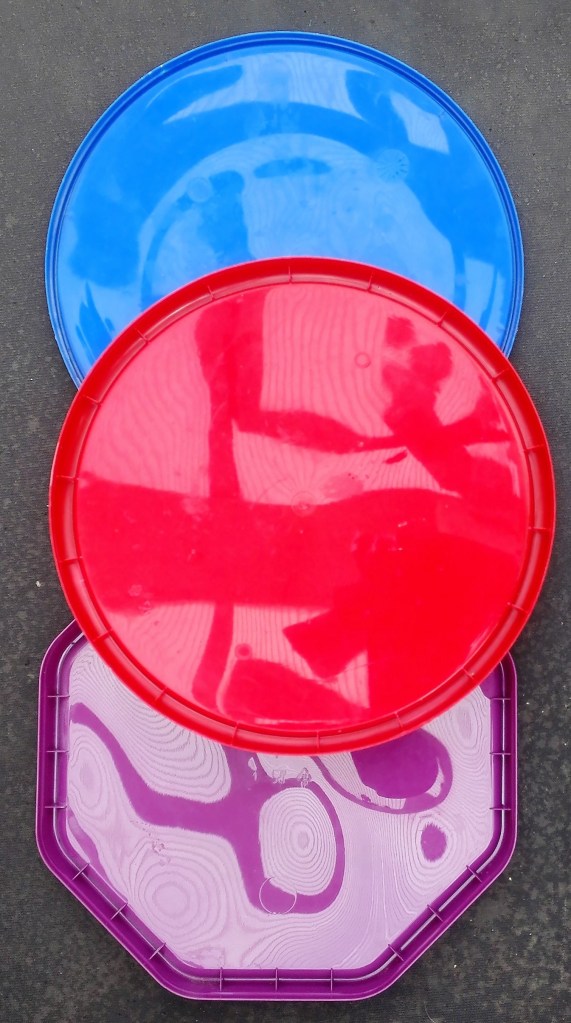
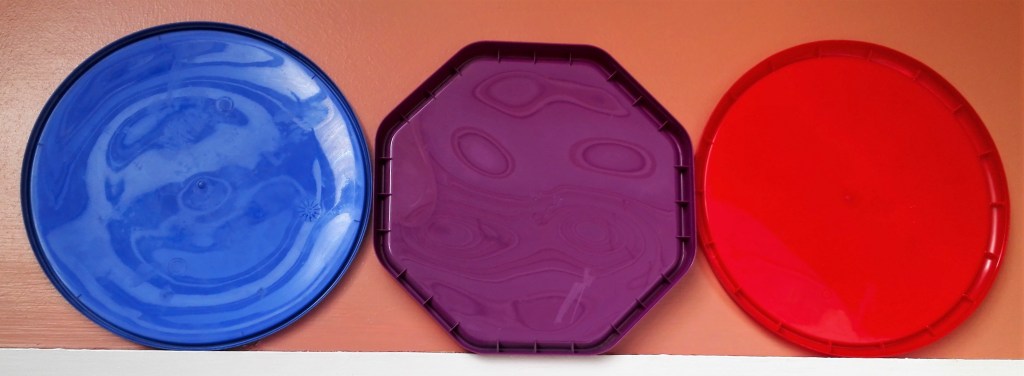
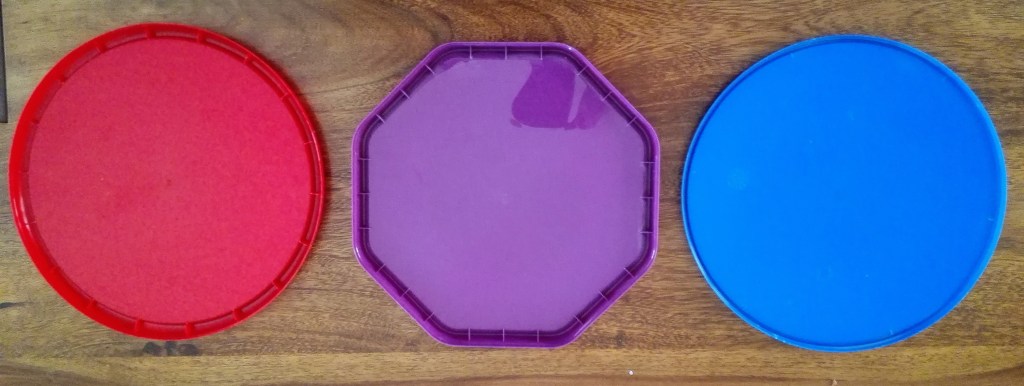
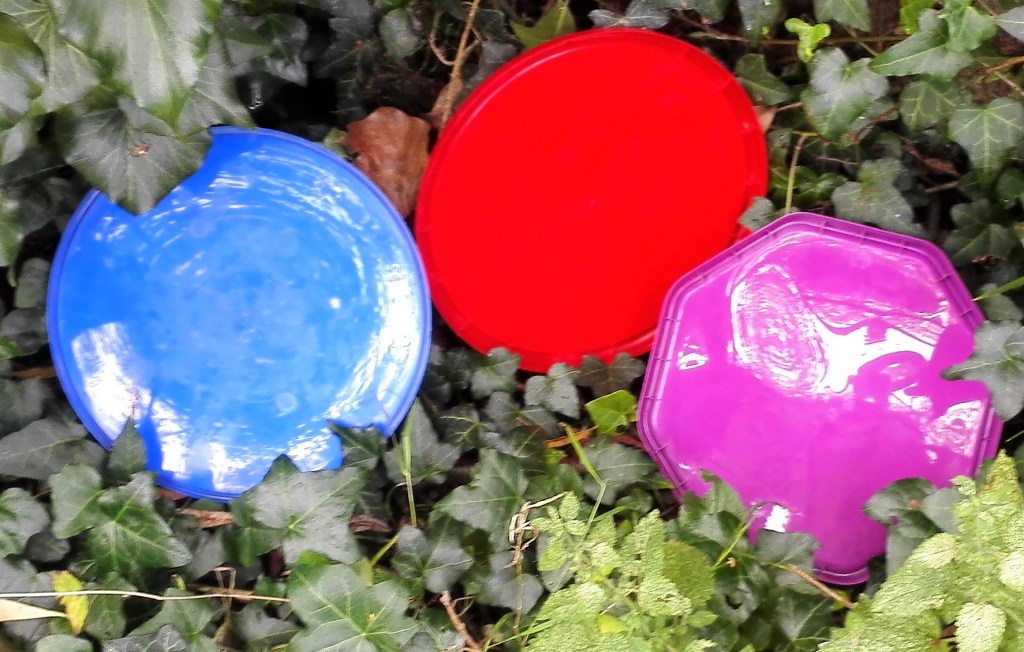
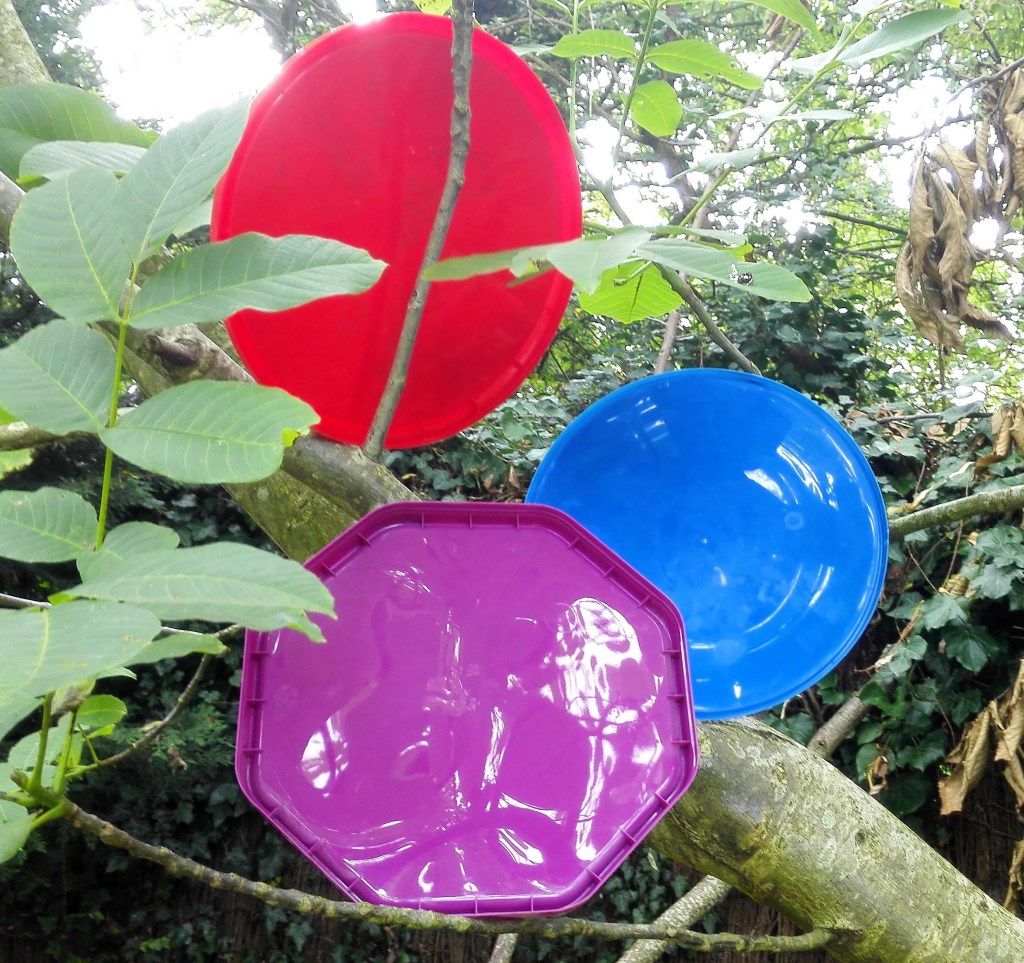
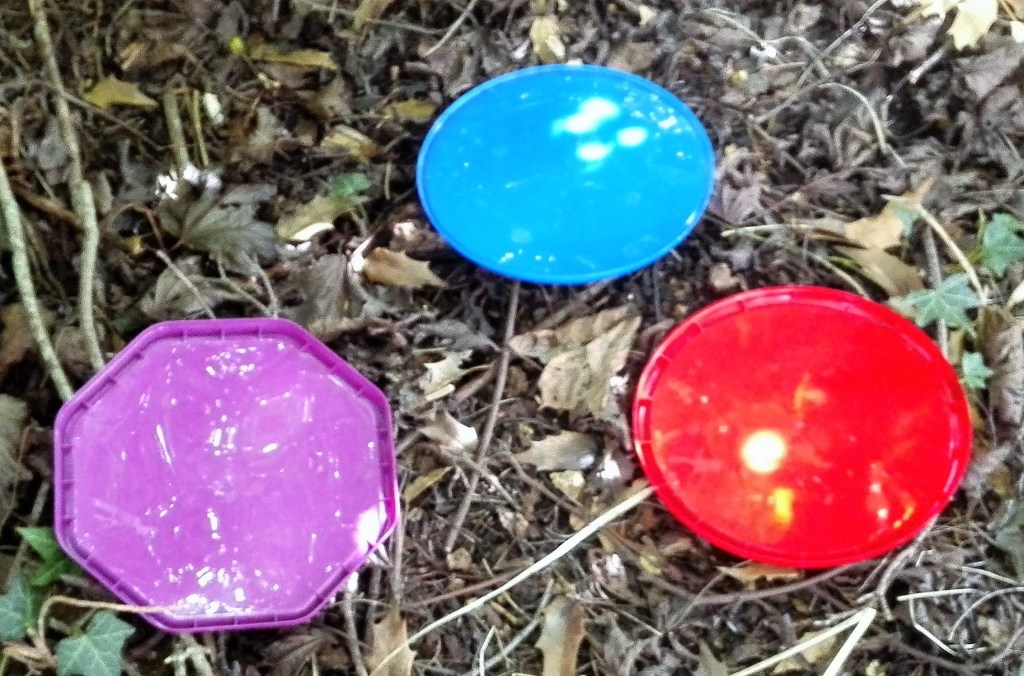
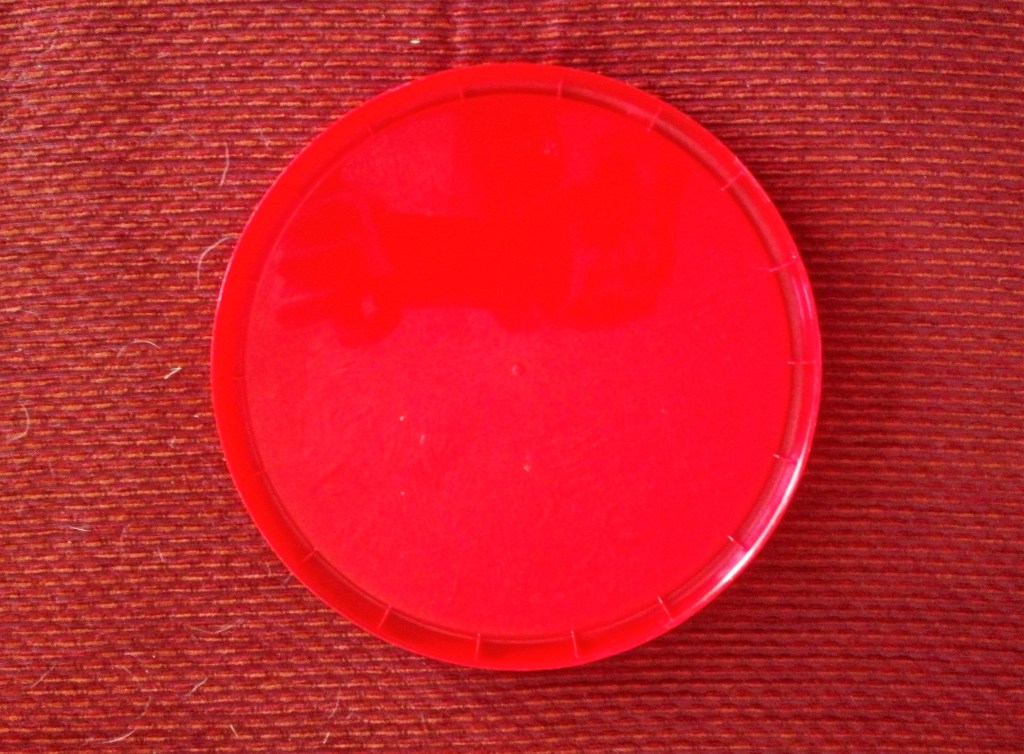
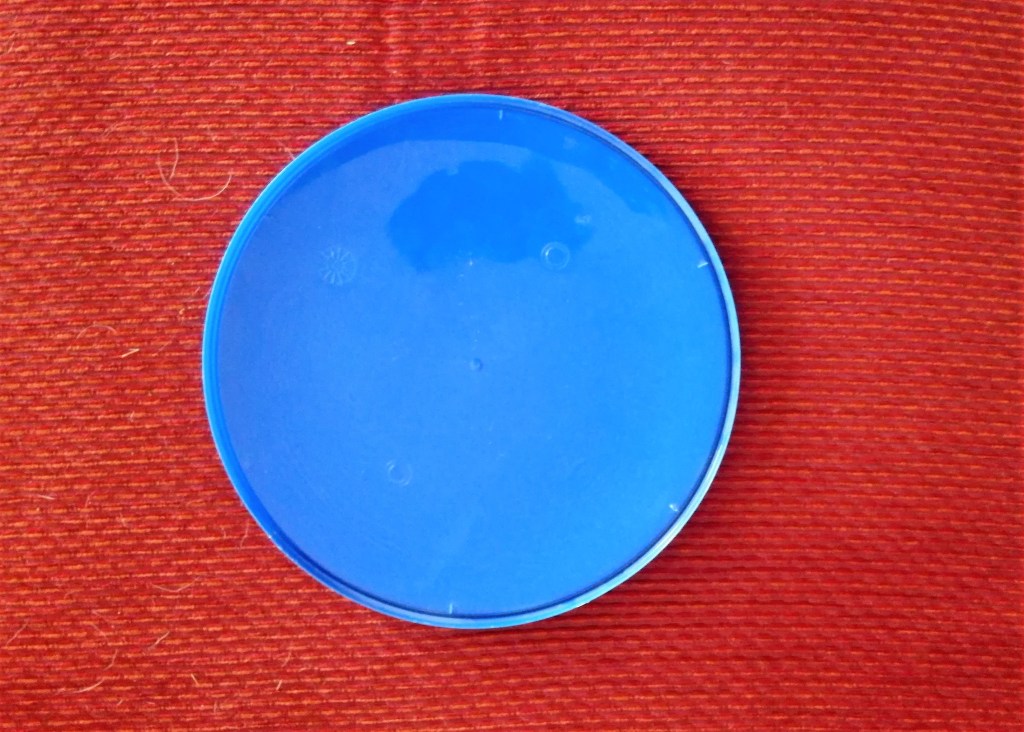
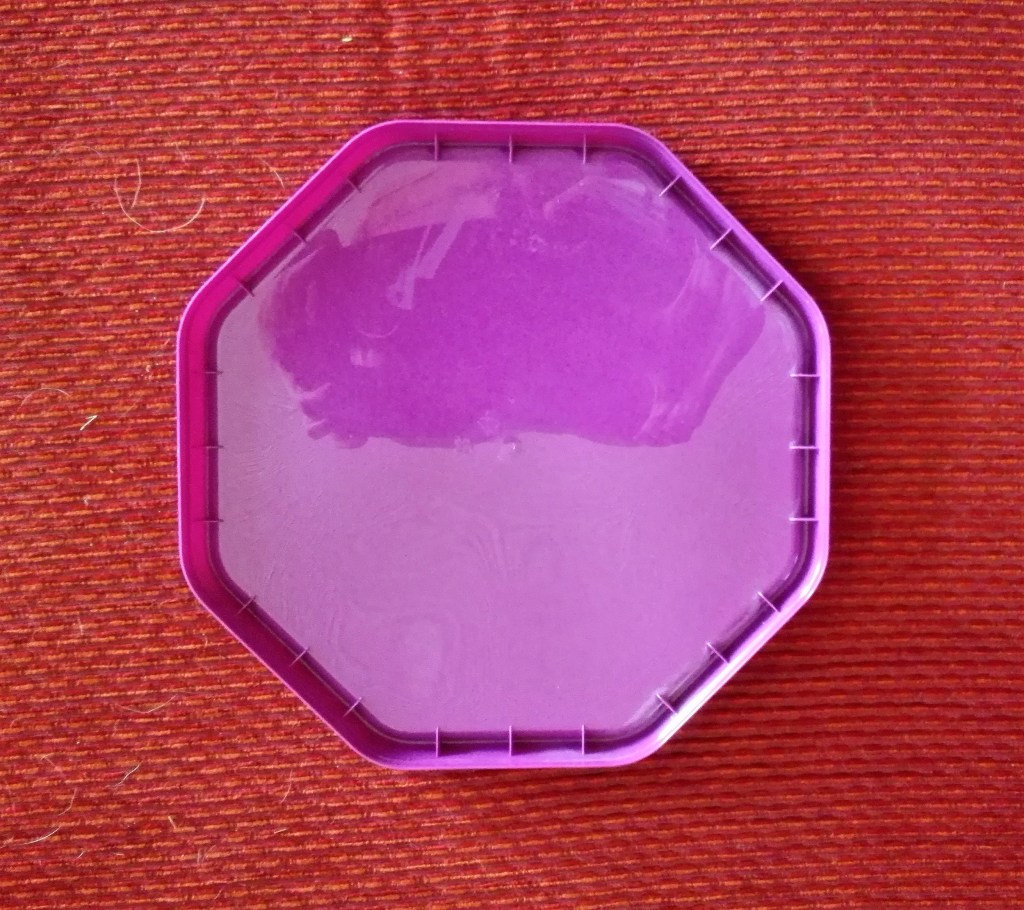
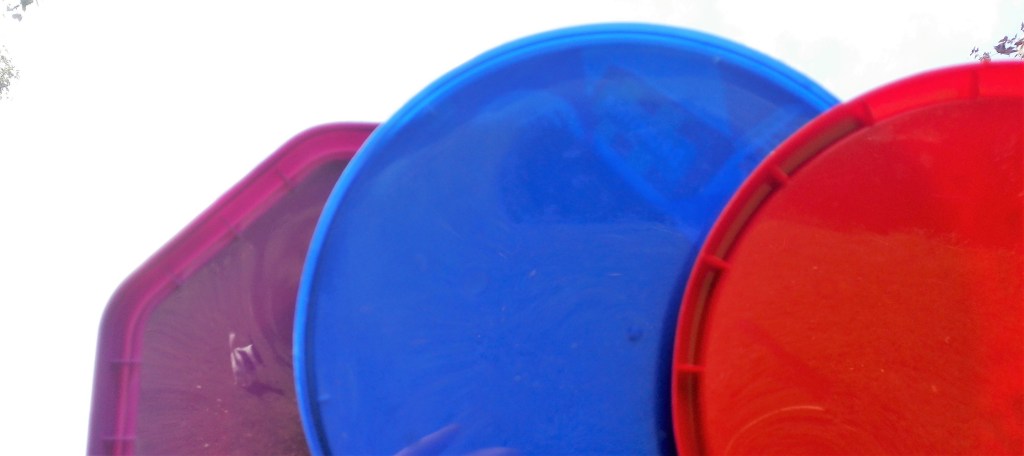
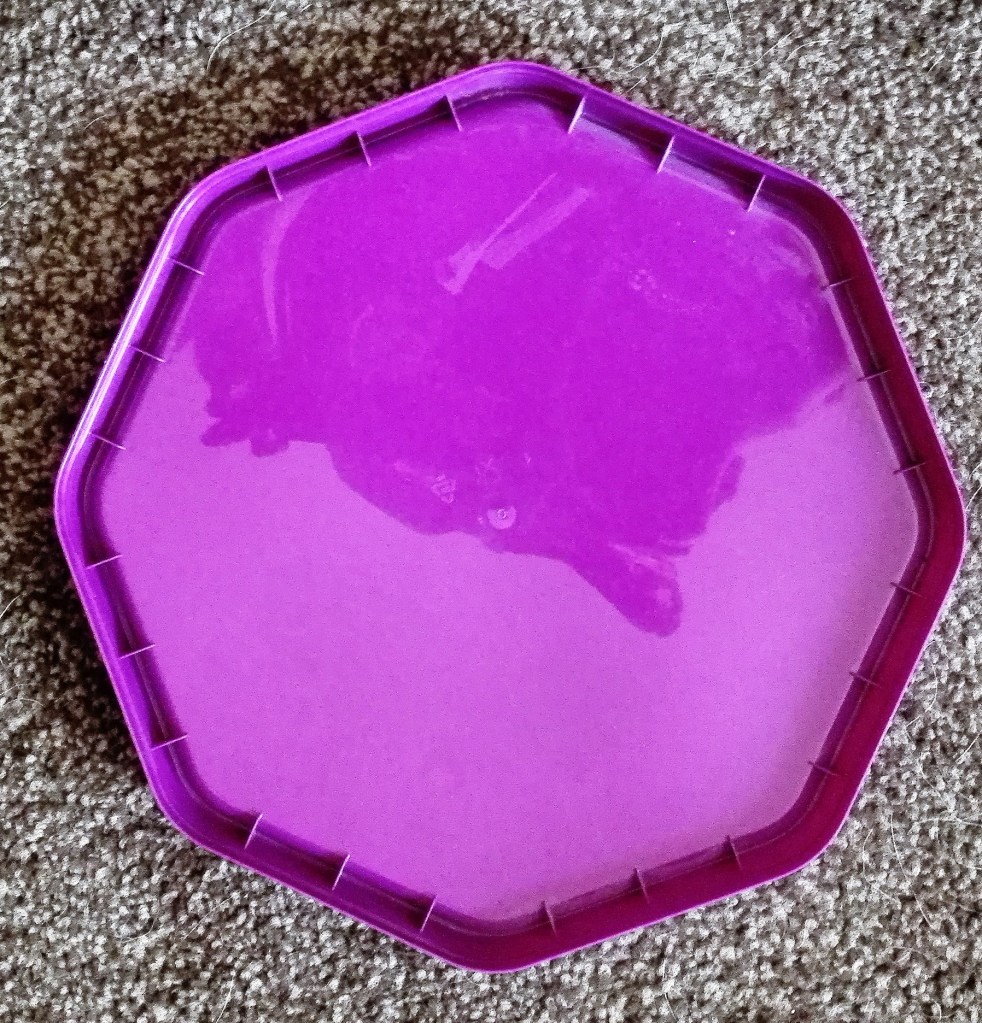
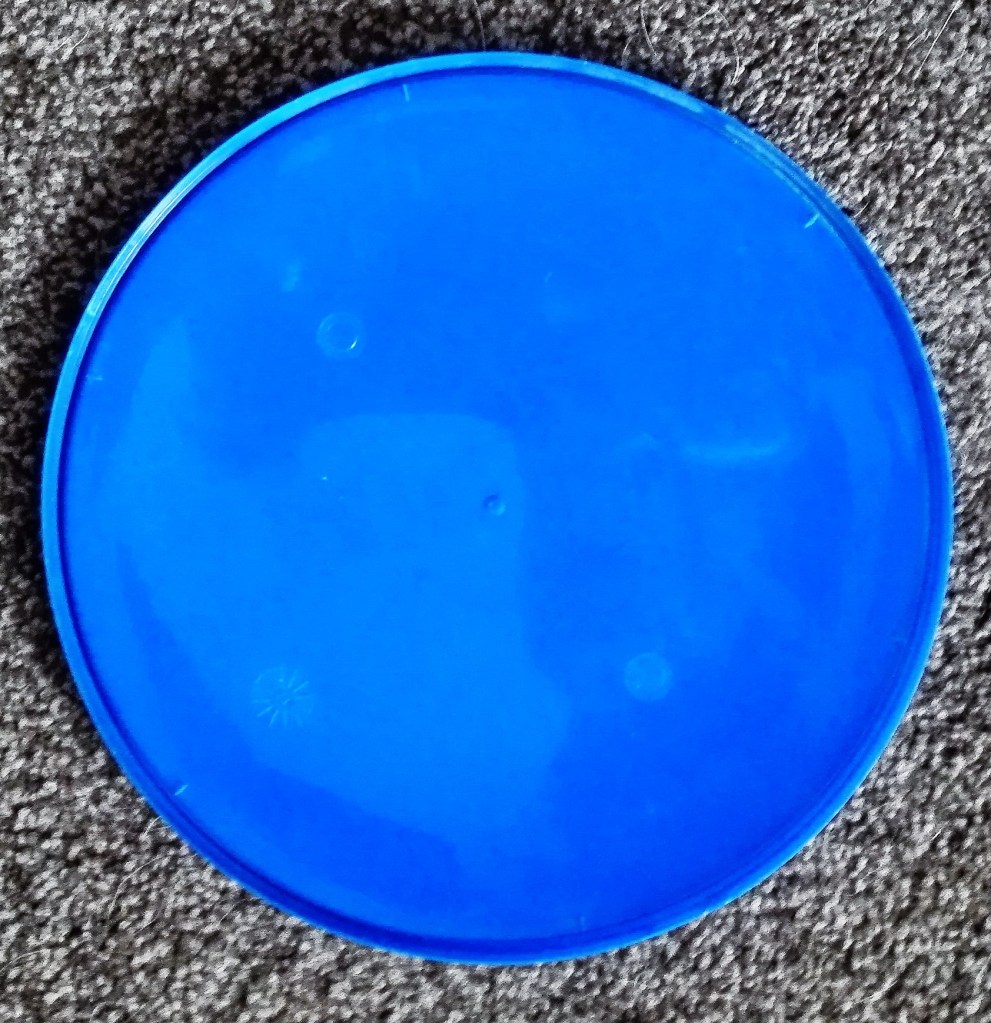
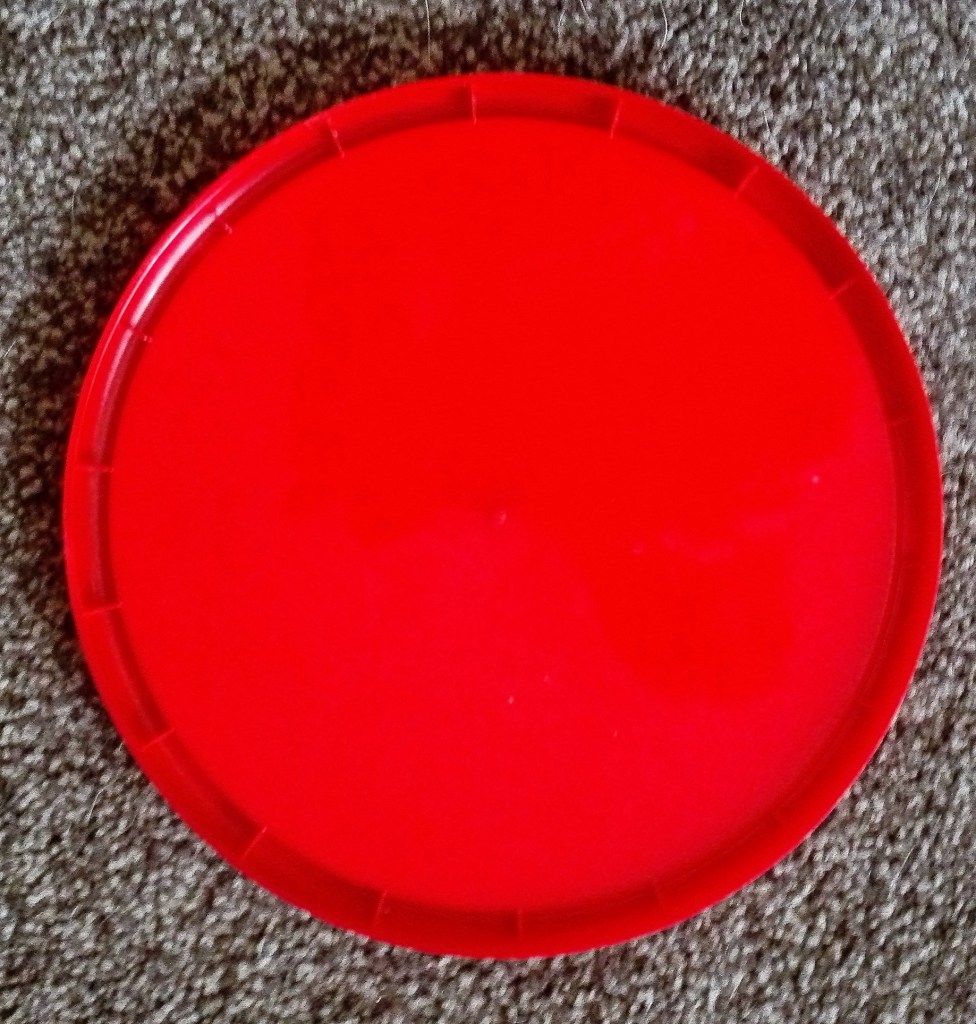
My choice of objects was limited to what I found around the house. I encountered difficulty in finding object of pure colour. Most items that I considered were multicoloured. Additionally I found that the need to be able to move the object to various locations limiting. Eventually I settled on three plastic sweet tin lids. These can be seen below photographed against a pale background.
Three coloured lids against a pale background
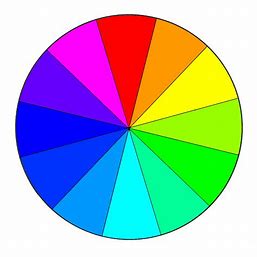
This photograph, taken in natural light, shows the three lids in their true colour as there is very little reflected light. I realised shortly after undertaking the exercise that the three colours were all on the same sector of the colour wheel. Would it be advantageous or detrimental to the exercise? From a colour mixing perspective it would make the reproduction of the differing shades, tones and hues easier to render. Two of the lids were in a primary colour and the third a secondary colour derived from the first two. The detrimental side of this was that I expected that the impact of the colour of the objects in different lighting conditions and situations would be less impactful.
Colour wheel
Another aspect that I noticed at an early stage was that the three lids were similar in that their surfaces were reflective. Any light that fell upon them would be reflected back rather than absorbed. Again, as per the limitations of the colour choice, this would have advantages and disadvantages. It would be advantageous in so much as I would know that the observed colours would not be impacted by their differing surfaces. All three would show the same characteristics. On the detrimental side I would not be able to observe the impact of non reflected light on the colours.
Armed with this knowledge I set about trying to explore how the colours were impacted in an array of different locations and lighting conditions. I recorded these via photography. My intention being, as explained in the opening paragraph of this blog, to try to replicate the observed colours on acetates that I could manipulate into a hanging 3D colour chart.
A selection of the photographs accompanied with a brief explanation is below.
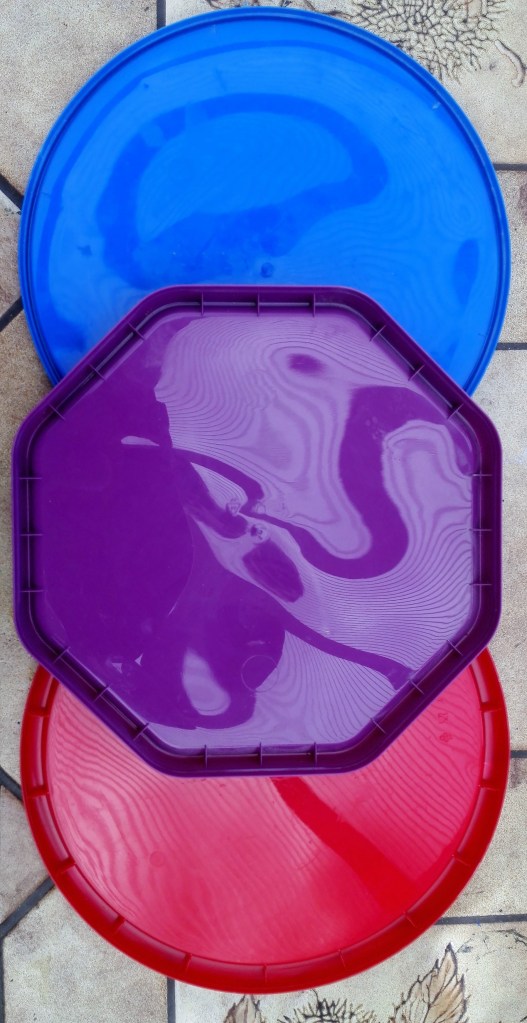
On Table top – well lit
The three colours stand out from the background, the reflection of the conservatory roof creates both tonal interest and patterns.
Against a dark plain background
Similar to the previous images the colours stand out but are slightly paler. This is due to two effects, the reflected light and the stronger contrast against the darker background.
On table top and floor in darkish room
In these images the true colours are observed as there is much less light.
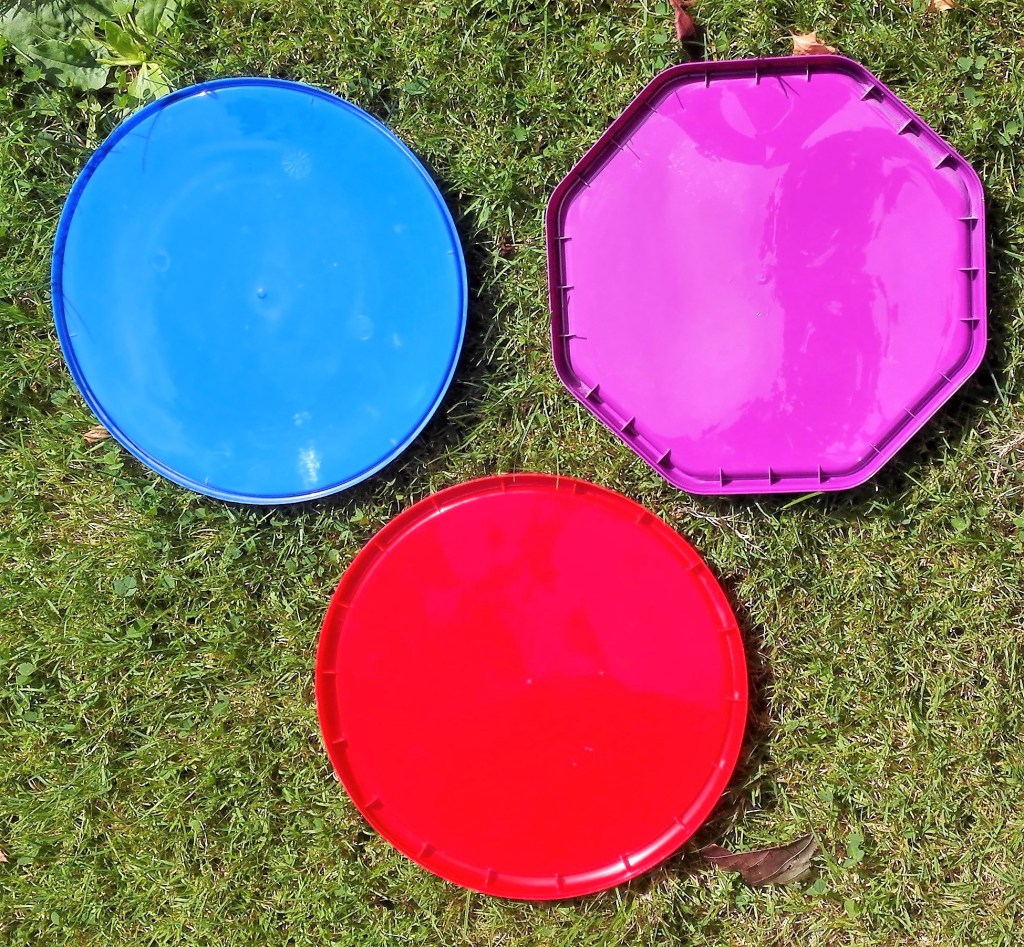
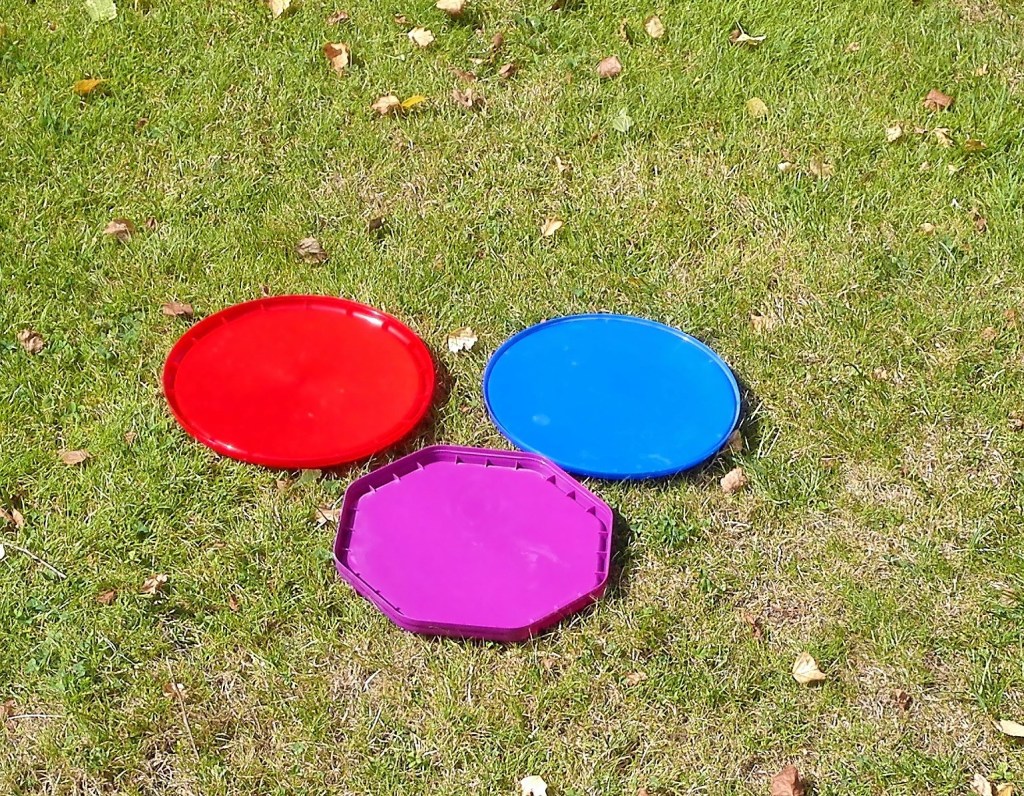
On grass
In these images it is noticeable, particularly in images 1 & 3, how the red lid shines out against the green grass.
In trees and undergrowth
Again the colour red dominates and is less reflective. This could be an accident of the positioning of the lid. Where there is reflected light it is intense.
On a red sofa
The red lid is partly absorbed into the background whereas the strong contrast of the blue makes it shine out. The purple lid being somewhere in between, not surprisingly.
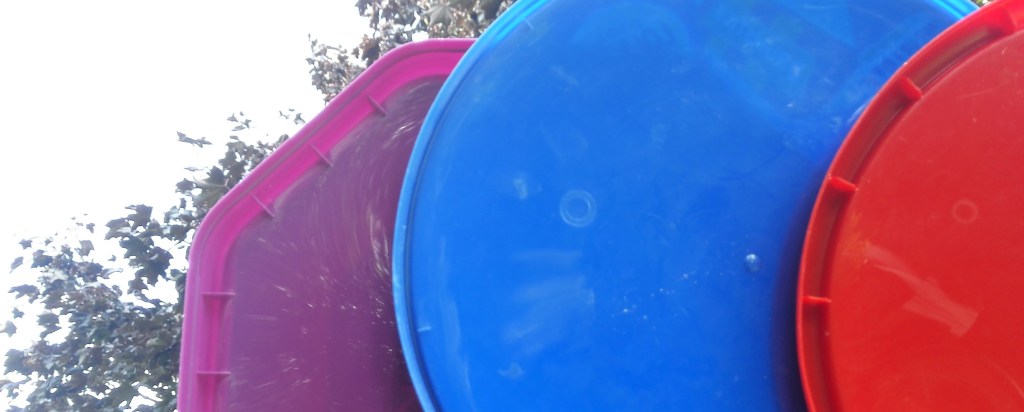
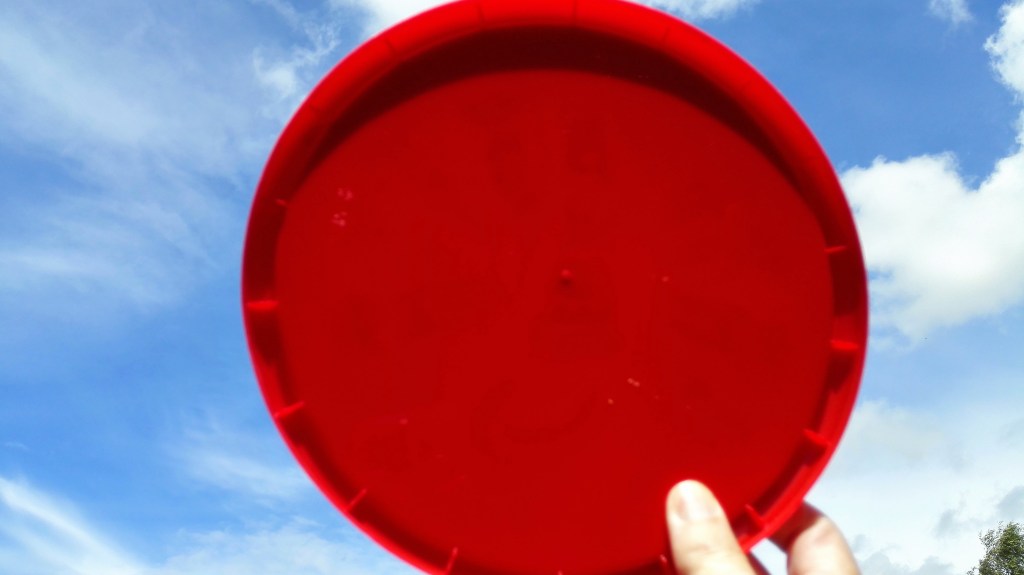
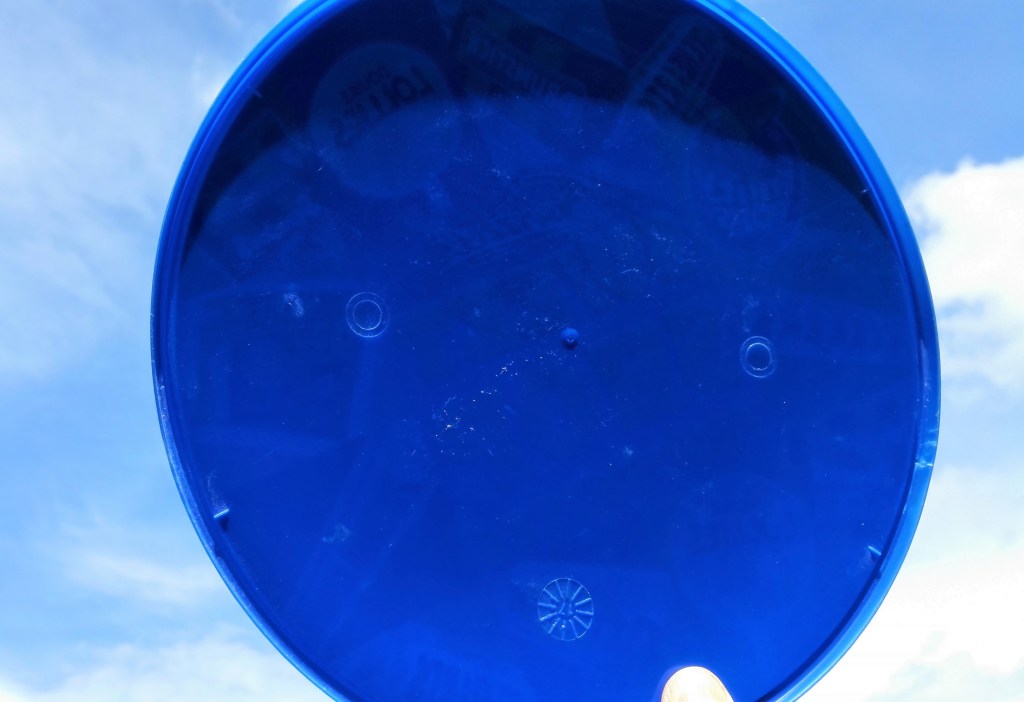
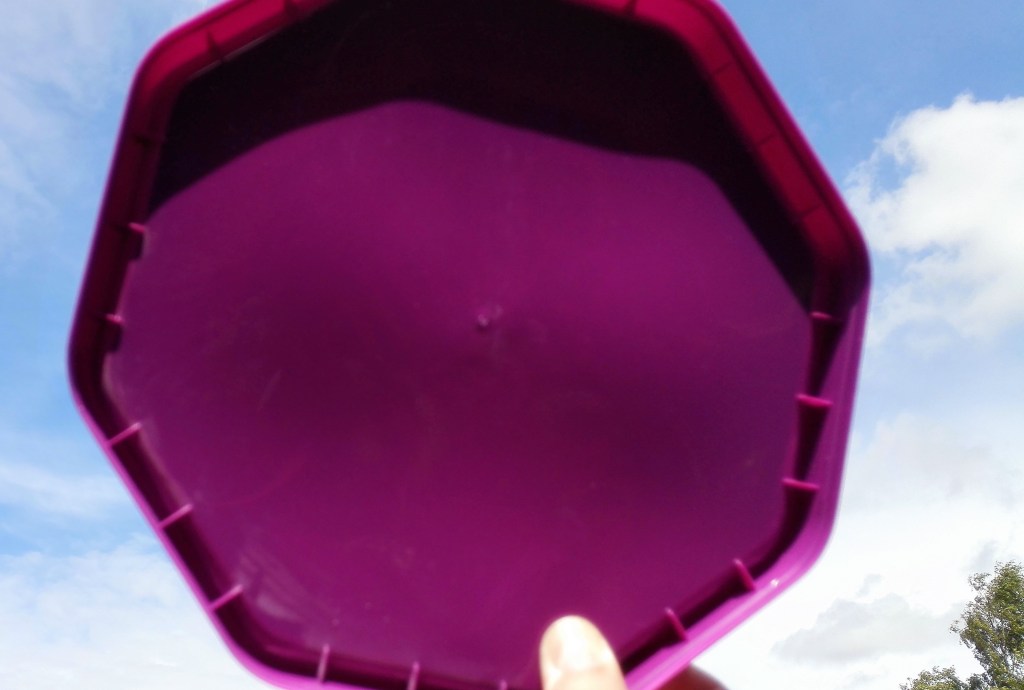
Together against the sky
Singularly against the sky
Against the pale blue sky, minimal light directly hitting the surface the colours of the three lids are vibrant. The dark shadow at the top of each lid will be a challenge to replicate.
Against a grey carpet in in medium natural light
The final set of images. This is as close as I got to what I would perceive is the natural colour of the three lids.
In summary the perception of colour is highly influenced light, surrounding colours and reflective surfaces. There are many more influences and impacts. Colour theory being a significant line of study in many forms.
This blog follows on from my previous one relating to using feathers as a medium. It was whilst working through that exercise that an additional experimental project was suggested to me. Painting with soap. I had noted previously in the course material the reference to Rashid Johnson using soap as a painting medium but hadn’t followed up this idea. Completely independently the suggestion to try to use soap to paint with had come from Marian, my wife. She had observed my struggles and seen the resulting feather paintings and suggested that I should try soap as a material. I was sceptical but agreed to give it a go. Marian makes soap, one of her hobbies, in doing so she uses different pigments, aromas and chemicals to create interest in the soap. I will document the soap making process later in this blog. The collaborative aspect of this project also appealed to me. I had to rely on a third party to supply my materials. However this is only slightly different from purchasing them from artists suppliers. Note that at this point I hadn’t seen the soap paintings of Rashid Johnson so was in no way influenced by them. The results, unsurprisingly, are entirely different.
The process started by the making of soap from first principles. Not being a chemist or understanding the process of saponification I have had to make notes from Marian. These are below……………………………
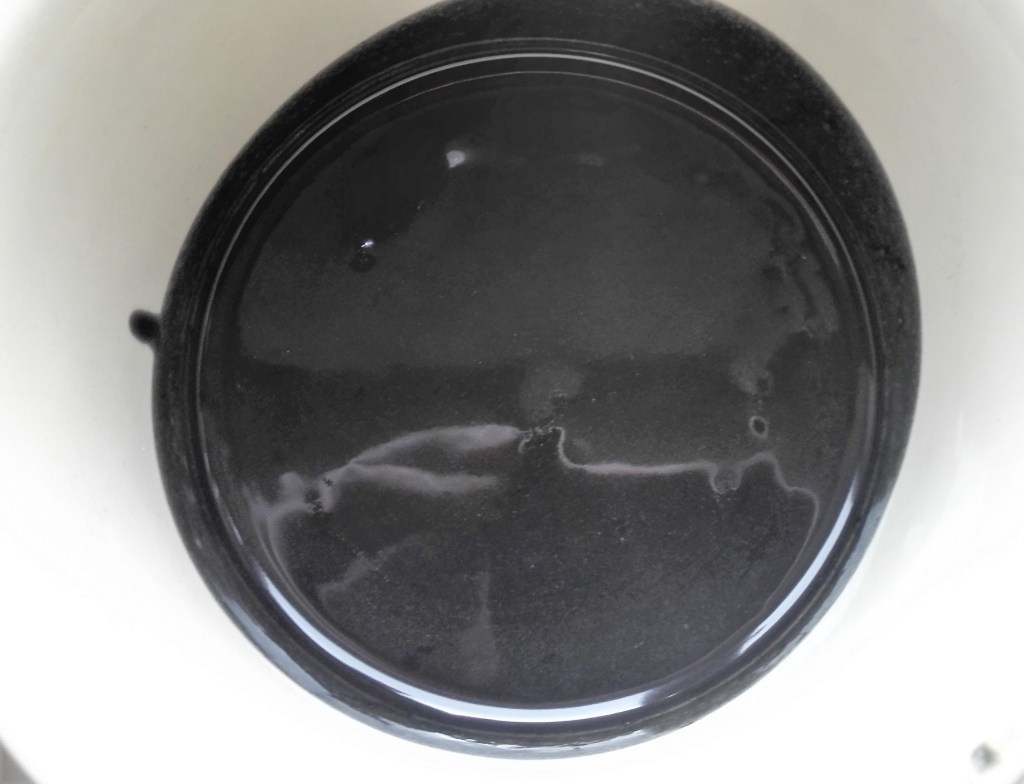
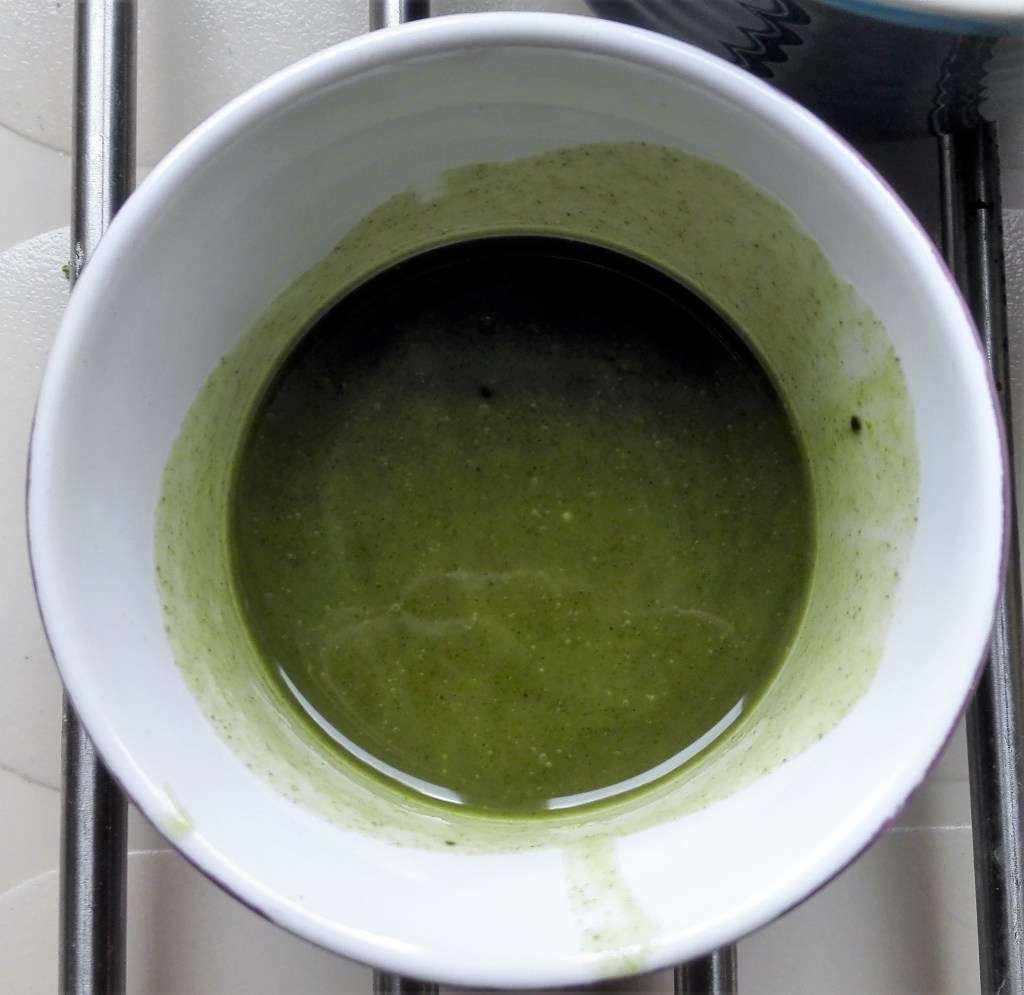
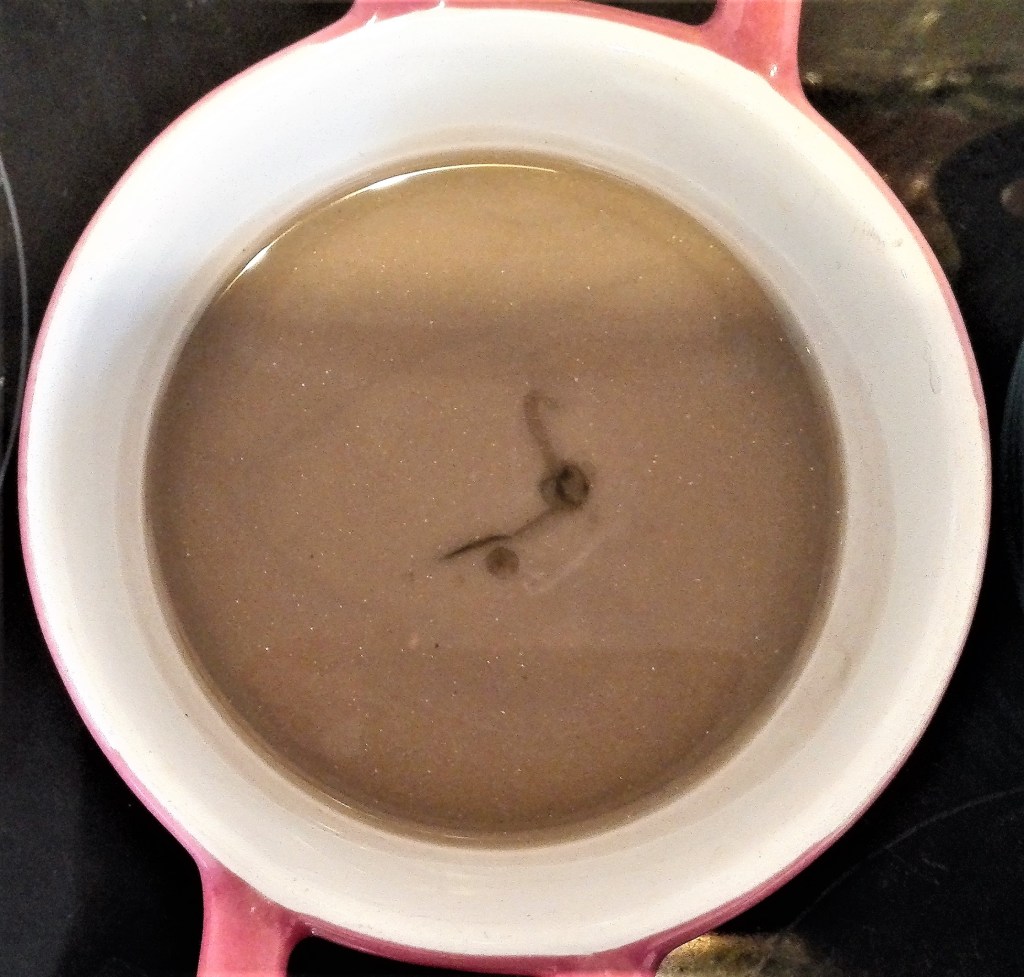
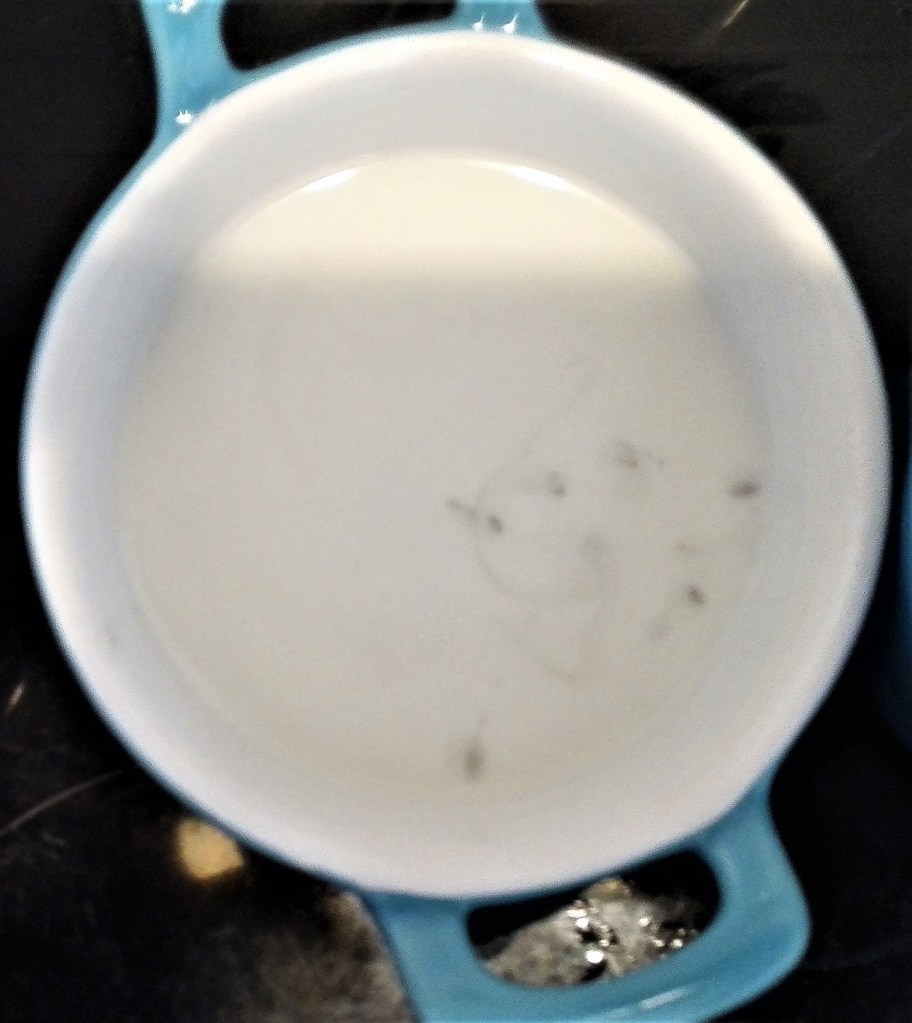
Cold Process SoapI’ve used a cold process soap that relies on the saponification reaction between the hydroxide portion of NaOH (Lye) and the fatty acid portion of various triglyceride molecules. The soap was made using sunflower oil and concentrated NaOH solution. The oil was warmed to a room temperature and the NaOH solution was added. The mixture was mixed using a hand blender until full emulsification was reached. This is a very liquid stage. The mixture was then decanted into several separate jugs and coloured micas, charcoal powder or spinach powder was added to achieve the desired colour palate. The mixtures were then blended again to a ‘slight trace’ and then used.
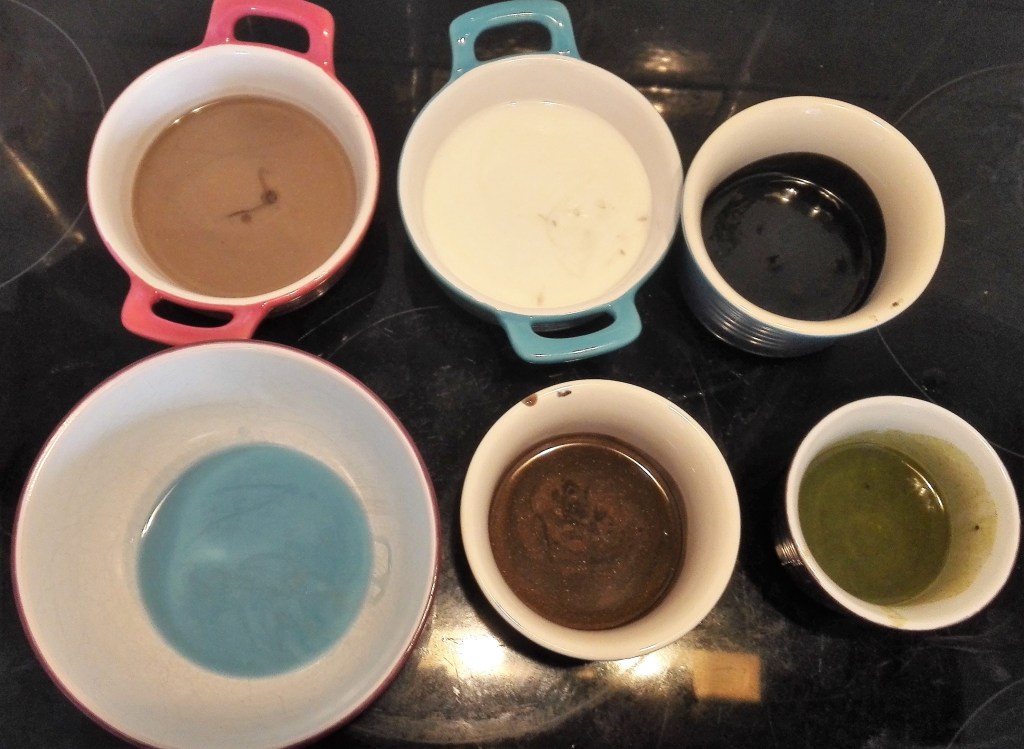
The six coloured soaps that were made from this process are shown below. These would be used for the painting. The corrosive nature of the soap prior to its chemical reaction meant that I would have to wear rubber gloves and be careful not to get any material on my skin. No scratching my nose whilst painting.
Dark Brown
Dark Grey / Black
Green ‘Olive’
Light blue
Light Brown
White
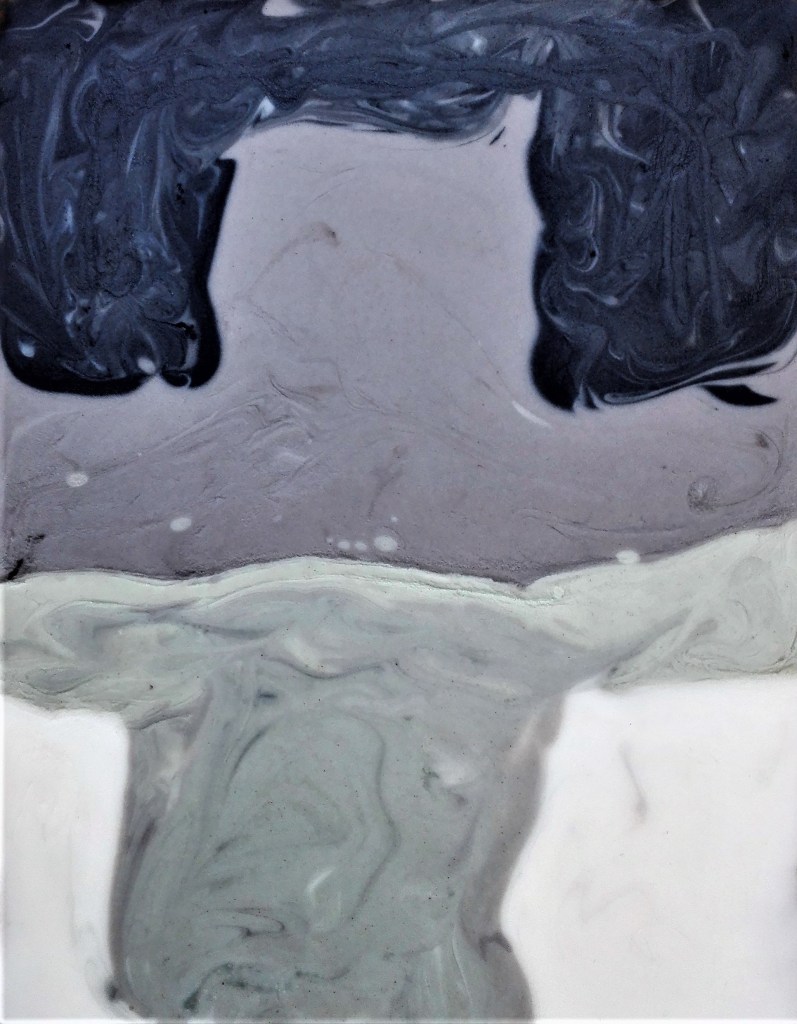
Two supports were also created these consisted of soap poured into trays. The coloured soap would then be applied via palette knife to build up a painting. The soap supports when laid down with material measured 19 x 25 cms. The depth of the soap is approximately 0.5cm. Interesting to note at this point that the material is also the support. Prior to painting this is how the supports looked. They could be, and are, paintings in their own right. They are the result of pouring the soap, a technique that could be used to create soap abstract soap paintings. They no longer exist in this form.
Soap supports
My aim was to exert some control over the process. The pouring had created paintings but I wanted to take the act painting with soap to a more interventionist level. To do this I would use palette knives to paint with.
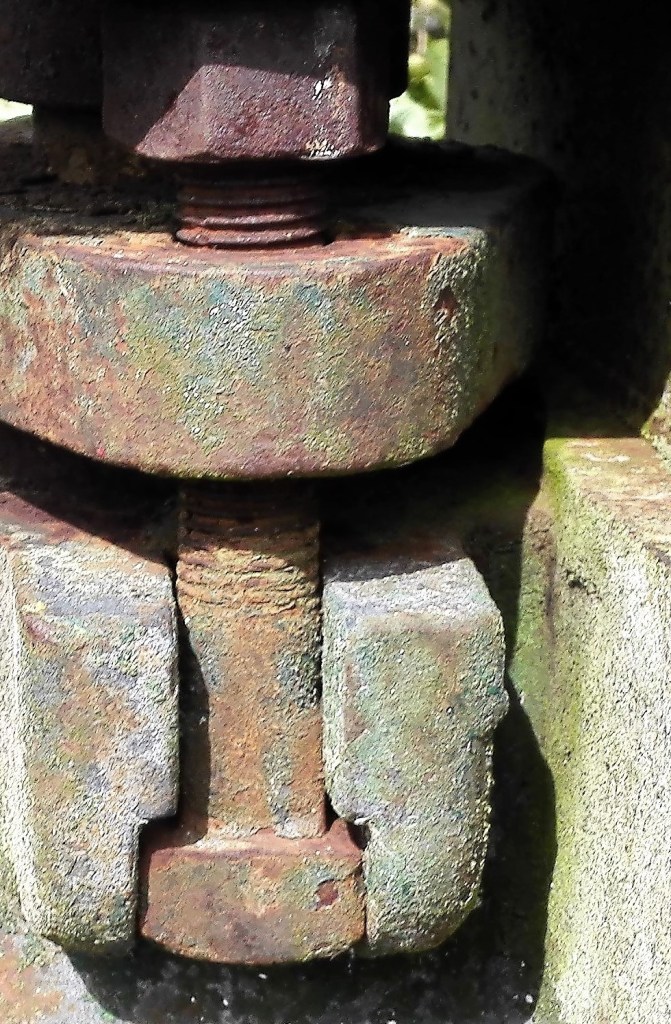
Throughout the project I had an image in mind that I would use as the template for the painting. It was a further image taken from the old pump series that I had used for some of my initial Parallel project paintings. The photograph would predominantly be used a shape, colour and tone guide.
Section from Old pump
I would work on on both supports simultaneously. This was partly necessitated due to the ‘open time’ of the material. This gave me several hours to complete the paintings before the chemical reaction would render the material unusable. The first painting became the more experimental of the two as I was testing out how to apply the soap material. They way it reacted with the support and how to mix and blend colours. The soap had a buttery texture which allowed it be applied in both spreading and dabbing motions. I found that it mixed reasonably well and variations of colour and tone could be achieved.
The work in progress:
It was more difficult to draw partly due to using palette knives. In was during the second painting that I found a solution for this. By pushing the knife into the support this created a line on the surface. I found that I could manipulate this into controlled curves or straight lines. The act of cutting into the support layer changed the textures of both the support and material giving a textured effect. Armed with these techniques I proceeded to create the following two paintings on which I will discuss my thoughts on the results.
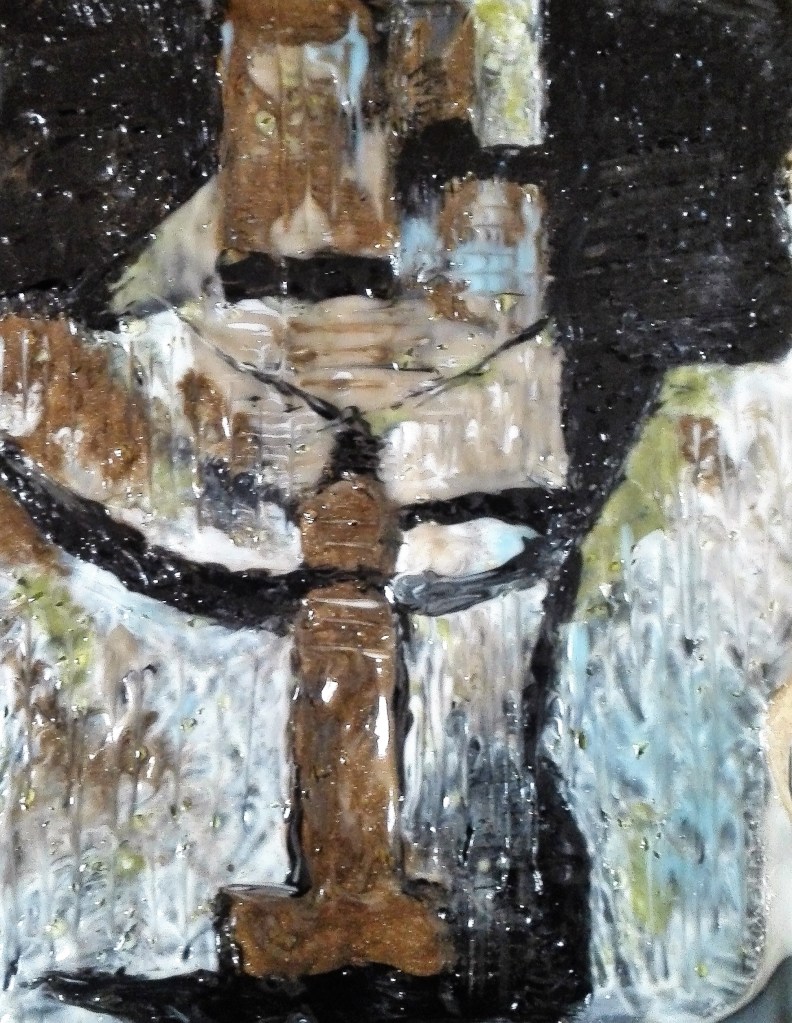
Soap Painting 1
Soap painting 1
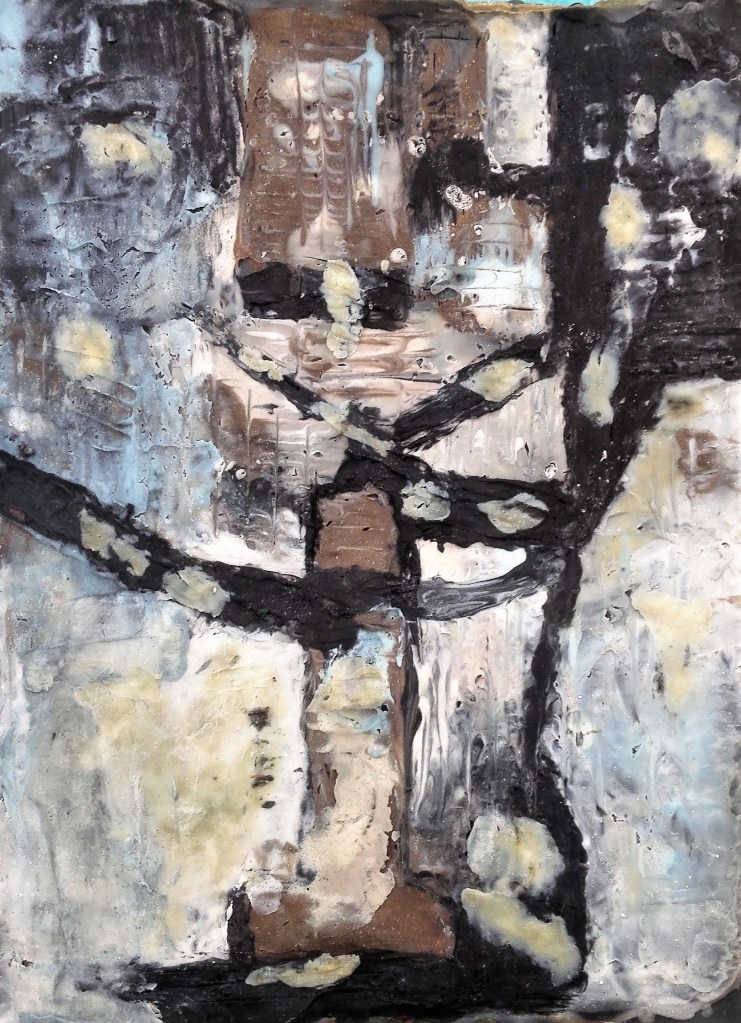
This abstract work invokes a feel and look of damp decay. Dark recesses, faded paint, mildew, exposed plaster. A neglected corner of a building ravaged by the effects of water and time.
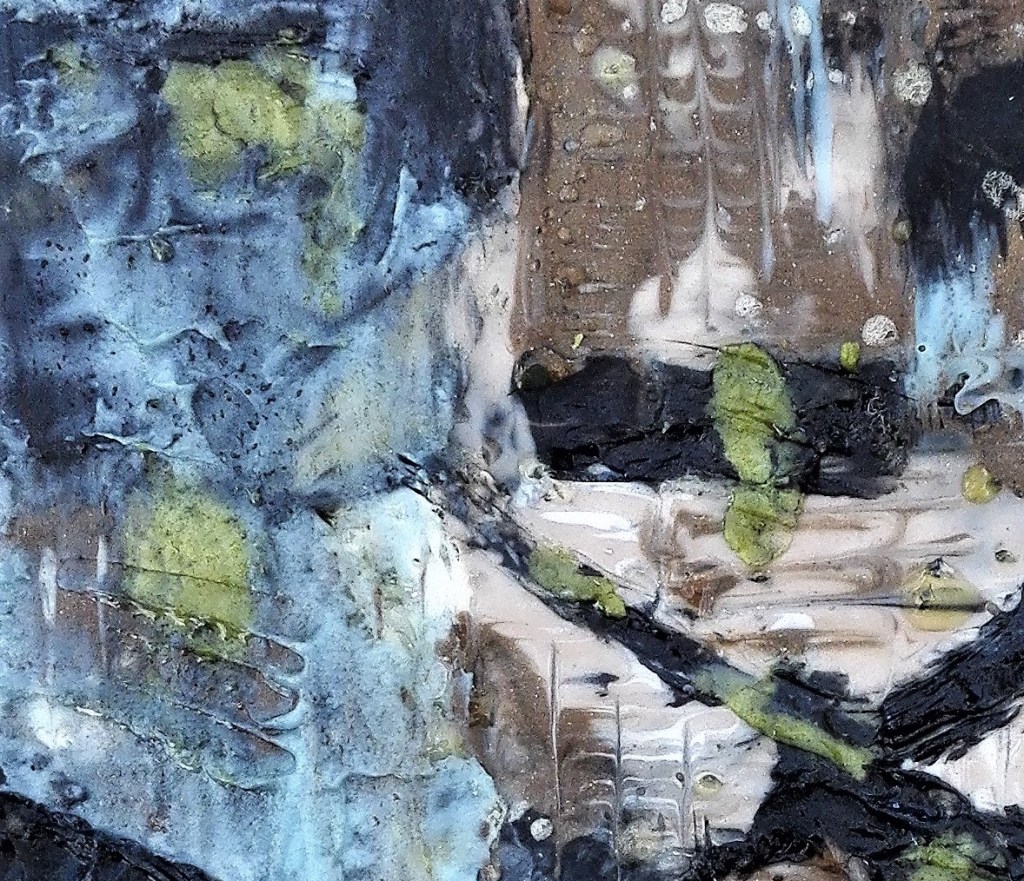
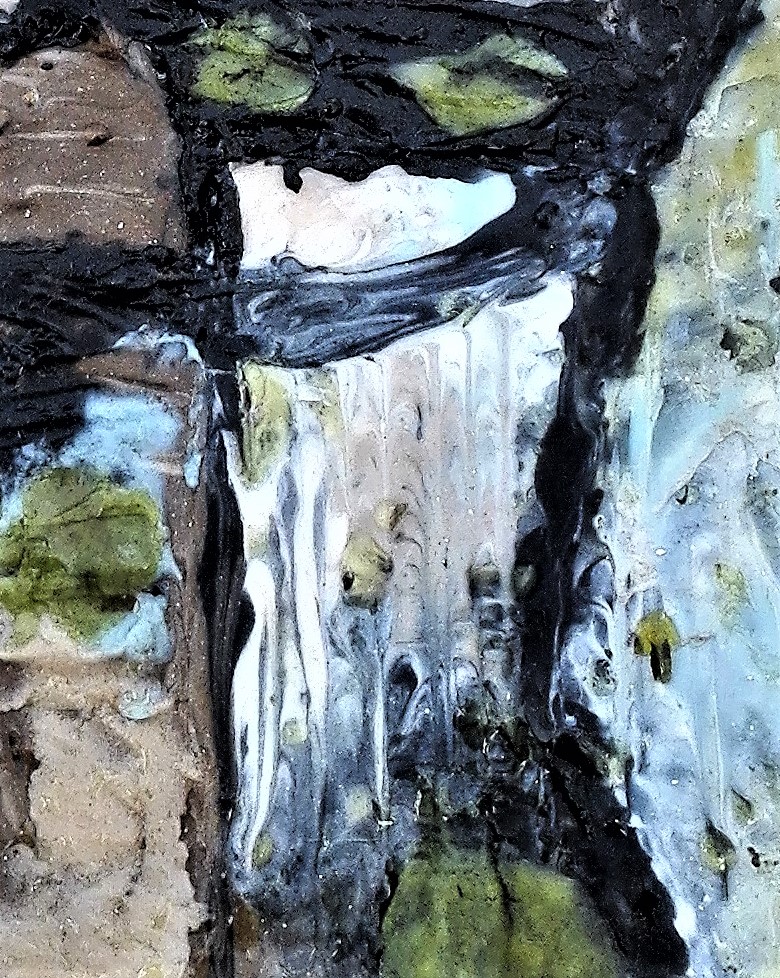
The textural aspect of the soap, the act of its application, its translucent properties when applied thinly and the way in which the colours mix together can be observed in the two close up views below.
Two Close up views of Soap painting 1
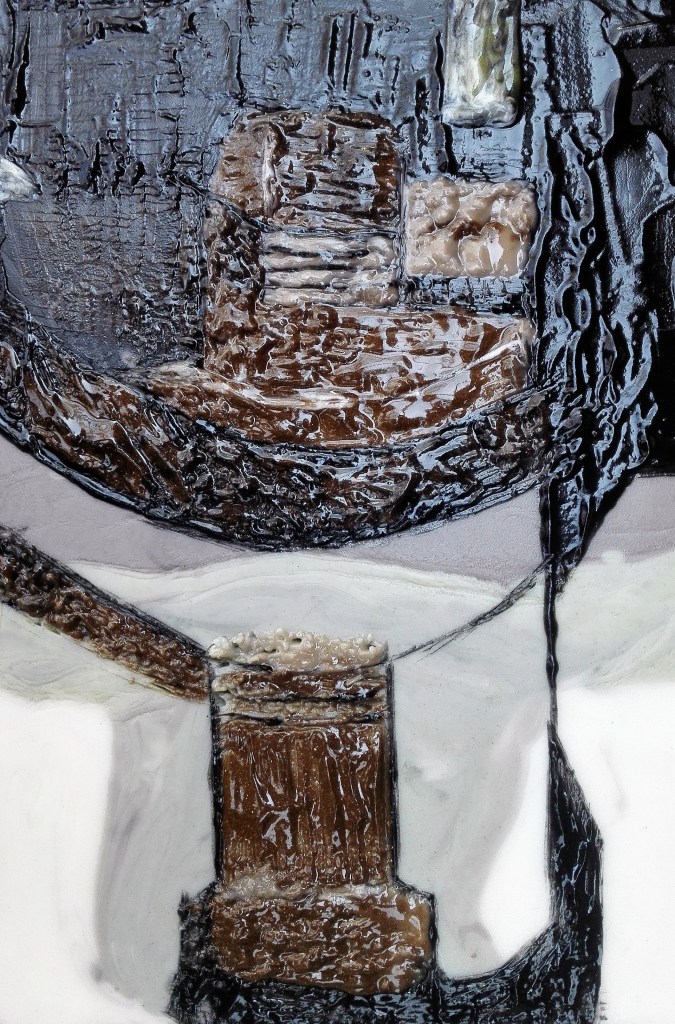
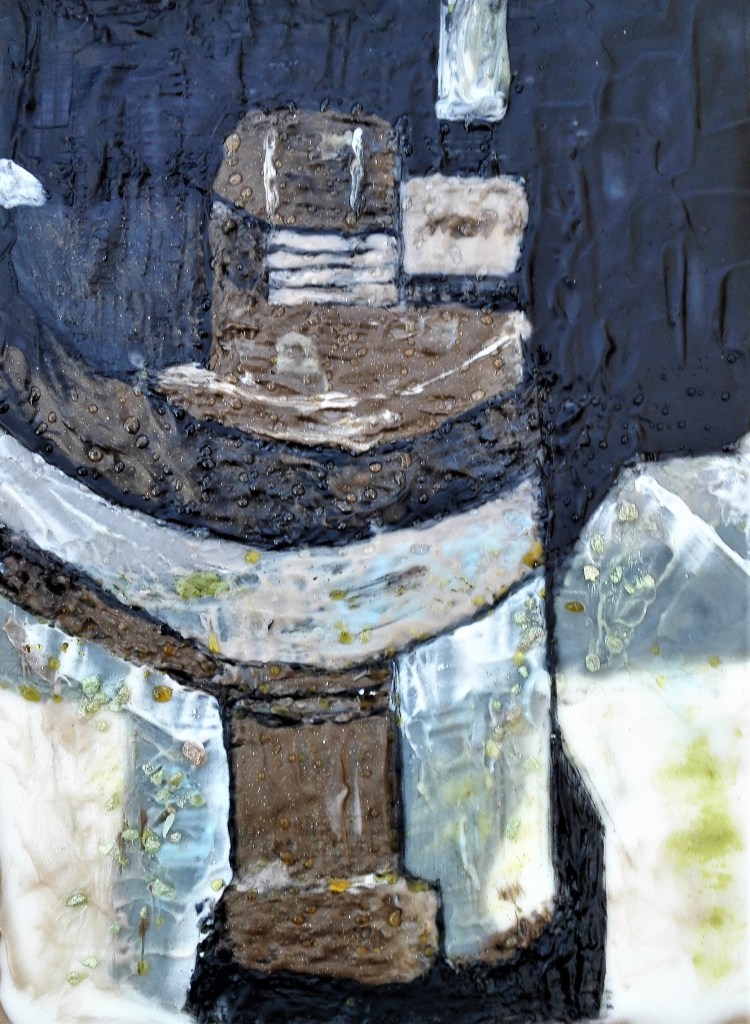
Soap Painting 2
Soap painting 2
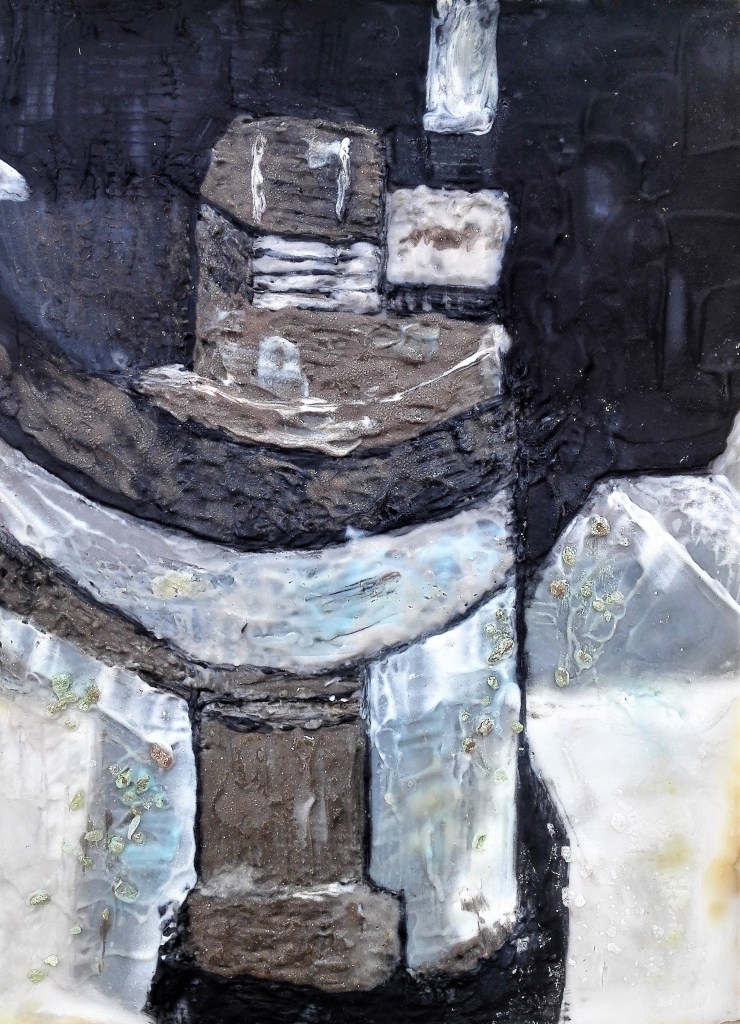
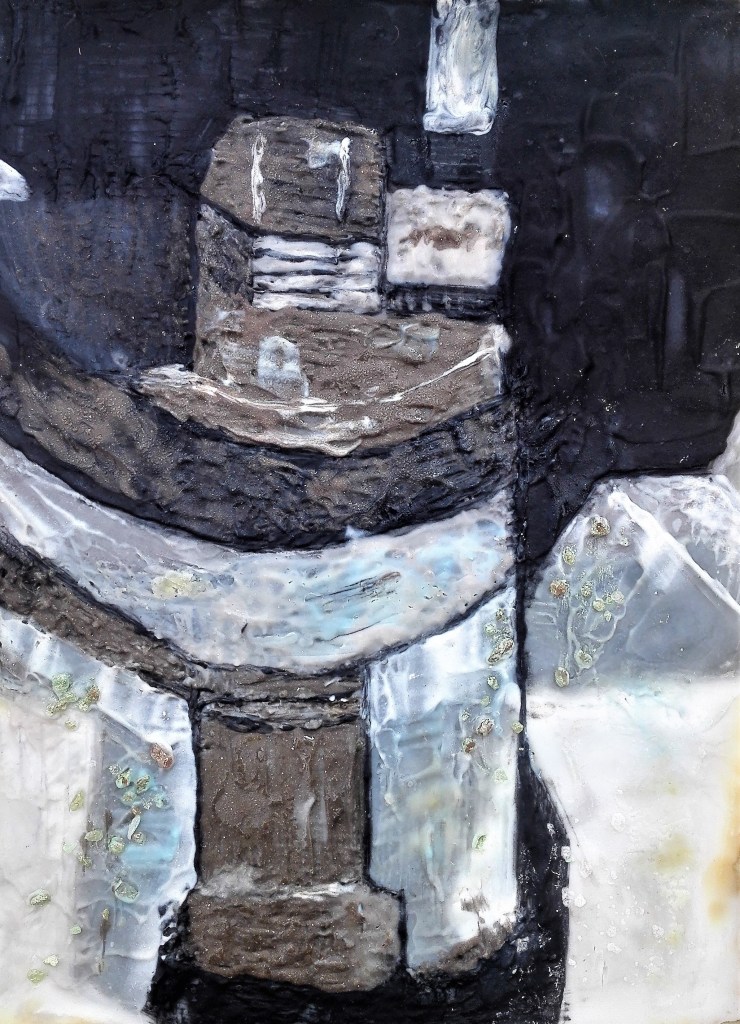
In this abstract painting there is evidence of form. This is loosely described leaving much to be explored and imagined. The control of the application of the material is evident. The addition of pigmented salt to the surface adds to the rough look.
Summary, the project has been successful in its learning points, the challenges of the material and the resolution thereof, and the outcome. Whilst I doubt that soap will become my material of choice it is certainly an option. In having to adapt the methodology of applying material it has opened up new avenues to explore further.
Lastly to quote Rashid Johnson in his interview with Alistair Sooke “at the end of the day you can cleanse yourself with the painting”.
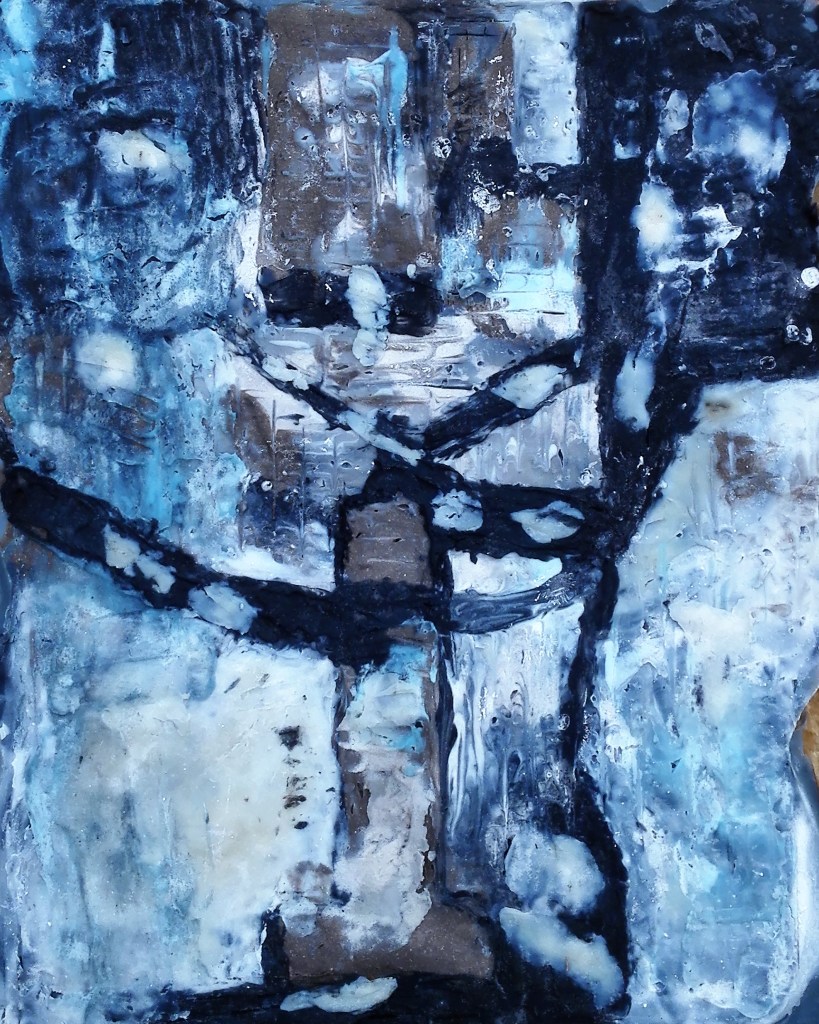
Post script: I have noticed that as the saponification process takes place the colours have faded quite dramatically. The green has now become a pale yellow meanwhile the light blue has become more prominent. There is also some bleed through from the lower layers which has increased the translucent effect. This is particularly noticeable under the white. I expect that this effects will continue until saponification is complete. I will document this with a number of photographs which I will post below.
The Soap paintings after two days, saponification still some way off. The material is still very flexible and soft.
After 10 days the saponification process is almost complete and the paintings could be used as soap. In their current shape the would be rather awkward. A better option would be to cut them into cubes. The deterioration in the colours has slowed and I suspect that they have reached a point where they will maintain there current status for several months, if not much longer. To my mind the second soap painting is much the better result. The clear delineation between the parts of the painting, defined by the carefully painted black lines help to give a sense of shape and coherence. It looks deliberate. By comparison the first painting looks a little messy but does have a sense of abandon and has retained a look of deterioration. It is also very noticeable how the blue has become far more prominent. This is partly due to the different lighting conditions when the photographs were taken. However I notice that it is less pronounced in Soap painting 2.
I found it difficult to muster enthusiasm for this project. I have explored different and unusual painting mediums previously and have always returned to paint, either acrylics, traditional oils or aqua oils. I believe that I have become comfortable with these materials although I realise that I have plenty more to discover about these materials. Their application, the way I can apply them. The options seem to be endless. I also consider myself to be, primarily, a painter. My chosen method of communication is via paint. Although I can see the merits in trying out different mediums and this in turn can open up other avenues of exploration i don’t feel that this is beneficial to me at this time.
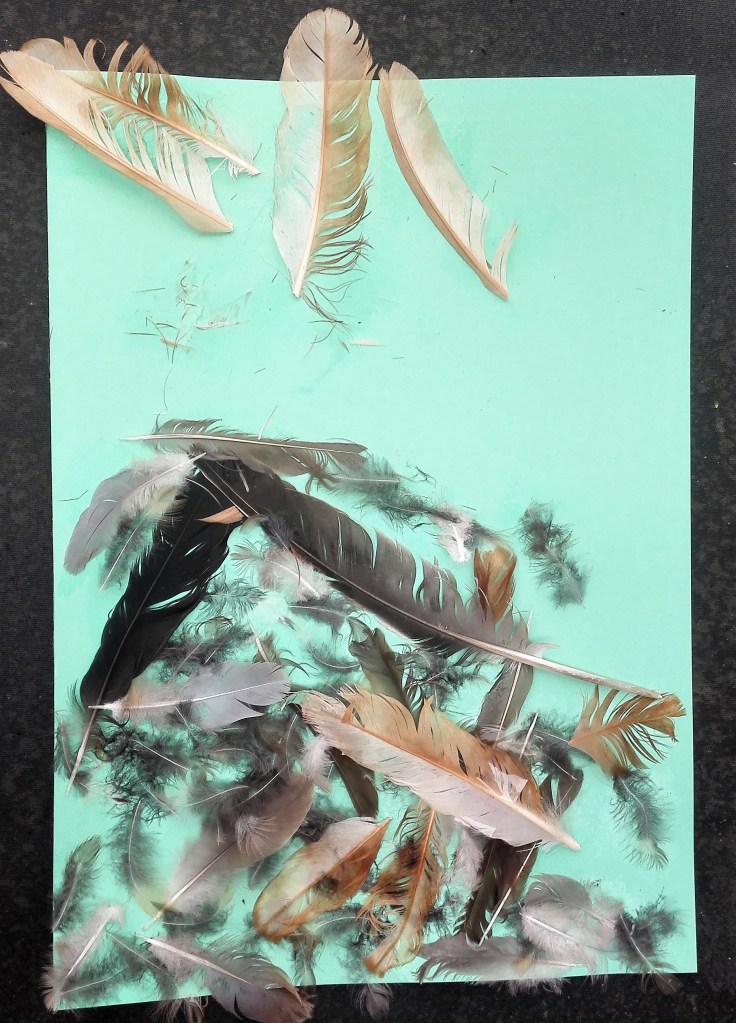
It was with this in mind that I approached this exercise, less than enthusiastic. My first idea was to create a collage type painting using the feathers from one of our chickens plus the remnants of a pigeon that had been mauled in the garden. It was mainly the practical things that took my thinking. How to arrange the feather and how to adhere them to a support? The first method was to apply PVA adhesive to card and stick the feather to it in a random fashion. The result was a disastrous mess.
Feather painting
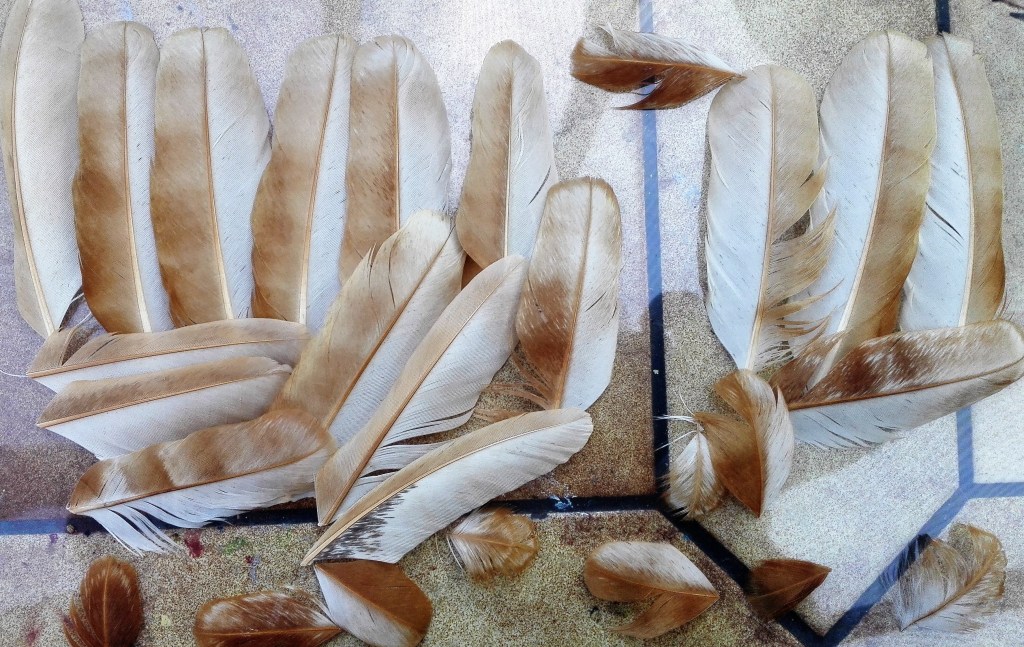
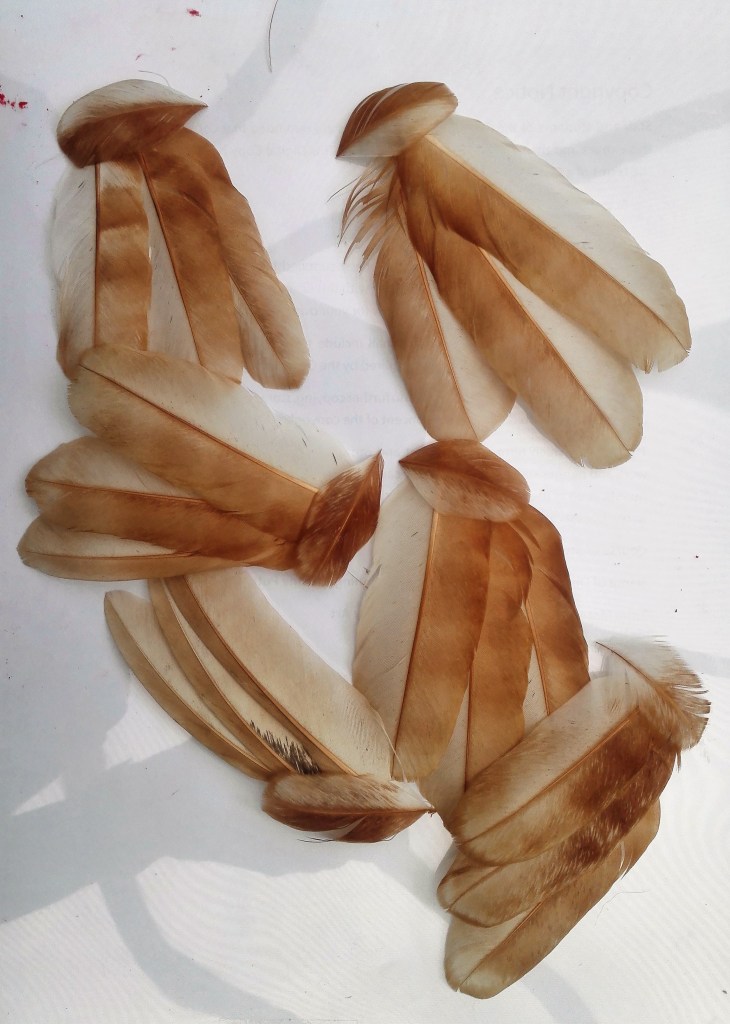
Next I took a more considered approach to arrange the chicken feathers in various shapes and patterns until I had one that I thought would try to make permanent.
Work in progress
Feather arrangements
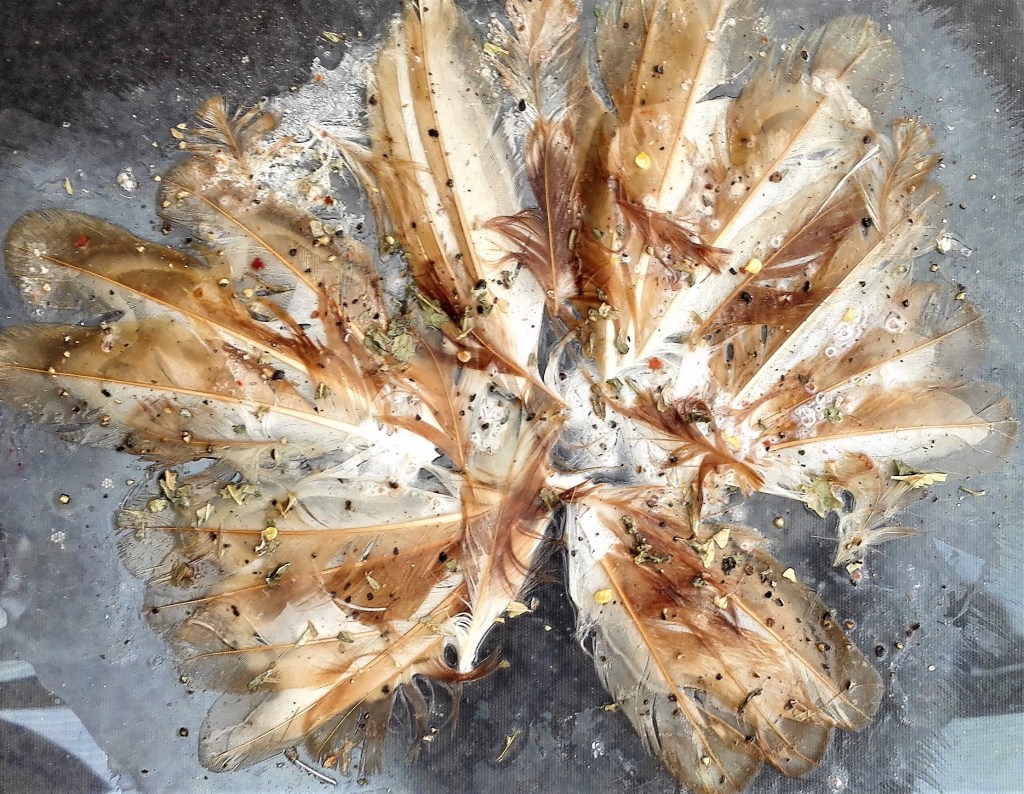
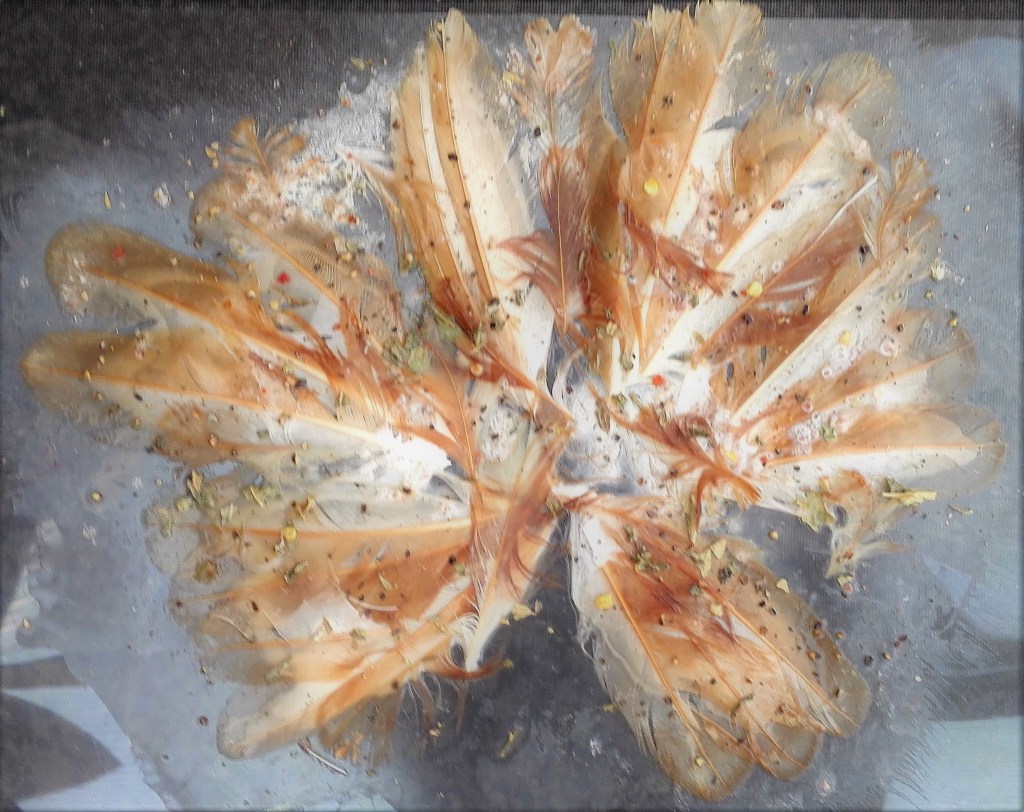
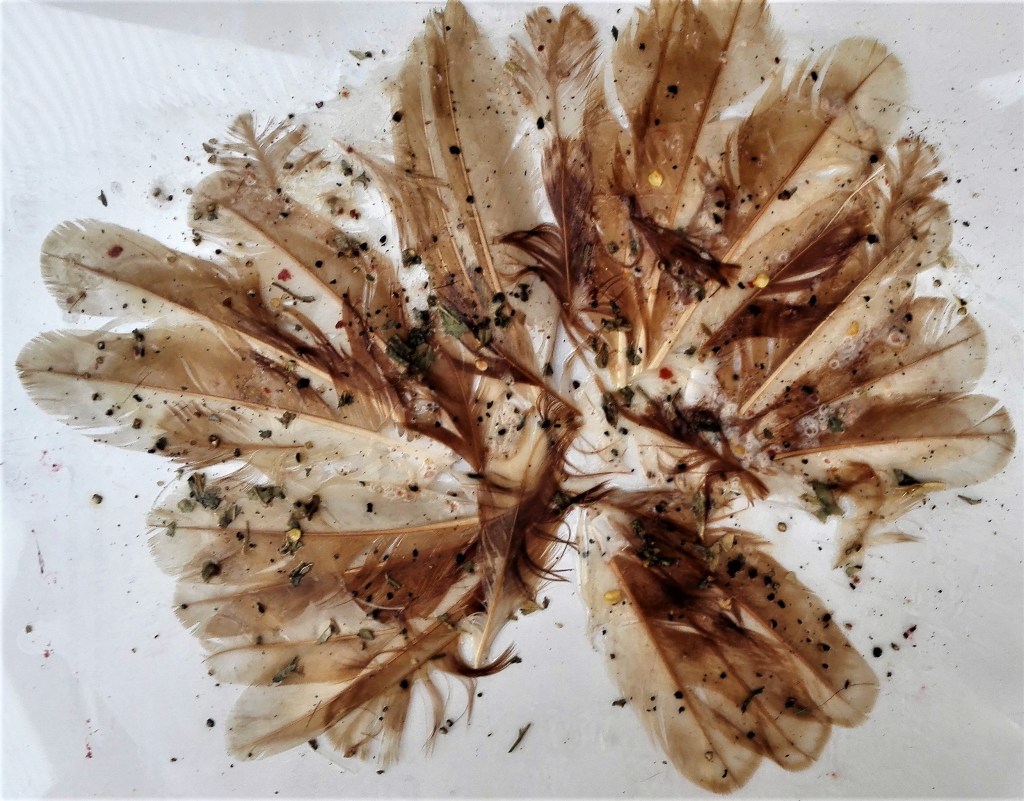
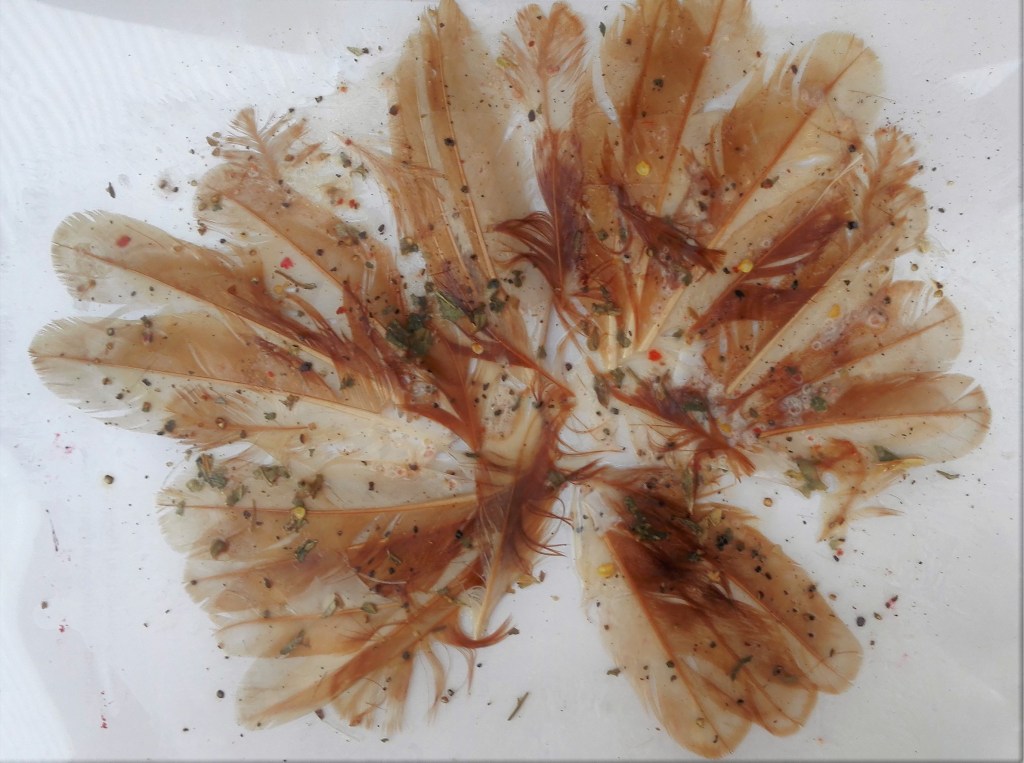
I encountered the same problem of how to adhere the feather to a support. I had chosen to use an acetate as the support as I imagined that the resulting painting could have multiple viewpoints. Note I now realise that using PVA adhesive to fix feathers to a support is not a good idea. The PVA ruins the feathers by ruffling them up. Also it doesn’t hold the feathers in place whilst it is drying. This makes the arrangement difficult to maintain. Applying sellotape to hold them in place doesn’t improve the process. Whilst the PVA was wet I added salt, pepper and some dried mixed herbs. At least the chicken was seasoned!
The resultant collage is reproduced in four formats below. I used two backgrounds, one dark, one white to take photographs. The photographs were enhanced by either sharpening of softening the images.
Four photographs of Feather collage
I realise that rather than a experiment with alternative painting materials I have created a collage with chicken feathers. This misses the point of the exercise I know.
It was whilst working through this exercise that an additional experimental project was suggested to me. Painting with soap. I had noted previously in the course material the reference to Rashid Johnson using soap as a painting medium but hadn’t followed up this idea. Completely independently the suggestion to try to use soap to paint with had come from Marian, my wife. She had observed my struggles and seen the resulting feather paintings and suggested that I should try soap as a material. I was sceptical but agreed to give it a go. I will document this process and the result in a separate blog. Note that at this point I hadn’t seen the soap paintings of Rashid Johnson so was in no way influenced by them. The results are, unsurprisingly, entirely different.
I’ll start with the quote “What does it mean to give agency to the material, to follow the material and to act with the material?”
I look at that quote and wonder whether it is something that I am learning to do. My relationship with the materials that I use, have used continues to change and develop. More and more I am finding that I am allowing materials, particularly paint, dictate the direction of a painting. This is particularly true for my experimental work, less so for my paintings where the pictorial considerations are more apparent. I have in my mind the notion that I should allow, give agency, to the materials I use, but how much? Am I comfortable to be dictated to by material, to give it control over my painting? Would this remove me from the process?
I believe that the answer to these questions will be seen in my work as I search for further refinement to my style. It seems to me that there will be a line that will be drawn where there is a balance between how much agency I give to the material and how much I retain. The best examples of this in my work outside of the experimental pieces are two of the paintings recently completed as part of my Parallel project. These paintings may not end up as the pieces I submit as part of the project, but at this stage they show a direction of travel, whereby I am allowing the paint itself to inform the work. I am allowing the material to have some agency. Is this right, should not agency be demanded, taken for itself. If so can material really have agency?
A comment or quote that is often used by artists is ‘happy accident’. I feel that this is a useful but misleading phrase. In most cases the artist has made conscious decisions to place materials, colours and prepared surfaces in direct competition with each other and is looking for a result. That the actual result is unknown is not entirely true. It is expected that the confrontation will give something back. This can then be accepted, changed or removed. The artist is making these decisions not the materials. Agency has been given to the materials but in a controlled manner. To me this is the nature of experimentation and discovery. A continual process of gaining knowledge and experience.
I have done this the wrong way round. Having completed Project 1 & 2 and the relevant exercises I have got round to researching the artists that were recommended to investigate. I will assess in this blog whether I believe they would have influenced the work that I have completed.
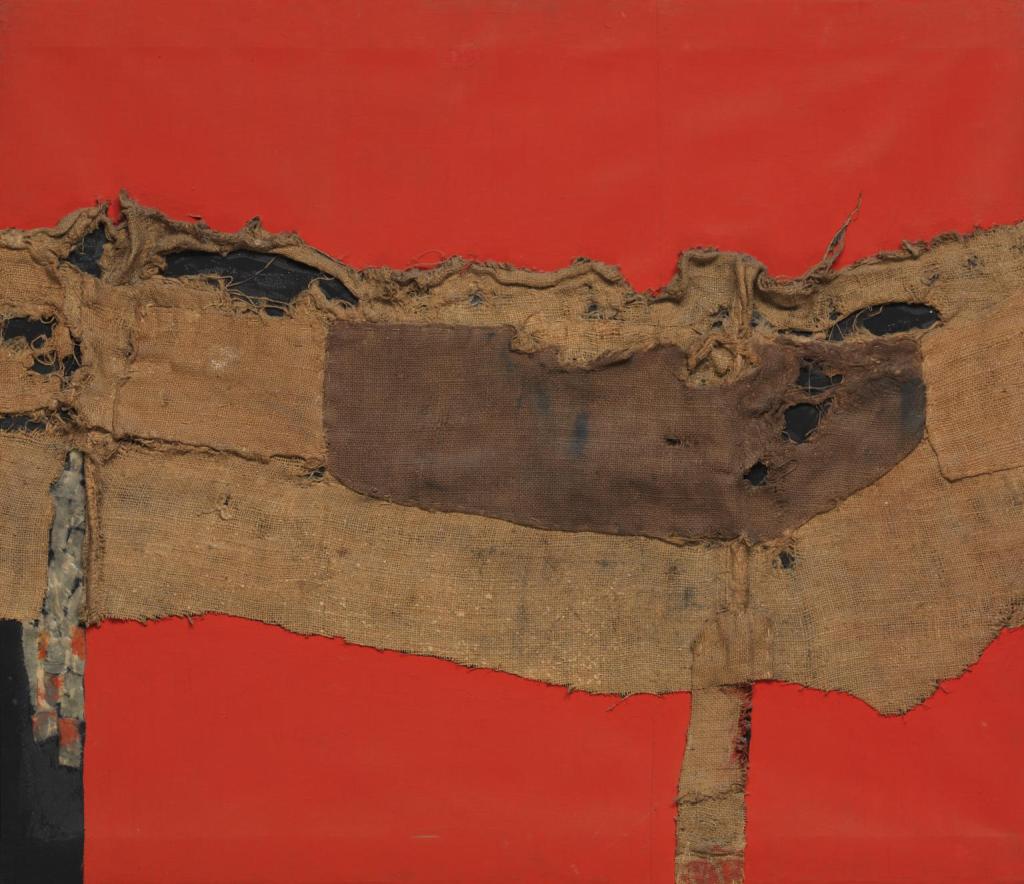
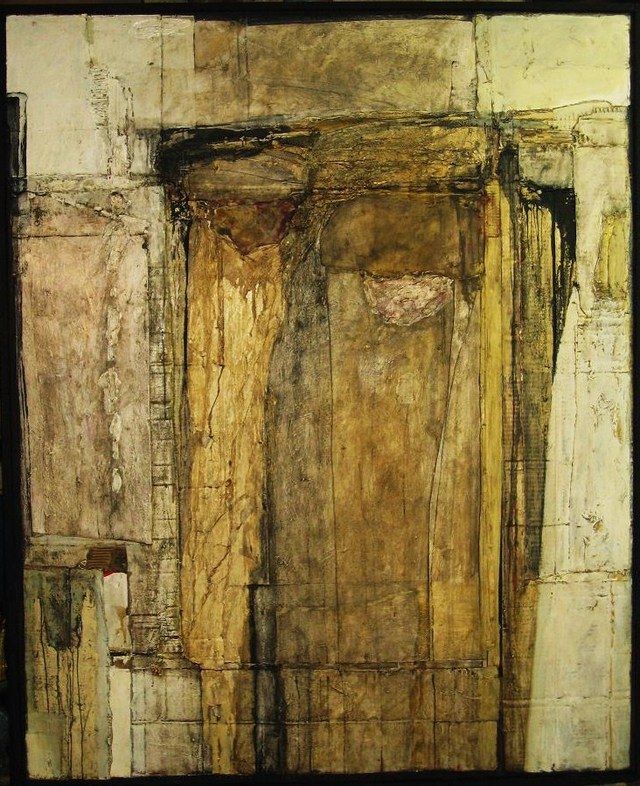
The first artist that was suggested was Alberto Burri, 1915 – 1995, who apart from being a painter was also a visual artist, sculptor and physician. The two painting that interested me were ‘Sacking & Red’ and ‘Assemblage’ both of which I have added below. It appears to me that I have explored similar techniques in my work. Although I note that the colours are much more muted than mine. Should I explore further but use a more harmonious, Fenland inspired, palette?
Sacking and Red 1954 Alberto Burri 1915-1995
Assemblage
Two paintings by Alberto Burri
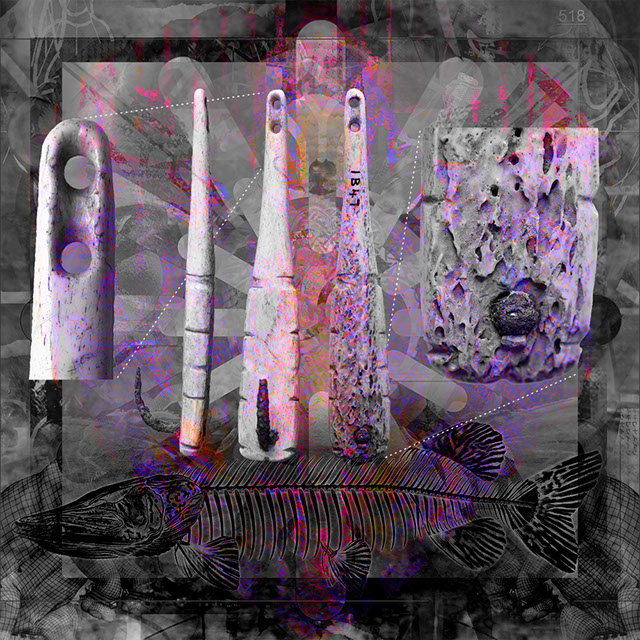
The work that I looked at by Will Kendrick, 1983 -, was more a mixture of installations and sculptural works. The work ‘Architecture of a Spectral city’, shown below, is a colourful mixture of sculpted objects against a layered background.
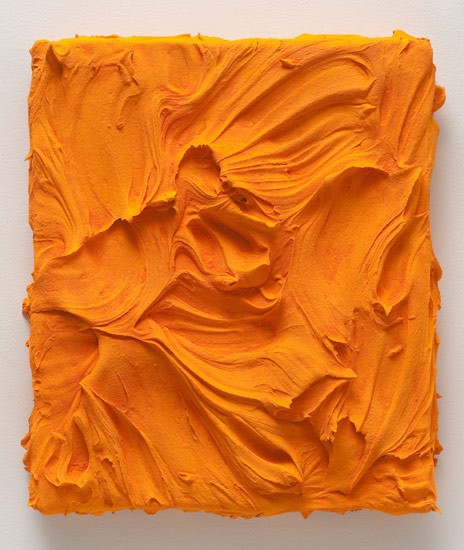
Jason Martin, 1970 -, works in both two and three dimensions, seemingly at the same time. The works are somewhere between painting and sculpture. Often his works are in pure colour, the example below, ‘Rajah’, is created from pure pigment on panel.
Jason Martin, Rajah, Pure pigment on panel, 65 x 56 cm
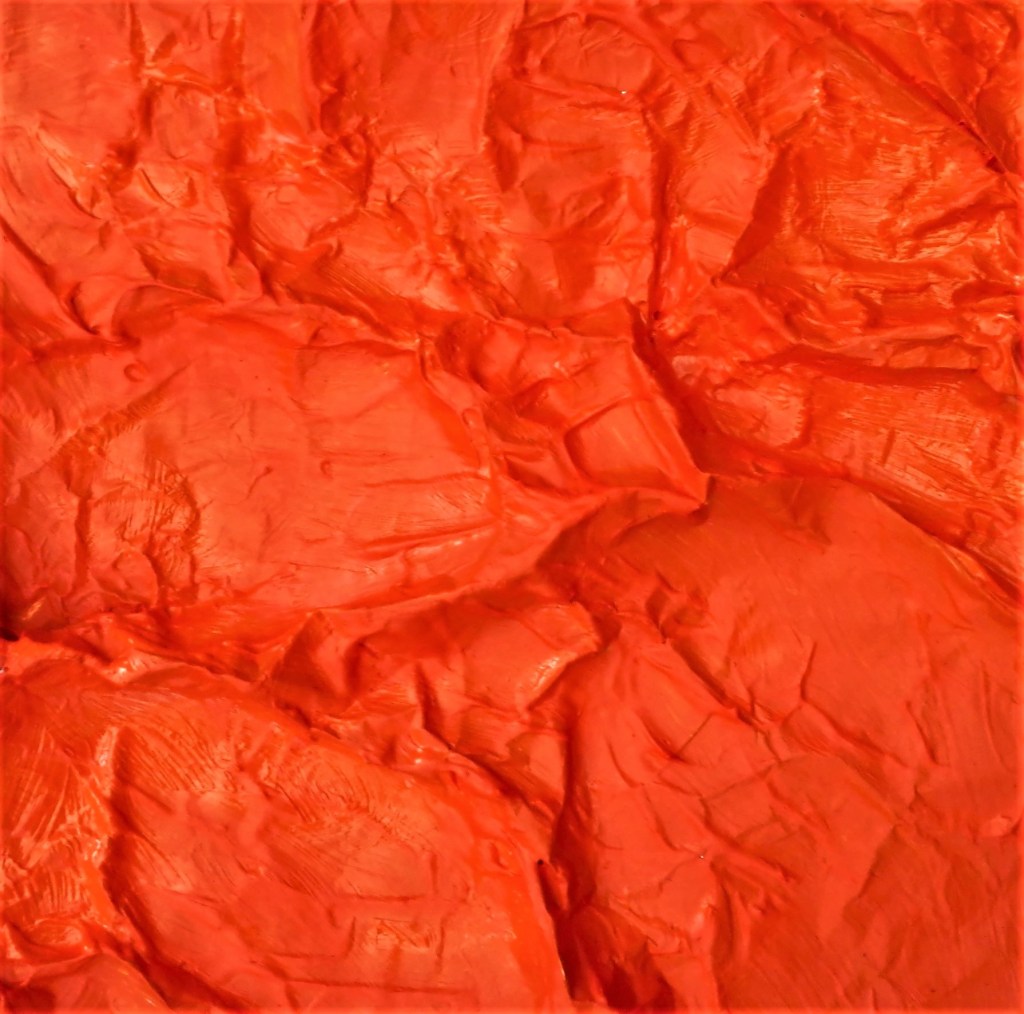
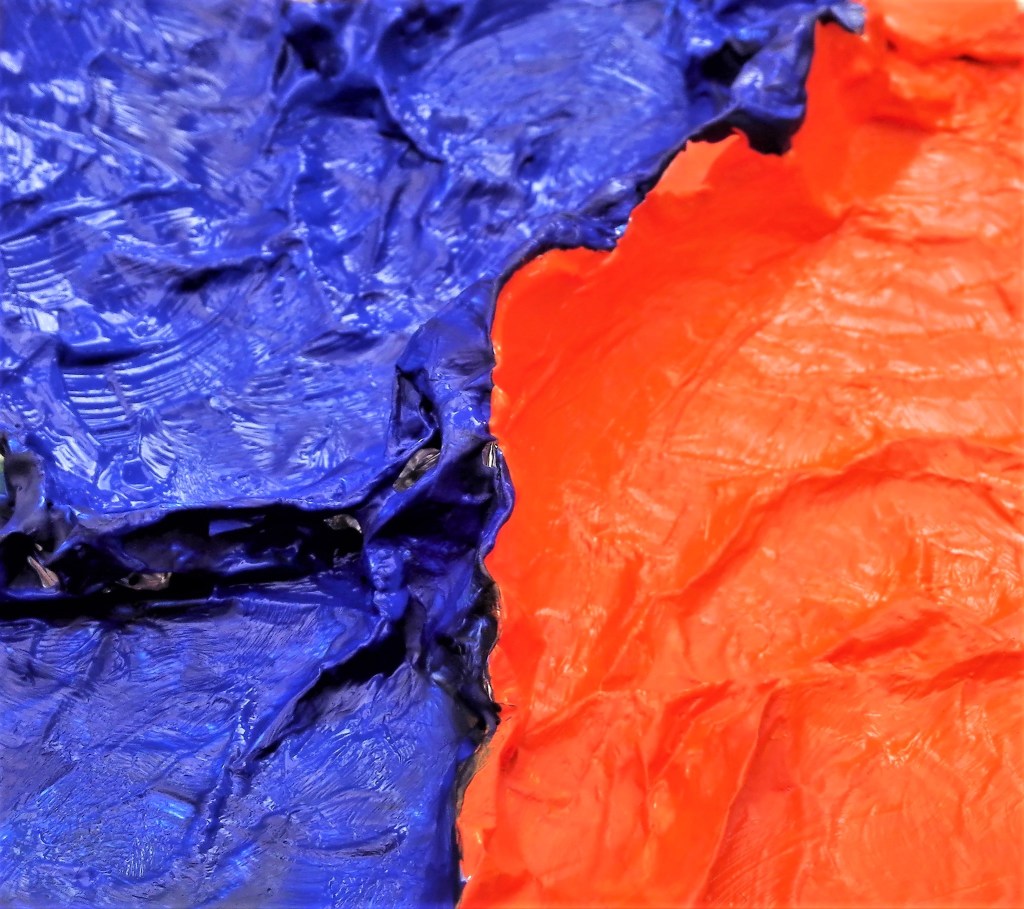
I find that there are similarities between this and the experimental work that I completed. The paintings I made were on kitchen foil which enabled me to create a textured surface.
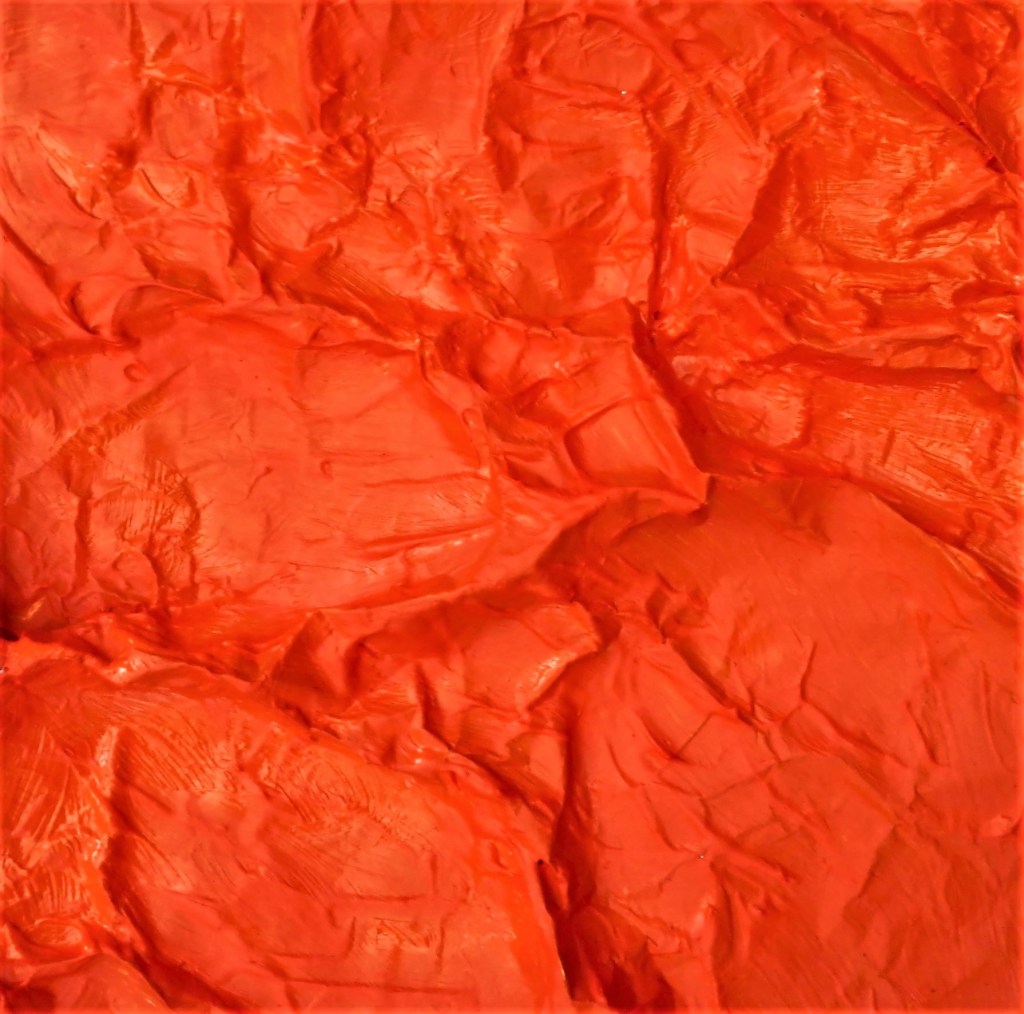
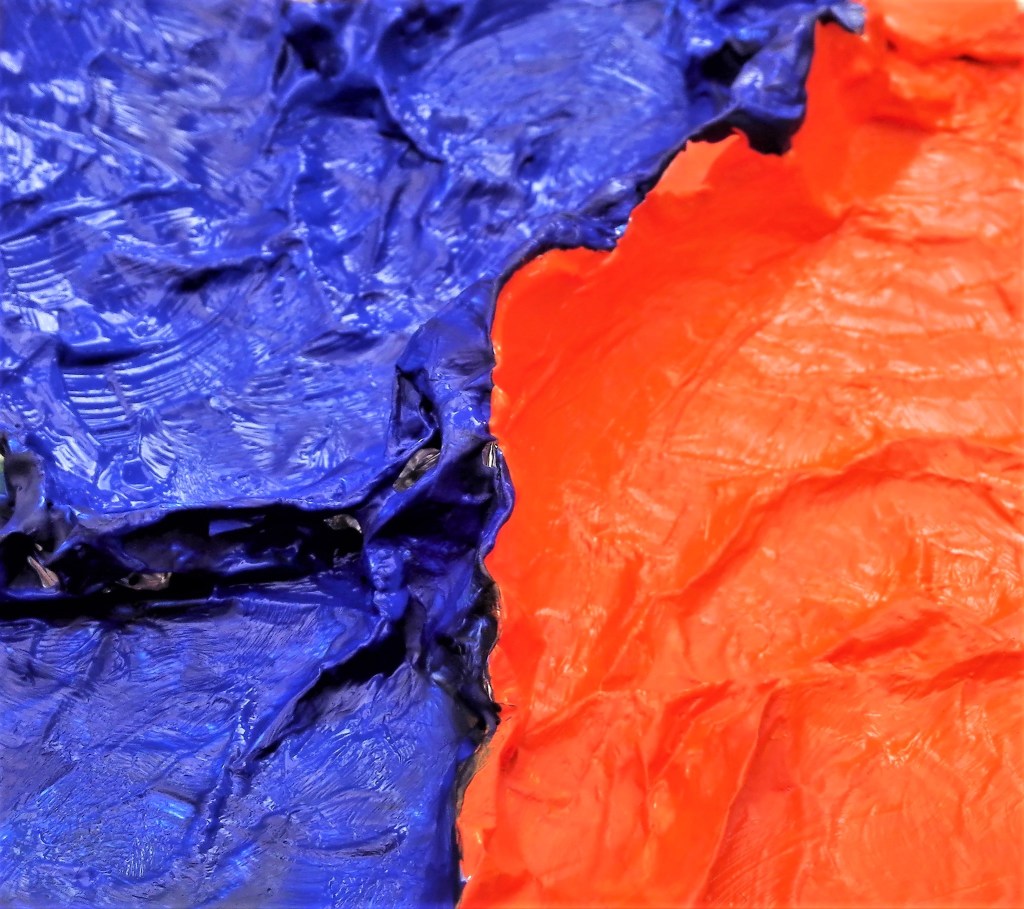
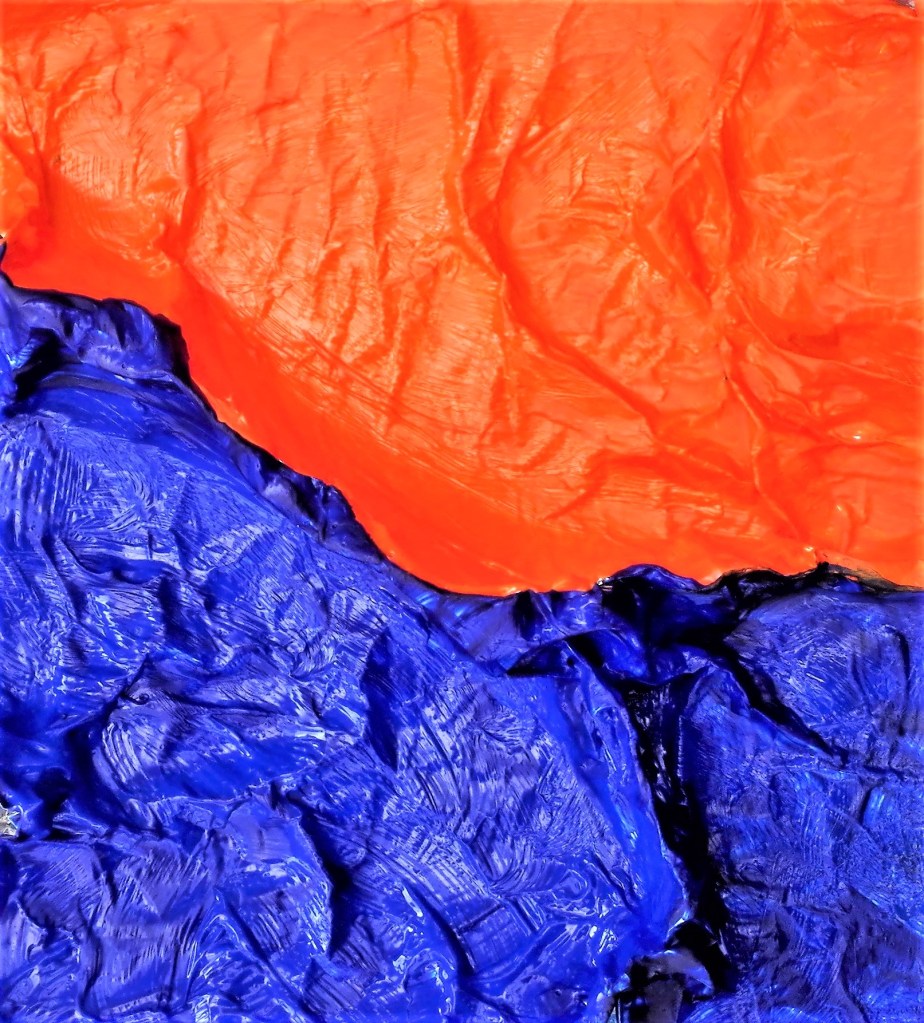
Painting 1, Orange on kitchen foil – Painting 2, Orange and Ultramarine on kitchen foil
I took the following quote from a blog by Tracey Harnish writing about Jason’s exhibition at L. A. Louver in 2011. “the work is seemingly abstract and minimal yet it doesn’t sit there quietly unassuming. Instead it powerfully vibrates outwardly drawing you in, close up and personal, taking you on big meaning by involving you in its physicality”
I have viewed some of Frank Stella’s work as an abstract painter previously. The painting below is a good example of his work. There are aspects that have influenced some of my experimental pieces.
Frank Stella, Gobba Zoppo Collotoro, 1985
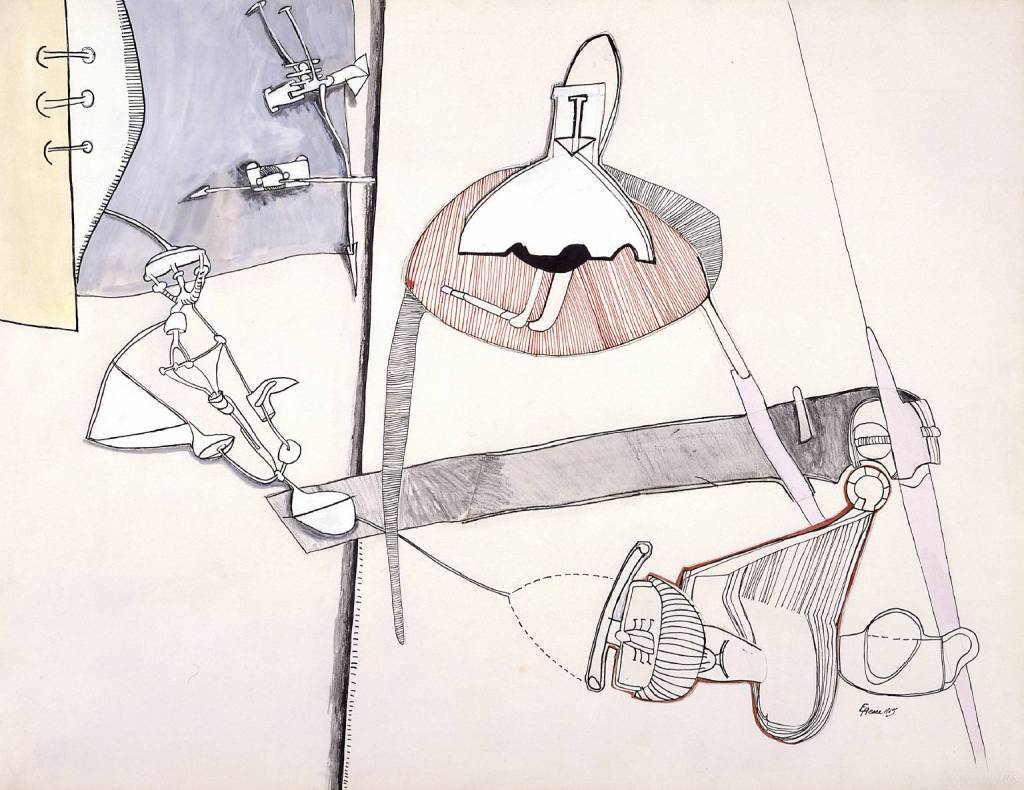
Lastly I examined the pioneering work of Eva Hesse, 1936 – 1970. She created works using materials such as latex, fibre glass and plastics. However the pieces that I was drawn to when re-examining some of her art was a drawing and a painting. The drawing looks like it has been stitched together.
Untitled, 1965, Eva Hesse , Ink and gouache on paper
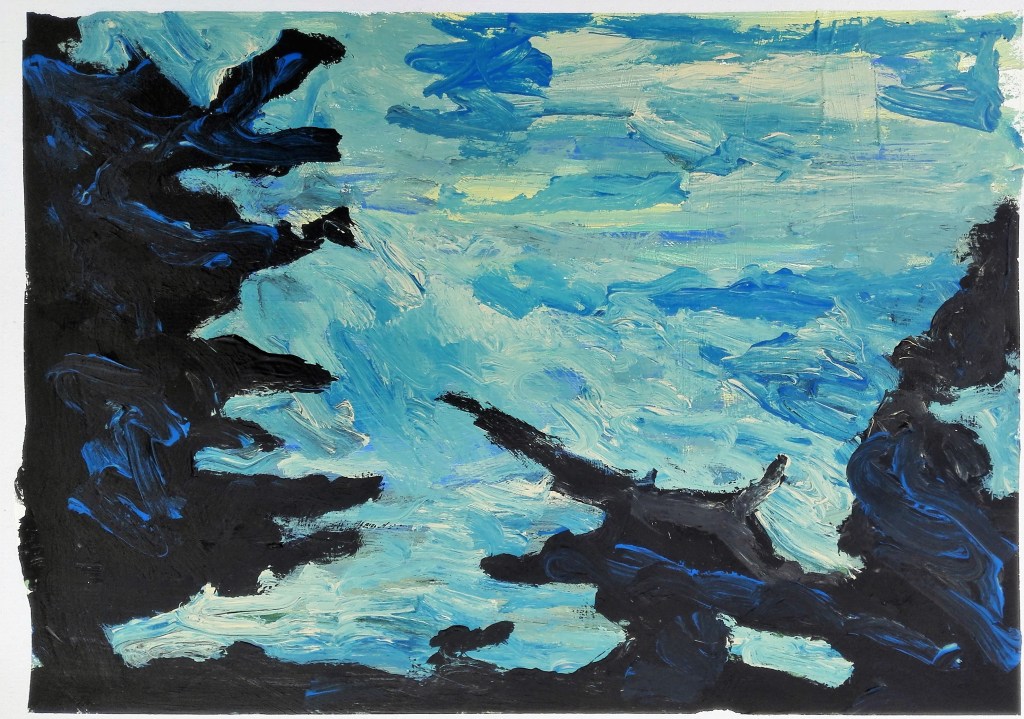
Whilst the painting has an untutored, scribbled look. The figures are barely described but convey vulnerability and menace in equal measures.
Eva Hesse, No Title, 1960
Conclusion: Would I have changed my approach to the exercise if I had completed this research prior to commencing on the exercises? I don’t think so. However, it is always good to experience and look at other artists works and to draw something from them. This is part of the continual learning experience. The culture of the art thief. Picking up ideas and inspiration from each other and melding it into their own practice.
These two projects merged into one. I created a series of paintings whereby I experimented with, material, form, supports, tools, processes and application. Some of these would fall into one or other of the two exercises. Exercise 1.0 ‘Stretch, stitch, fold, crease, wrap’ and Exercise 1.1 ‘Exploring form’. In the end I decided to combine all the work into one larger blog and to document and comment on them here. Research points 1 and 2 plus link 34 to the art of Anj Smith will be the subject of separate blogs.
At the start it is worth pointing out that the results of the experiments were a mixed bag. They ranged from poor to pleasing. Some of the pleasing results I will explore further and try to incorporate the methodologies into my practice. In total I created over 30 paintings and other pieces. These are discussed in, more or less, the chronological order in which they were created.
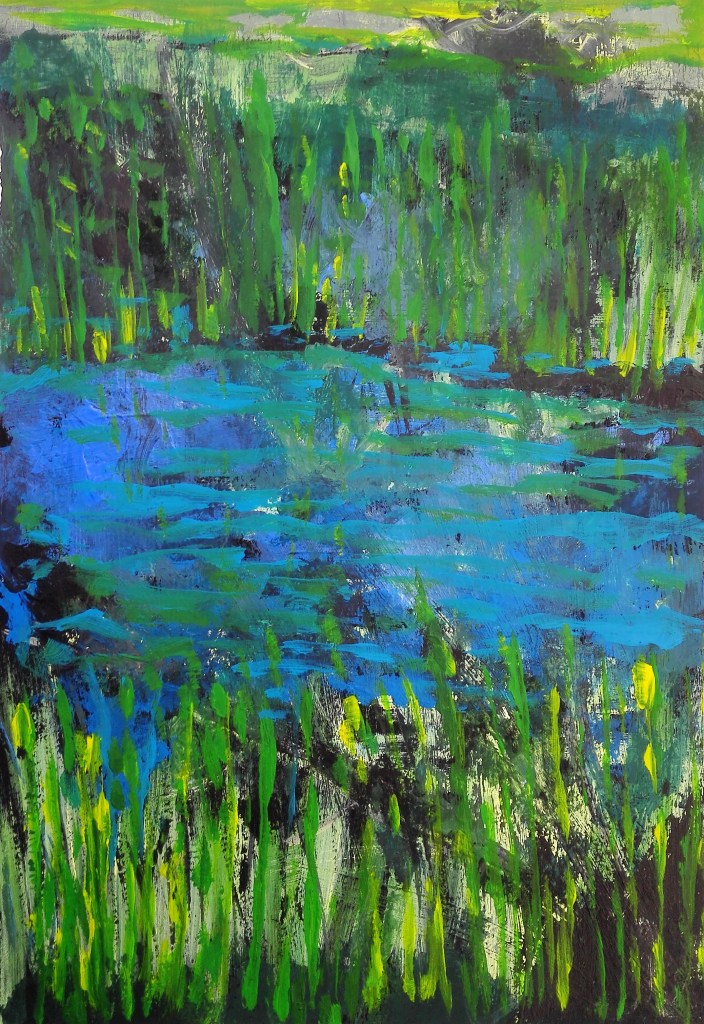
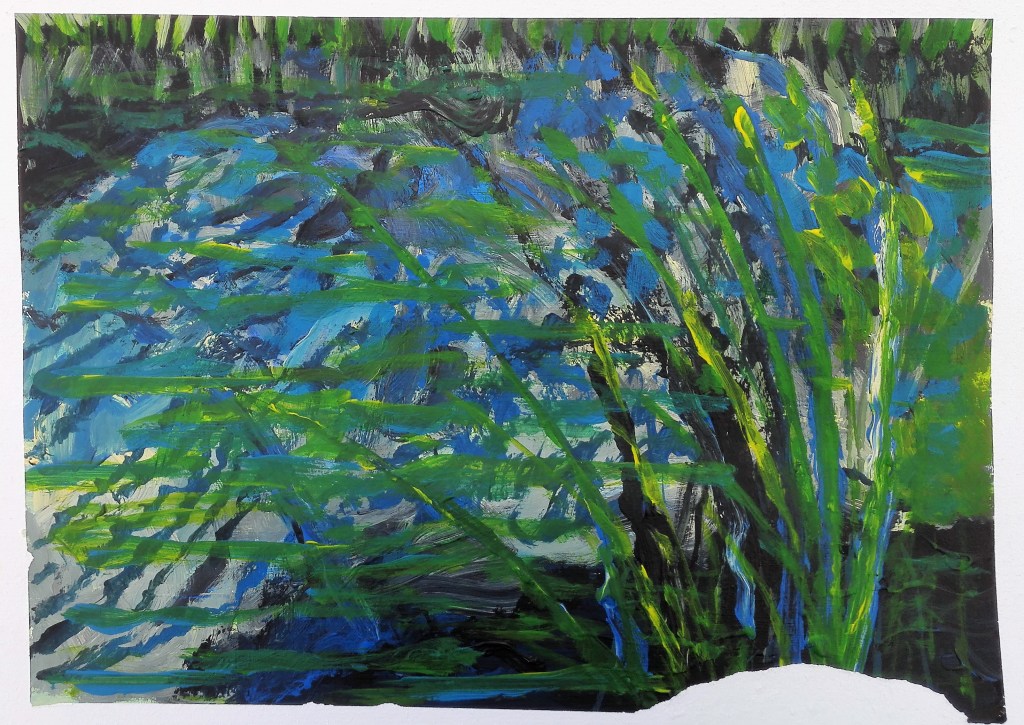
Experiment 1: The first three paintings were a quick rough experiment the results of which are varied. To White and black primed gesso paper I loosely applied acrylic paint and manipulated it with brushes and a palette knife.
Paintings 1, 2 & 3 Acrylic on white and black gesso primed paper, 18.5 x 27cm
I feel that I was still thinking of reflections from the last exercise from Part Three and my Assignment piece. I was referring to some of the photographs I took and trying to apply the paint loosely. Painting 1 has some redeeming qualities in that the mixture of the blues is interesting. Some happy accidents have created a textured feel. The second, whilst looking non-naturalistic does invoke the look of reeds and water. There is sufficient in this painting for it to be worked up into a more finished piece. The third painting is just poor and has no redeeming qualities.
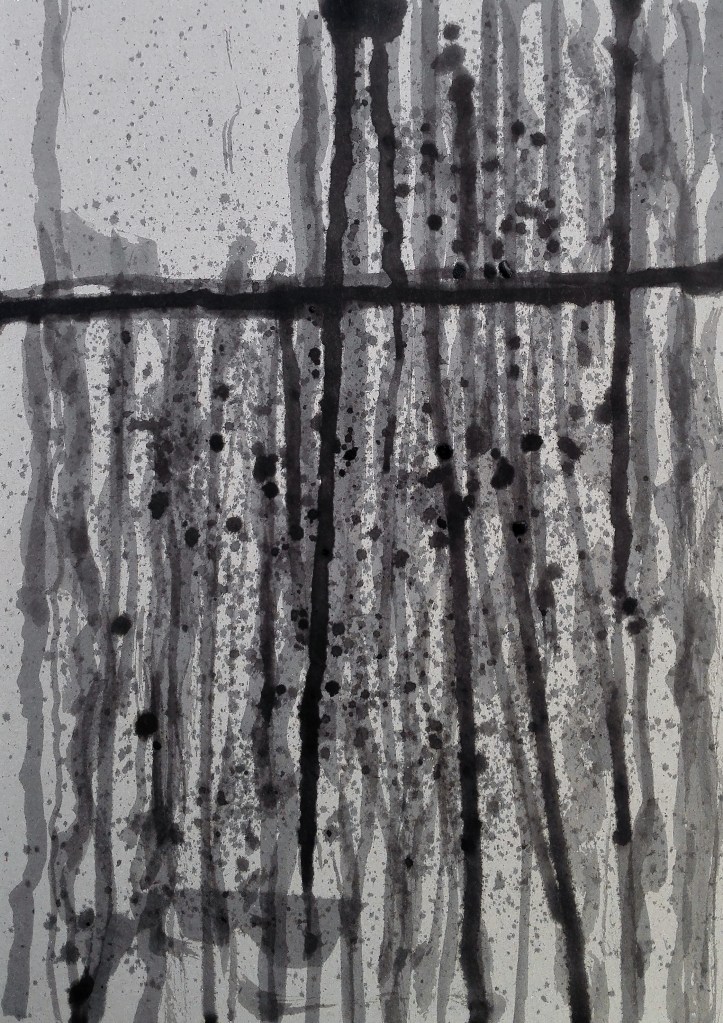
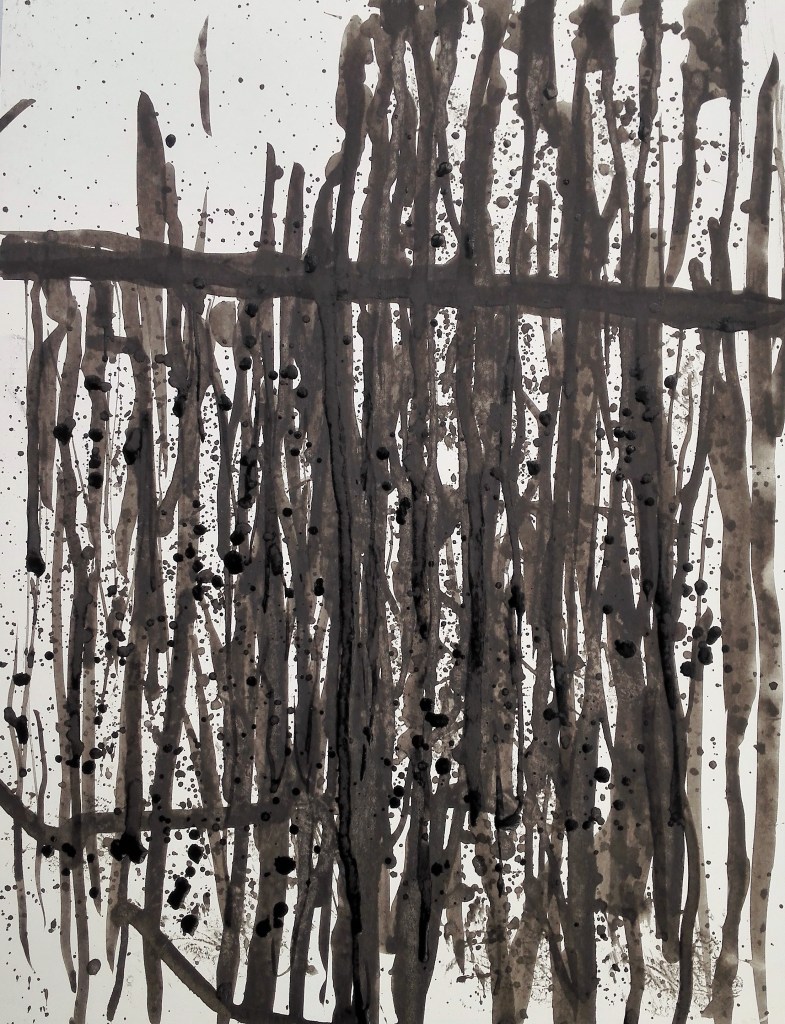
Experiment 2: For these two paintings I used two types of card, one with a shiny surface the other not. The idea was to apply black ink and allow it to run. The inspiration for this was a photograph I had taken a few years previously of a piece of corrugated iron where the paint or bitumen had been eroded by weather and time.
Photograph of weathered corrugated iron
For the most part I did allow the ink to react to the forces of gravity. However I did apply a minimal amount of brushwork.
Ink paintings, 21 x 28cm
The two different surfaces produced the sort of effects that I expected. In first on normal cardboard absorbed the ink and required more to build it up. This created a layered effect which whilst not mimicking the photograph is a more pleasing result. The second, on the shiny card lacks depth. The addition of flicked ink creates a little more interest. In hindsight I should have also looked to apply bleach and observe the impact of this.
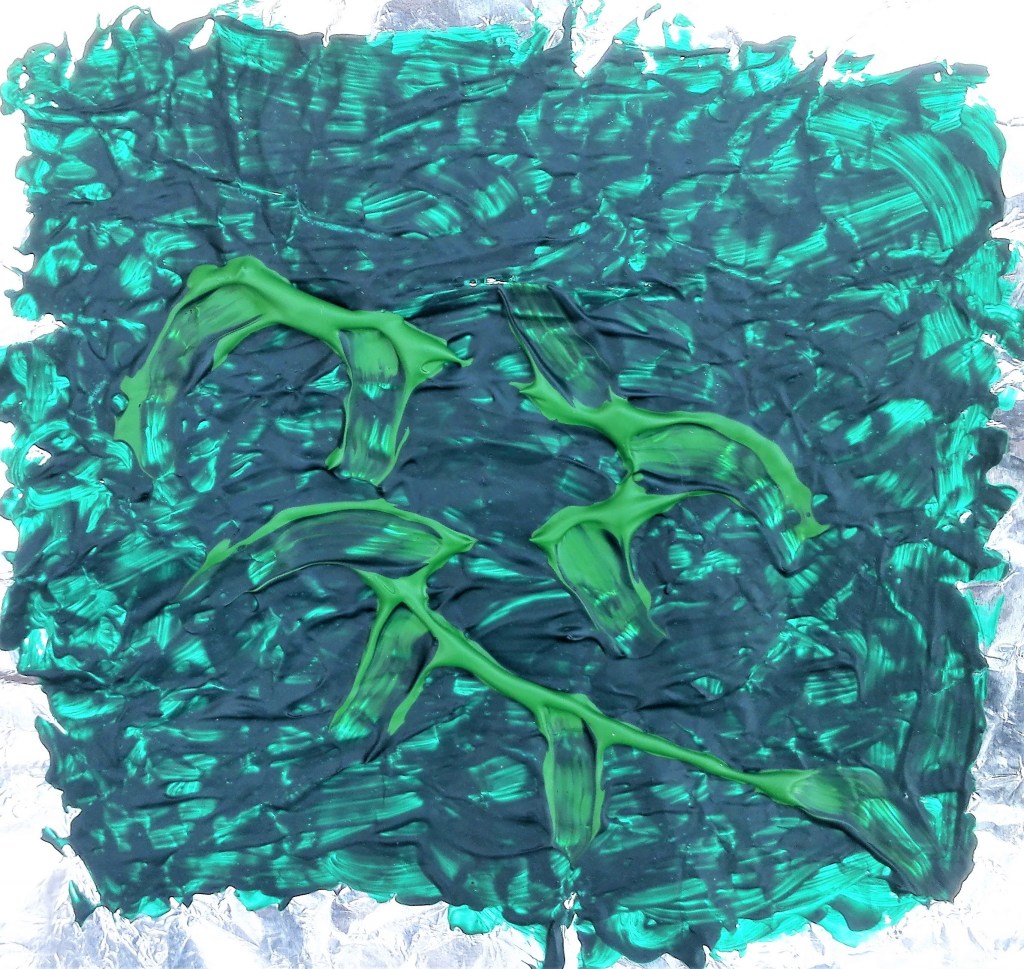
Experiment 3: for this series of experimental work I used kitchen foil as the support. The intention was that the foil could either be pre-creased or creased after it had been painted. This would give texture to the paintings.
I started by painting a single colour onto the kitchen foil that had been partly creased. The results were encouraging. Using acrylic paint it adhered to the surface well and created a richly textured surface.
Acrylic paint on kitchen foil, 14 x 14cm
I now created a further painting using orange and its complementary colour blue. This worked well the two colours highlighted each other and tonal interest was created depending on where the light source was coming from. I have banked this idea and intend to created a larger painting perhaps combing several pieces of kitchen foil.
Orange and Blue acrylic on creased kitchen foil, 14 x 14 cm
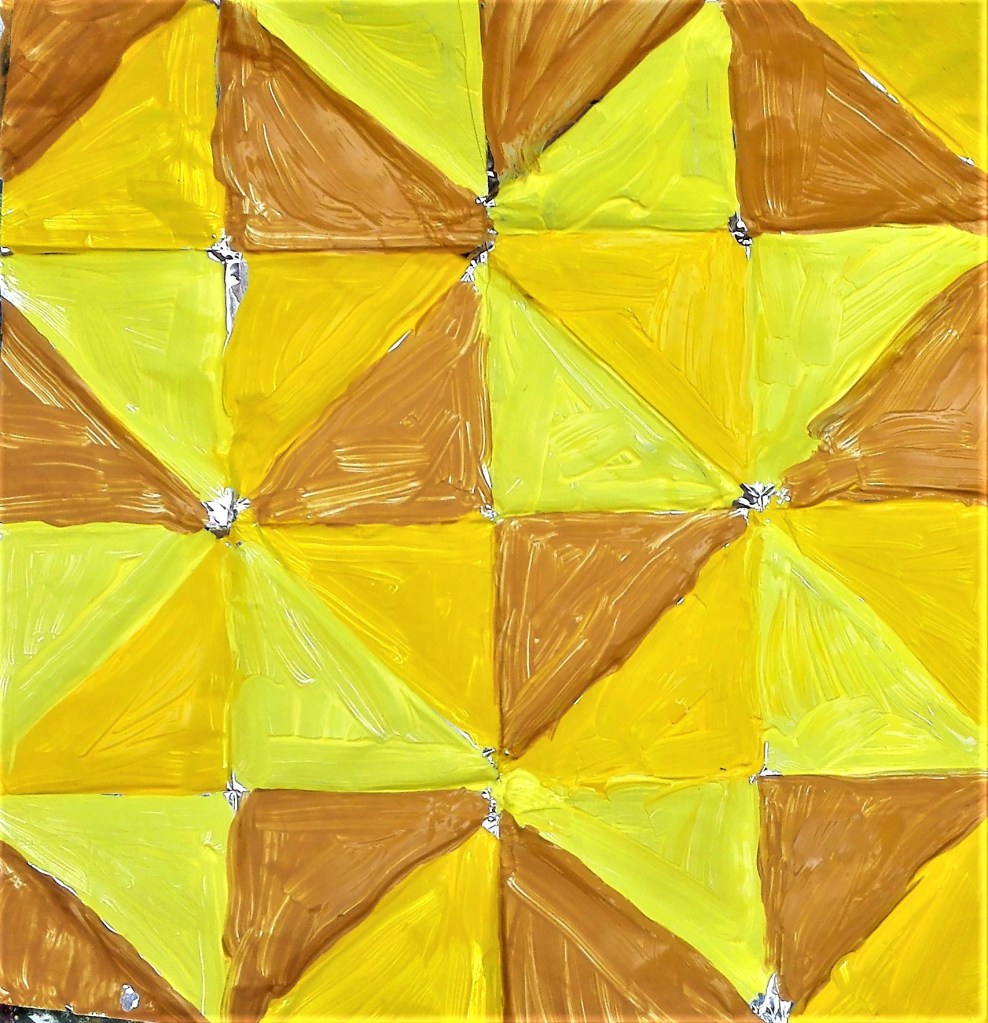
So far I had used randomly creased kitchen foil. I would now try painting onto foil that had been folded into patterns.
Example:
Folded Kitchen Foil
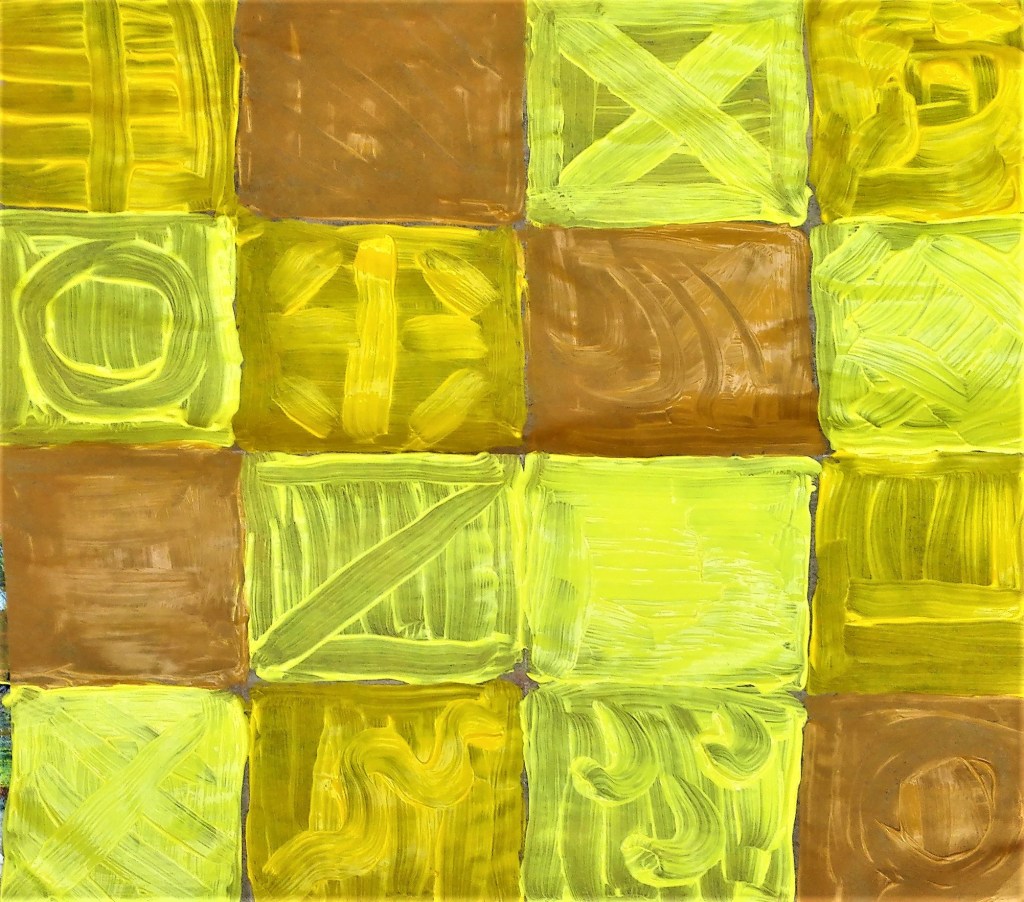
Using three yellows, mid yellow, lemon yellow and yellow ochre, I painted the foil. The results are satisfactory but don’t inspire me to create further works using this methodology.
Acrylic on folded kitchen foil, 14 x 14 cm
I completed one further painting on kitchen foil where I applied the paint directly onto the foil and manipulated it with the handle end of a brush. The resultant painting was messy.
Viridian and light green acrylic on kitchen foil, 14 x 14 cm
Following the cloth and greaseproof paper experiments, documented below, I returned to kitchen foil and produced two further abstract paintings. With these I was looking to build up the paint in layers, allowing some of the previous layers to be visible. The result was patchy at best.
Abstract paintings, acrylic on kitchen foil
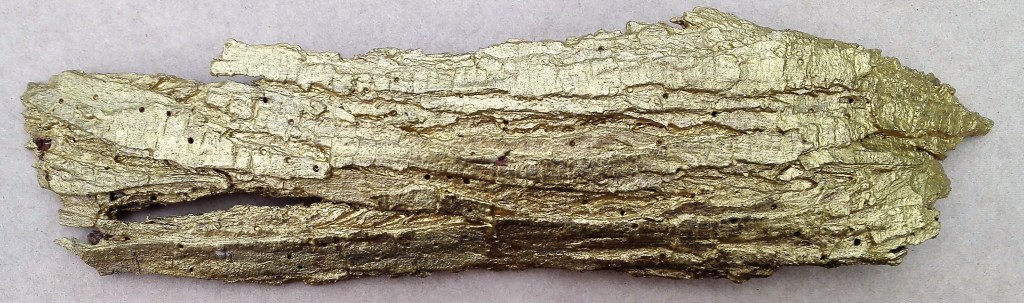
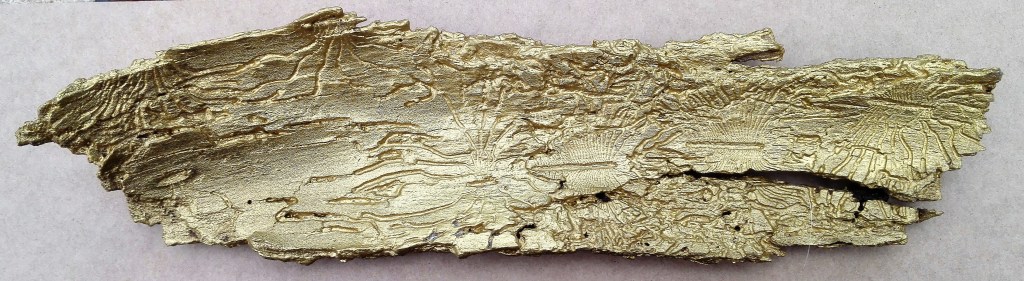
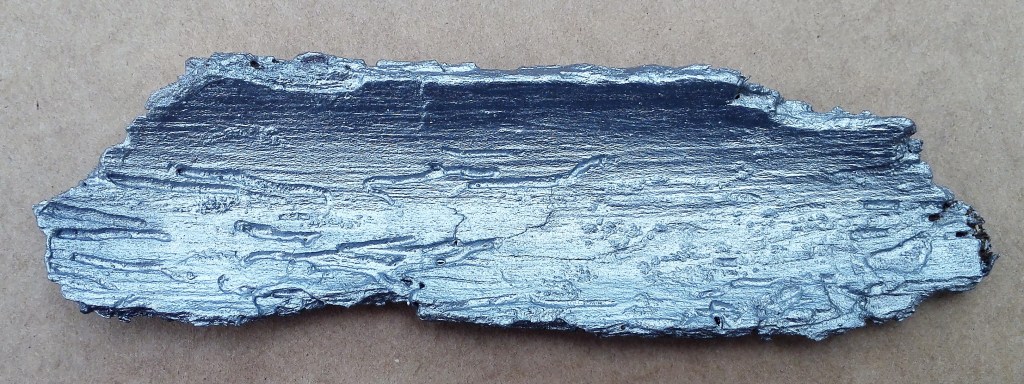
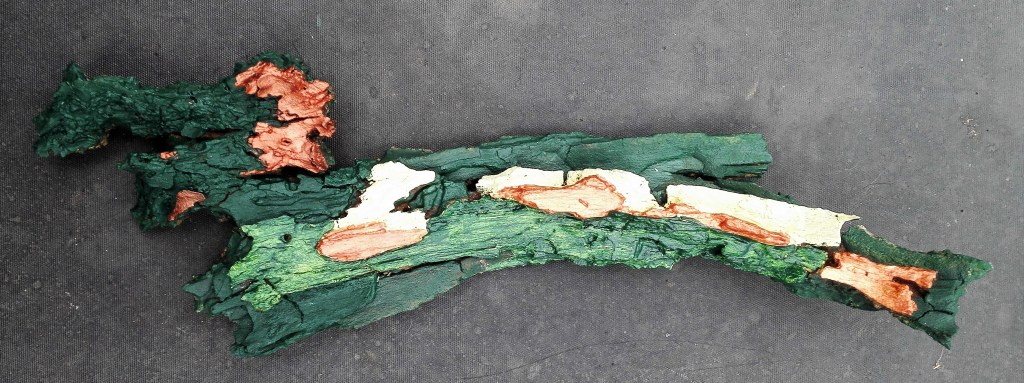
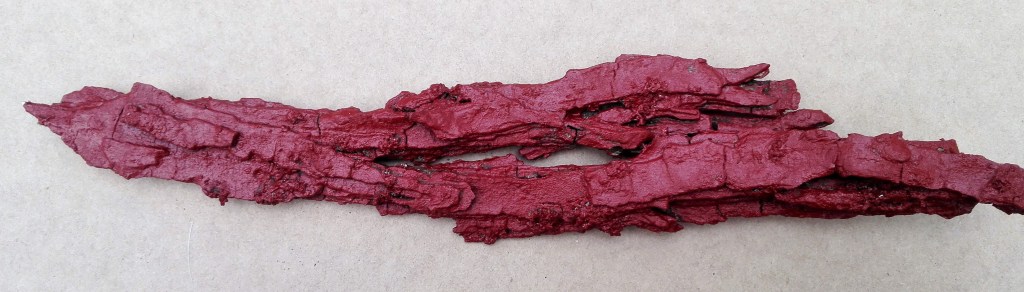
Experiment 4: Using some found material, tree bark, as a support I painted it. The result is pleasing although I feel that on its own it isn’t enough. I have transformed it into a decorative object but is it enough? Does it become art? Could I do more with, for example incorporating it into a more considered work? For the time being I have left the pieces lying in the studio for potential consideration into a future project.
Painted Bark – Seven pieces
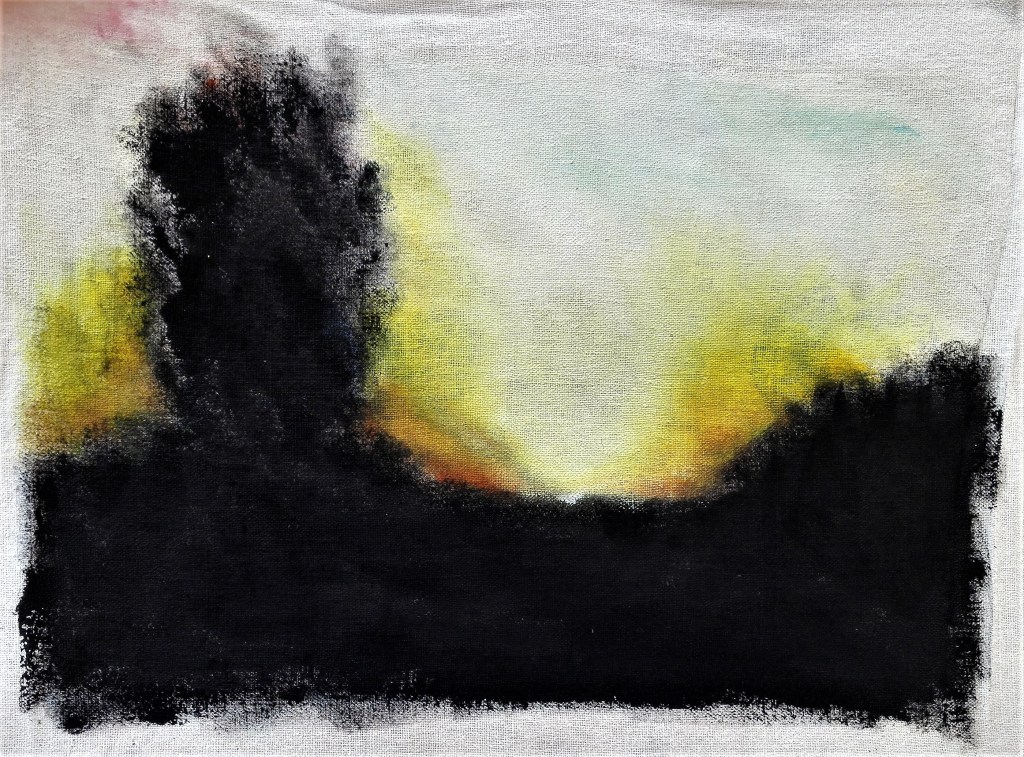
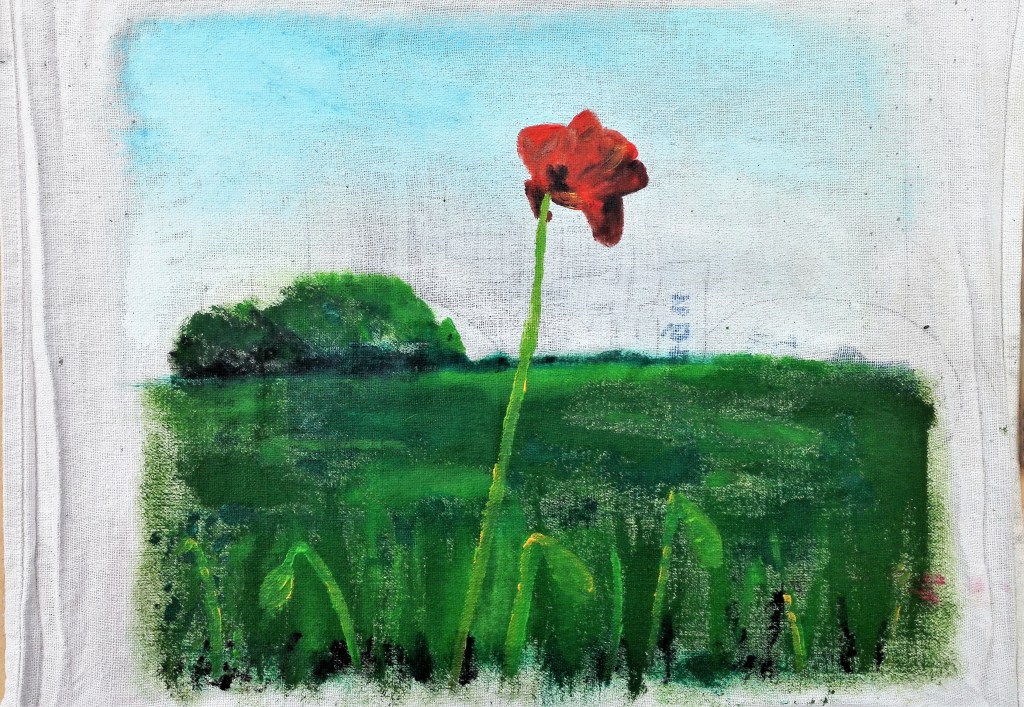
Experiment 5: for this I would paint directly onto cloth, a dish cloth, that was pinned to a board and primed with gesso.
Prepared cloth
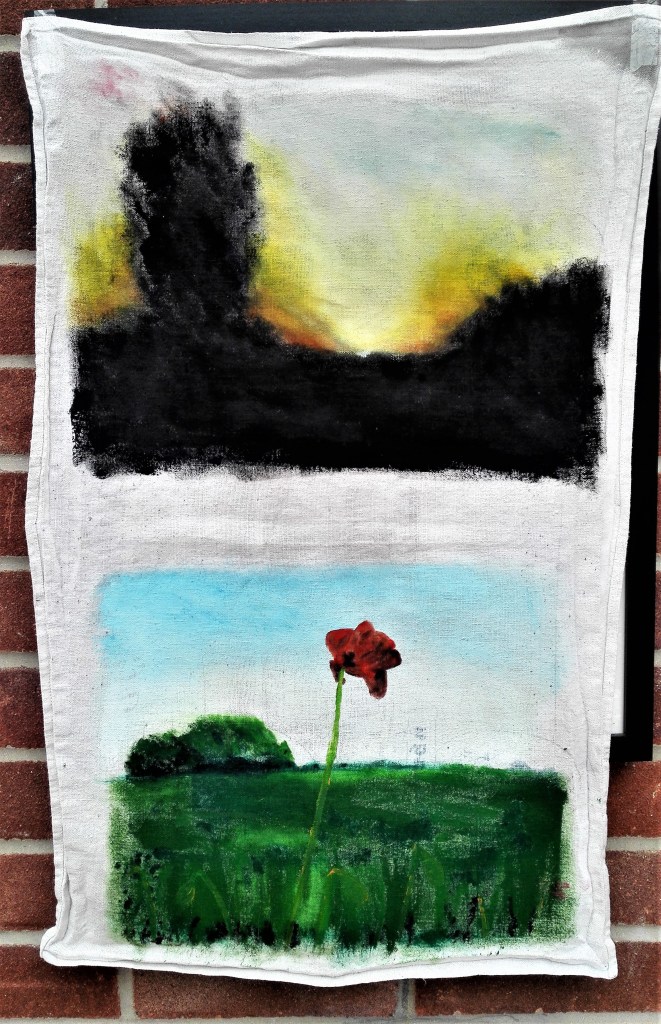
Splitting the cloth into two sections I made two paintings using photographs as references.
Cloth painting 1, 36 x 27 cm
Cloth painting 2, 36 x 27 cm
The paint was quickly absorbed into the cloth which due to its roughness caused me to use scumbling brushwork. The resultant paintings have a loose feel that I like, they have an airy atmospheric quality. The cloth is clearly visible through the paint which accentuates the rough look. Direct painting onto fabric is something that I will look to try out again.
The painted cloth, hung
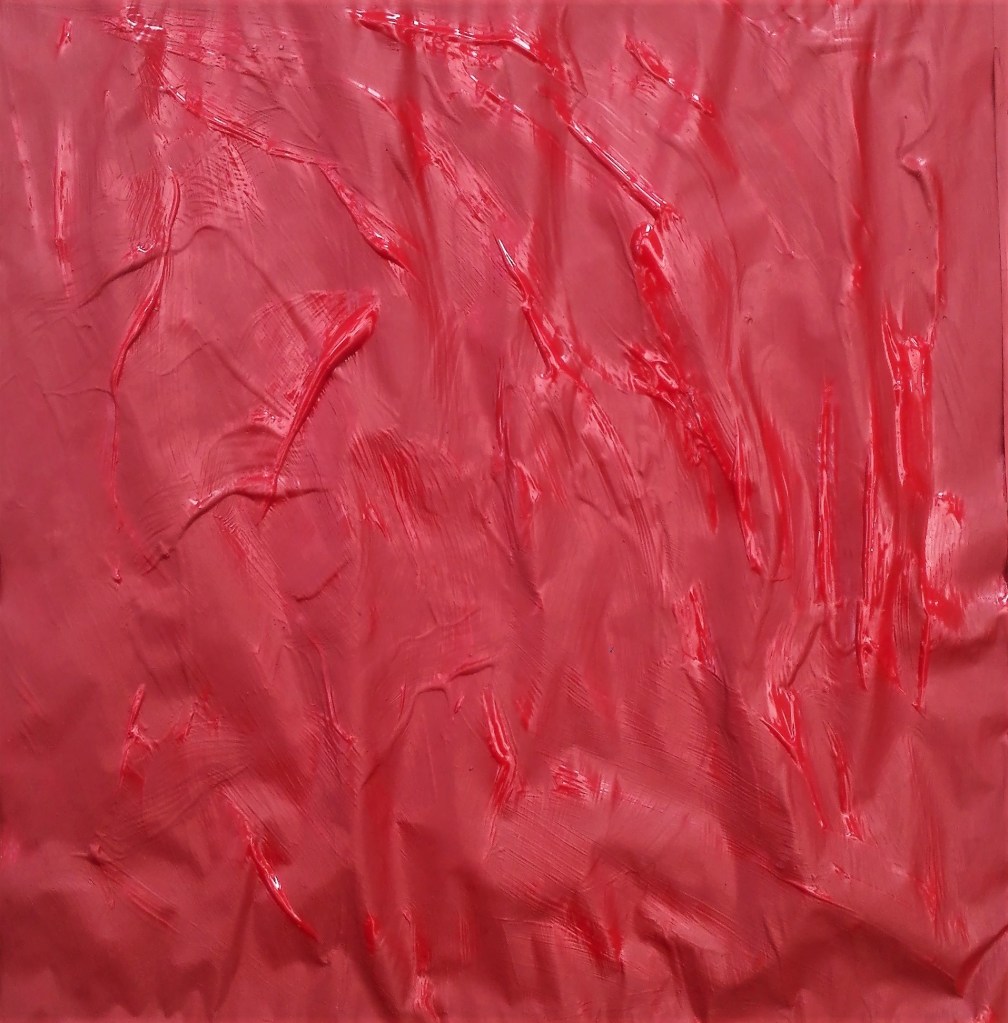
Experiment 6: Greaseproof paper was the next support that I would experiment with. I would try different materials, inks and acrylics and different application methods. I started by using a single colour and found that I needed to apply several coats of paint to cover the paper. I tried to create texture but this was not as easy as it had been with the kitchen foil.
Deep red acrylic on greaseproof paper, 17 x 16cm
Next I painted an imagined scene.
Imagined scene, Acrylics on greaseproof paper, 21 x 18.5 cm
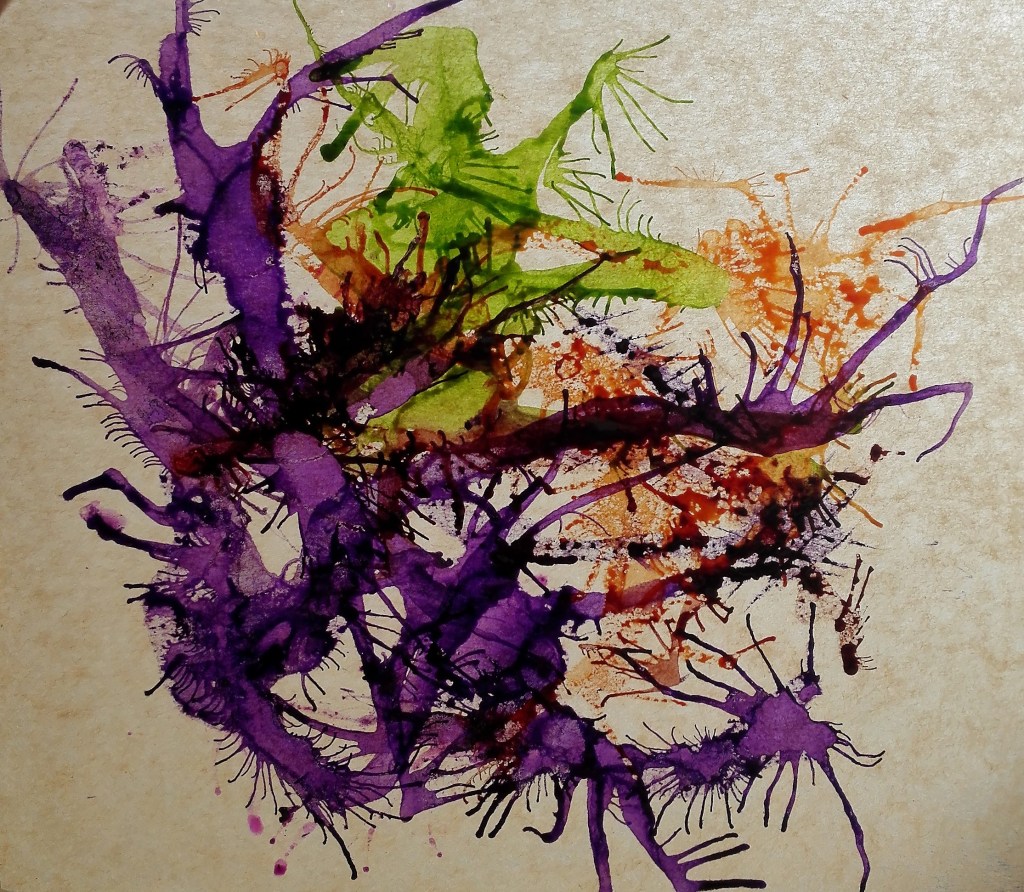
The paint was easy to apply and manipulate however when dried it had a translucent quality which I didn’t like. The photograph of the painting above doesn’t show this too well. I felt that the paint lost its vibrancy and looked washed out. I next experimented with inks. This was more satisfactory. The ink wasn’t absorbed into the support. I was able to manipulate it via blowing with a shortened straw and lift the paper to allow the ink to run. Applying several layers enabled a gradual build up of colour, this enhanced the tonal value of the painting. Where the acrylics had looked washed out the ink retained its vibrancy. However these effects can be achieved using cartridge paper. I didn’t feel that the greaseproof paper was bringing any specific benefits.
Ink on greaseproof paper
Similar to the work on kitchen foil using pre-folded greaseproof paper to create a pattern and used the same three yellows for the painting. Again the result was disappointing.
Mid Yellow, Lemon Yellow & Yellow ochre acrylic on greaseproof paper, 21 x 18 cm
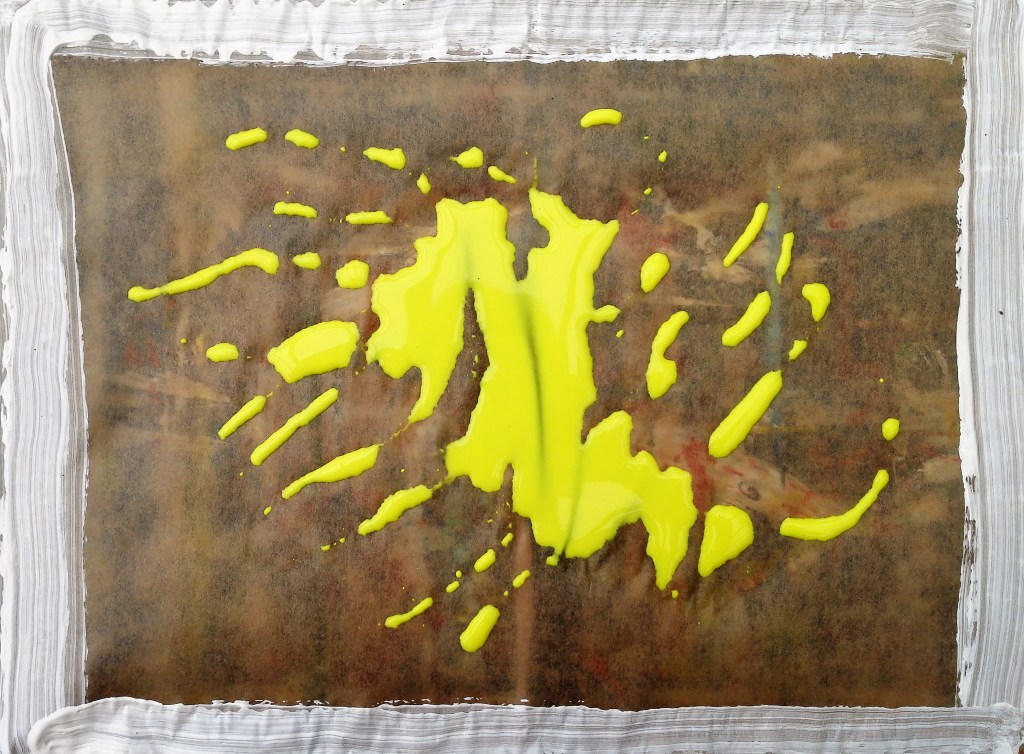
I proceeded to make a further investigation using acrylics. This time I would apply the paint thickly by pouring it directly onto the support. The painting went through several stages as I manipulated the paint searching for something that looked and felt right. I didn’t have a clear idea what, I was just playing with the paint.
Painting in progress, addition, manipulation and removal of paint
Finally I added some red with a brush and also tipped a little ink. After all the stages I was left with an unsatisfactory painting. My conclusion being that acrylic paint on greaseproof paper is not a good mix. Greaseproof paper is not a support that I will be turning to.
Finished painting, acrylics and ink on greaseproof paper, 34 x 26 cm
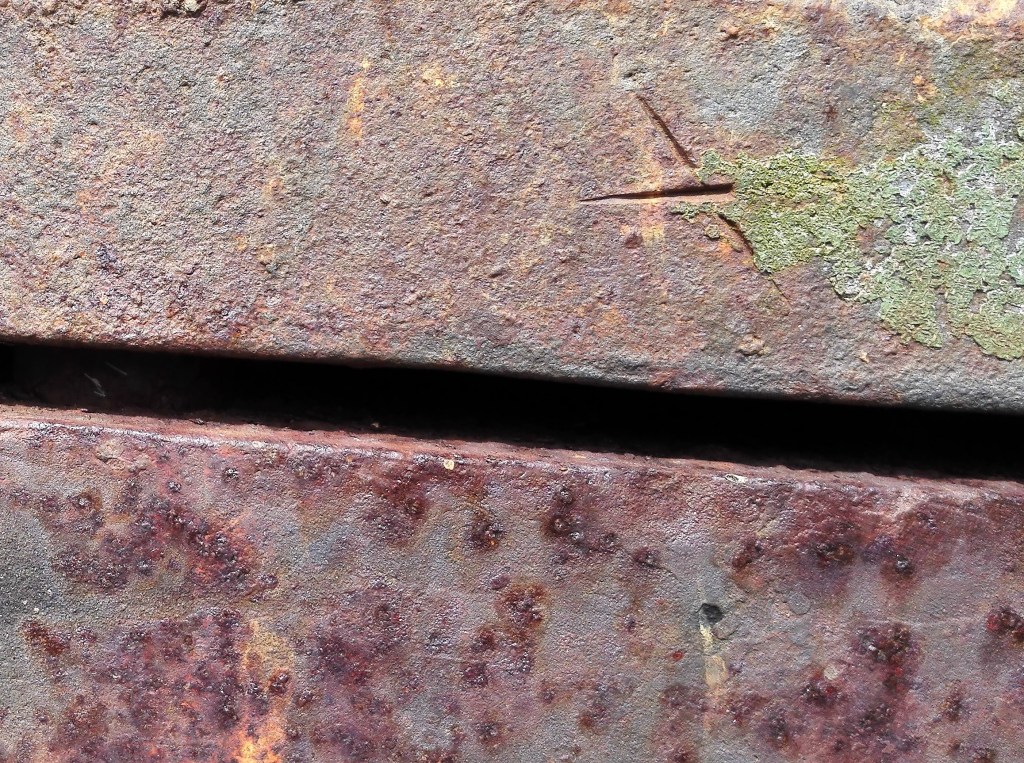
Experiment 7: this was less an experiment and more a return to familiar support and materials. I used a close up photograph of a piece of rusty farm equipment as source material. My materials were water soluble oil paint applied with palette knives. The support was linen based canvas paper.
The photograph
Dragged oil on canvas paper, 25 x 22 cm
The photograph of the painting greatly enhances the painting which in the flesh lacks the vibrancy that is apparent in the image. Further layers of paint would improve this. I may return to it later. As stated this was more an escape to a methodology that I have investigated before.
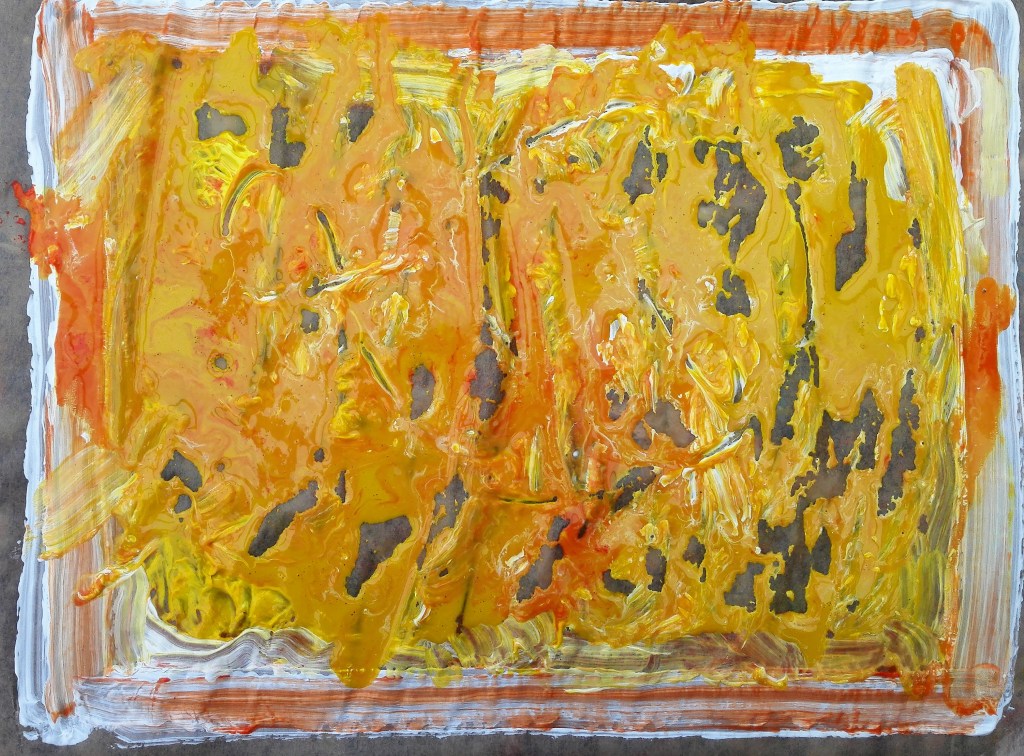
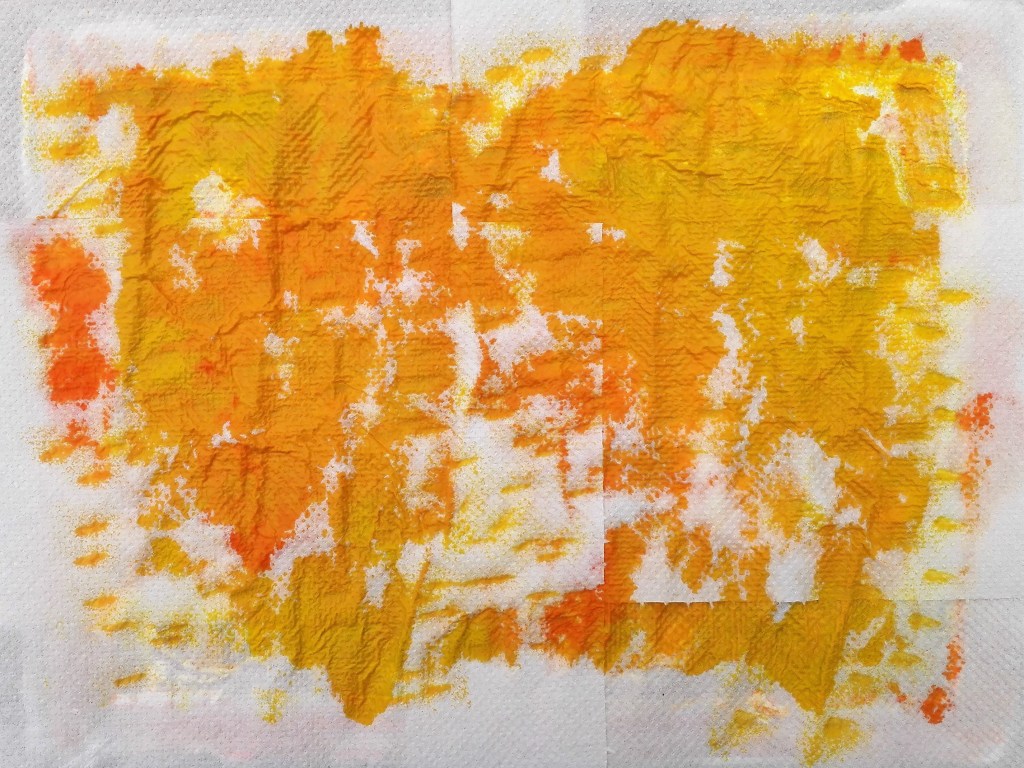
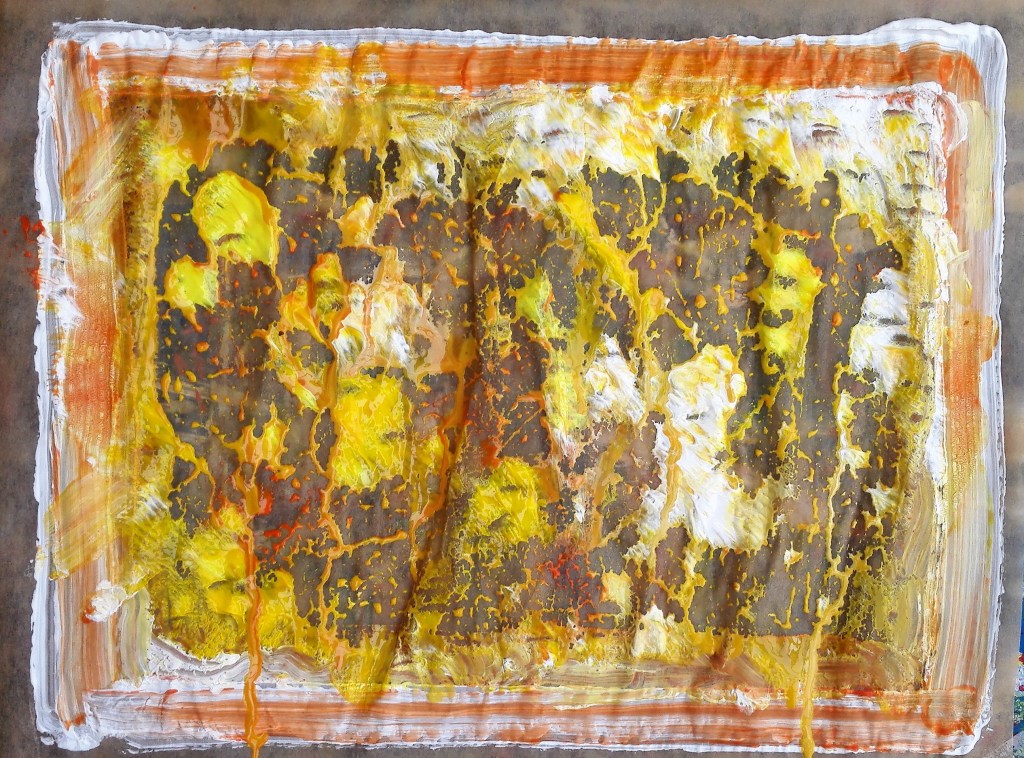
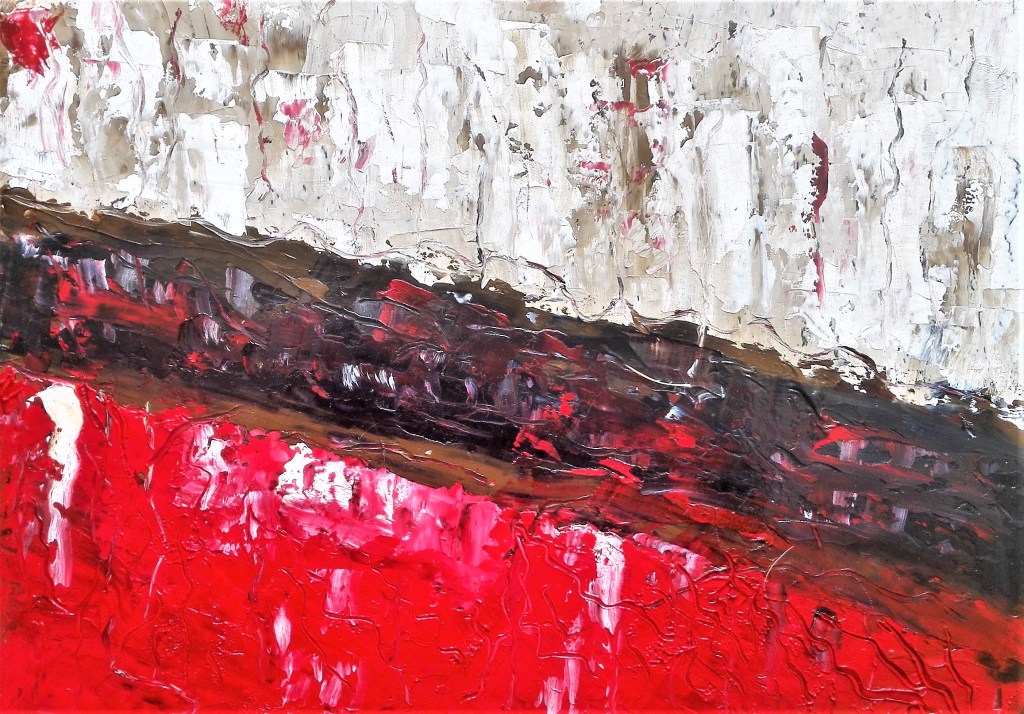
I revisited this subject again. This painting started as a way of using up excess paint that I had on my palette after completing the Pump plate painting, see Parallel project. However I ended up using much more paint than I had leftover. The resulting painting is below.
Dragged Aqua oil on acetate
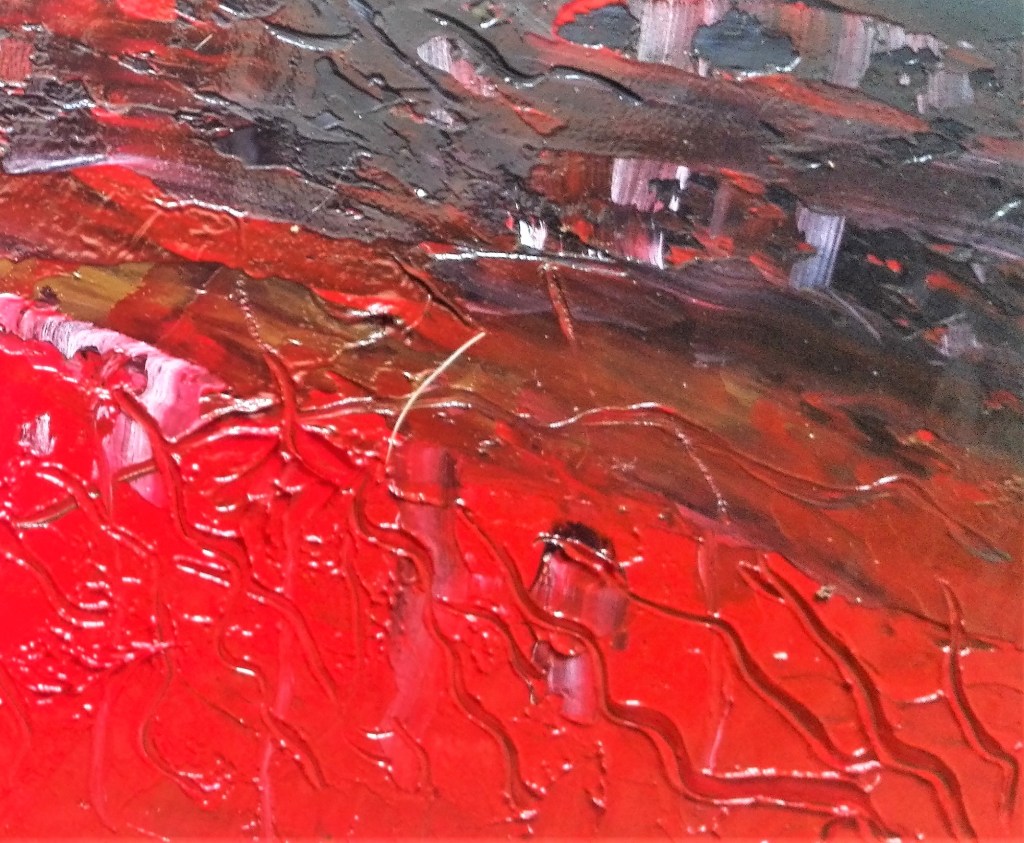
Detail from ‘Dragged oil on acetate’
The white and raw sienna works well it has a chalkiness to it which the traces of red enhances. In hindsight it would have been better to have continued this theme below the Payne’s grey band. the use of just four colours works well in so much as the eye is not assaulted with too much colour. I noted that the paint took a long time to dry as nothing is absorbed into the support. I will test its rigidity when it eventually dries. The detail section gives an idea of the lushness of the paint. Thick and creamy.
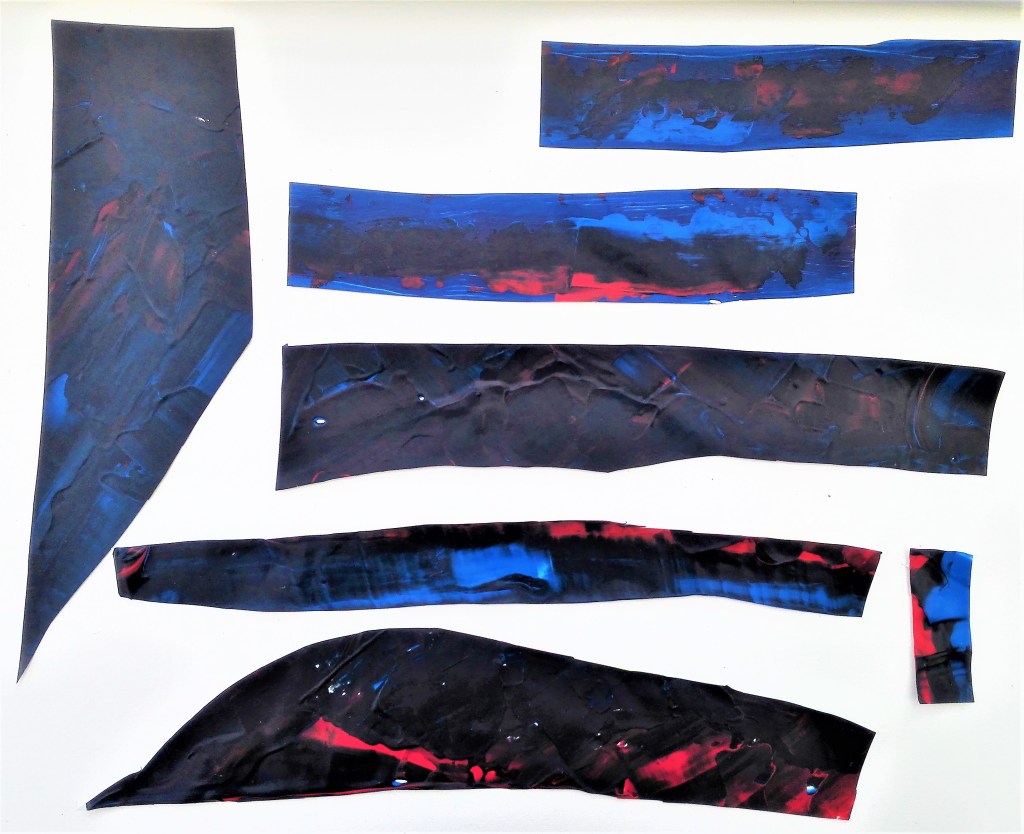
Experiment 8: this evolved into a long series of explorations investigating the impact of applying acrylic paint to plastic. The materials were applied directly from, tubes, manipulated with palette knives, brushes, sticks and other tools. In some cases PVA adhesive was painted onto the dried paint to give it strength and allow it to be removed from the plastic support. Below is the result of these explorations, the paintings and the different ways I have tried to use them to create further works.
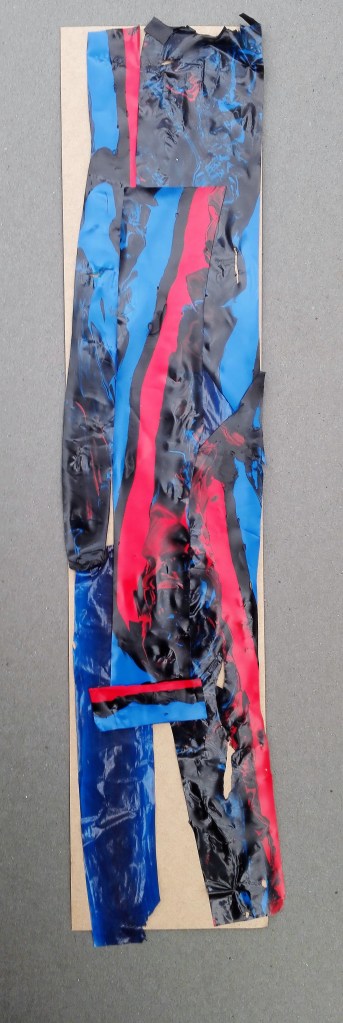
Collaged figure
The individual pieces prior to putting them together and securing with PVA adhesive.
Collaged figure, acrylic paint strips on card, 8 x 39cm
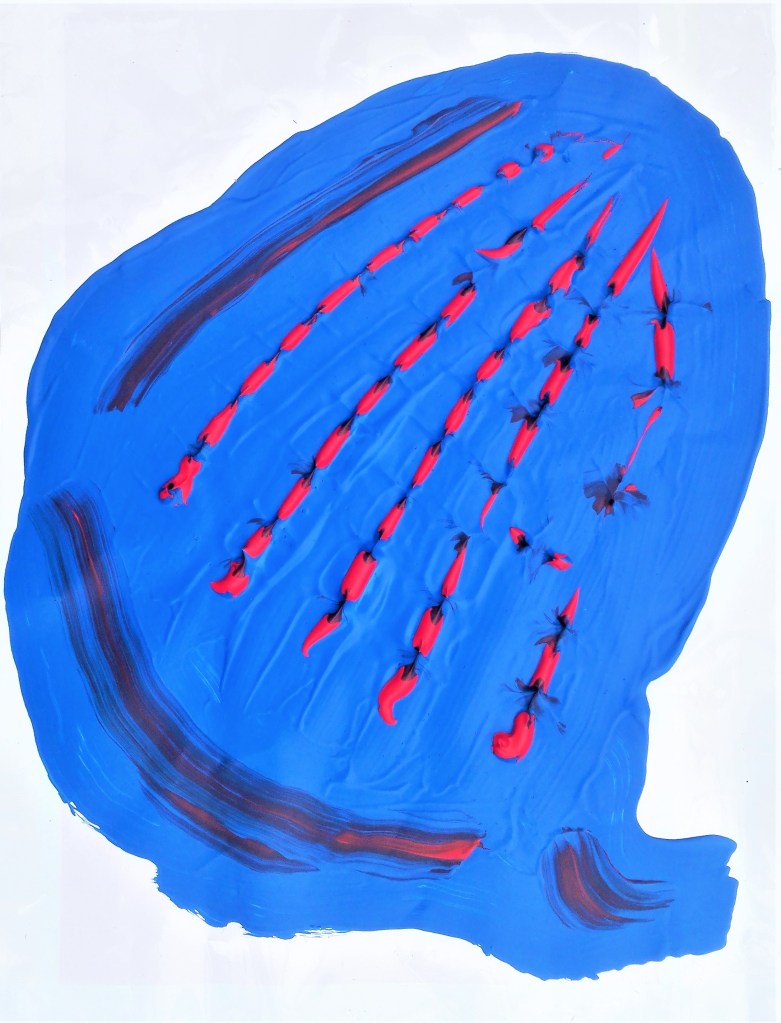
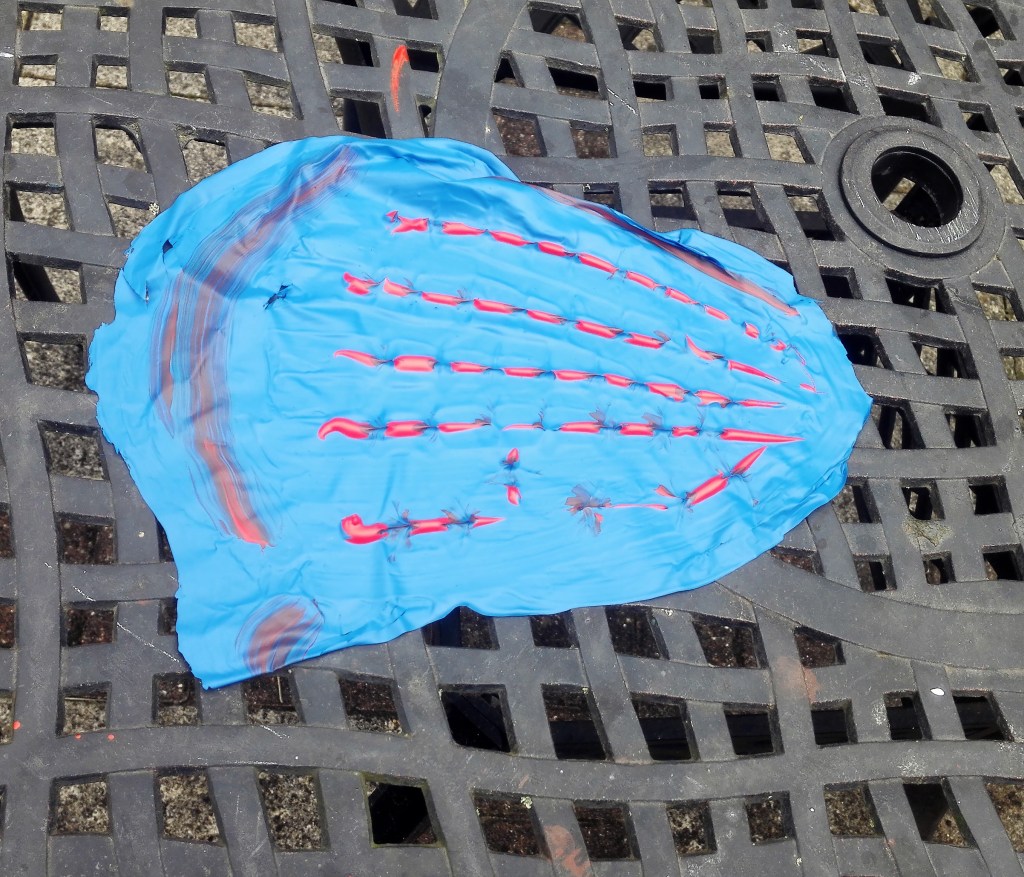
2. Blue frog
Blue frog, thick acrylic, 23 x 27cm
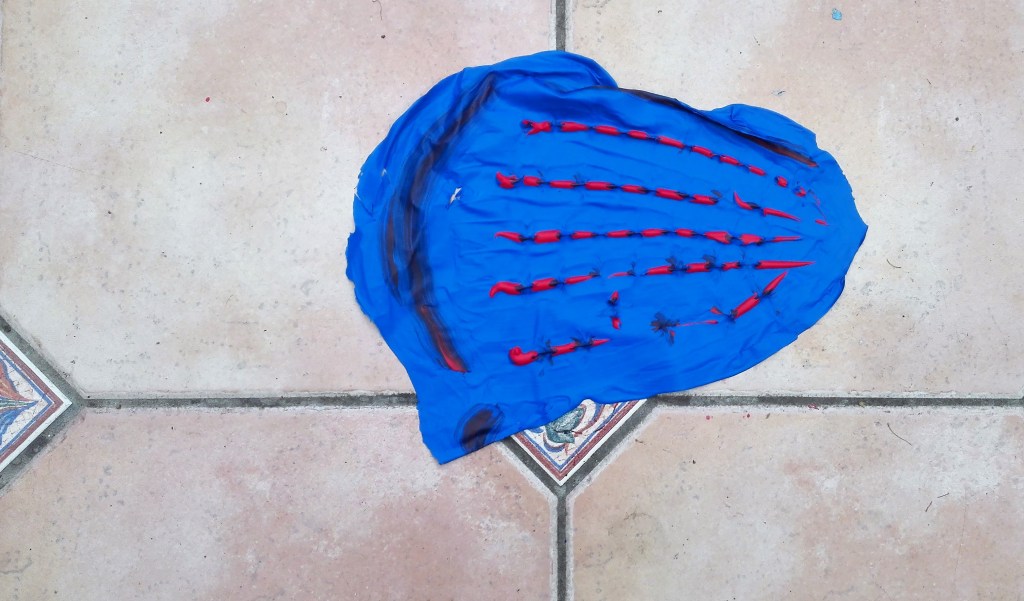
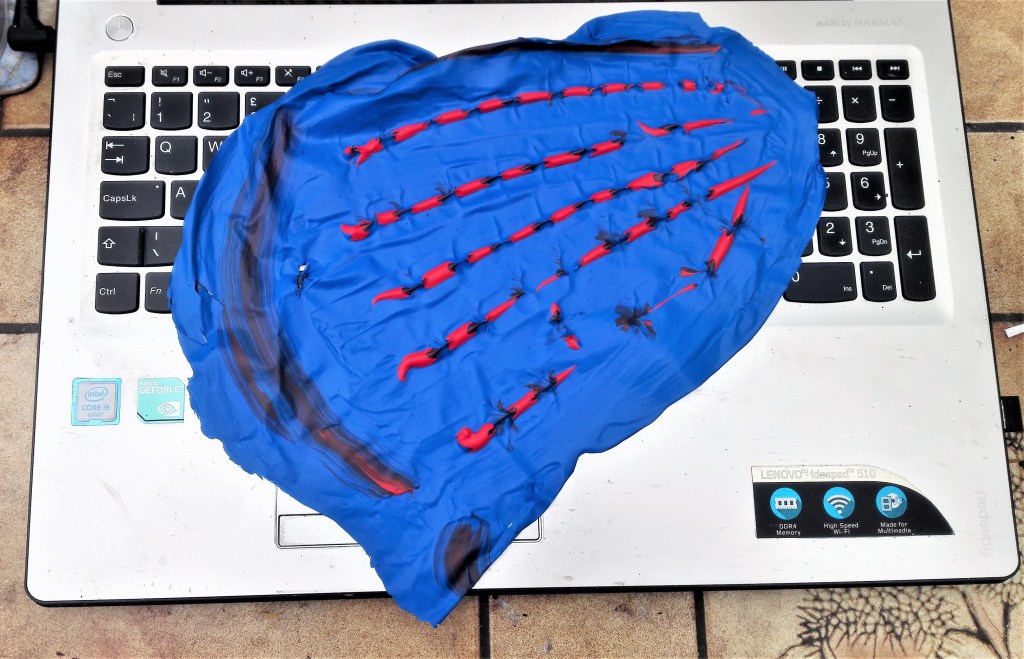
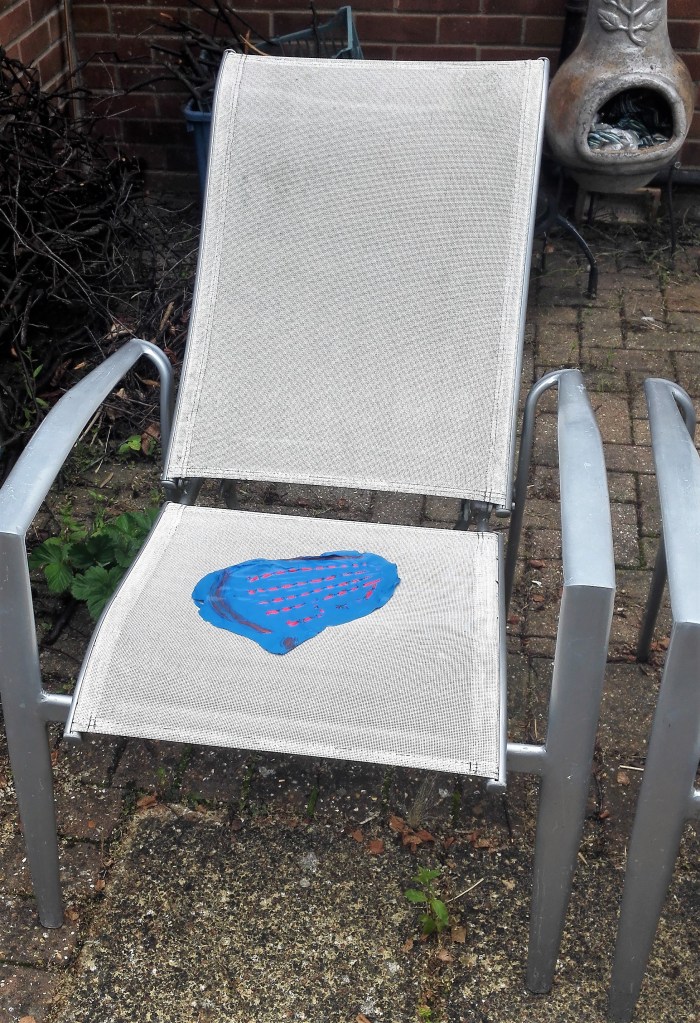
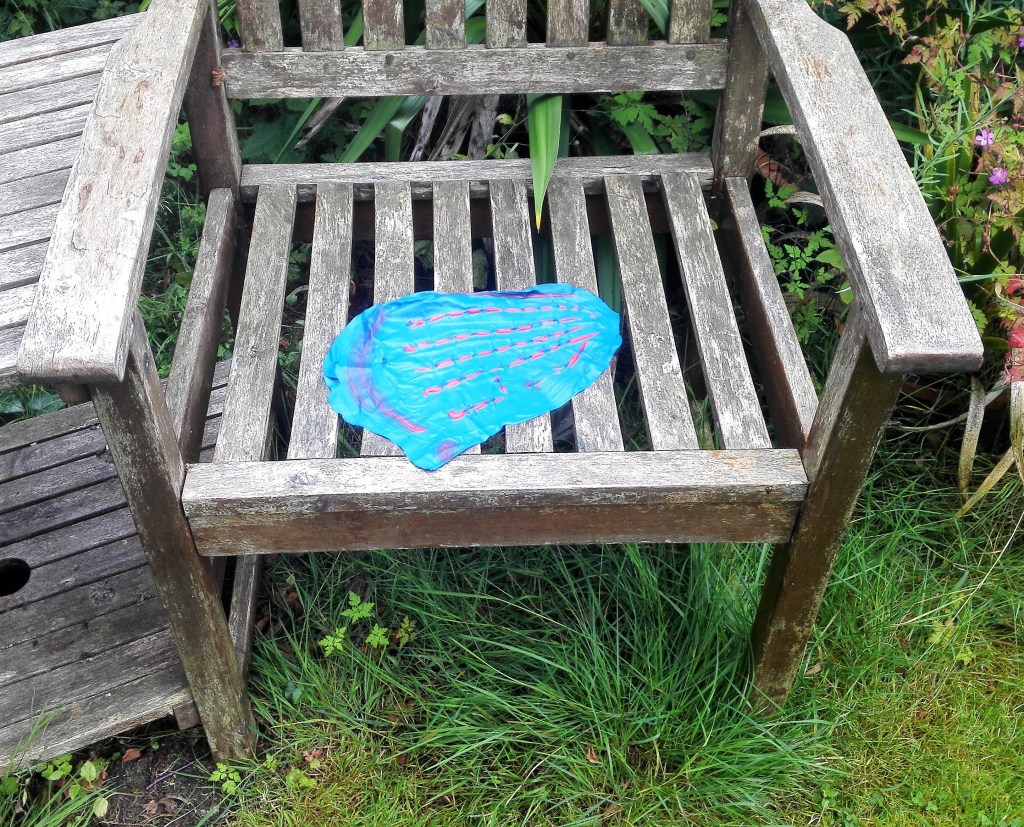
I moved this painting around the house and garden and photographed it in a number of locations. Its forms and appearance changed dependant upon where it was located. The idea of being able to move painting from the confines of the support began to intrigue me. It was notable how the location of the painting had an effect on both it and its surroundings. In some of the photographs it appears to take on form.
The adventures of Blue Frog
3. Four paintings on plastic bags. The plastic bags used were of a good quality, a thick plastic. I found that this helped in the application and manipulation of the paint which was mainly done with palette and painting knives. The paintings need to remain on the plastic as I feel that removing them from it would damage them. The resultant paintings are pleasing, particularly paintings 1,2 & 3 where both the colour and texture of the paint looks rich and textured. I feel that painting 4 looks less cohesive. It does have an look of Scotland about it though.
Painting 1, 20 x 32 cm
Painting 2, 18 x 31 cm
Painting 3, 34 x 23 cm
Painting 4, 20 x 34 cm
I considered what further I could do with these paintings after having these paintings on display in my studio for a couple of weeks. Could I bring them together into one larger work. Knowing that my assignment piece would be an expansion on work completed during Part Four could these paintings become the basis. These considerations are currently ongoing.
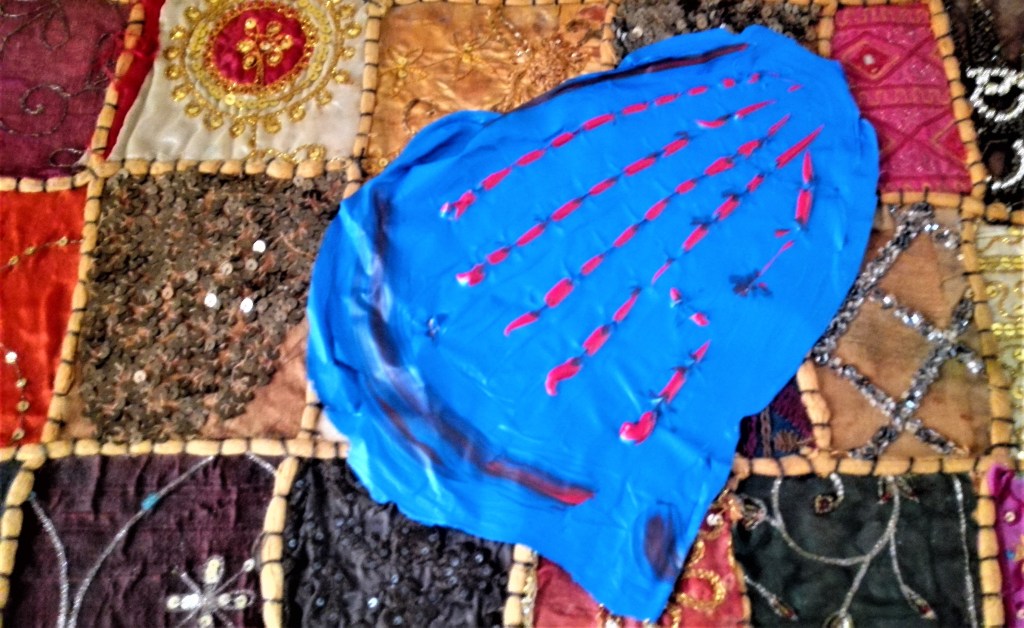
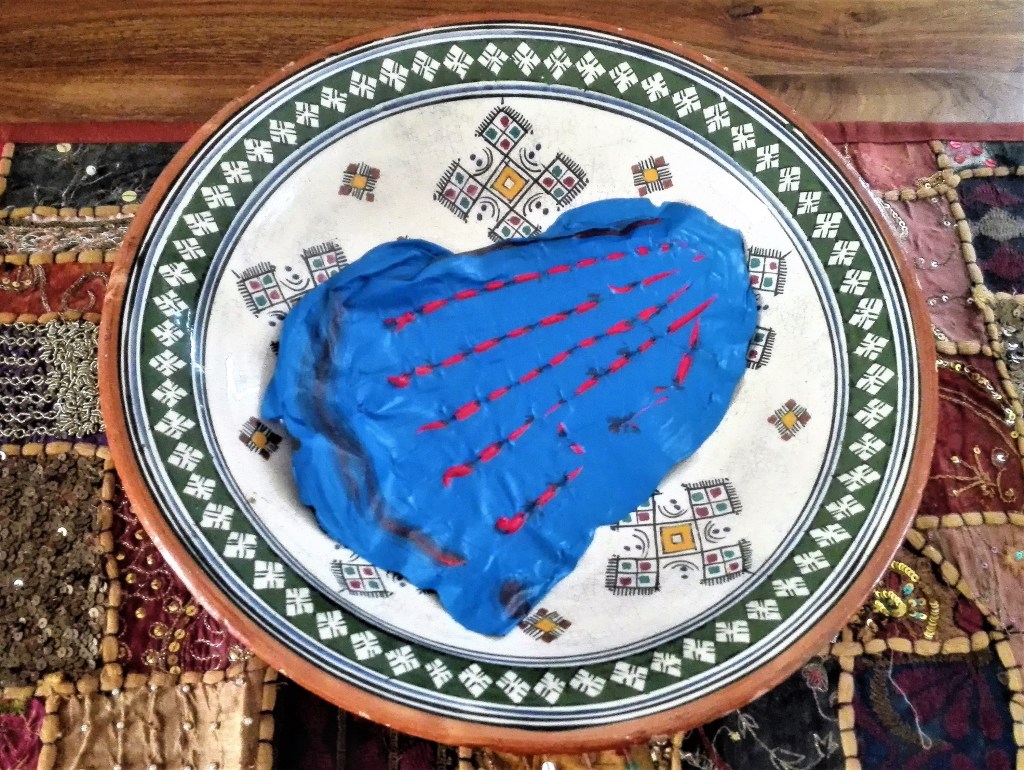
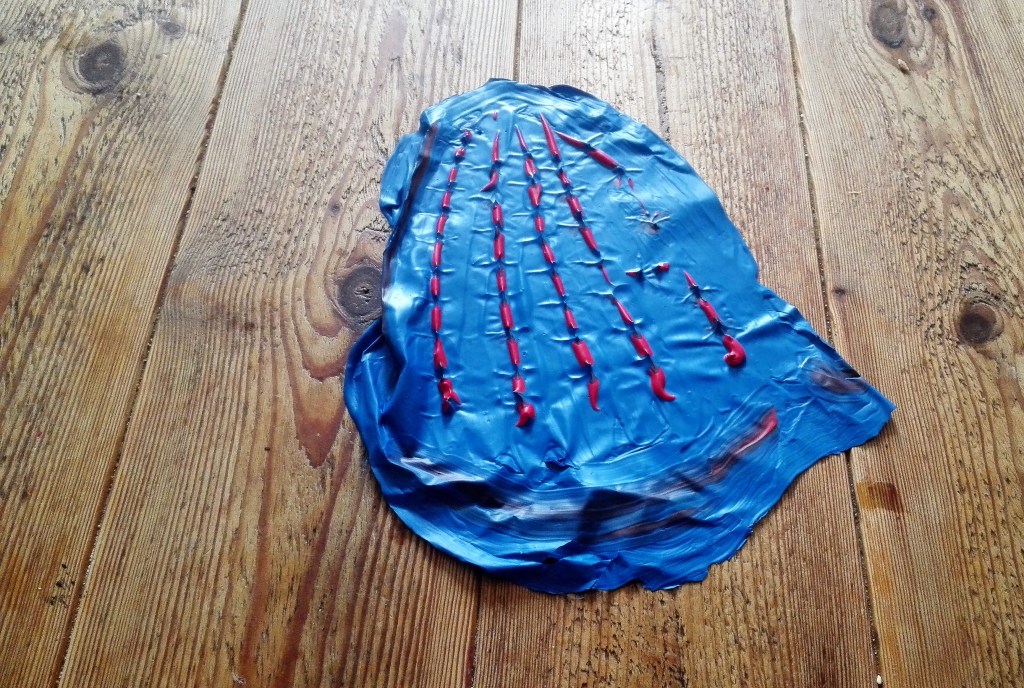
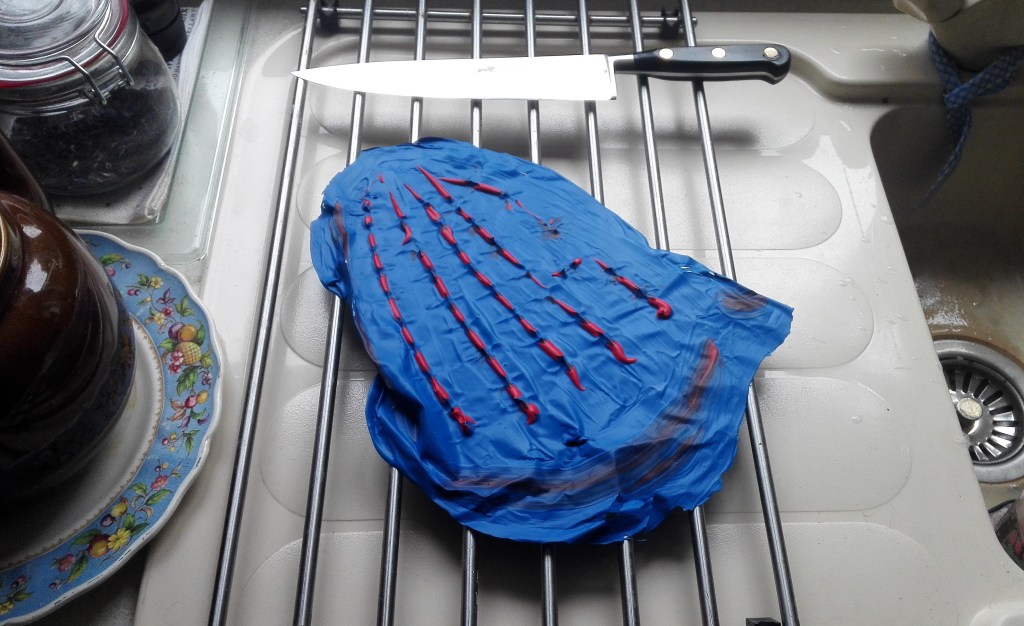
I made a further two paintings on plastic. with these I applied the paint thickly and built it up to a level where I would be able to remove it from the support. The two paintings are displayed below.
As with the four paintings on plastic bags I wanted to do something with the paintings. To display them in a manner that was outside the usual framed, hanging on a wall but how.
Experiment 9, Whilst thinking about how to display / use the paintings above I had obtained some A4 size acetates. These should be good to apply paint to as it would not need to be removed and the resultant paint could be viewed from either side.
Using the acetates I painted two works. The first:
Acrylic on acetate1
The second:
Acrylic on acetate 2
Painting on acetates produced a good outcome. Both of these paintings have a number of pleasing aspects. They can be viewed from both sides, although the backs were less interesting as only the base layer of paint can be seen. They can be displayed on glass windows which allows them to be backlit. Also the acetate support gives the paintings strength and enables the painting to be displayed in positions other than flat.
A number of options and ideas were beginning to present themselves. I took one of the plastic bags paintings, the thickest one, and carefully removed the bag from it and adhered it to an acetate. Placing this on a window gave it a new light. Before and after are shown below.
Painting 21 – Before and after removal from plastic bag and adhering to acetate
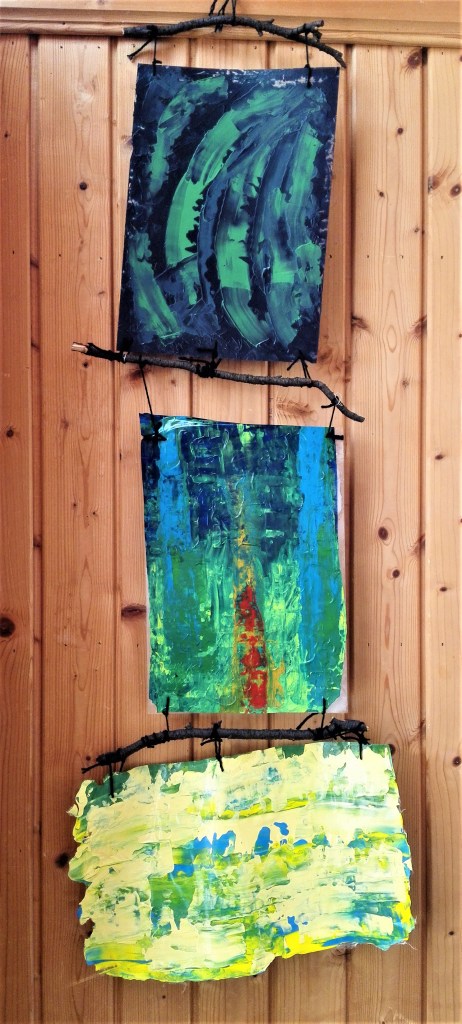
Experiment 10, the object of this experiment was to try to move beyond the obvious way of displaying paintings. I looked to join three paintings into one piece. I would use one of the paintings made directly onto acetate, one that had been fixed to an acetate and lastly one that the paint was thick enough to support itself. The paintings would be tied to large twigs with wool and joined together. An abstract hanging triptych.
Abstract hanging triptych
Conclusion, this is a long blog that has documented a series of experiments and explorations into paint, ways of applying paint, use of different supports and different way of displaying the resultant paintings. The process has given me many ideas that I shall take forward into my practice. I anticipate that it will impact my parallel project and also the way that I will approach future exercises and assignments.
+++++++++++++++++++
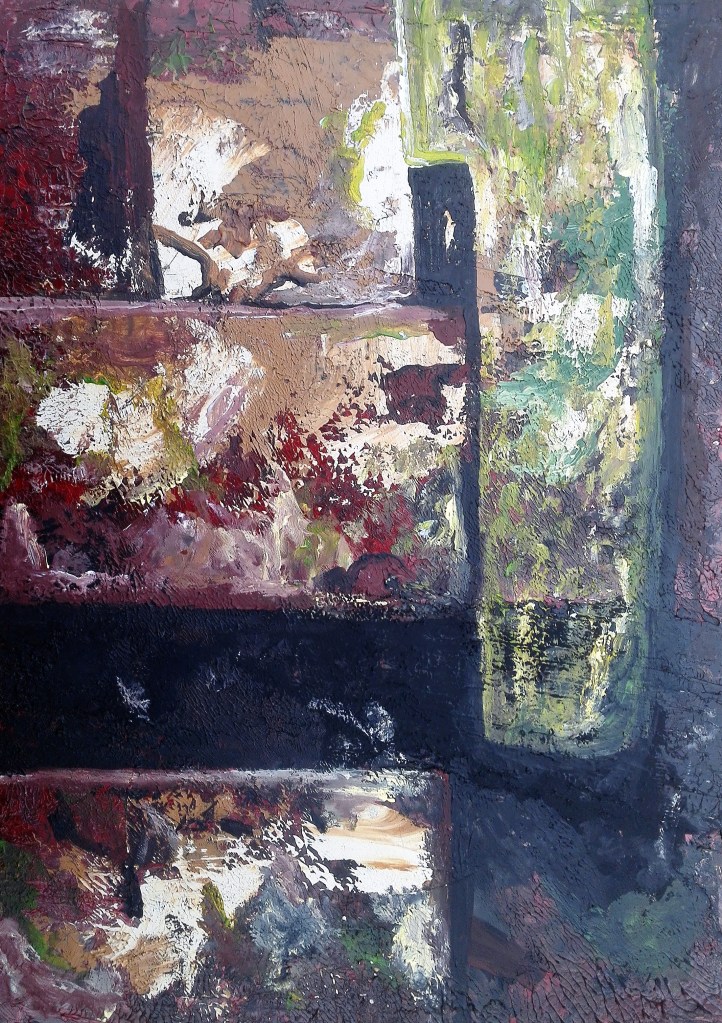
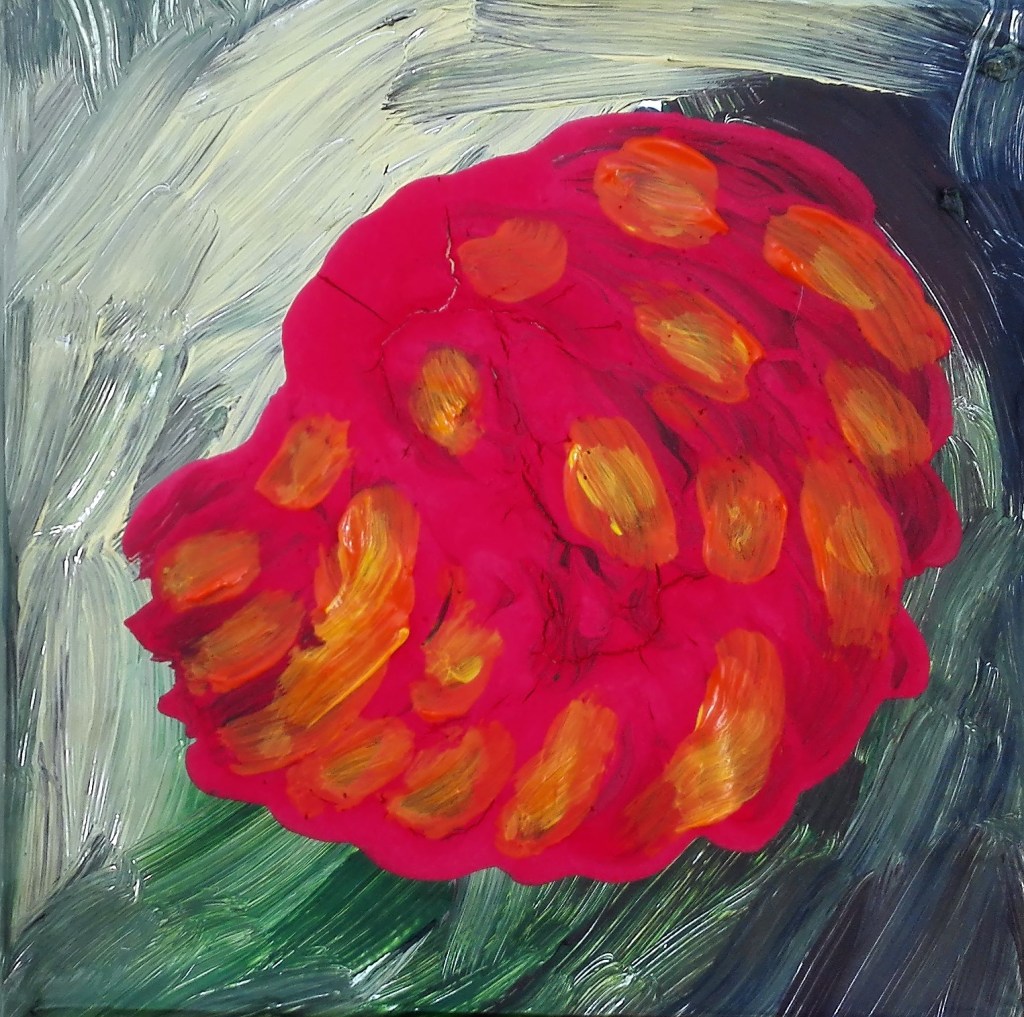
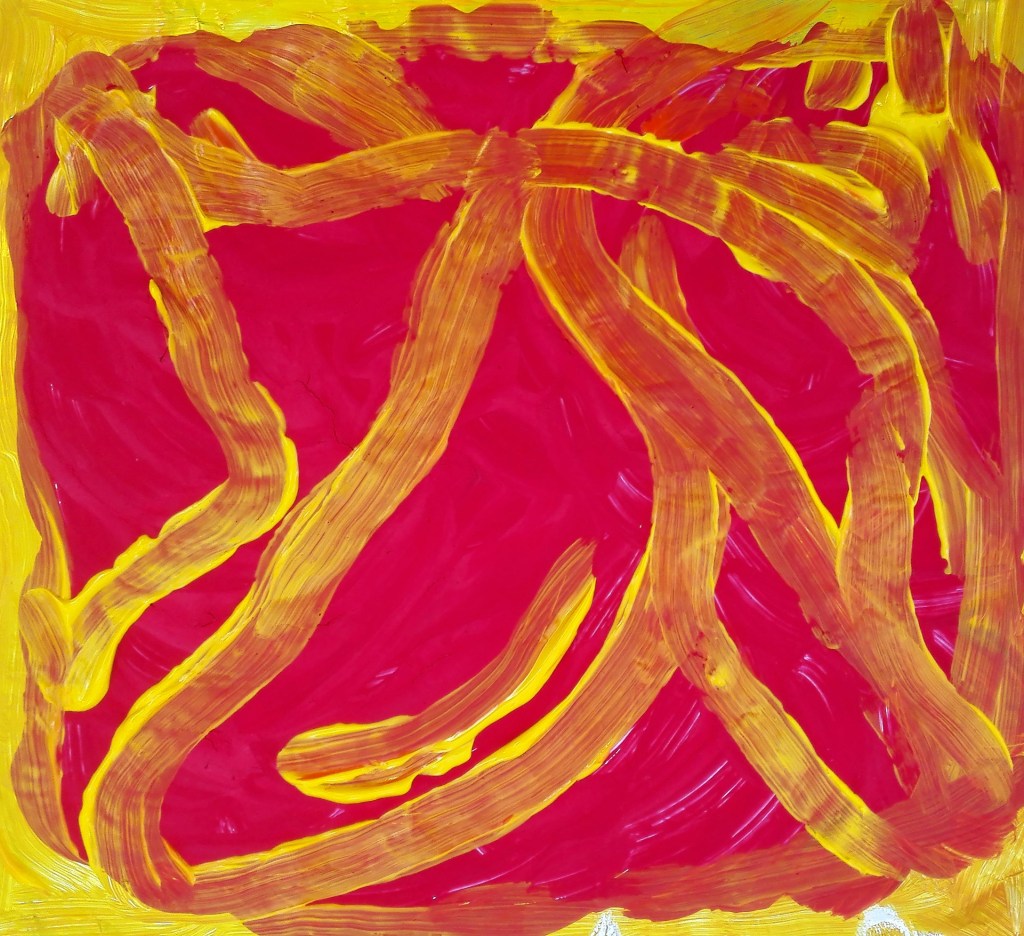
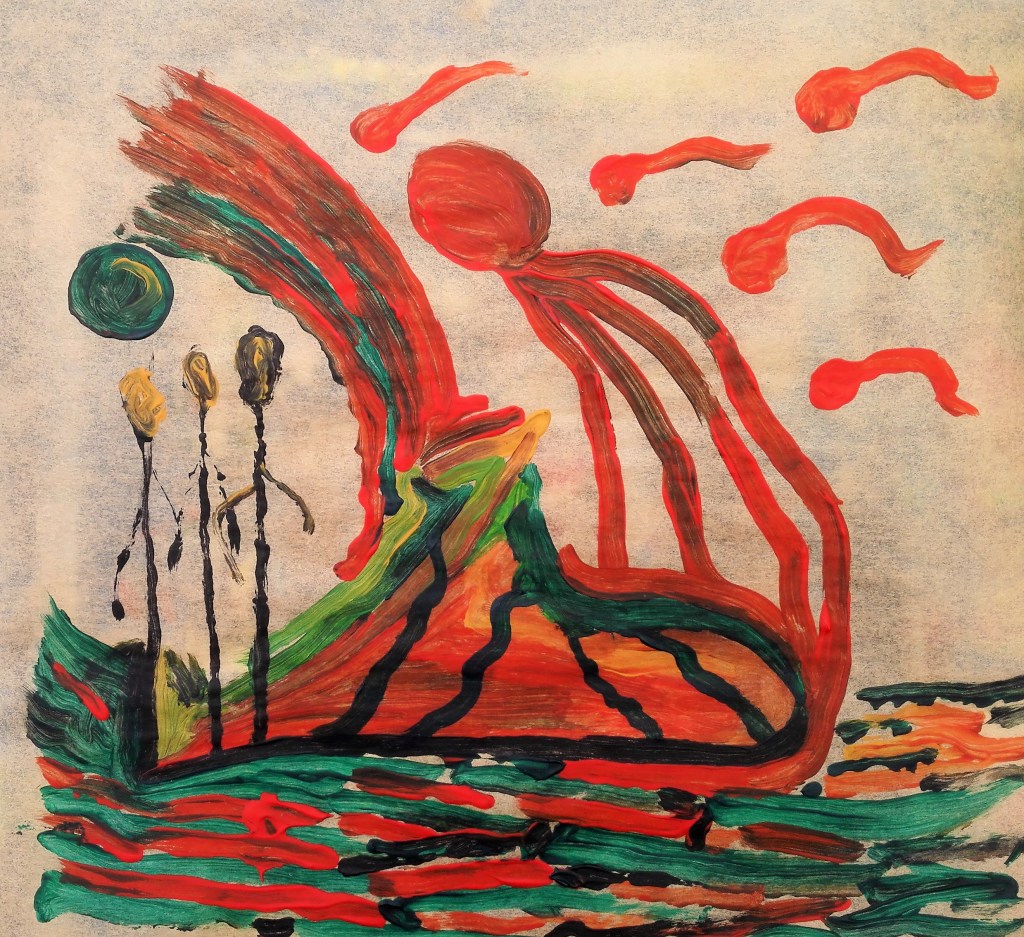
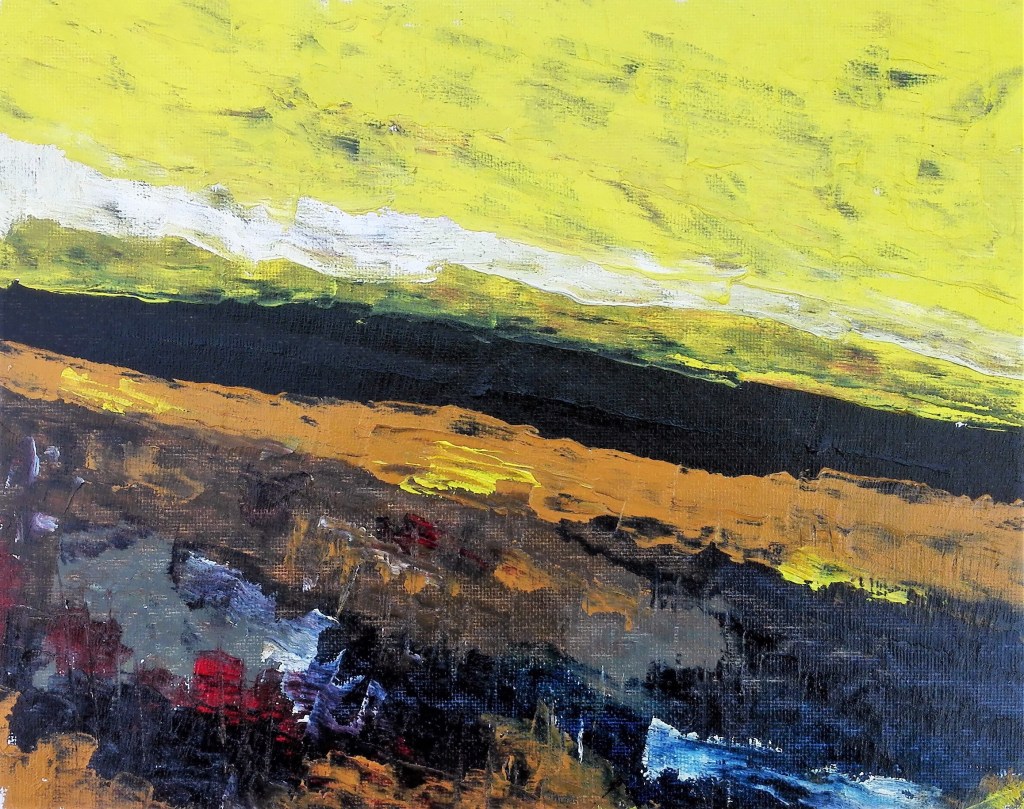
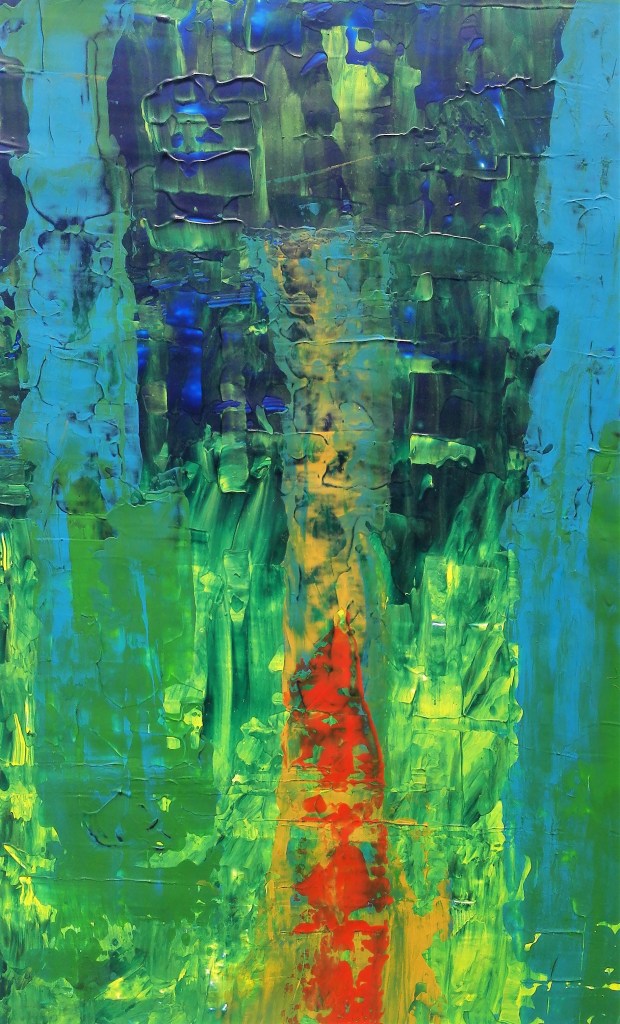
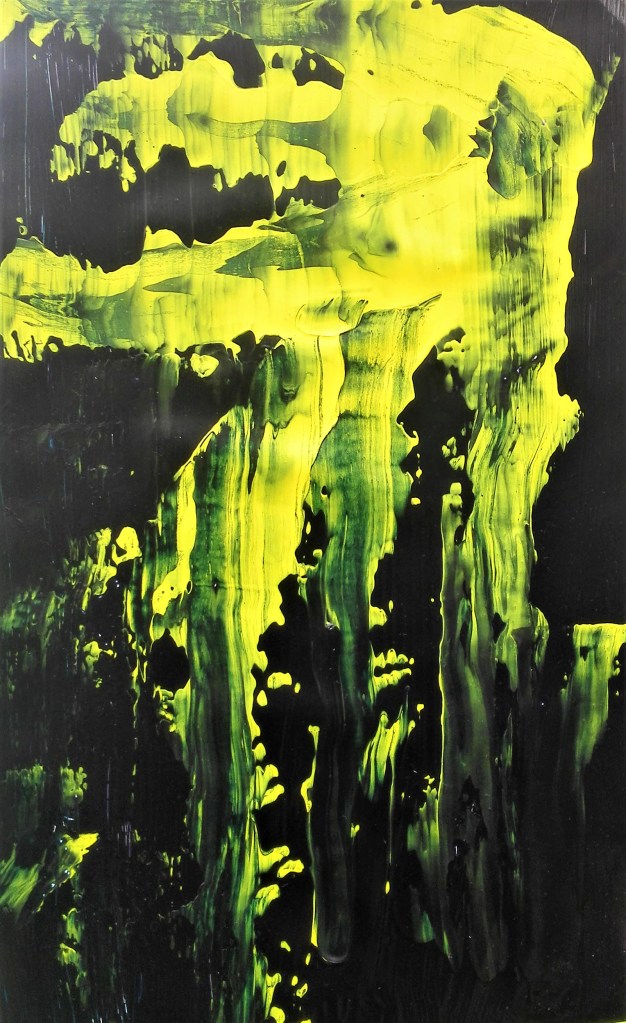
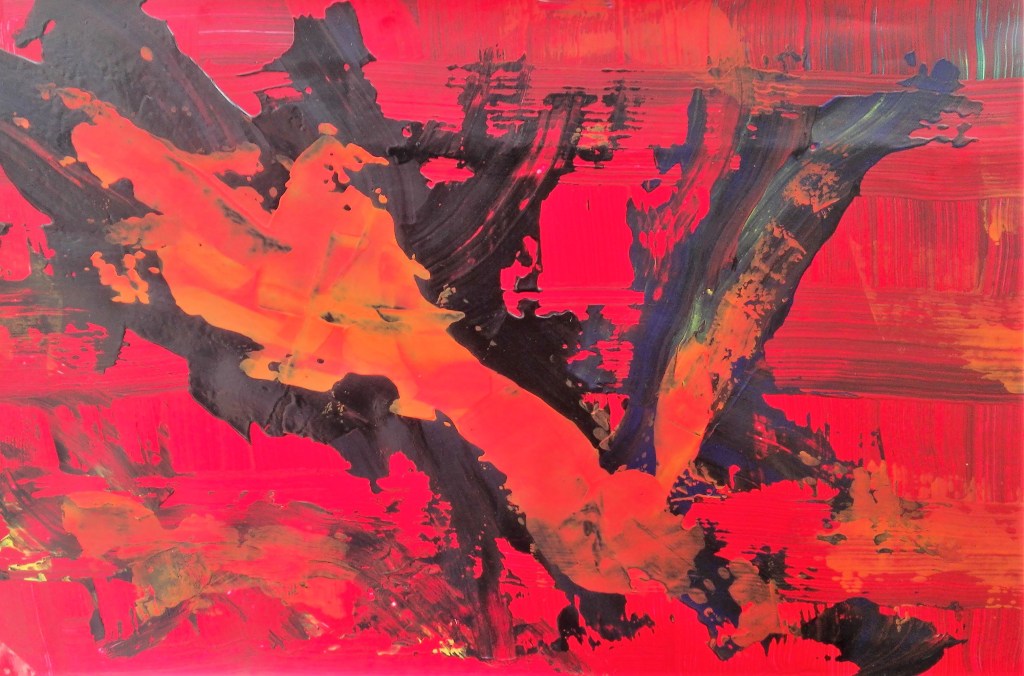
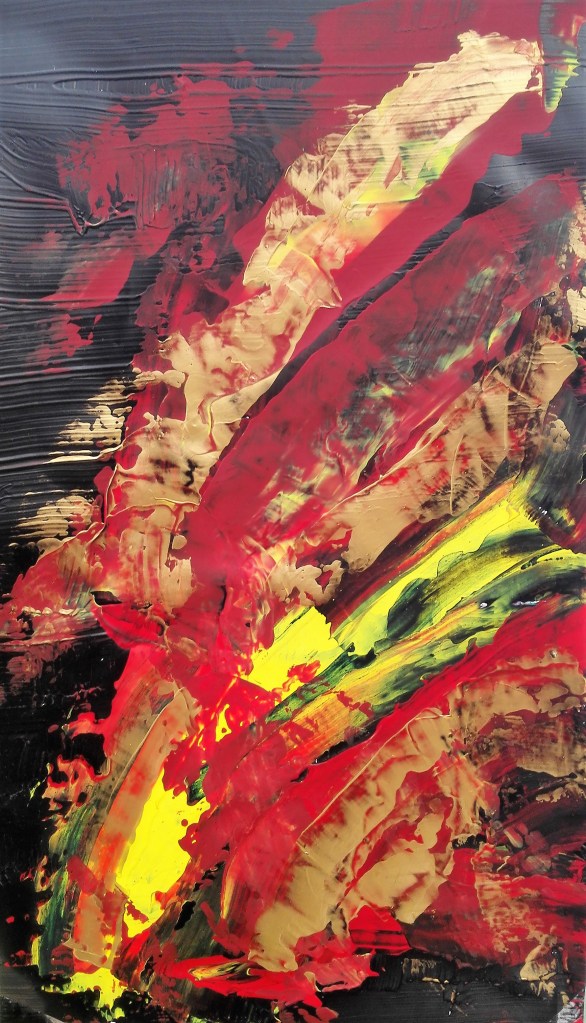
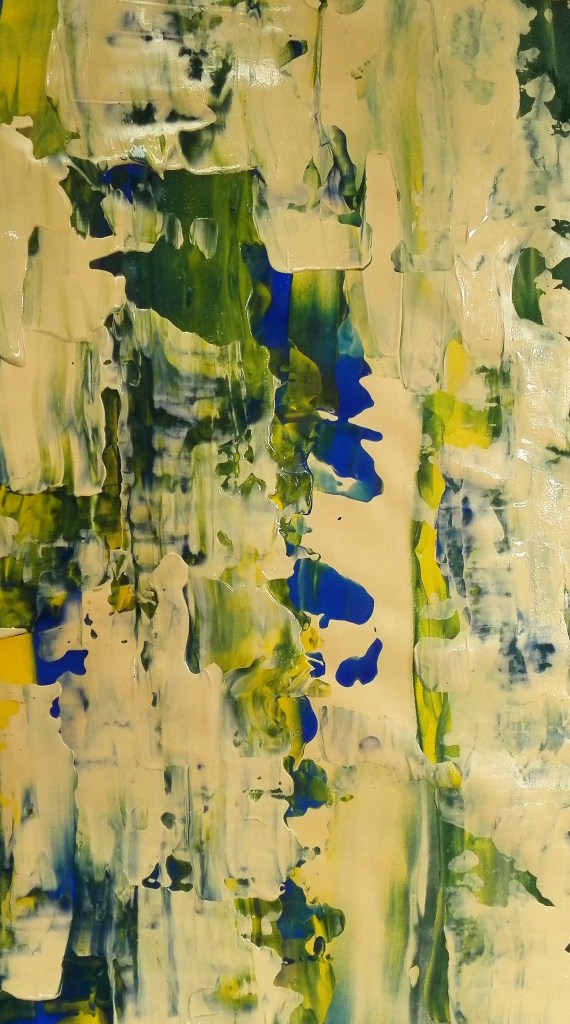
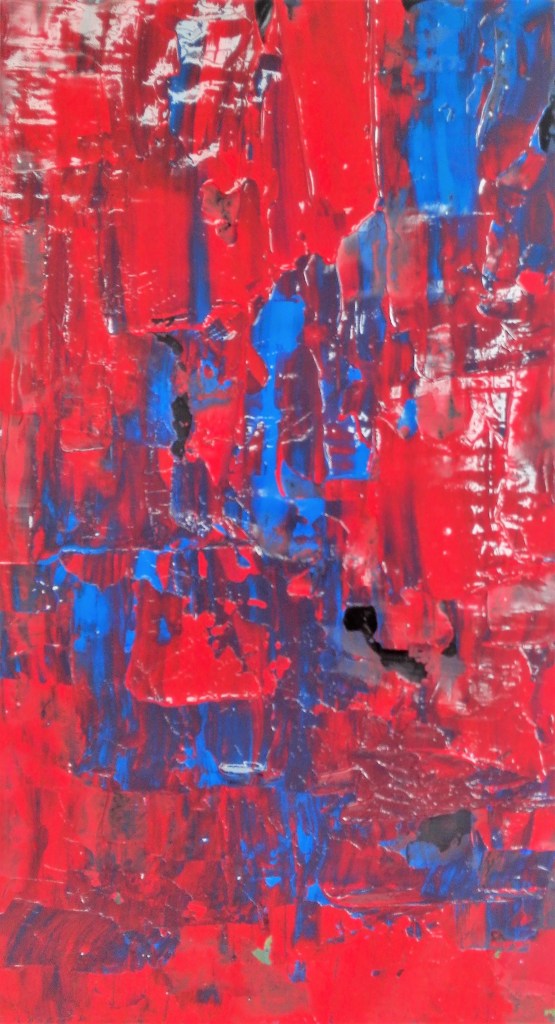
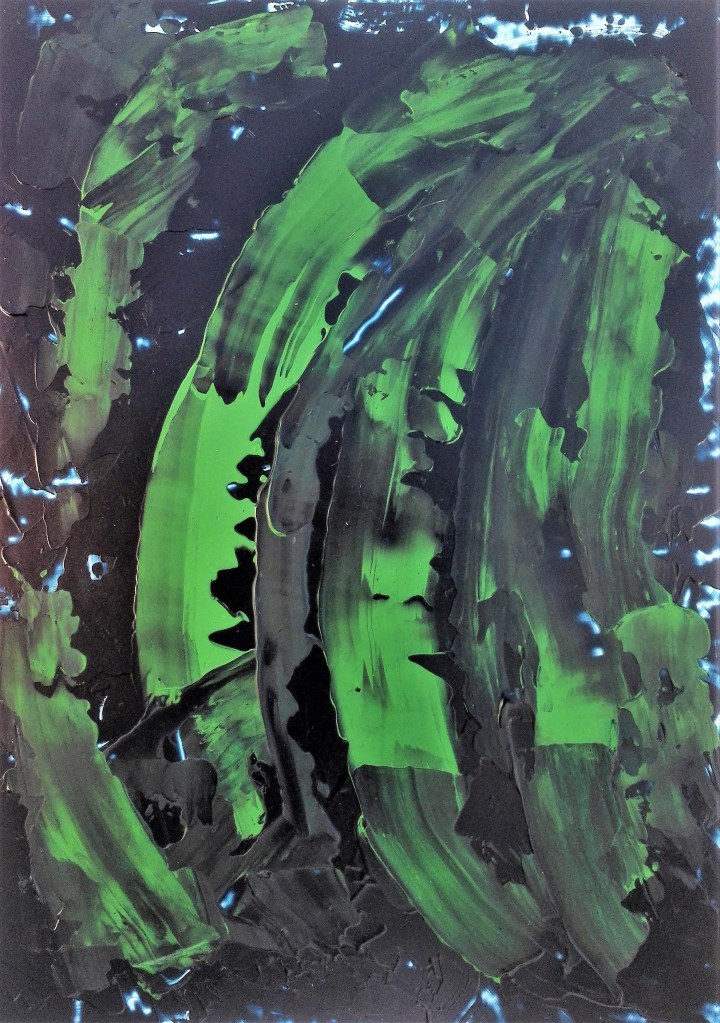
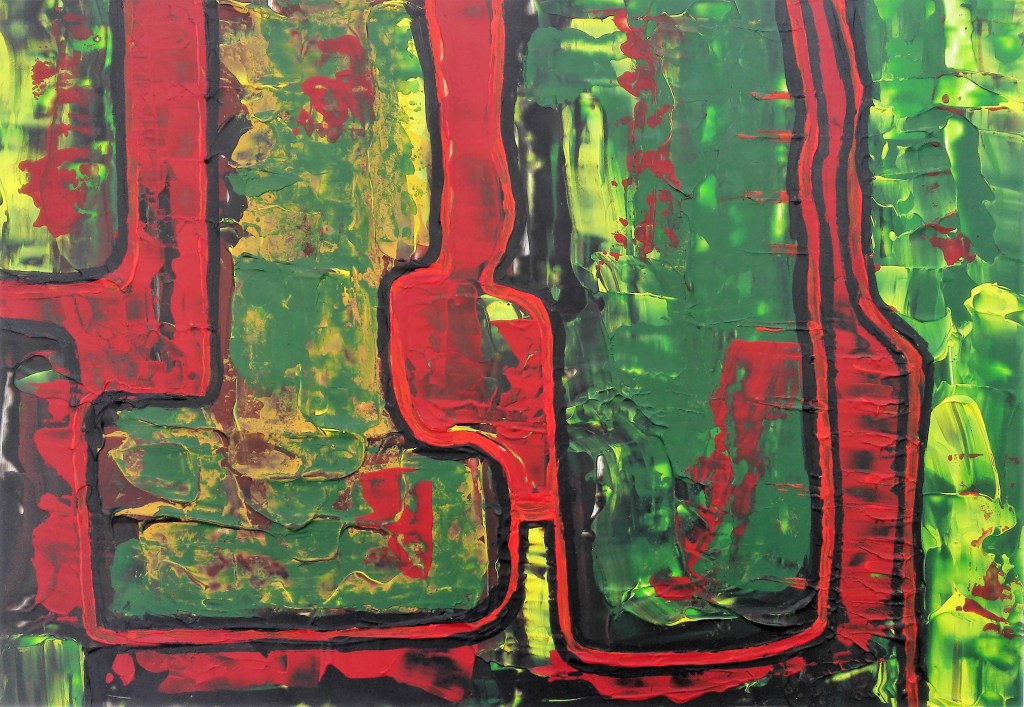
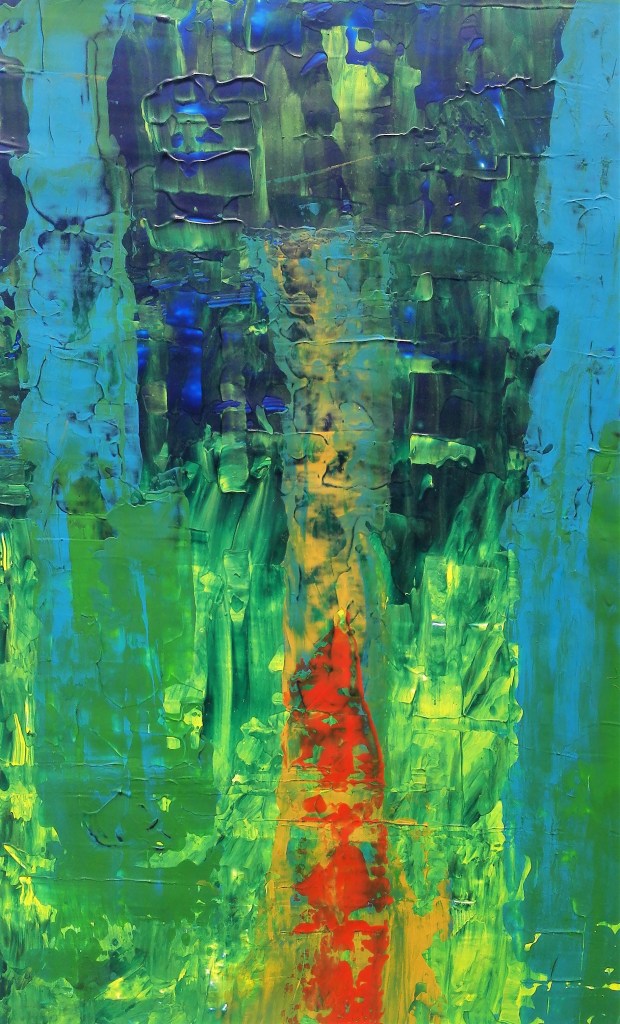
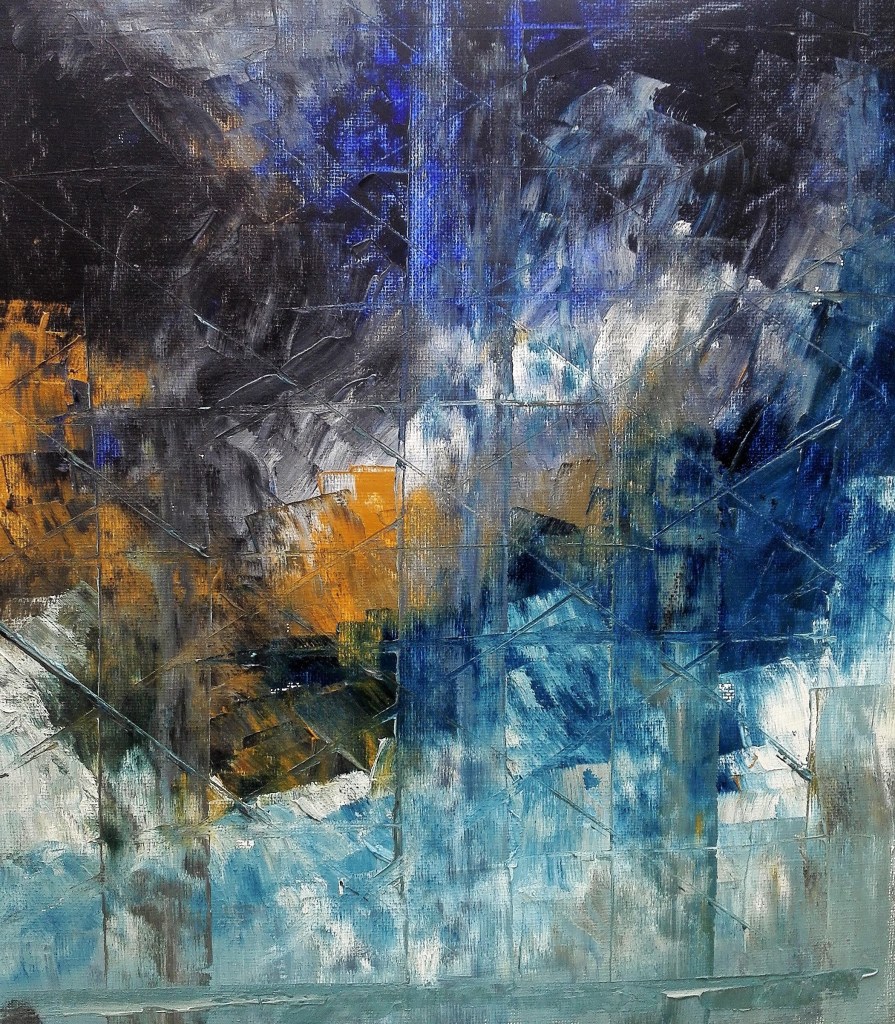
A further work completed later which I feel deserves to be included in these exercises is shown below. It is an abstract work, untitled, which has movement and drama.
This blog has nothing to do with Part Four of this course. I have documented it here as it occurred at the point where I working on this part of the course. The notes are in bullet point form.
Noted 23 participants of which 5 males.
These are the notes that I made from the discussions included in the meeting which was supported by five HE6 students.
How well prepared did you think you were before starting HE6?
Jane, felt ready, wanted to paint rather than sit behind a computer.
Dawn, completed CIP, smooth transistion to HE6.
Patricia, felt ready, 11 years study, thinking differently about self.
Naomi, rollercoaster, emotional experience, light hearted and fun at previous level. Made self uncomfortable, intense. Communicating with the art world.
Rachel, juggling with work comittments, essay was a struggle. Book ‘How to write about Contemporary Art’ Risk taking.
Two project at once, essay writing difficult. Alternating between two courses.
*Essays need to be on something that you are interested in*
Major project and contextual studies interlinked.
ESSAY IS KEY TO HOW YOU GET YOUR HONOURS
Librarian is a good resource to be used.
UCA Library website – Journal of Contemporary Painting – sign up for
Organising an exhibition(s), sending invitations, digital platforms. Exhibiting gives / provides a drive to continue working and improve painting practice.
Lots of ideas or very disciplined, allow things to evolve, same subject but different ways of seeing and representing.
























 Mark Taylor 'Studio Practice'