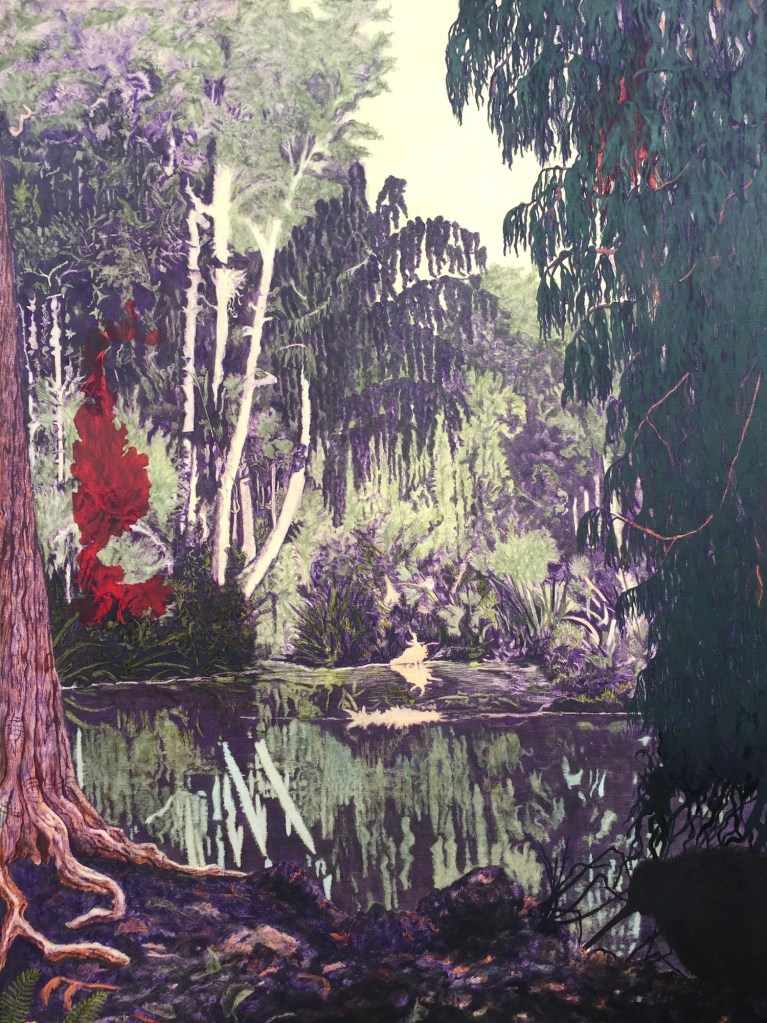
Robyn Litchfield was the winner of the Jackson’s Painting prize 2020 in the Landscape / Seascape / Cityscape category. The winning painting, The Hollow Place, which is shown below immediately drew me in. I saw a link to a topic that I wanted to attempt but had, to date, avoided. It also resonated with the work that I had been completing for “Exercise 1.3 – The mirror as a stage”.
Robyn Litchfield, The Hollow Place, Oil on linen, 92 x 68cm, 2020
Robyn is based in New Zealand and her inspiration comes from the primeval landscapes there. She works both from photographic images from the 19th century and photographs taken by herself . Her working method is similar to my own in that she works from sketches, smaller painted studies then larger canvases. Her paintings capture landscapes and often use reflections to amplify space. The colour palette for each painting is limited and subdued. This gives the paintings a coherence. The colours are not typically representational of the actual colours. Most of her works have an amorphous shape which is added as an unconscious act.
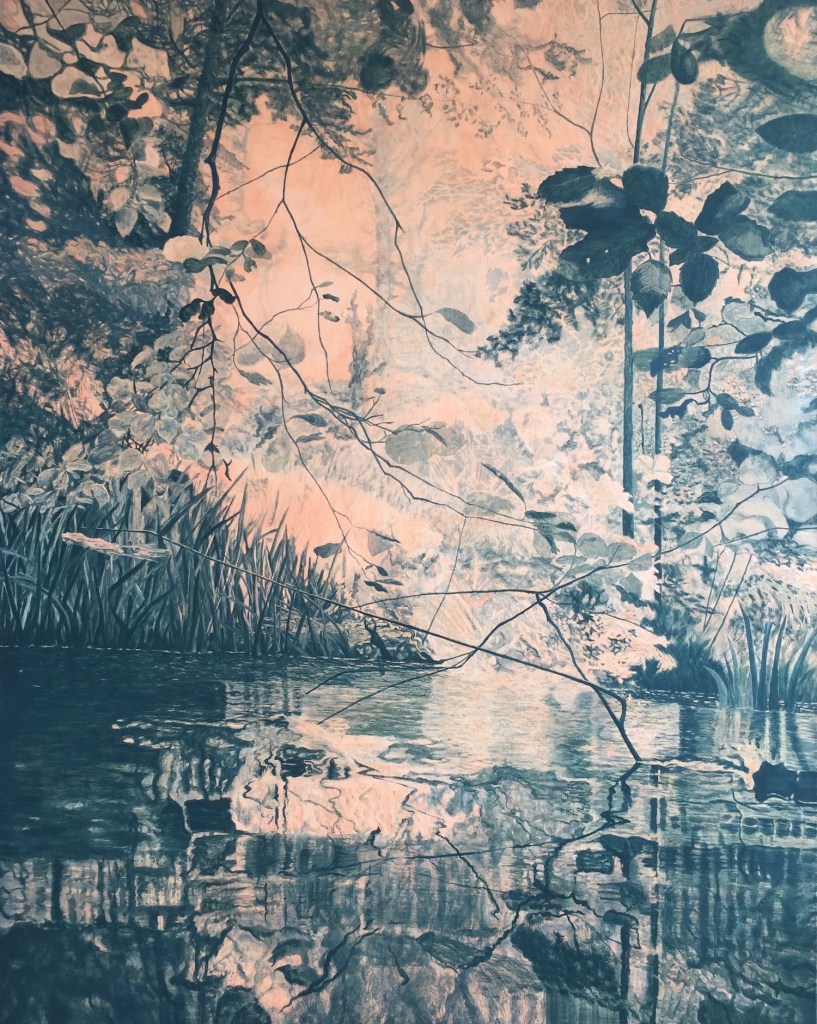
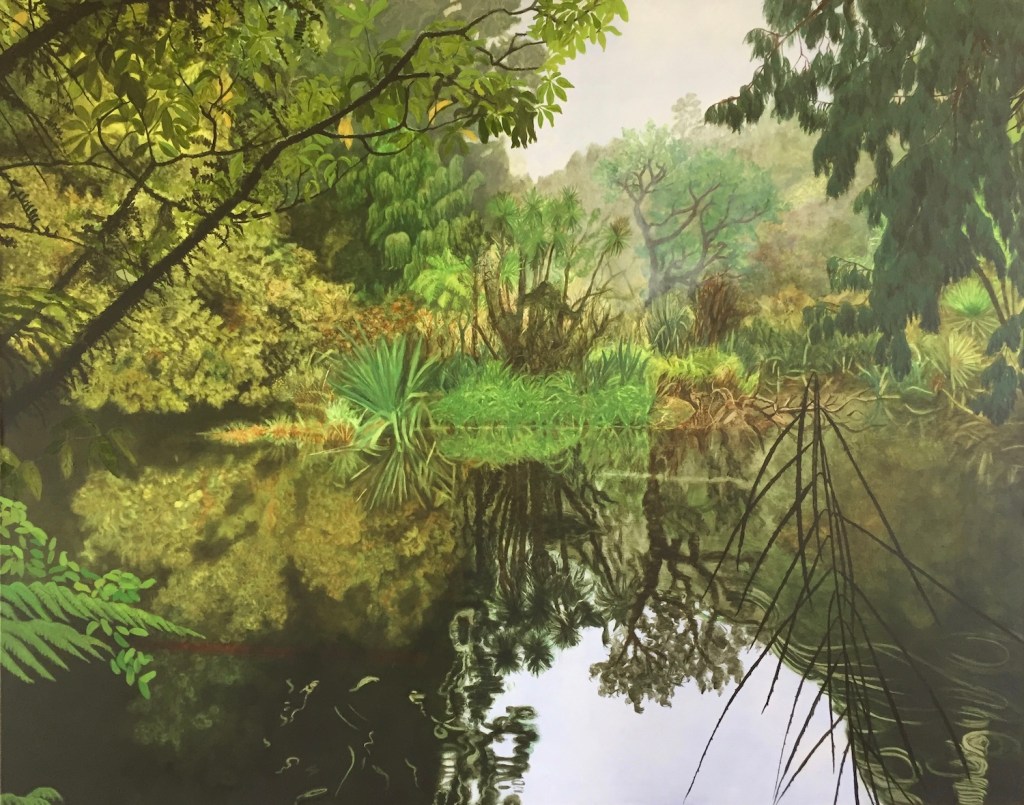
Two more of her paintings are replicated below.
Robyn Lichfield, Forest Gloaming, Oil on linen, 120x95cm, 2018
Robyn Litchfield, Ship Creek, Oil on linen, 41x51cm, 2019
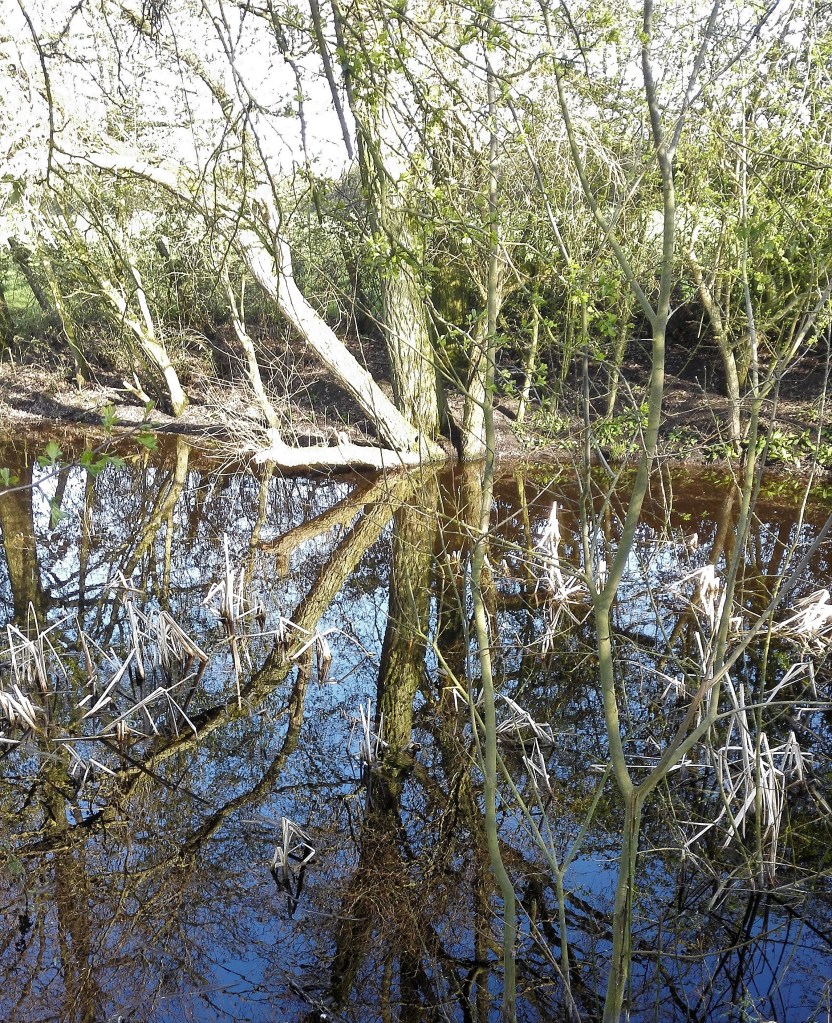
As stated earlier in this blog I am drawn to these paintings and see links to where I would like to take some of my work. I have a set of photographs which examine a similar topic, see below, which I will attempt to turn into a painting which will be my Assignment Three piece.
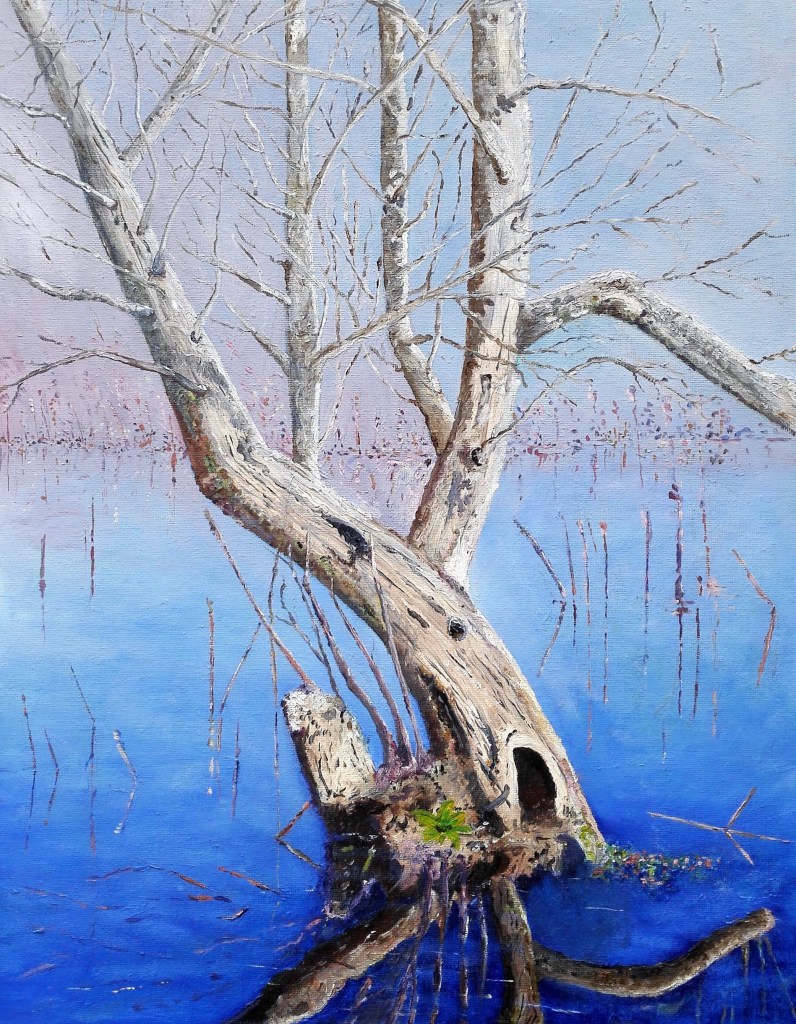
I will set up a separate section of my blog to highlight additional paintings that I have completed whilst working through ‘Studio Practice’. These are often an idea or an image that I have found that I want to try and draw or paint. However I will start this blog with a painting that I had completed during Part Two that I wasn’t happy with. It is a painting of a sunken tree. I was drawn to the image whilst out walking. I took a photograph of it and committed myself to reproducing it in paint. I returned to it during Part Three and having made some improvements to the painting I felt that it fitted in with the brief for Exercise 1.3. The topic is as much about the reflective property of water as it is about the tree.
Sunken Tree – Rework 5 , Oil on board, 35 x 45cm
The background , its colour and image is a creation made up in the studio. In earlier versions of the painting I had dispensed with a horizon line which made the painting look flat and lacking depth. The addition of the horizon line and the blurred, misty background brings the whole composition together.
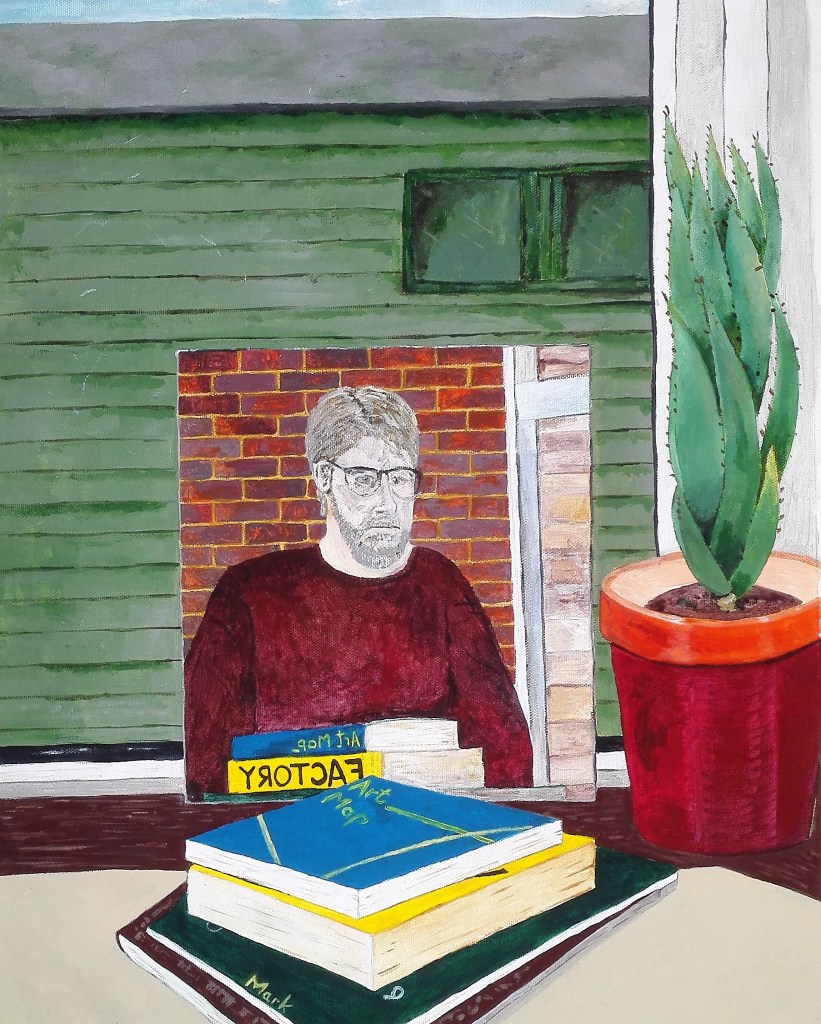
The second painting in this series exploring reflections is a more formal representational painting. It is a self portrait painting using a mirror against a window. The view through window, the objects on the table and windowsill along with the background behind myself. I have described the image in a literal manner. The self portrait whilst representing a likeness does make me look sombre with a vacant expression. Perhaps this is a reflection on the time that it was painted, during Lockdown. I feel that the painting works as a composition, maybe it lacks interest to the left side. I was tempted to add some plants but decided to leave these out to emphasis the empty feeling of Lockdown.
Self Portrait – During Lockdown, Acrylic on canvas paper, 37 x 48cm
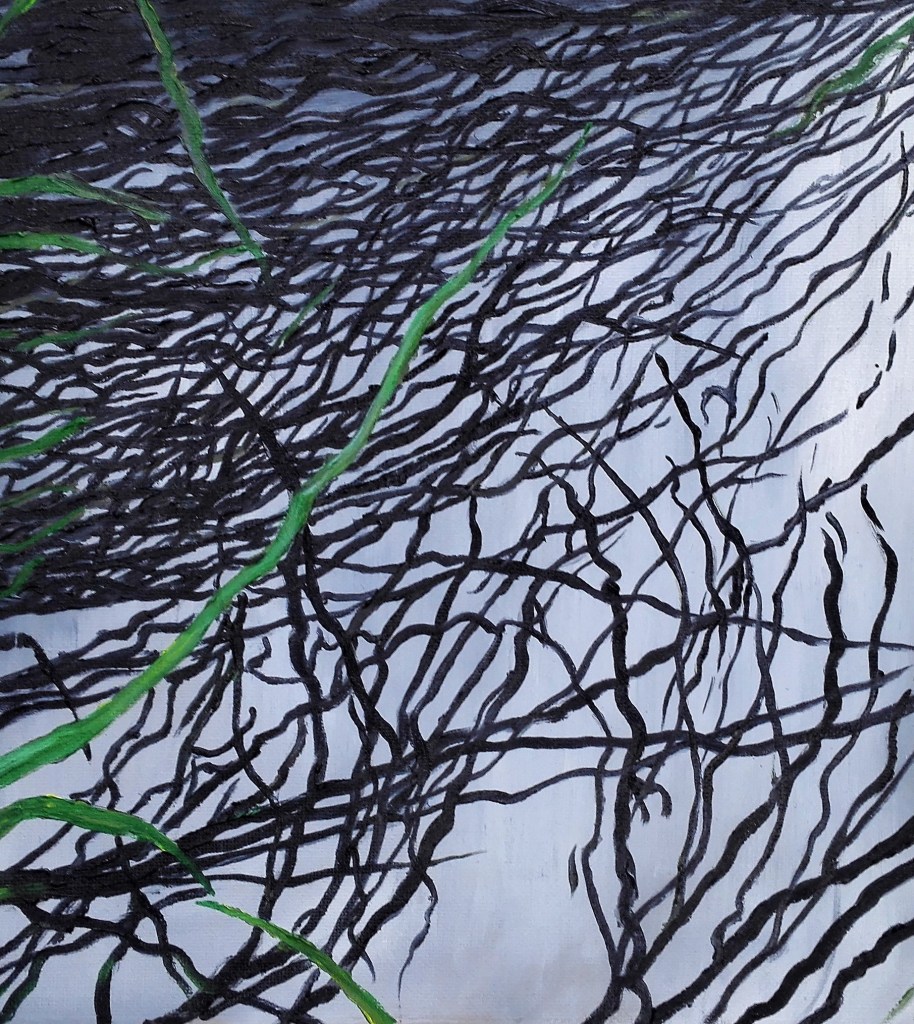
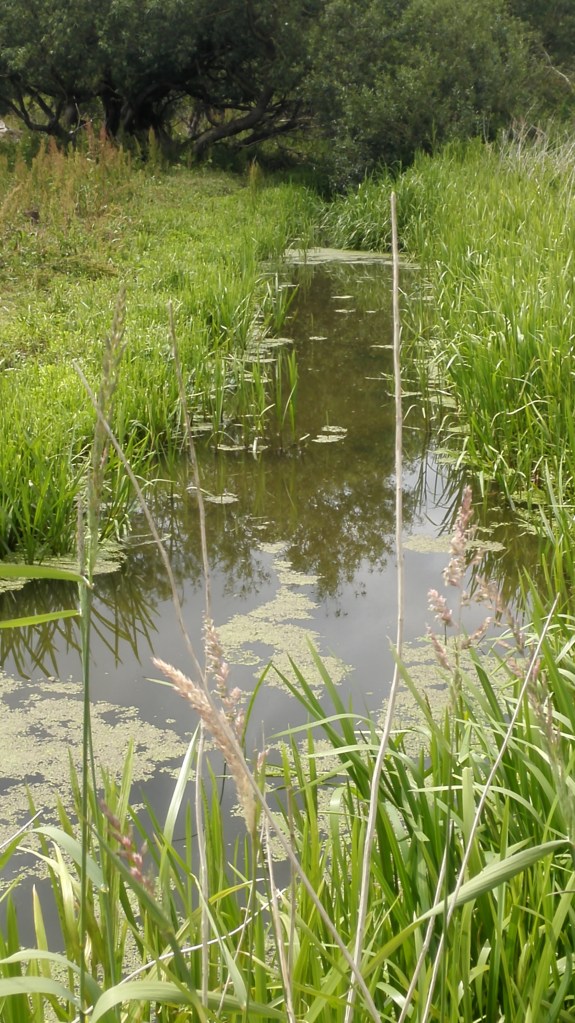
Painting 3 is a study in the reflective qualities of water. The painting is taken from a section of a photograph where I was looking into the water and seeing the refection of the grasses and reeds. I feel that this is important to point out as when I showed this painting it was commented that it wasn’t obvious what it was or what it was supposed to represent. To me it was obvious but then I knew of the source material and how I had arrived at the image. Despite this I feel that it works as a painting.
Grasses reflected in water, Acrylics, 25x23cm
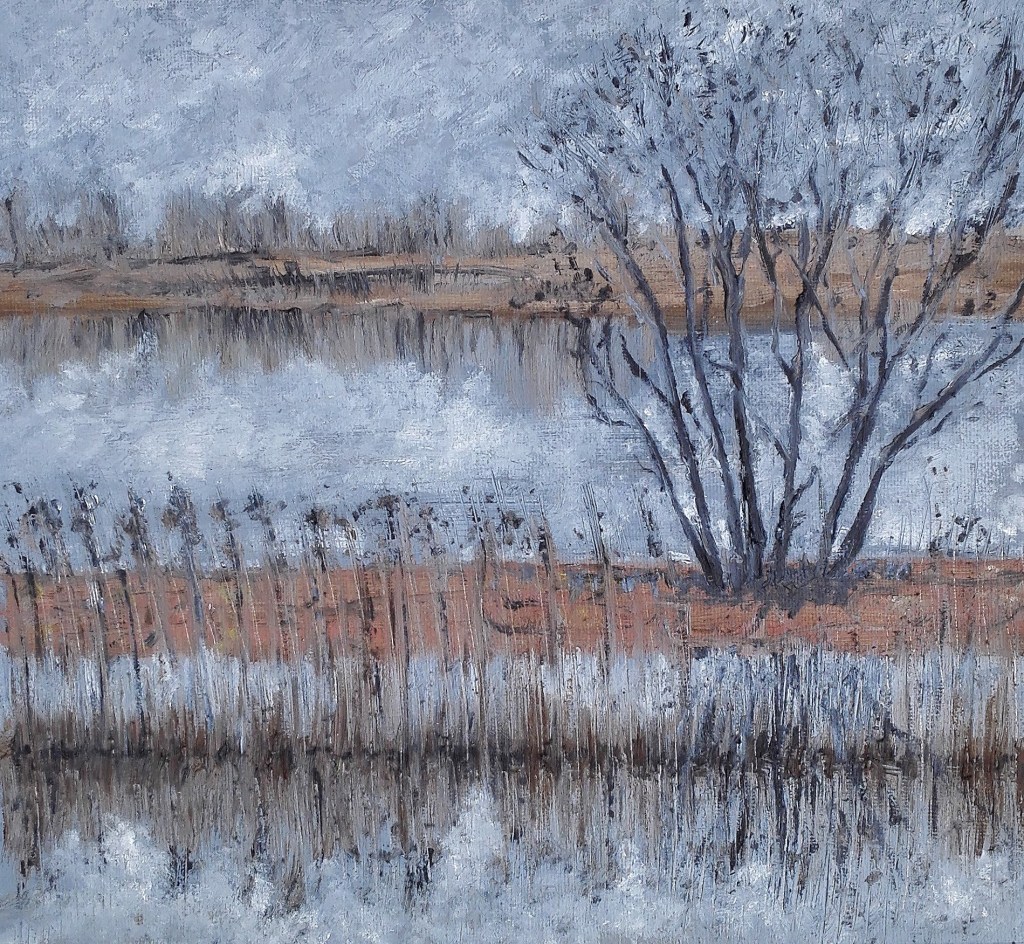
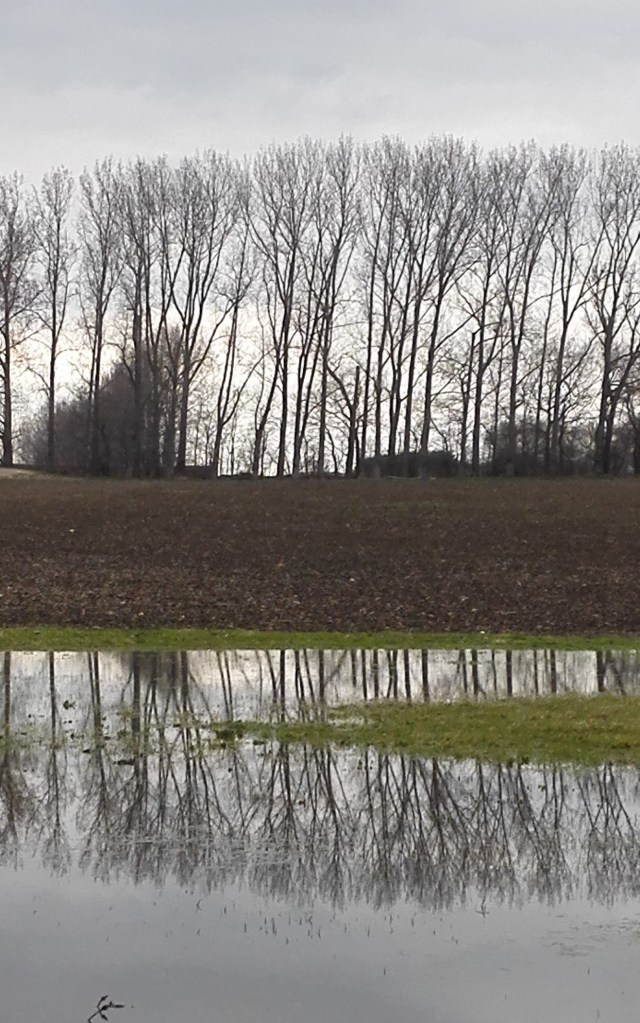
Painting four, the last in this series, is another exercise in trying to depict the reflective qualities of water. This painting, a Fenland landscape, attempts to capture how the reflections amplify the size and scale of the landscape. In hindsight I made the greys slightly too dark which has taken some of the life out of what I wanted to convey and made the painting more gloomy than I had intended.
Flooded Fenland scene, oil on canvas paper, 25 x 23cm
As I mentioned in Blog One on this exercise the Fenland landscape, its atmosphere, the water, the reflections in the water are all aspects that I want to explore further in my work. It is amongst the confusion of ideas that I will focus in on a topic for my parallel project.
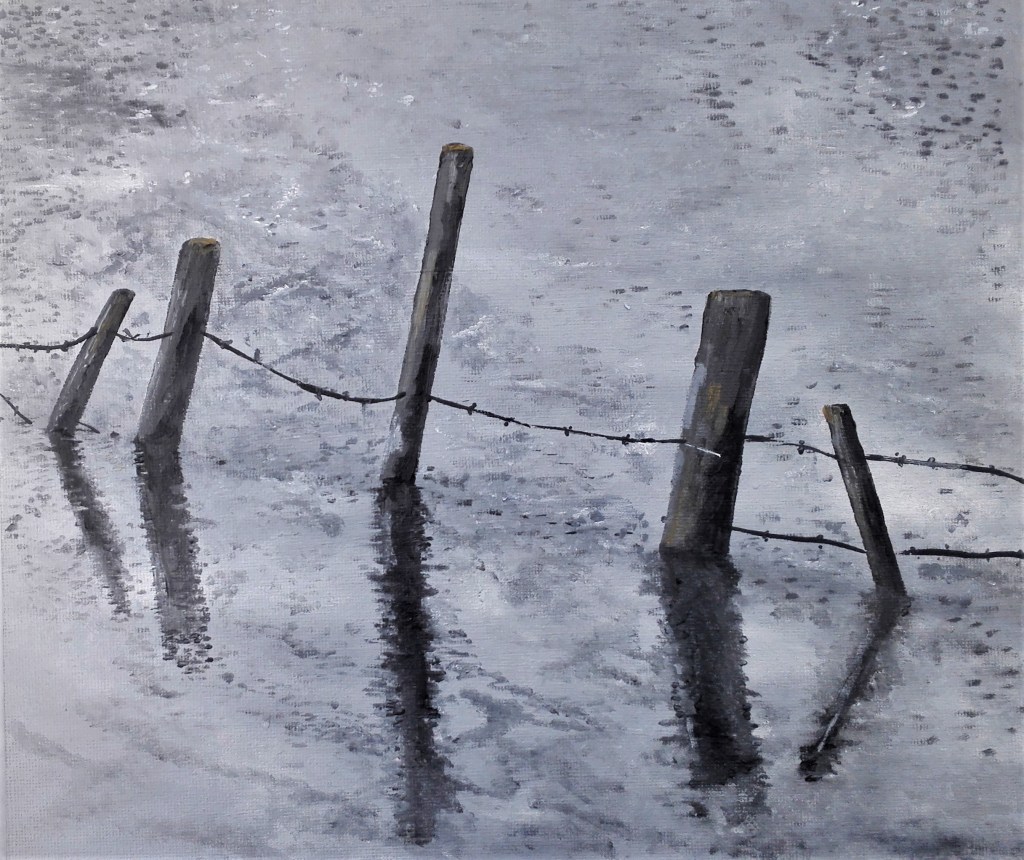
Before I started work on my painting for Assignment Three I completed a further two quick studies examining the topic of reflections in water.
Fence posts, oil on canvas paper, 25x23cm
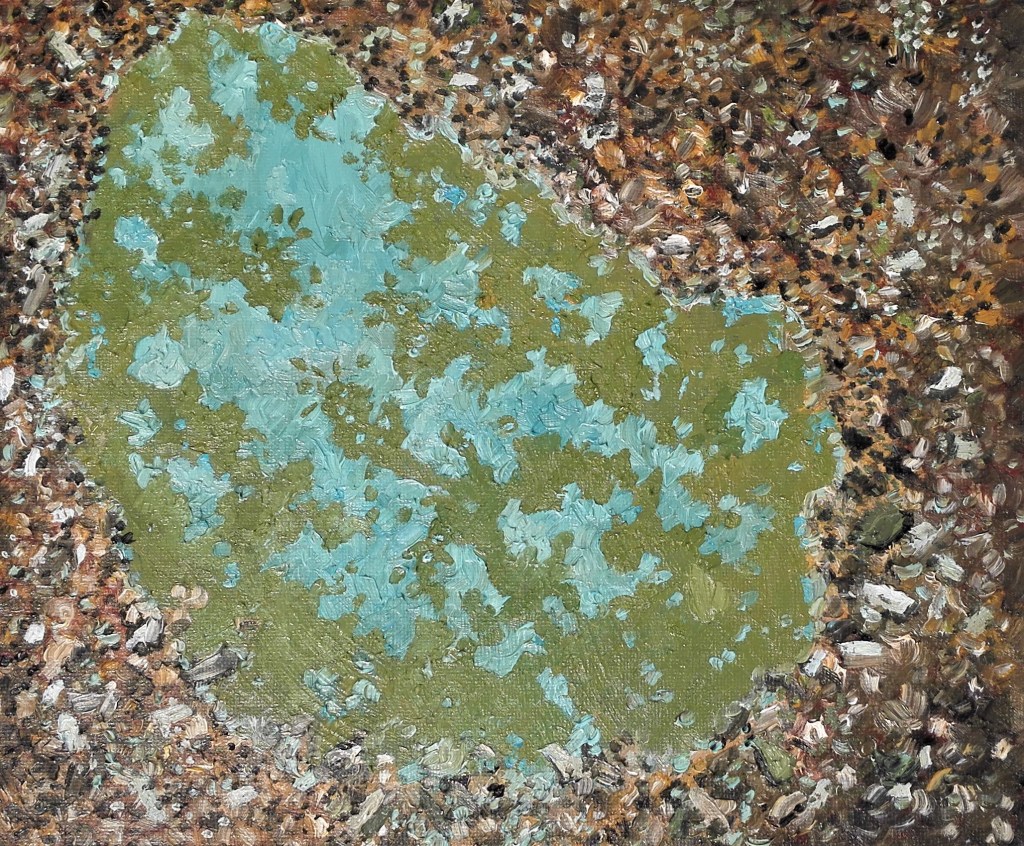
…and the second one
Puddle, Oil on canvas paper, 25x23cm
In summary I am happy with the outcome of this Exercise and the differing ways that I have approached the topic of mirrors and reflections. I suspect, that it is a subject I will continue to return to often as I find the topic offers endless fascination. It forces me to look carefully and consider what I’m looking at.
Link 32, Katerina Grosse, these were large scale paintings which are part of the architecture of the building. The use of spray guns helped to increase her reach. The painting envelopes the buildings interior which in turn envelopes the viewer or occupant of the building as they move through it.
Link 33, The multiplication of being, or a reflective abyss? Mirrors
An essay into the role, mystery and intrigue that can be created by mirrors and reflective surfaces.
“Daguerreotype” process the first publicly available photographic process widely used during the 1840 -50s.
Examples of artists mirrors and mirrored surfaces.
Robert Smithson
Six mirrors, chalk, Oxted Quarry, England
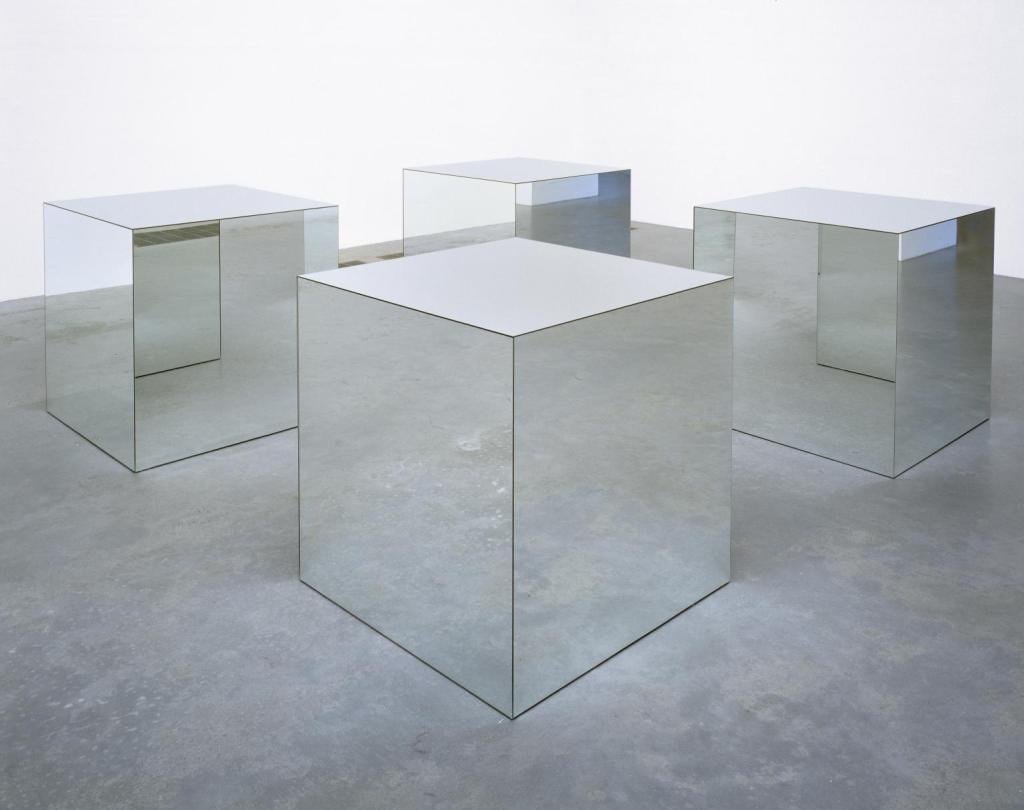
Robert Morris, minimalist
Untitled 1965, reconstructed 1971 Robert Morris
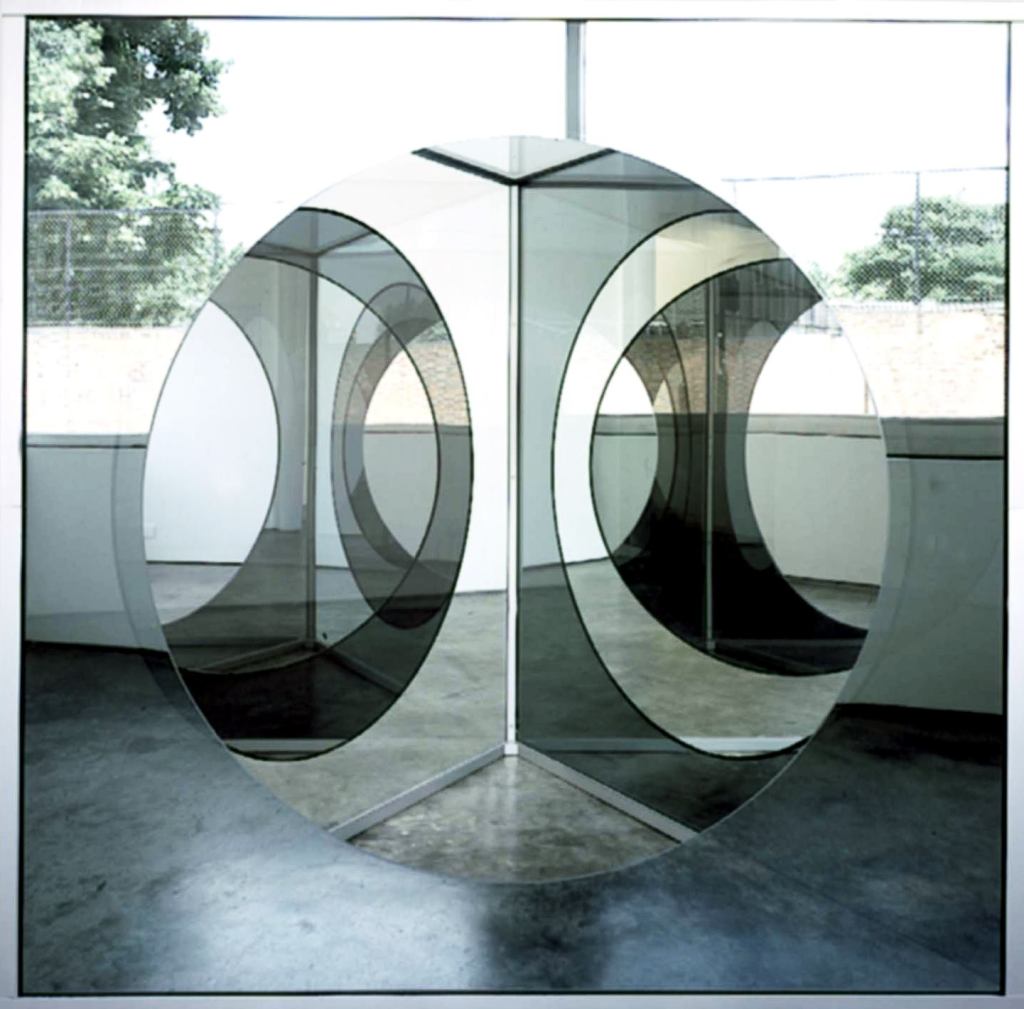
Dan Graham, installations and structures
Pavillions
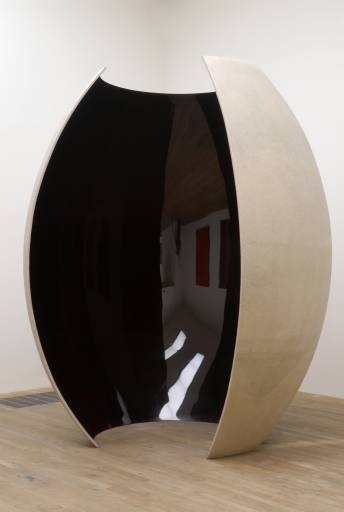
Anish Kapoor, specialising in installation art and conceptual art. The piece below I have visited in Tate modern on more than one occasion. The surface of the work is highly polished. Its presence changes as you wander around and into it.
I wanted to explore this Exercise in more than one direction. The idea of using paint as a mirror or reflective surface was one topic. The second was the use of a mirror to construct a composition and the third was to incorporate reflections into a painted study.
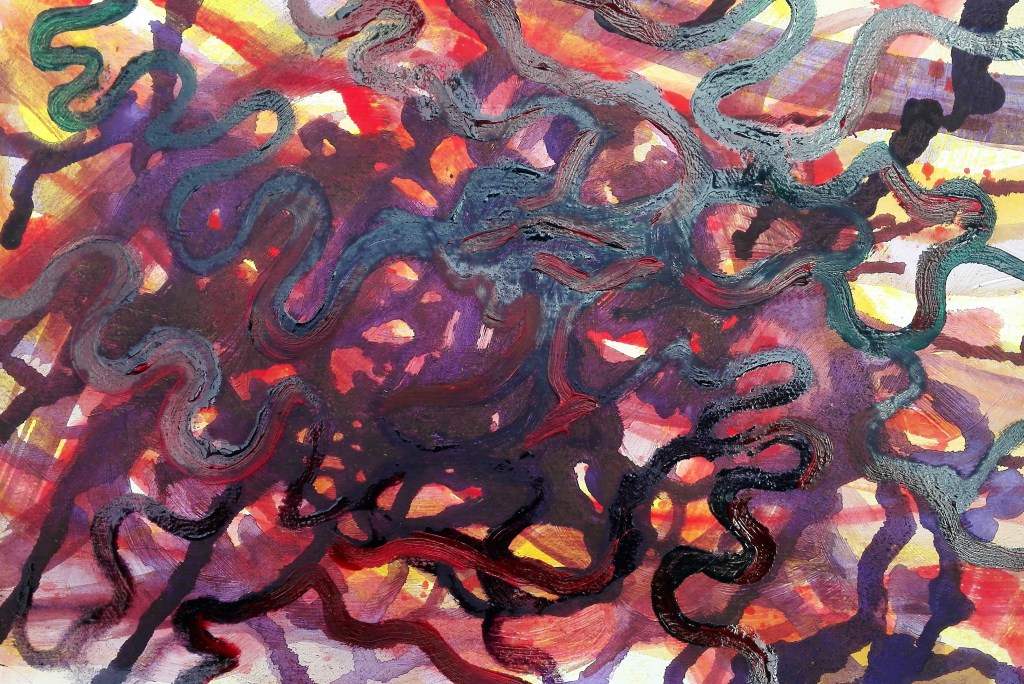
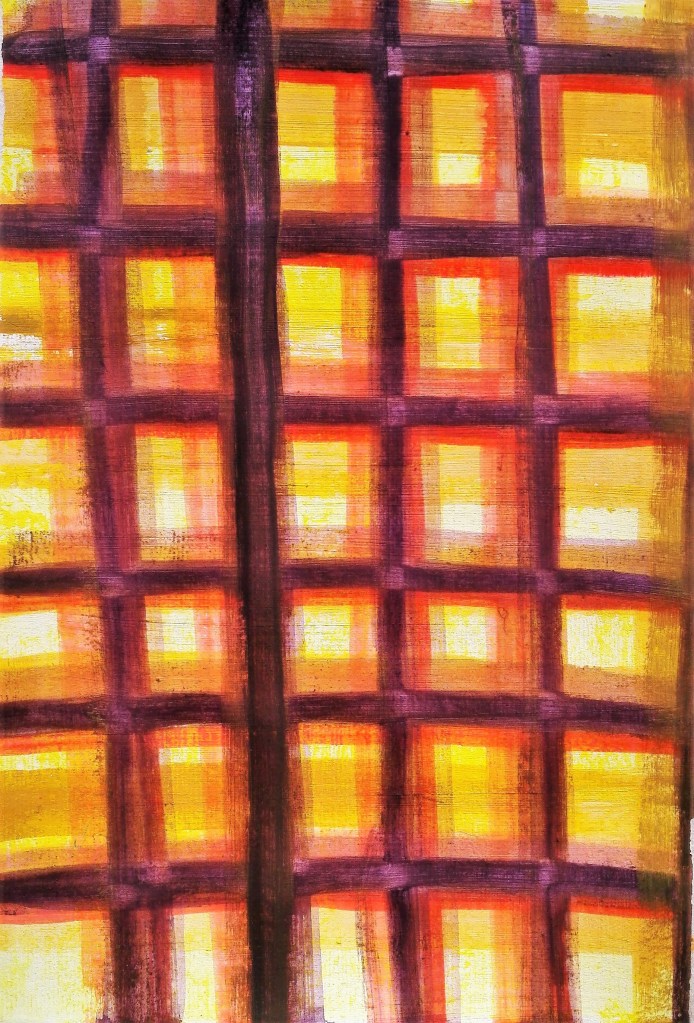
Experimental paintings, the two paintings below were produced simultaneously. Working from light to dark using thin washes of water soluble oil paint, Jackson Aqua oil, I built up the two paintings. There was very little preconceived notions other than in one I would use fluid movements and in the other I would restrict myself to straight lines.
Experimental Reflective Painting 1
Experimental Reflective Painting 2
Both of these paintings are fairly small scale 21 x 29.7cm. In the first I feel that I went one step too far and lost the translucent quality that I had built up. The addition of the dark, heavily oiled paint was an attempt to rescue the work. It reflects the light. I’m not sure it entirely works. The second painting ended up being more about the light and dark rather than reflections. It reminds me of the thick glass skylights that are found on city streets, but with colour.
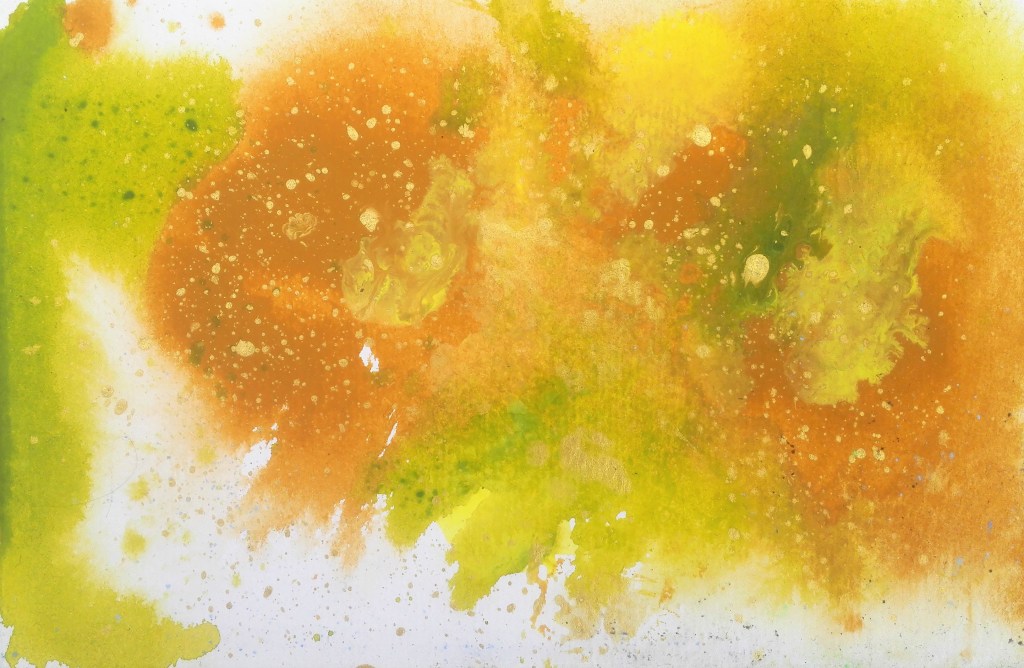
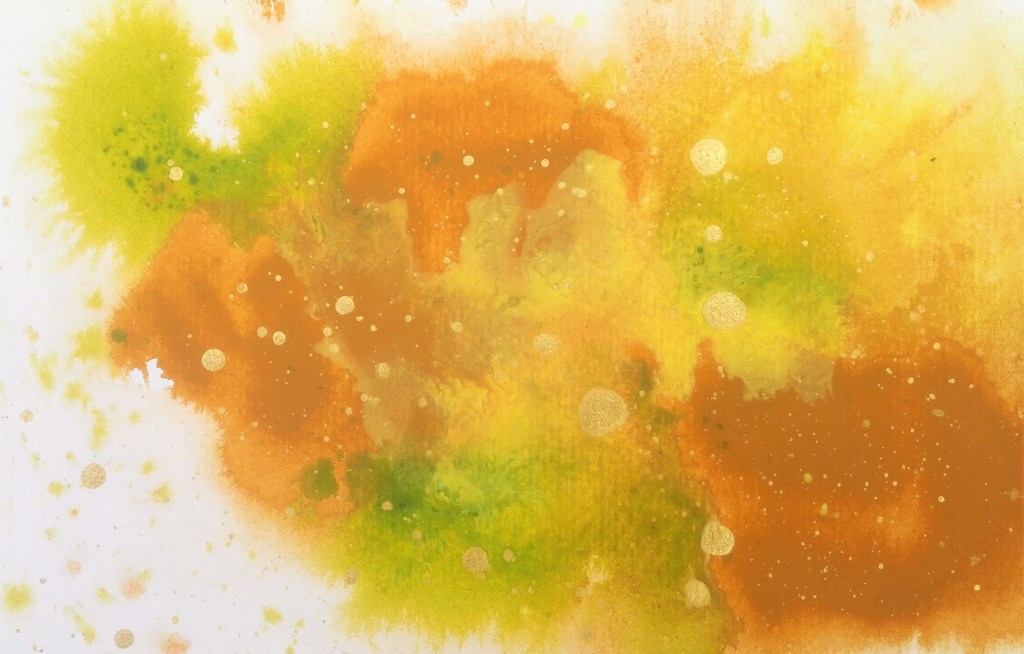
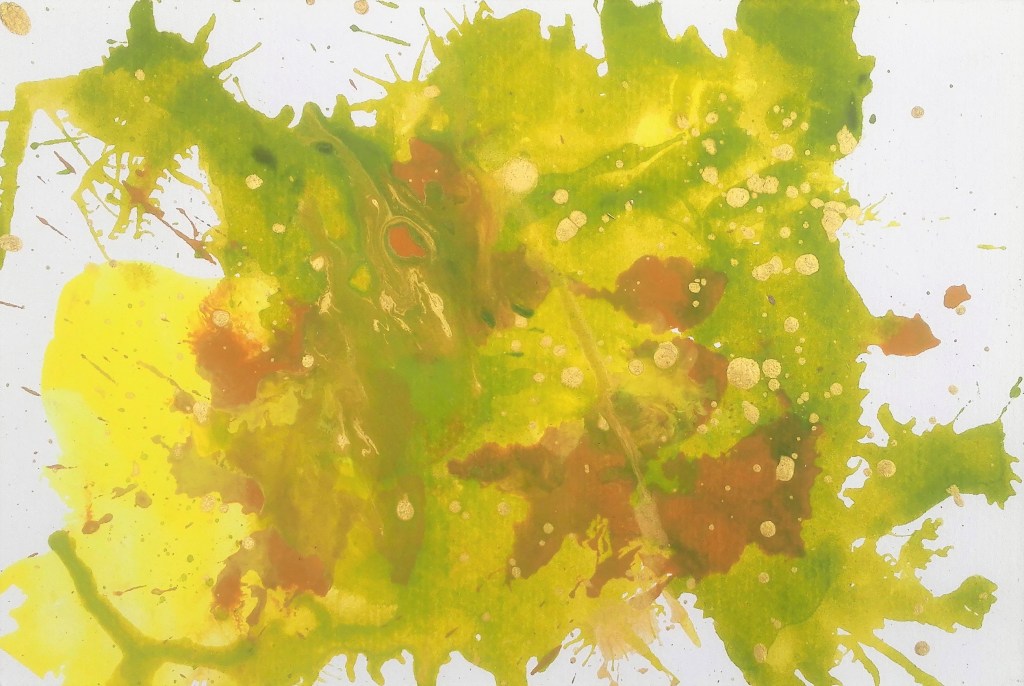
Whilst completing the paintings above I remembered some painting trials that I completed earlier in the course. These were not enacted with any preconceived idea but they did now have a link to the challenges of this exercise. The four paintings were constructed using a thin, nearly wash like paint. Allowing the paint to be absorbed into the paper and using different ways of spreading the paint the resultant four paintings contrast with each other. There is a symmetry to them. Returning to the previous exercise of storyboard, the paintings could a series, the evolving of shape from a gaseous mix.
Experimental paintings
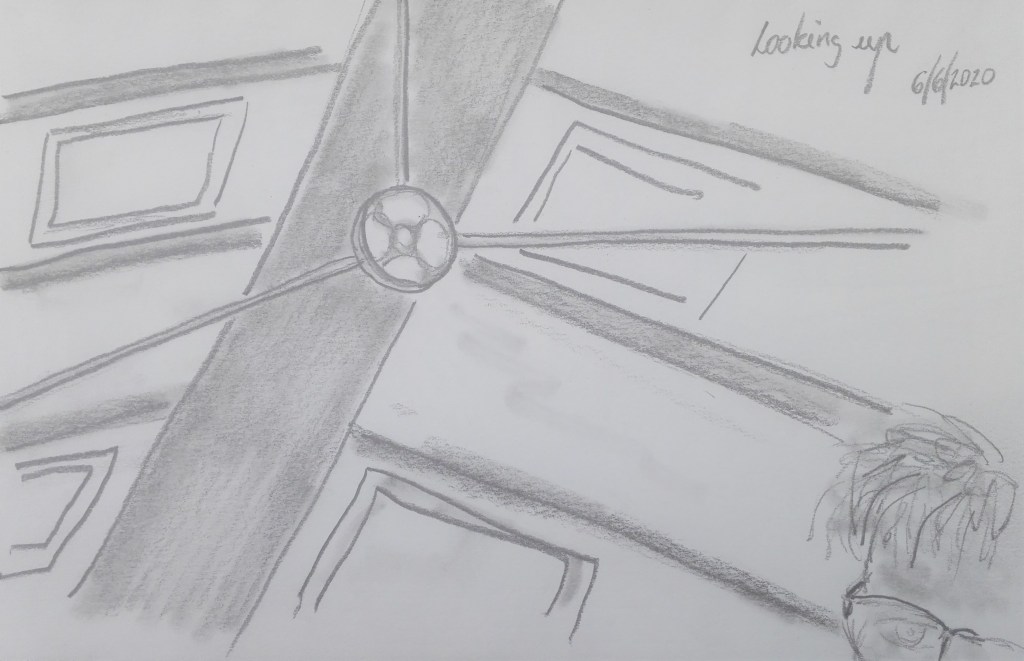
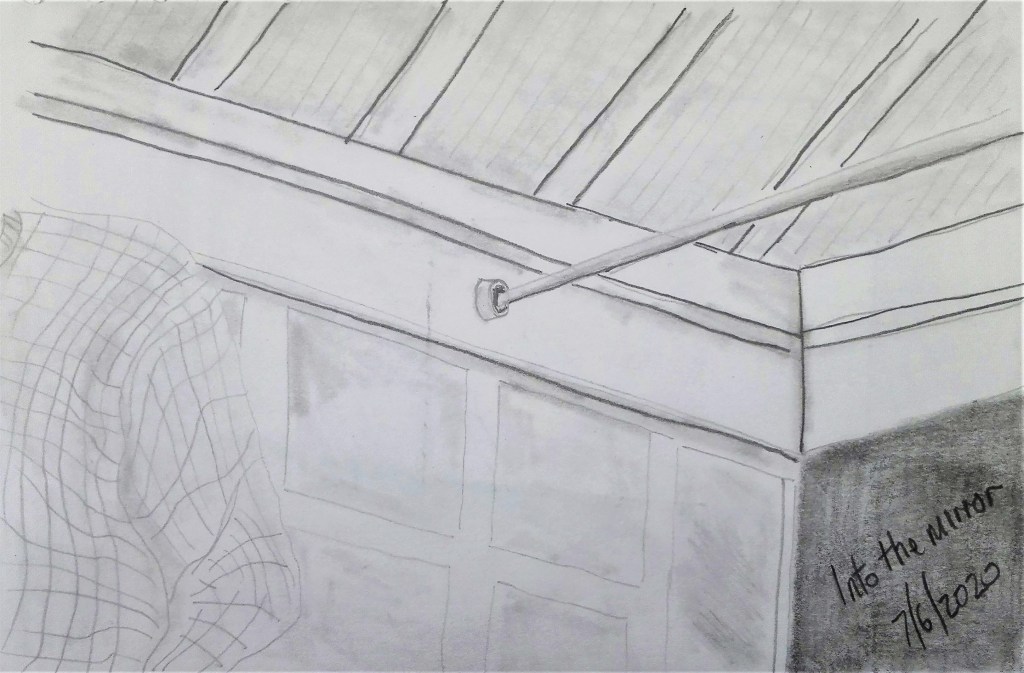
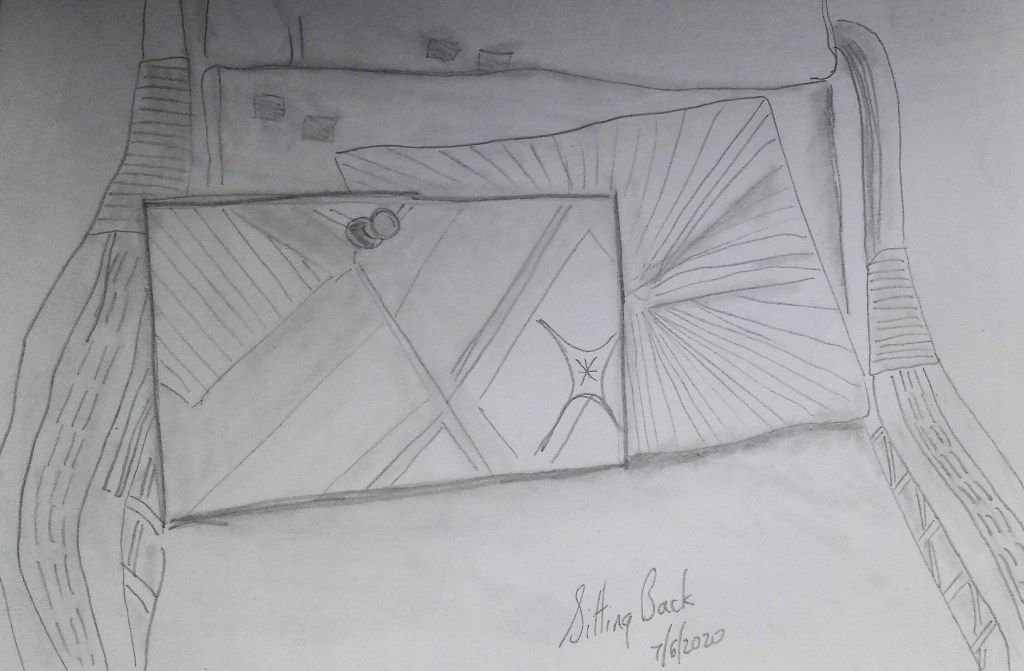
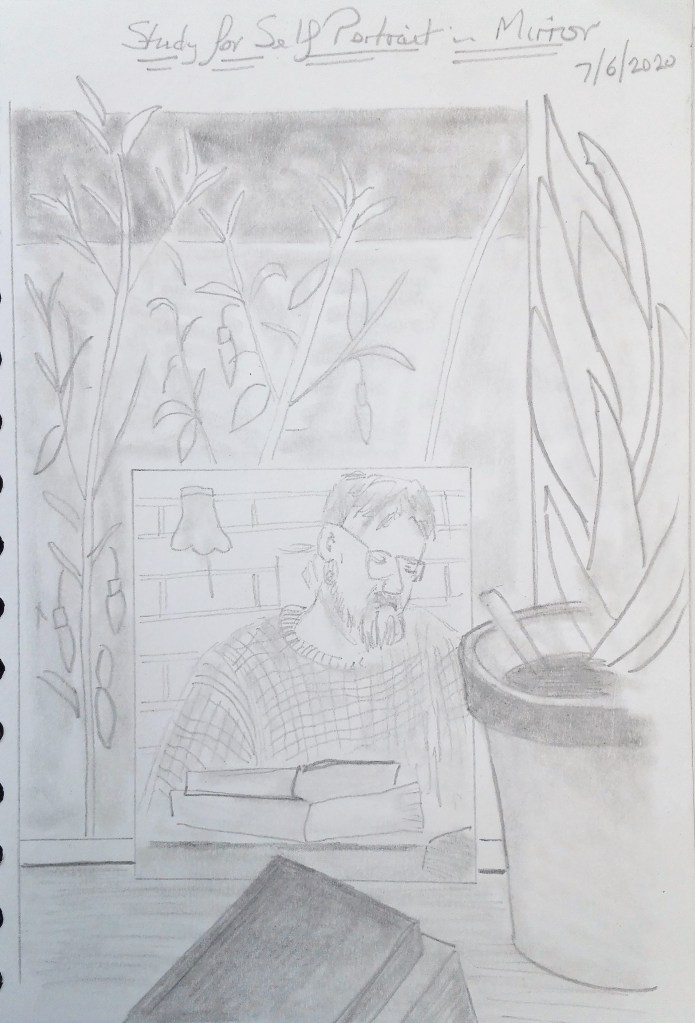
Following these painting experiments I turned to a more considered approach to the task. I set up a mirror in my studio and proceeded to make a number of sketches looing into and around the mirror. The aim was to make a pictorial study of my surroundings whilst working. It was whilst performing these sketches that I decided that I would try to produce a self portrait using the mirror to provide the setting. The last of the sketches below became the main idea for the composition.
Four sketches – I am present in three of them, just.
Compositional sketch for Self Portrait
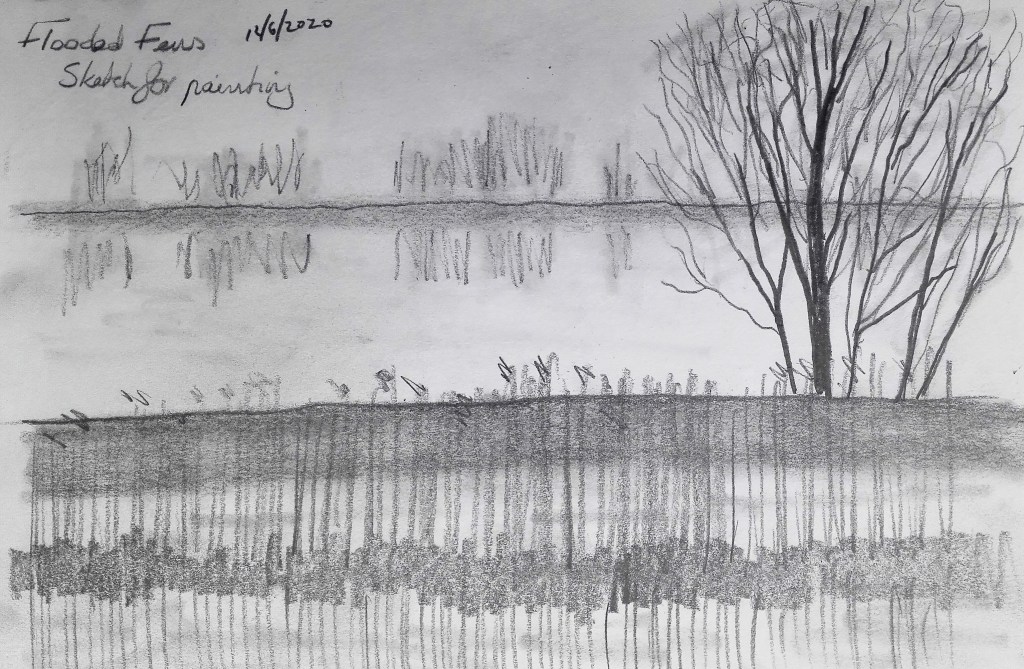
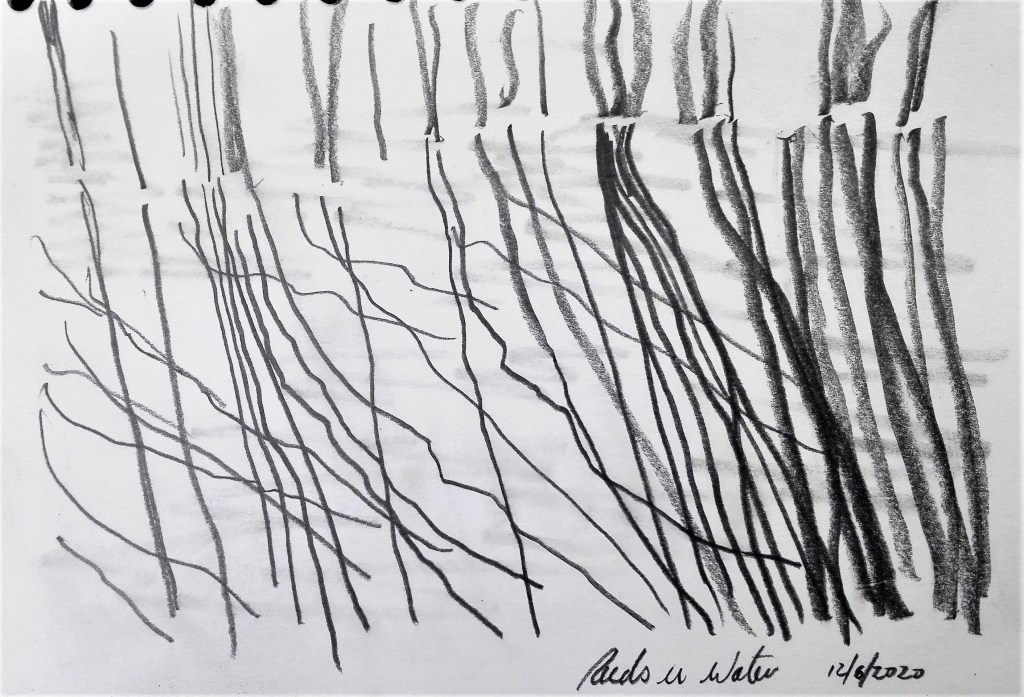
The other topic that I wanted to explore as part of this exercise was to look at reflections in the landscape. This is something that has been an interest for me for sometime and as mentioned in Blog 1, on this exercise, it may become the topic for my parallel project. I reviewed the photographs I had, see blog 1, and choose two to make preliminary sketches .
Sketches for Fenland water reflection paintings
This point was the end of sketch and experimental stage at I now looked to produce some paintings which explored the topic of mirrors and reflections. The results of which can be seen in the third blog on this exercise.
I have separated the blog for this exercise into three parts. The first, this one, will look at the research and inspiration that I referred to complete the exercise. This research lead, in turn, to the sketches and experimental paintings and then onto the two paintings that I completed.
The subject of reflections, reflected images, reflective surfaces is a source of interest and fascination for me. I find interest in how light is turned upon itself to create mirror images of objects. The flat landscape of the Fens, where I live, is magnified in the reflected light in the water. This creates a grand canvas upon which the landscape and nature of the Fens can be observed. As I work through this course and consider potential topics for my parallel project I am increasingly drawn to focusing in on reflections in water.
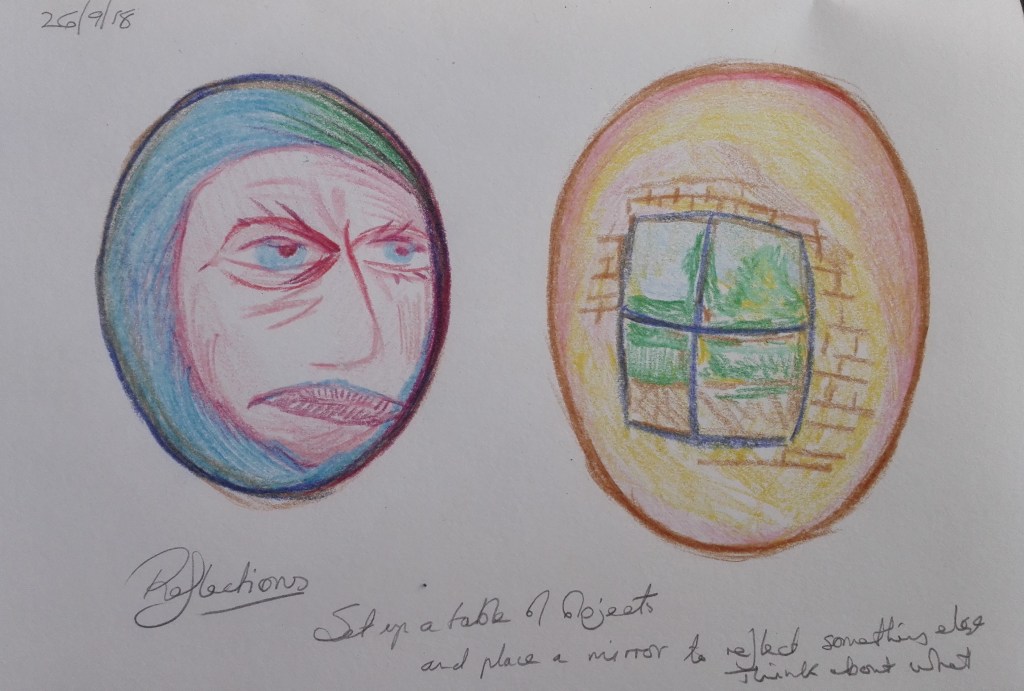
I have used mirrors in my paintings and sketches in previous courses as can be seen in the sketches and paintings below.
Mirror sketch – Produced as part of Concepts in Practice
Mirror painting – Produced as part of Concepts in Practice
The topics explored in these sketches and paintings will be explored in the first painting that I produced for this exercise, see blog 3. The use of mirrors is a device that has been used extensively in art history. I am reminded of both Van Eyck and Massys.
Extracts from paintings by Massys and Van Eyck
Having attempted to bring reflections into my paintings with varying degrees of success I looked for examples of artists who performed this successfully.
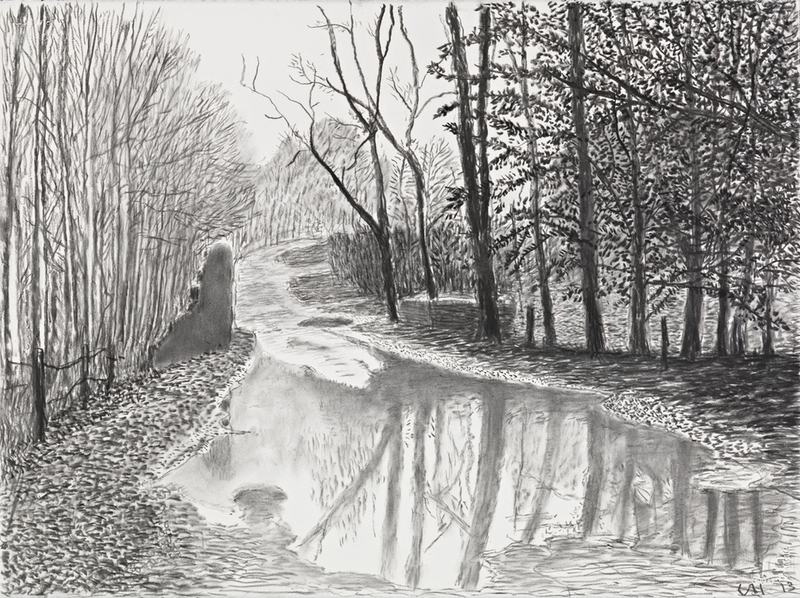
The first example, which I recalled from visiting the David Hockney exhibition at Tate Modern in 2018, was one of his large charcoal drawings of Yorkshire. A rain puddle on the roadway is used to give the drawing depth, scale and interest.
David Hockney, Woldgate 6-7 February 2013, Charcoal
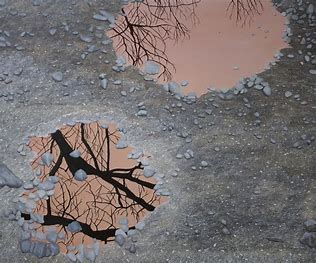
A further example is the work of Covadonga Valdes who, it was suggested, that I research as part of the feedback I received from Assignment 2.
Covadonga Valdes, Homeland II, Painting from Homeland series
Just two examples of many that have helped to inspire and challenge me.
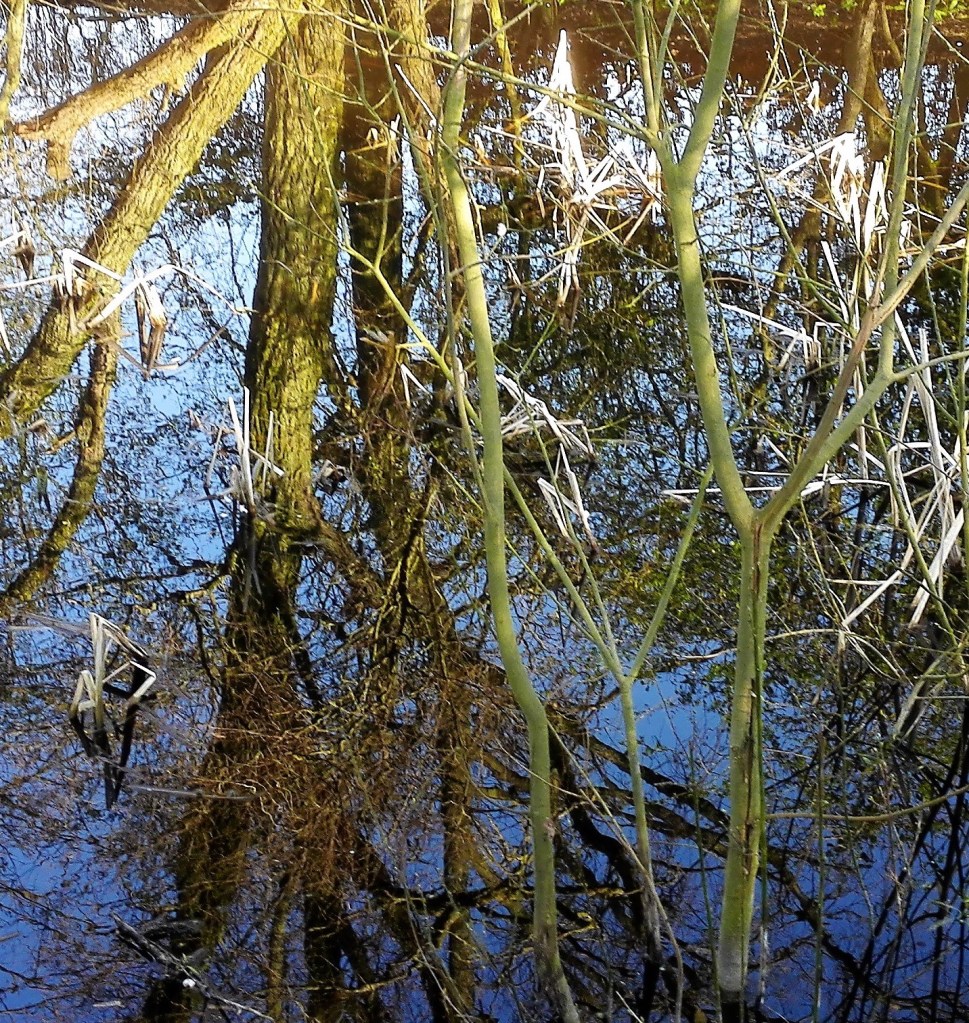
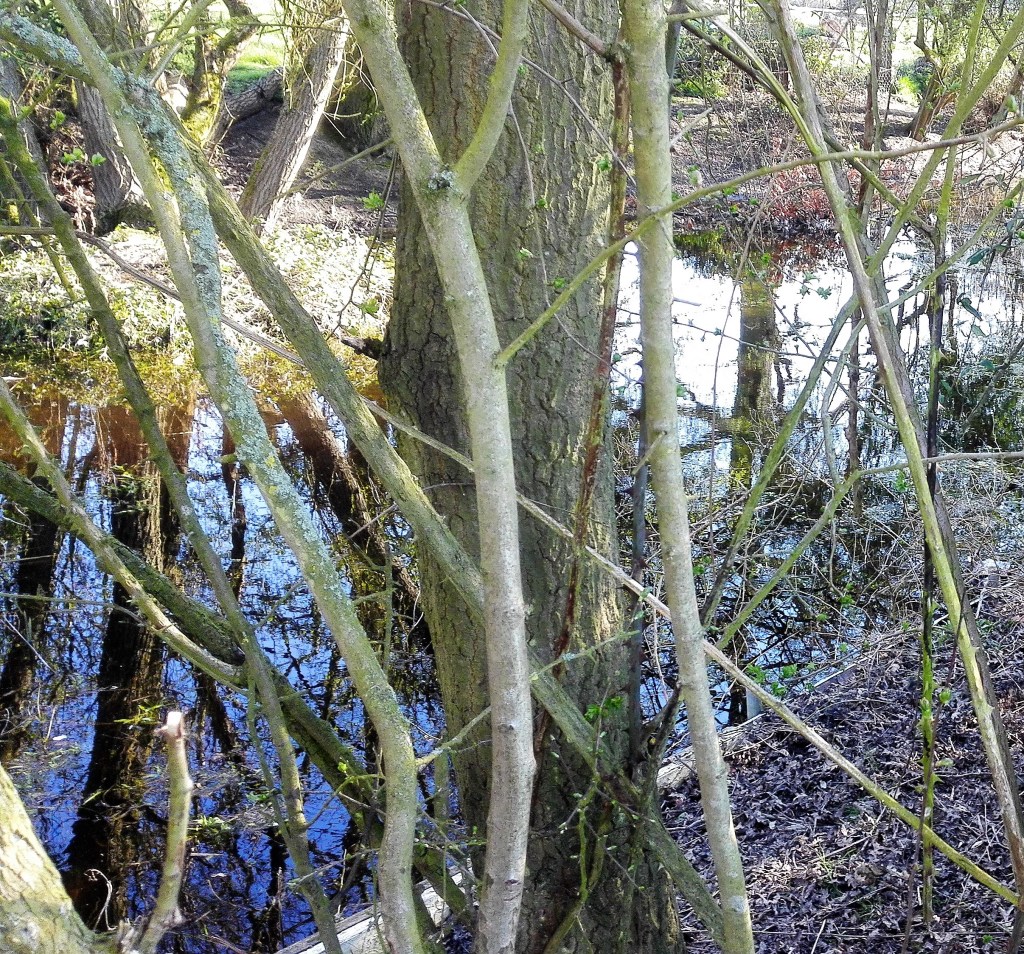
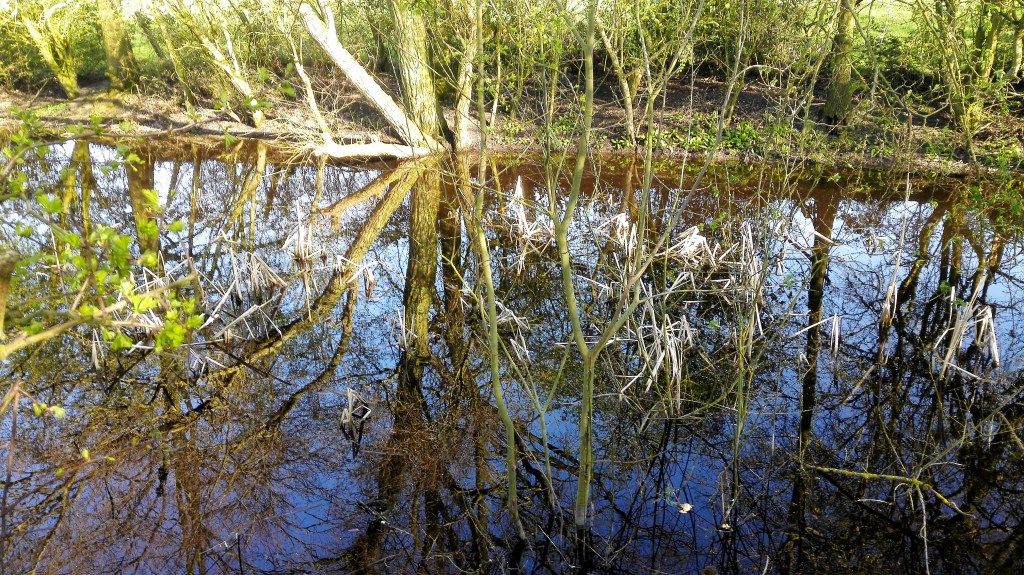
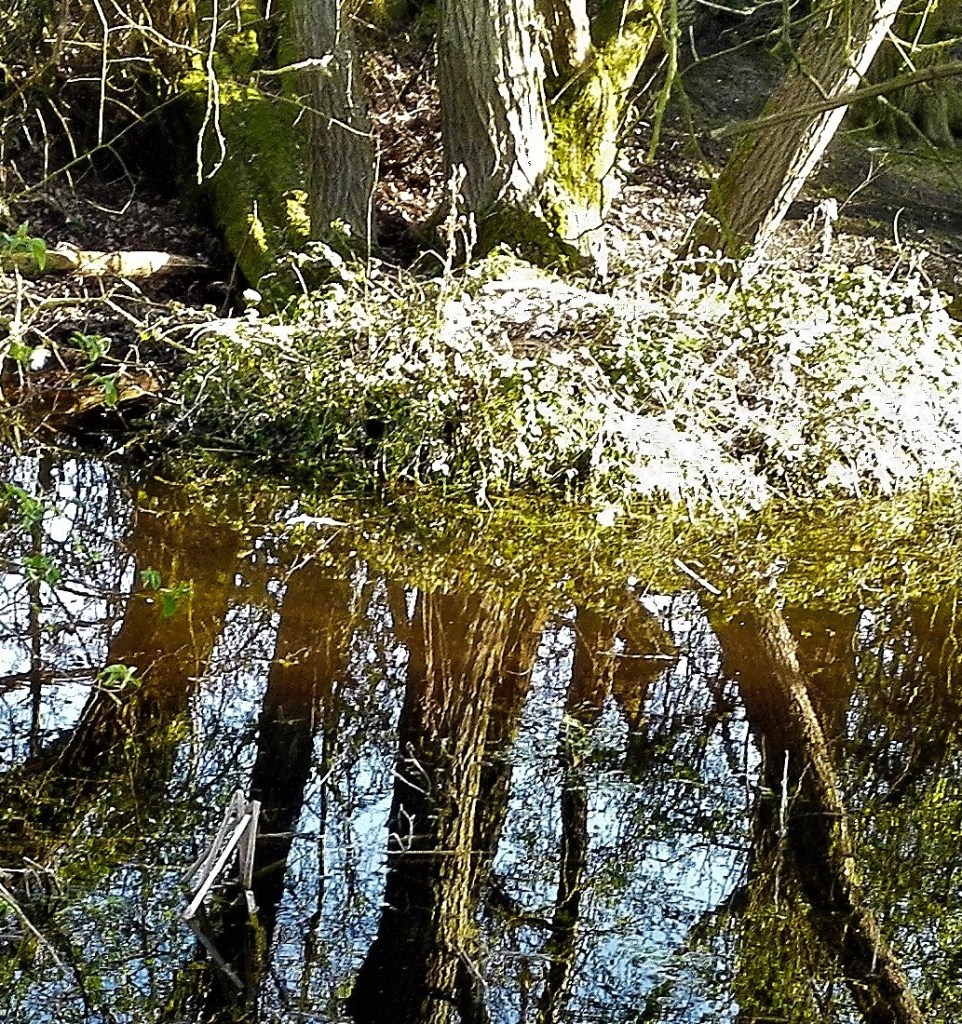
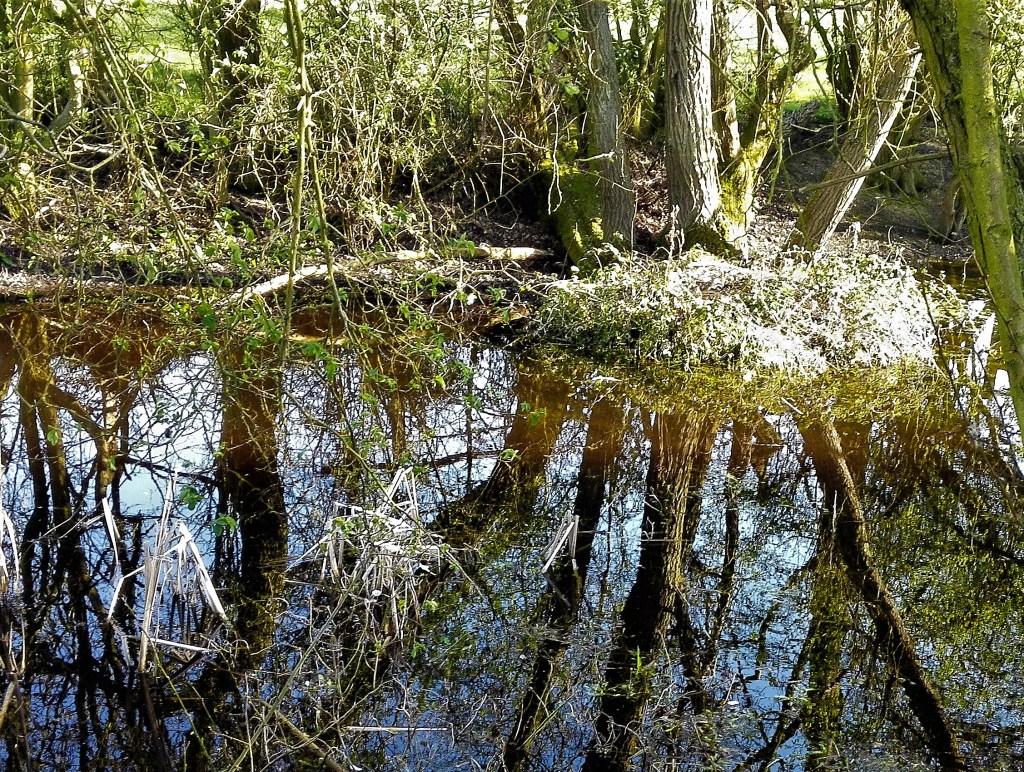
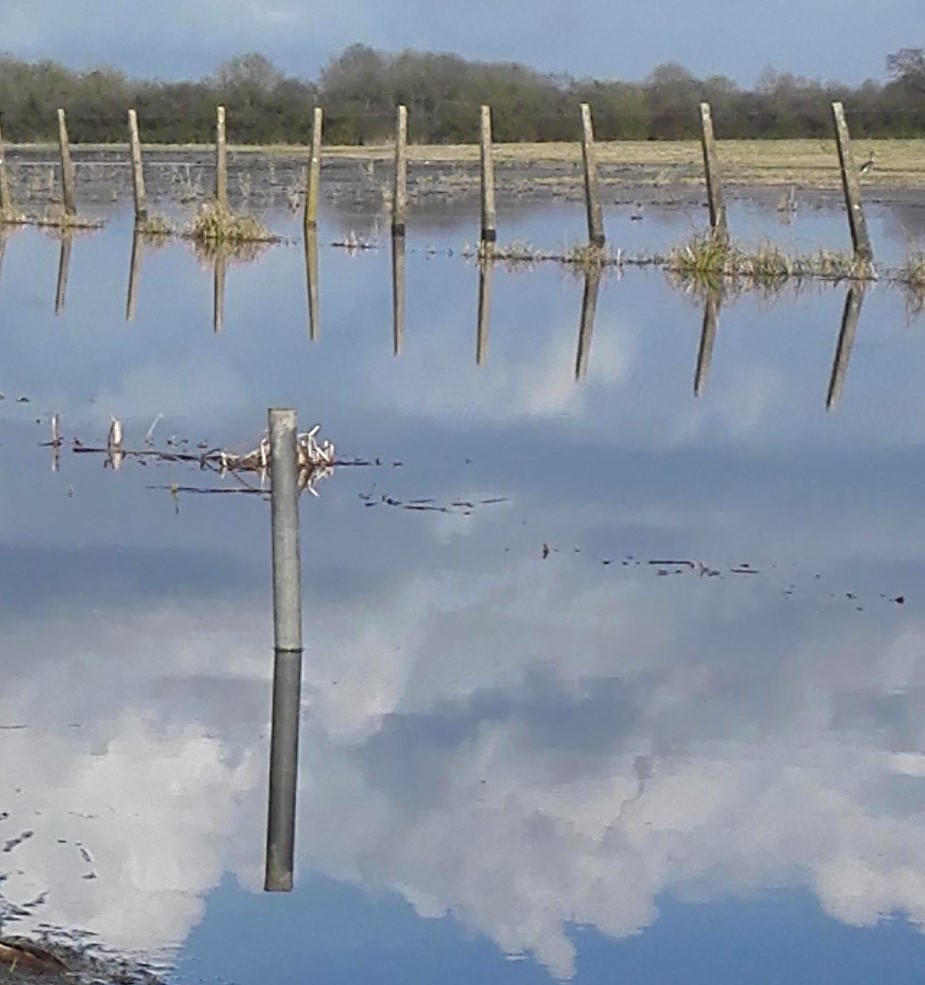
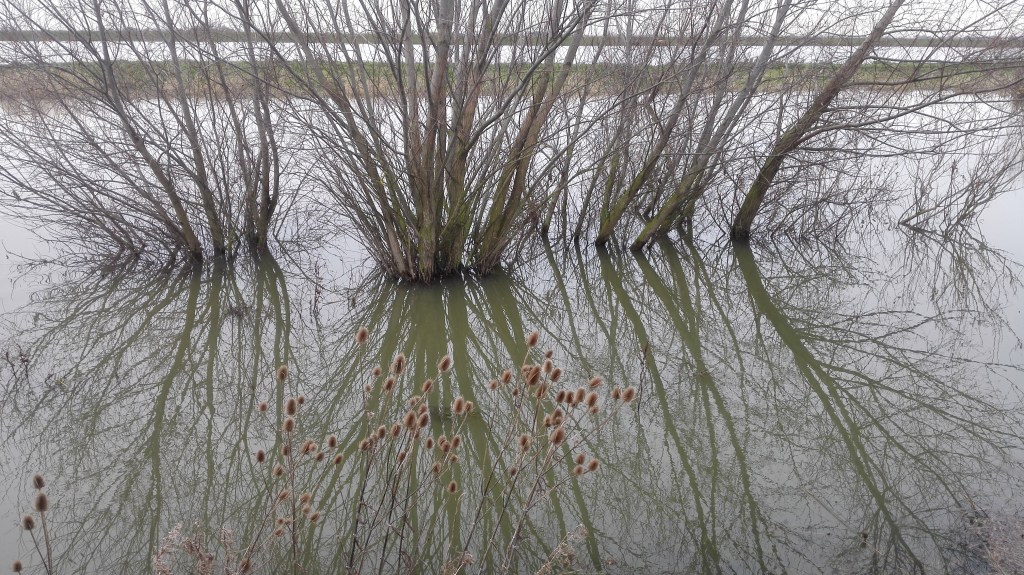
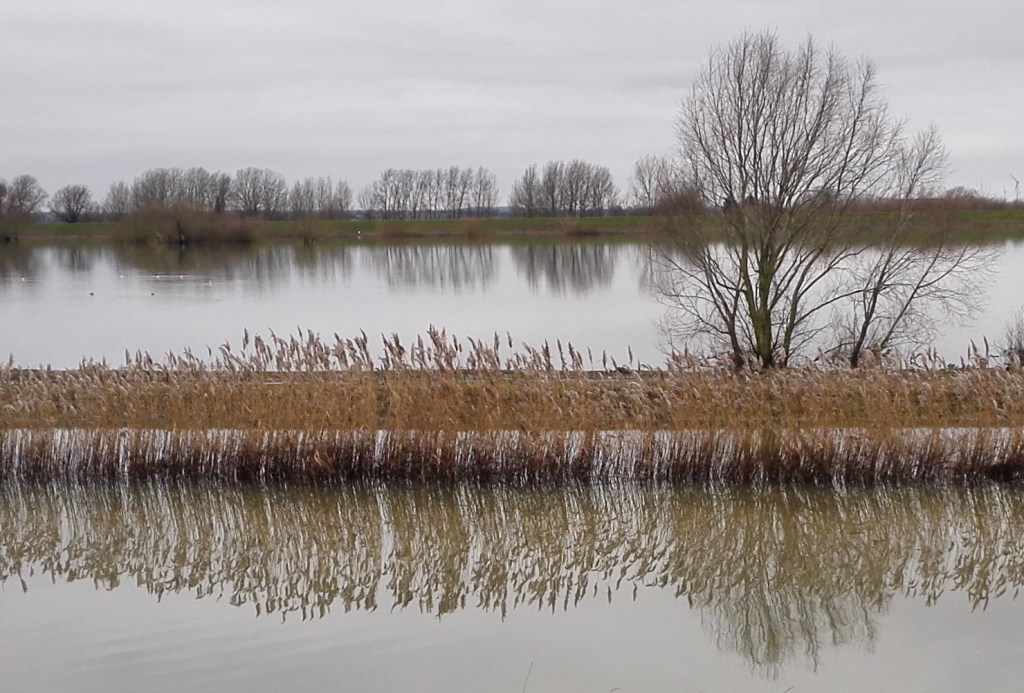
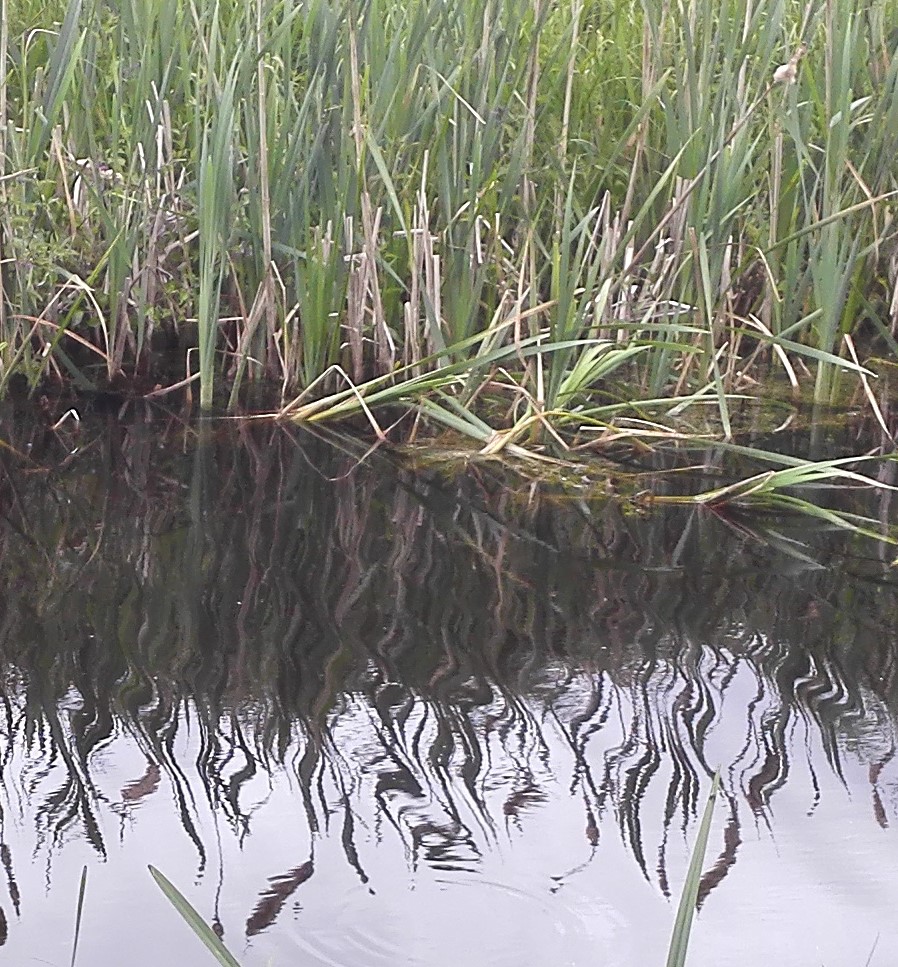
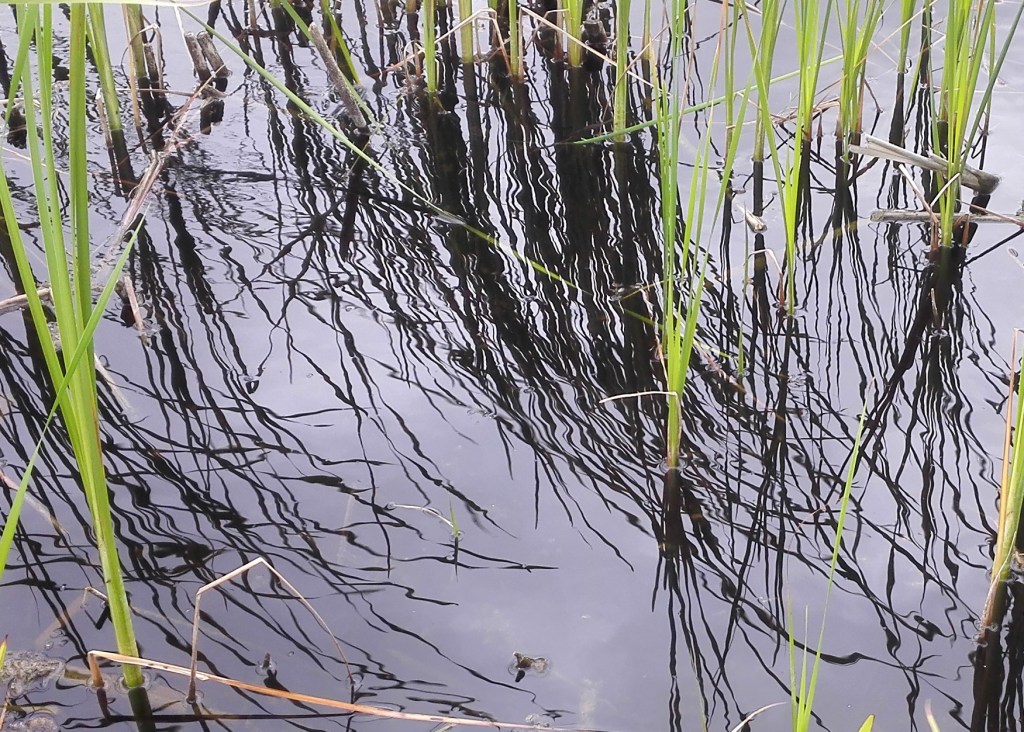
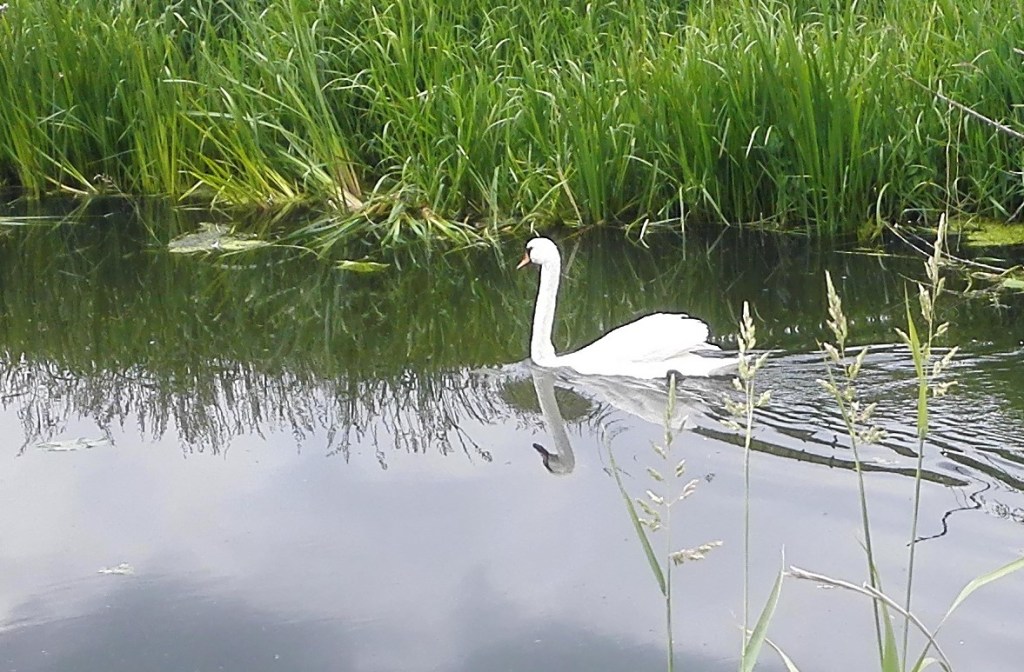
The continual source of inspiration and fascination, as touched on earlier, is the Fenland landscape where I live. I have numerous photographs which I have taken over the years which explore the reflections. Some of these are close ups others look at the landscape from a wider, larger perspective and use the reflective qualities of the water to expand the view. The examples below are recent additions.
A selection of my photographs exploring reflections
I will continue to use this resource to educate my practice.
Draft of Voice over for split screen, Poem by Lisa Robertson, Paintings and animation by Amy Sillman. The piece is an animated split screen video to which a poem has been set. I guess that the poem was the starting point for the work. The poem consists of a number of repeating sentences which are then linked to the changing images. To start with this was easy to follow but I found I got a little lost over the six plus minutes. However I didn’t find that this distracted as I was making continual links between the imagery and the dialogue. I found that the meaning of the repeated sentences changed over the duration of the piece. I guess that this was the intention. To my mind the words and images complemented each other and I believe it would be hard to watch the video without the dialogue. I don’t feel that it would make any sense. The poem without the imagery would still have meaning although the pictures would have to be made by the listener.
Jutta Koether – Seasons and sacraments, the video consisted of a talk by Jutta through her exhibition and the links and meaning of the works displayed within it. The exhibition, consisting of two rooms, is inspired by Nicolas Poussin. The first room is in response to his paintings ‘The Four Seasons’ and second room ‘The seven sacraments’. The talk consists of the challenge that the viewer is confronted with trying to make connections and find their way through the exhibition. There is a dialogue throughout the work. Without the back story or the knowledge of the Poussin paintings I feel it would be difficult to make sense of the work. My assumption is that there was information available to the visitors, this was not apparent from the video.
The reading point Link 31 consisted of a long text by James Elkins. the main thrust of the piece was the depiction or the use of time within art. I found it informative and through. There were plenty of interesting point that I need to reflect upon further.
I found this exercise an interesting challenge and ultimately a rewarding outcome. Initially, I found the limitations set in the exercise of creating a narrative using the paintings made in the previous exercises problematic. I could imagine a whole range of different scenarios regarding the ‘Man with a guitar’ painting but none that I found grabbed my interest.
Man with guitar – Painting for Exercise 1.1
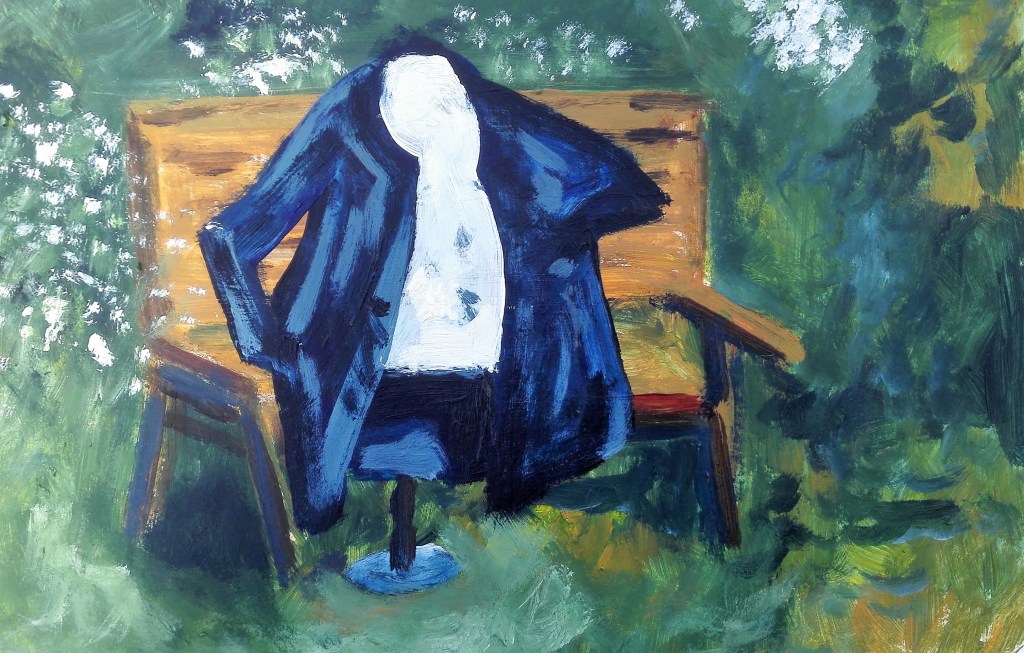
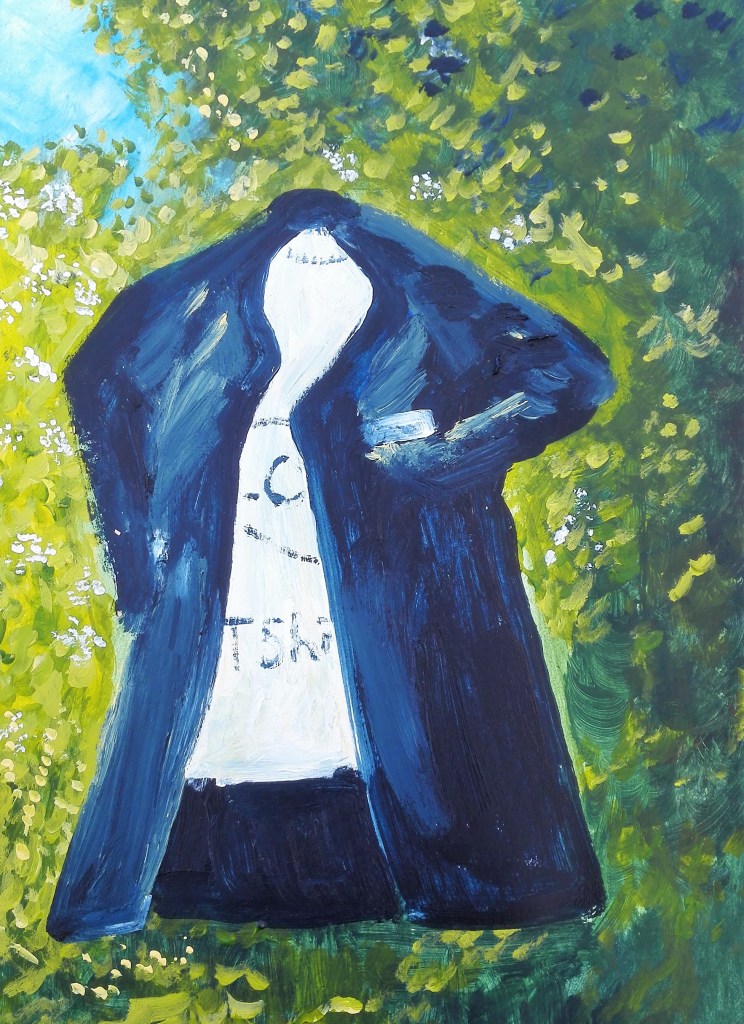
Rejecting this train of thought I turned to the prop that I had constructed for Exercise 1 and the subsequent paintings that I had made.
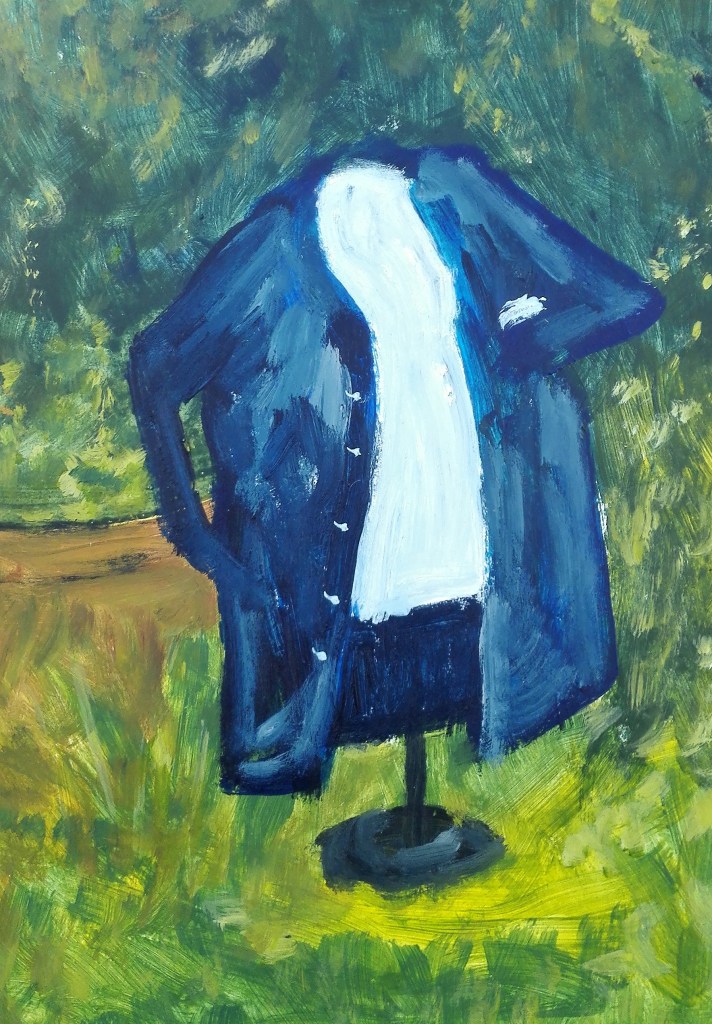
3 Paintings from Exercise 1
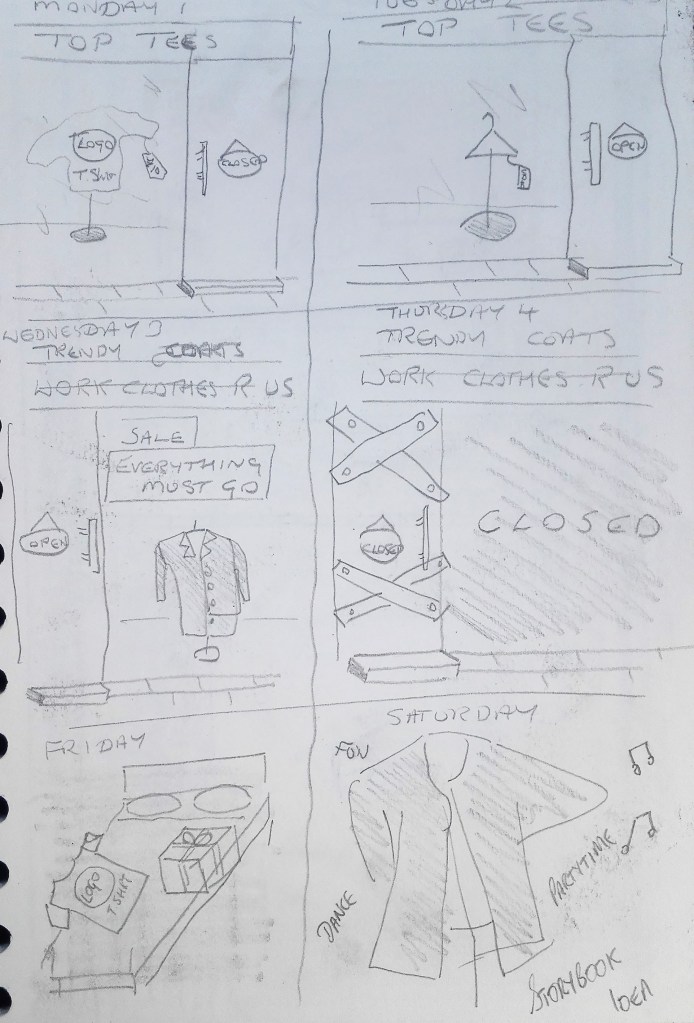
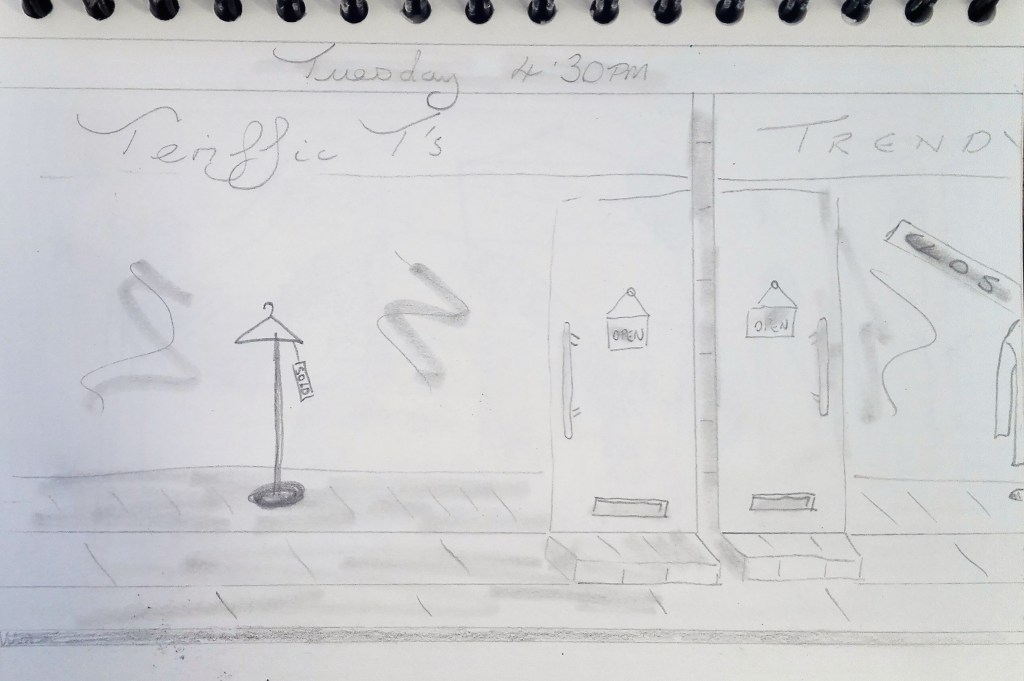
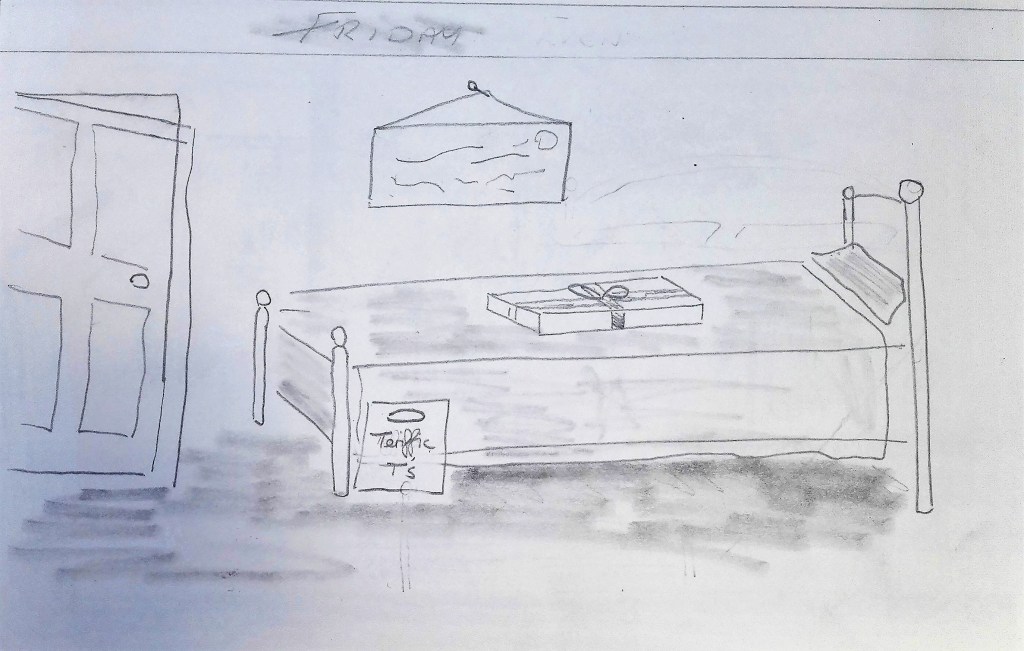
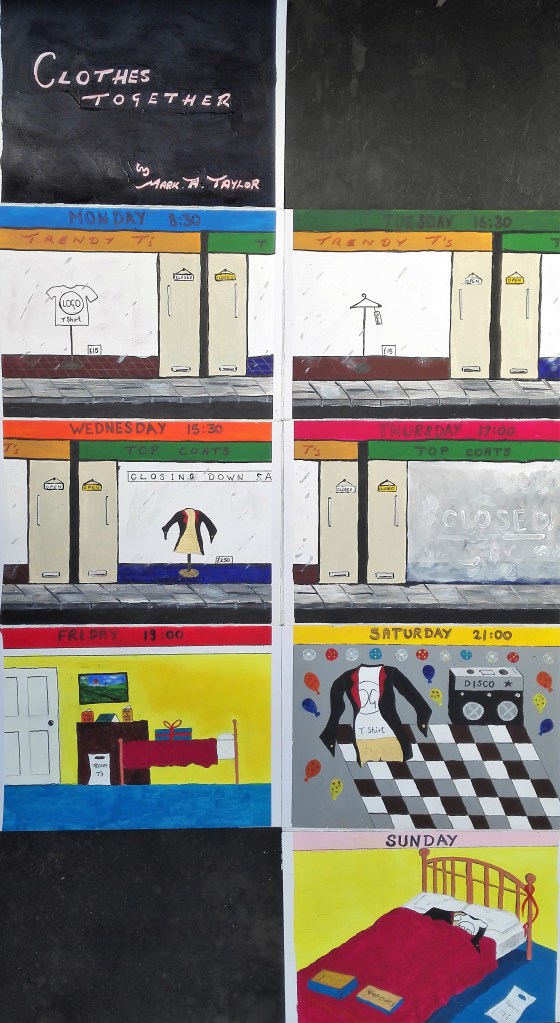
I considered whether I could incorporate any of these paintings into a narrative but this seemed limiting. A better option would be to try to construct a new narrative involving the T-shirt and the Lab coat. The Lab coat would soon become a proper coat as I tried to imagine how they two garments could have come together. A storyboard narrative seemed to be the best way of articulating this and the days of the week seemed to be a good way of forcing the story into a chronological narrative. I put my ideas down in a sketched storyboard.
Storyboard idea
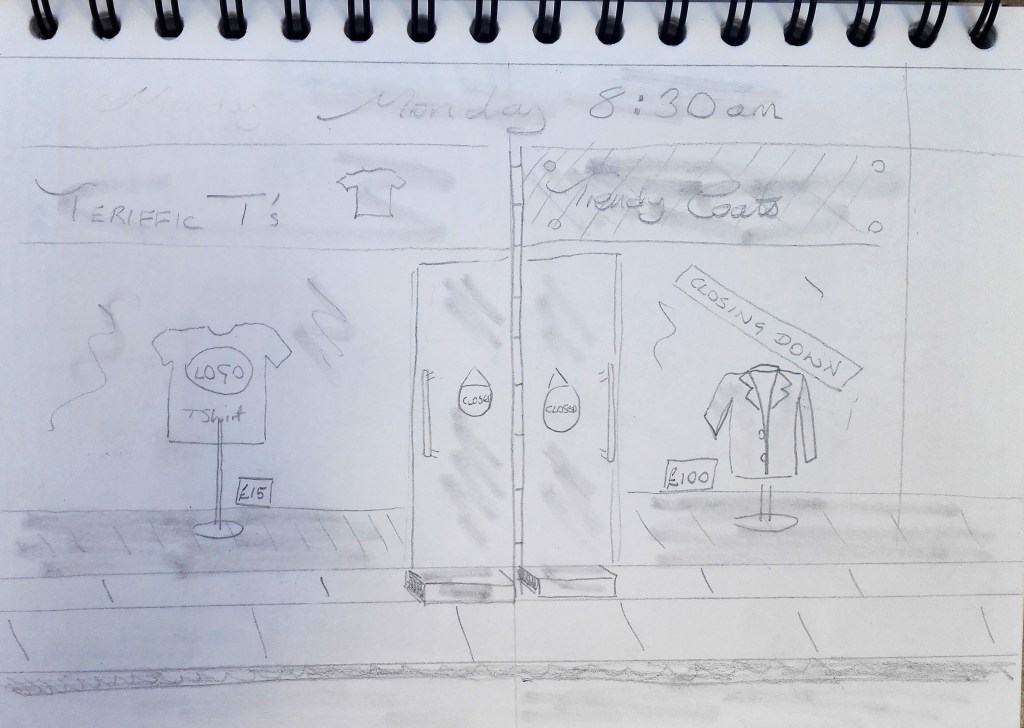
There was nothing subtle about the story and the narrative was obvious but I enjoyed its playful aspect. It would also be interesting to paint the different scenes. There would be certain constraints in that the same scene is observed on consecutive days and therefore there would be the need for consistency in the way the paintings were constructed. I created a further set of sketches.
Four sketches for storyboard
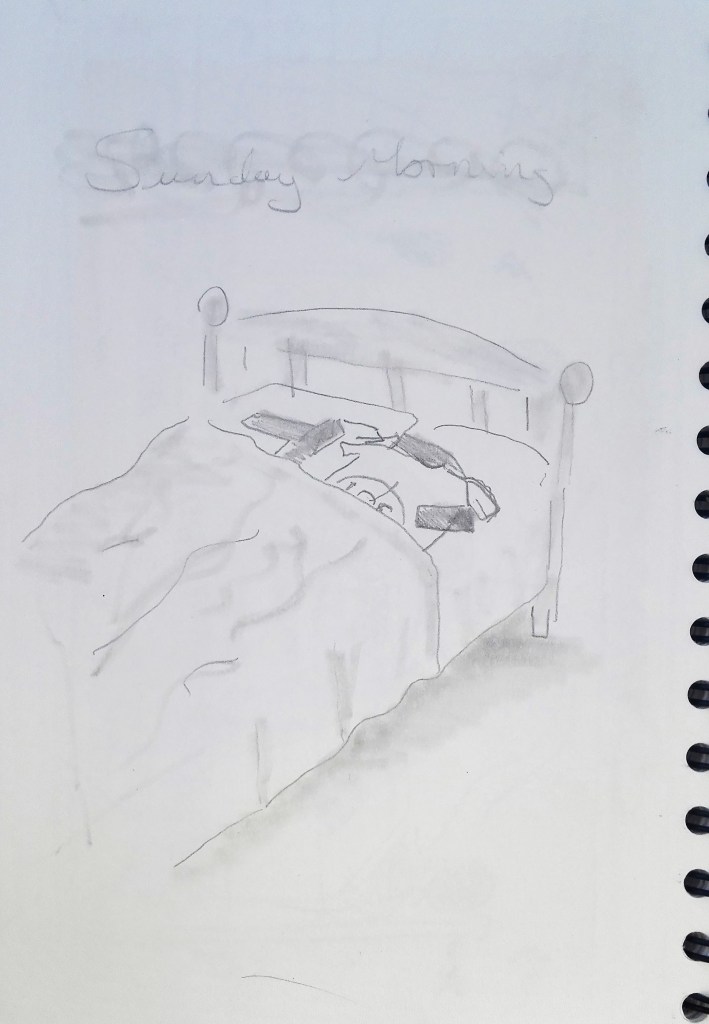
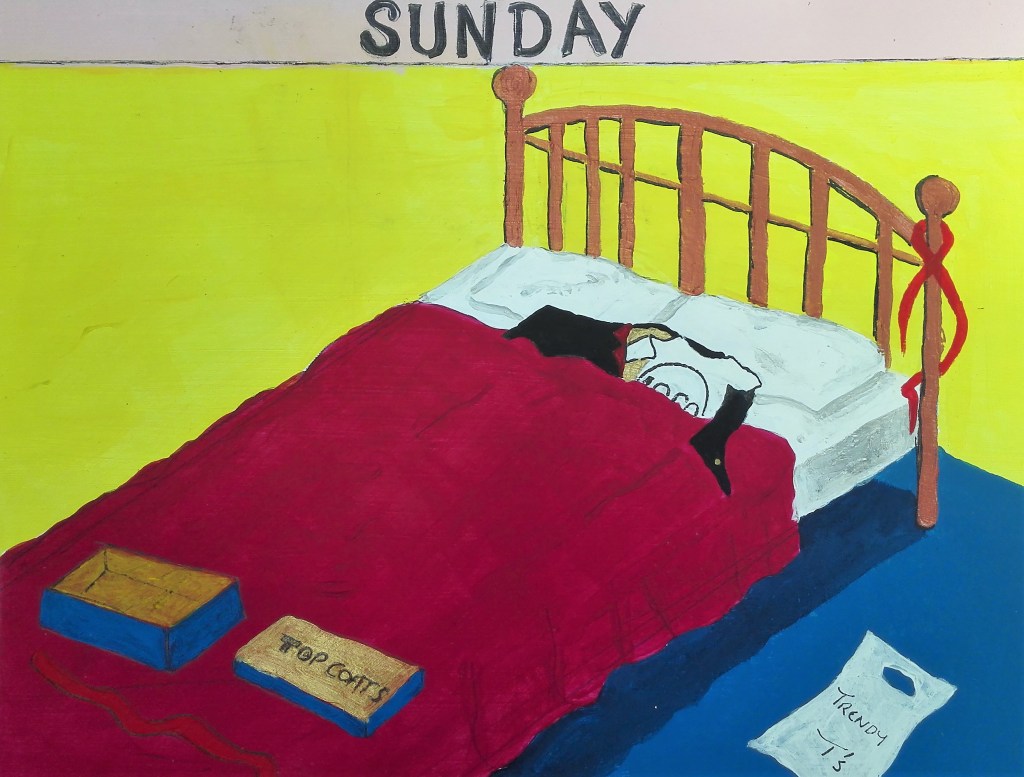
The project was certainly coming together. However I thought that the story needed a conclusion on the Sunday. I made a final sketch.
Storyboard – Sketch 6
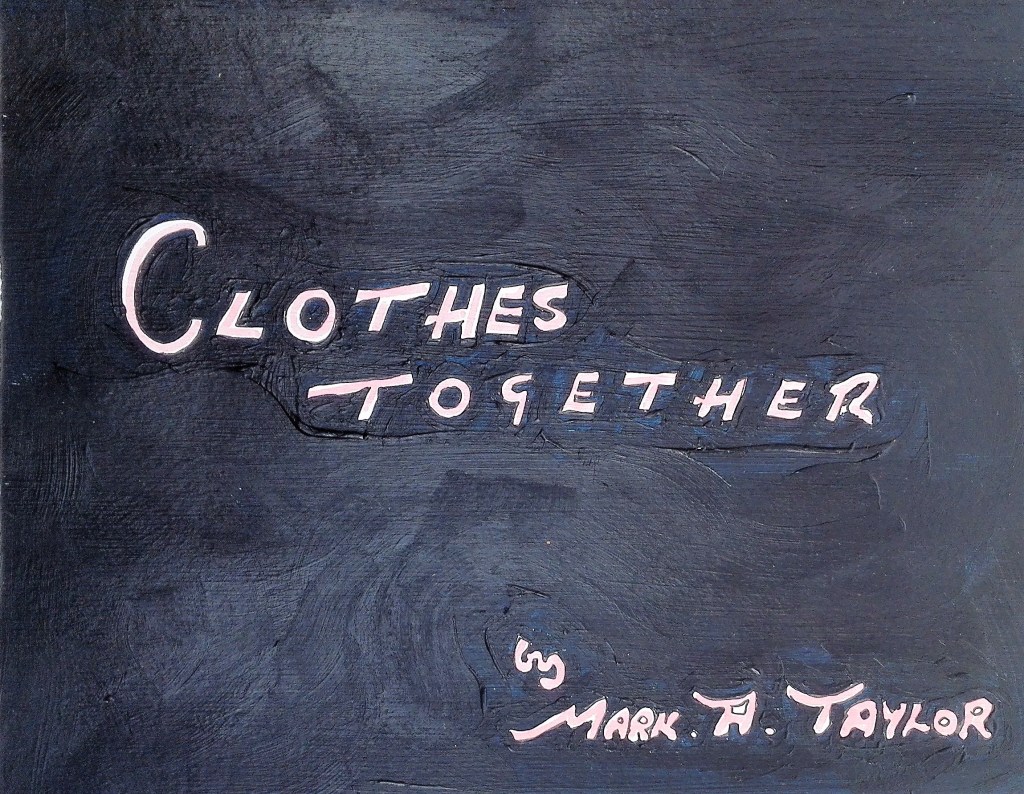
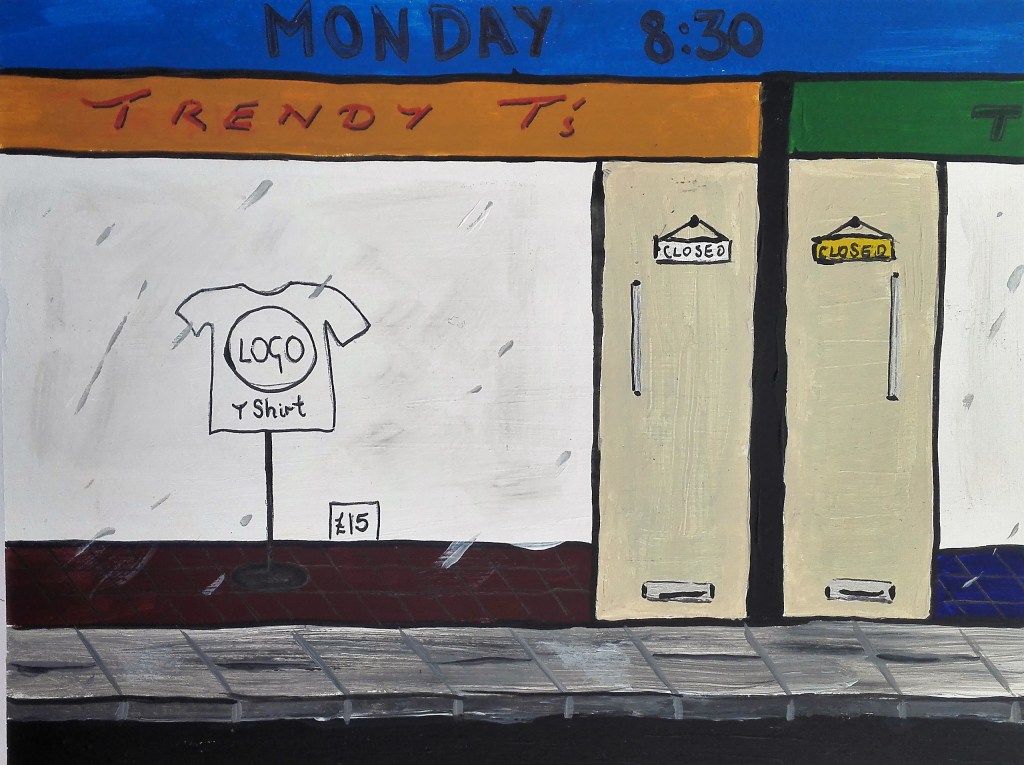
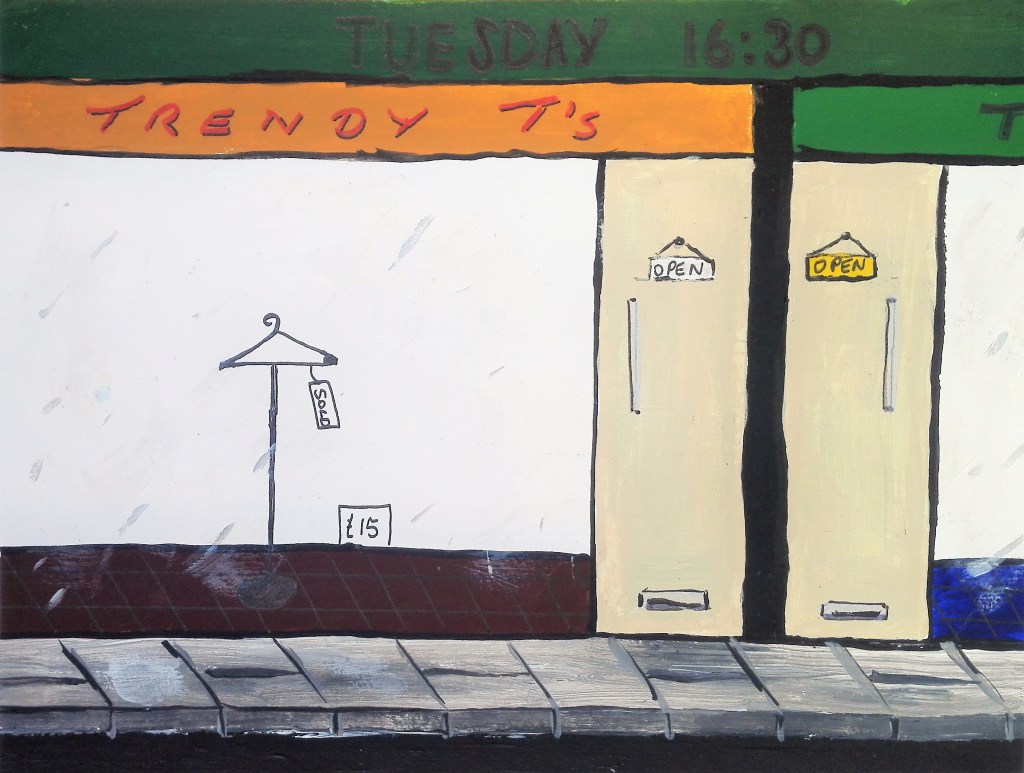
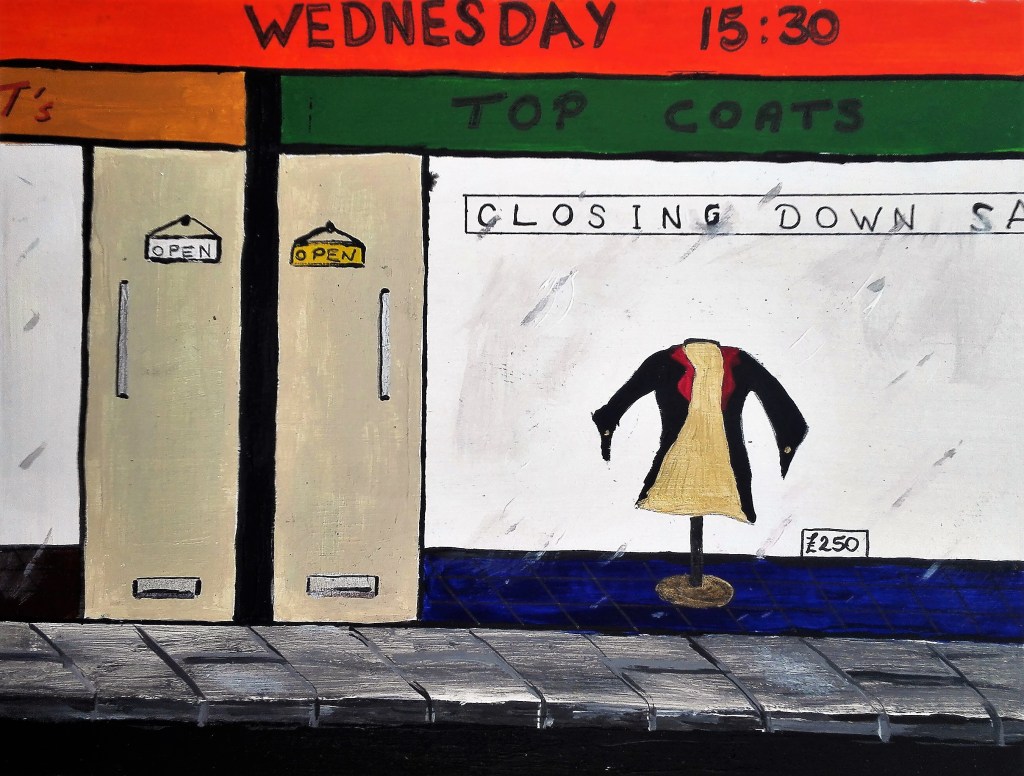
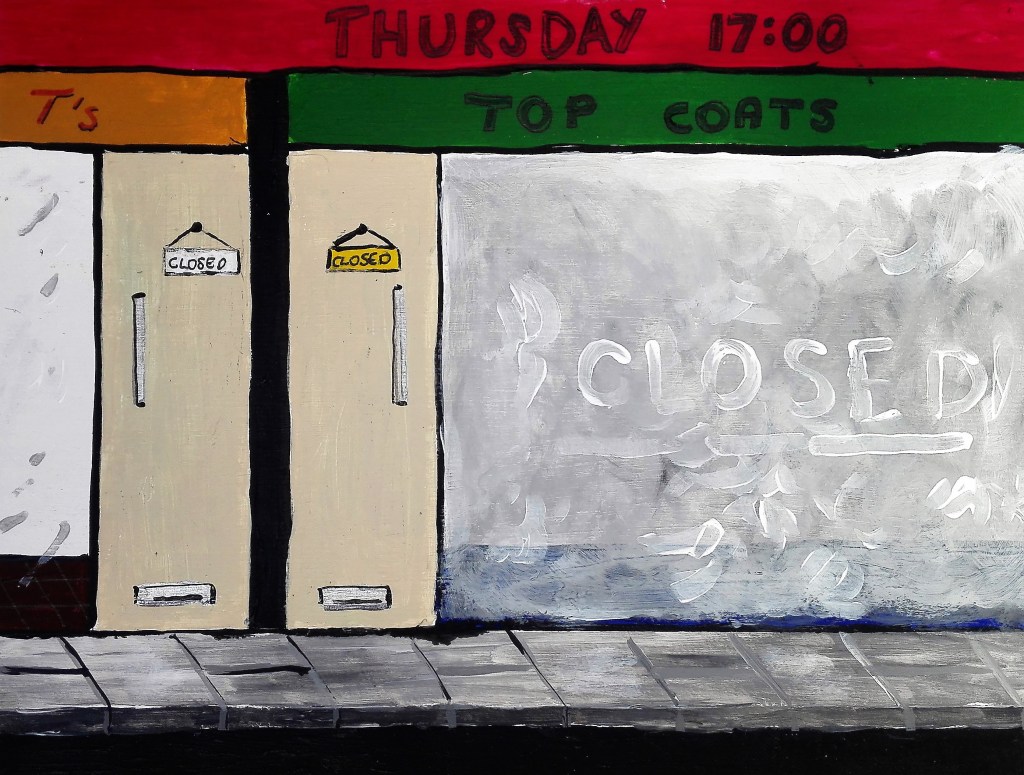
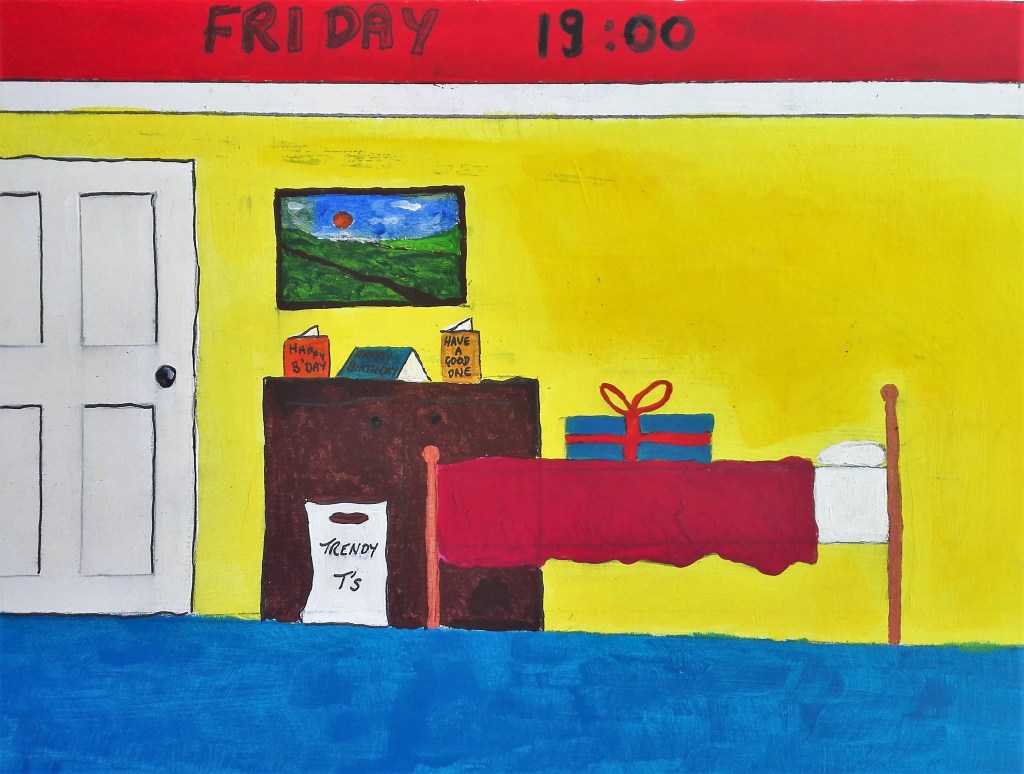
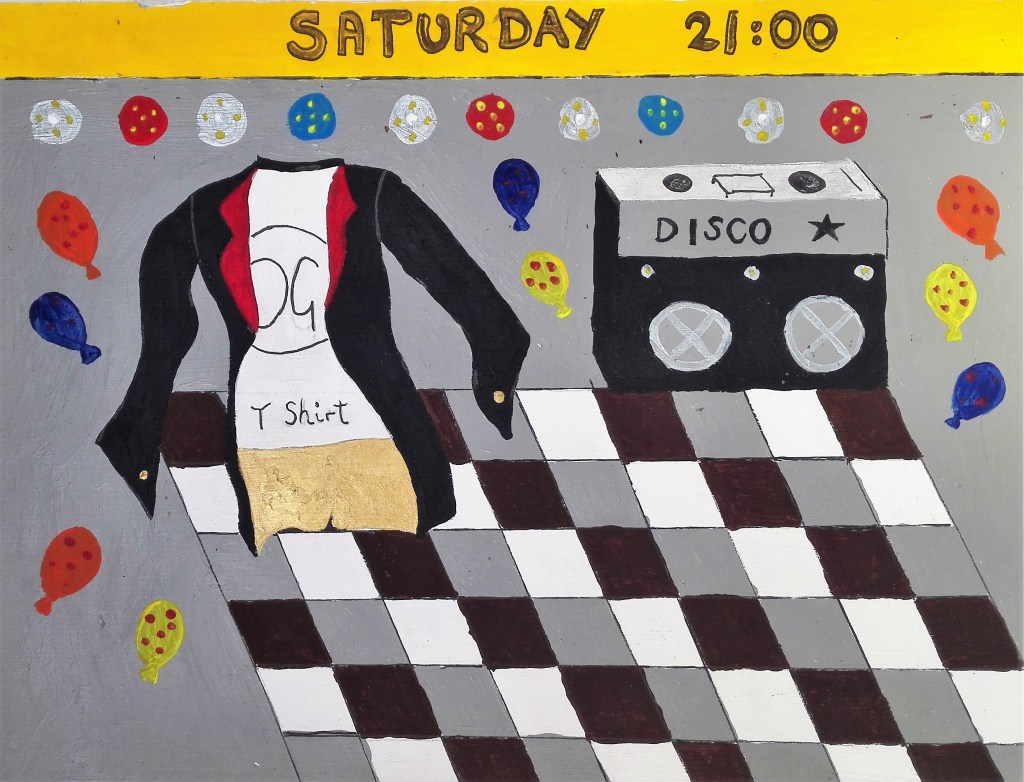
At this point I set about working on the paintings. Each painting would be in landscape orientation painting on 21×29.7cm acrylic paper using acrylic paints. The paper would be primed with Gesso. Securing the individual sheets to a large board I worked on the Monday to Saturday at the same time. Concentrating on Monday to Thursday to start with and then Friday and Saturday. Lastly I worked on Sunday and the cover. When complete the separate sheets would be joined together to create the complete storyboard and also to enable them to be stored together as one.
The whole process was a joy to work on. There was a discipline required in trying to keep the consistency in the paintings. I had adopted a flat comic book come pop art style which helped in maintaining the conformity. Using colour more or less straight from the tube with very little mixing helped. Additionally the use of words and dialogue with the addition of symbols assists in the telling of the tale and makes the narrative obvious.
Each of the paintings is shown individually in chronological order below followed by the complete storyboard.
Conclusion and final thoughts. I’m tempted to make a short video with perhaps some music or dialogue however I have resisted this as I don’t feel it will add to the project. The aspects of creating as series of paintings on a theme is something that I have embraced before particularly in my Assignment 5 paintings for Painting 1. It will be my aim to produce a series of paintings on a theme for Assessment. I very much doubt that they will have such an obvious narrative but will be linked.
A couple of shorts notes regarding these reading points.
Sherrie Levine ‘Statement’ 1982 extract “A paintings meaning lies not in its origin but in its destination. The birth of the viewer must be at the cost of the painter” my interpretation of this extract is that it is the contract that exists between the painter and the completed painting. Once it is handed over it takes on a new life which the painter no longer controls. It’s life is now determined by the viewer(s).
Link 28, Apropos Appropriation: Why stealing images today feels different. article written / published 2007. I found that this was not the most entertaining read but a useful insight into how the appropriation of objects, art, images has changed over time. My thoughts turned to how different the article may have been if its was re-written in 2020. The rate and number of images being shared globally now has expanded exponentially so that it has become difficult to ascertain the original source.
A tool, a symbol, a weapon just three of the many possible focuses or reasons that hands define art.
The following is extracted from a Google search: Hands are an organ for performance, serves as eyes for the blind, the mute talk with them and the deaf hear with them. They are a symbol of salutation, supplication and condemnation. The hand has played a part in the creative life of every known society.
When I consider hands in art I think of them as the ultimate artists tool. The hand holds the brush or pencil to make the marks on the support to convey the artists vision. Hands can also be used directly to apply material, smearing, rubbing, scratching etc. There are alternatives such as the mouth or the foot but but these lack the dexterity of the hand. I have long supported the Mouth and Foot painting artists charity and am always surprised by quality of the paintings. However the mouth or foot is used due to circumstance rather than preference.
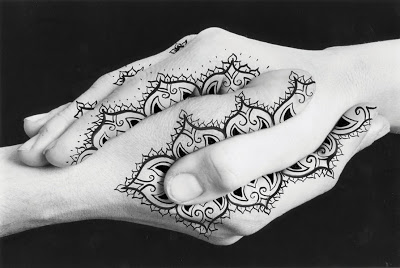
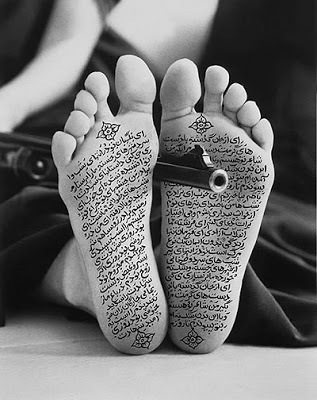
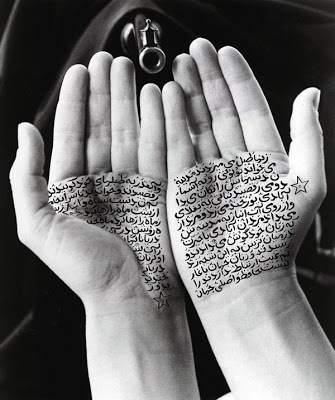
Shirin Neshat, an Iranian visual artist who works primarily in film, video and photography. Her work centres on the contrasts between Islam and the West, femininity and masculinity, public life and private life, antiquity and modernity and bridging the space between these subjects. She often uses test in her work, writing across photographs of faces, hands and feet. These images are used to get across messages, particularly pertaining to feminine suppression in Iran. They create awareness of the repression facing Muslim women and their pursuit of freedom.
Examples of Shirin Neshat’s work
Douglas Gordon’s installation ‘The divided self I and A divided self II, 1996 on display at Tate Scotland is a two channel video installation. I read it as a battle between the two halves of the self. An expression of the internal dialogue that we have within ourselves. This manifests itself in the contradiction of the image of ourselves that we present to the world, sane, ordered and the private identity that we keep hidden from view. All the contradictions that we withhold from the mirror view of ourselves and our place in the world.
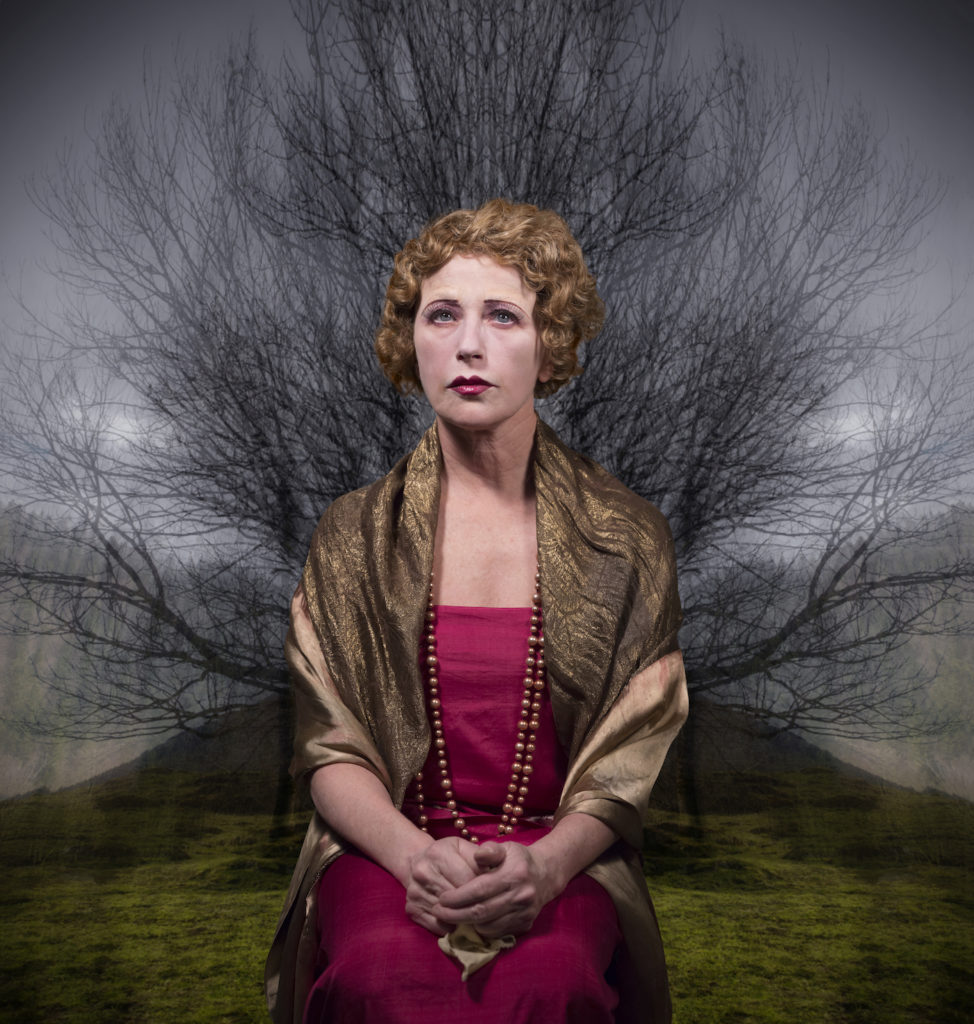
Cindy Sherman, works exclusively in photographic self-portraits depicting herself in many different contexts and imagined characters. Whilst initially interesting I found that I quickly became bored with the photographs.
I took a different approach to that indicated in the outline for this exercise. Rather than restaging an image using my own body I restaged a painting using props and photographs of myself and then used these to create a painting of the outcome.
My focus was to concentrate on hands.
Albrecht Durer, Praying hands
Being an amateur guitarist and having a strong interest in music I considered this an ideal opportunity to bring this interest into this particular exercise.
The first step was to look for some interesting images of guitarists hands via a Google image search. As expected there were thousands but I reduced these down to three images. Two photographs and one drawing / painting.
Guitarist’s hands
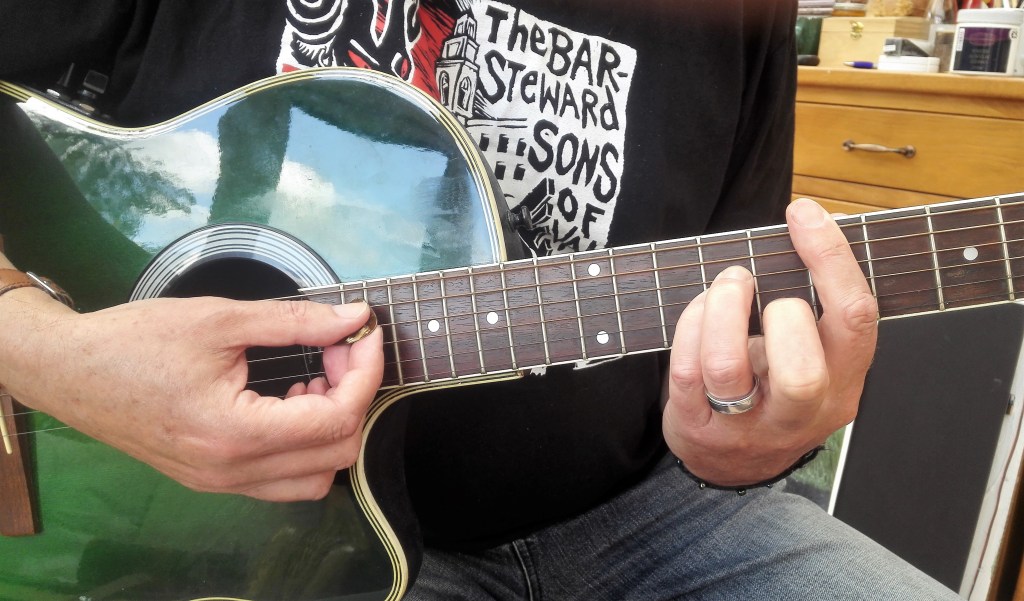
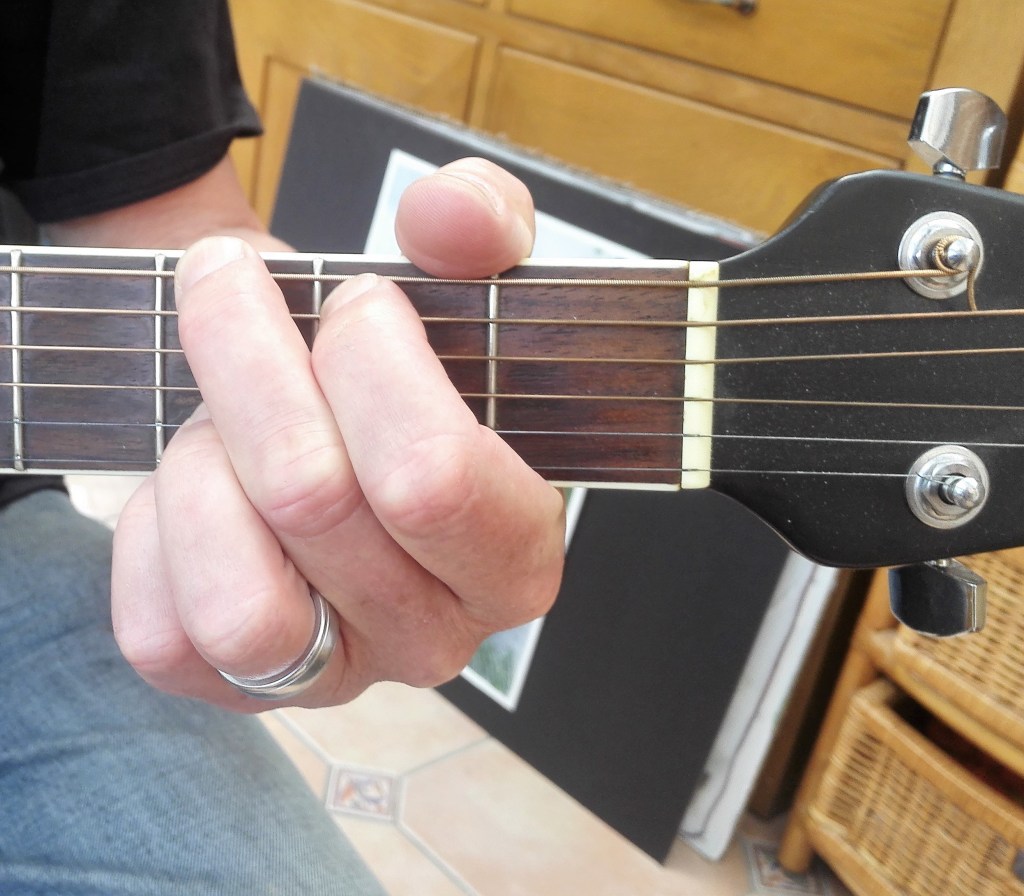
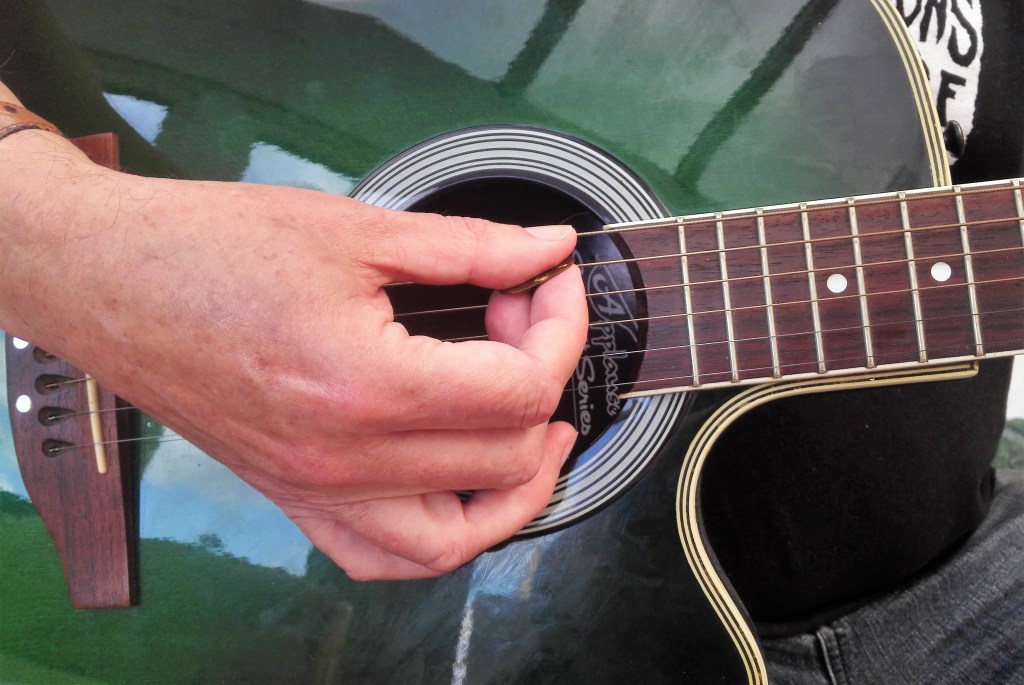
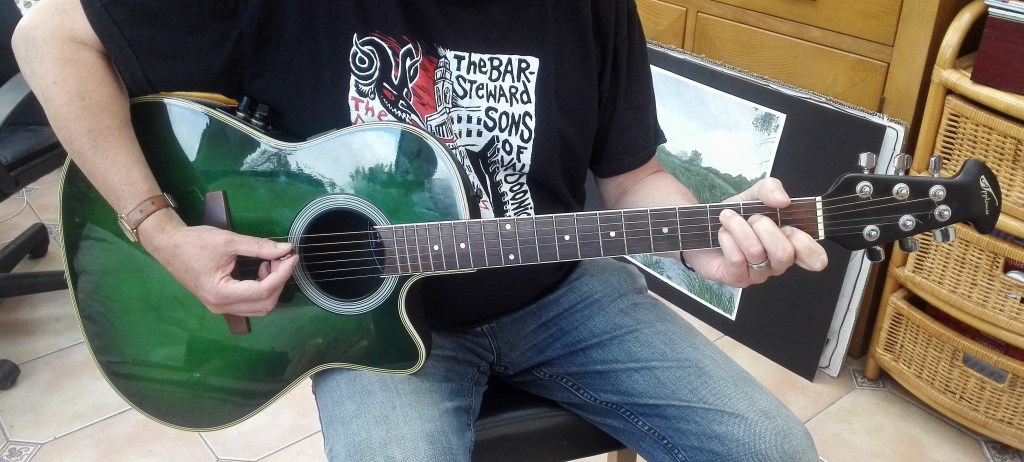
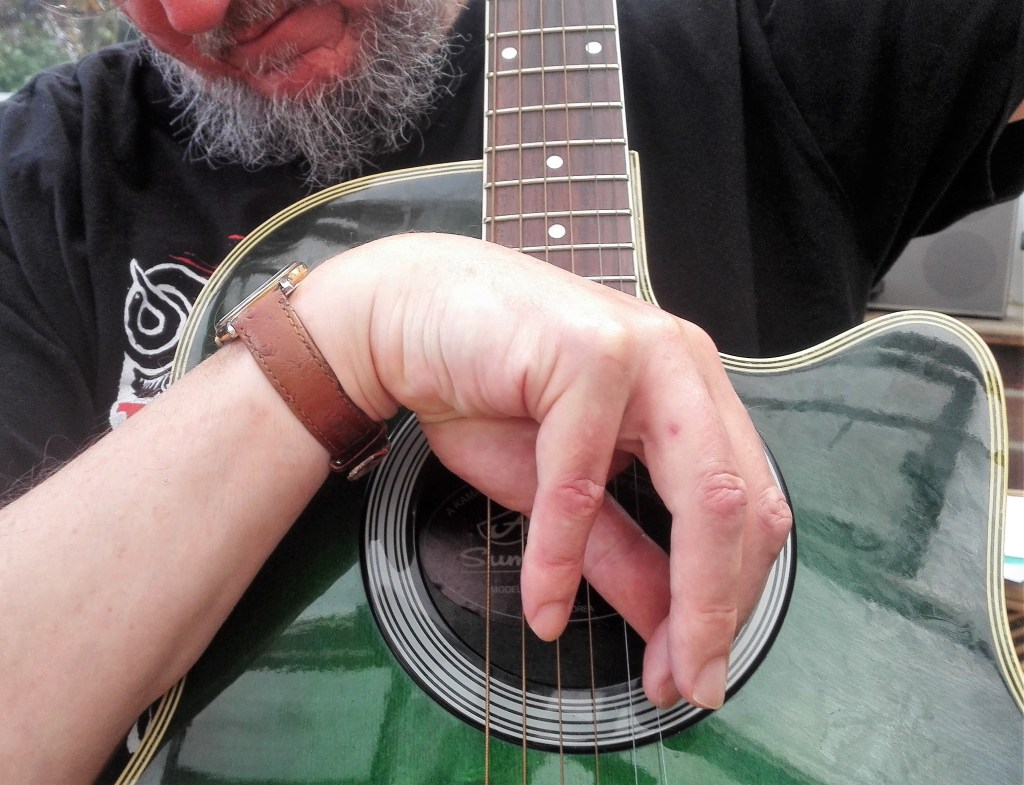
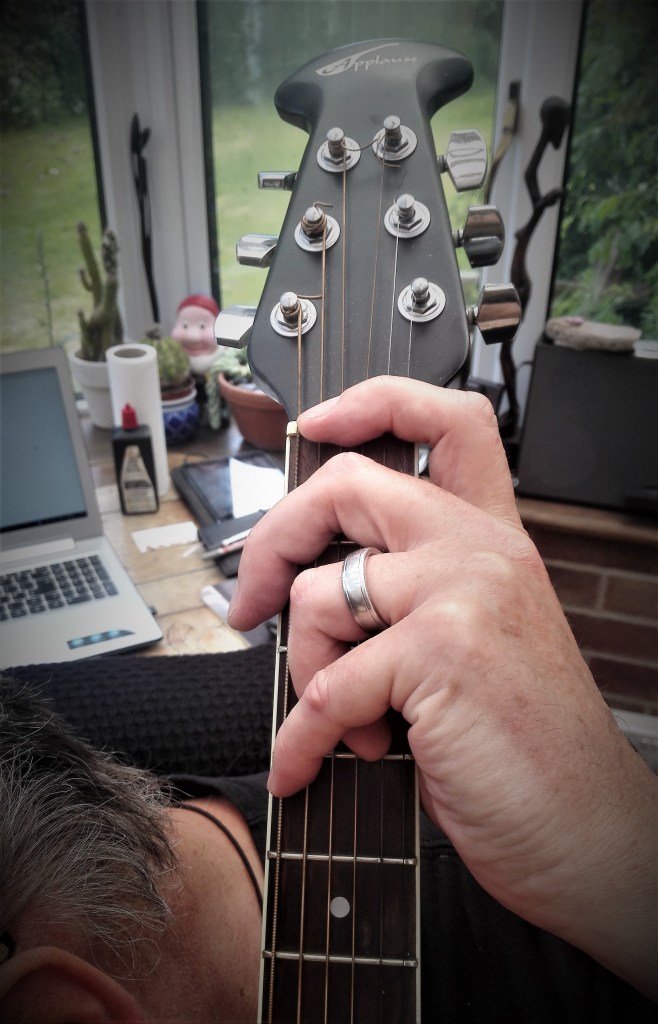
The next step was to take some photographs of myself playing guitar. I enlisted Marian, my wife’s, assistance for this. A few examples below:
Me playing guitar
Whilst these were interesting a would make good subjects they didn’t fulfil the prop, appropriation, enactment or restaging brief. However I did make a couple of sketches to familiarise myself with the shapes and challenges of drawing / painting hands.
Two sketches of my hands playing guitar
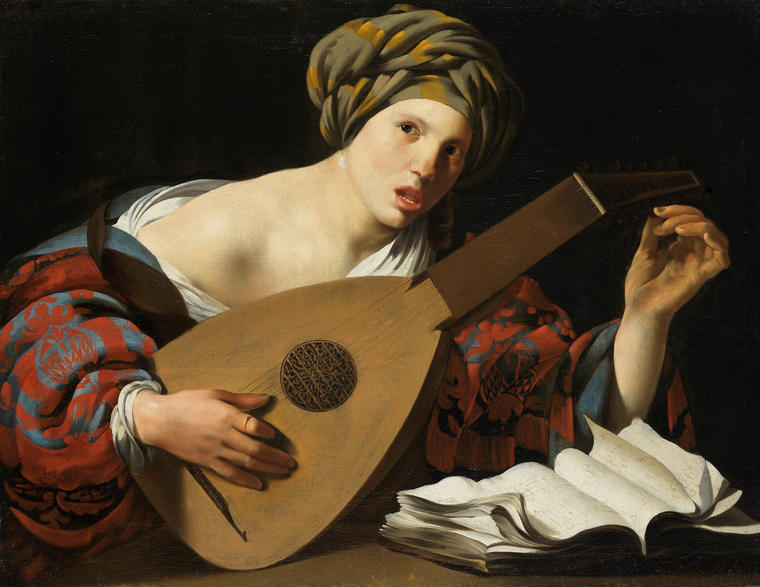
I had in mind two paintings that i was familiar with to try to stages the re-enactment part. The first is a painting that I came across in the Fitzwilliam museum in Cambridge. It is a painting by Hendrick ter Brugghen entitled “Young woman tuning a Lute”
Hendrick ter Brugghen, Young woman tuning a Lute, oil on canvas, circa 1626.
Whilst this would be an interesting painting to restage, the hands are well defined and the woman’s expression is that of being startled or caught. The painting is well lit using chiaroscuro techniques to emphasis the highlights. Additionally the fabric of the clothes that she is wearing is wonderfully observed. Despite all this it wasn’t what I was looking for. I had another painting in mind.
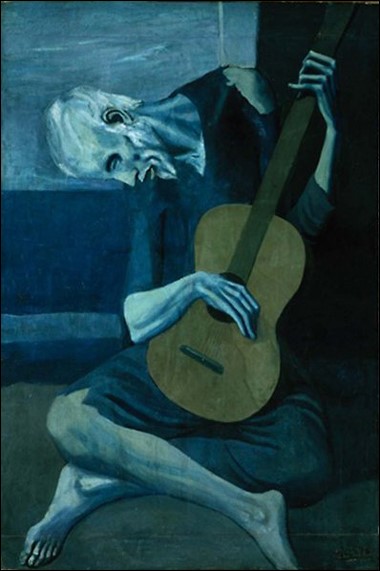
I recalled a painting by Pablo Picasso from his Blue period titled ‘The Old Guitarist’ which I remembered as having an unusual pose. The body looks contorted but appears natural. There is an emphasis on the hands which seems to be caressing, enveloping and clinging to the guitar.
Pablo Picasso, The Old Guitarist, 1903, Oil on panel, 122.9x 82. 6cm
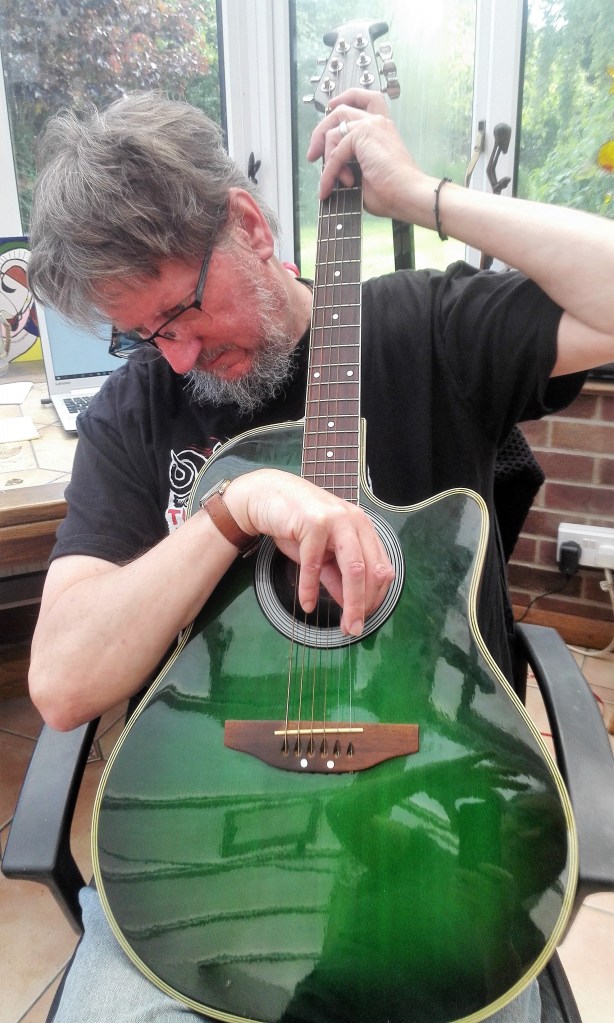
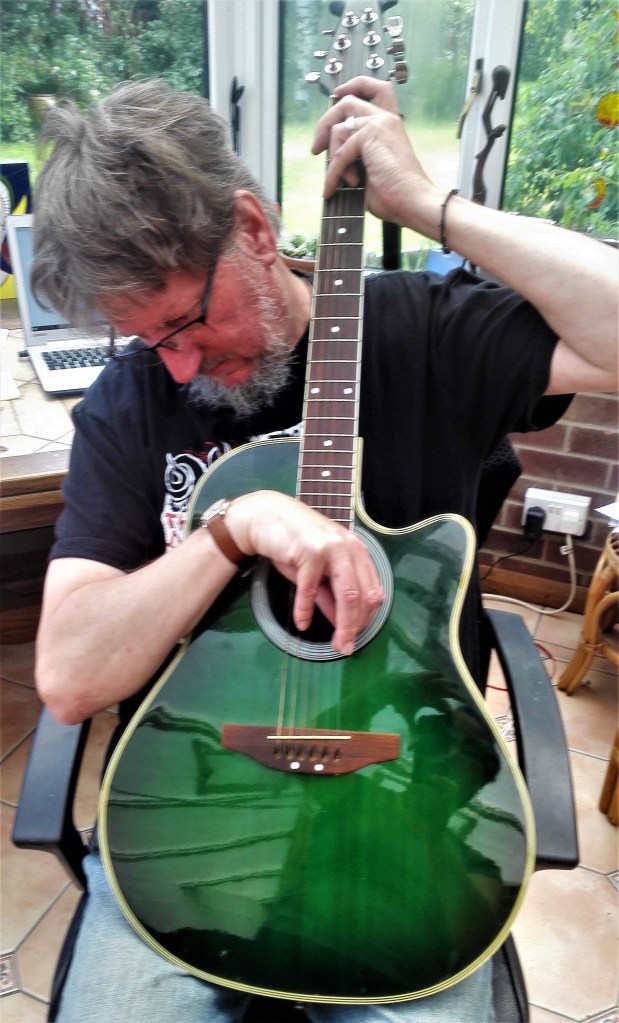
Again I got Marian’s assistance in taking some photographs of myself trying to assume a similar pose. Examples below:
Photographs of me trying to assume the pose
From a guitarists perspective there was nothing natural about the pose. I wouldn’t be able to play the guitar hunched up like this. I did get the feeling that I was close up and intimate with the guitar.
I would use the photographs and ‘The old guitarist’ as a source of reference and inspiration to complete a painting of my own. The emphasis of which would be the hands.
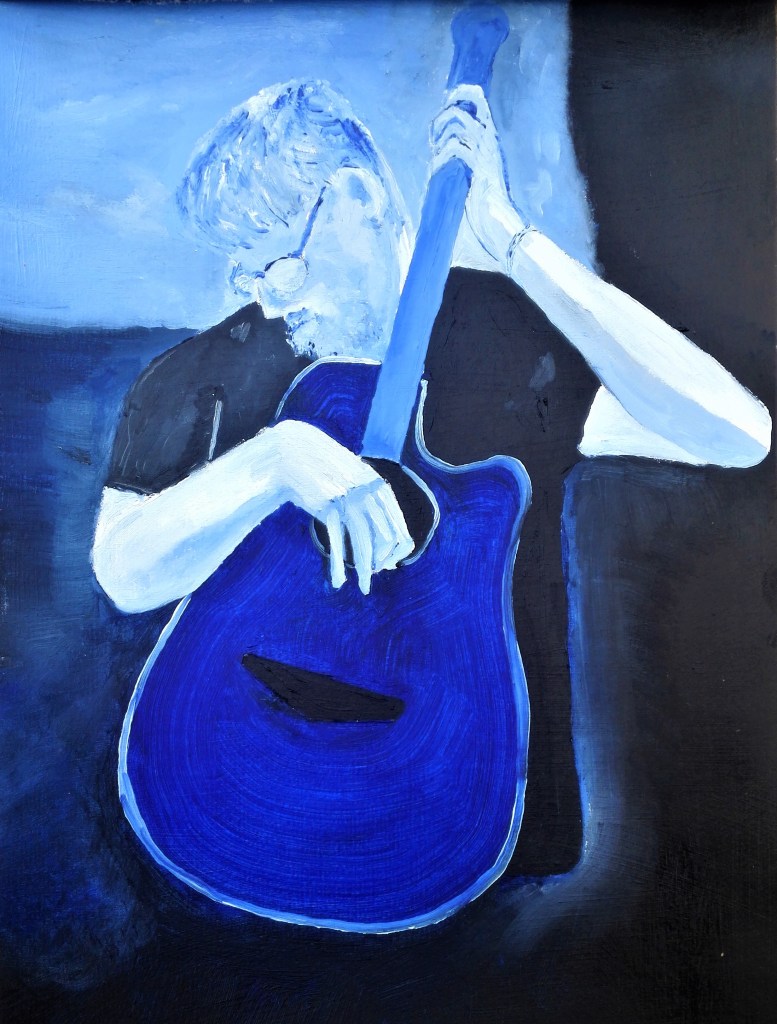
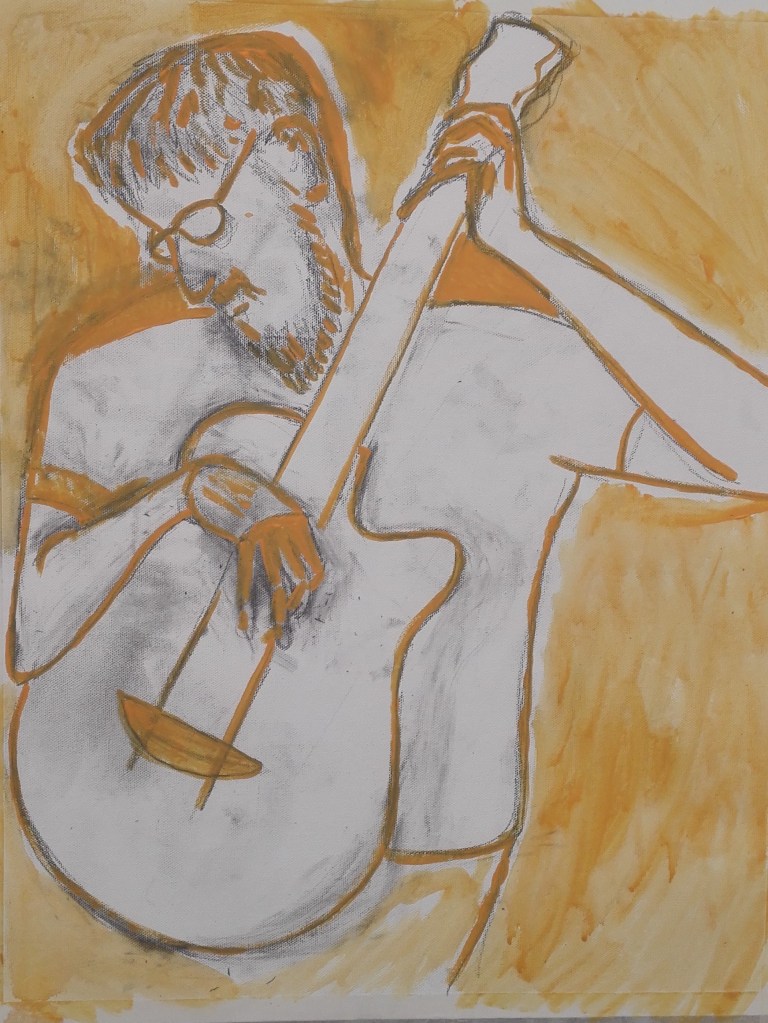
Two sketches were made and this was followed by a small painting.
Two sketches ‘Man with guitar’
‘Man with Blue guitar’ oil on paper, 21×29.7cm
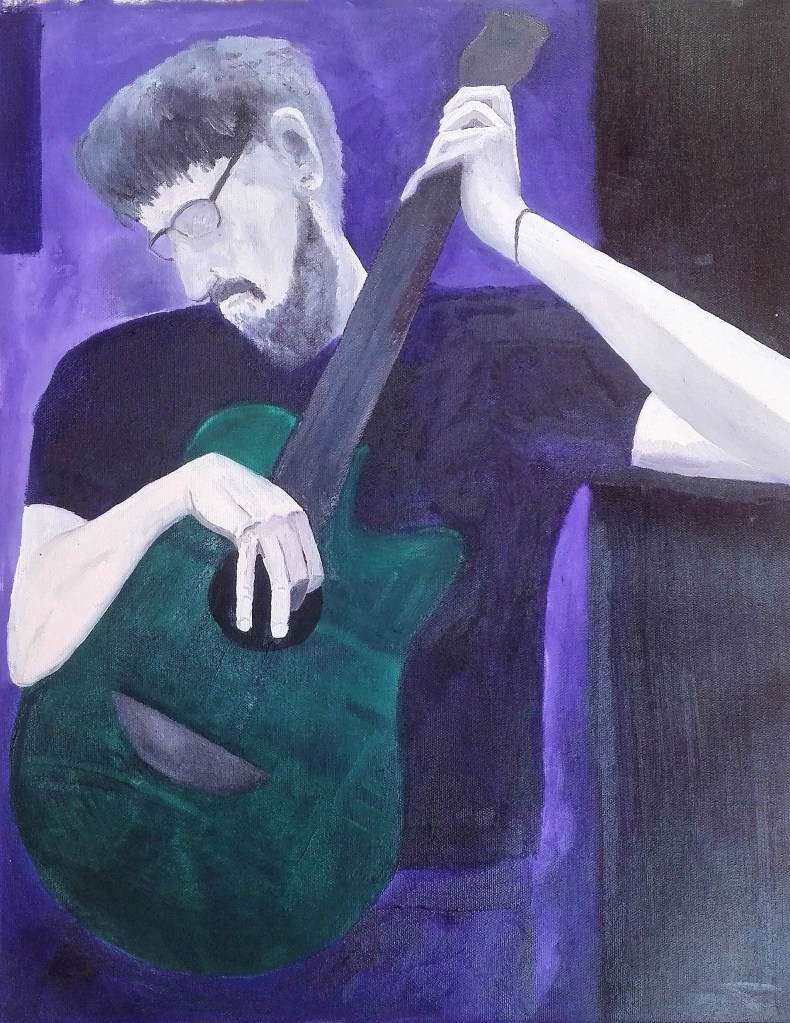
The painting whilst being a little crude had captured the essence of what I was trying to achieve. The player appears to be listening carefully to the guitar and thoughtfully enjoying the sounds that it is making. there is a focus on the hands particularly the right hand picking at the strings. Given the success of this trial painting I decided to complete a further work. Larger scale and less influenced by Picasso’s ‘The Old guitarist’
Man with guitar -work in progress
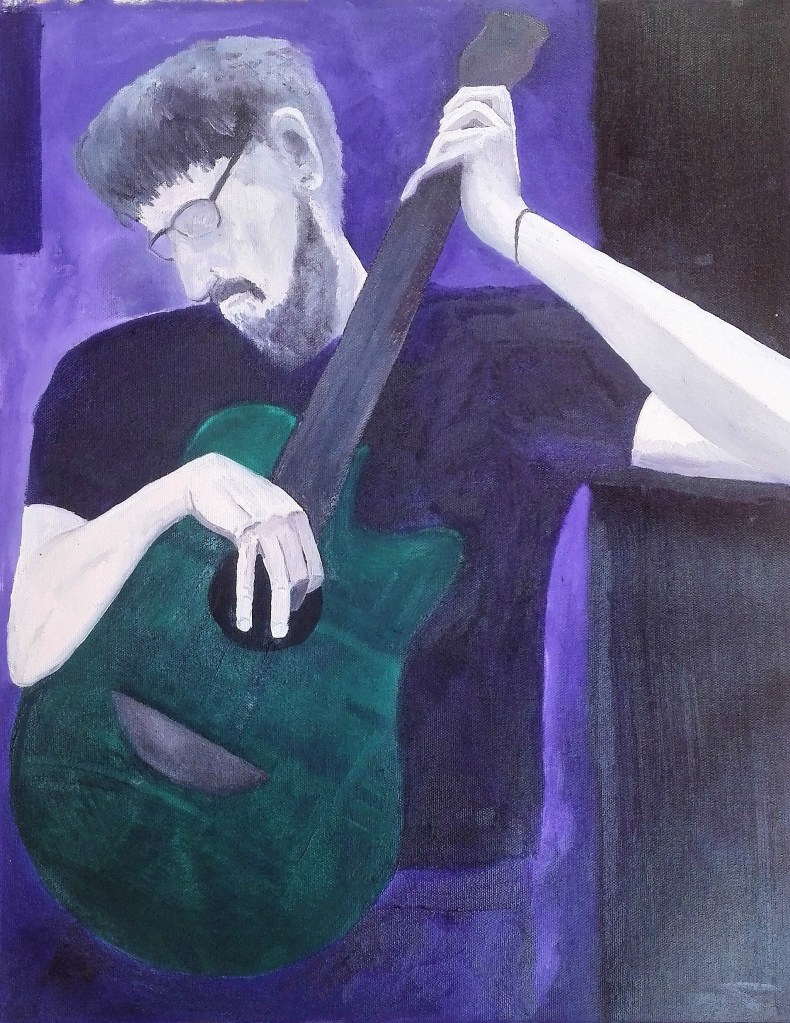
The completed painting is shown below. I’m pleased with the outcome of this painting. I managed to maintain the feeling of the draft painting and keep the feel of the caress of the guitar whilst maintaining the focus on the hands.
In the context of the exercise I believe that I have explored my response to the challenge and dealt with it in a painterly manner. Becoming an image was the exercise title which I became.
Man with guitar, oil on canvas paper, 38x48cm
Postscript: trying to photograph this painting was more difficult than I usually find. I think that this is partly due to it being fairly dark and the contrast between the matt finish of the man and the shiny lustre of the guitar. Getting the light correct was problematic. The painting works much better when seen by the naked eye.













 Mark Taylor 'Studio Practice'