Category: Part 5

Reflection on Formative feedback on Part 5

A positive discussion on the work that I completed during Part 5 and my assignment pieces. The main points that I reflect upon are:

The use of titles: look to apply engaging titles. An idea would be to use specific place/ time to my abstract paintings and use abstract or ambiguous title to the figurative paintings.

Artists’ statement: Rewrite / reorder my statement so that the more engaging section is at the start of the statement. In addition look to include a more poetic description of what I do. The challenge to do this without it sounding pretentious. Example that was given was a section from the artist’s statement of Joanna Whittle which I have replicated below

“The tent paintings represent fragile and temporary structures constructed within these notions of the ruin and time passing. Canvas sits in water; ropes are pegged in to the fluid land. Time sits still and moments brush against each other – canvas rots and weeds scramble over surfaces, but some lights remain on or have just been lit. They hold their own histories, ideas of vanished circuses or fairgrounds – events once frenetic now silenced and ominous in dusk or rain. concealing their internal space whilst their exposed surfaces weather and rot, they are hostile in their refusal to reveal their secrets. The still light ossifies both tents and trees, like a petrified forest, whilst liquid, motile elements pool around them making these worlds almost static, yet they seem to be slowly moving towards an uncertain or foreboding conclusion.”

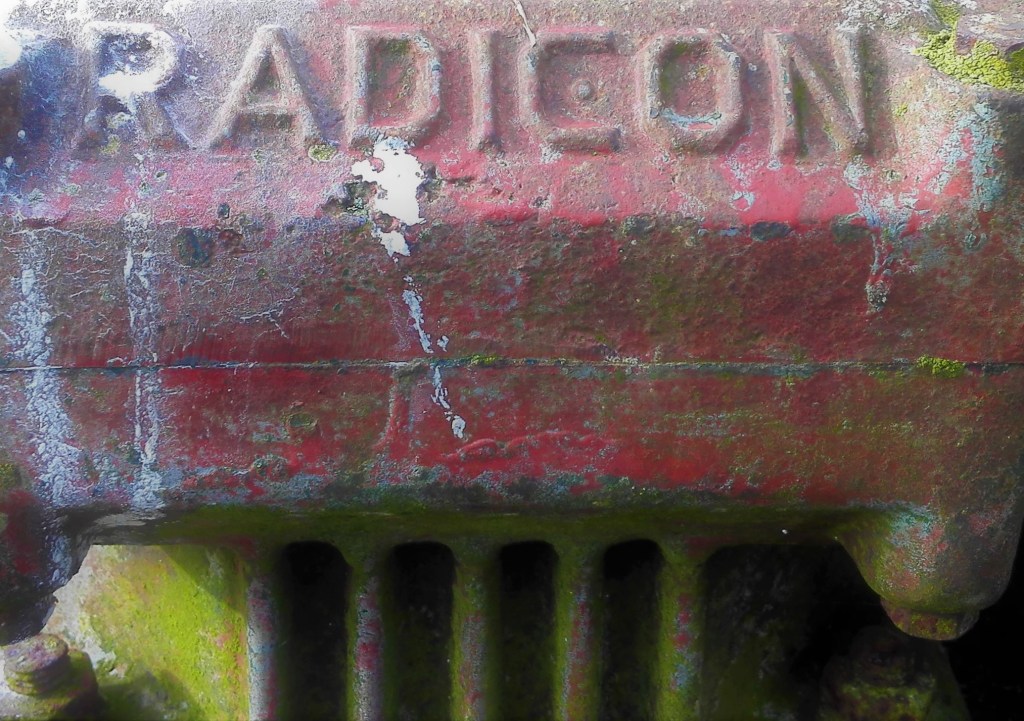
Assignment work: Positive feedback on painting titled ‘Radicon’ “lower section works well suggesting depth / entry point. curious / ambiguous structure that fits in with parallel project work.

Critical review: a good first draft further exploration using specific paintings from each of the two artists saying something about the work. Also include one of my own paintings and how it relates to memory. Include references at the end of the review.

Parallel project: a good selection of paintings already completed which convey the idea that I have about place. Improvement rework ideas discussed which will be implemented and demonstrated in a separate blog. I will also complete some further paintings. The final selection will be discussed at the next feedback session.
Review of work completed in Part Five in relation to assessment criteria

Demonstration of Technical and Visual skills

I have taken a similar approach to the ones I completed for Parts three and four. The review has been broken down into the four key assessment criteria and where appropriate into the key sections within these criteria.

Materials: 

Part Five differed from the previous Parts of the course in that there was less scope for creating artwork. The two exercises for which there was this opportunity were: Exercise 1.0 Cut up technique and Exercise 3.1. For Exercise 1.0 I responded with paper and scissors to complete the exercise and for Exercise 3.1 I used technology to create a triptych using paintings and words. Neither of these were particularly ground-breaking.

Techniques: 

I feel that it is worth documenting here that my approach tackling a painting has evolved. I have a methodology which can be applied to different types of painting. In essence the technique is not dissimilar to working from dark to light but with my own personal tweaks. Most, if not all, of my painting during this part of the course has been directed toward the Parallel project where I have completed a number of paintings which I feel meet my criteria for submission for Assessment.

Observational skills: 

This is the area where I believe that I have made the biggest improvements. This has been in two distinct areas. The first is in respect of how I am approaching my paintings where I am continuing to develop my own language which is informing how I respond to subjects. The second is with regard to my contextual capabilities where they have needed to improve in order to complete the first draft of my Critical review. A major factor in assisting my improvement has been reading ‘How to write about contemporary art by Gilda Williams’. The tips, do’s and don’ts contained in the book have assisted my ability to respond to a painting in writing. I’m aware that this is a skill that needs to be practiced.

Visual awareness: 

Not an area where I have made any significant steps forward over the duration of Part five other than those mentioned above.

Design and compositional skills: 

Similar to visual awareness this was not an area that was particularly addressed during Part five.

Quality of Outcome

The paintings that I have completed for my Parallel project are, I feel, amongst my most accomplished to date. There are aspects where I see areas for improvement and believe that these are within my reach.

Demonstration of Creativity

There has been less opportunity to be as creative in Part five than there has been in previous parts of the course. Therefore my main focus has been on the completion of the exercises, creating a first draft of my critical review and more work towards my Parallel project.

Context

The contextual focus was the most important aspect of Part five. In trying to write a brief artists statement I needed to reflect on my practice, what it is, what drives me and why it is important to me. Trying to get that into a short statement that made sense and was, I hope, interesting was a challenge. This was followed by my first draft of my critical review in which I have completed detailed research, pulled this research into an essay where I have reflected on the research and generated my own opinions.

Summary

At this stage of the course I need to reflect on the progress that I have made, the key learning points and how to pull these together so that I am successful at Assessment.

Assignment Five – ‘Working with words’ – Two pieces and a review of Assignment

I have found Part Five a challenge in so much as it has forced me to confront how I approach my art practice. In doing so I had to use words to explain what it is I am trying to do, why it is important to me and whether I have been successful in achieving my aims?

Whilst considering how to approach this final assignment for the course I was tempted to move away from the approach that I have adopted throughout. This being to look for a solution whereby it involves painting. Should I challenge myself to create a work that was outside these confines. If so what could I do that would meet the criteria assignment?

To answer the questions raised above I reviewed the work that I had completed for Part Five, ‘Cut up technique’, ‘The role of the title’ and ‘Writing an artists’ statement’. Did I want to expand upon the work that I completed for these exercises? It was the upon re-reading my artists’ statement and reflecting on it that my mind was made up. Within my artists’ statement I clearly stated my interest is in painting the Fenland landscape. With this in mind I looked to try to incorporate ‘words’ into a painting or paintings. The additional advantage to this approach was that, if the paintings were successful, they would also be an addition to my Parallel project.

I decided make two paintings, one for each of the two ways that I try to depict the Fenland landscape, the landscape as seen and a close up study. After completing a review of some of my photographs I settled on two that met both my artists’ statement criteria and also included words.

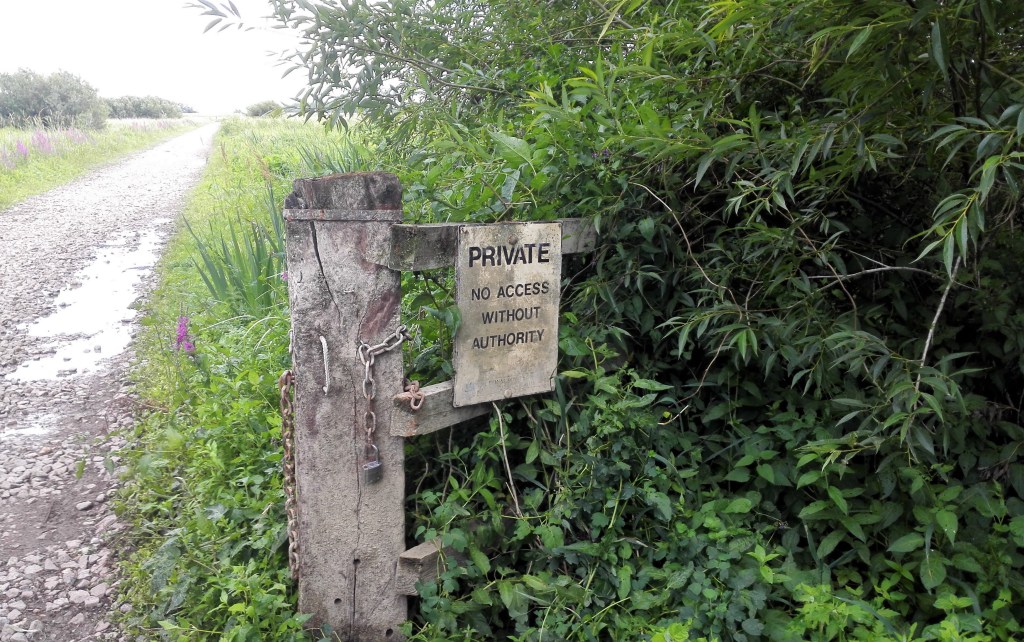
The first was a close up of a another part of the old pumps which I have used in previous studies. The second a landscape scene which included signage.

I have noticed that my approach to these paintings is becoming more refined in that I have developed a technique which enables me a route into the painting. This approach starts with a covering the support in paint whilst mapping the main colours and tonal highlights. The next step is to focus on the darkest area and to work up the detail in gradual steps. Once this part is completed I will work on sections of the painting and define colour, shape and texture. All the time I am cognisant of the whole painting and the need to keep the overall feel consistent.

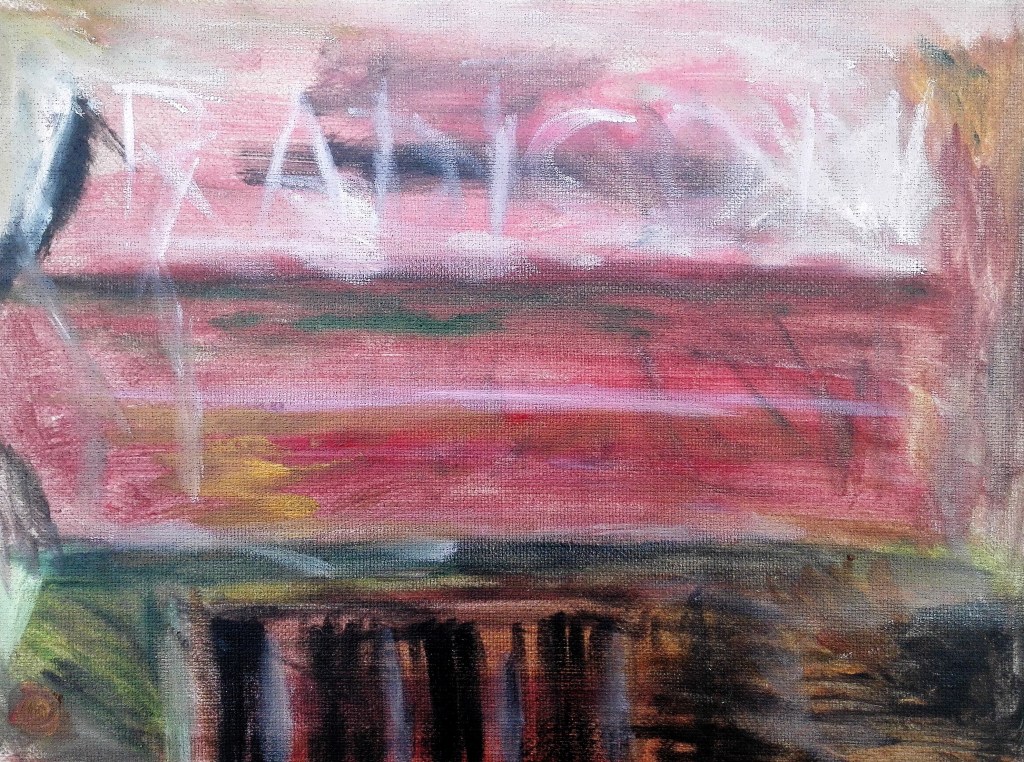
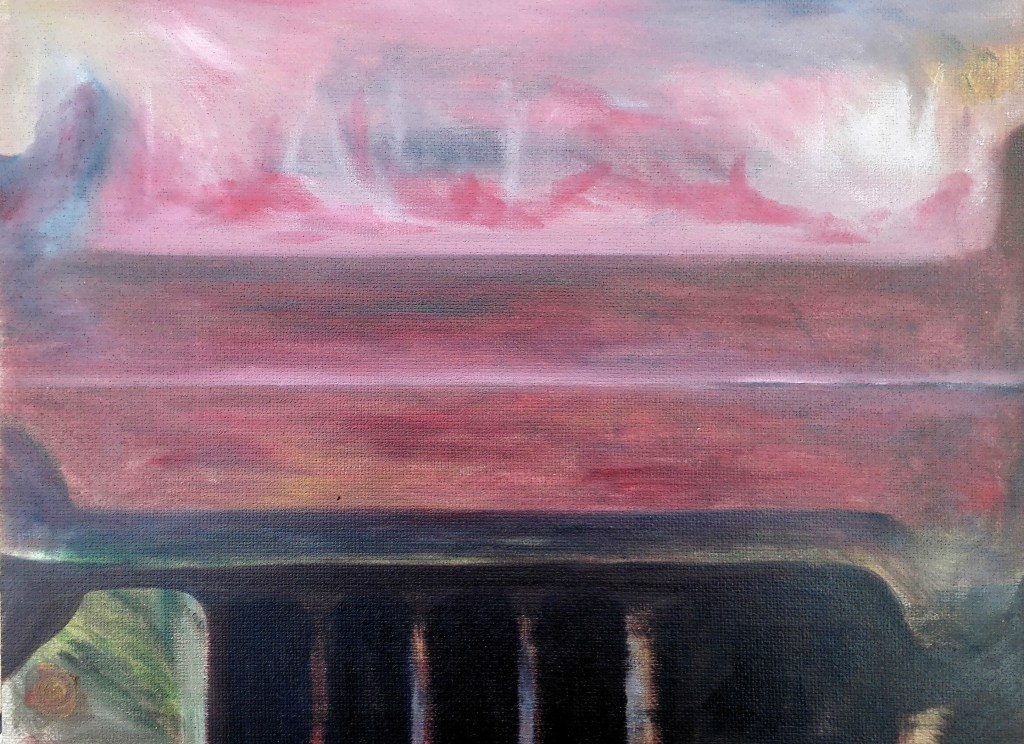
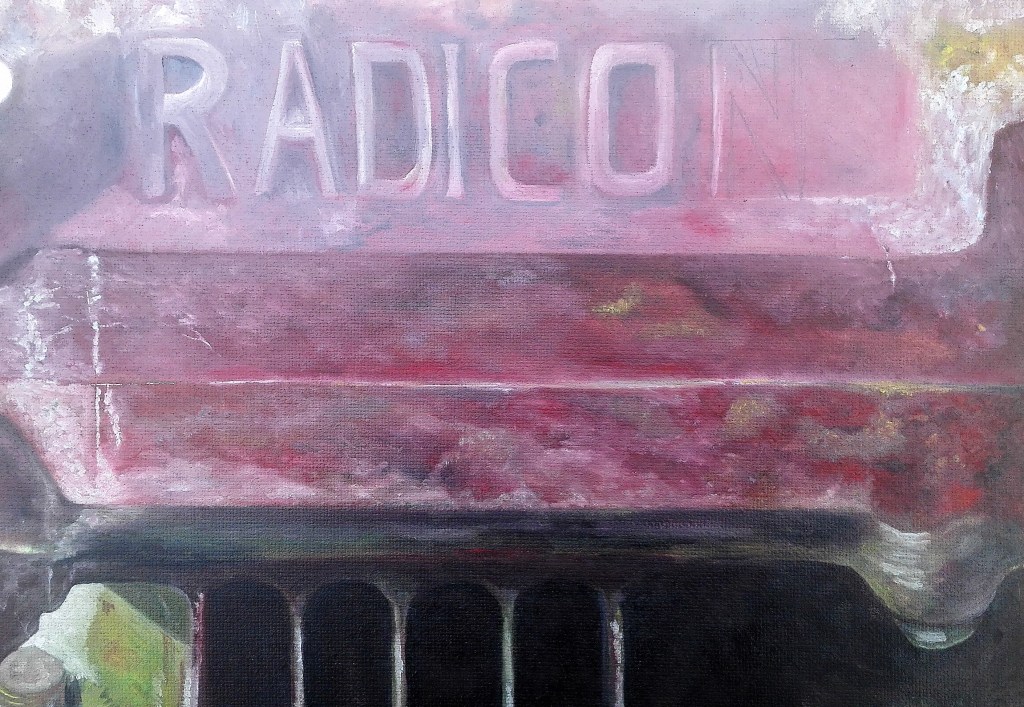
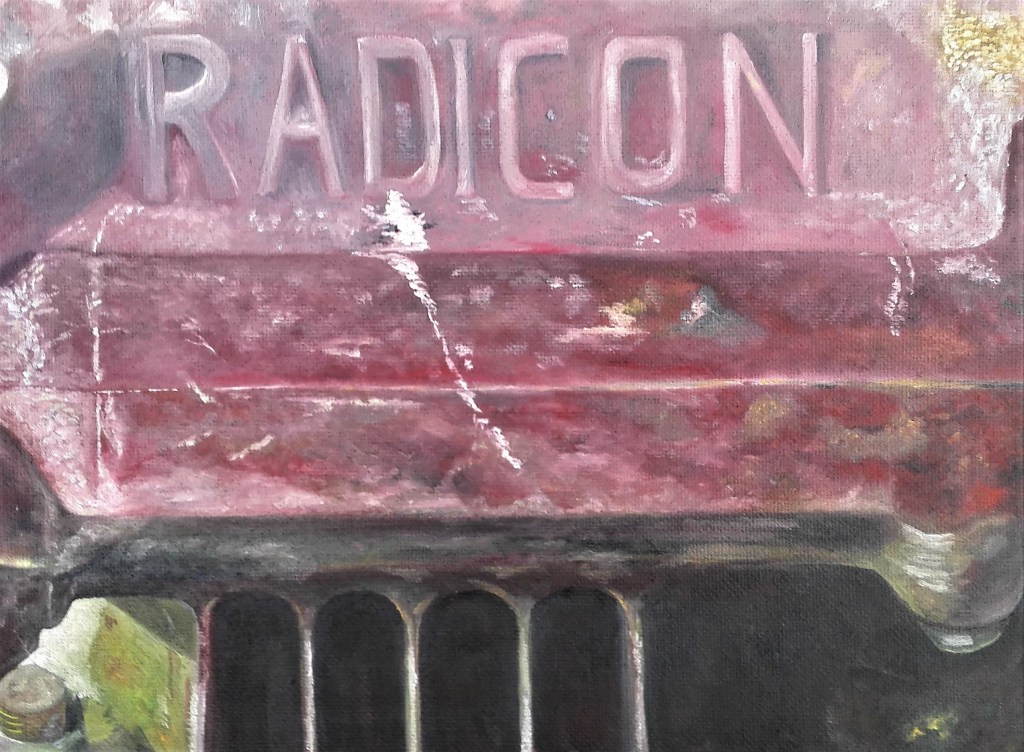
The first painting which I have called ‘Radicon’ for obvious reasons, I assume that this was the name of the company which manufactured this piece of machinery. I took three photographs of the work in progress.

The finished painting, shown below, has a number of aspects in which it meets my criteria. There is a pictorial element to it, the bottom third invites a closer inspection and the light from the left is well handled. The title is clearly depicted but it doesn’t give much if a clue as to what it is.

‘Radicon’, Aqua oils on linen board, 30 x 40 cms

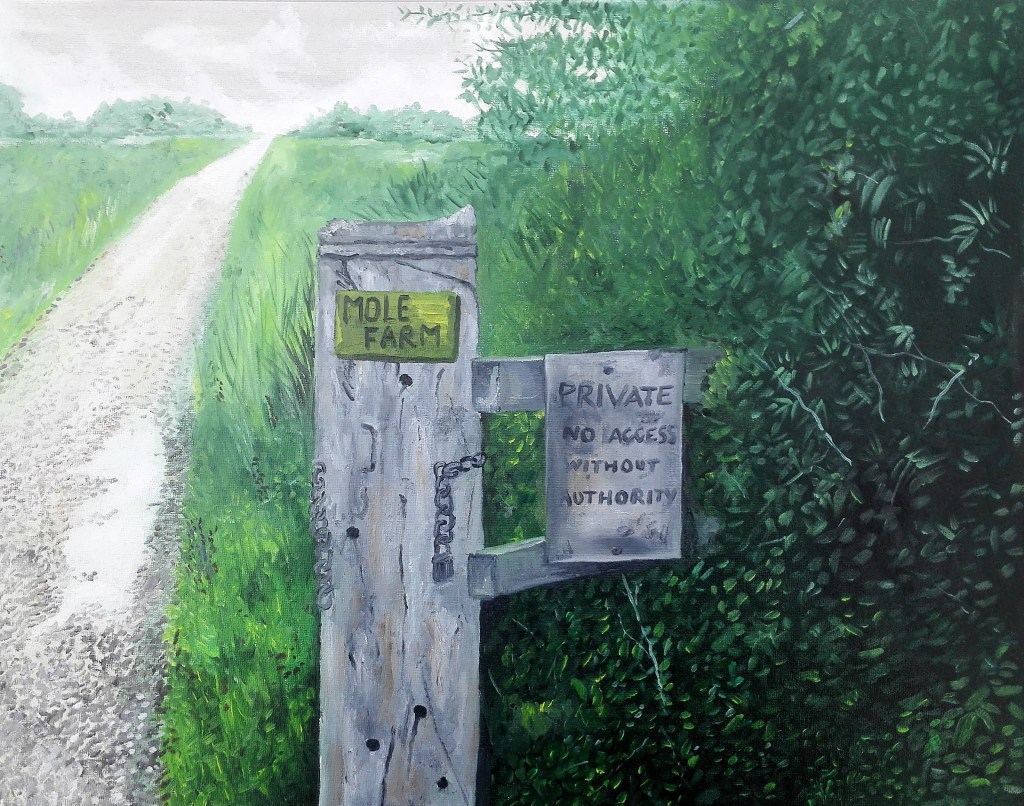
For the second painting the title ‘Pathway near Purl’s bridge’ is descriptive. The inclusion of words in this painting is a bit forced. Do the words add anything? In an earlier stage of the painting they did the opposite in that they distracted and made the painting as a whole look more like an illustration. I had added a nameplate to the fencepost so as to add some further interest. This also promoted the illustrative quality.

‘Pathway near Purl’s bridge’

To complete the painting the signs were made to look more weathered and the light toned down. The completed painting, below, meets both the assignment criteria and that of my Parallel project.

‘Pathway near Purl’s bridge’, Aqua oils on canvas, 16 x 20 inches’

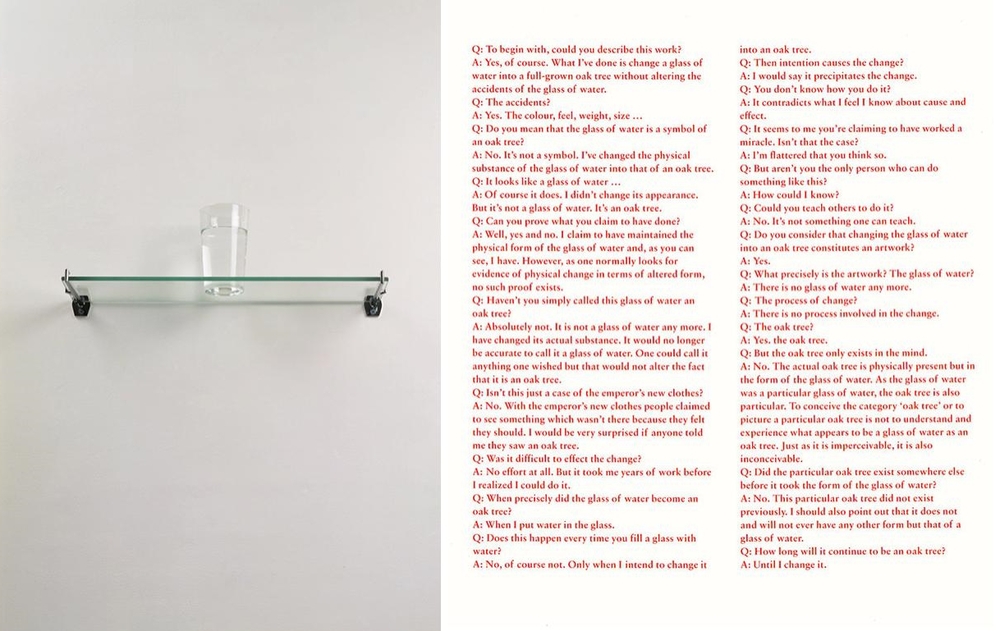
Part Five – Contextual focus point – Link 42 ‘An Oak Tree – Michael Craig Martin’

Michael Craig Martin, An Oak Tree, Assorted Objects and printed text, 1973

I view this work as an intellectual argument into what something is or appears to be. It is a challenge to the observer to take a step back and think again.

I am reminded of the work of Rene Magritte as in his painting titled ‘Cesi n’est pas une pipe – this is not a pipe’ which indeed it isn’t. It is a painting of a pipe. Therefore it is a representation of a pipe but it is not a pipe.

In the case of ‘An Oak Tree’ Michael has taken this argument a stage further. We are presented with what is clearly at first sight a glass of water on a glass shelf. However Michael informs us, the viewer, that we are in fact looking at an Oak tree. The objects are accompanied by a text in which we are informed why it is an oak tree. The text, written by the artist, in the form of an interview, challenges him to explain himself and ask why it is an Oak tree. The process of creating the Oak tree is presented along with the statement that the Oak tree exists in the mind and is physically present but in the form of a glass of water.

The piece is an example of conceptual art whereby the act of presentation, coupled with the dialogue, questions us to examine and think about what we perceive about the world in which we exist. In this example the artist describes what he has presented to us and explains why it is what it is.

This is better explained by the Michael in an interview on his website titled ‘I’m interested in language’. In this interview he states “I am interested in language and the way in which we interpret the world, understand the world, through the things we create.”