Overall the feedback was good and mentioned that I had made a positive start to the course.
There were some pointers emphasising that I should make more rigorous use of visual and contextual research to support my enquiries into ideas that I find interesting. I have taken this comment on board and will develop this as I work through the course. I have found during the courses that I have undertaken thus far with OCA that that exploration and reflection become more and more important. Thinking about this it becomes obvious that this a window into what is informing my creative process and development as an artist. It is my story of how I see the world and how I respond to it and how it informs my art.
It was also suggested that I should look to explore further with some of the experimental techniques that I had employed during some of the exercises. Namely the blowing ink and diluted paints and also to look for new ways of applying medium to surfaces. I will look to invest in some new colour pastes and shellac inks to compliment these investigations. My aim will be to take time out between exercises in Part Two to complete these tasks.
Lastly I noted the suggested artists to investigate and will do so. These investigations will be reported in my blog under Research.
I found a number of parallels with the start of ‘Studio Practice’ to elements of ‘Concepts in Practice’ where the emphasis was on breaking out of traditional notions of what painting is. The focus is towards the experimental, to challenge the student, to open up new possibilities and challenges.
Some of the exercises required me to think in ways about painting that I have previously only given passing consideration. An example of this is extent that although painting is a physical act I have always thought of it as mainly a mental or cerebral pursuit. Being required to question and think about my physical movements, constraining them and then asked to create works within these limitations was enlightening. To experience painting as an action or event rather than just a mode of communication was enjoyable. As was trying to encompass the part played by chance endurance and time. Whether the outcomes were successful or not was not the point. I would like to try to include a sense of my physical presence in my work. Similarly the attempting to employ alternative ways of applying materials in mechanical or non participative ways forced me to address issues that I had not previously explored in any considered manner. These projects and exercises opened up new possibilities which I must try to employ when thinking and engaging in my own practice. That isn’t to say that I will necessarily produce works using these techniques but will let them and the thought processes involved influence how I approach my work.
One of the interesting discoveries I made was when trying to work collaboratively on one of the exercises. I found it difficult to allow others to influence what I considered to be my work. This is in opposition to allowing materials to react to each other to create chance outcomes where I am happy for this to happen. This discovery made me think about my attachment to what influences the outcome of the work and my ownership of the result. In many ways I consider the act of painting to be an individual act, a personal document of myself and my responses to life. In saying this, which is in danger of sounding pretentious, I realise that I have a long way to go in really being able to truly and honestly say that my paintings represent me. The start of this course has given me opportunities to consider and explore more possibilities.
The final piece that I worked on for Part One was a further attempt to try to remove as much of me from the process creating as possible. This got me to think about how much I can remove myself from the act of creating. At some point there is an interaction which results in a decision that what I am presenting is a piece of work.
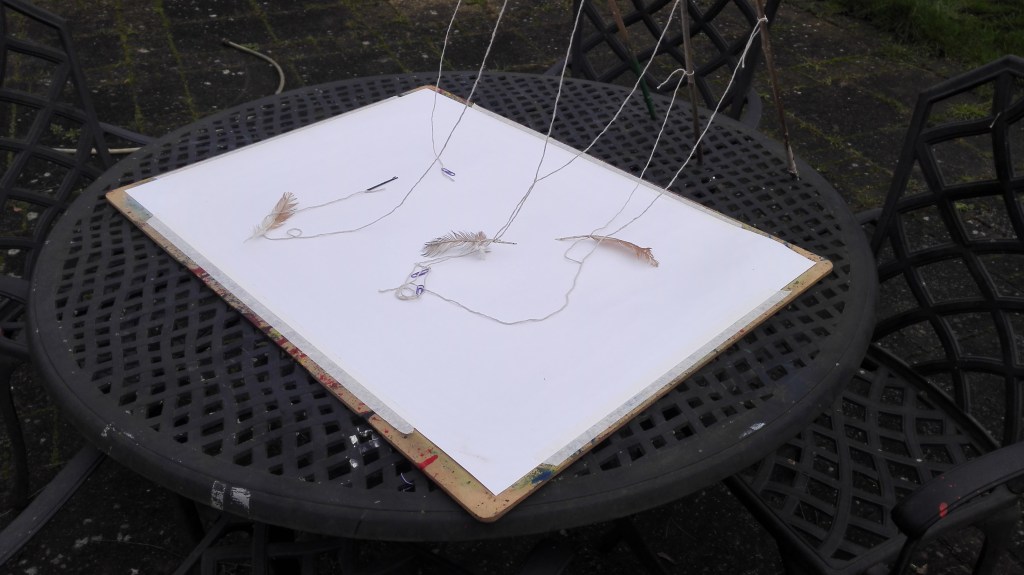
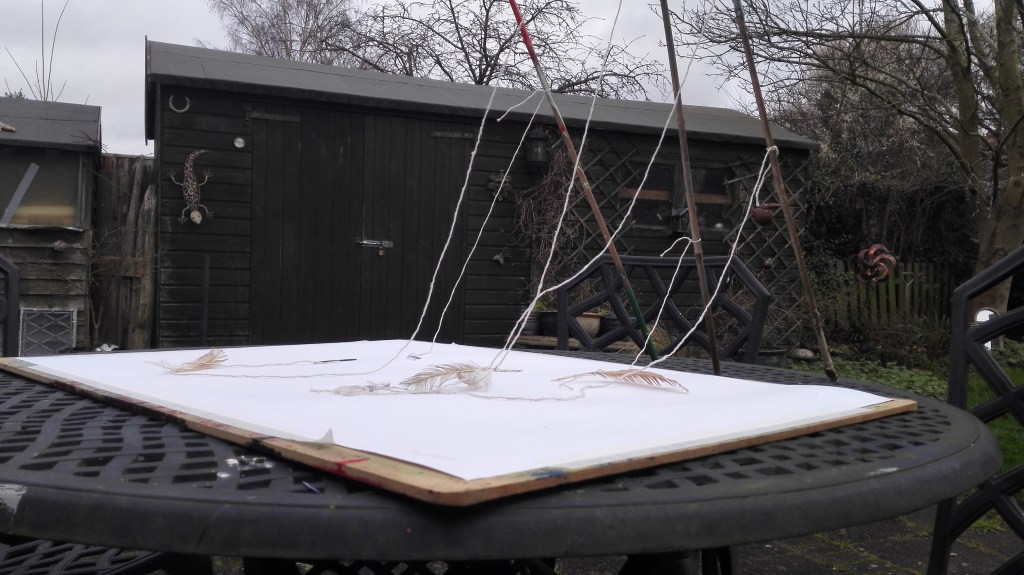
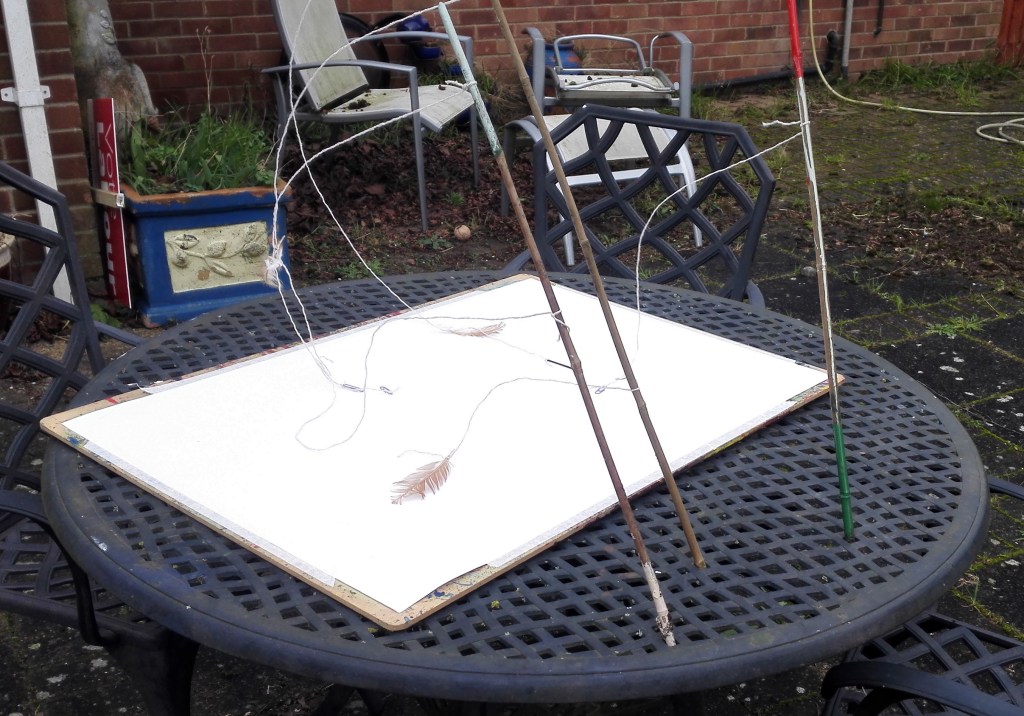
My aim in trying to create this work would be try to utilise the wind to create the marks. The weather over the past few weeks had been particularly windy due to two storms that had hit the UK, named Ciara and Dennis. I would work outside and set up a series of tools that would react with the wind. My starting point was to tie string to garden canes. Some of the strings were weighed down with hair clips or paper clips. These seemed to move reasonably well in the wind but the movement was a little limited. I would later try to increase to movement with the addition of bird feathers. The bird feathers would also be used to create marks.
Below are pictures of the set up.
The initial set up
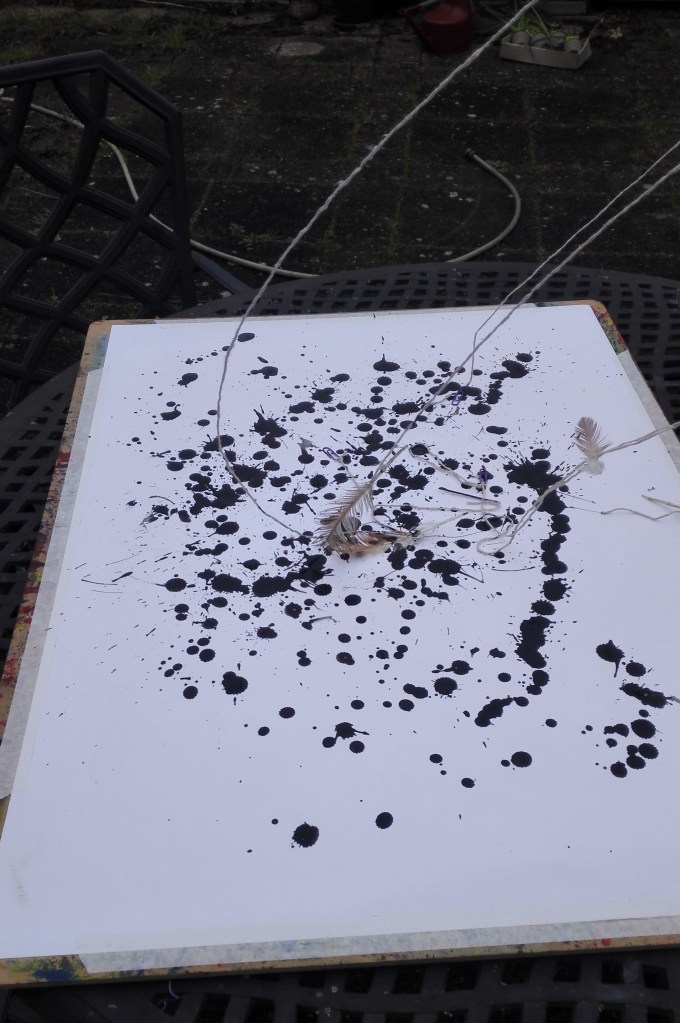
The issue that I struggled with was how to get the ink and paint onto the paper. I didn’t want to be involved but I couldn’t think of a way of removing myself from the process other than some sort of dripping mechanism. In the end I decided that I would apply the ink and paint by tipping and dripping it onto the surface. I was disappointed with the marks that the dripping made but hopeful that these would be removed, altered by the mark making. Initially I applied black drawing ink, this would be the dominant material. Later I would add diluted Acrylic paint using two colours Red Ochre and Naples Yellow.
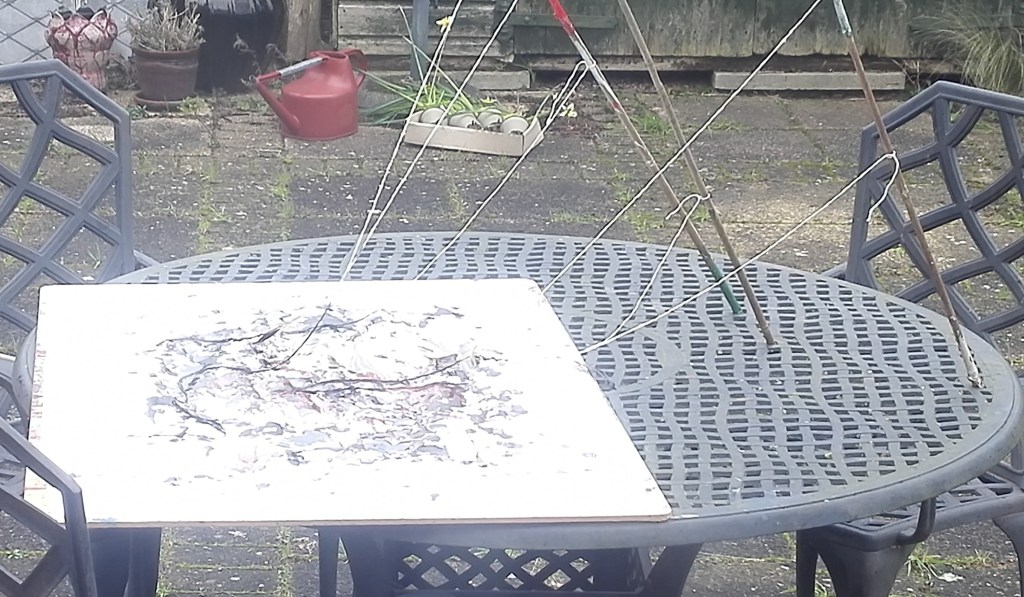
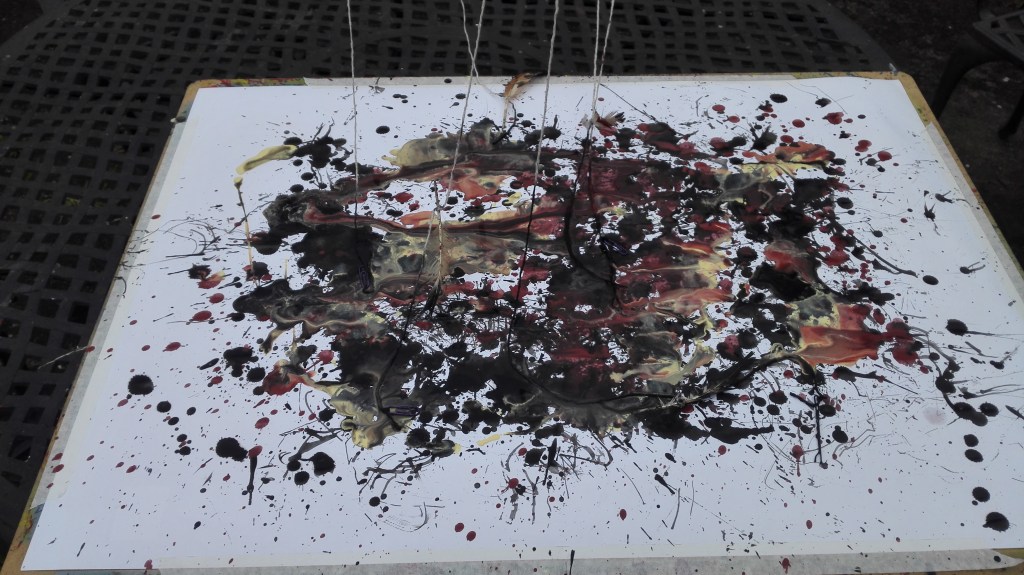
Some photographs and a video of the process in action below:
Painting in progress
Painting in progress – Video
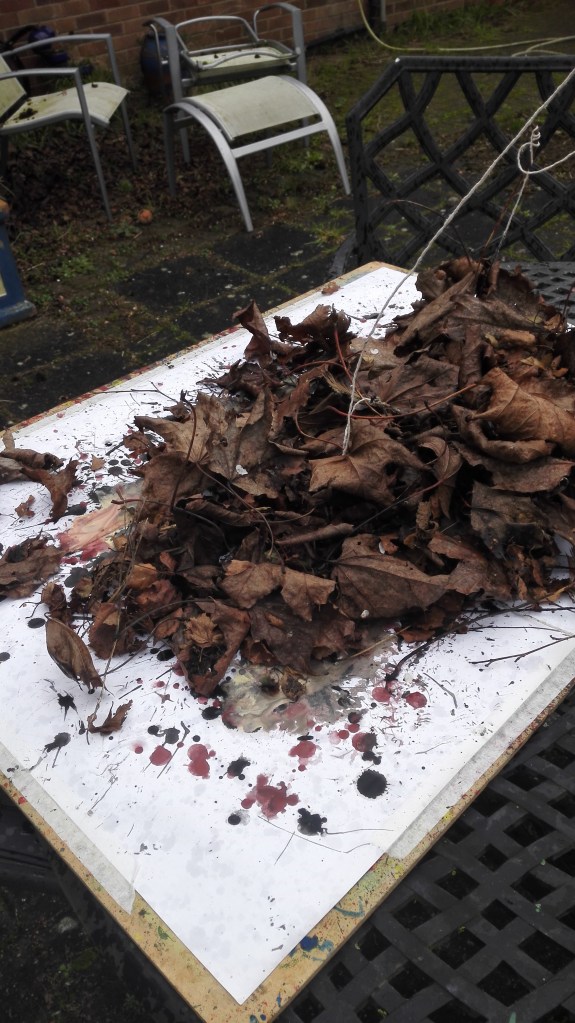
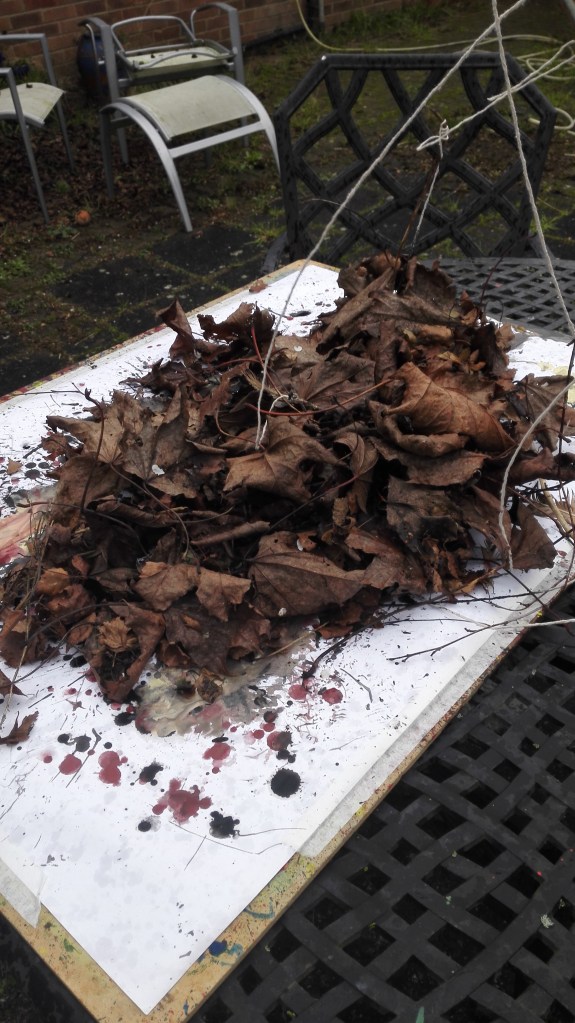
To try to increase and vary the marks I added some twigs to the string and covered the support with dead leaves. These would get blown over and off the support.
Twigs and leaves added
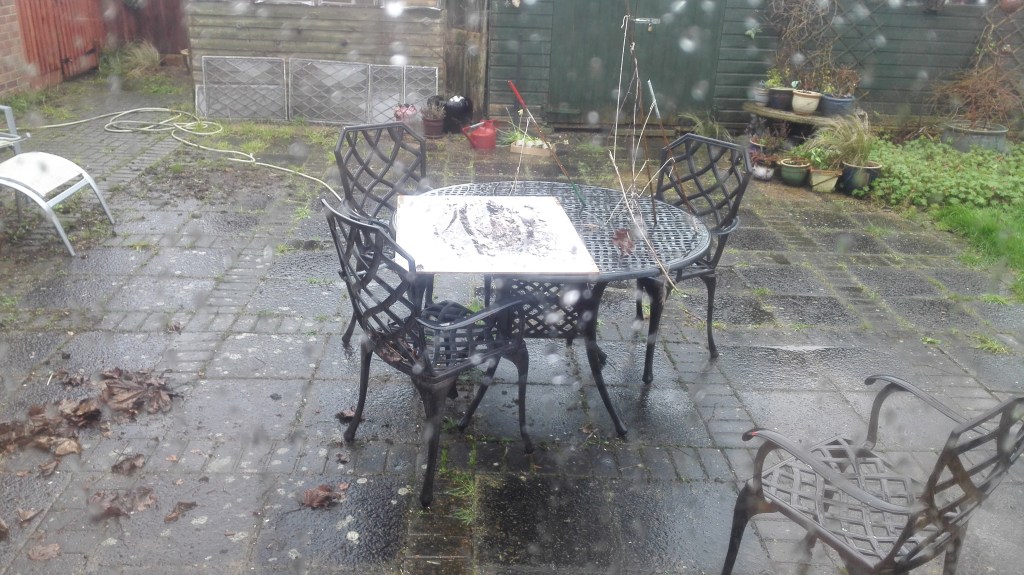
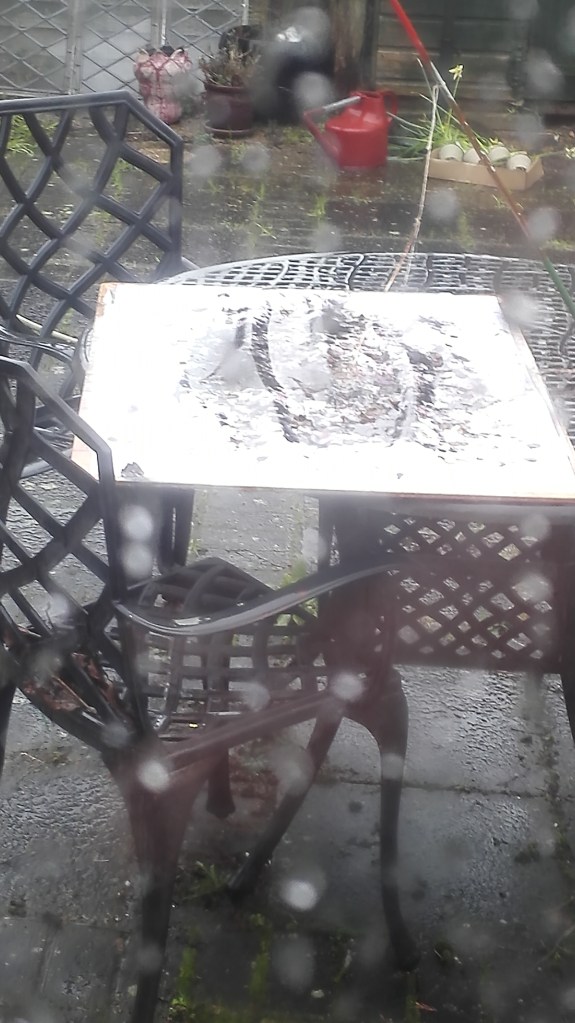
I intended to let the process run for several hours and this was confirmed when unsurprisingly it started to rain. I hoped that this would help the paint and ink to remain wet and allow more marks to be made. However it seems that the main impact was to wash the paper and allow watermarks to accrue.
The painting being rained upon
It rained for approximately three hours. I left the painting outside to dry but it was further assaulted with more heavy rain and some hail too. It remained outside overnight before being bought in the following day to slowly dry in the shower.
What would the final painting be like? Would it reflect the process that it had been through to suggest its creation?
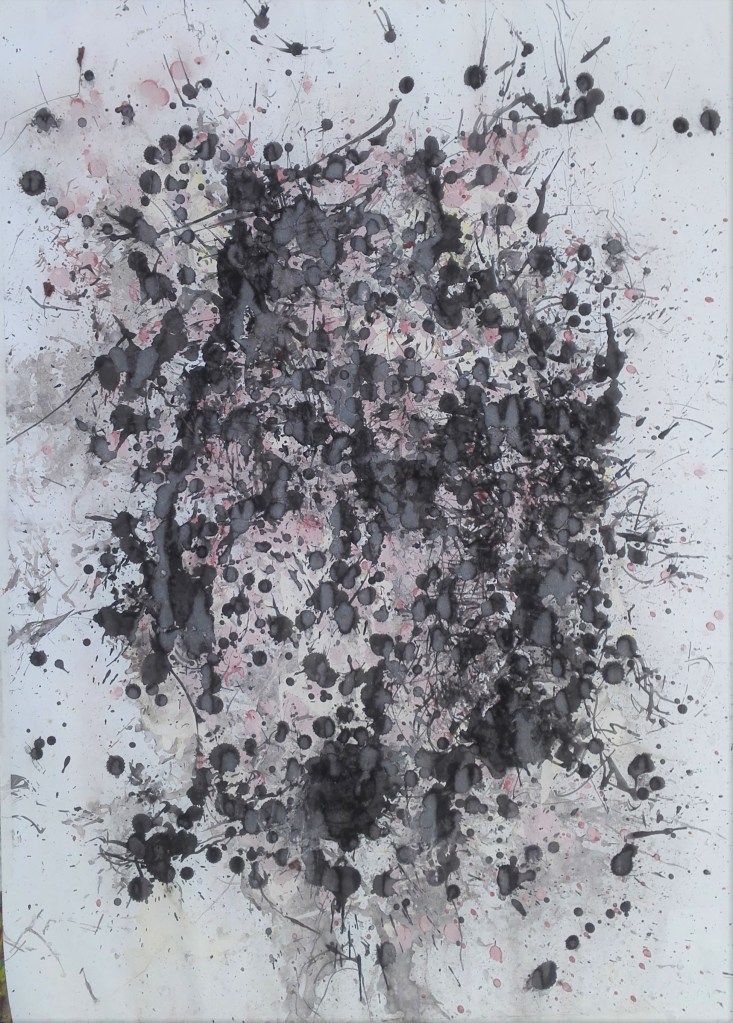
My initial reaction was one of disappointment. It appeared to me to be a washed out version of some of the other action paintings that I had created for earlier projects.
Final Painting
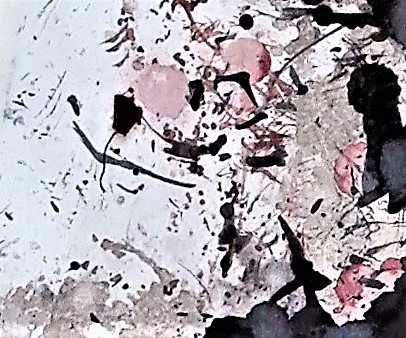
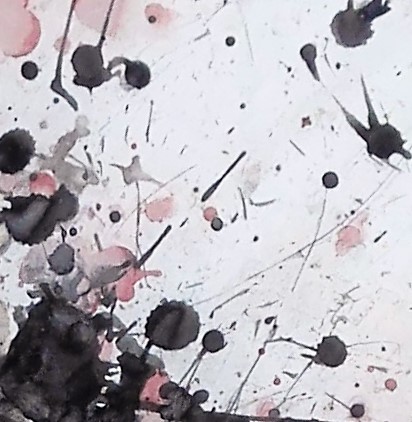
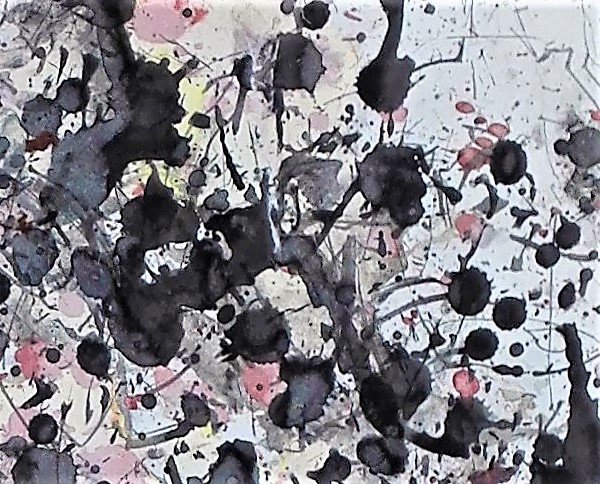
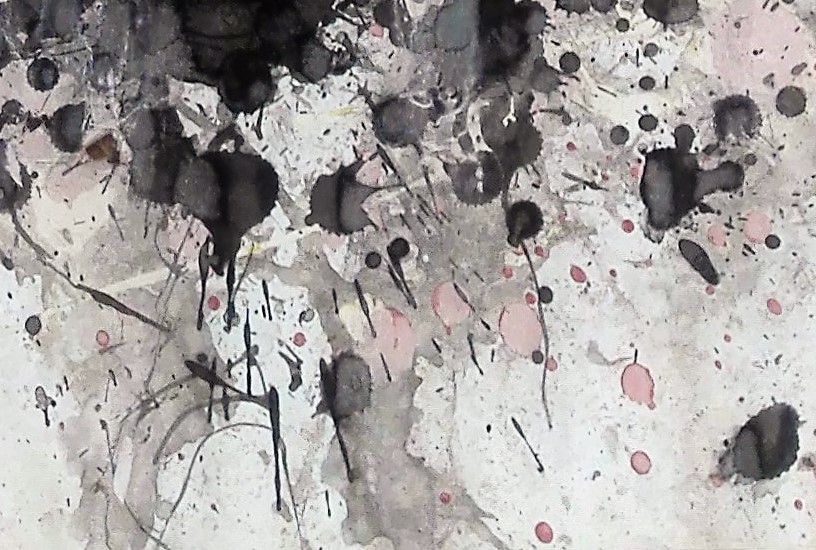
It was after closer observation that the subtleties of the work started to reveal themselves. The small marks and washed out colours were seen better in sections of the painting. Firstly I cropped and zoomed in on the painting using a photo editing tool. This process reminded me, a little, of the Sea Paintings of Jessica Warboys. As part of the process the canvases she had made were cut up, edited and reassembled to create the final piece.
Zoomed in photographs
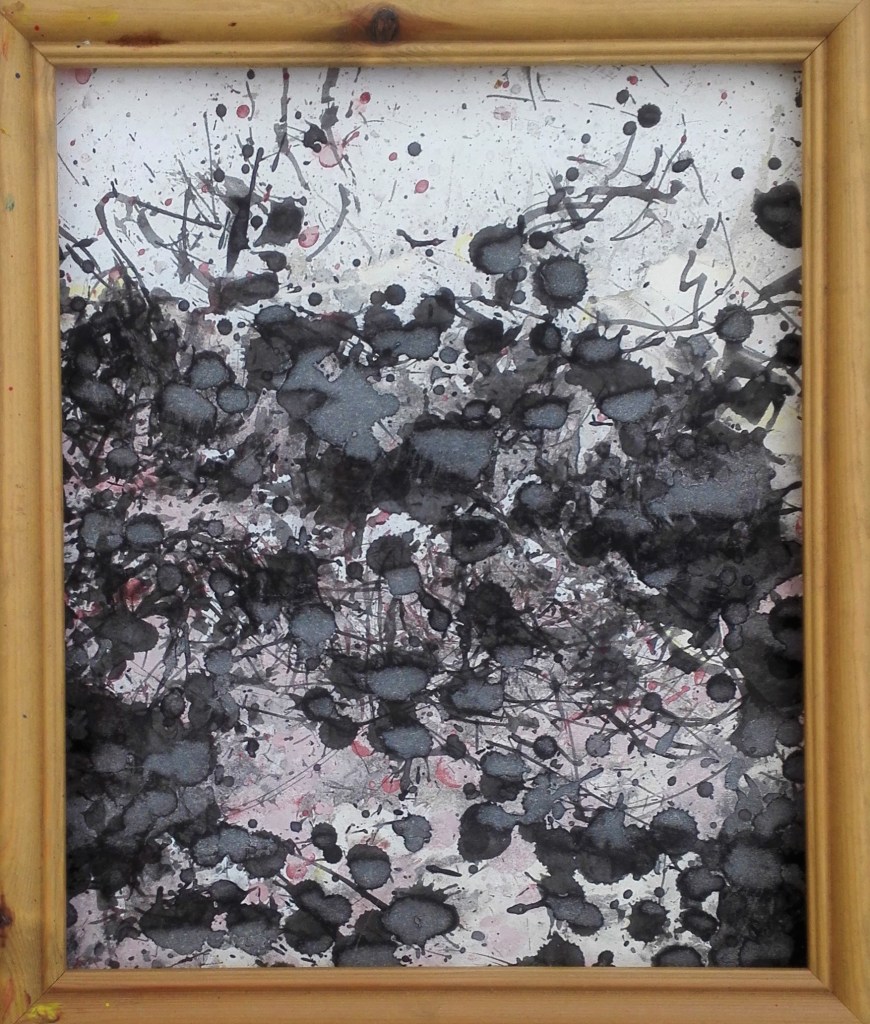
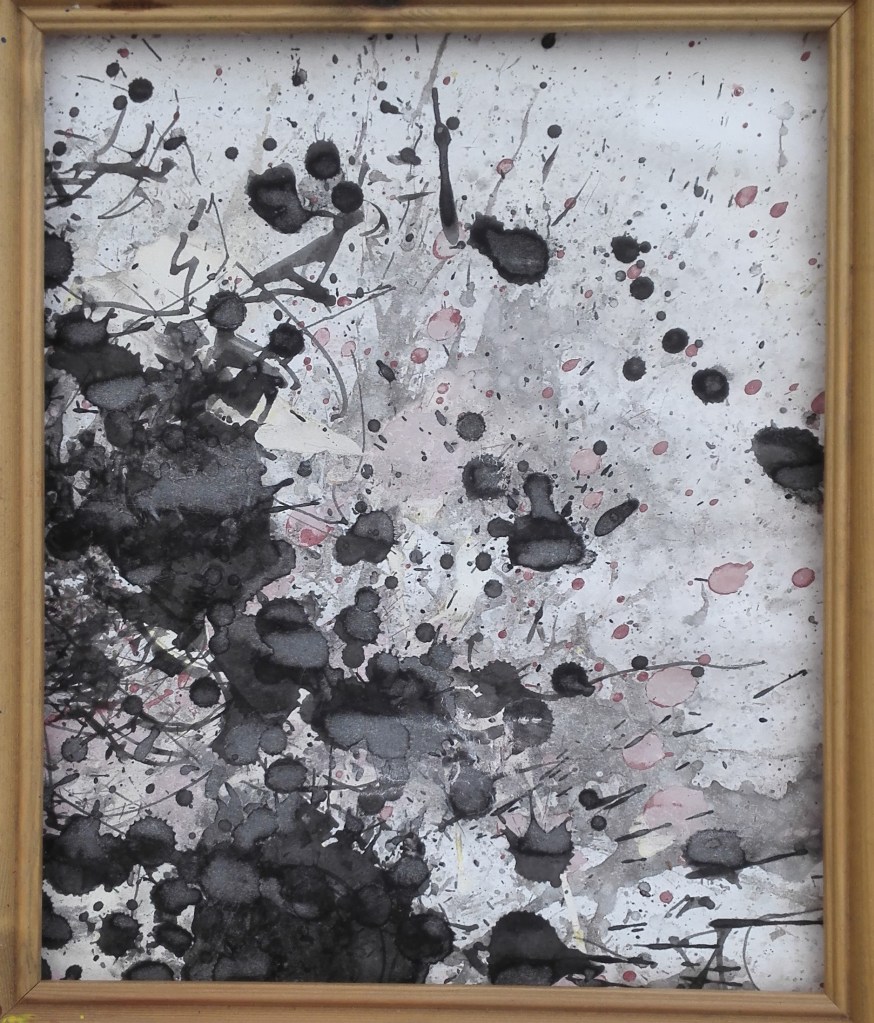
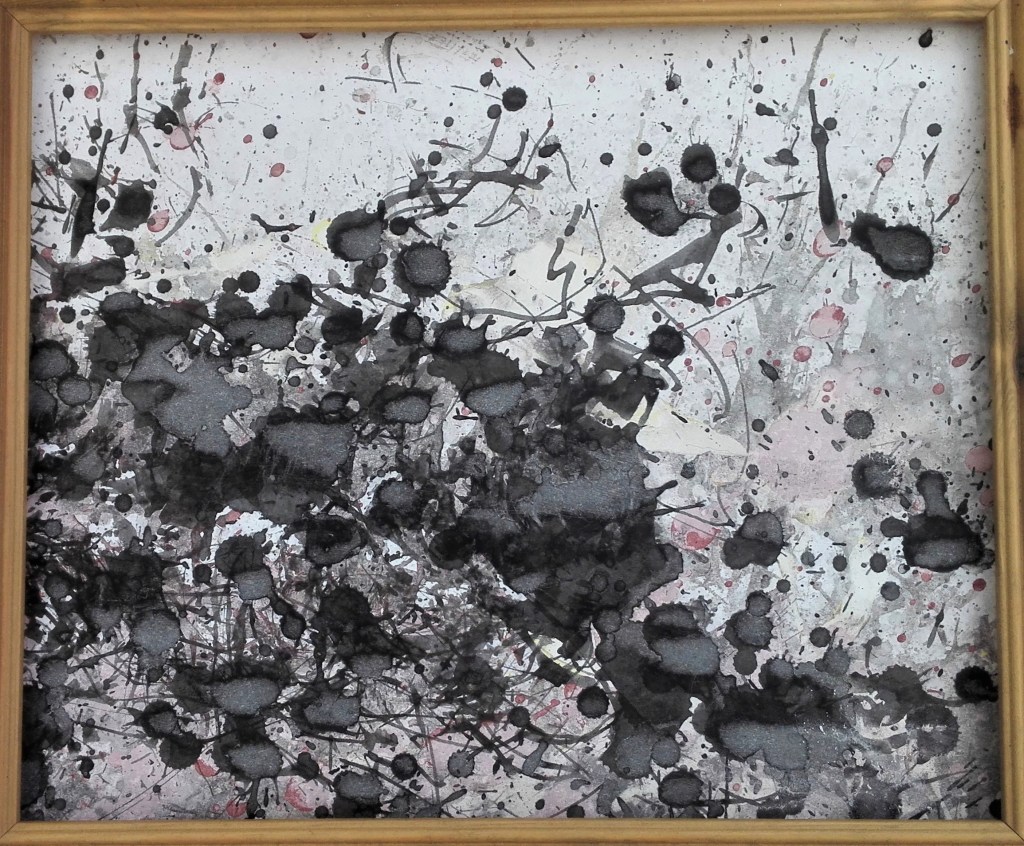
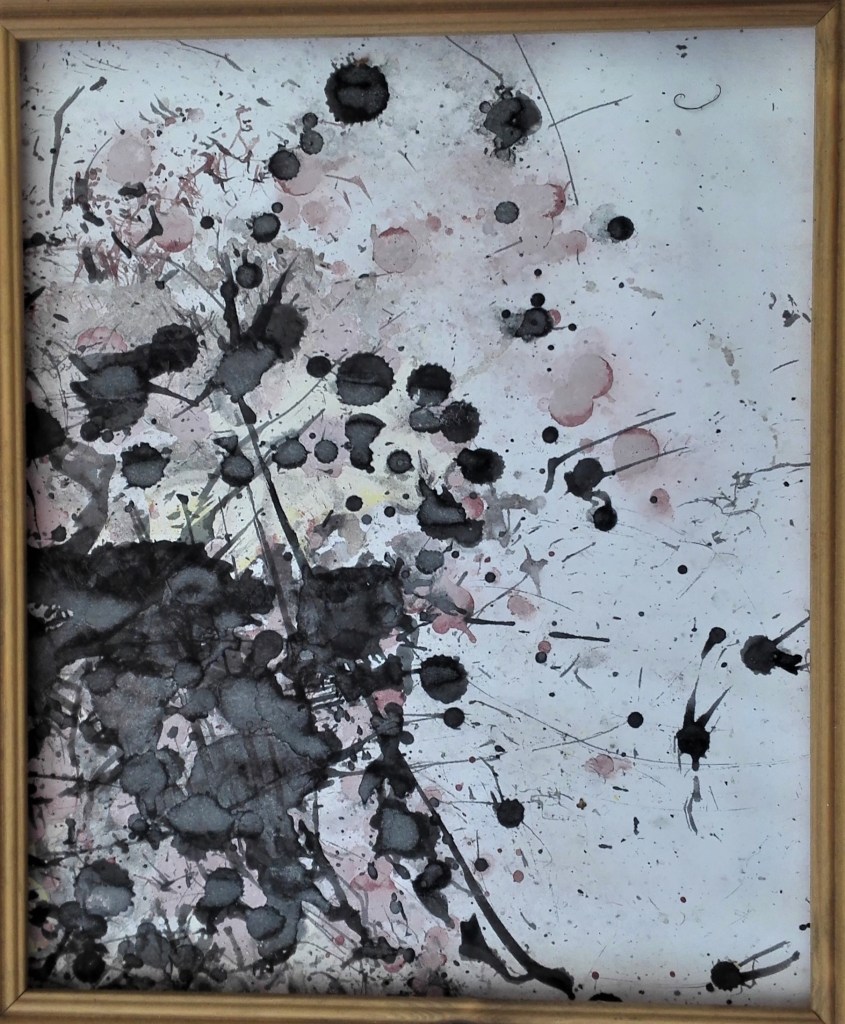
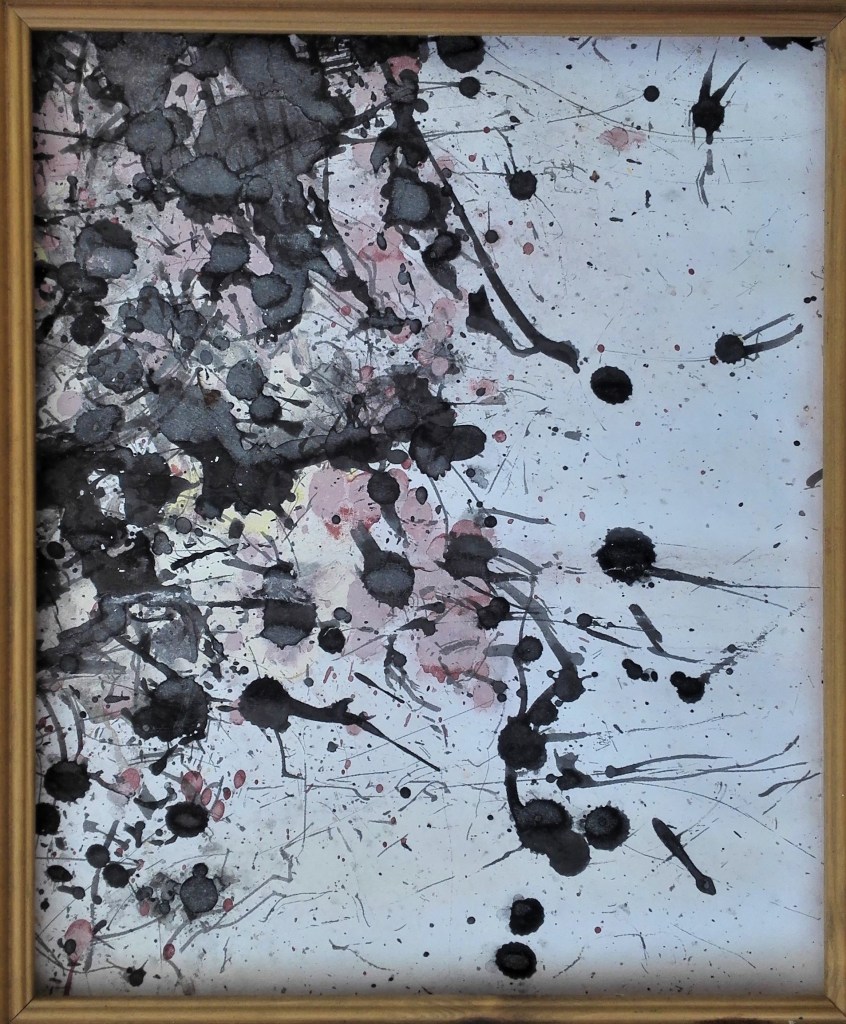
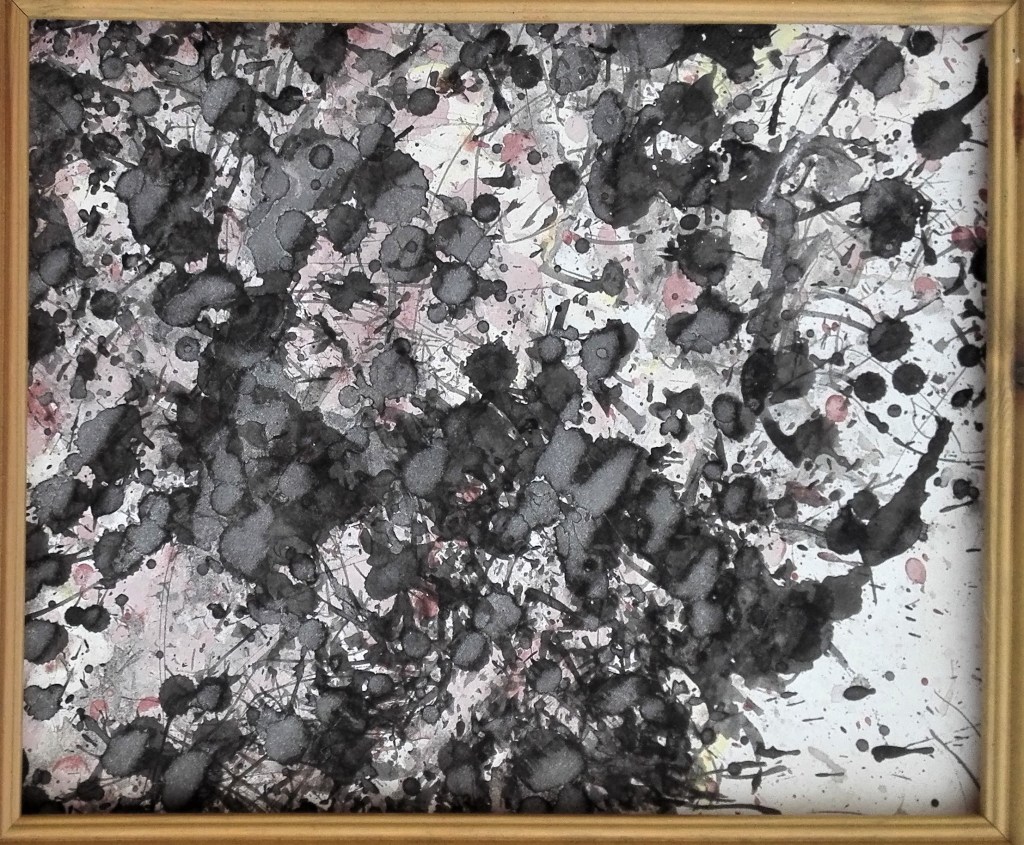
Next I used and old picture frame and moved this around the painting noting the different views that this gave me of the work. Two of these are shown below.
My final action was to decide whether I should cut up the painting and create a series of smaller paintings. At this time I have desisted from this and have kept the painting intact. The main rationale for this was to keep the work whole and for the editing not to be initiated by myself. The picture frame can be moved, by myself or others, to create different views which can then be captured by being photographed and an endless series of images created.
I tested this by asking Marian, my wife, to create three views that she liked and I also created two myself by placing the frame randomly on the painting. These five images are shown below.
Marian’s view 1
Marian’s views 2 & 3
Random views 1 & 2
These smaller images do suggest the process and the time taken. In summary the painting process has been reversed whereby the viewer creates the painting from the combined actions of the weather and its impact on the materials.

 Mark Taylor 'Studio Practice'