To assess the outcomes that I have achieved I have broken this section down into the key elements.
Materials:
The materials that I used during Part Three were those that I would expect to use, oil and acrylic paints, pencils, charcoal for the paintings and drawings. However for the creation of the stand in for the human form I used old clothes and fashioned a t-shirt from paper.
Techniques:
There were a number of different painting techniques that I utilised to create the varied styles that I utilised in responding to the exercises. These ranged from loose gestural application of paint to tightly controlled.
Observational skills:
I believe that I have demonstrated a depth of observation throughout Part Three. I have looked to complete the exercises in a variety of ways whilst at the same time looking to resolve them with a painting.
Visual awareness:
The exercises forced me to address how I looked at, around and into objects, their positions and relationship to their surroundings. In doing so I found that I expanded my knowledge and responses to visual challenges.
Design and compositional skills:
I had to utilise a number of different design and compositional skills for the exercises. The most notable example was the storybook paintings that created for exercise 1.2 ‘before and after’. In this exercise I needed to create and consistent and clear design to enable the story to unfold and be understandable.
Quality of Outcome
I feel that I have produced throughout part three has been of a consistently good quality. There are some pieces which I believe are amongst the best paintings that I have made.
Demonstration of Creativity
In trying to resolve the exercises with painted solutions I have needed to look beyond the obvious solutions.
Context
My learning log details a lot of my thoughts and reflections on both the work that I have completed and my thought processes. I would have liked to have complimented some of the exercises with visits to exhibitions but this has not been possible during lockdown. In response to this I have utilised on line resources. These do not compensate for the experience of confronting art in the flesh. I have set up a regular, not quite daily, routine of exploring a new, to me, artist. For each one I have written a short blog about their work and my reaction to it.
Summary
Overall I have enjoyed Part Three and can look back on the work that I have undertaken and the resulting paintings with satisfaction.
I had been warned that Part Three could be a challenge as it would take me into areas of art which I would not normally venture. However it was also mentioned that I should look to embrace these challenges whilst also looking at ways to respond to them via painting. It is painting that is my primary artistic drive. I feel that in the work that I have completed during Part Three I have managed to marry both the objective of exploring the tasks in an open way and found ways to articulate these tasks with painting. In doing so I have created a body of work in which I have explored a number of different styles which have also encompassed a variety of techniques. This has ranged from near cartoon like, illustrative painting through to more standard pictorial painting, expressionist work and also abstract works. In completing these I have worked in both the studio and outside, ‘en plein air’. I feel comfortable moving amongst these different styles but I do have some minor concerns that my own personal style has not emerged.
Whilst working through the exercises, responding to the research topics and taking time out to work on some personal projects, I have also been cognisant of the need to be considering both the Parallel project and the Critical review. In both of these areas I have made progress in bringing my thoughts and ideas together. I have yet to create any work in respect of either beyond making notes and starting to make a resource archive of photographs. I will be discussing my ideas with my tutor as part of the Formative feedback review for Part Three. At this stage I have plenty of time to fully realise both of these challenges.
Of the exercises it was Exercise 1.4 ‘ The mirror as a stage’ which I was best able to respond to. This wasn’t a surprise to me as the topic of reflections is an area that I have explored before. It also aligns closely with my Fenland landscape paintings where water acts as both a reflective surface and a mirror. Unsurprisingly, to me, I created six paintings exploring aspects of this topic and I also went on to to complete a further work for my Assignment Three piece.
In summary despite the challenges thrown up during this stage I have enjoyed confronting them. They have forced me to look at my practice and style of painting which has in turn moved in a number of complimentary directions. I look forward embarking on Part Four.
I will start this written piece by posting the finished painting and then I will go through my thoughts and reflections on its creation and outcome.
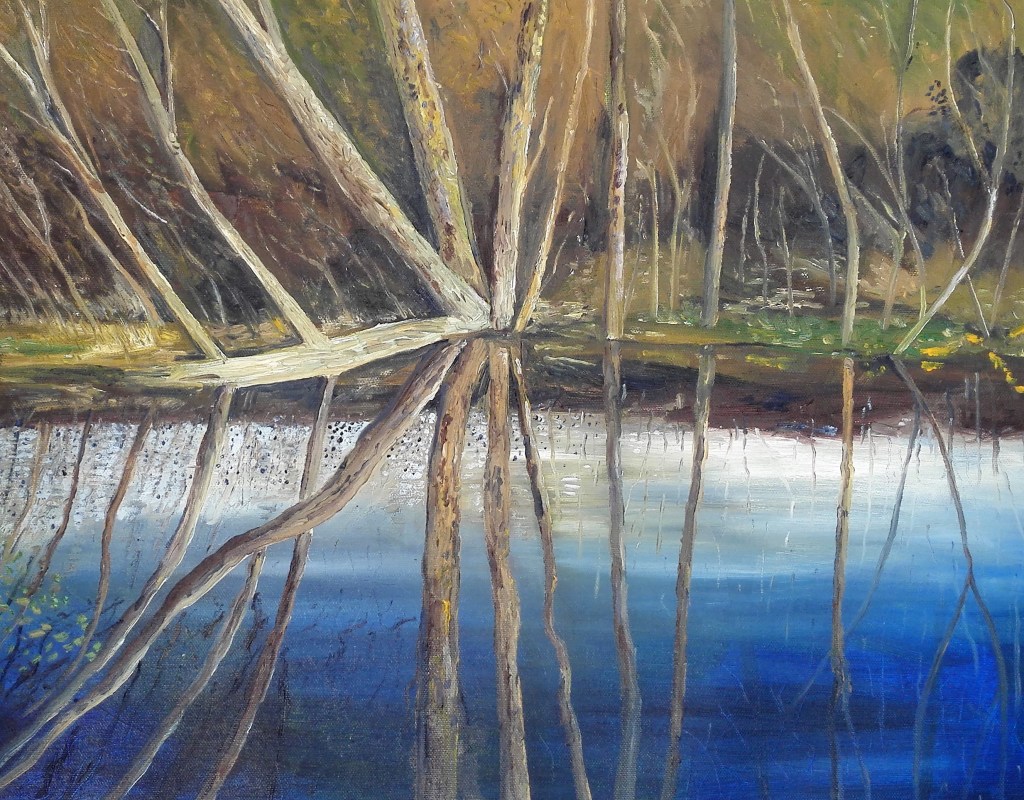
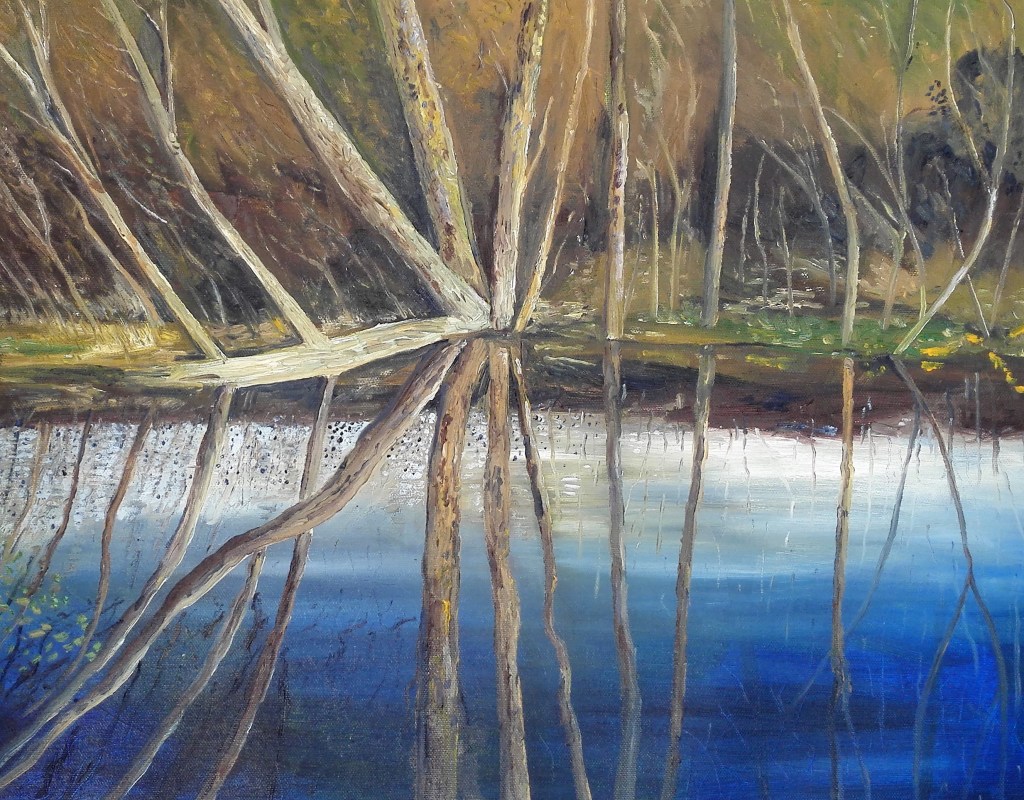
Hidden Away, Oil on canvas paper, 40.6 x 50.8
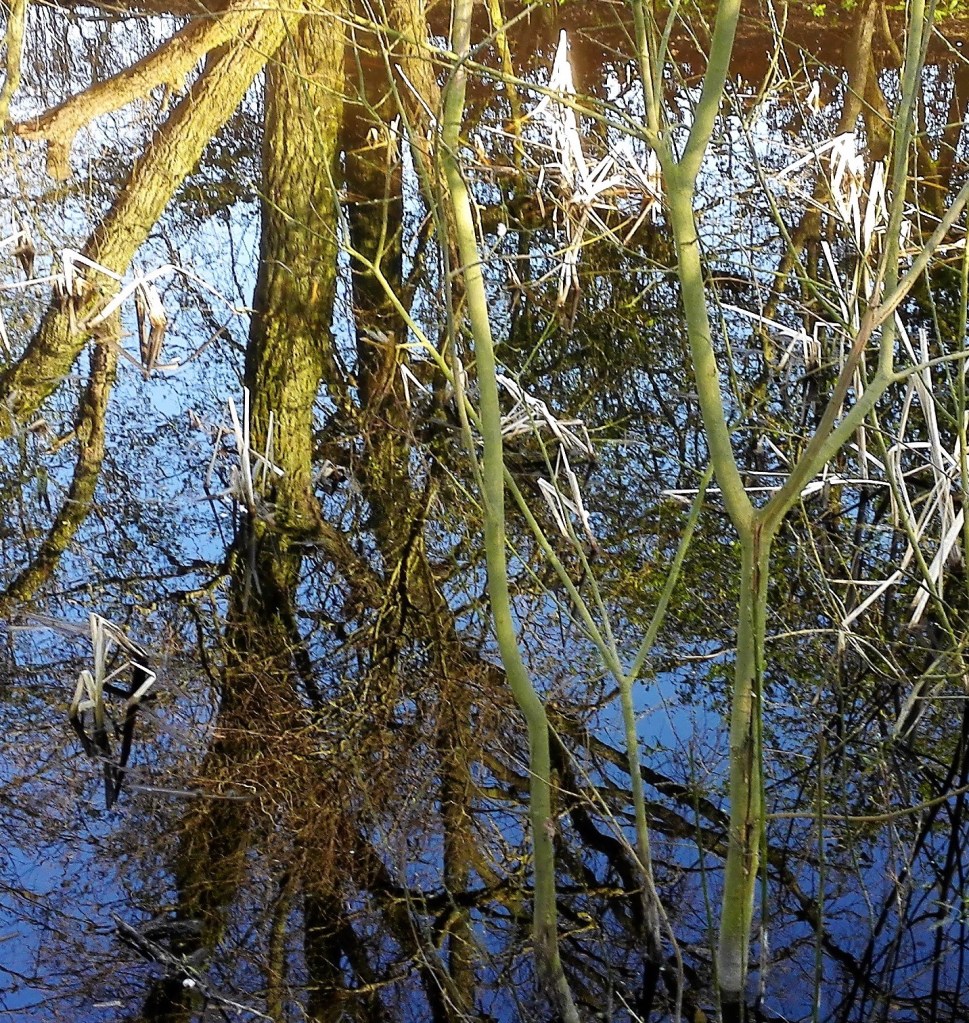
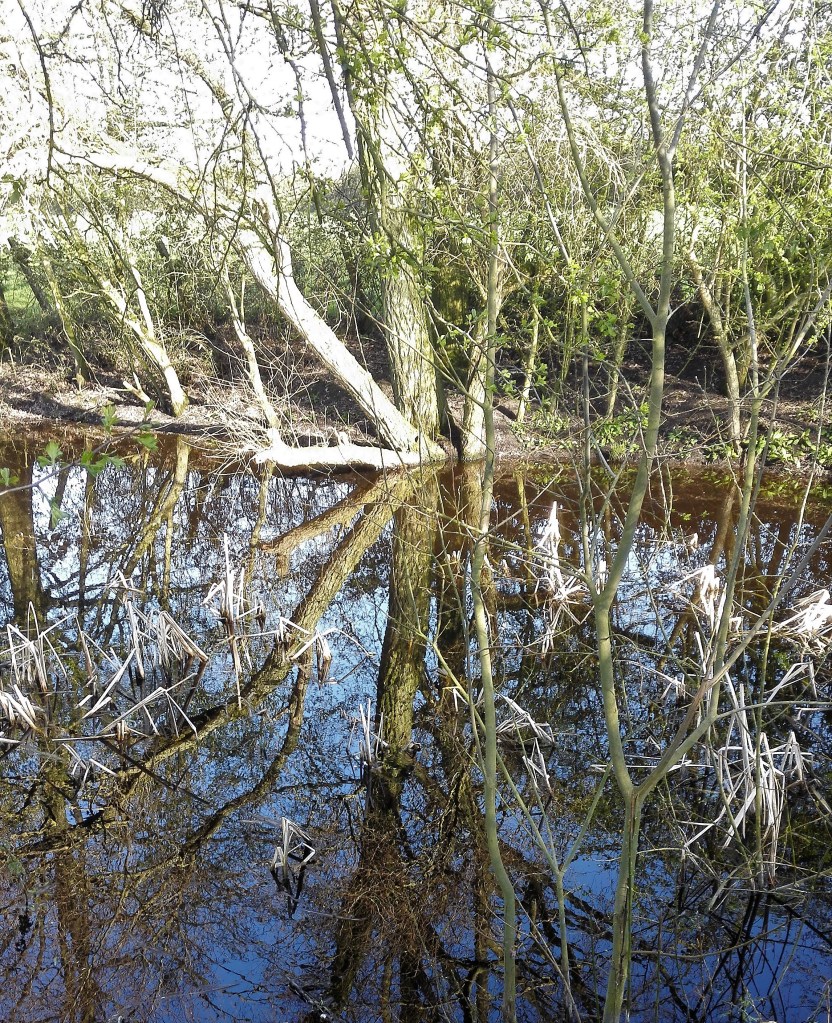
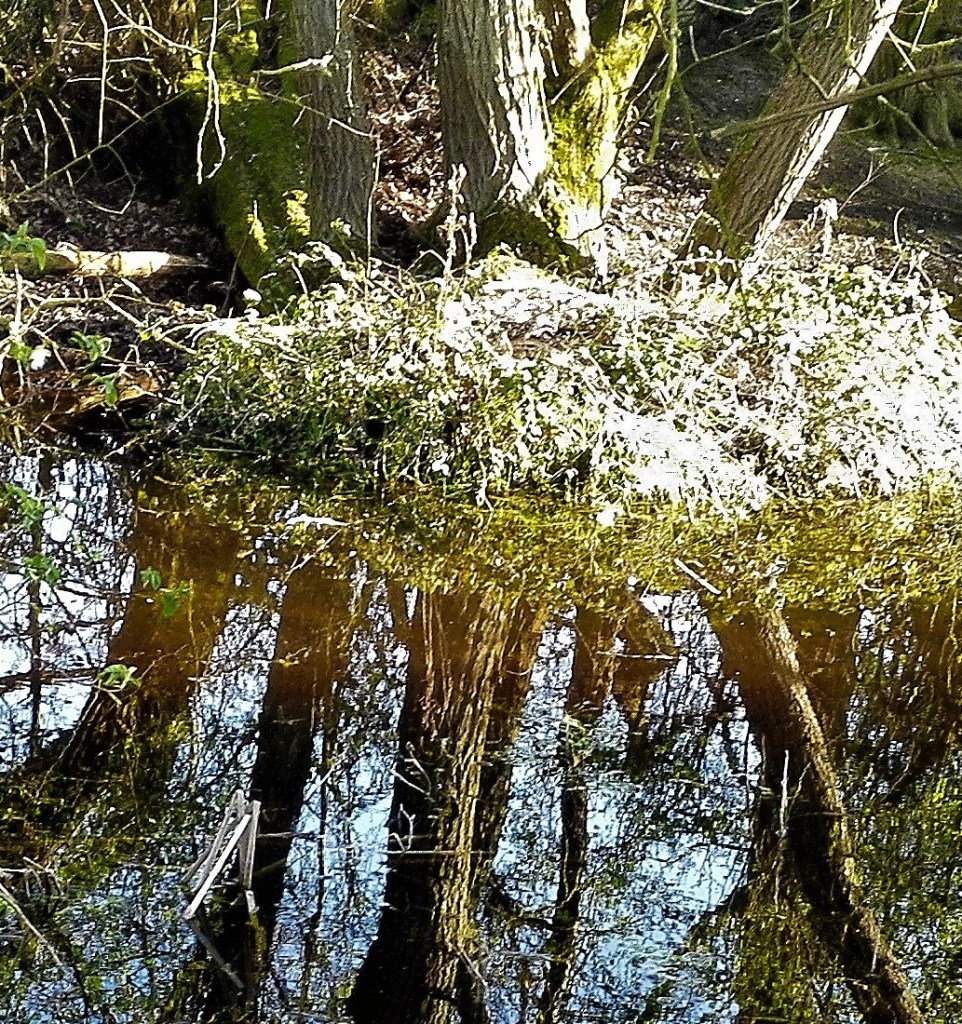
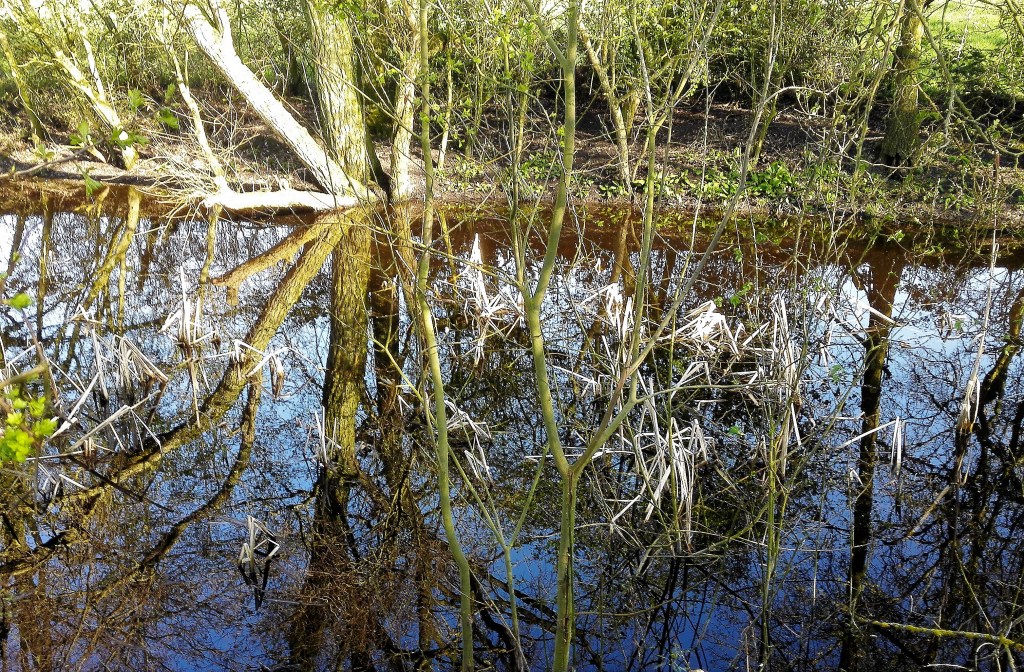
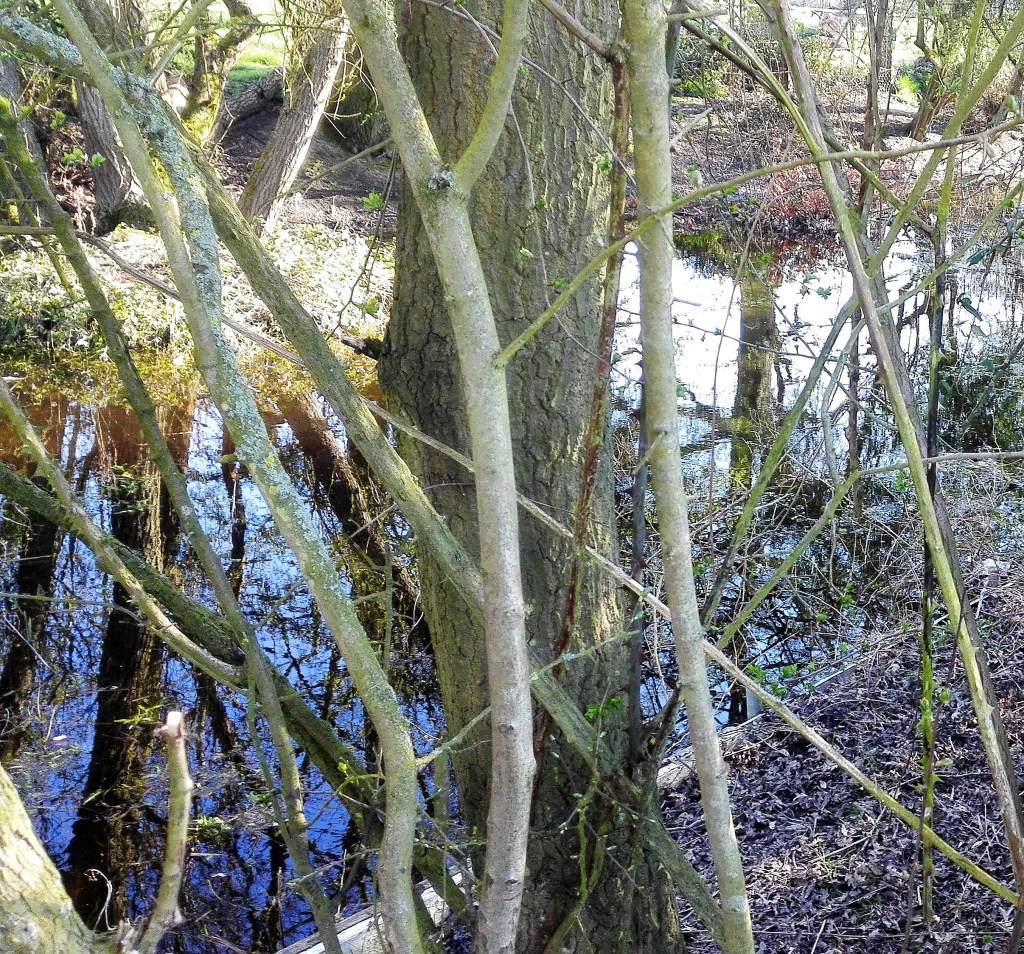
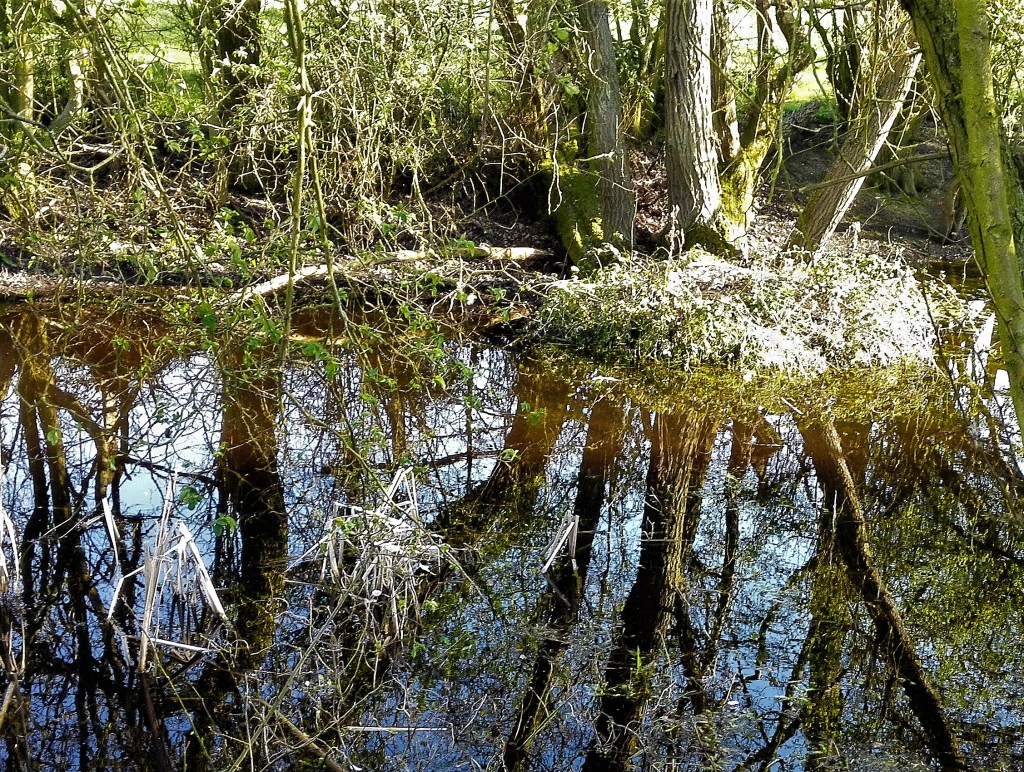
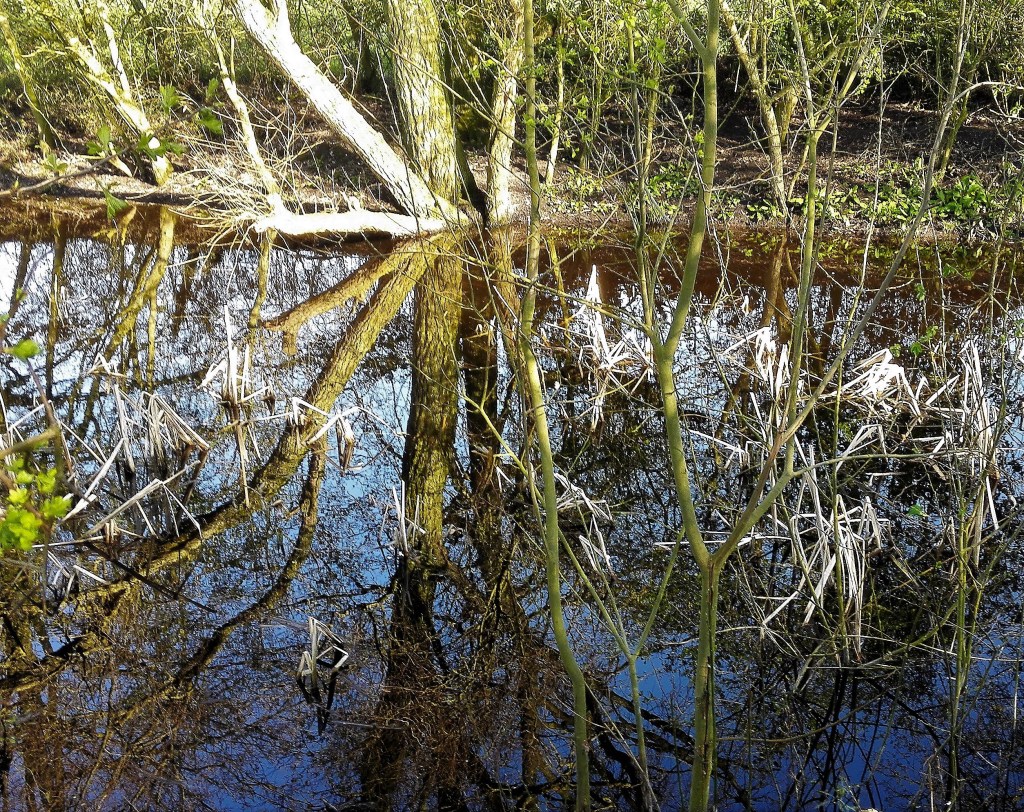
This painting is very much a follow on from Exercise 1.3 ‘The mirror as a stage’. The subject of reflections has been a line of investigation for me for some time. I have made a series of paintings, going back to the start of my previous OCA course ‘ Concepts in Practice’ which explore the reflective qualities of water, particularly in the landscape. My investigations have explored both the mirror aspect of bodies of water and the act of looking into water. It’s ability to be looked through and to reflect back at one and the same time. For this particular painting I wanted to make use of a small series of photographs I took earlier in the year. They focus on part of a Fenland drain that is usually hidden from view. The photographs were taken in early spring before the foliage obscures the view. The water at this part of the drain also dries up and the reflective qualities disappear.
Photographs
There is considerable information in the photographs which I would need to edit in order to try to convey the subject in a clear way. This started by making an edit of one of the photographs which would then become the template for the composition.
Edit for painting
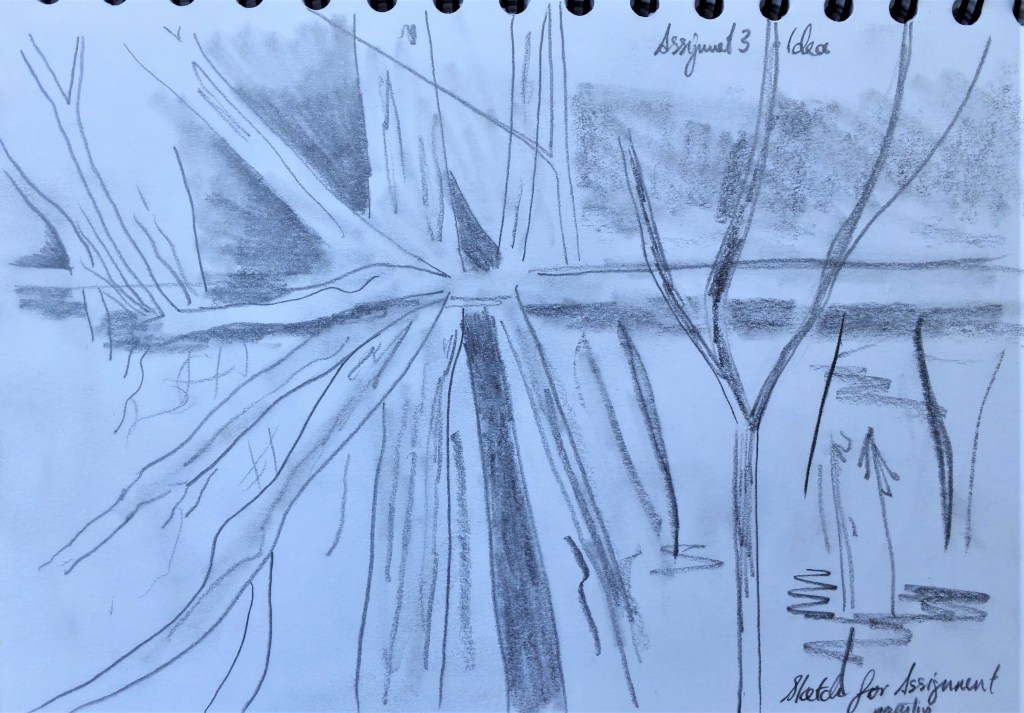
A quick sketch was made before I embarked upon the painting.
Quick sketch
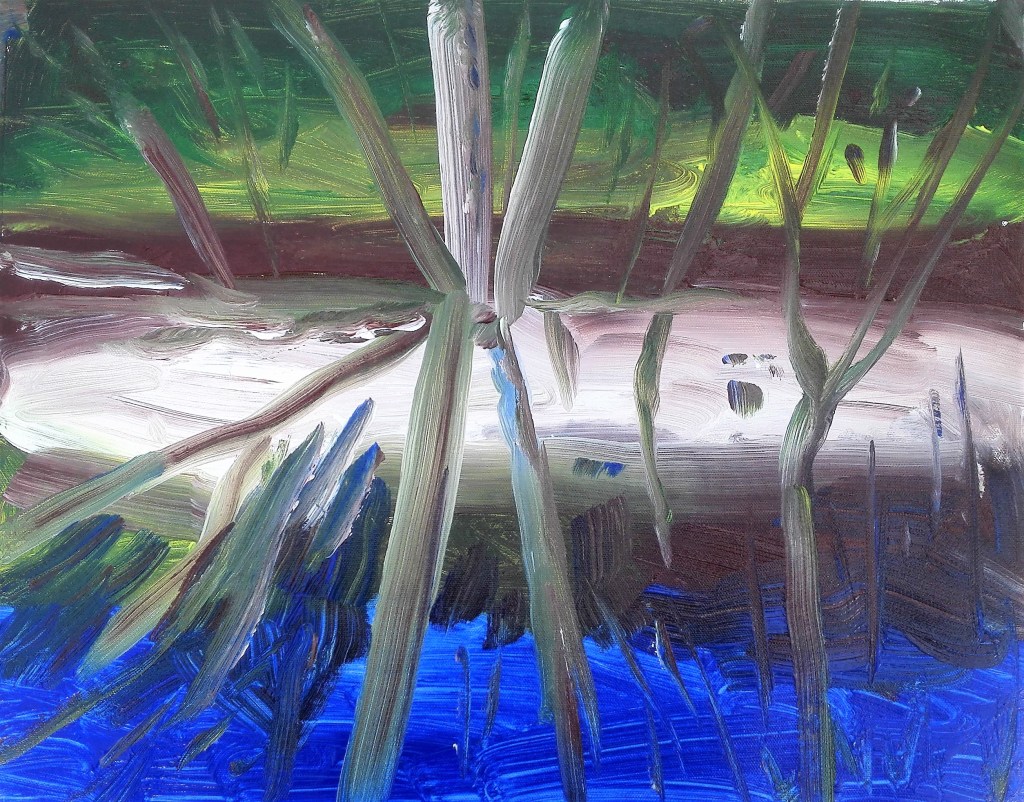
At this stage I was stuck in two minds as to how to approach the painting. I had a number of different outcomes in mind ranging from a painting that was more abstract in nature to a more pictorial one. It was during the initial laying down of acrylic paint for the underpainting that I stopped when I realised that I had a loose painting that encapsulated much of what I had envisaged as a potential abstraction. This became a work in itself.
Hidden Away, Abstraction, Acrylic on canvas paper, 40.6 x 50.8
What I enjoy about this painting is the way in which the light, yellow and green, on both the banks behind the trees and the white reflected on the water contrast with the dark shadows. The trees themselves are crudely suggested by vigorous lines dragged through the background paint with a loaded brush but appear believable.
I started again, this time I would not stop at the underpainting, it wasn’t as good. It had many of the qualities of the first painting but lacked something.
The second, completed painting which I used to open this blog, is a more focussed painting. It is also more pictorial in intent and outcome whilst taking some liberty with the colour palette which makes it less naturalistic. The temptation to overwork it and potentially lose some of its vitality was strong.
Whilst being content with the outcome I feel that I still have more to do before I feel satisfied within myself with this style of work. There are elements of my practice that I am trying to resolve. This will take time and practice and will evolve.
Hidden Away, Oil on canvas paper, 40.6 x 50.8
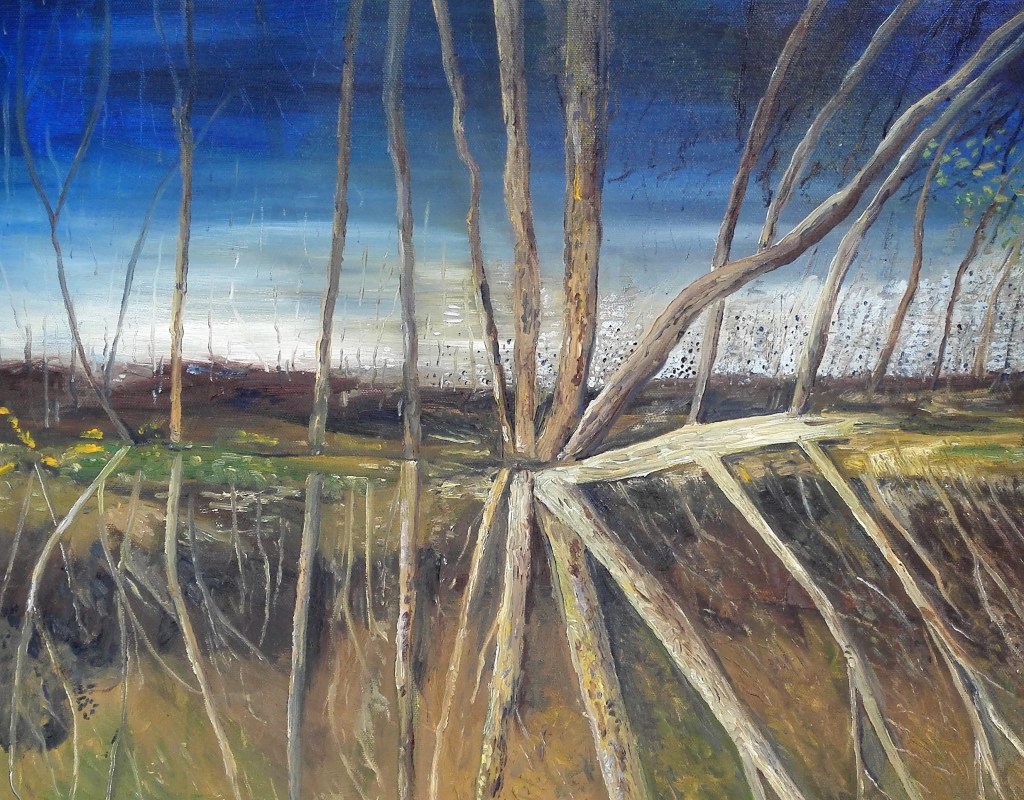
I have discovered a dilemma with this painting in that whilst editing the photograph, rotating the image, it struck me that the painting also looks good upside down. In fact it takes on different qualities. It has more depth as the what is the water now becomes a receding landscape. I am not entirely convinced. I will live with it hung this way for a few days and make a final decision.
Hidden away – upside down
This has become my preferred way of displaying this painting. The positive feedback that I received was that it had the appearance of exposed roots at waters edge. The reflected light in the water becomes a receding skyline. There is a sense of desolation a barren landscape beyond the trees. A foreboding gloom in the sky as day moves into night.
As part of the feedback from Assignment Two and the work completed for Part Two I received a list of suggested artists to view and research. These suggestions were based on the the conversation and ideas that had been discussed during the feedback session. Although this is quite a long blog I have deliberately kept the text brief.
The following are my notes and thoughts:
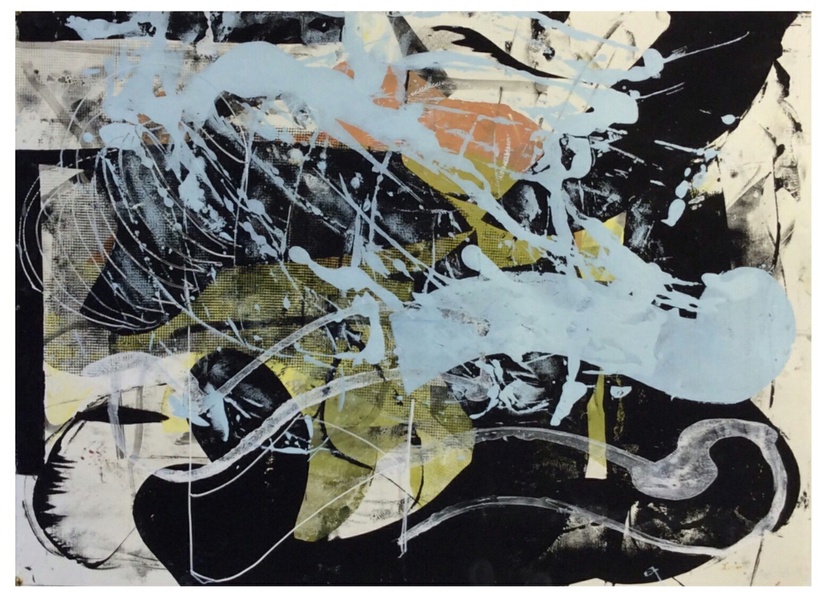
Vincent Hawkins, 1959 – , painter / draftsman working in acrylic on canvas, cardboard and paper. Influences cited as Picasso, Paul Nash and his work has been compared to that of Matisse and Klee. The expressive nature of his abstract paintings contain an energy that remind me of Jackson Pollock’s floor paintings. The palette is similar but there is more structure to the composition.
Vincent Hawkins, Untitled IV, 2016, Water based woodblock medium on paper, 55x75cm
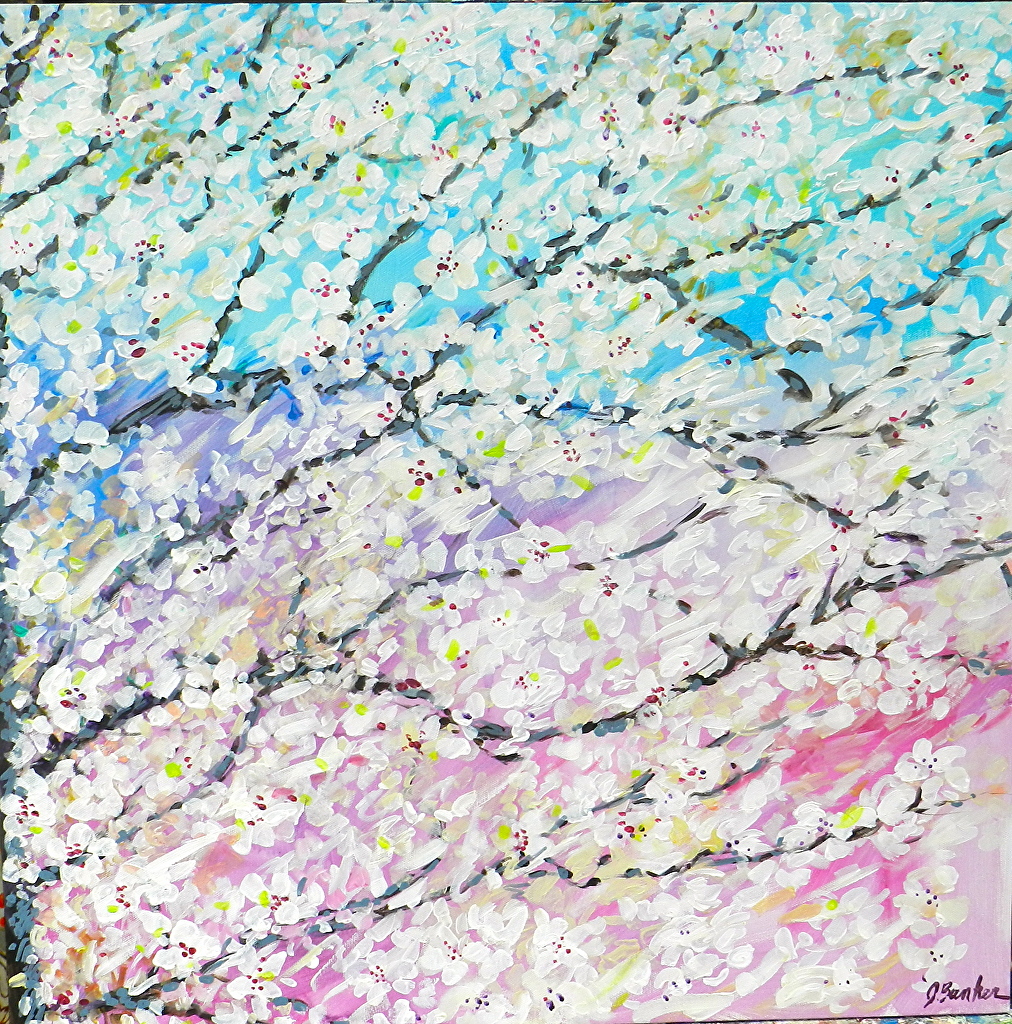
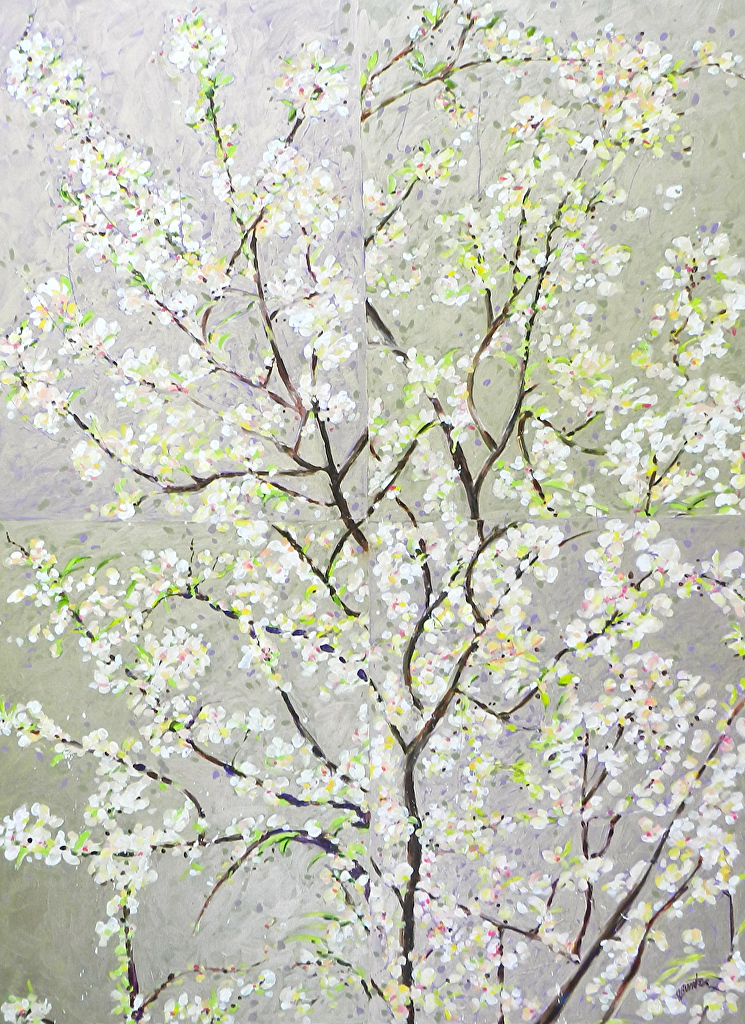
John Bunker – colourful flower inspired collages, paintings with blossom. I enjoyed the blossomed tree paintings but hose with human nymph like images I found a bit twee.
John Bunker, Cherry Blossoms B, Acrylic, 24x24inches
John Bunker, Quadrant branch blossom memory, acrylic on canvas, 48x36inches
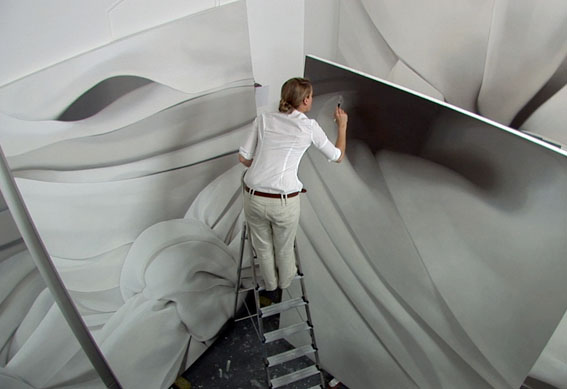
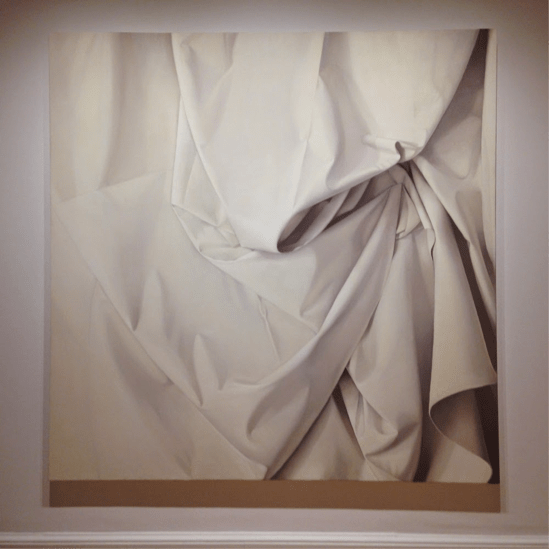
Alison Watt, paintings of white fabric, very large paintings where the tonal quality and subtle adjustments seems to envelope the observer and comfort them.
Alison Watt at work
Alison Watt, Fabric study
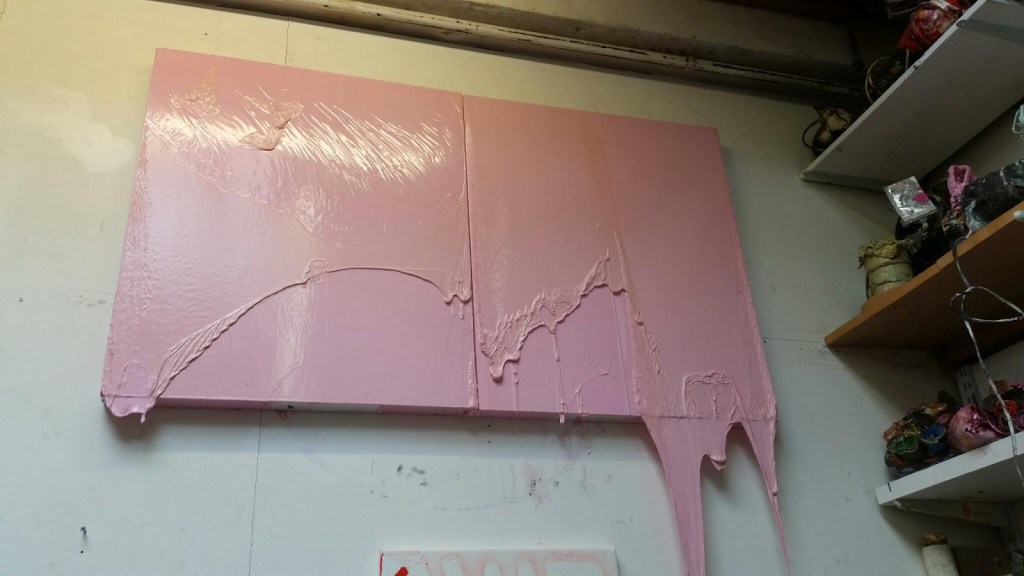
Alexis Harding, layered paintings that have a skin to them, lumpy large canvases where often the paint seeps beyond the limitations of the canvas or support.
Alexis Harding, Untitled
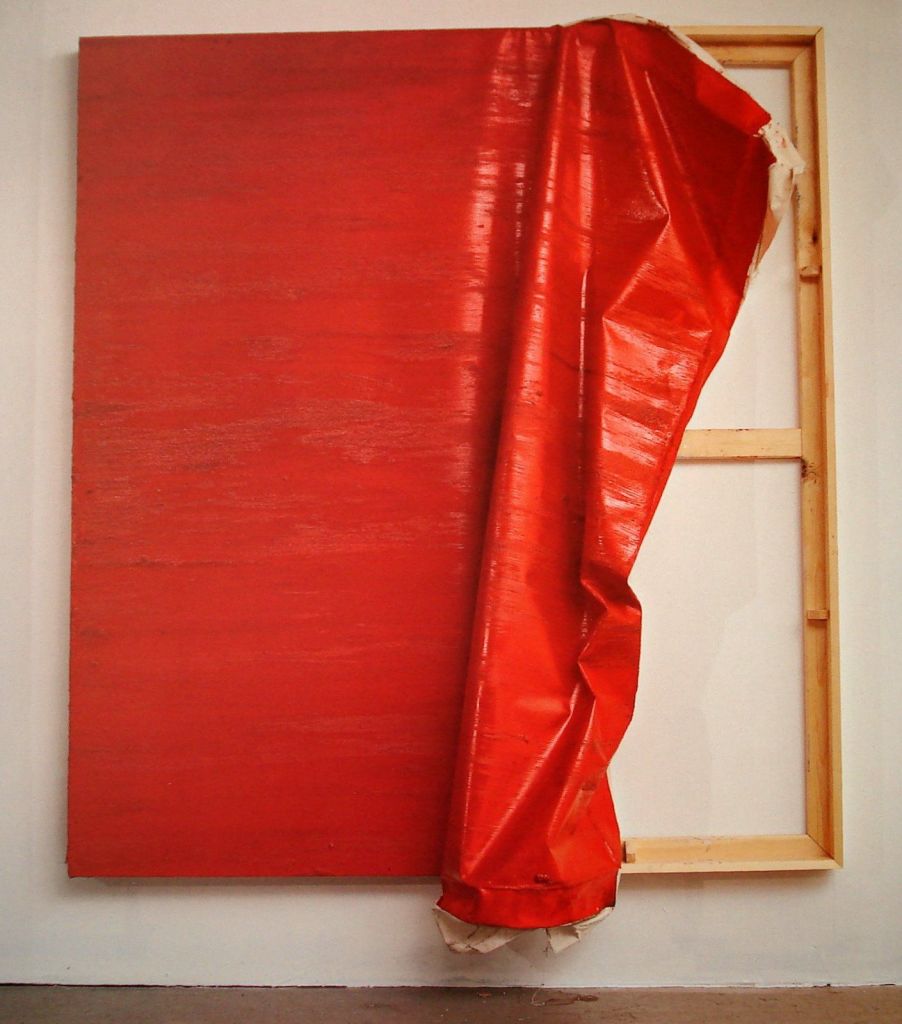
Angela De La Cruz, her paintings seems to exist in a place that is somewhere between painting and sculpture. There is an exploration of the nature of paint itself in her work.
Angela De La Cruz, Ready to wear (Red)
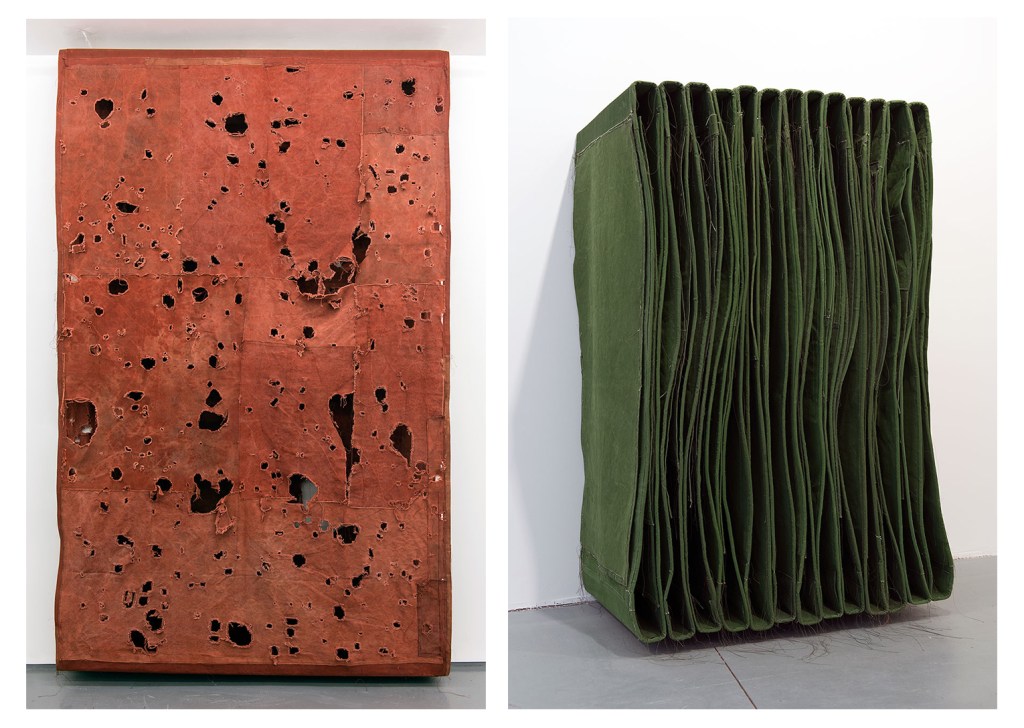
Simon Callery, his work is somewhere between painting, combines and sculpture. The works have a sculptural quality to them. I find these works difficult to read.
Simon Callery, Another Something
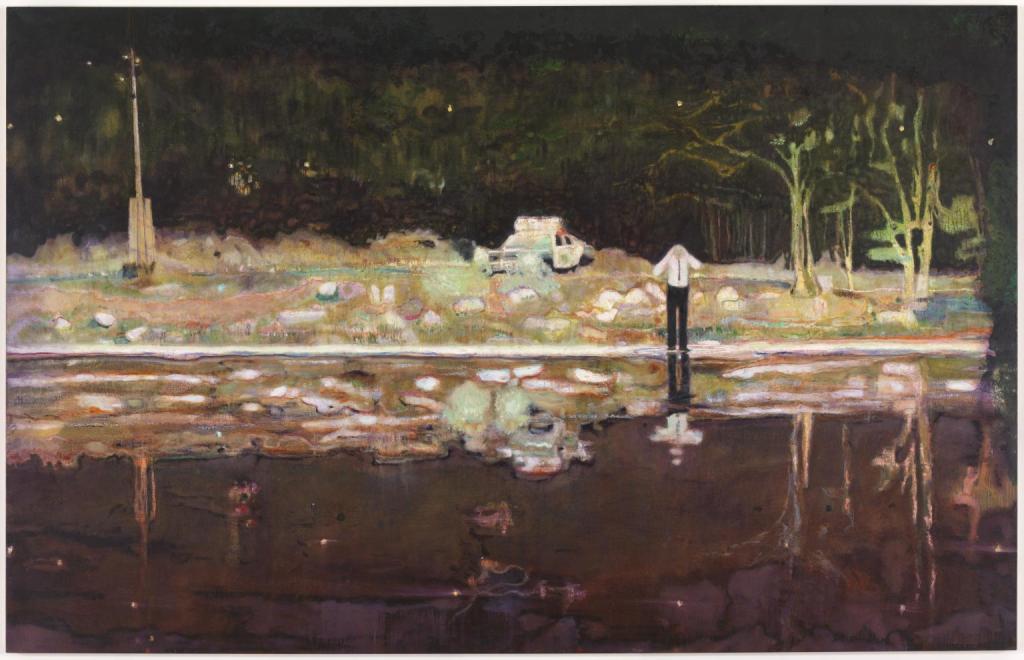
Peter Doig, 1959 – , I had looked at Peter Doig’s work previously. This time as suggested I concentrated on his landscape paintings. Those that I found resonated with me were those that had a European, perhaps Scottish, feel to them. I was less captivated by the Caribbean influenced paintings. I will consider whether to base my critical review on Peter Doig’s landscape paintings. The other artist suggested to me is George Shaw whose work I feel is perhaps closer to my own. Returning to Peter Doig one of the key aspects of his landscape paintings is the inclusion of a human element. An example of this is his painting ‘Echo Lake’. This painting, see below, has a narrative to it. The lakeside setting appears to be on the outskirts of a town. The lights from the town can be seen behind the dark trees. The scene is lit by the headlights of the police car and the reflective quality of the water. This highlight the tress to the right of the painting. These trees fade into the night sky. There is a symmetry to the composition, the telegraph pole on the left, the trees on the right, the police car just offset from the centre of the painting. The white shore line about a third of the way up and the reflections in the lake all work together to give the painting a cohesiveness. The storytelling narrative comes from the policeman, presumably, who is calling, shouting out to the observer across the lake. What is he shouting? Is he shouting at us? What is happening in / on the lake? These questions remain unanswered but give the painting a drama.
Peter Doig, Echo Lake, 1998, Oil on canvas, 230x360cm
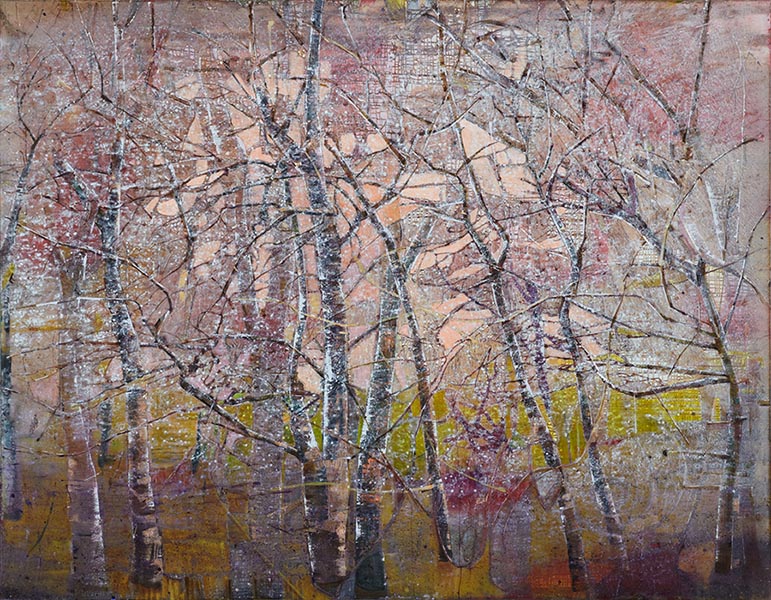
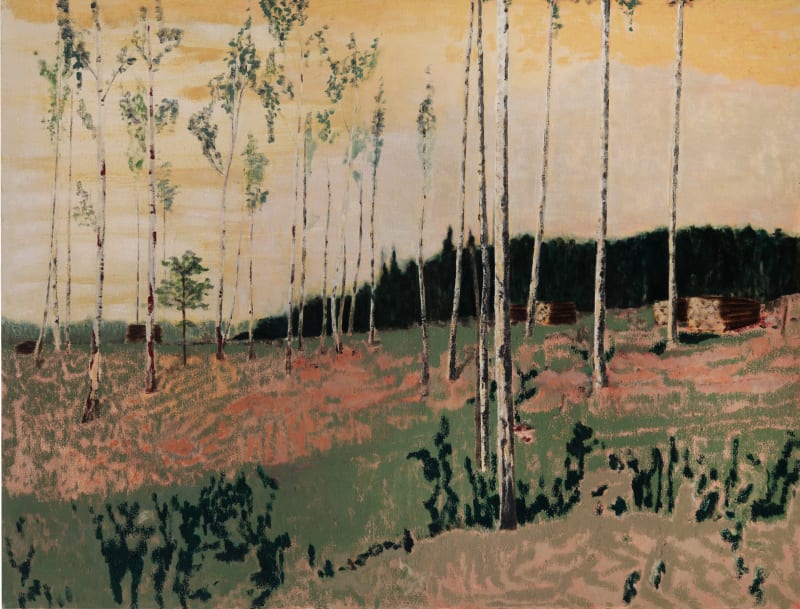
Elizabeth Magill, 1959 -, I have downloaded a number of Elizabeth’s paintings as these really resonate with me. The capturing of the delicacy of trees and the timid light that surrounds them is something that I have tried to capture in my work. Two examples are reproduced below.
ElizabethMagill, Betula Pendula, & Dendriform 10, both oil on canvas, 168x198cm & 214×277 respectively
Hurvin Anderson 1965 – , depictions of Caribbean landscapes often verging on abstraction. Student of Peter Doig.
Hurvin Anderson, Bridge Study, 2013
Hurvin Anderson, Cloning, 2016
Mamma Andersson 1962 – , influenced by the Swedish landscape which she grew up in her paintings are inspired by filmic imagery, theatre sets and period interiors. Her landscapes are melancholic and dreamlike.
Mamma Andersson, Cuckoo Hill, 2019, Oil on linen, 90x118cm
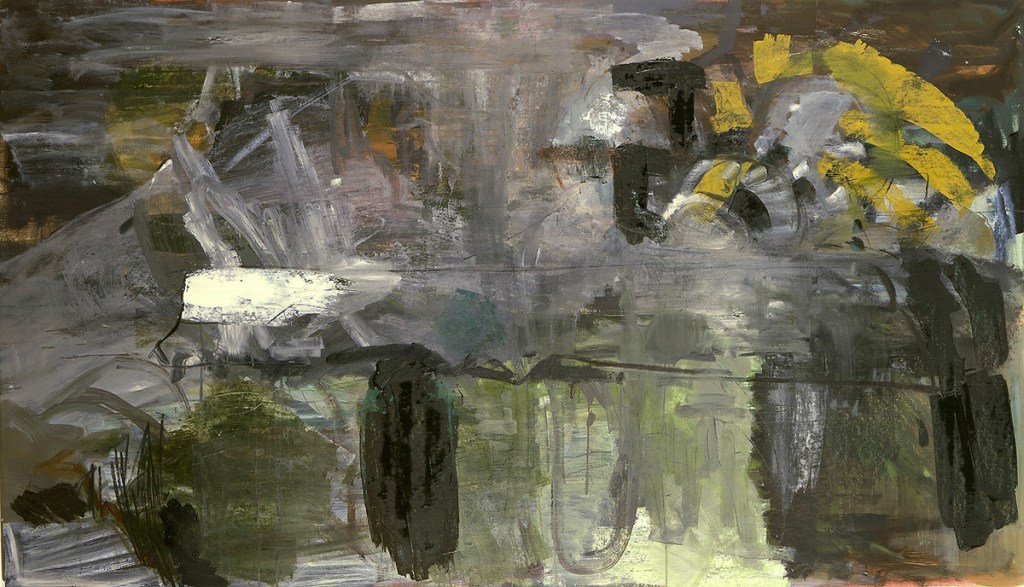
Per Kirkeby 1938 – 2018, Danish, part of Danish experimental art school “eks-skolen” working primarily as a painter, sculptor, writer and lithographic artist. His works was informed by geology and nature. The two examples below are abstracted paintings which explore the colours and solidity of harsh landscapes.
Per Kirkeby, Fram, 1982, oil on canvas, 118x200cm
Per Kirkeby, Rublick III, 1987, oil on canvas, 200x200cm
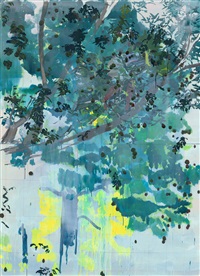
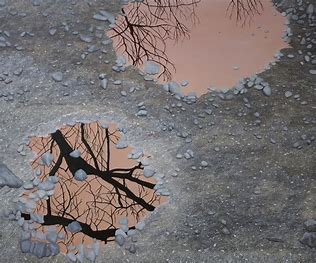
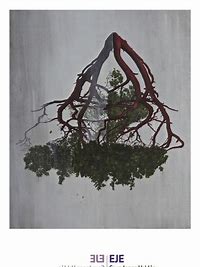
Calvadonga Valdes , Spanish artist using the landscapes of Spain, England, Italy and Swedish Lapland to create surreal paintings, often group of paintings on a theme. Two examples are a series called “Homeland” where the reflection of trees are observed in small pools of water and puddles. The second series “Vascular” uses the heart and vascular system as a vehicle to organise the paintings. Examples of both of these series are replicated below.
Covadonga Valdes, Homeland II, paintings from Homeland series
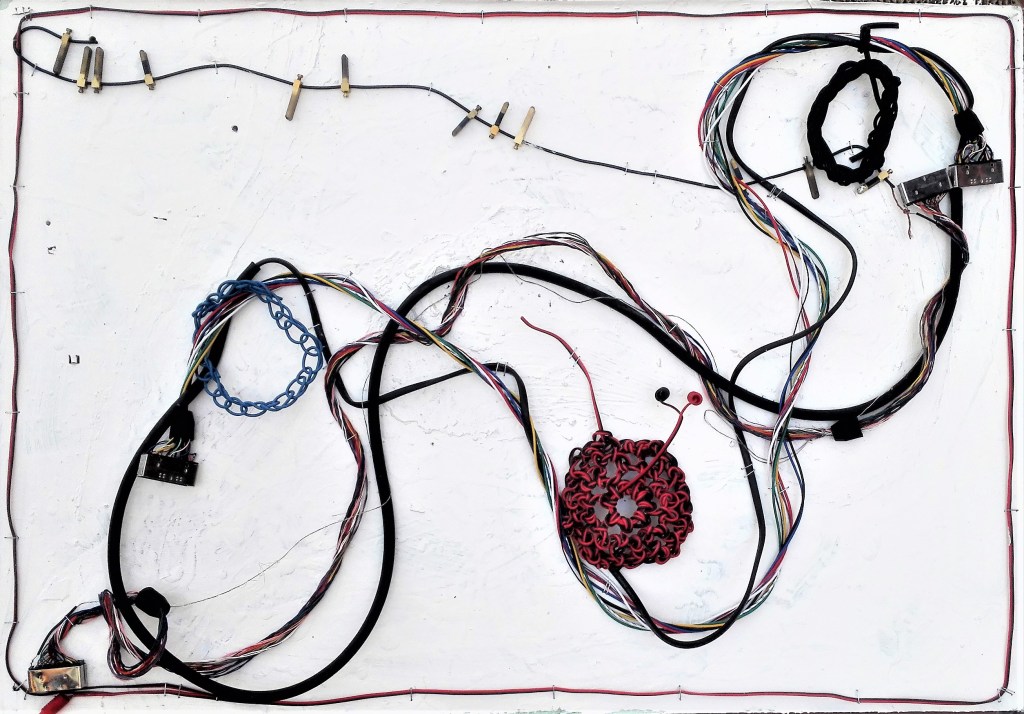
Below is a short video of my Assignment Two piece which I hope shows the work in slightly more detail. As mentioned in the commentary it was remarked in my feedback meeting that the piece has the look of a drawing. I will make some paintings that explore the gestural lines in the work. I will add these to the post when they are completed.
Totally Wired– The Video
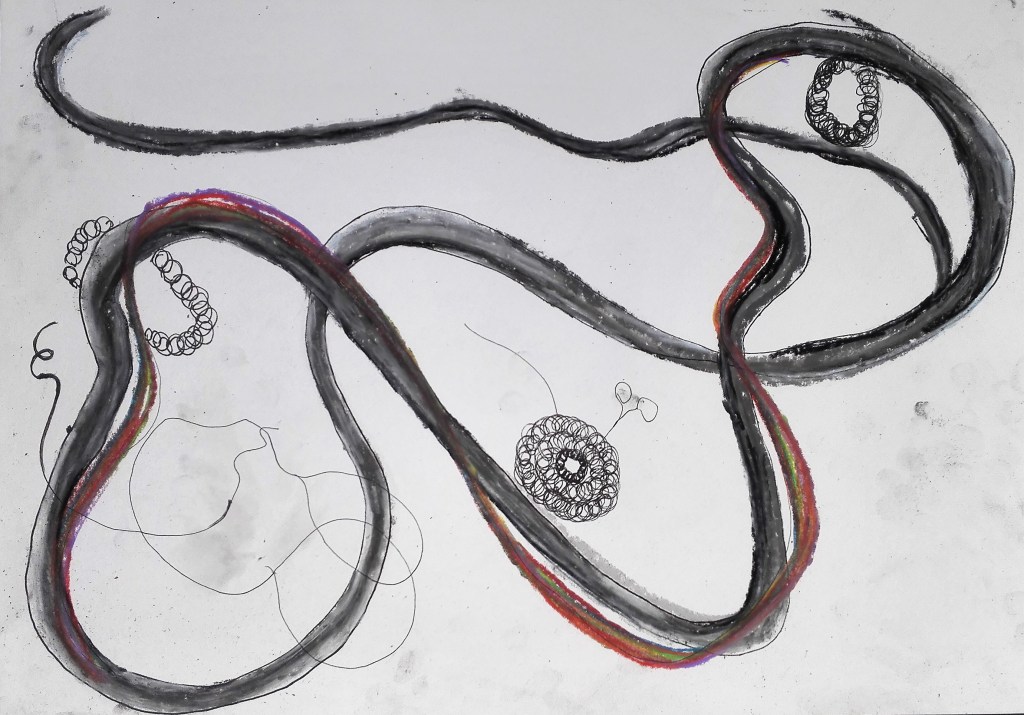
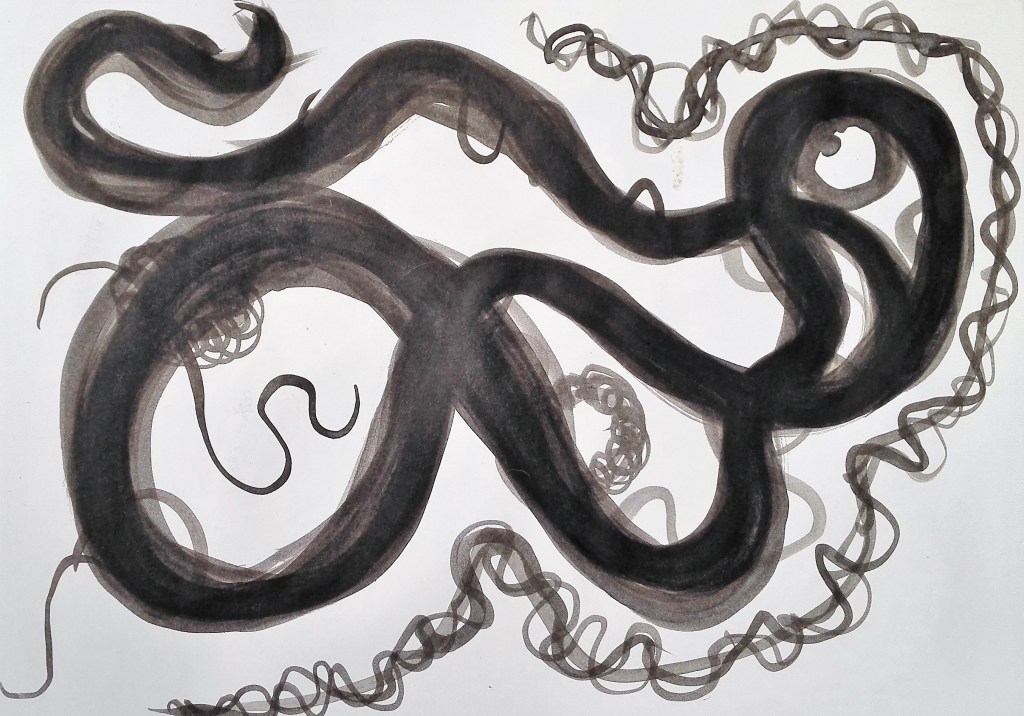
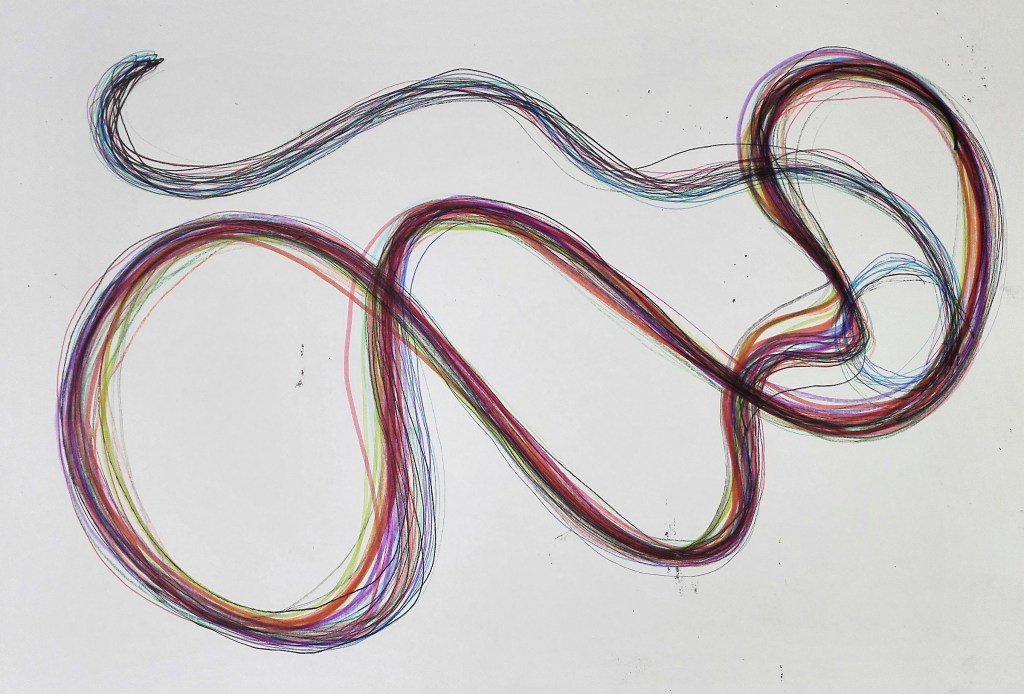
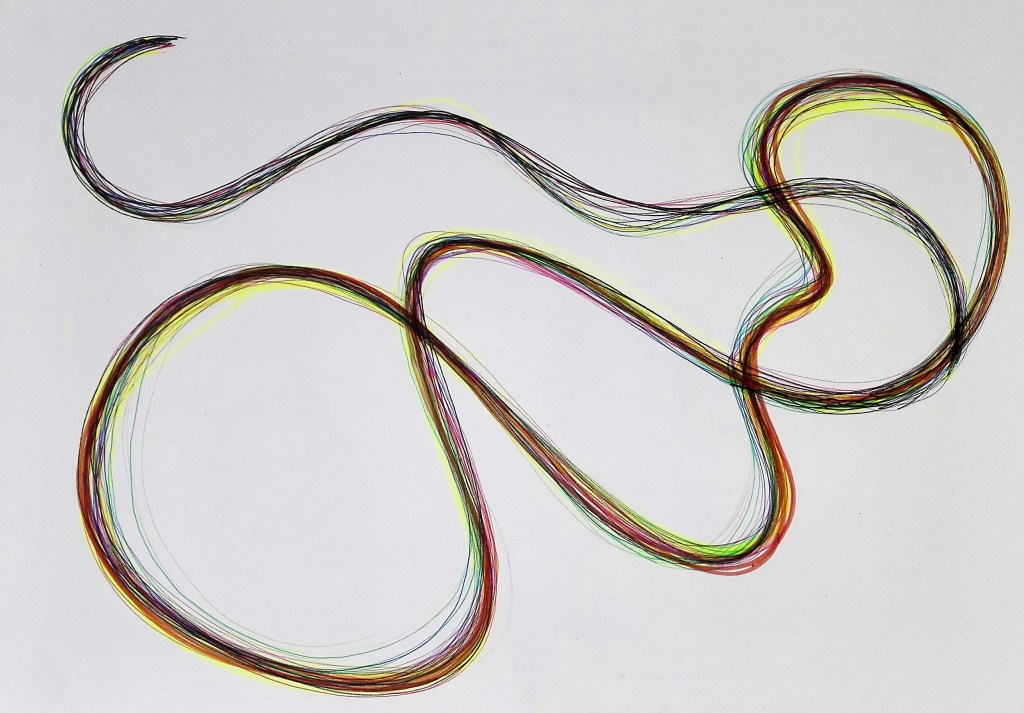
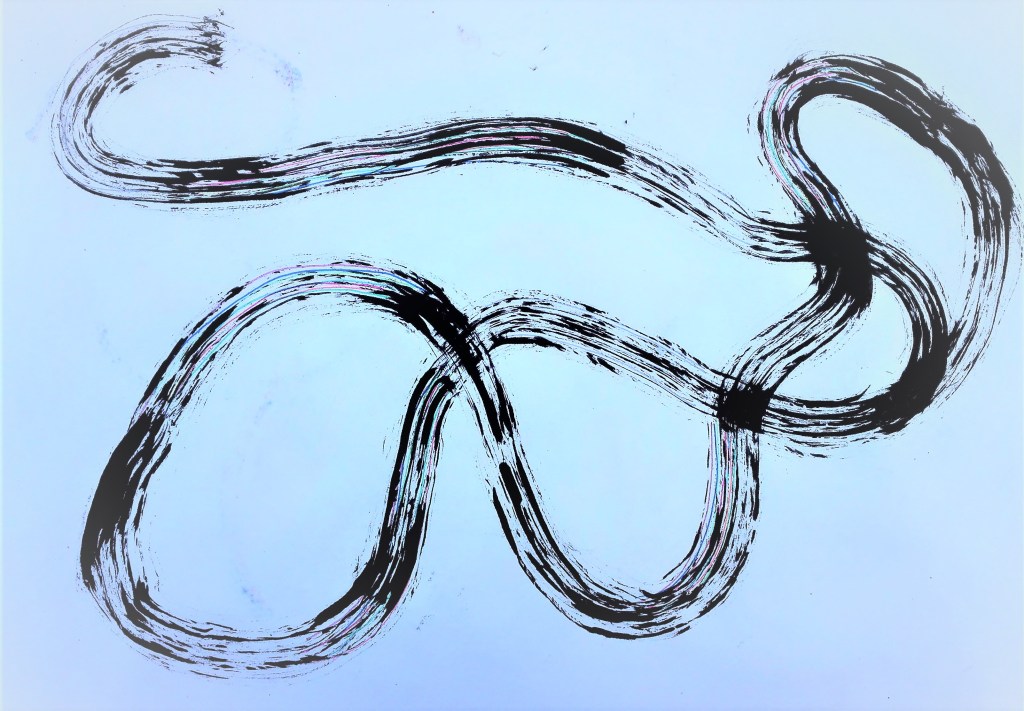
I completed a set of gestural drawings and ink paintings using Totally Wired as the template. The results, whilst having some merit, were disappointing. I feel that the lines whilst following the lines of the work and having a pleasing flow lack the interest that is provided by the wires. There is less to challenge and interest the eye and the resultant drawings look rather flat and uninteresting. A further challenge would be to undertake a more detailed drawing or painting which also tries to pick out some of the tonal interest along with the flow of the wires. Perhaps this could focus in on a section of the work rather than trying to capture it all.
I found that this was a challenging essay which took me some time to understand. I will start with my understanding of the essay and later describe how it resonates with my personal experiences.
Analysis of the essay
The use of the term Literalist art to describe Minimalism was initially distracting. I found that the Tate’s description of Minimalism was helpful to my understanding.
Minimalism = extreme form of abstract art developed in the USA in the 1960’s which typically composed of simple geometric shapes based in the square and rectangle.
I found that when I researched the work of the artists highlighted in the essay it was easier to understand the points that Martin Fried was making.
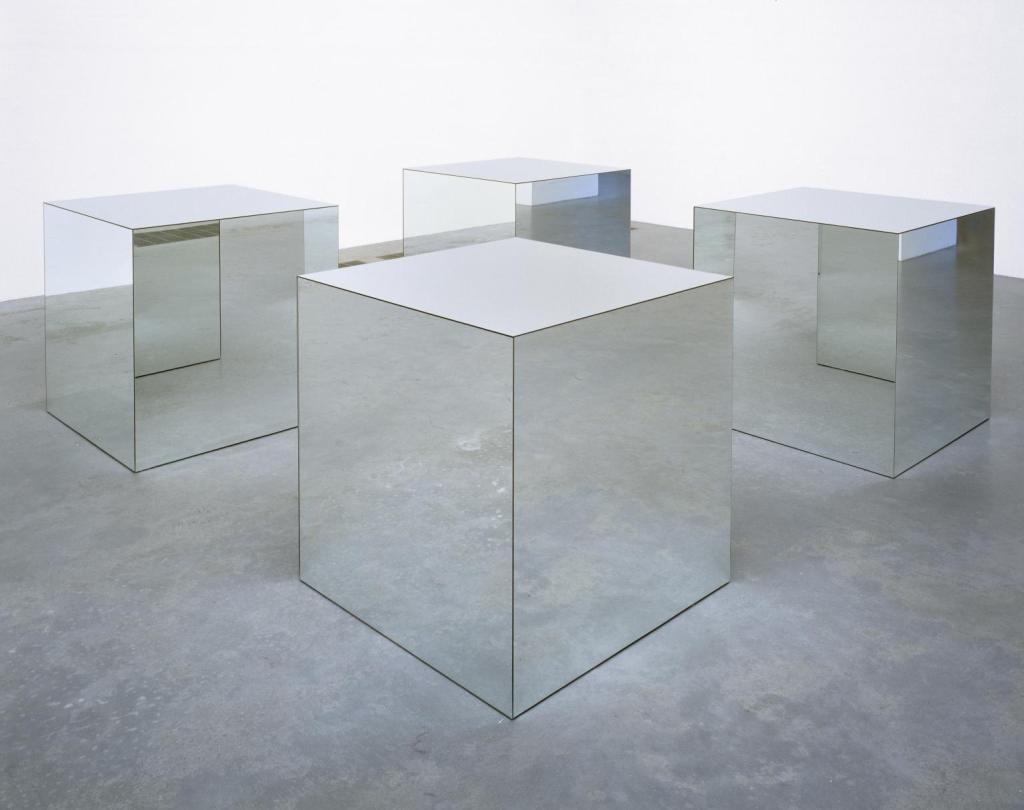
The essay starts with an explanation of what Martin considers to be literalist art and how it aspires to displace modernist painting and modernist sculpture as a way to establish itself. In many ways it is about the shape of an object. It is what it is, a whole, and not the sum of its parts. To quote from the essay ‘What is at stake in this conflict is whether the paintings or objects in question are experienced as paintings or as objects: and what decides their identity as paintings is their confronting of the demand that they hold as shapes. Otherwise they are experienced as nothing more than objects.’ The object has to suspend its own objecthood. The concept of non art is discussed and how the look of non art has moved beyond painting and onto sculpture. The term objecthood is adopted to encompass what literalist art is. However by doing this it becomes theatrical in how it confronts the beholder. The experience of literalist art is of an object in a situation. That much literalist work is large forces the beholder to keep their distance from it and be confronted by it. The object includes the beholder, large scale but not overpowering, too large. The object confronts the beholder, perhaps unexpectedly, by being in his way.
The theatricality of literalist art is inherent as the object is a statement of confrontation. In trying to explain theatre as an experience or situation as a work of art, which it isn’t, the experience of theatre is replaced by the object but the object is not there. Paintings and sculpture are not objects but by comparison literalist art assimilates objects to be art.
In trying to break or suspend objecthood the work of David Smith is held up as the prime example. His work occupies a space in which its part become entirely optical, part of ambient space but are still seen in terms of objecthood. The sculptor Anthony Caro’s work resists objecthood by imitating the efficacy of gesture.
To be able to defeat theatre literalist art degenerates in that the work only needs to be interesting. This is not a mark of quality. There is also a literalist preoccupation with time, with the duration of the experience which in turn is theatrical. The argument, essay, comes full circle in that in summary it states that we are all literalists most of our lives.
How does this resonate with my own experiences?
I can’t honestly say that I thought about my making during Part two in terms of literalist or minimalist art. I hadn’t considered questioning whether painting or even Combines were objects. They were the sum of their parts and presented as a work. I was trying to understand the language of working in a new way. Using new materials to create and assimilate into my work. It is only with hindsight that I can see parallels with the challenges that confronted artists such as Robert Morris in that I was considering the shape of objects. However I was nowhere near trying to limit the scope of the shapes down to simple geometric forms. That the literalists were trying to remove the association with anthropomorphism was contrary to what I was attempting. I wanted my work to be relatable and to contain gesture. I do remember having to consider the confines of the support. To me. the confines were in two dimensions and I didn’t really feel that I was working on a sculpture. This I feel was even true when working on the construction piece. I felt that I was assembling rather than sculpting.
My conclusion is that after reading the essay, and the points documented therein, I can see that the logical extension to pursuing a path of trying to simplify form and present work as an object removed from anything else would lead towards literalist or minimalist art. This was not a conscious consideration in my making. I was working to create pieces that had form and were, I hoped, aesthetically pleasing.
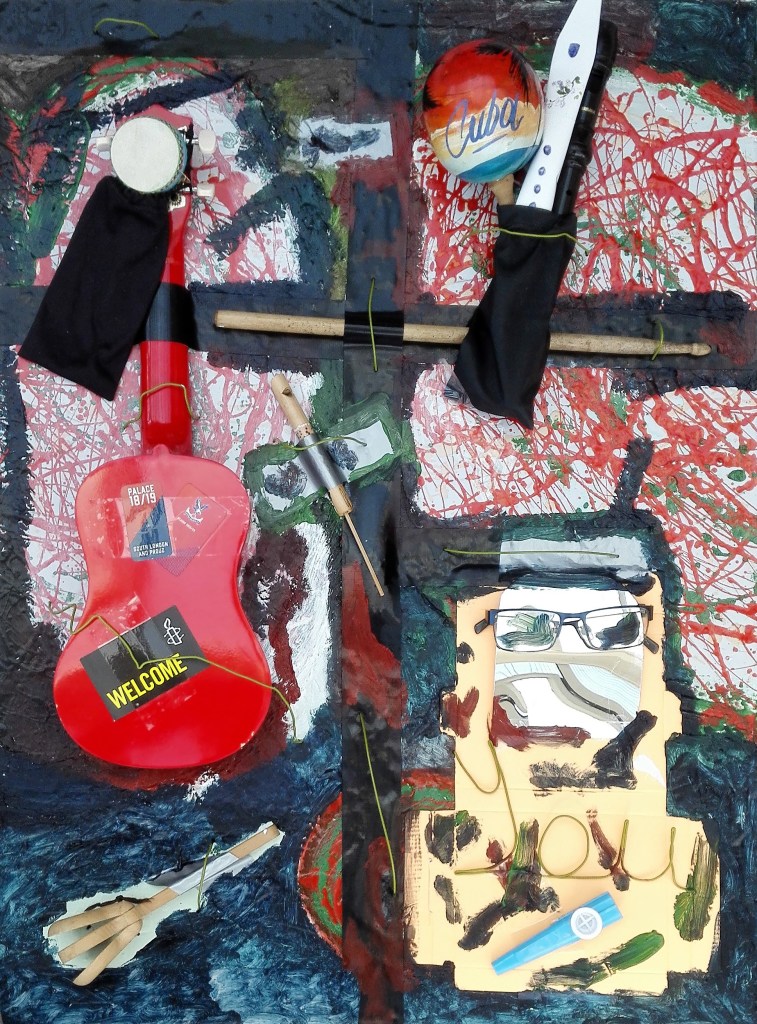
I made the decision to work on a combine as my Assignment Two final piece for several reasons. I had enjoyed the process of working on a Combine during Part Two. The physicality of the process of creation gave me an energy which I had not previously experienced when working on my art. The possible exception being when I had worked on large canvases. Additionally I was still trying to understand and reconcile Combines as a form of painting. Whilst I could see the artistic merits of using and repurposing objects in a way that makes the viewer think of them in a different way, I was still struggling to extract meaning from the completed paintings. Perhaps I was looking at them the wrong way in so much as there wasn’t a single meaning but that the act of looking, thinking and reflecting was the challenge.
Working on my previous Combine had been a new way of creating work. The manipulation of objects, the playing with ideas, testing juxtapositions and trying to relate forms to each other presented questions that I did not have a learnt knowledge to solve. This was new. I had to try to solve the issues that I was confronted with. To my mind the previous Combine that I had completed was more about the process than the result. That I completed the exercise was an end in itself. However reflecting and looking at the work it lacks coherence. It presents itself as a set of objects that have an inherent commonality which have been placed together. There is no challenge as to what they are or why they have been presented in the manner that they have.
The process of moving, reassigning objects based upon their aesthetics, their shapes, lines, colour and form becomes an act of creativity. The confines of the frame becomes apparent. The choices of what to discard becomes as important as what to include. Their placement, manipulation and how they interact with each other is far more important than what they are. In completing this piece I wanted to create a work that forces the viewer to look at it, is interesting to look at and provokes questions.
My opinion of the completed piece is that it invites closer inspection and solves some of the issues documented above. There are forms suggested which are beyond what the individual objects would convey by themselves. The objects are not placed randomly there is clear evidence of a choice being made to arrange and display them as they are. The viewer is confronted with a piece that is interesting as a whole and is challenged to look at its make up, the discarded objects, and to reflect on their original purpose and how this has now been rendered obsolete.
A short video is included below the painting with more of my reflections.
To assess the outcomes that I have achieved I need to break this section down into the key elements.
Materials: my choices were perhaps a little conservative but this was mainly due to what I had available to me. The exercises and alternative ways of working and creating work has made me look at objects that, previously, I would have considered junk in a new light. I will explore the possibilities opened up in my work in the future and look to incorporate found materials into my work.
Techniques: during Part Two I was trying out new techniques particularly in respect to the Combines and the Construction work. I find it difficult to assess the success or not of these works. I feel that my attempts are fairly primitive or naive but that in itself has a innocent quality.
Observational skills: my main focus was on trying to understand the concepts and relate these to my own work.
Visual awareness: I have found myself looking at objects and materials in a new light and considering their properties in ways that I would not have previously. New avenues of exploration and possibilities have been opened.
Design and compositional skills: Upon review I feel that there have been some successes in my work. Where I have stopped and carefully considered how the materials work and respond to each other have worked the best.
Quality of Outcome
At best I would suggest that the quality of my work during Part Two has been variable. There are successes, I believe, in particular, my Assignment two piece, Totally Wired, some of the exploring space pieces and Collect – make – arrange. On the other side I feel that the pieces that I completed for the Combine and Construct exercises are lacking in execution and visual impact.
Demonstration of Creativity
I fully engaged with all of the exercises during Part Two despite some initial hesitancy. This involved utilising a host of materials which I incorporated into the work in experimental ways. I tried to look for the materials properties, shapes, colours and their utility beyond their purpose.
Context
I have spent longer reflecting on my work and the relationship with the given examples and my research than I have done previously. This is particularly true of the contextual focus point. Where I spent time deconstructing the paragraphs, analysing the text and trying to make sense of the piece. The nature of the exercises and the confrontation with new ways of working caused me to increase the reflection on my own work as I tried to make sense of what I was trying to achieve.
Overall I have the feeling that I have achieved my goals for Part Two and that I have progressed my practice.
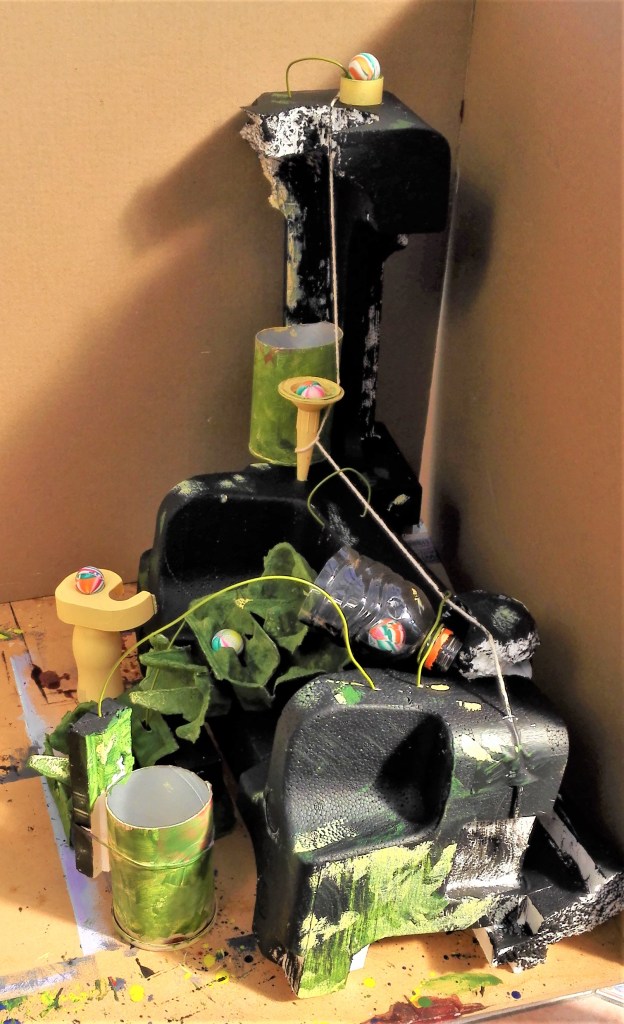
The initial consideration before embarking on this pieces of work was to review the two piece that I had completed earlier in this part of the course. The aim of the review was to think about whether I could use them as a starting point for this final piece. The two works under consideration were the Combine and Construction 1, these are shown below.
Combine & Construction 1
I considered that both pieces had reached a conclusion and that to develop them well beyond their present state was not feasible. I therefore considered what alternative I had. The first problem was to try to find materials that I wanted to work with. I reached a point where I needed to allow time for ideas to emerge and not to rush into working on something that had no meaning to me. It took a few days for ideas and trains of thought to coalesce into a potential plan. In the meantime I set about working on a painting. Using a photograph as the visual reference for the painting. I made a number of sketches before starting the painting. Whilst working on the painting I could allow myself to consider options for the Final piece for Assignment 2. This is a technique that I have used before. In some ways it is a distraction that I find allows my subconscious to arrange my ideas and formulate solutions. The paintings that I have completed during this course will be documented and added to my blog under a separate heading.
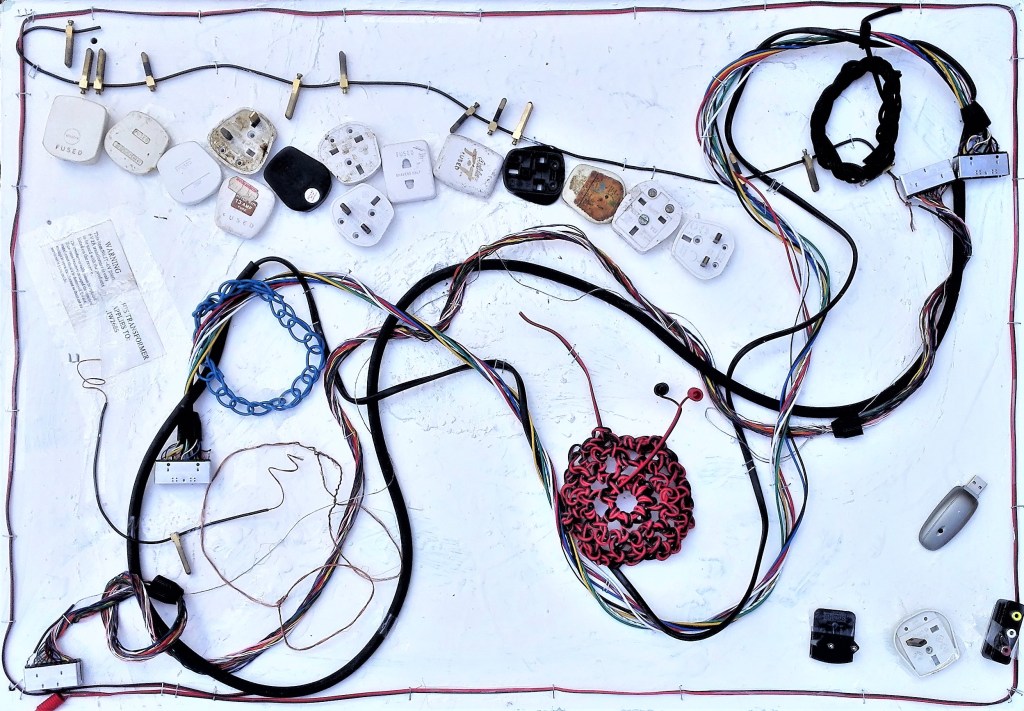
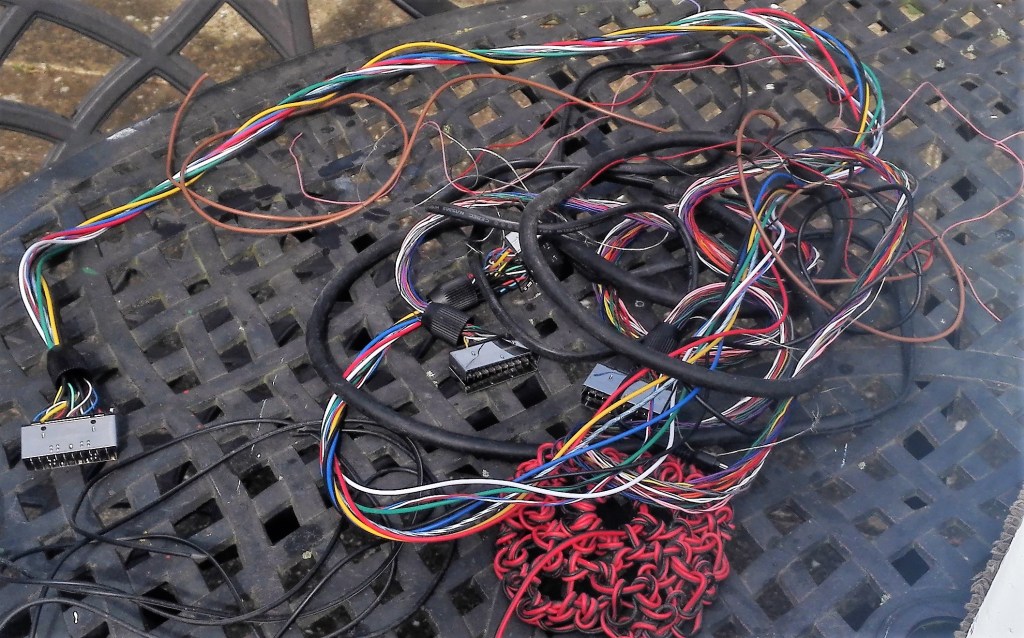
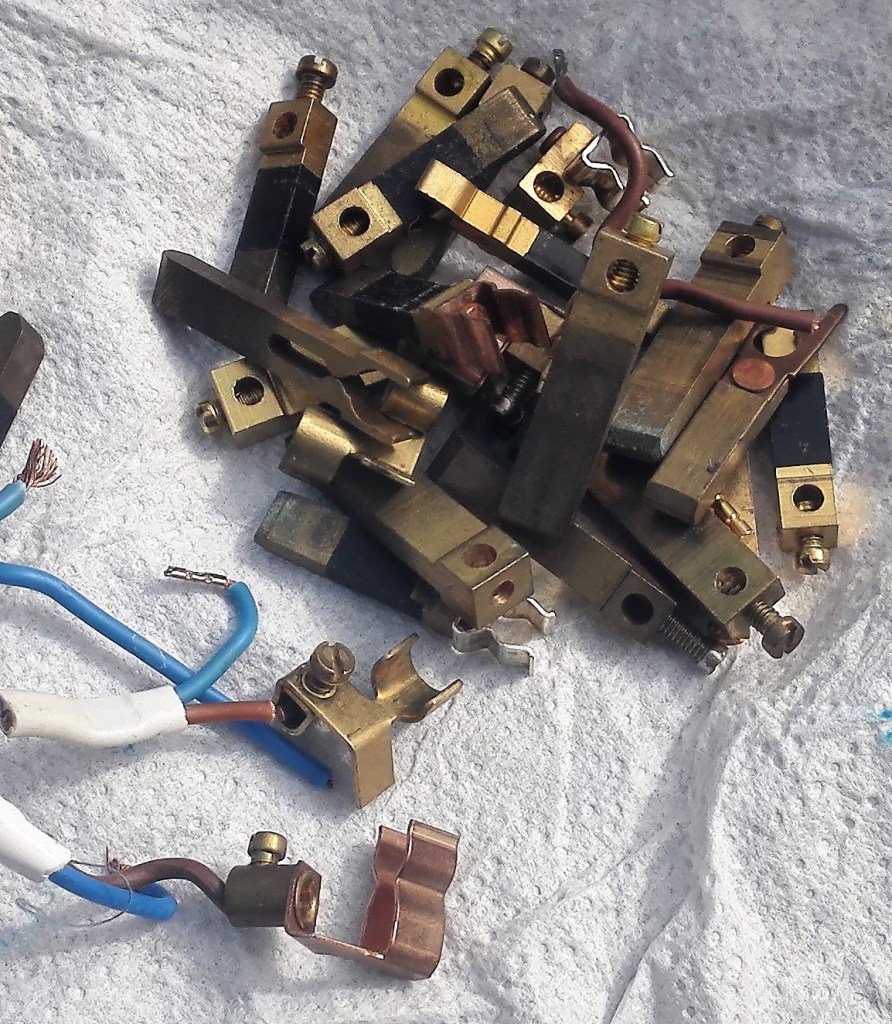
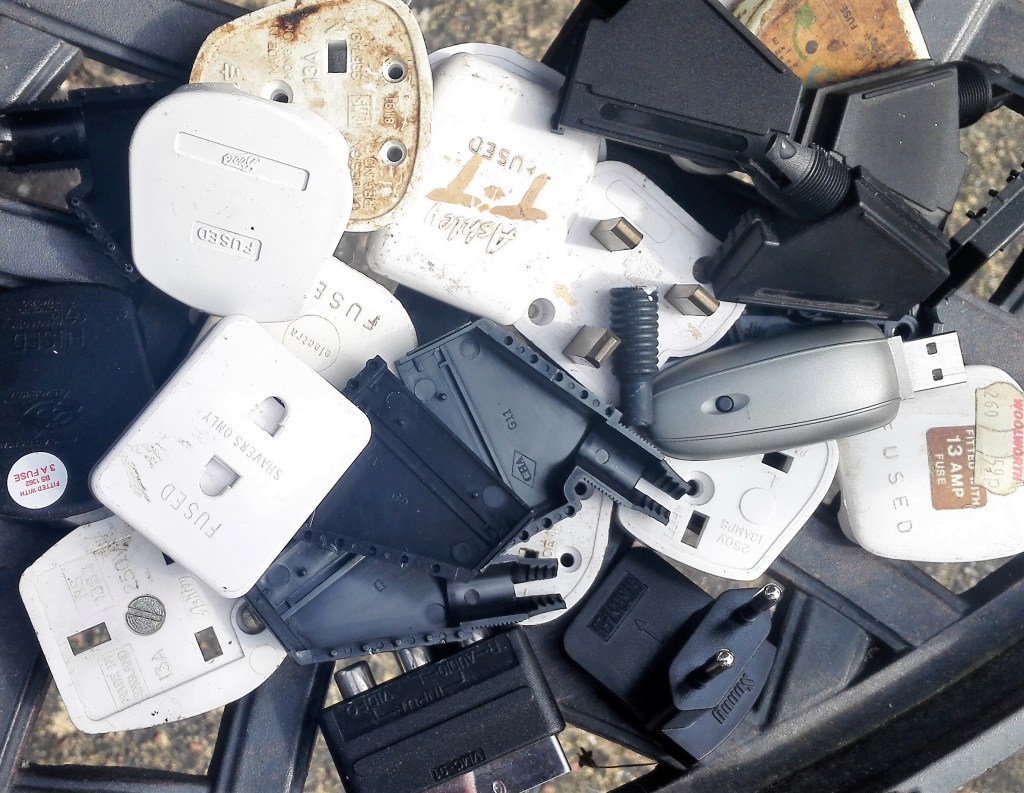
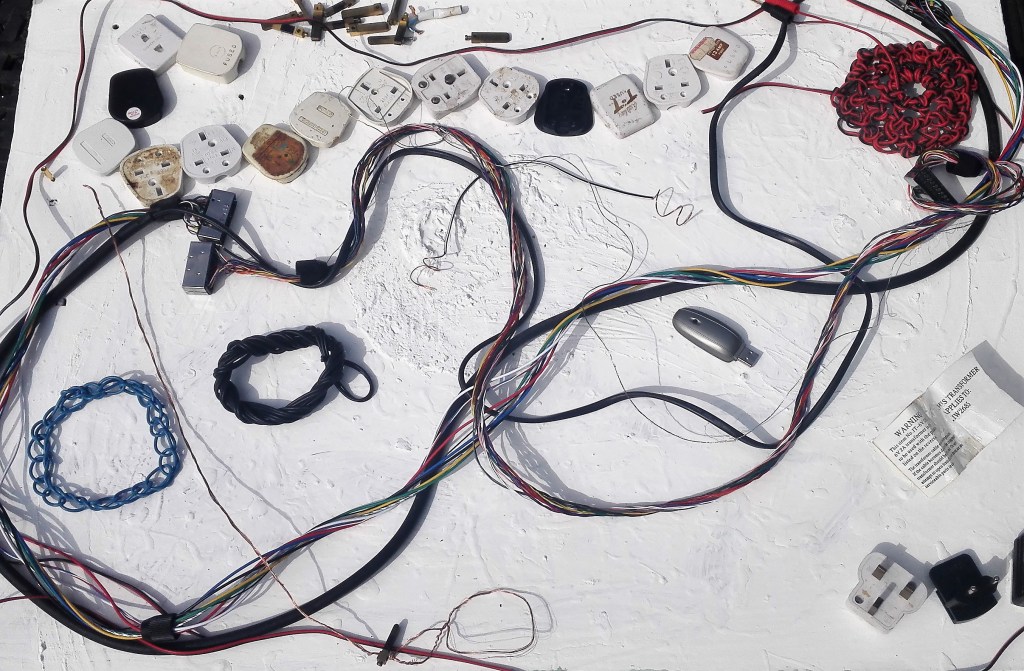
I had found that I had various bags and drawers old electrical equipment, plugs, wires, phones and other discarded or obsolete items. Could I use these and if so how? I collected them together and looked at their shapes, colours and properties including how they could be manipulated and sculpted.
Materials ?
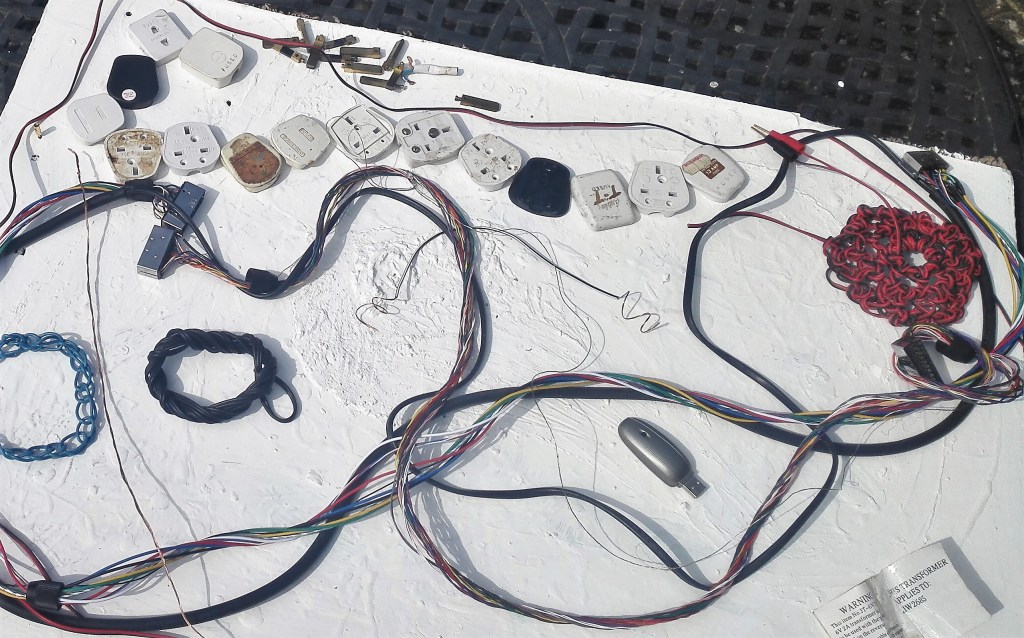
I still had the two pieces remaining of the thick cardboard that I had re-purposed for the Combine piece and one of these could be used as the support for the work. I deconstructed some of the wires by removing their covering and disassembled the plugs which revealed their shapes. These I placed on the support to see how they related to each other and whether I could arrange them into an interesting composition.
It was whilst I was placing, removing and reorganising the materials that Marian suggested that she could use some of the wires and manipulate them into patterned shapes. This was an interesting idea and I liked the collaboration aspect. However I didn’t want to just create a pretty pattern from the objects but to suggest something else, to move them from their intended application and use them in an alternative way whilst they still retained their intrinsic properties. The three patterned shapes are included in the final piece.
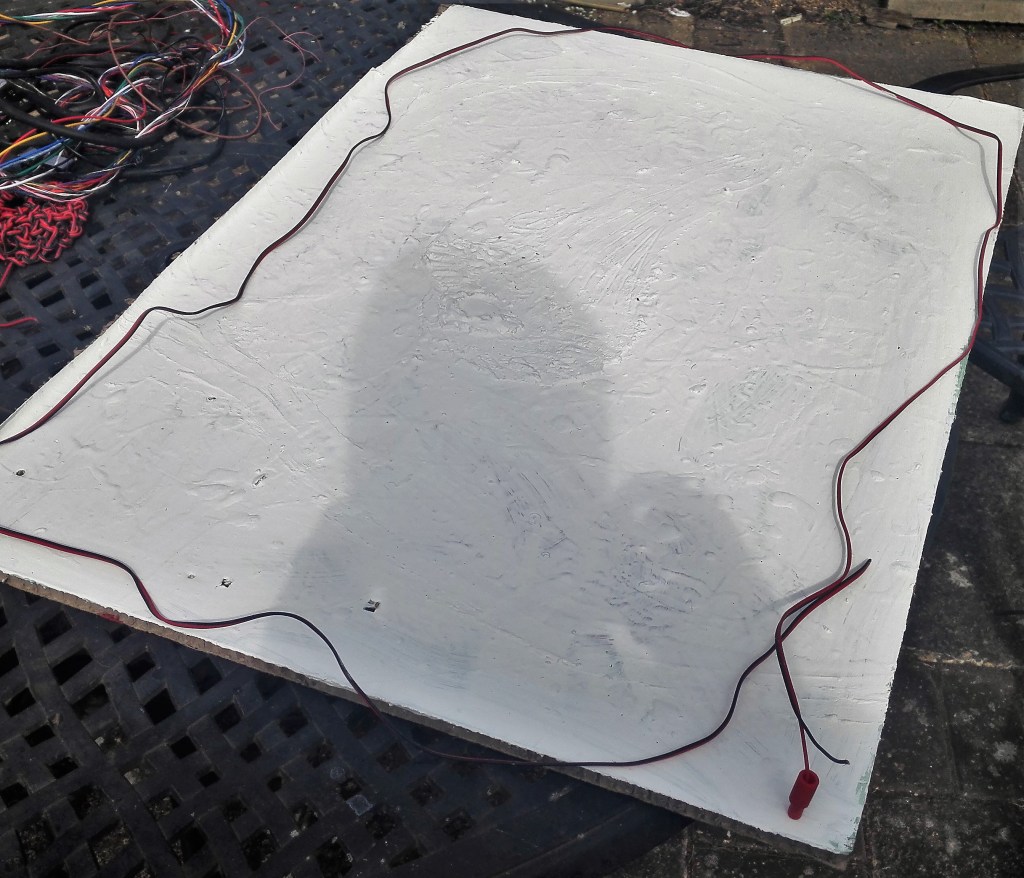
After much consideration I decided to use some wire to create and edge to the support and create a frame.
Support and framing idea
The next four photographs document a coupe of the arrangements and how I then reduced these down before building them up towards the final piece.
Totally Wired – Work in progress
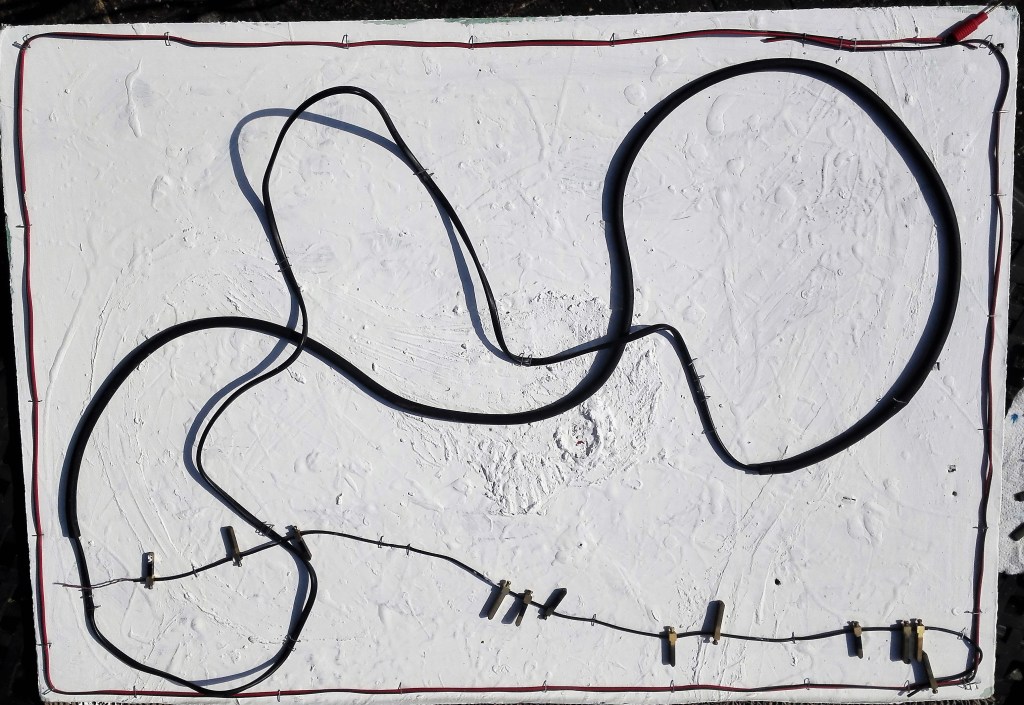
Yes, I now had a name for the piece, Totally Wired. The last logistical problem was how to attached materials to the support. This was solved by the use of a staple gun and Sellotape. I would have perhaps preferred to have used some strong adhesive but didn’t have any available and due to limitations of not being able to venture out due to lockdown had to use what I had available. My final consideration was whether to add paint. The thought was to drip or pour some household paint in a random way over parts of the piece. In the end I resisted this but will be interested to hear feedback on this decision.
A photograph of the final piece is shown below. I am pleased with how the piece looks. The materials have moved beyond their obvious use. The abstract nature of the arrangement suggests something else, is aesthetically pleasing and I hope demands a closer examination.
Totally Wired
I hope to add a video of ‘Totally Wired’ to this blog when I have copied all of my posts to my OCA Spaces blog. Update 2/5/2020 I have now found a way to add video footage to my Blog and a separate blog containing a video of this work along with some drawing has been posted.
Overall the feedback was good and mentioned that I had made a positive start to the course.
There were some pointers emphasising that I should make more rigorous use of visual and contextual research to support my enquiries into ideas that I find interesting. I have taken this comment on board and will develop this as I work through the course. I have found during the courses that I have undertaken thus far with OCA that that exploration and reflection become more and more important. Thinking about this it becomes obvious that this a window into what is informing my creative process and development as an artist. It is my story of how I see the world and how I respond to it and how it informs my art.
It was also suggested that I should look to explore further with some of the experimental techniques that I had employed during some of the exercises. Namely the blowing ink and diluted paints and also to look for new ways of applying medium to surfaces. I will look to invest in some new colour pastes and shellac inks to compliment these investigations. My aim will be to take time out between exercises in Part Two to complete these tasks.
Lastly I noted the suggested artists to investigate and will do so. These investigations will be reported in my blog under Research.



 Mark Taylor 'Studio Practice'