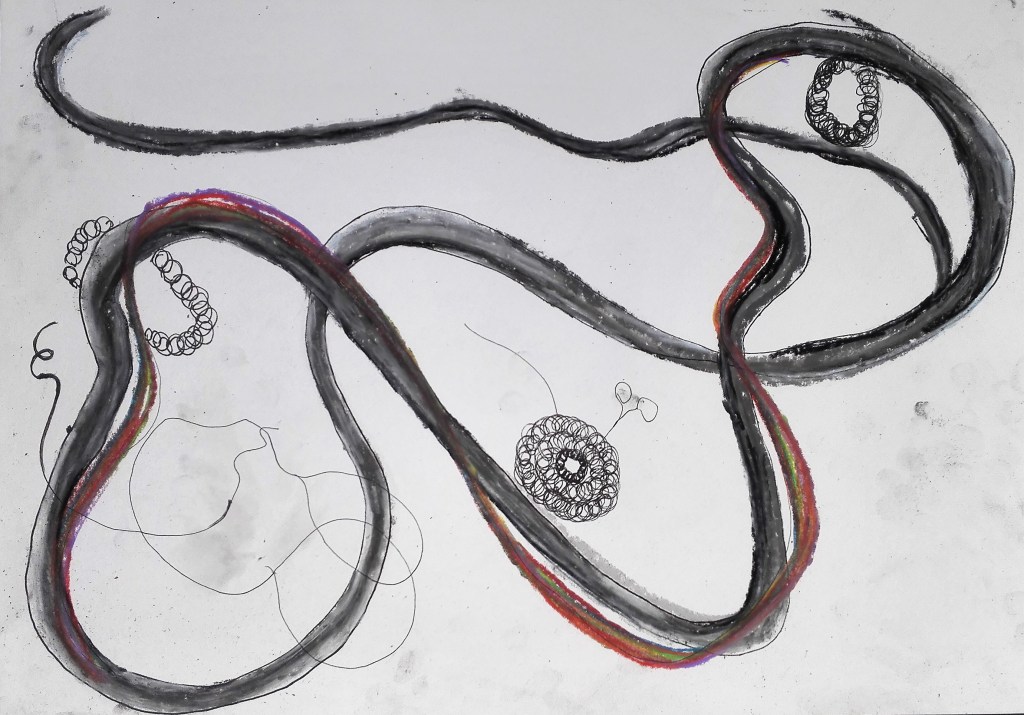
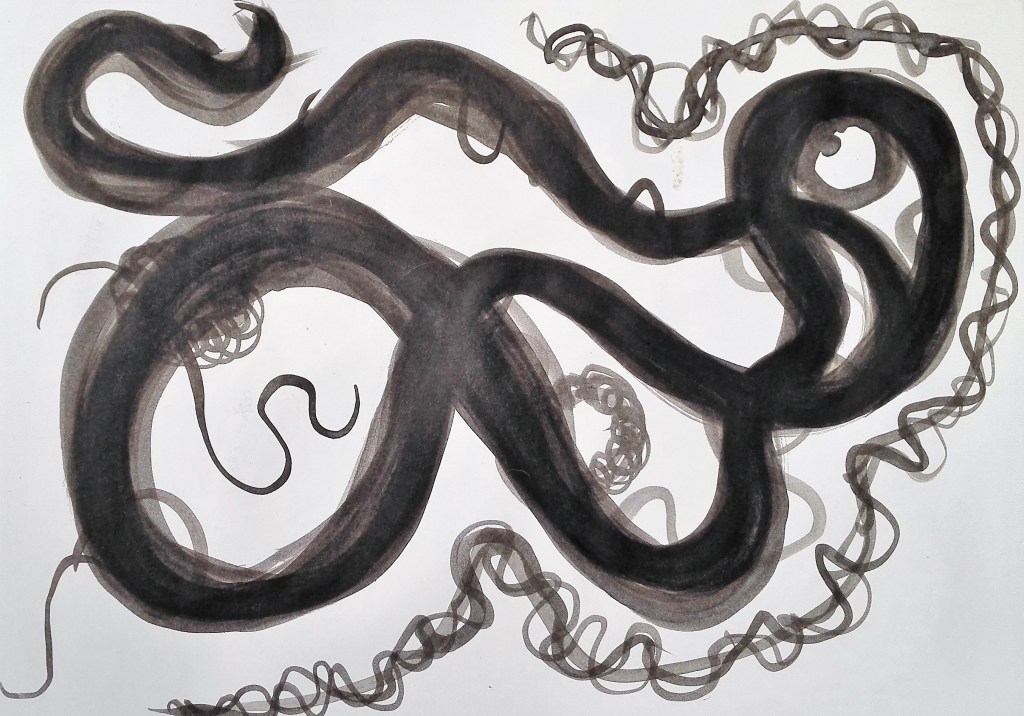
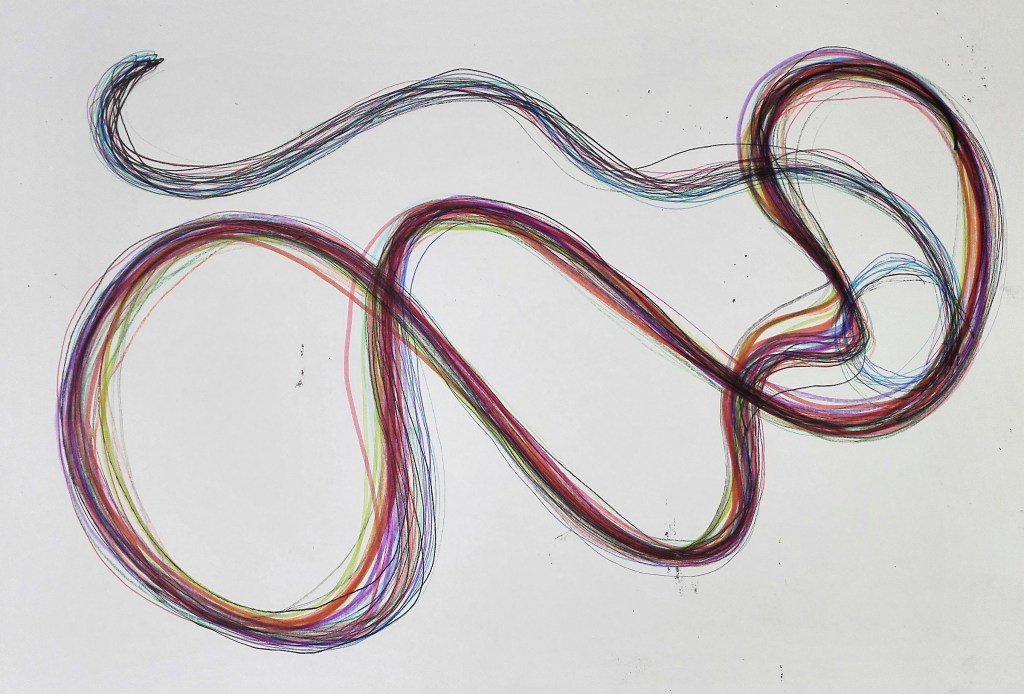
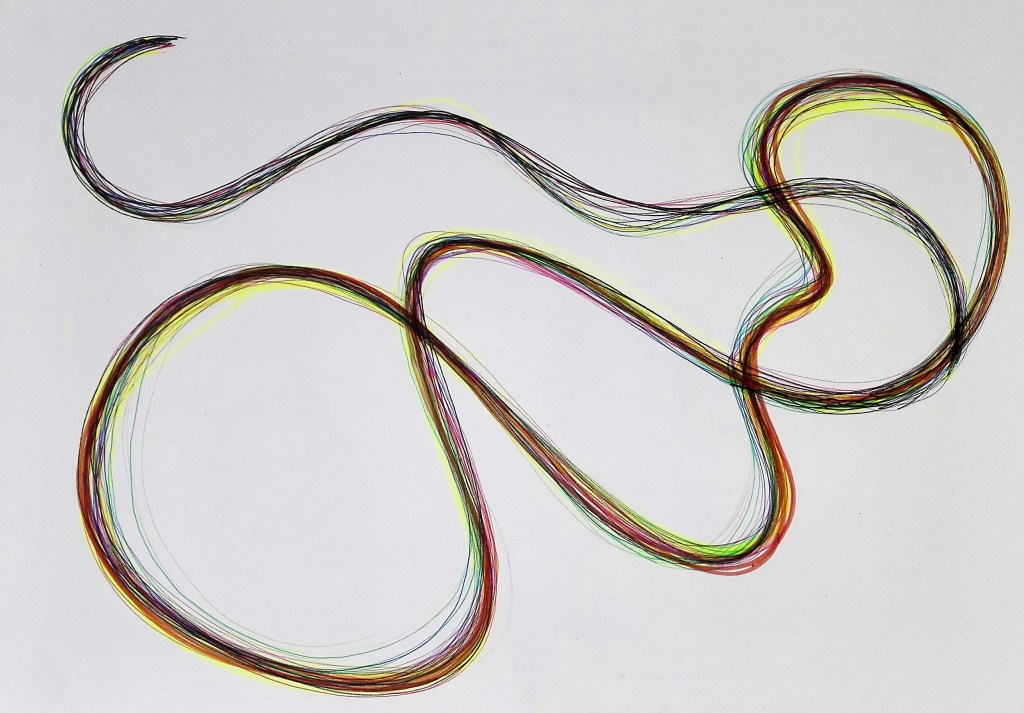
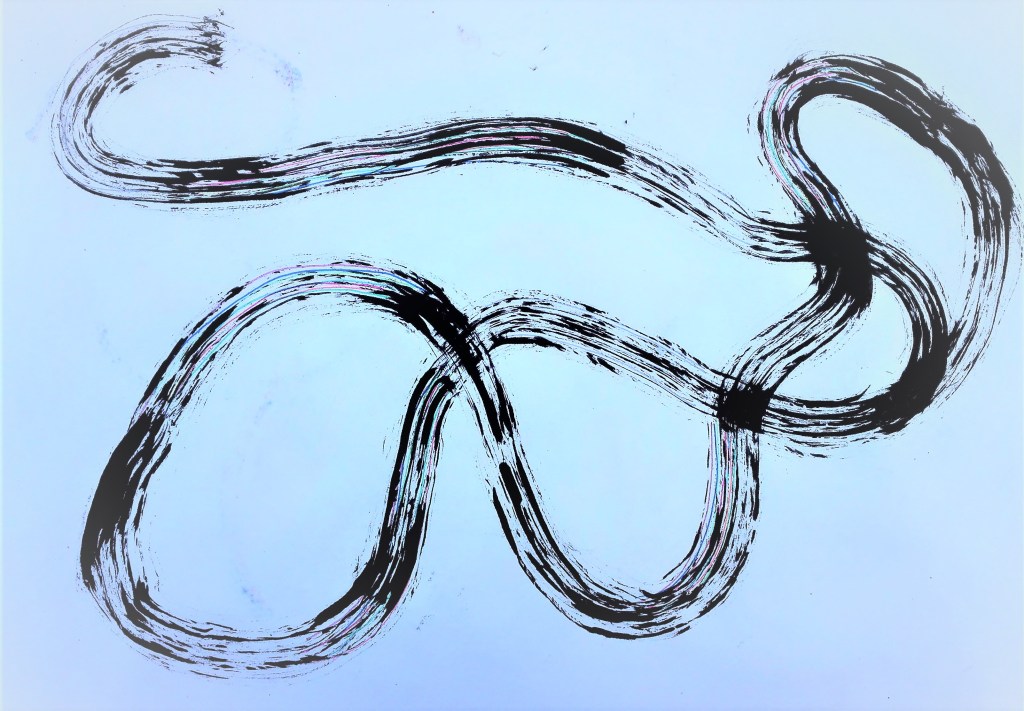
Below is a short video of my Assignment Two piece which I hope shows the work in slightly more detail. As mentioned in the commentary it was remarked in my feedback meeting that the piece has the look of a drawing. I will make some paintings that explore the gestural lines in the work. I will add these to the post when they are completed.
Totally Wired– The Video
I completed a set of gestural drawings and ink paintings using Totally Wired as the template. The results, whilst having some merit, were disappointing. I feel that the lines whilst following the lines of the work and having a pleasing flow lack the interest that is provided by the wires. There is less to challenge and interest the eye and the resultant drawings look rather flat and uninteresting. A further challenge would be to undertake a more detailed drawing or painting which also tries to pick out some of the tonal interest along with the flow of the wires. Perhaps this could focus in on a section of the work rather than trying to capture it all.
I found that this was a challenging essay which took me some time to understand. I will start with my understanding of the essay and later describe how it resonates with my personal experiences.
Analysis of the essay
The use of the term Literalist art to describe Minimalism was initially distracting. I found that the Tate’s description of Minimalism was helpful to my understanding.
Minimalism = extreme form of abstract art developed in the USA in the 1960’s which typically composed of simple geometric shapes based in the square and rectangle.
I found that when I researched the work of the artists highlighted in the essay it was easier to understand the points that Martin Fried was making.
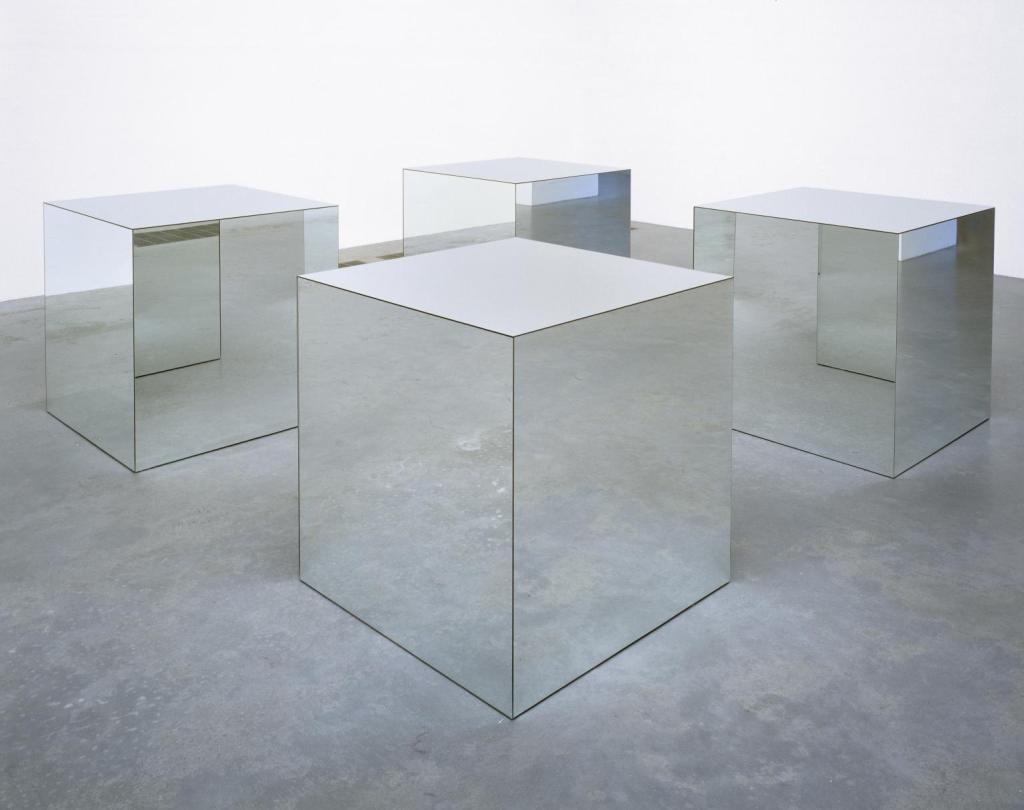
The essay starts with an explanation of what Martin considers to be literalist art and how it aspires to displace modernist painting and modernist sculpture as a way to establish itself. In many ways it is about the shape of an object. It is what it is, a whole, and not the sum of its parts. To quote from the essay ‘What is at stake in this conflict is whether the paintings or objects in question are experienced as paintings or as objects: and what decides their identity as paintings is their confronting of the demand that they hold as shapes. Otherwise they are experienced as nothing more than objects.’ The object has to suspend its own objecthood. The concept of non art is discussed and how the look of non art has moved beyond painting and onto sculpture. The term objecthood is adopted to encompass what literalist art is. However by doing this it becomes theatrical in how it confronts the beholder. The experience of literalist art is of an object in a situation. That much literalist work is large forces the beholder to keep their distance from it and be confronted by it. The object includes the beholder, large scale but not overpowering, too large. The object confronts the beholder, perhaps unexpectedly, by being in his way.
The theatricality of literalist art is inherent as the object is a statement of confrontation. In trying to explain theatre as an experience or situation as a work of art, which it isn’t, the experience of theatre is replaced by the object but the object is not there. Paintings and sculpture are not objects but by comparison literalist art assimilates objects to be art.
In trying to break or suspend objecthood the work of David Smith is held up as the prime example. His work occupies a space in which its part become entirely optical, part of ambient space but are still seen in terms of objecthood. The sculptor Anthony Caro’s work resists objecthood by imitating the efficacy of gesture.
To be able to defeat theatre literalist art degenerates in that the work only needs to be interesting. This is not a mark of quality. There is also a literalist preoccupation with time, with the duration of the experience which in turn is theatrical. The argument, essay, comes full circle in that in summary it states that we are all literalists most of our lives.
How does this resonate with my own experiences?
I can’t honestly say that I thought about my making during Part two in terms of literalist or minimalist art. I hadn’t considered questioning whether painting or even Combines were objects. They were the sum of their parts and presented as a work. I was trying to understand the language of working in a new way. Using new materials to create and assimilate into my work. It is only with hindsight that I can see parallels with the challenges that confronted artists such as Robert Morris in that I was considering the shape of objects. However I was nowhere near trying to limit the scope of the shapes down to simple geometric forms. That the literalists were trying to remove the association with anthropomorphism was contrary to what I was attempting. I wanted my work to be relatable and to contain gesture. I do remember having to consider the confines of the support. To me. the confines were in two dimensions and I didn’t really feel that I was working on a sculpture. This I feel was even true when working on the construction piece. I felt that I was assembling rather than sculpting.
My conclusion is that after reading the essay, and the points documented therein, I can see that the logical extension to pursuing a path of trying to simplify form and present work as an object removed from anything else would lead towards literalist or minimalist art. This was not a conscious consideration in my making. I was working to create pieces that had form and were, I hoped, aesthetically pleasing.
I made the decision to work on a combine as my Assignment Two final piece for several reasons. I had enjoyed the process of working on a Combine during Part Two. The physicality of the process of creation gave me an energy which I had not previously experienced when working on my art. The possible exception being when I had worked on large canvases. Additionally I was still trying to understand and reconcile Combines as a form of painting. Whilst I could see the artistic merits of using and repurposing objects in a way that makes the viewer think of them in a different way, I was still struggling to extract meaning from the completed paintings. Perhaps I was looking at them the wrong way in so much as there wasn’t a single meaning but that the act of looking, thinking and reflecting was the challenge.
Working on my previous Combine had been a new way of creating work. The manipulation of objects, the playing with ideas, testing juxtapositions and trying to relate forms to each other presented questions that I did not have a learnt knowledge to solve. This was new. I had to try to solve the issues that I was confronted with. To my mind the previous Combine that I had completed was more about the process than the result. That I completed the exercise was an end in itself. However reflecting and looking at the work it lacks coherence. It presents itself as a set of objects that have an inherent commonality which have been placed together. There is no challenge as to what they are or why they have been presented in the manner that they have.
The process of moving, reassigning objects based upon their aesthetics, their shapes, lines, colour and form becomes an act of creativity. The confines of the frame becomes apparent. The choices of what to discard becomes as important as what to include. Their placement, manipulation and how they interact with each other is far more important than what they are. In completing this piece I wanted to create a work that forces the viewer to look at it, is interesting to look at and provokes questions.
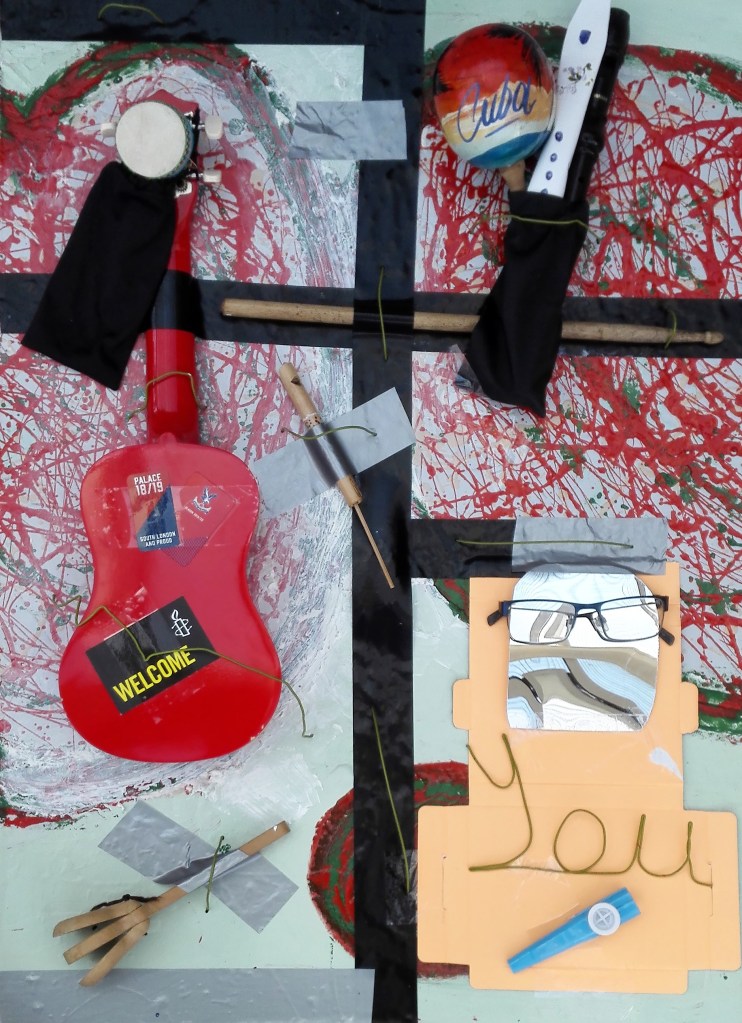
My opinion of the completed piece is that it invites closer inspection and solves some of the issues documented above. There are forms suggested which are beyond what the individual objects would convey by themselves. The objects are not placed randomly there is clear evidence of a choice being made to arrange and display them as they are. The viewer is confronted with a piece that is interesting as a whole and is challenged to look at its make up, the discarded objects, and to reflect on their original purpose and how this has now been rendered obsolete.
A short video is included below the painting with more of my reflections.
To assess the outcomes that I have achieved I need to break this section down into the key elements.
Materials: my choices were perhaps a little conservative but this was mainly due to what I had available to me. The exercises and alternative ways of working and creating work has made me look at objects that, previously, I would have considered junk in a new light. I will explore the possibilities opened up in my work in the future and look to incorporate found materials into my work.
Techniques: during Part Two I was trying out new techniques particularly in respect to the Combines and the Construction work. I find it difficult to assess the success or not of these works. I feel that my attempts are fairly primitive or naive but that in itself has a innocent quality.
Observational skills: my main focus was on trying to understand the concepts and relate these to my own work.
Visual awareness: I have found myself looking at objects and materials in a new light and considering their properties in ways that I would not have previously. New avenues of exploration and possibilities have been opened.
Design and compositional skills: Upon review I feel that there have been some successes in my work. Where I have stopped and carefully considered how the materials work and respond to each other have worked the best.
Quality of Outcome
At best I would suggest that the quality of my work during Part Two has been variable. There are successes, I believe, in particular, my Assignment two piece, Totally Wired, some of the exploring space pieces and Collect – make – arrange. On the other side I feel that the pieces that I completed for the Combine and Construct exercises are lacking in execution and visual impact.
Demonstration of Creativity
I fully engaged with all of the exercises during Part Two despite some initial hesitancy. This involved utilising a host of materials which I incorporated into the work in experimental ways. I tried to look for the materials properties, shapes, colours and their utility beyond their purpose.
Context
I have spent longer reflecting on my work and the relationship with the given examples and my research than I have done previously. This is particularly true of the contextual focus point. Where I spent time deconstructing the paragraphs, analysing the text and trying to make sense of the piece. The nature of the exercises and the confrontation with new ways of working caused me to increase the reflection on my own work as I tried to make sense of what I was trying to achieve.
Overall I have the feeling that I have achieved my goals for Part Two and that I have progressed my practice.
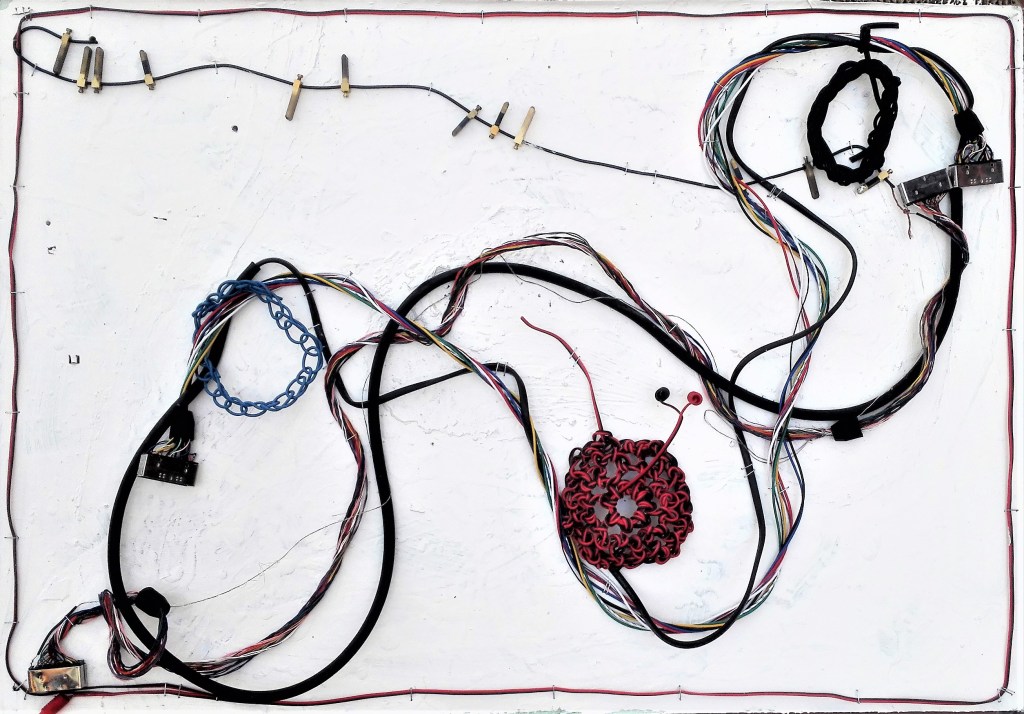
The initial consideration before embarking on this pieces of work was to review the two piece that I had completed earlier in this part of the course. The aim of the review was to think about whether I could use them as a starting point for this final piece. The two works under consideration were the Combine and Construction 1, these are shown below.
Combine & Construction 1
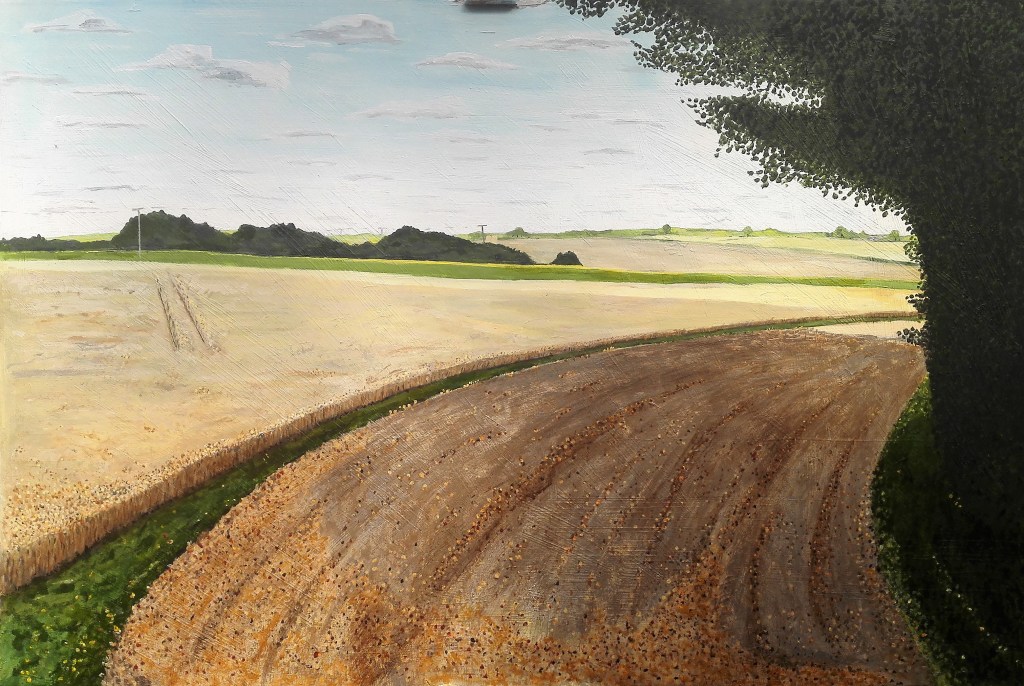
I considered that both pieces had reached a conclusion and that to develop them well beyond their present state was not feasible. I therefore considered what alternative I had. The first problem was to try to find materials that I wanted to work with. I reached a point where I needed to allow time for ideas to emerge and not to rush into working on something that had no meaning to me. It took a few days for ideas and trains of thought to coalesce into a potential plan. In the meantime I set about working on a painting. Using a photograph as the visual reference for the painting. I made a number of sketches before starting the painting. Whilst working on the painting I could allow myself to consider options for the Final piece for Assignment 2. This is a technique that I have used before. In some ways it is a distraction that I find allows my subconscious to arrange my ideas and formulate solutions. The paintings that I have completed during this course will be documented and added to my blog under a separate heading.
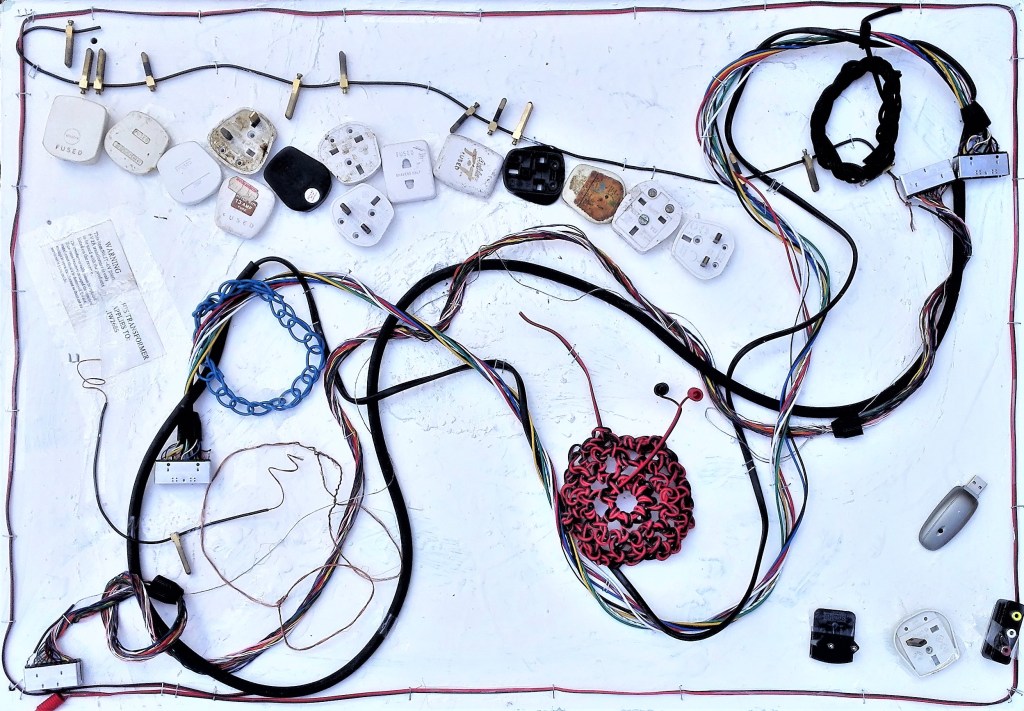
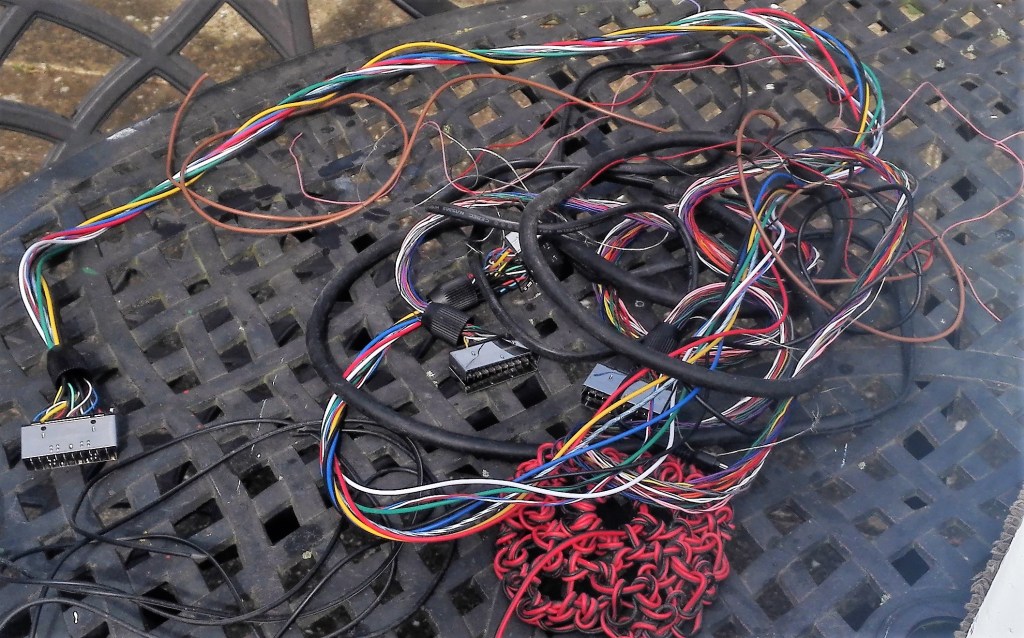
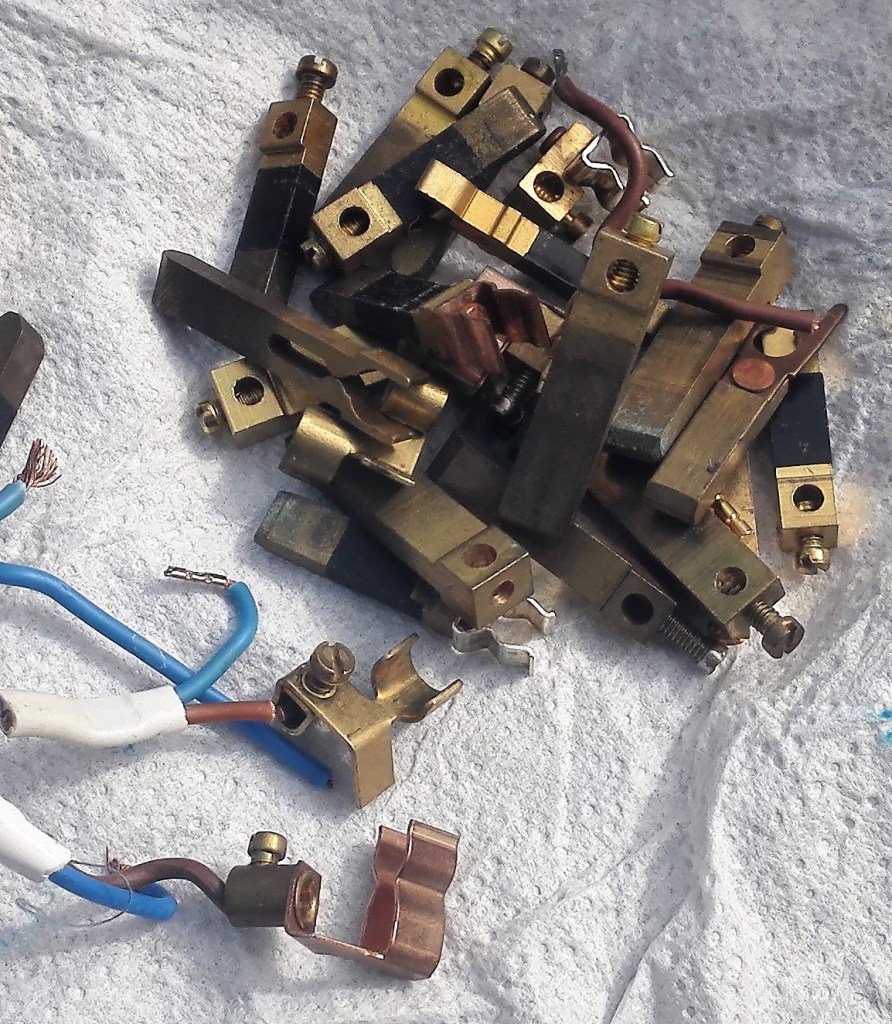
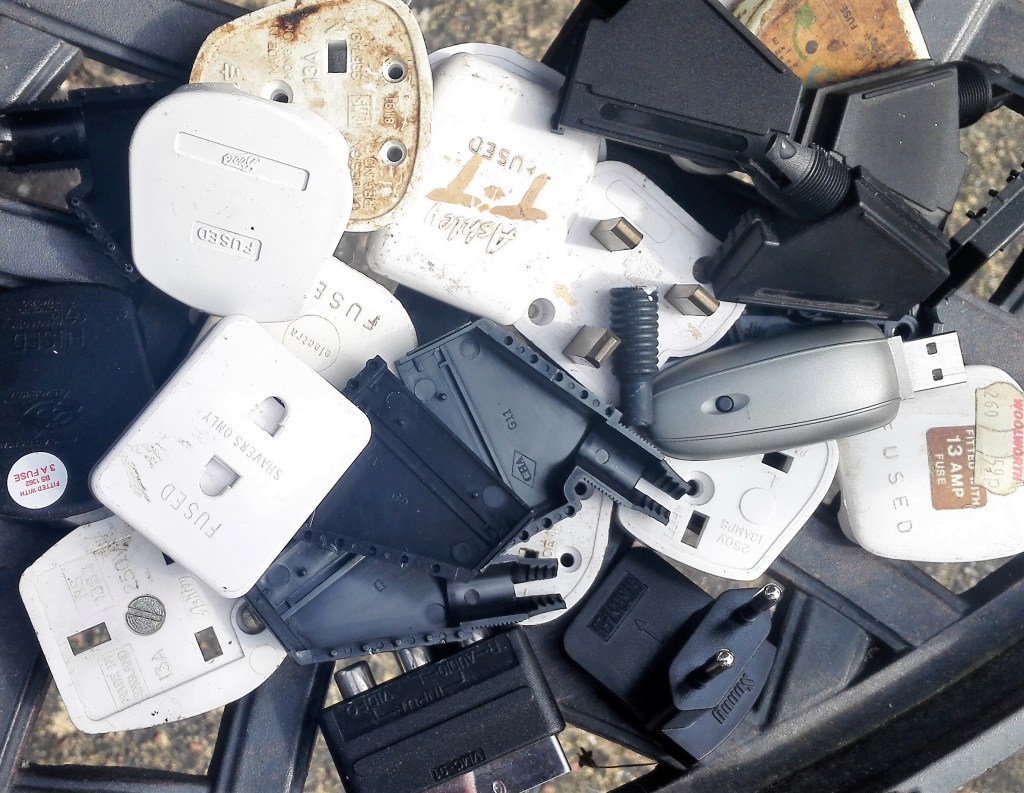
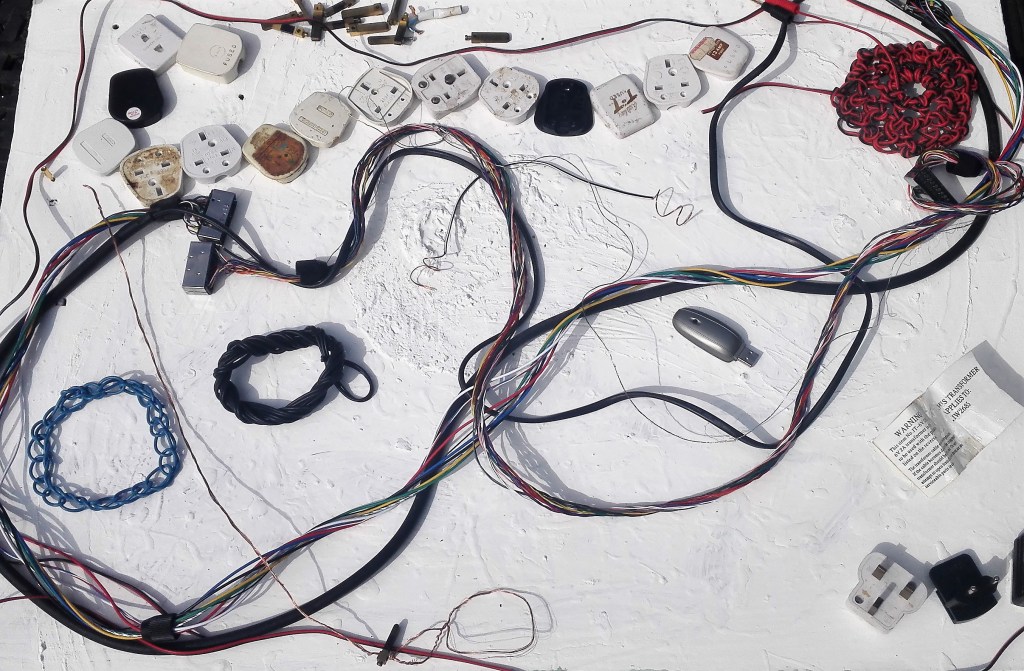
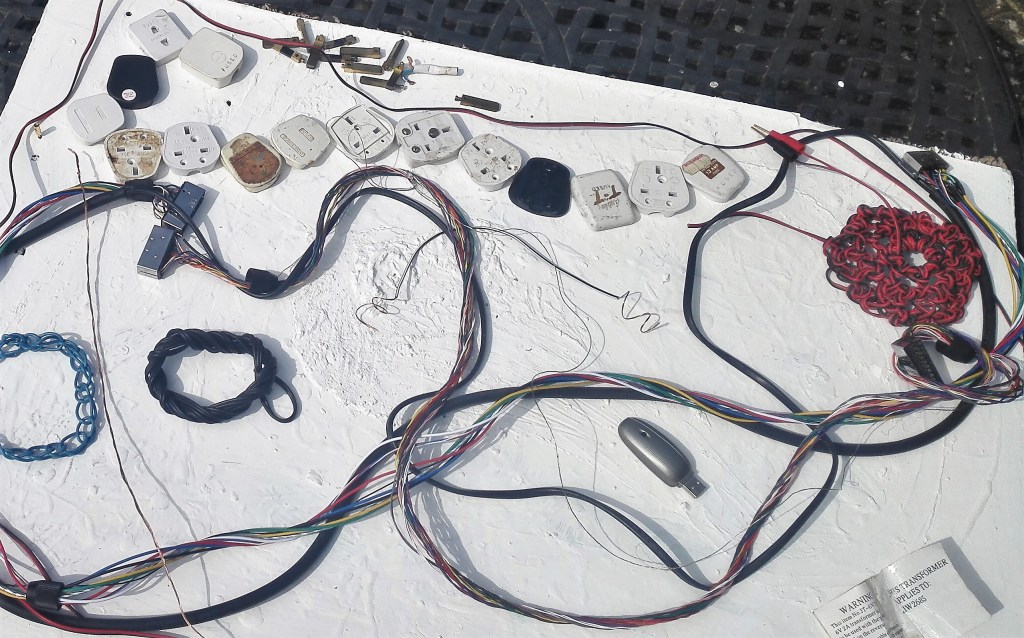
I had found that I had various bags and drawers old electrical equipment, plugs, wires, phones and other discarded or obsolete items. Could I use these and if so how? I collected them together and looked at their shapes, colours and properties including how they could be manipulated and sculpted.
Materials ?
I still had the two pieces remaining of the thick cardboard that I had re-purposed for the Combine piece and one of these could be used as the support for the work. I deconstructed some of the wires by removing their covering and disassembled the plugs which revealed their shapes. These I placed on the support to see how they related to each other and whether I could arrange them into an interesting composition.
It was whilst I was placing, removing and reorganising the materials that Marian suggested that she could use some of the wires and manipulate them into patterned shapes. This was an interesting idea and I liked the collaboration aspect. However I didn’t want to just create a pretty pattern from the objects but to suggest something else, to move them from their intended application and use them in an alternative way whilst they still retained their intrinsic properties. The three patterned shapes are included in the final piece.
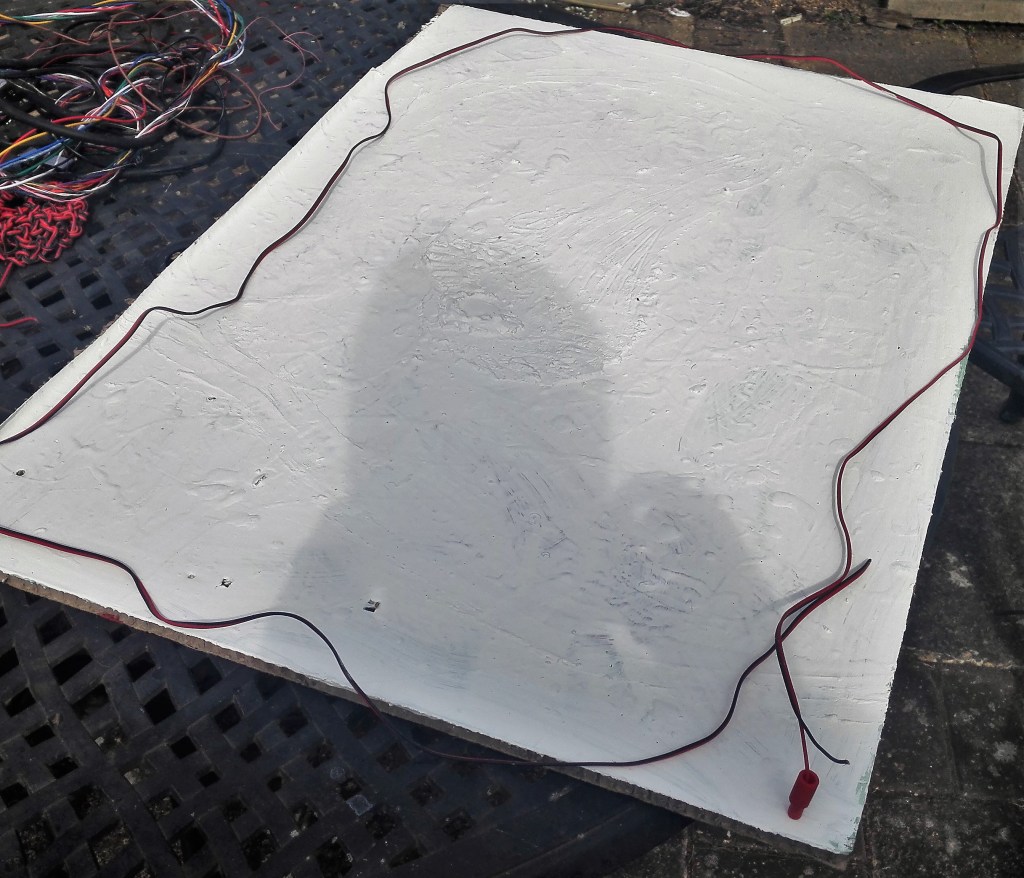
After much consideration I decided to use some wire to create and edge to the support and create a frame.
Support and framing idea
The next four photographs document a coupe of the arrangements and how I then reduced these down before building them up towards the final piece.
Totally Wired – Work in progress
Yes, I now had a name for the piece, Totally Wired. The last logistical problem was how to attached materials to the support. This was solved by the use of a staple gun and Sellotape. I would have perhaps preferred to have used some strong adhesive but didn’t have any available and due to limitations of not being able to venture out due to lockdown had to use what I had available. My final consideration was whether to add paint. The thought was to drip or pour some household paint in a random way over parts of the piece. In the end I resisted this but will be interested to hear feedback on this decision.
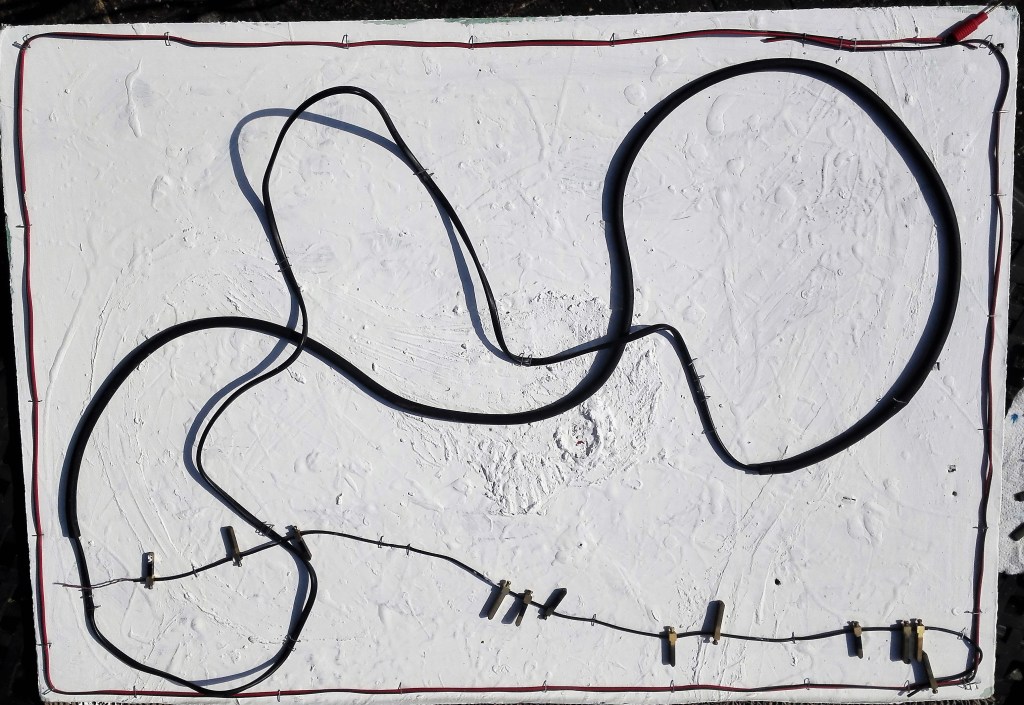
A photograph of the final piece is shown below. I am pleased with how the piece looks. The materials have moved beyond their obvious use. The abstract nature of the arrangement suggests something else, is aesthetically pleasing and I hope demands a closer examination.
Totally Wired
I hope to add a video of ‘Totally Wired’ to this blog when I have copied all of my posts to my OCA Spaces blog. Update 2/5/2020 I have now found a way to add video footage to my Blog and a separate blog containing a video of this work along with some drawing has been posted.
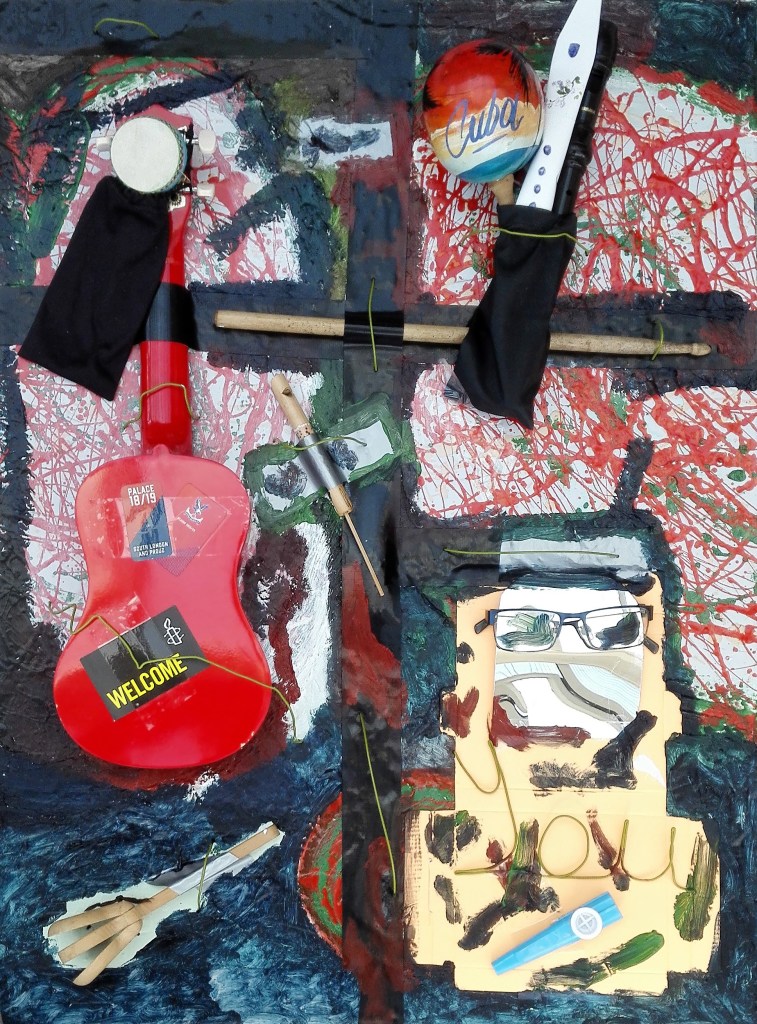
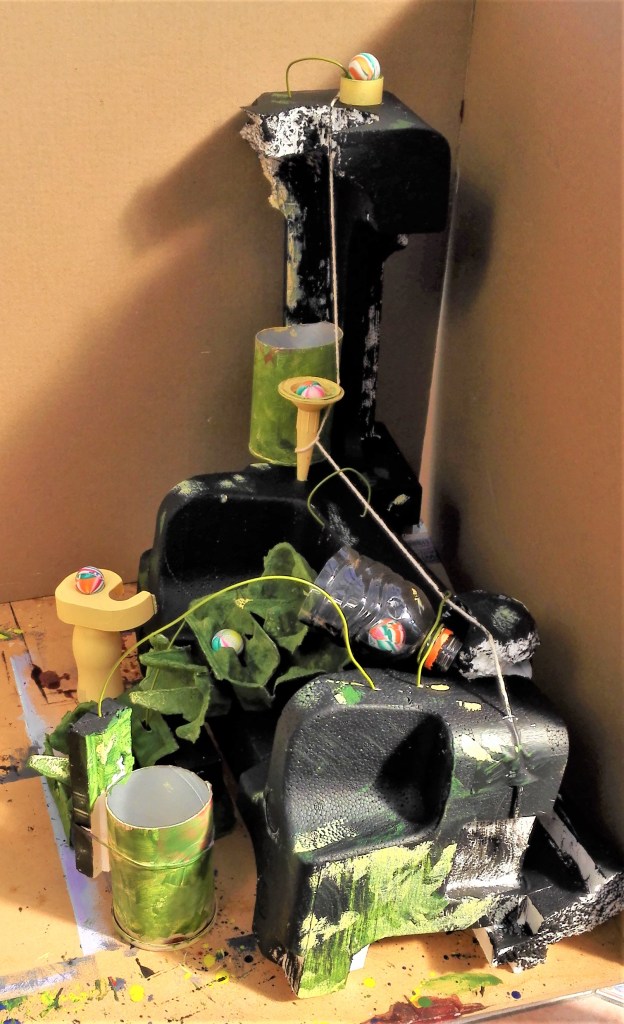
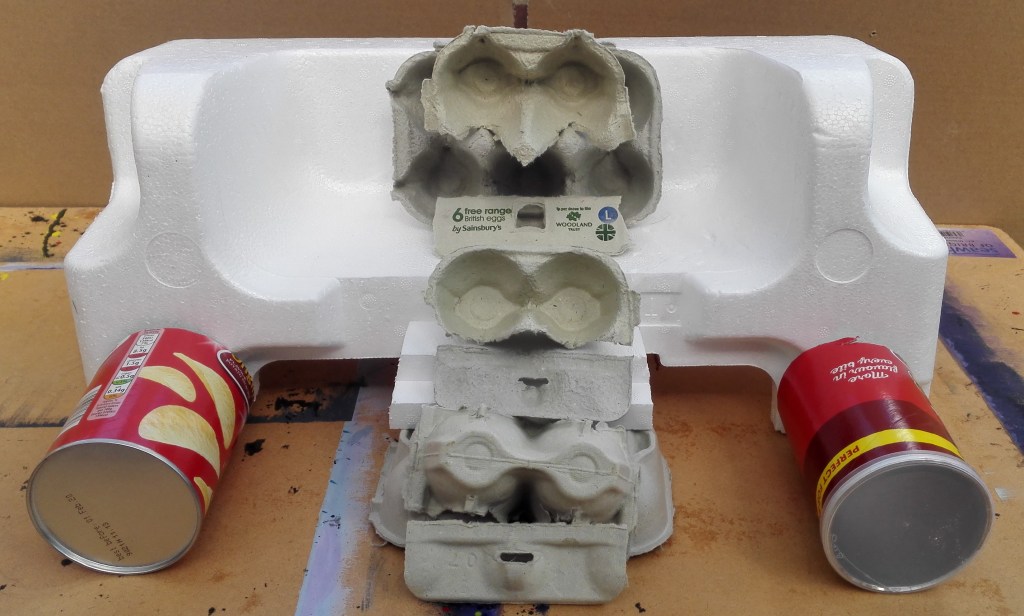
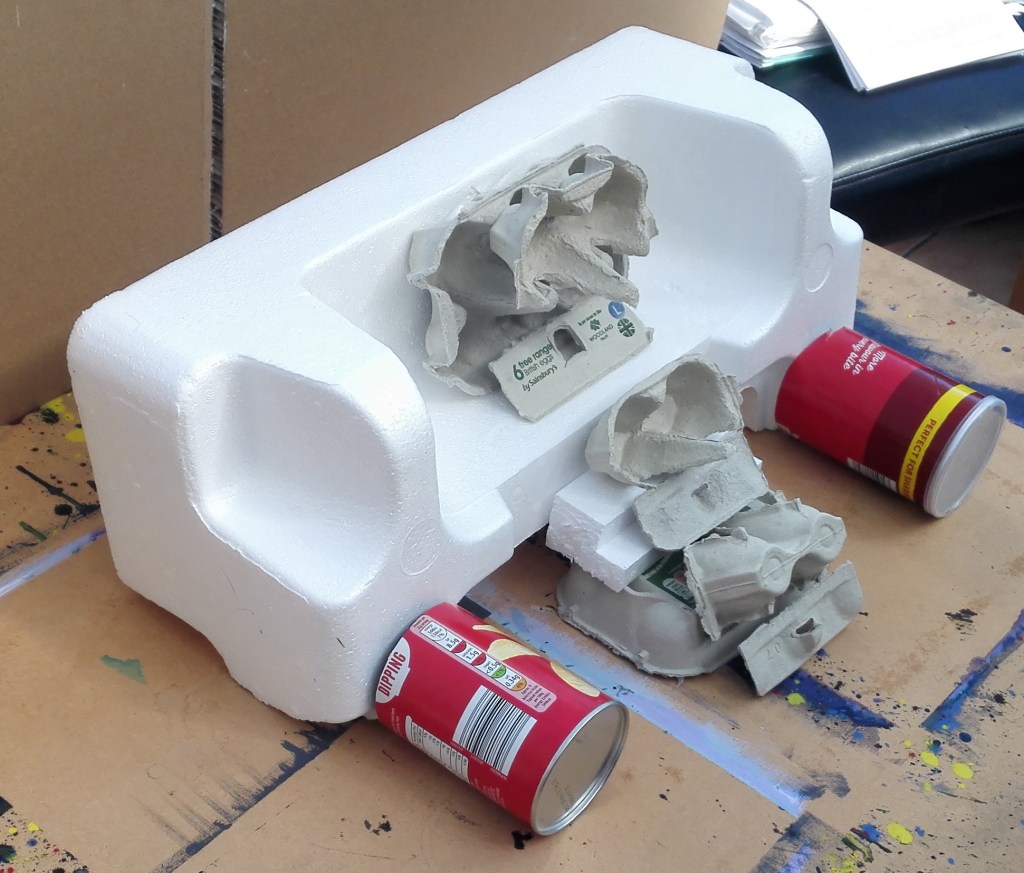
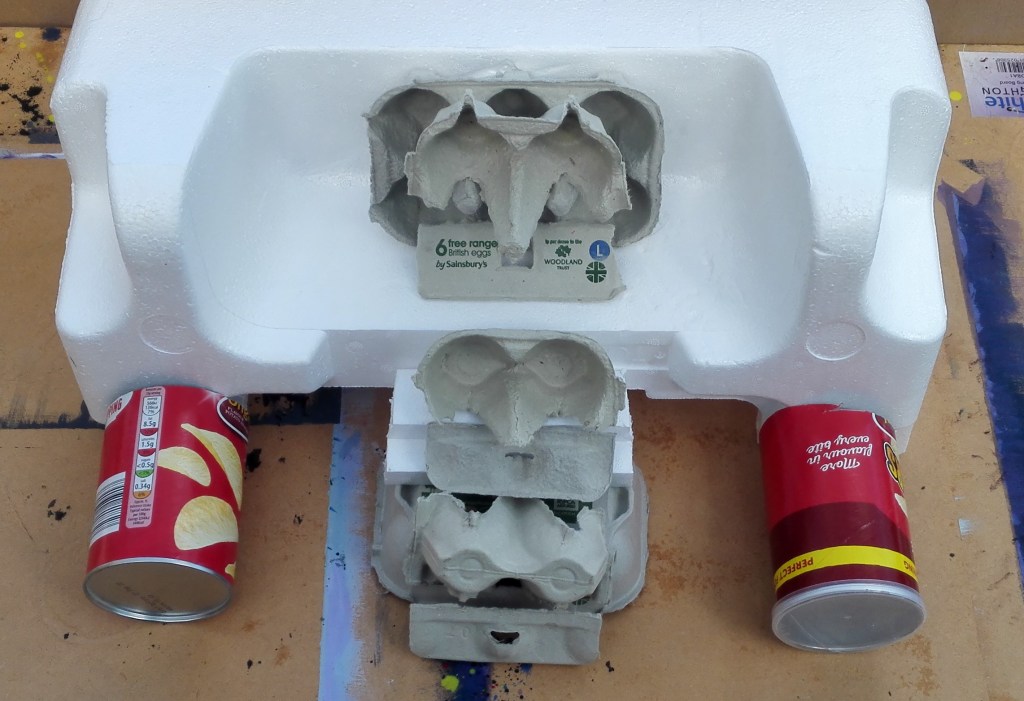
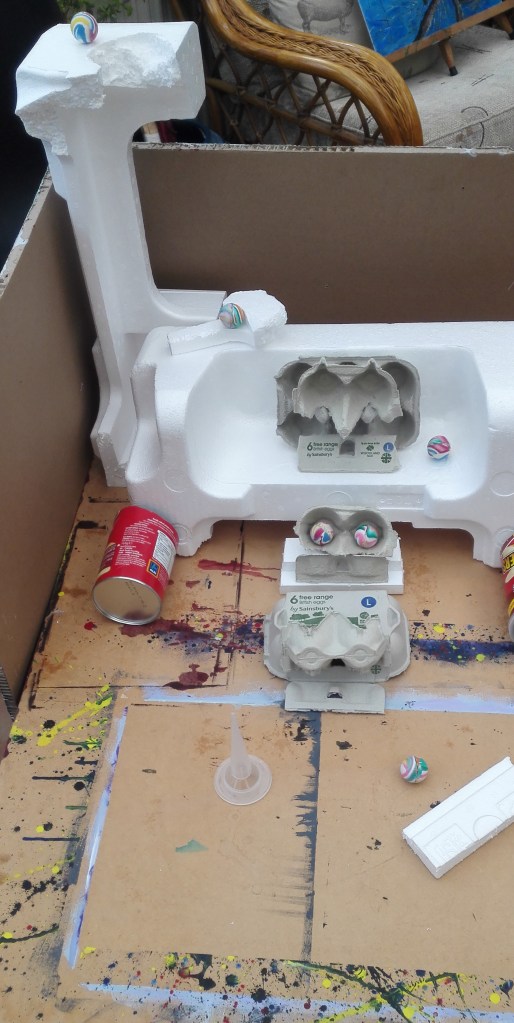
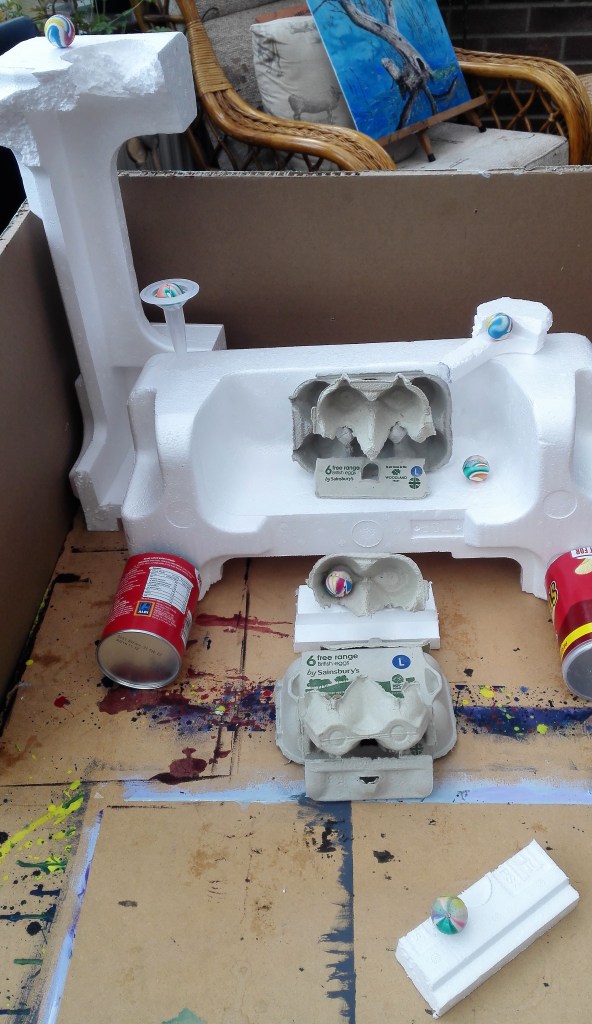
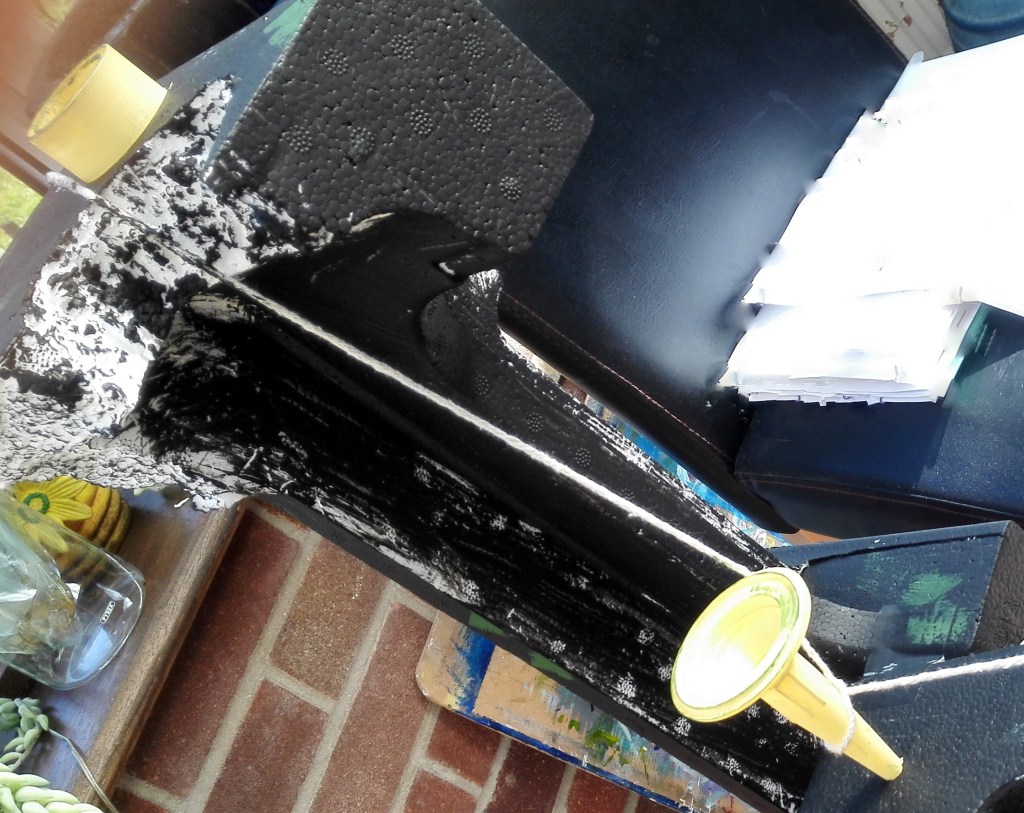
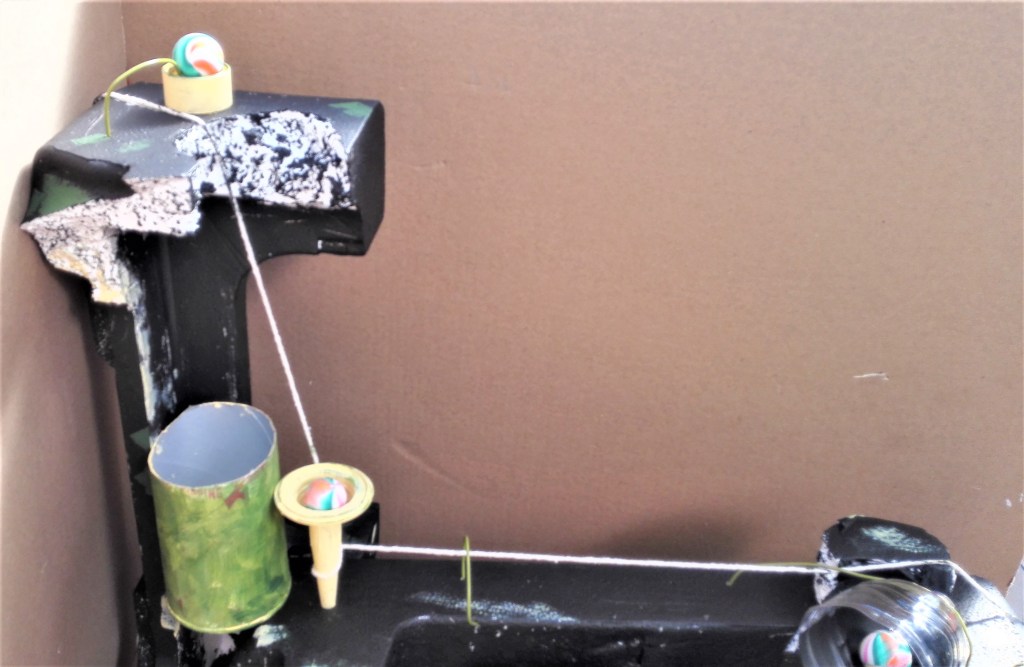
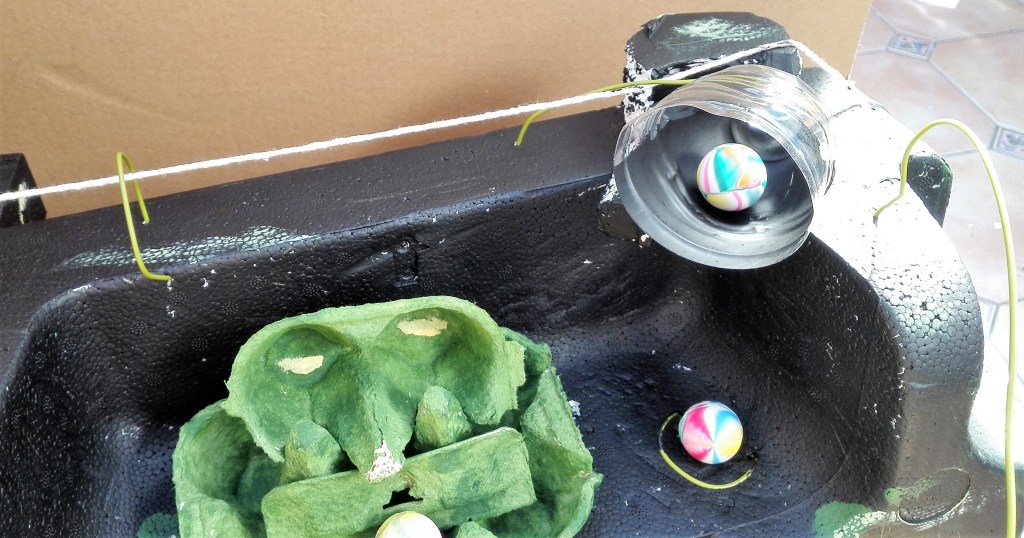
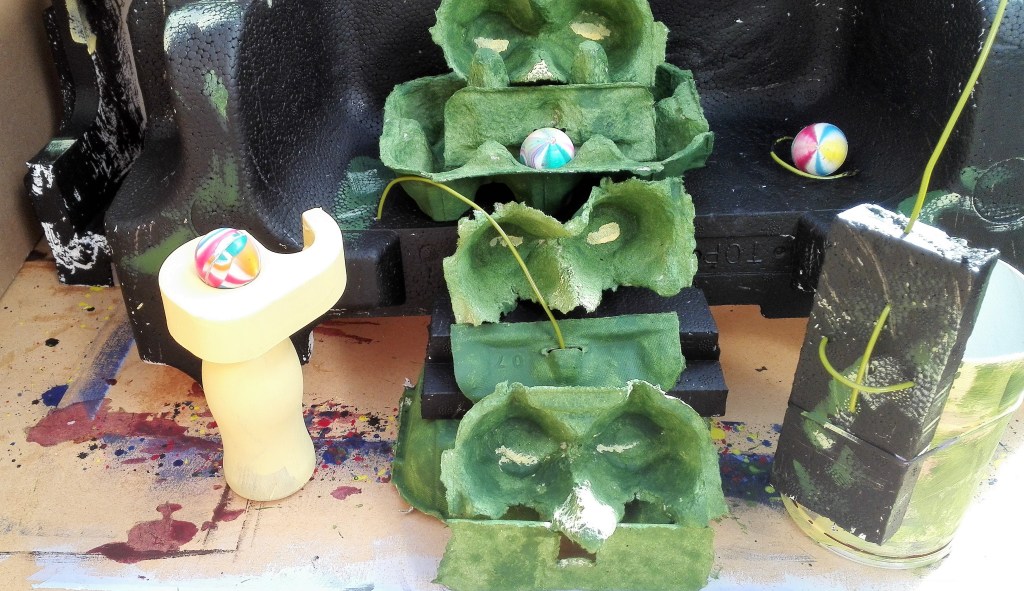
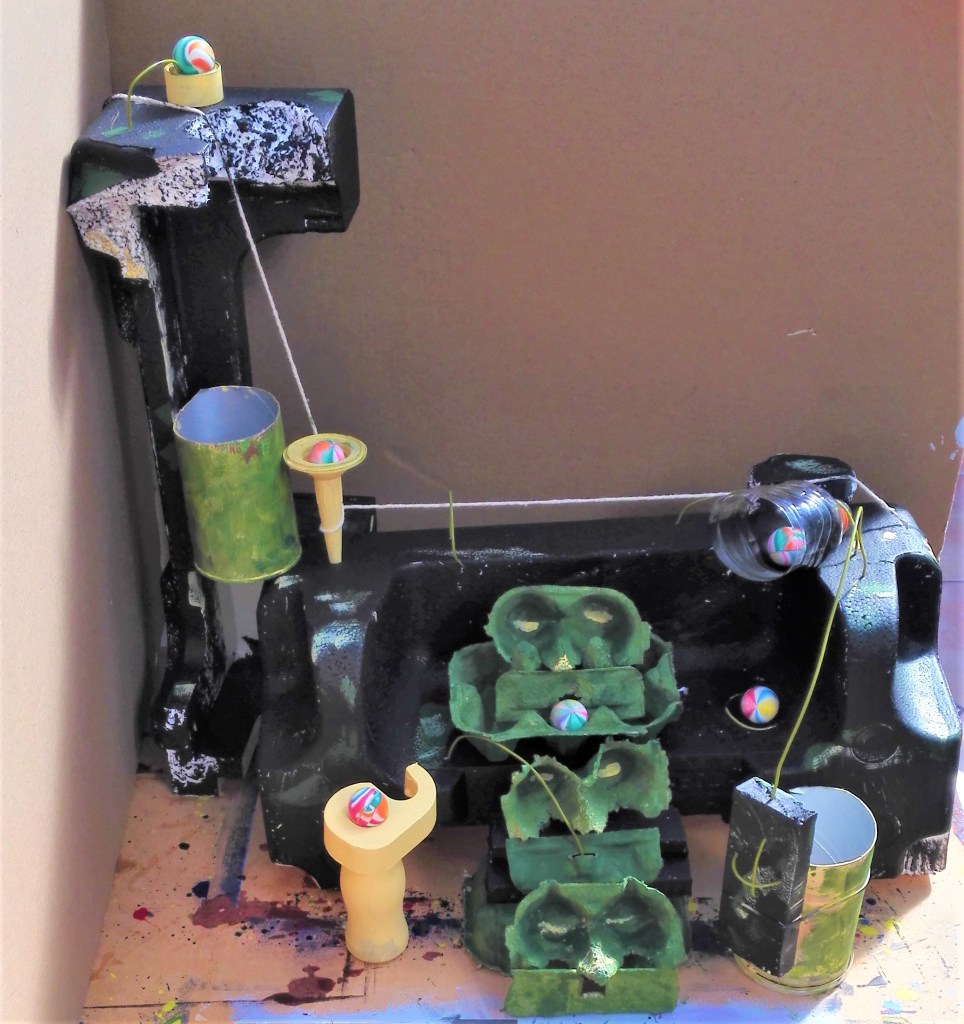
It took some time for me to embrace this exercise. I read through the requirements and was not inspired to get started. I needed to stop and think about how I was going to tackle it. As a distraction I embarked on a painting of a photograph I had recently taken. It was whilst completing this painting that I collected some objects together and started trying to manipulate them. The brief asked that the initial ideas be based upon the collection of objects pulled together for exercise 1. This I did more in idea than in using the actual objects. My main material was going to be polystyrene. The intention was that it could shape to replicate the shapes from the table. Easier thought about than done. I found that cutting and shaping the polystyrene was much more difficult than I had expected. I fashioned a piece that resembled the shape of a harmonica other shapes would be problematical. At this point I looked for other materials that I could manipulate, cut up, re-arrange. An empty crisp tube and egg boxes were added. I had a vague idea of using music as an underlying idea, perhaps creating a representation of a radio or boombox or alternatively some sort of stage.
The objects were not too large but large enough to need to be placed on a table. This could be moved around and worked upon from different aspects. The initial construction is shown in three photographs below.
Initial construction
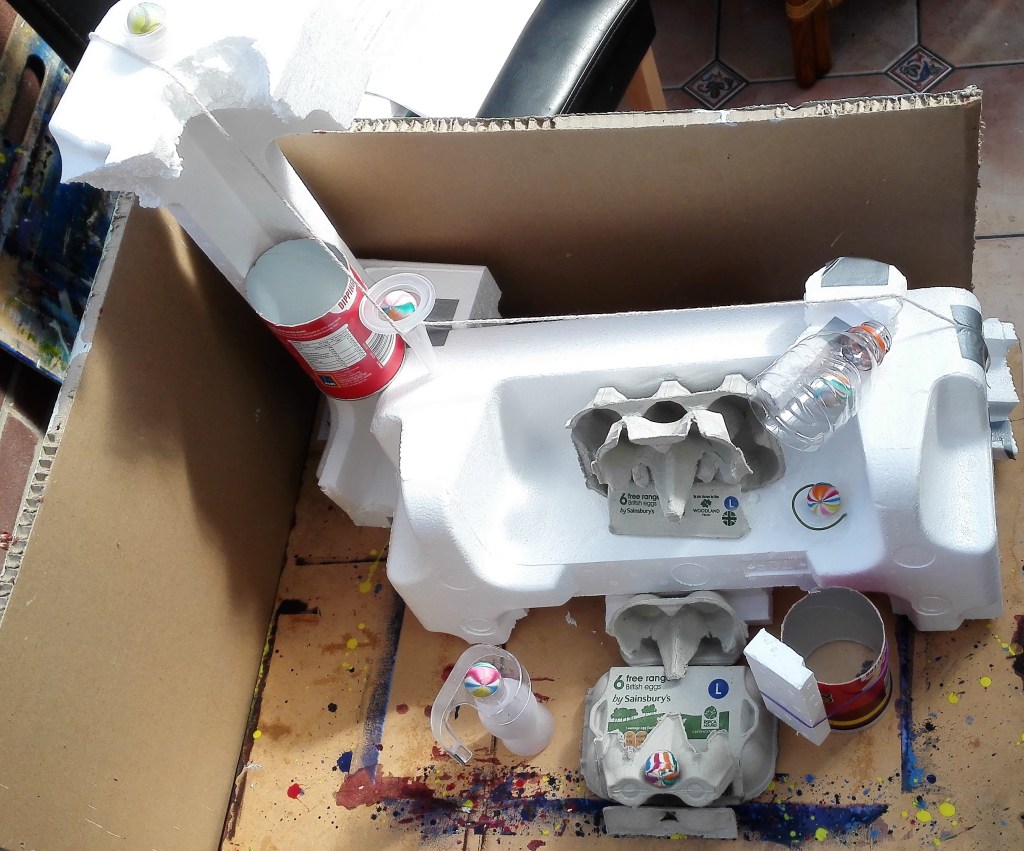
The initial construction was extended. The work started to take on its own life. Another piece of polystyrene was added which gave the work height and another piece was used to provide support. I continued to move the object around and supplemented them with further objects. An empty yoghurt pot, garden wire, a cellotape dispenser, small bouncy balls, string and elastic bands. The piece grew.
Expanded construction
I now had a relatively fixed idea of how the objects would be arranged and connected. The next step was to consider colour.
I followed the links to the work of Jessica Stockholder and Katherina Grosse. It struck me that colour and paint was used both as a skin and a way of bringing the objects together and blurring the edges between them. Colour itself has a quality, it is ephemeral and embodied. Its application is also part of its quality, applied by hand, applied in gestural ways with brushes or other tools. I would try to incorporate these ideas into my work.
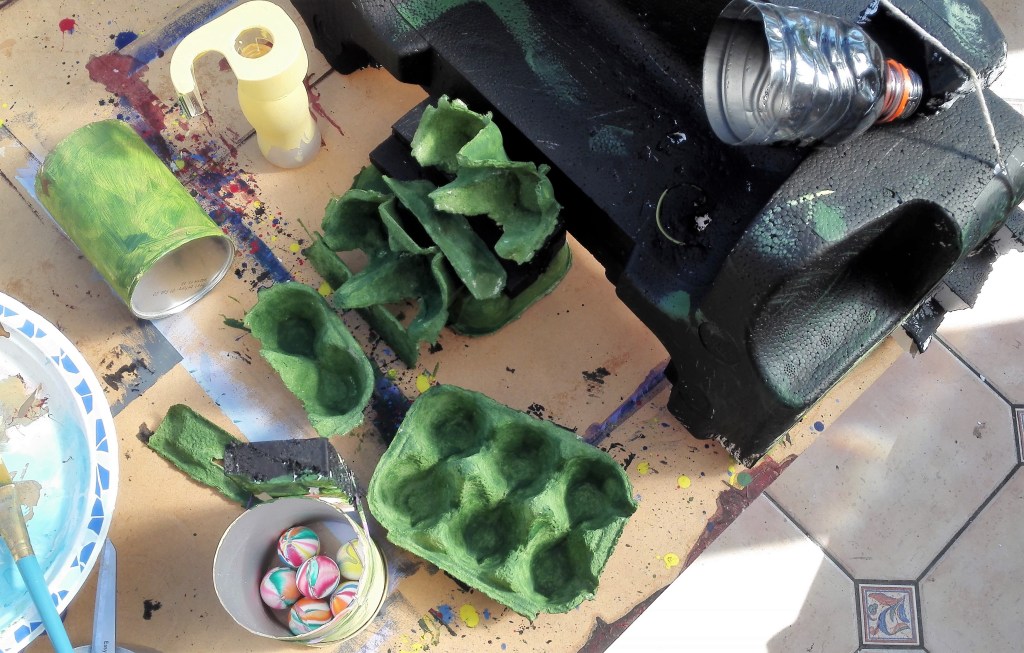
For the main blocks I thought that black would give them a look of solidity. All painting would be by brushes but I would keep it as loose as possible not worrying whether any underlying colour was visible. I would end up using three colours, black, Naples yellow and green earth. Other colour would come from the coloured balls and garden wire. After painting their was a connection between the objects and pieces that had not been apparent before.
Painted pieces
The task that remained was to construct the pieces into one coherent work. I would use the garden wire for two purposes, to aid in stabilising the work and as a link between the separate parts.
I found that the completed work was difficult to photograph and video without getting interference from its surroundings. It needs its own space in which to exist so that it can be itself. I used some cardboard to separate it from its surroundings. I then set about photographing and videoing the work. Whilst I was a non instructive name for the piece arose, Construction 1. Detailed photographs below.
Detailed photographs
What did I learn from this exercise?
I found it problematic to find inspiration. I was limited by what materials I had available and therefore had to adapt. The importance of colour in providing unity was revealing. I have continued to think of other ways I can create similar works and my approach to creation of work has been expanded.
Two photographs of construction 1 below. I also have four videos which will be added when I am able to.
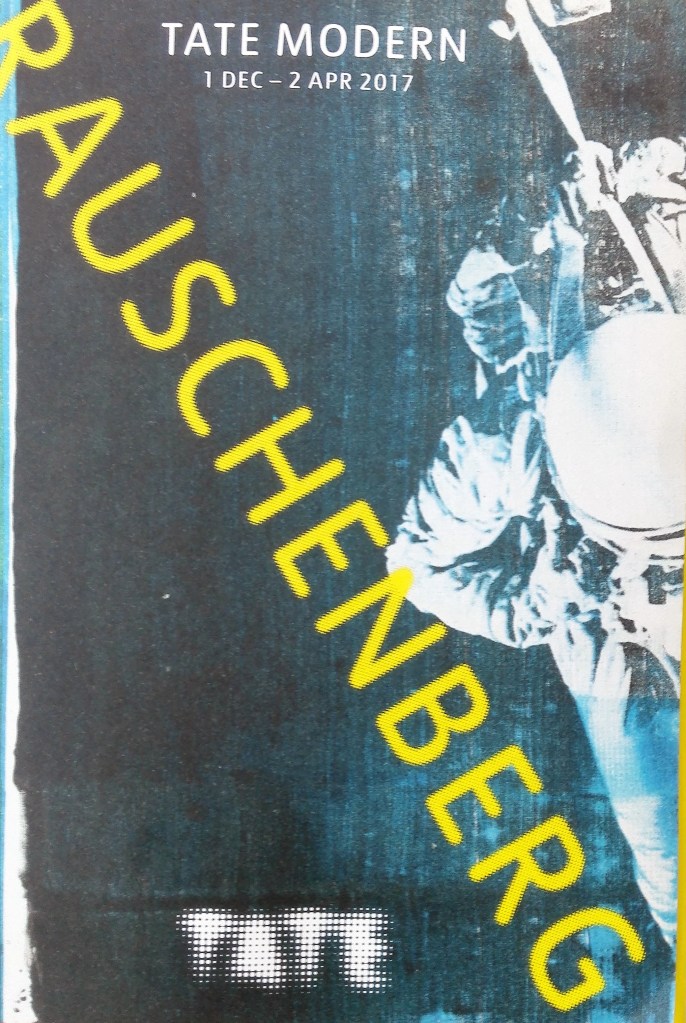
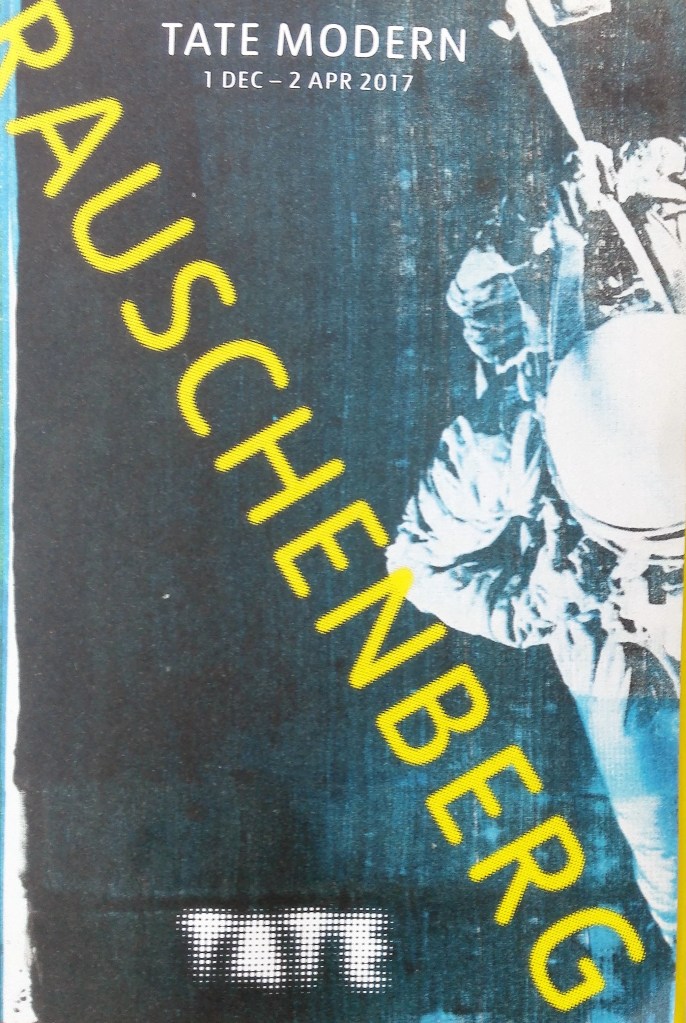
I started my blog on Exercise 1.4 with a few words regarding the Rauschenberg exhibition that I had attended at Tate Modern in 2017.
Exhibition Guide
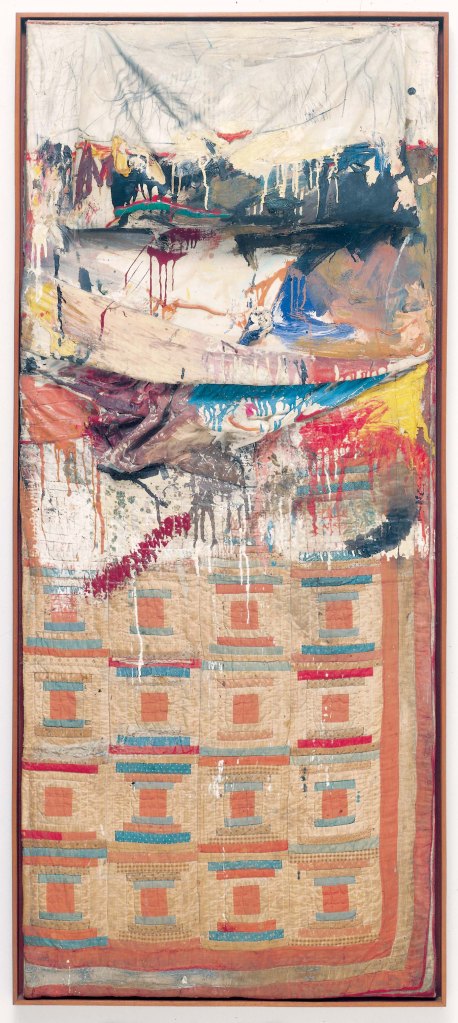
Prior to this exhibition I had confronted Abstract art, installations, and avant-garde sculpture but had not confronted Combines. The exhibition covered all of Rauschenberg’s career and only a part, room 3, included the Combines. This room along with ‘Material Abstraction’ were the two largest rooms. The Combines were different. They seemed to be about painting but had other aspects to them which at the time I didn’t come to terms with. I couldn’t make sense of them. As I recall the one that made most sense was ‘Bed’ which was completed in 1955 at the beginning of his Combine period.
Bed, 1955
It was obvious what it was but why was it contained with a frame with paint. It was a painting that utilised oil paint and pencil on pillow, quilt and sheet. It now makes more sense having worked on my own Combine and also having read more about Combines. The bed itself is an ordinary object. It is usually confronted as horizontal. Here it is presented to the viewer vertically within a frame. this was the intention to endow ordinary objects with a new significance. This topic is explored further in the article ‘On Rauschenberg – Art Theory 1900-2000’ which is similar in content with the Exhibition guide. The guide walks through Rauschenberg’s artistic life in a chronological order and explains his development. The many collaborations, the challenge to conceptions and continual experimentation with the art form.
Returning to the Combine’s they started to make more sense after reading Leo Steinberg’s lecture piece on ‘Other Criteria – The Flatbed picture plane’ in which he explains how the picture plane
“was moved from the Renaissance picture plane, which are experienced in the normal erect posture, to the work of Rauschenberg whose work challenged and overcame this so that the pictures no longer simulate vertical fields but opaque flatbed horizontals. They no more depend on head to toe correspondence with human posture than a newspaper does.“
Having read these pieces and reflected upon them I returned to Link 21 and looked to explore a couple more Combines. I selected two which are reproduced below along with my comments.
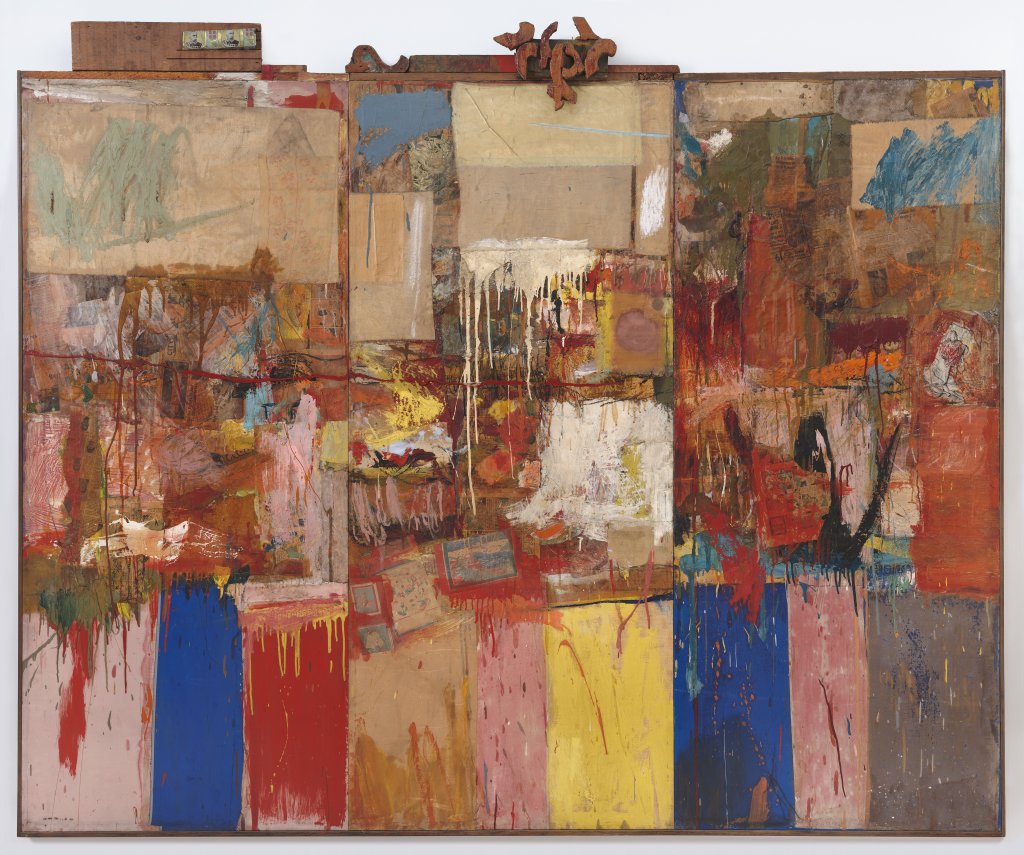
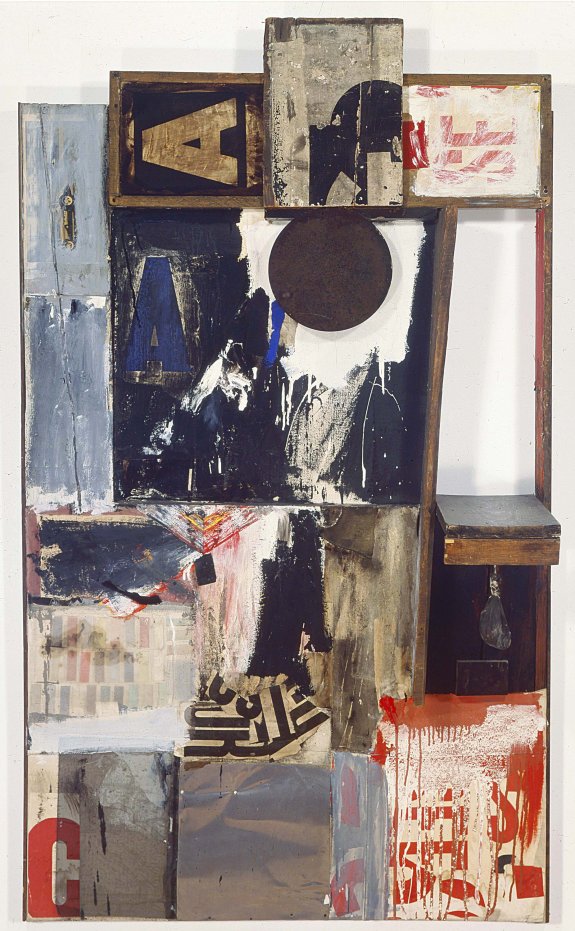
Collection, 1954/55
Rauschenberg’s Combine painting ‘Collection’ looks on first glance to be just what its title suggests, a collection of coloured shapes on which paint and been very loosely applied and allowed to run and mix. It is only when it is viewed close up that it starts to reveal a greater collection of materials and information.
On closer examination the support appears to be made up of three wood panels. However the painting is described as being on canvas. Is this a play with the idea of the triptych or another use of the title word ‘Connection’? To the frame of the paintings further wooden pieces have been added along the top. These pieces of wood have paint and fabric attached to them. Were they found like this or have they been added by the artist? The painting is made up of pieces of fabric and cloth, torn pieces of newspapers, magazines and comics which have been randomly adhered to the support. Hardly any of these have been placed in a position to be read naturally, often they are upside down or at various haphazard angles. Paint of many different colours and texture has been loosely applied by daubing, dripping and painting. Much of this paint has been allowed to run and to be absorbed into the fabric. The paint partly obscures the paper, some of it is translucent allowing the viewer to look behind. The whole painting looks faded. To me it is a collection of ideas, materials and, paints.
Magician, 1959
Oil, fabric, wood, printed paper, printed reproductions and metal on canvas with fabric pouch and string.
I find this painting very difficult to read. The techniques involved are similar to that used for ‘Collection’ but to me it is more refined. I guess that this is mainly due to it being painted 4/5 years later. The paint is more restrained, more refined and the whole composition is more coherent. However although I can observe this attributes I struggle to make an association between the painting and its title. Is there meant to be one? I note that there is another painting titled ‘Magician II’ which was painted two year later in 1961. Is this a companion piece or perhaps a follow on piece. There appears to be little connection between the two. I will return to these paintings and I hope over time some more of their secrets will reveal themselves.
Lastly I found it pertinent given the global crisis currently being endured that the strapline at the top of the Rauschenberg website is
“Artists always have been the first to rally around any national or international problem, acting as a conscience.”
When I read through the requirements for this exercise I expected a challenge. I had confronted Combines previously when visiting Tate Modern and took the opportunity to visit the Rauschenberg exhibition in 2017.
I found the Combines confusing and very difficult to read. Thinking back I was looking for a narrative to the paintings. At the time I was far more comfortable with representational work. I feel that my studies have now brought me to a place where I am better able to make some sense of Combines. However this exercise was asking for me to try to construct my own Combine. This started a train of thought as to how I could go about the process?
It took me some time to make progress. I started with trying to solve basic problems like what support to use? What to use? How to use it? A further limitation on the process was the prevention of going out to purchase a suitable support as the country had entered lock down due to the Coronavirus pandemic. This situation, in hindsight, was a benefit as it forced me to consider what I had available. The brief pointed in the direction of a canvas. I wanted to work quite large and the only two large canvases I had were used. Should I paint over these or incorporate them into the work. Whilst not my best paintings I felt that both were representative of a phase in my evolving practice and therefore I should preserve them. The two paintings are replicated below.
Old canvas paintings
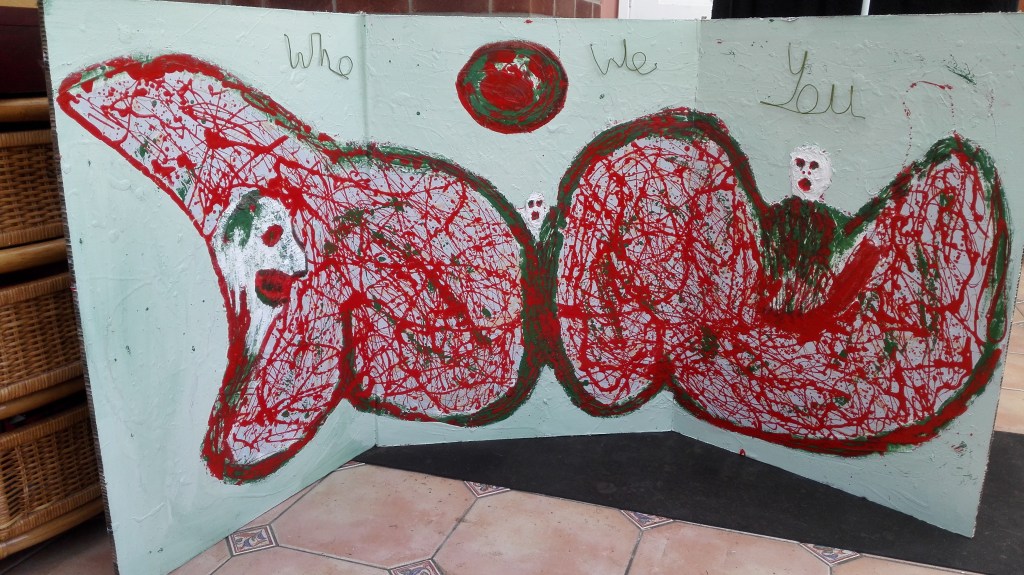
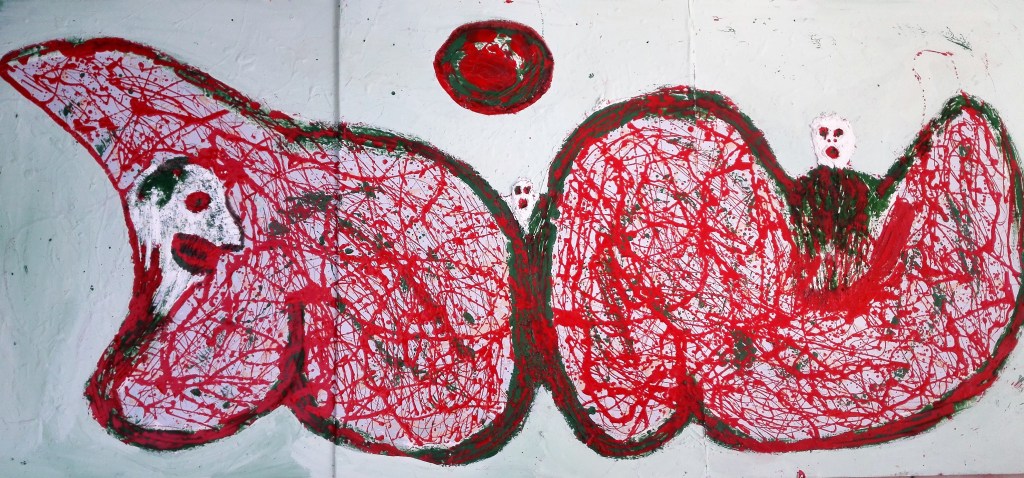
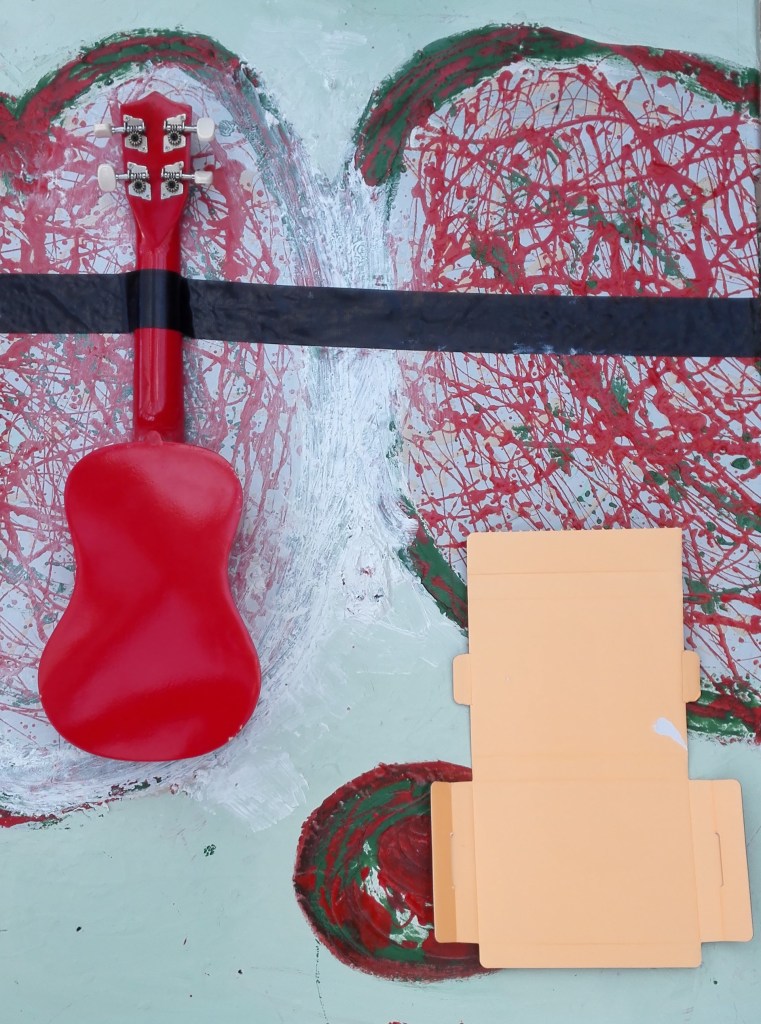
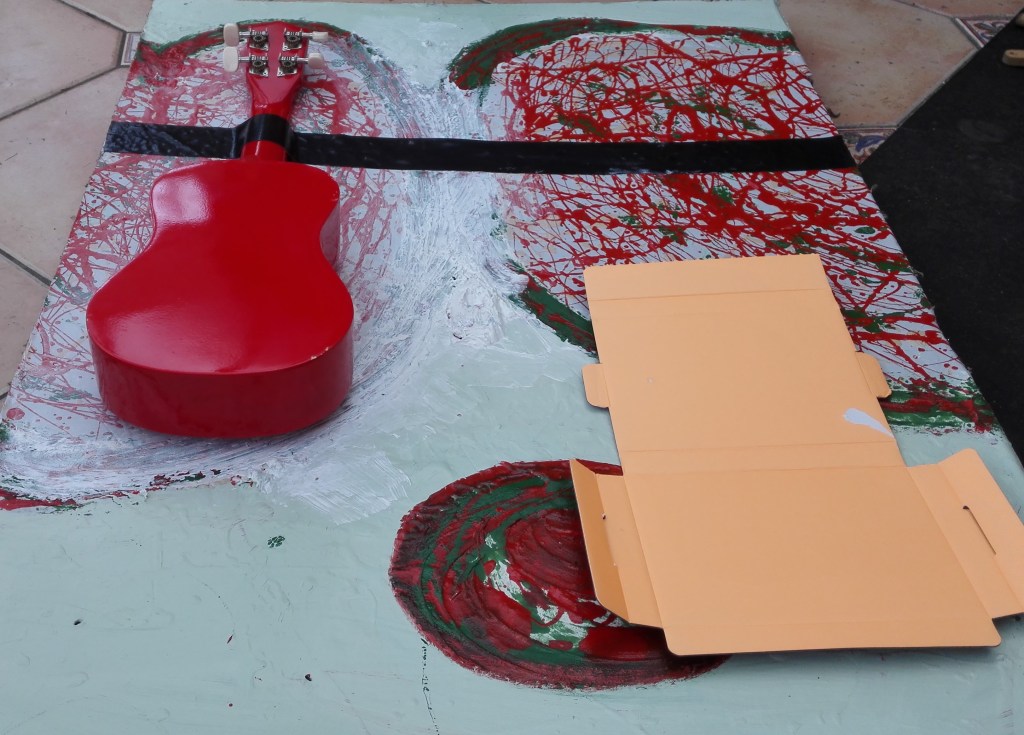
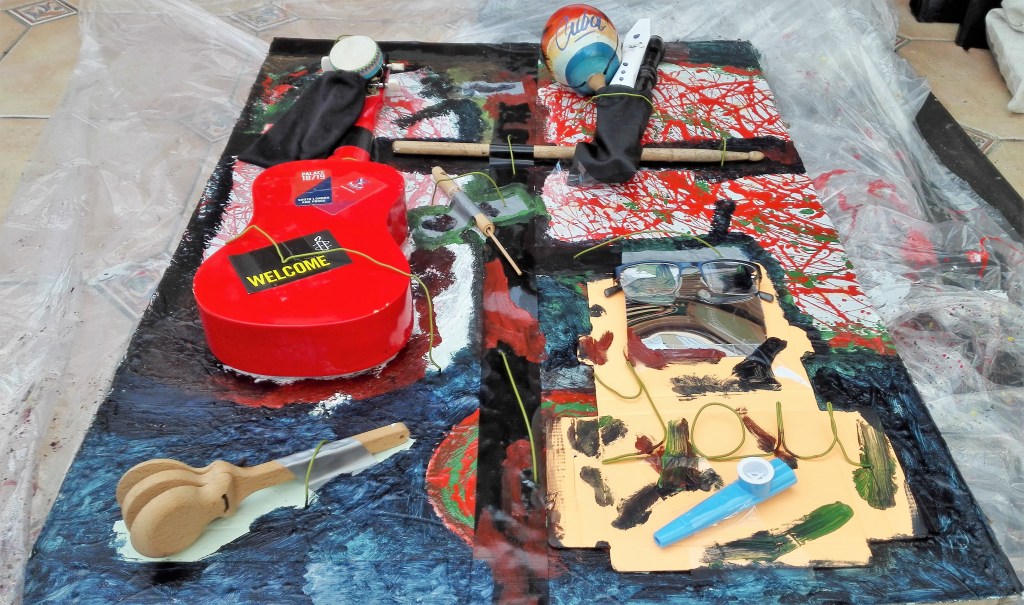
I reflected on what solutions I had used during ‘Concepts in Practice’ and remembered a large work that I had completed called ‘Who, we, you’ where I had used the cardboard that had come with the delivery of our washing machine. The work was now stored in the loft and was unlikely to see the light of day again. I could use a section of the cardboard for the Combine. Prior to its re-use I made a video of the work for my records. Two photographs of it are shown below.
‘Who, we, you’
I now spent a lot of time thinking about what to do? How to do it? Thinking about what to incorporate, solving problems, searching and finding objects, considering them, dismissing them. I seemed to be making little actual progress. It was all planning and no action but it certainly wasn’t procrastination. Eventually I decided on a way forward and started on the construct phase. The laying out of a couple of objects on the support and then the attaching of them broke the impasse and I now had a physical work in progress.
Combine – work in progress first steps
The physicality of what I was doing was far removed from the act of painting but it felt creative. A process was unfolding where I was adding, taking away, moving, arranging, considering and reacting to what I was placing on the support. Did the objects look and feel right? What was I trying to say about them? did I need to say anything about them?
Combine – work in progress continues
A pleasing aspect of the process was that I didn’t feel constrained. I felt an energy towards the work. It was tactile to move objects around and to move around the work. Whilst working I took time out to look at Rauschenberg’s Combines and to try and draw inspiration from them.
Combine – Work in progress approaches conclusion
Combine – Work in progress video
I noted that many of Rauschenberg’s combines were titled and my mind considered many options for naming my work most of which I thought were pretentious. I should allow the finished piece to convey its own meaning if it has one at all. The last step was to add paint. Again I spent more time considering, reflecting and pondering how to add paint, what colours to use, controlled or random application. I finally arrived at applying paint loosely using a brush.
Combine – finished workCombine – finished work
The addition of paint seemed to bring the work together and gave it a coherence that wasn’t previously present. The objects now had a relationship to each other became unified. Have I completed a Combine that can be read, does it say something, is it interesting to look at? I am unsure. I enjoyed the process, particularly the act of creation, but wonder at the result.
I did make a couple of short videos where I moved around the painting and spoke about it. The video of the finished can be found vis the link below.
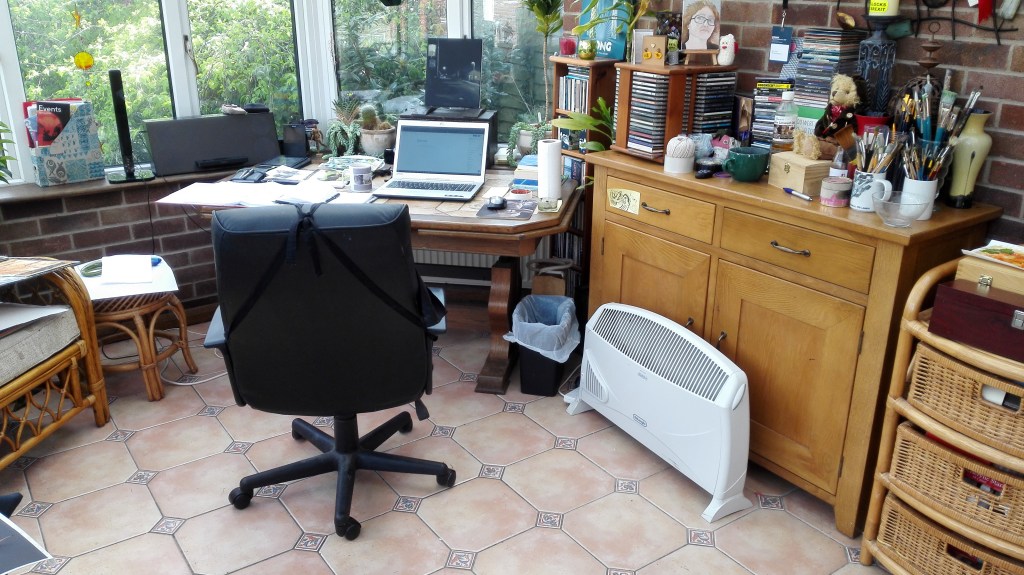
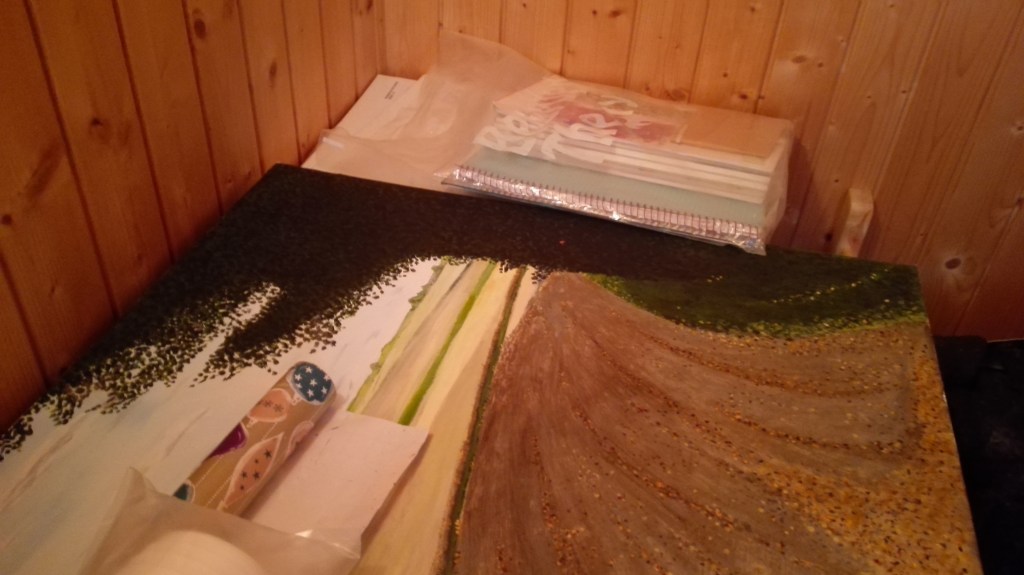
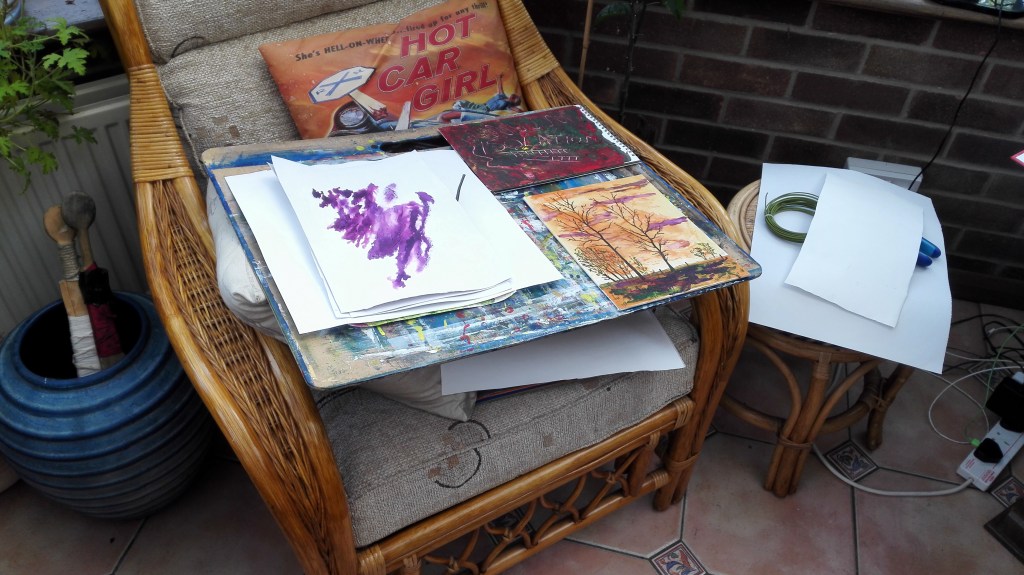
This is the place where I spend more of the daylight hours than anywhere else. It is situated in the conservatory at the back of the house. The room is entered via the sitting room. I still consider it to be a shared space but in reality I am the only one who uses it. It can be cold in winter and hot in summer but mostly it is a pleasant place to be. The view from the studio is to the back garden to which there is a door.
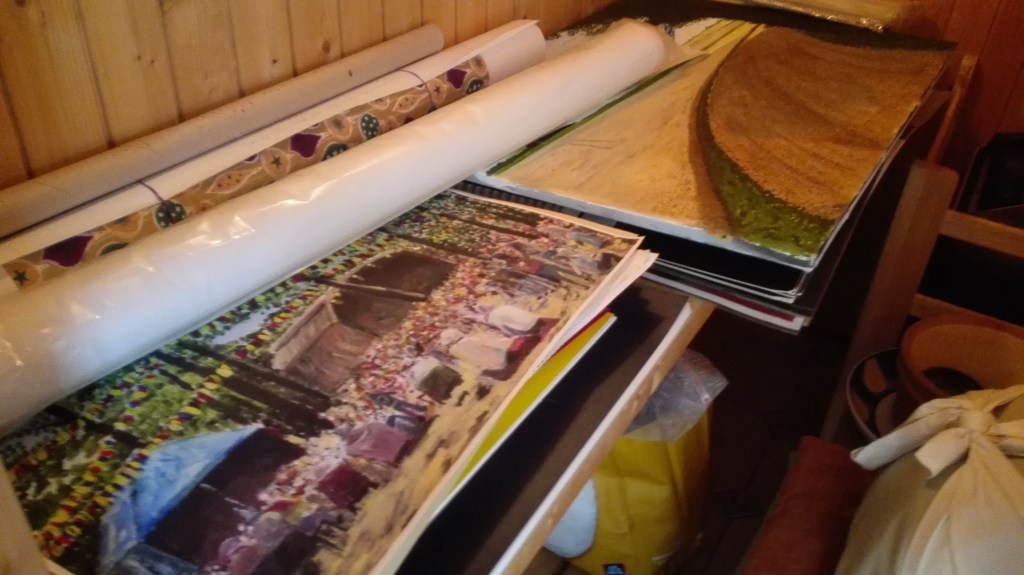
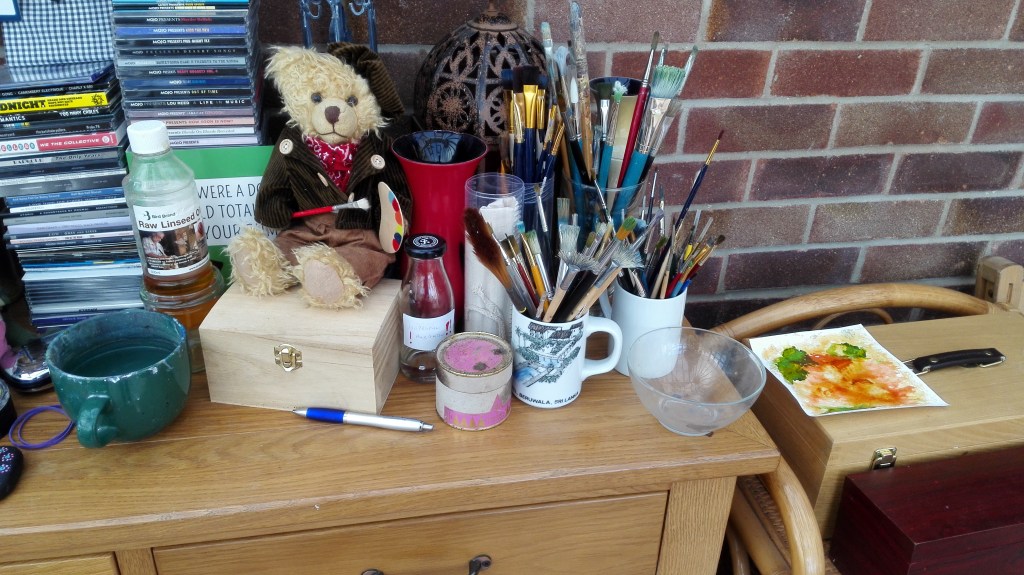
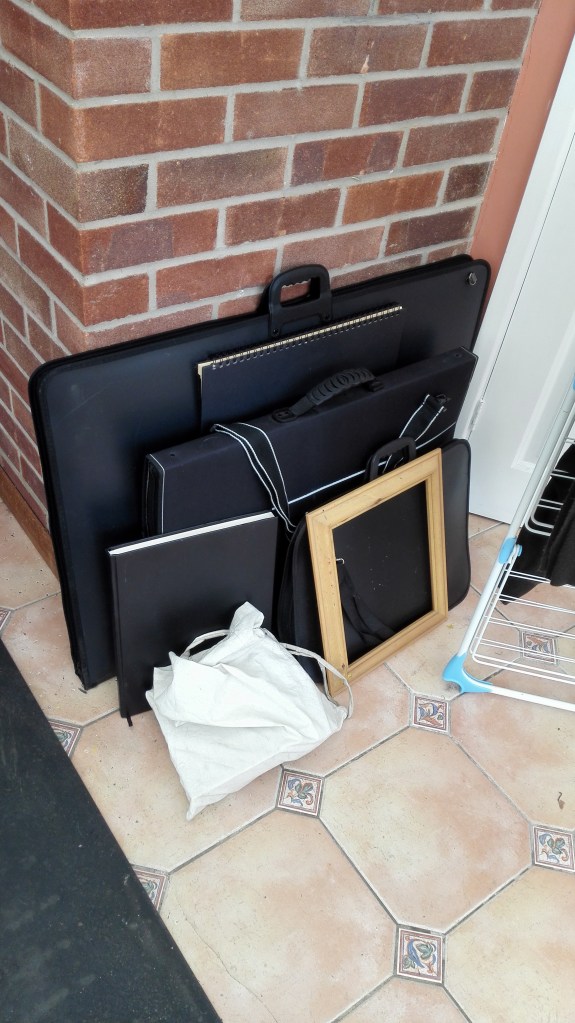
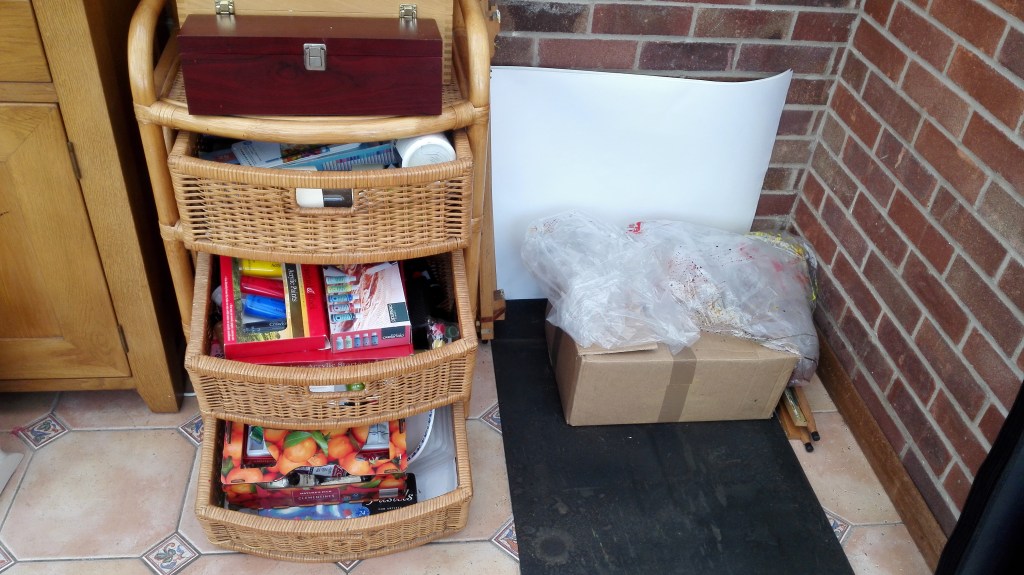
The room contains all of my art equipment, materials and supports which are all easily accessible. I do feel the need to keep the room reasonably tidy. I consider it to be part of the living space of the house but as said before I am the only one who uses it. It does have a dart board and dart mat which I like to keep free for practice and distraction. Rather unusually the room also contains a sauna and shower room. The sauna is rarely if ever used and currently I use it as a storeroom for supports, canvases and paper, and old paintings. The space above the sauna is where I keep old sketch books and packing materials.
Inside the sauna
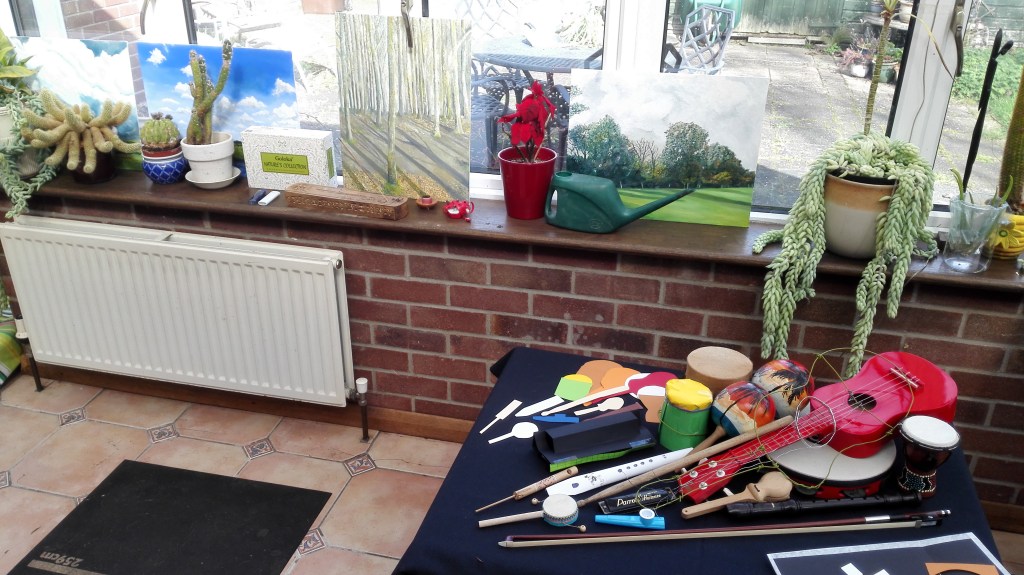
Whilst considering my studio for this piece I feel that it could do with some reorganisation. It was partly reorganised so that I could set up the table of objects required for exercises 1.0 – 1.2, this is still in place.
The table of objects with background of plants and paintings
I tend to keep on display the paintings that I have recently completed, I live with them for a while until I have moved on to new works. My desk has been described in an earlier blog. It always has my laptop, my OCA course book, my sketchbook, my notebook, my diary and my ipad mini which is mainly used for listening to music. Listening to music is a constant. sometimes I am not really listening.
My studio is a pleasure to be in. I like working in it, sitting in it. It is comfortable. I take my breakfast into the studio everyday. It is part of my routine which if I have no other commitments runs something like this.
9-10am Breakfast, emails, actions and update my diary
10am – 1pm Current OCA projects
1pm – 3pm Lunch and walking the dog
3pm to 5pm More work and painting
5pm – 11pm Other activities, I’m not usually in the studio during this time, often out.
More photographs of my studio
A Day in the Studio – Uri Aran
My first impression when looking at Uri’s studio was that it had an area displaying completed works and an area with work in progress. The works area is messy and confused and Uri explains why it is so. He states that a lot of his work is trying to organise, make sense of things, waiting, thinking, reflecting, trying out ideas and what I found most interesting, letting things age together. His process is about trying to tell a story and to represent this story using the objects in his studio. I was curious to find out how objects made there way into his studio but that I another activity. Collection and selection.
Valerie Mrejens ‘Start working’
This is a piece about procrastination.
Whilst I can sympathise with the feeling and notions expressed I have over the years been driven by deadlines. In my professional life, before retirement, my life was a series of deadlines, daily, weekly, monthly and annually. I seem to have retained this discipline and use the setting of Assignment deadlines as one of my motivations to complete the next task and keep moving forward. I do read ahead and try to ascertain what the next projects are and think about how long they may take. Is the deadline realistic? Do I need to get a move on? I keep a record of how much time I spend on my OCA studies. This helps to assure me that I am on course. I do put other tasks on hold at times so as to prioritise my studies. There is plenty of work to do in the garden as spring is here, what gets done gets done what doesn’t is left undone.
Where I sometimes struggle is with inspiration and this can lead to procrastination. This is particularly true if the task or project doesn’t resonate with me. It is then that I have to try alternative strategies. This can involve anything from walking the dog, going and playing my guitars and ukuleles, listen to music or perhaps painting something I want to paint. Once I regain focus on a task I find that I tend to get on with it, often with a rush to finish before the inspiration goes. The danger with this is that the full realisation of the idea or project is left without being fully explored.
Initially I found this difficult to read. It took me some time to adjust to how the words and phrases were put together and I had to change how I read. In many respects the work felt like a long poem. Images were placed in my mind that made me think about why they had been written. Where was the connection? Often I found that Stein was describing what something isn’t and at other times describing an aspect of an object that would not immediately be what I would choose to describe it. As an example of this I choose the following extract
A PURSE
A purse was not green, it was not straw colour, it was hardly seen and it had a use a long use and the chain, the chain was never missing, it was not misplaced, it showed that it was open, that is all it showed.
From this I take that it was an empty purse and that would be the only aspect of the purse that would be observed. All other information being superfluous. It doesn’t matter what colour it is. Its use is of no importance. That it had a chain and the fact that the chain wasn’t missing was only an afterthought. The salient point was that it was open and that was all it showed. It contained nothing.
We are used to language giving us information that we take for granted. It has how we have been conditioned to see and respond to the world around us. A representational language that describes what we see. To me there are obvious parallels to how the cubists represented the visual world. They challenged the conventional representational art. They painted multiple views of objects from many angles and perspectives. Different facets and multiple views can all be seen at the same time. This is how the eye sees the world before the brain processes it a makes sense of it. You are able to move around the an object or see a view and relate to it by moving around it or through it.
A S Byatt discusses Henri Matisse’s ‘The Red Studio’
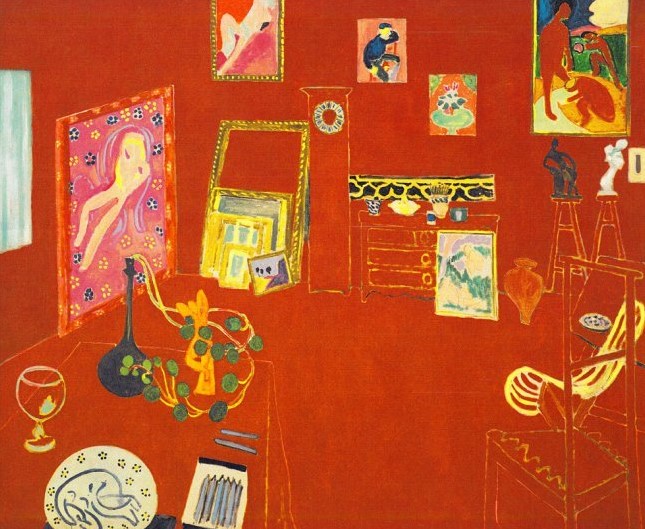
In this discussion A S Byatt describes her fascination and admiration for the paintings of Henri Matisse and in particular ‘The Red Studio’. She describes how every aspect of the composition from its collection of objects, how they are described and painted the colours used has been carefully considered. Everything is where it is supposed to be, its form, its perspective and their relationship to each other and the spaces between the objects. The eye can wander around and through the studio. The red colour carefully chosen exudes a feeling of warmth.

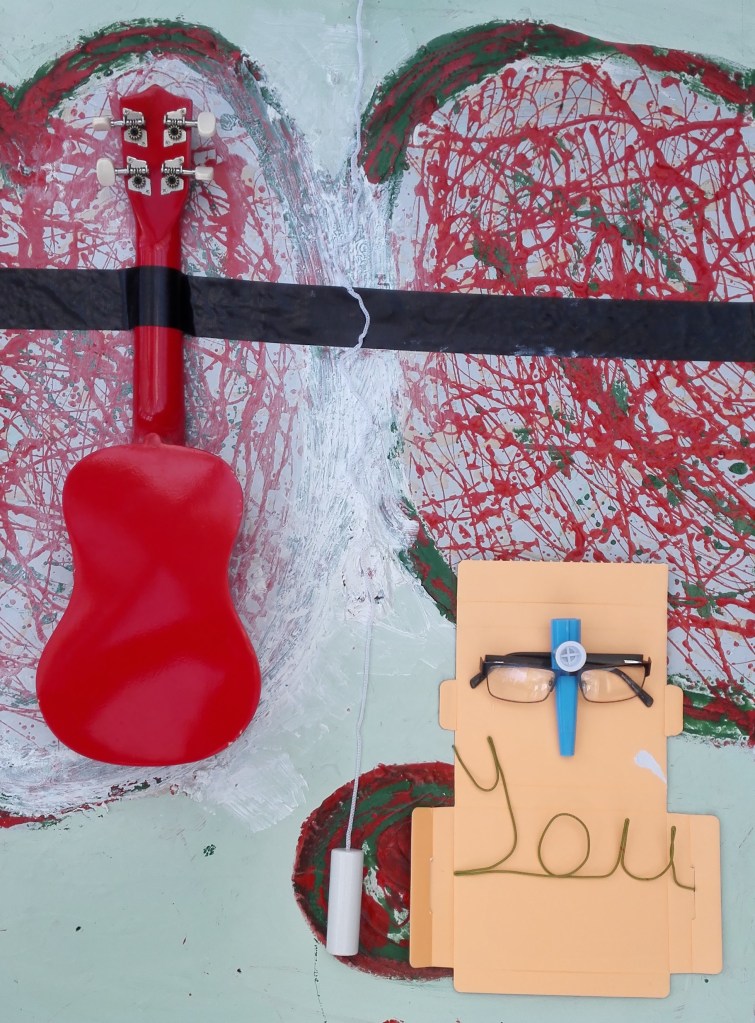
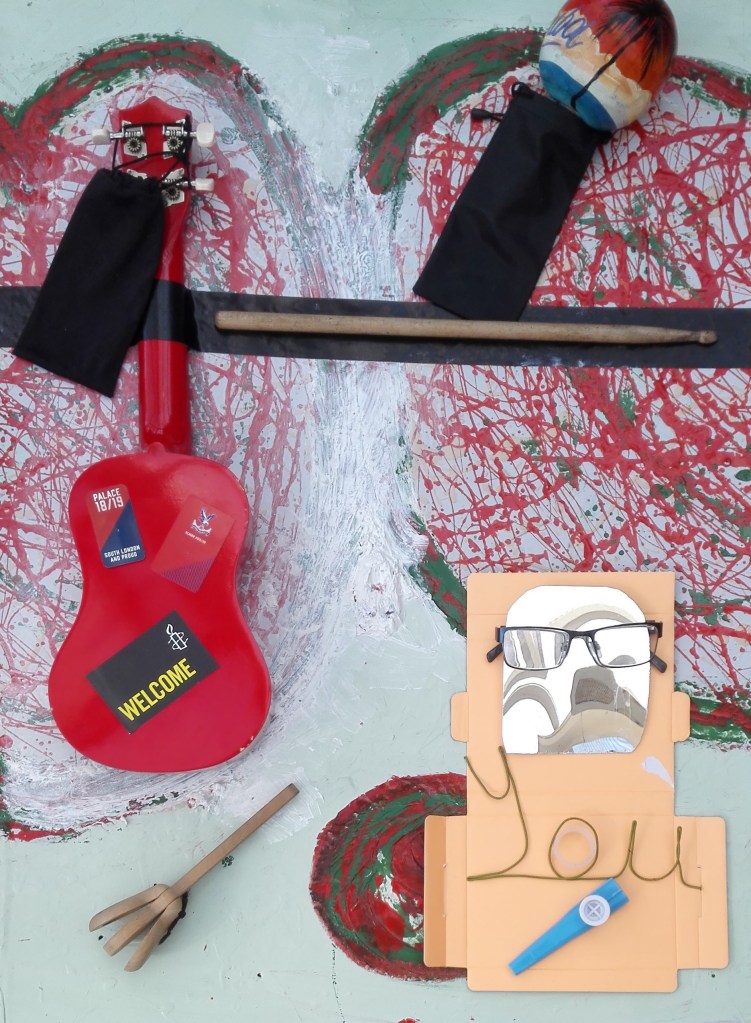
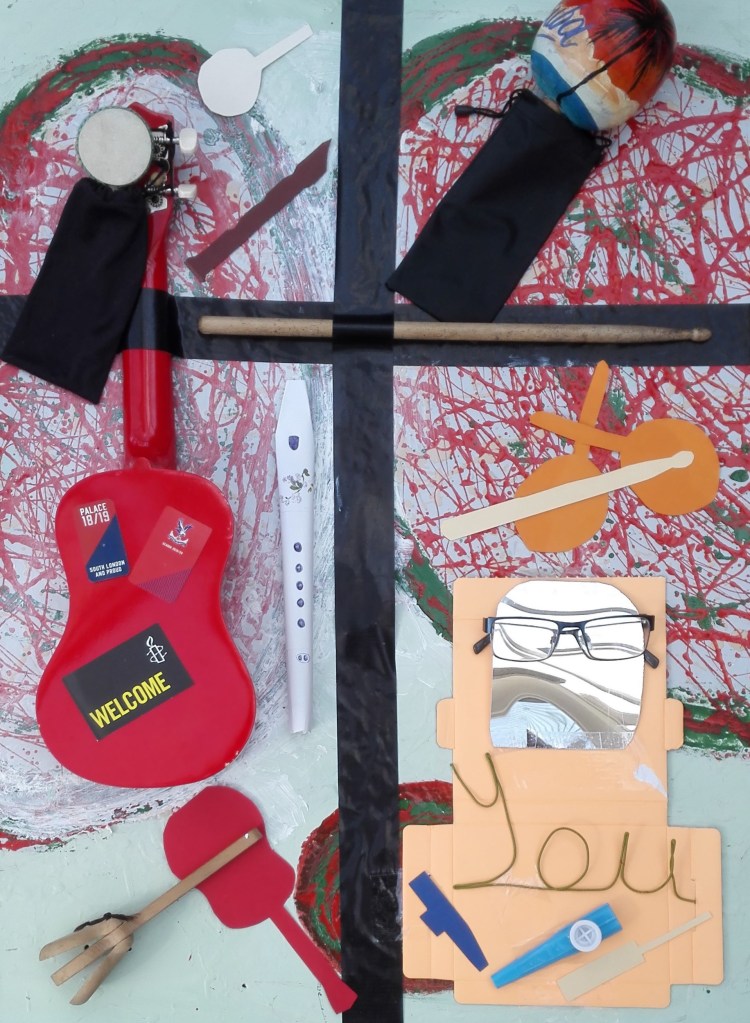
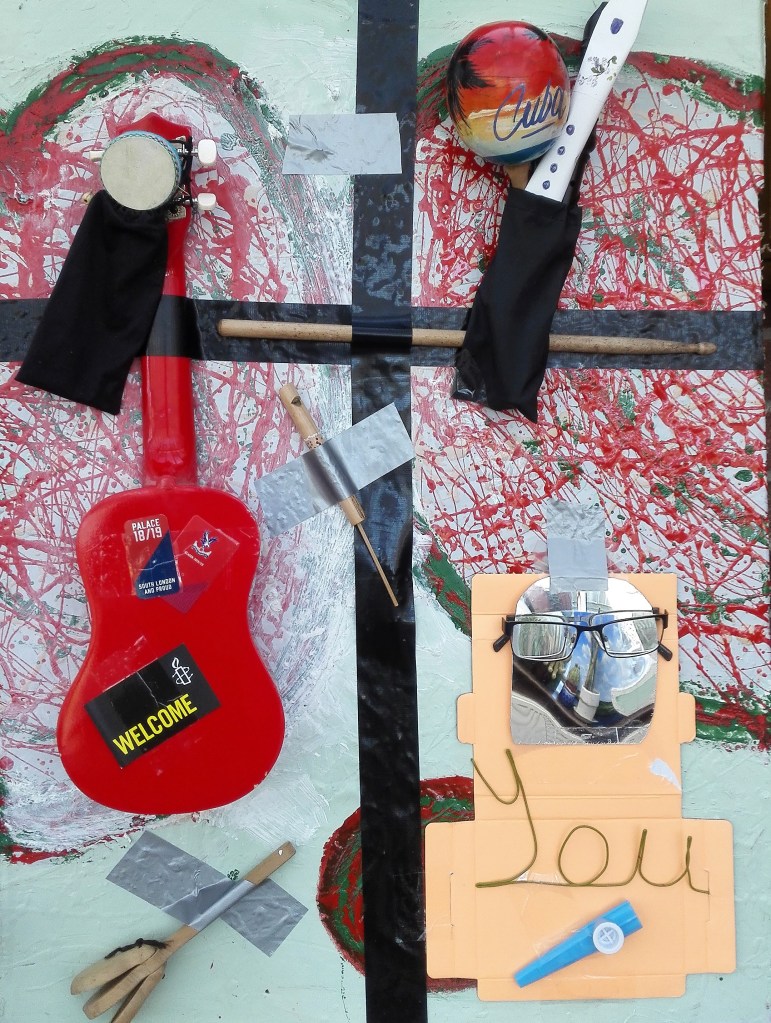
 Mark Taylor 'Studio Practice'