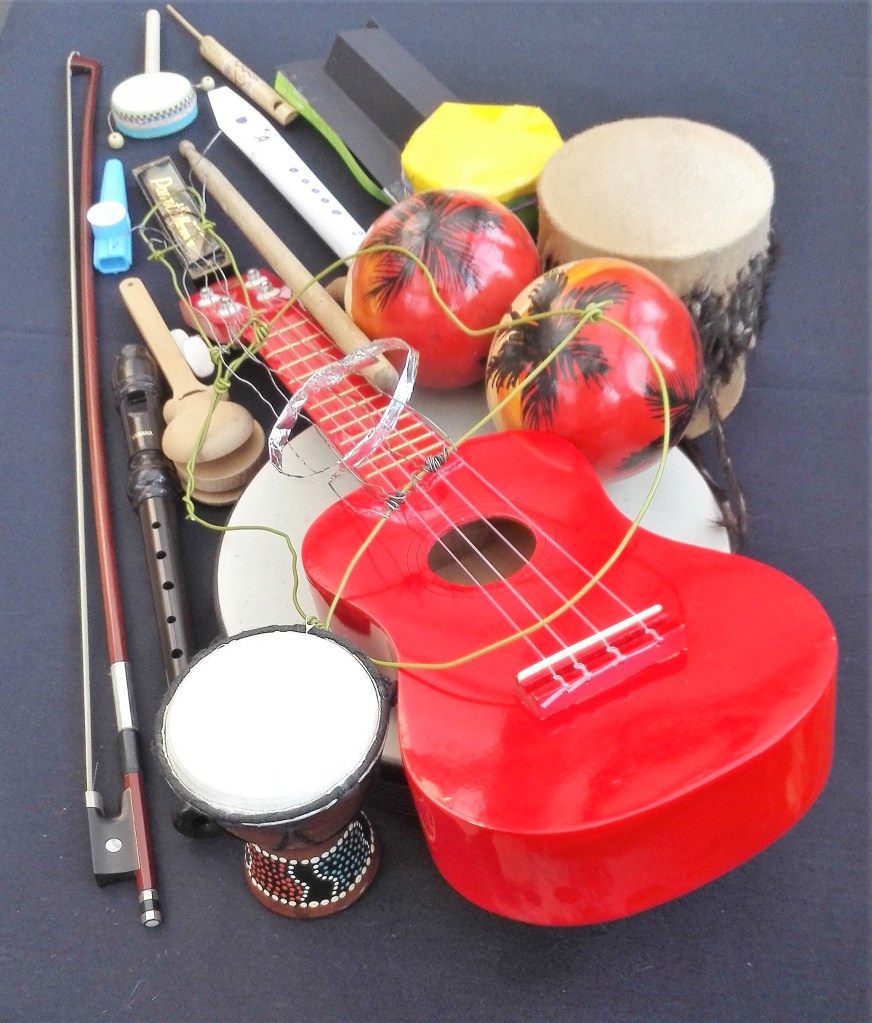
Part Two – Project Two – Exercise 1.1 Observe / Record

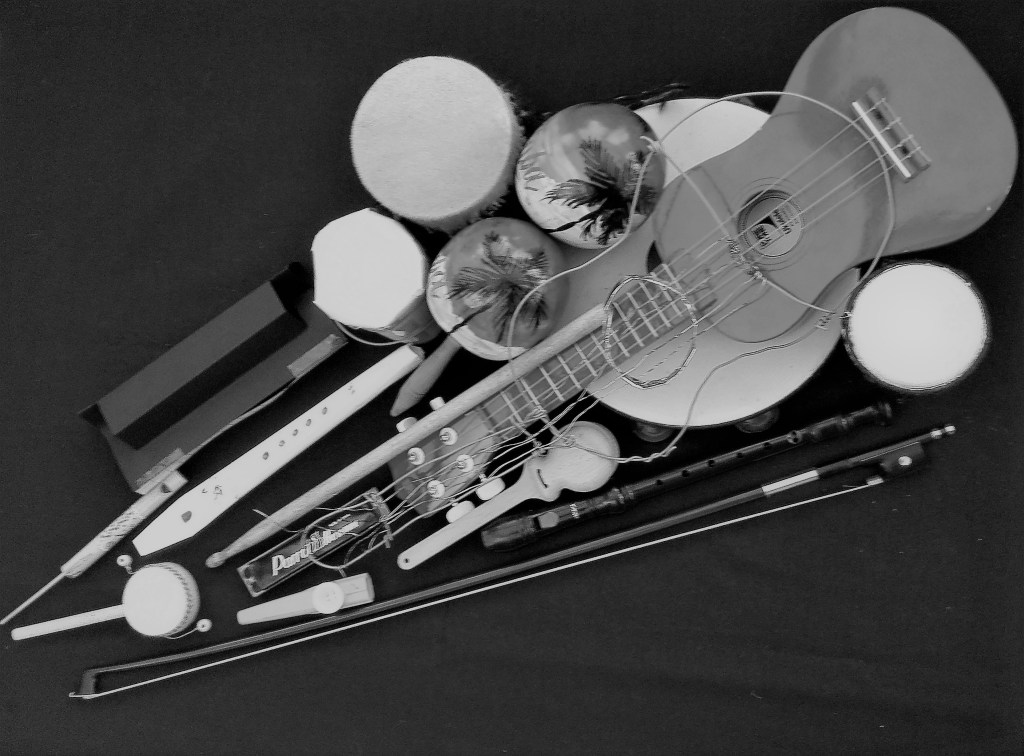
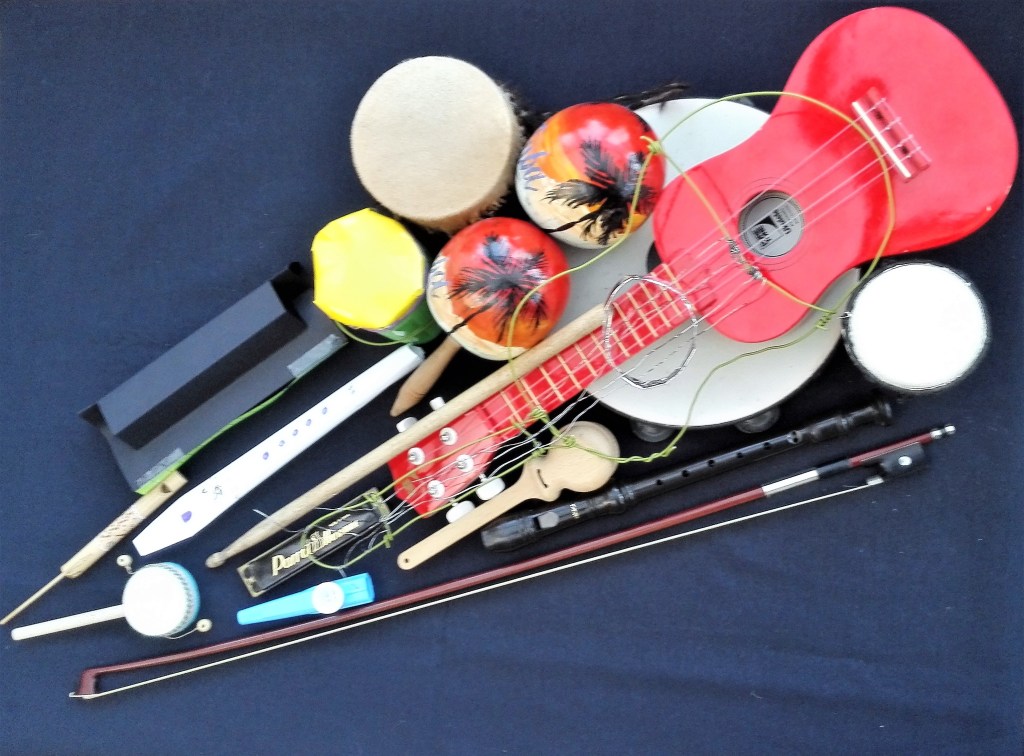
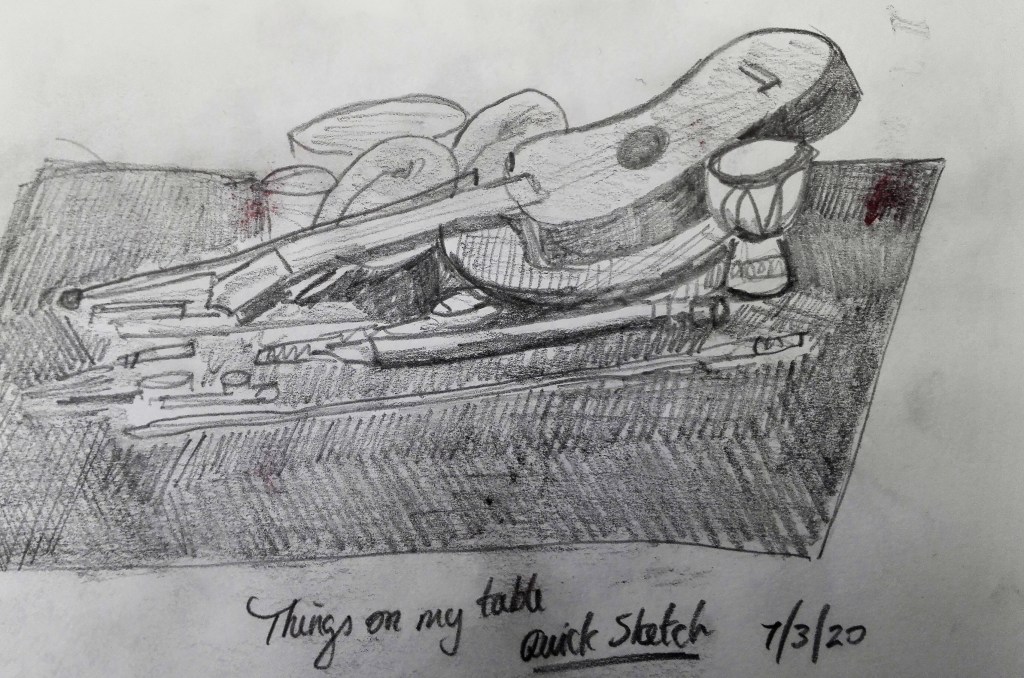
I made one quick sketch of the display, due to the cluster of objects it was quite confusing to draw. I would need more time to pick out the detailed relationships, colours, contours and lines to make a coherent depiction of the arrangement.
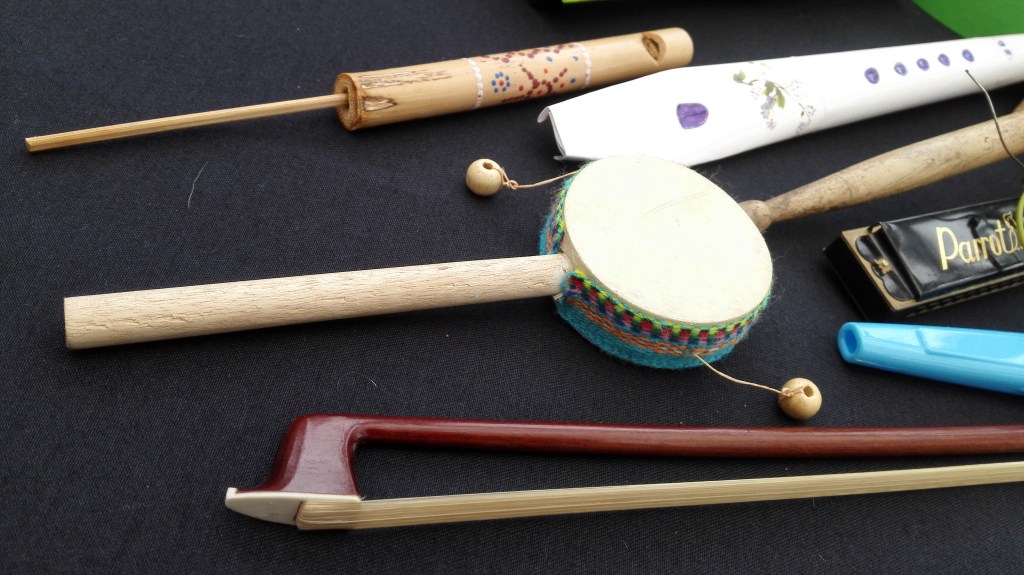
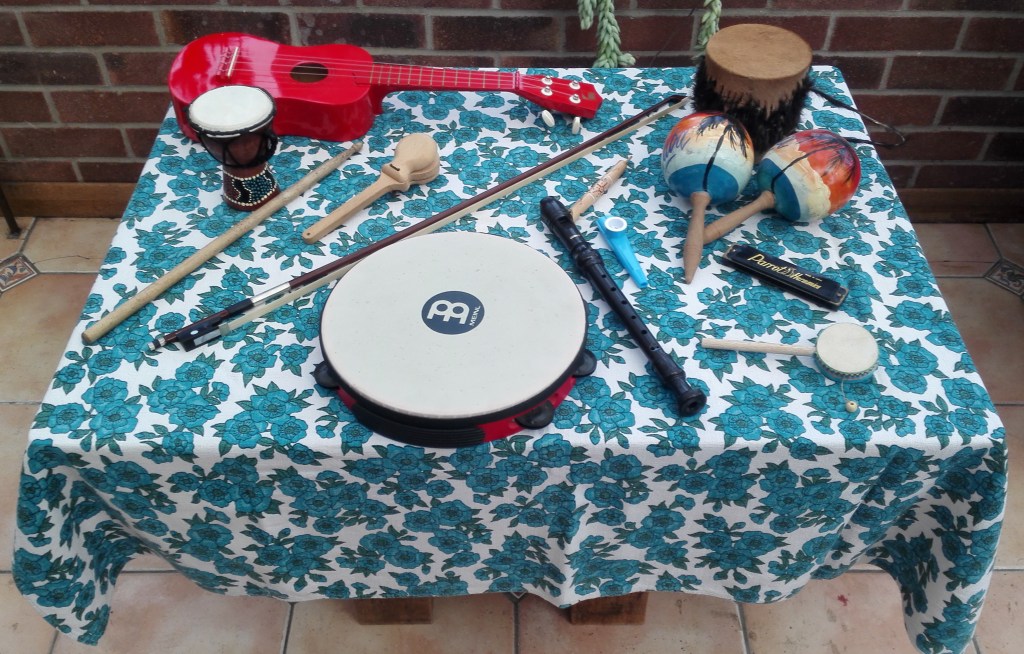
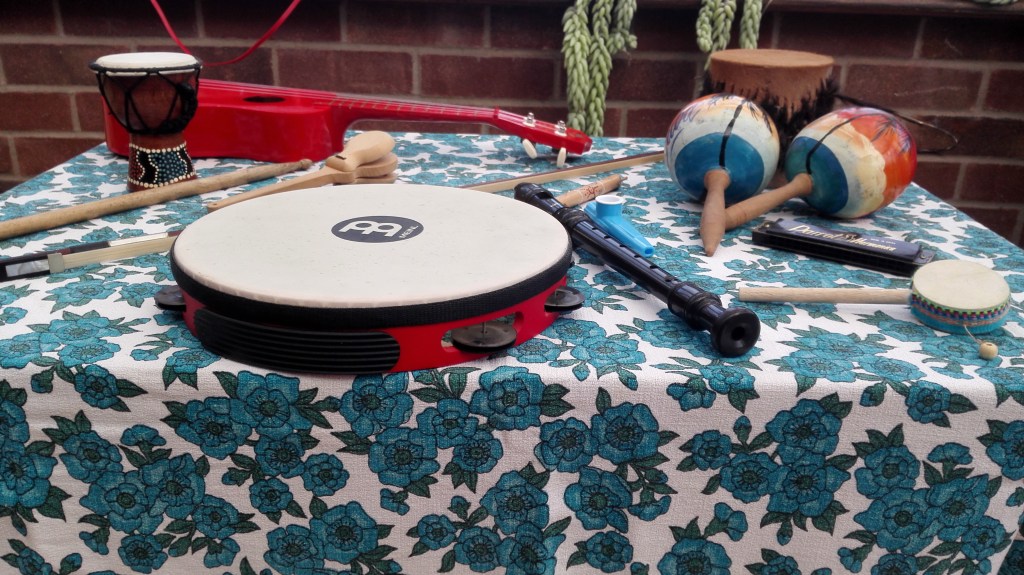
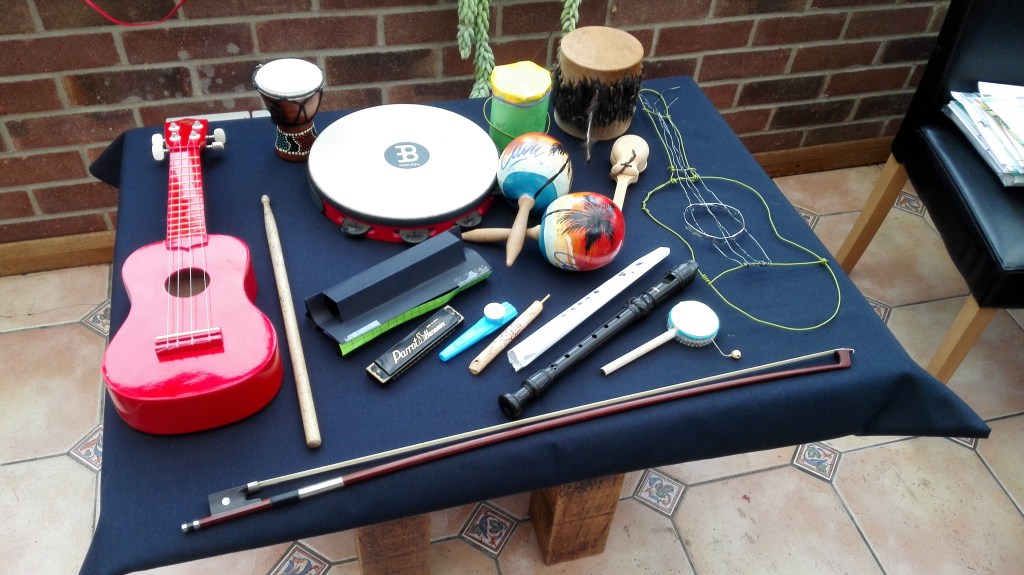
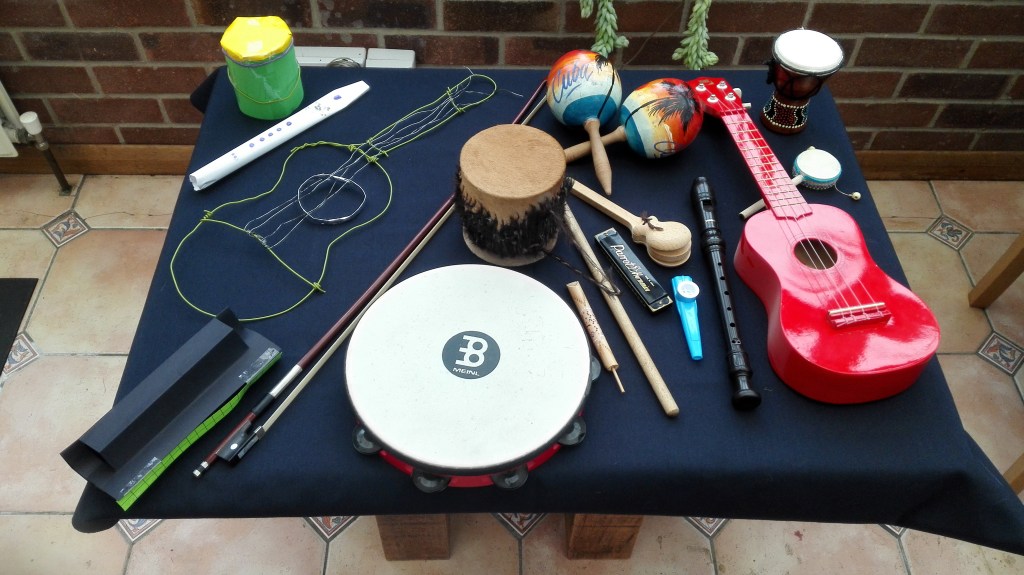
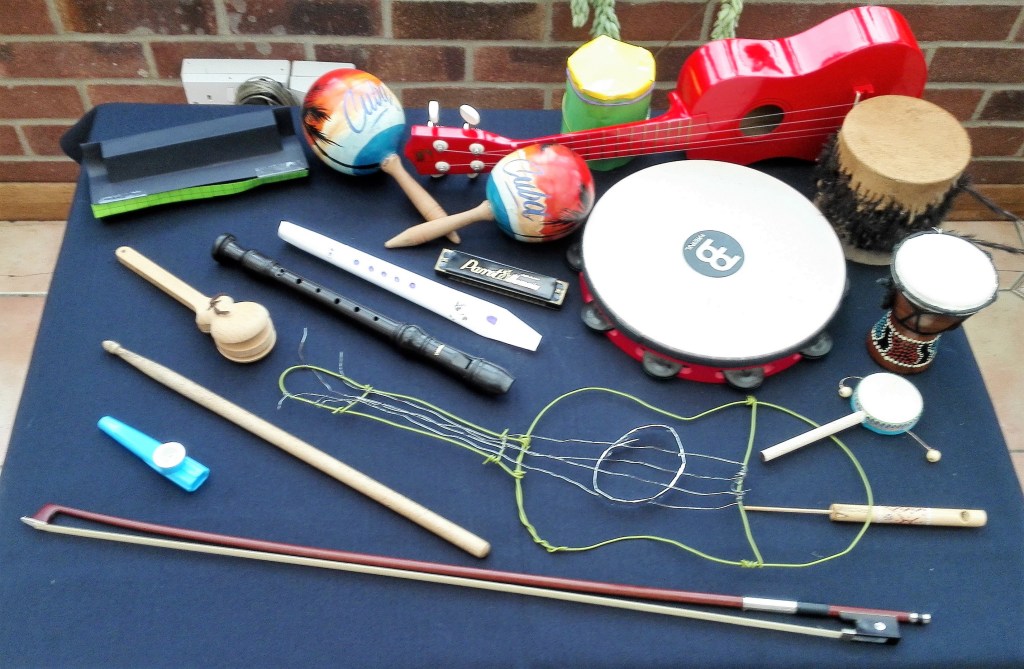
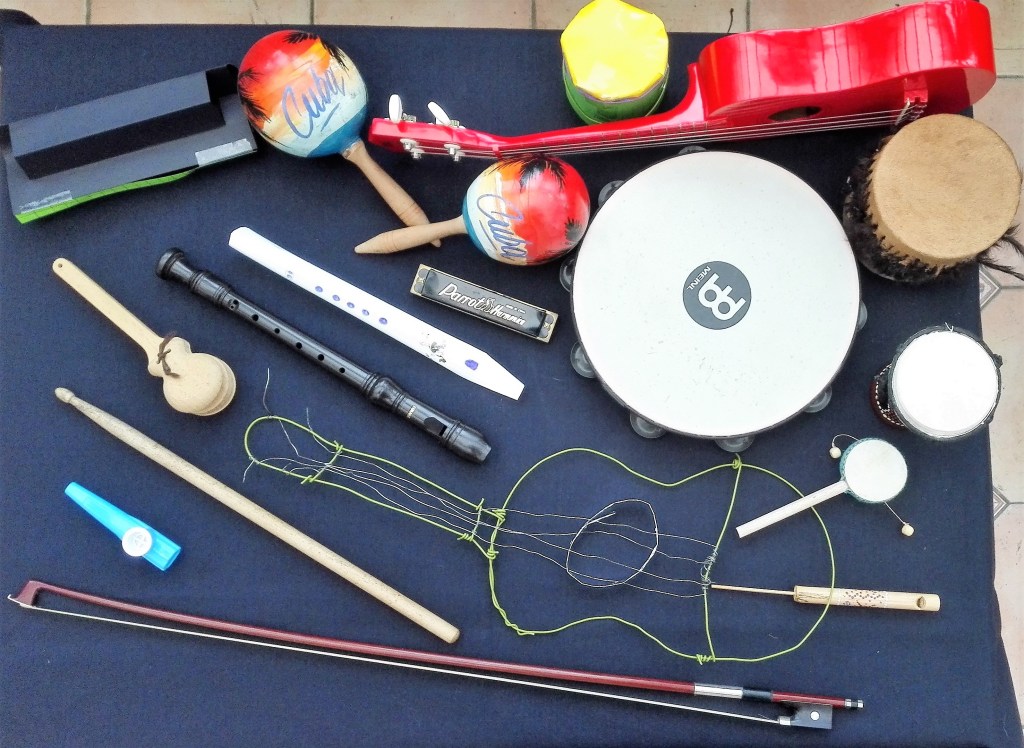
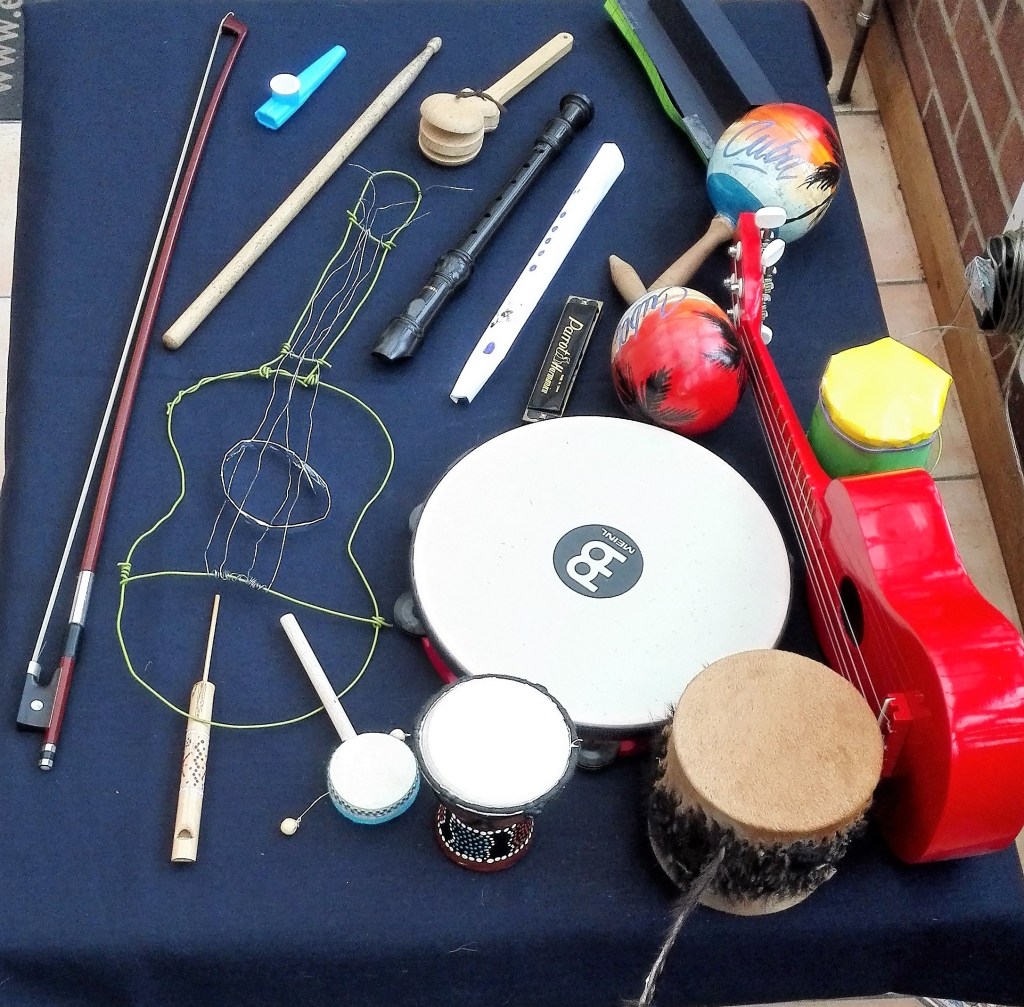
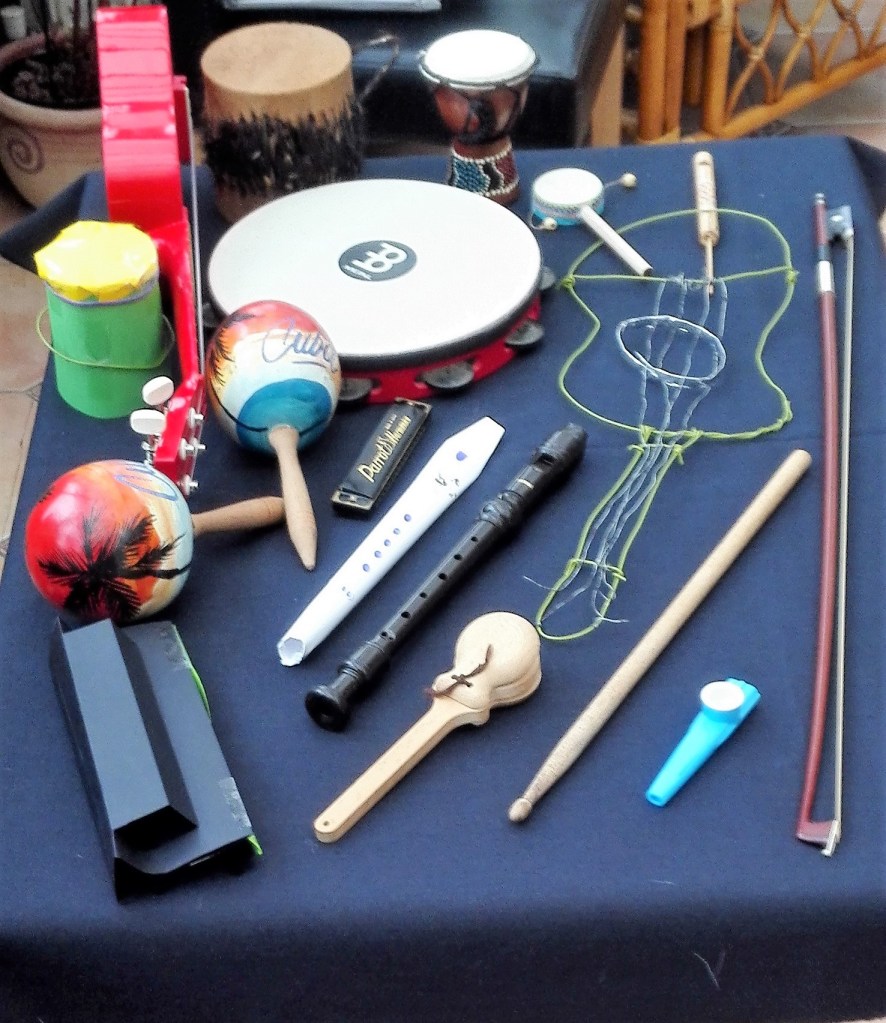
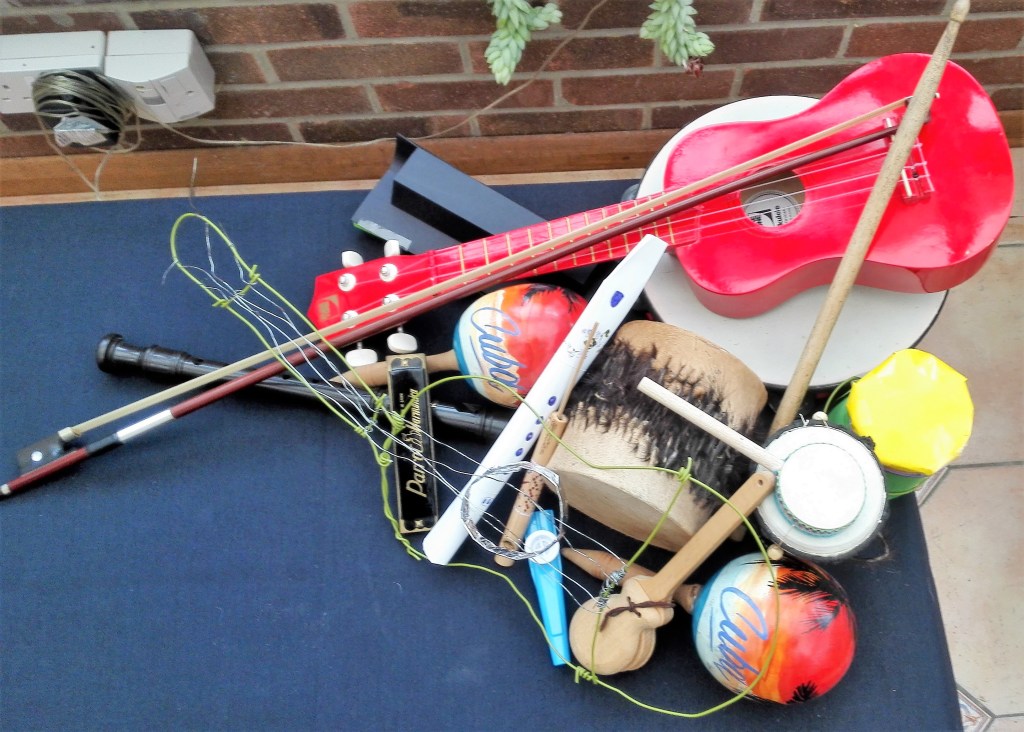
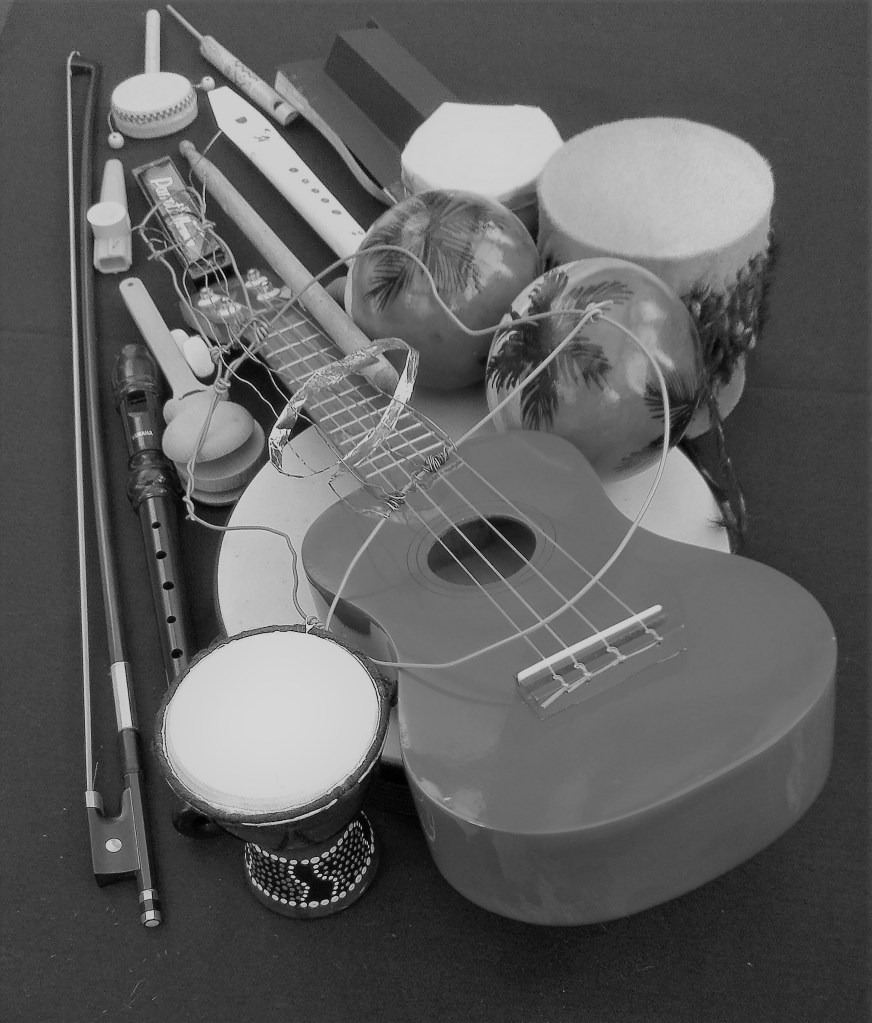
The objects have been on the table for a few days now, see photographs above. I have got used to how I have placed them and pleased with how they relate to each other and as a whole. The display has been commented on by others. One comment was, oh I like that. I investigated further as to why and received the reply that there was a coherence to it. There was also a suggestion that the orientation of the recorder and the paper model of the recorder could be switched, I tried this out, and agreed with the suggestion which is now how the arrangement looks. Additionally one specific object, the swivel drum, was picked out as having interest in how the striking bits looked animated. On a further separate occasion my son, who was visiting picked up, without asking, the aforementioned swivel drum and started playing with it. Fortunately he didn’t disturb anything else on the display so it could be placed back in the arrangement. However even if he had of moved other objects I already had sufficient photographs to be able to reassemble.

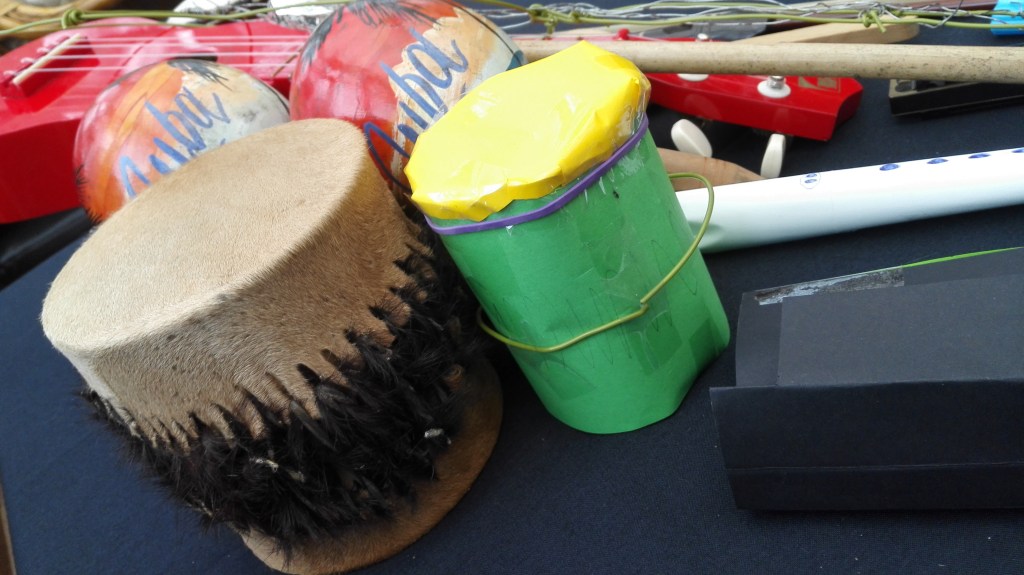
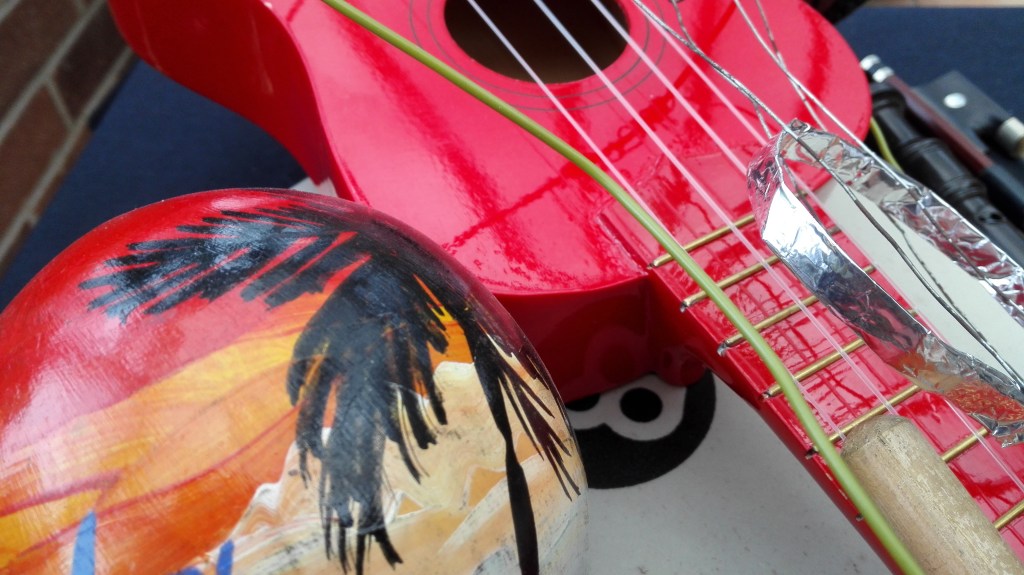
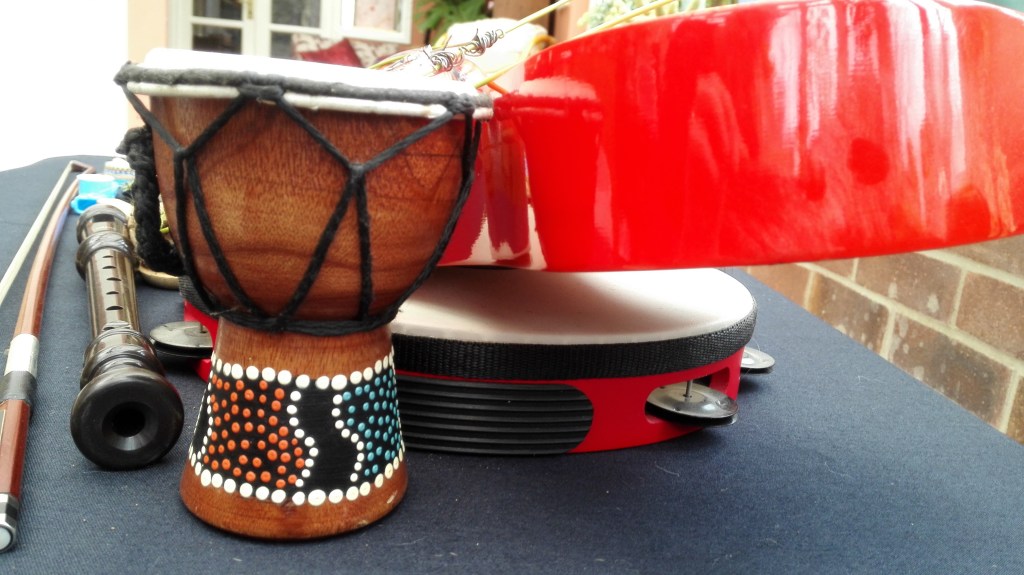
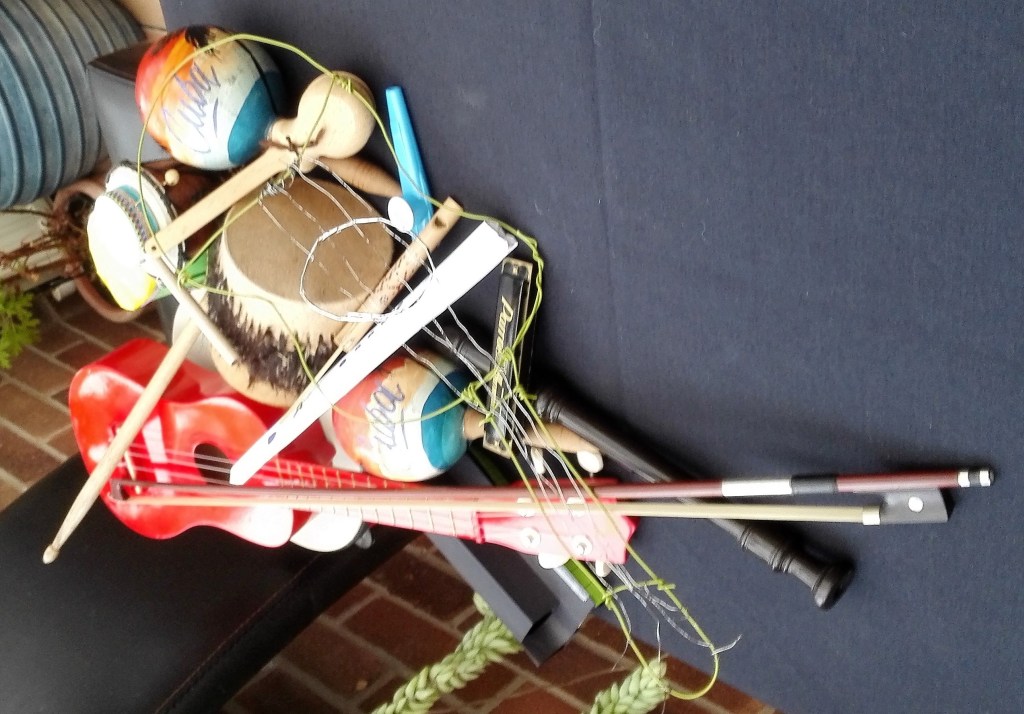
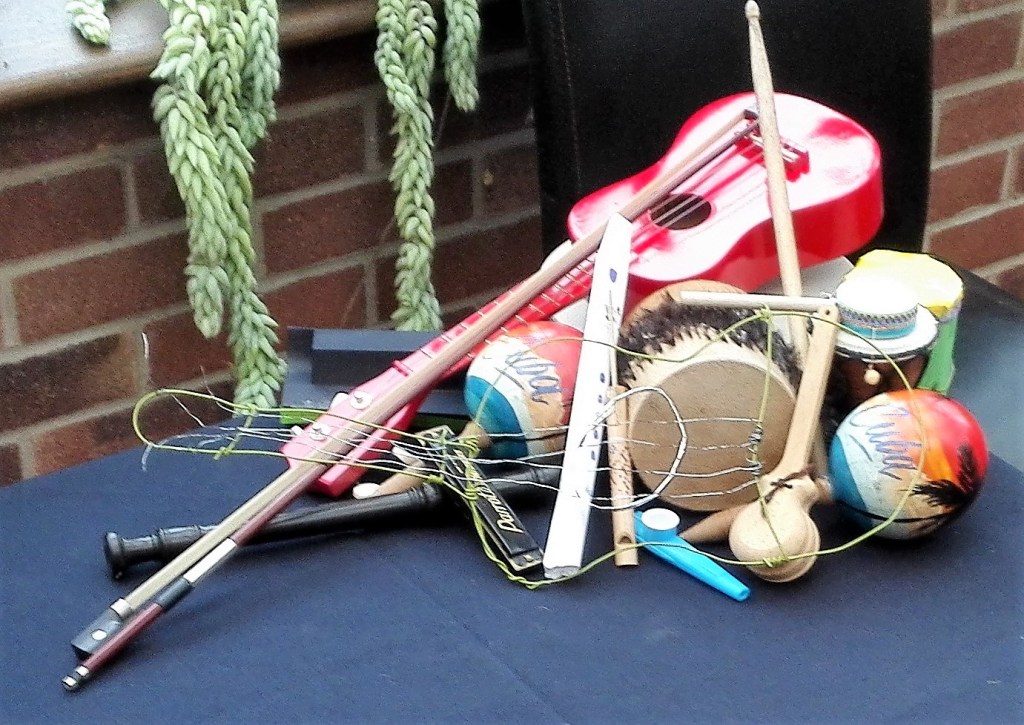
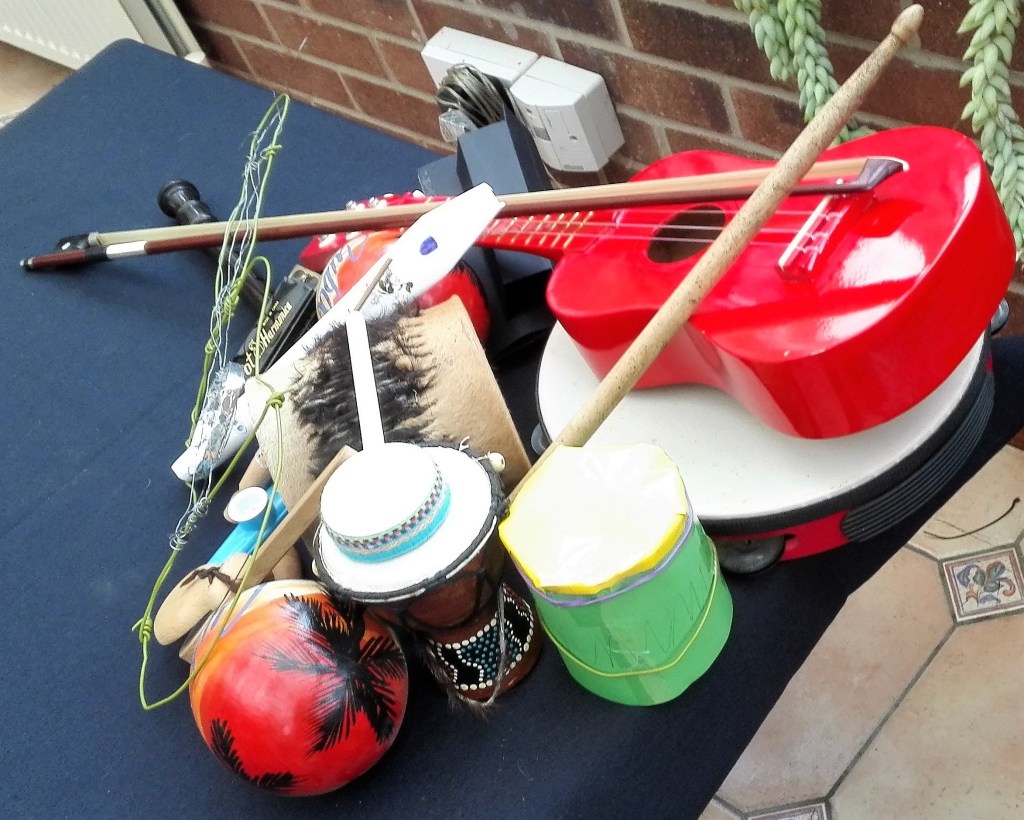
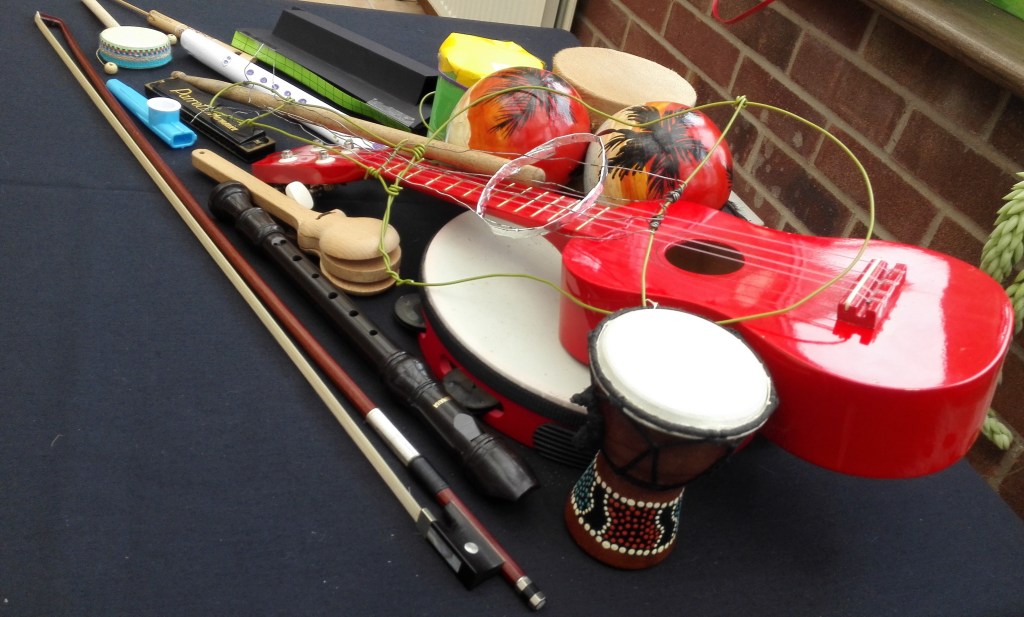
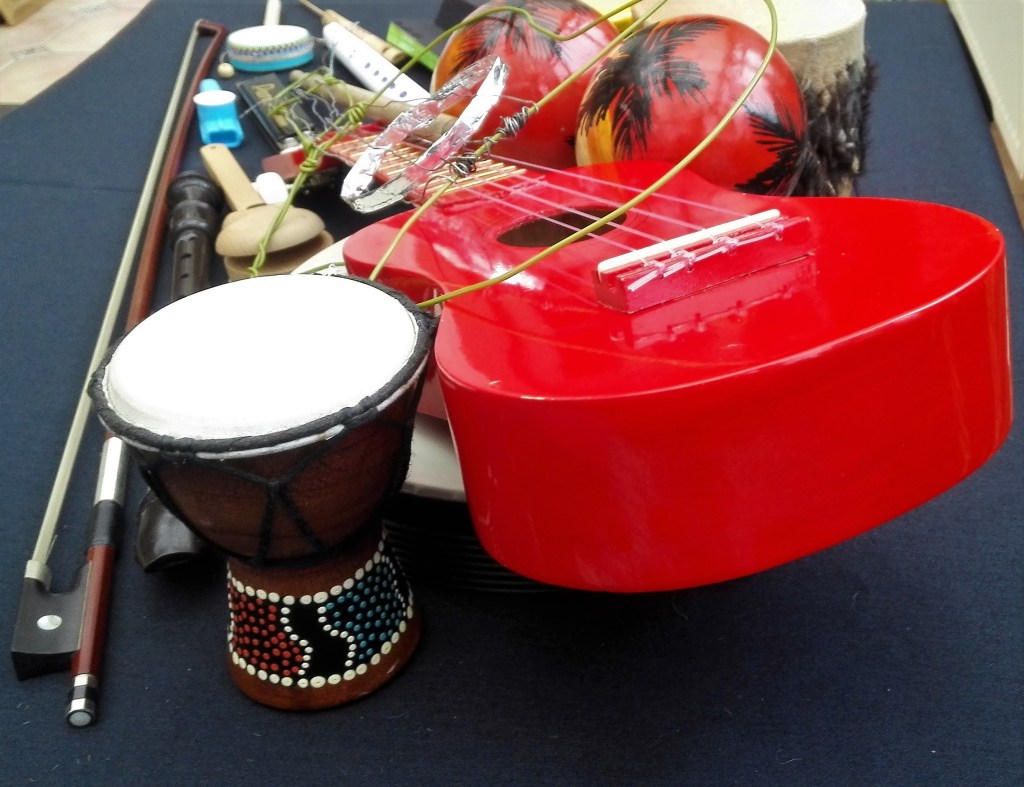
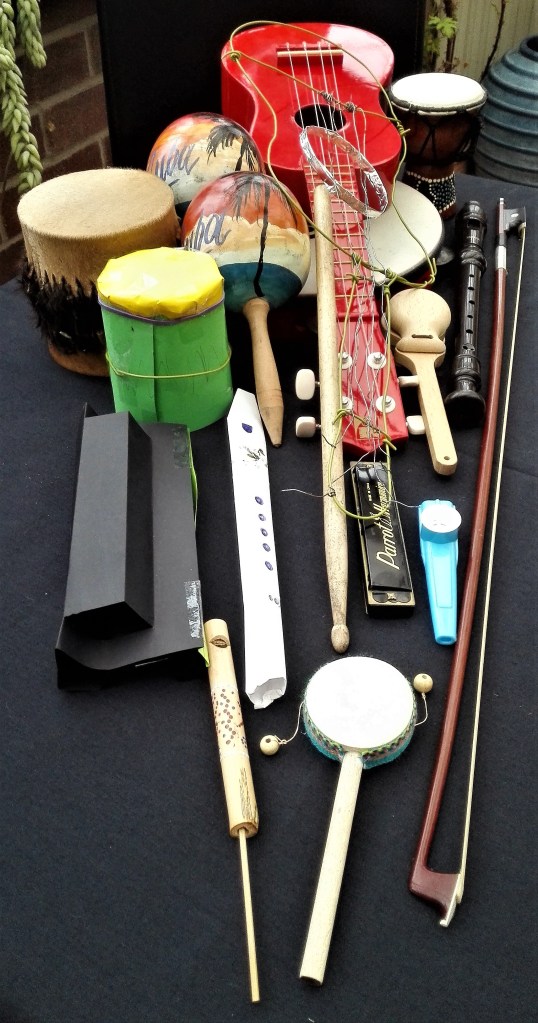
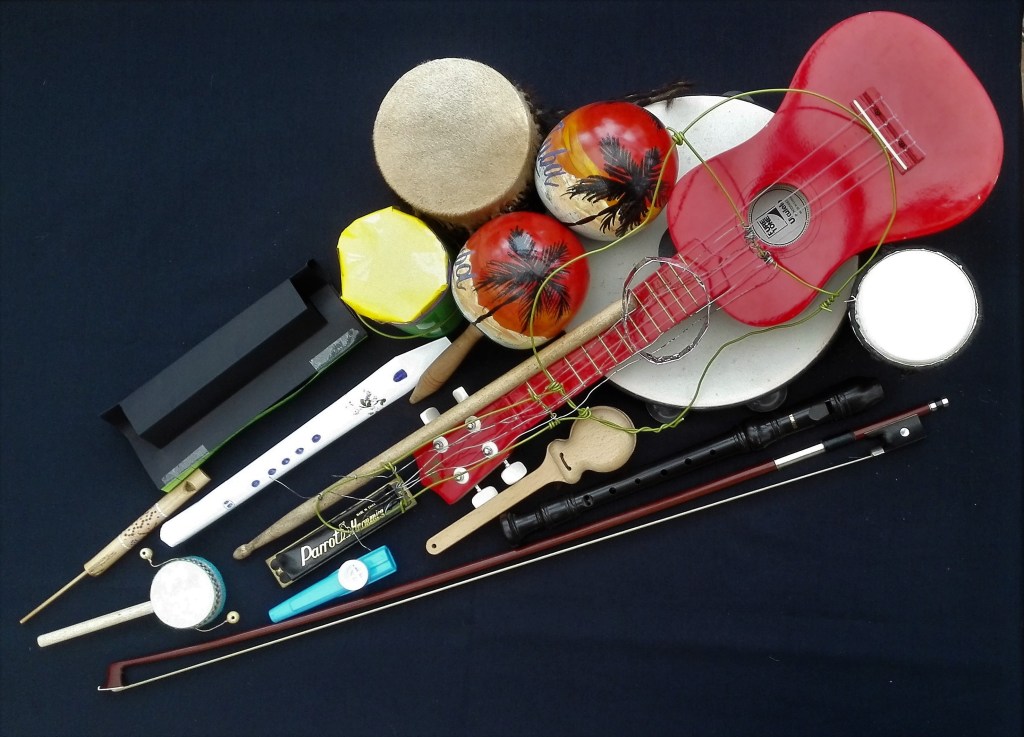
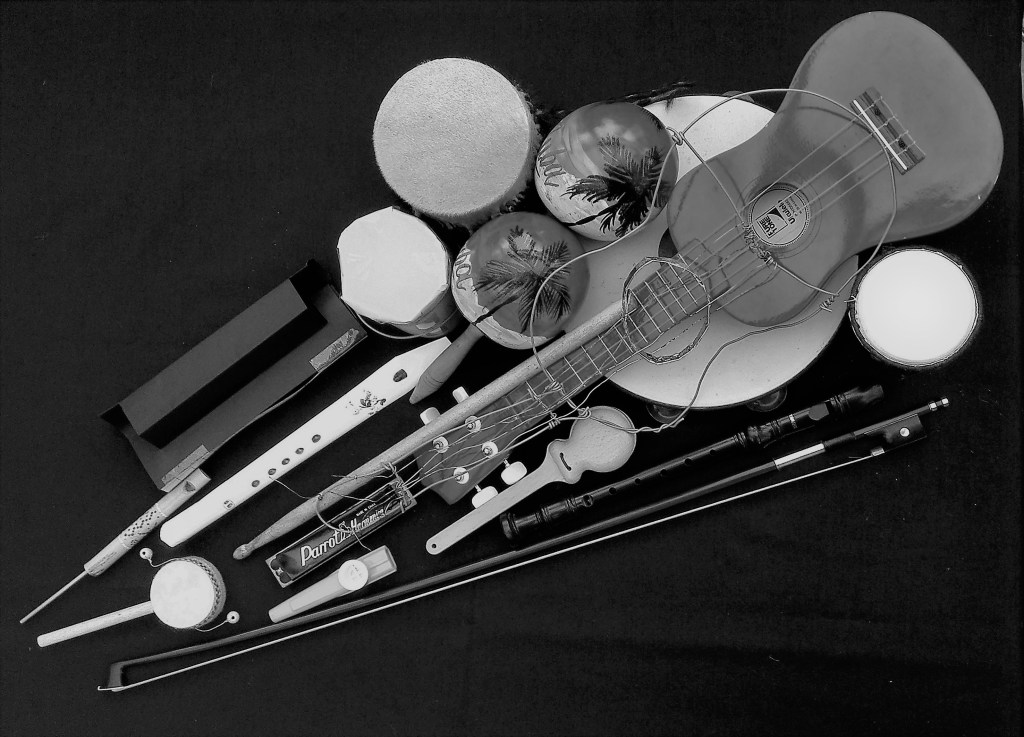
As mentioned I had already photographed the table from several angles and viewpoints and had also discussed the relationship with the edge of the table in my previous blog for Exercise 1.0. I decided to explore the internal relationships in a bit more detail with the emphasis on the special relationships between the objects that were close, on top and under each other. This involved looking from some previously unexplored views. I took a series of photographs which are reproduced below. I will discuss my thoughts on these below.
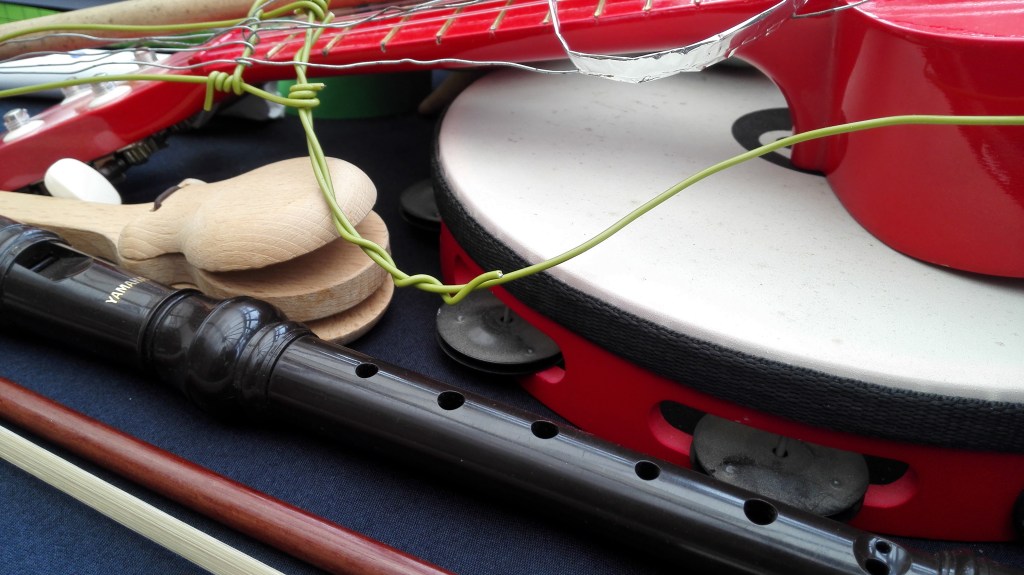
Photograph 1, it looks cluttered, not much space and little if any relationship between the objects of which none are seen in their entirety.

Photograph 2, similar to photograph one, cluttered but in this one there is more symmetry. The lines are all moving in the same direction including the strings on the Ukulele.

Photograph 3, this explores further the symmetry in the lines of the objects as the display approaches its tail.

Photograph 4, four circular objects in close proximity. The objects with rounded edges were deliberately placed near to or on top of each other.

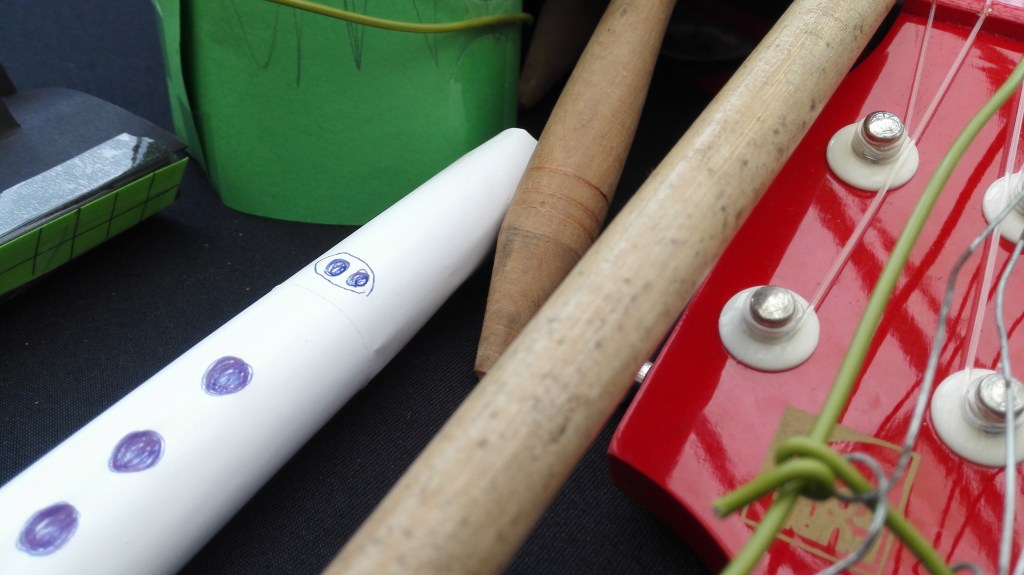
Photograph 5, There is little to be gleaned from this. A mixture of shapes, colours that have very little relationship to each other.

Photograph 6. This angle explored how the height of the display has been built up with objects placed on top of each other and sloped downwards.

I made six sketches, three in black and white and three in colour. These were more detailed. In them I looked to examine different aspects of the display. All the sketches were drawn quite quickly as I wanted to try to capture my intuitive responses.

The first examines the whole display. Here I was trying to make sense of the whole arrangement and the relationship of the objects to each other.
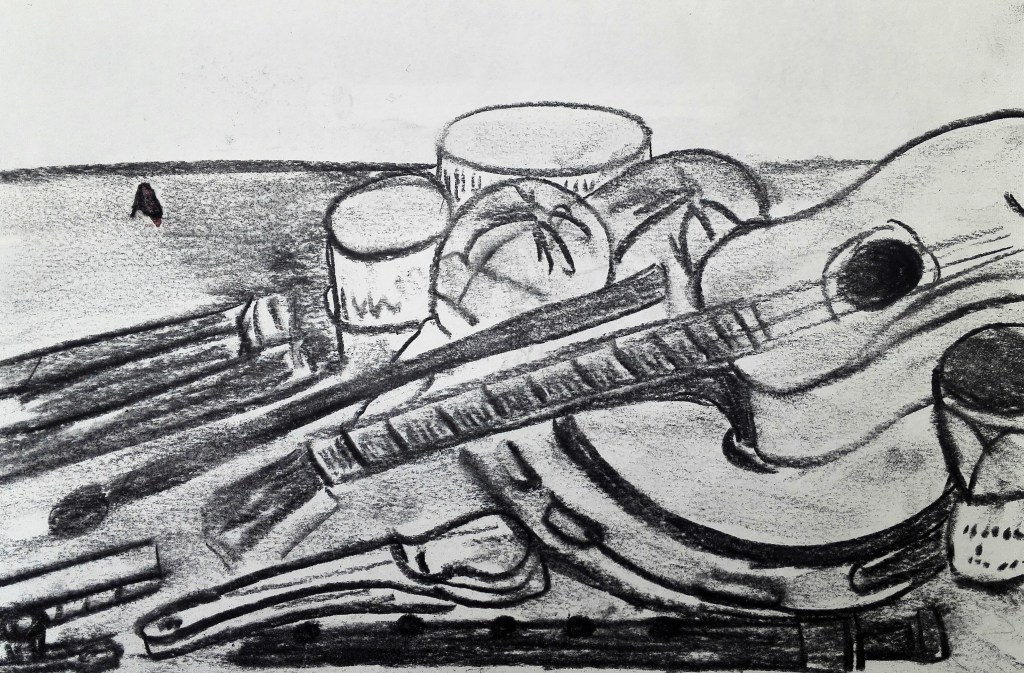
Observational Study 1

For the second sketch I focused in on the tail end of the display where the straight and longer items converge. As much as the objects themselves I was looking at the negative spaces in between them, this is highlighted by the black cloth.

Observational Study 2

For the third sketch I focused in closely on a part of the recorder. for this sketch I was looking to bring out the tonal aspects. When I look at this sketch now I note that I should have made more emphasis of the darkness of the cloth.
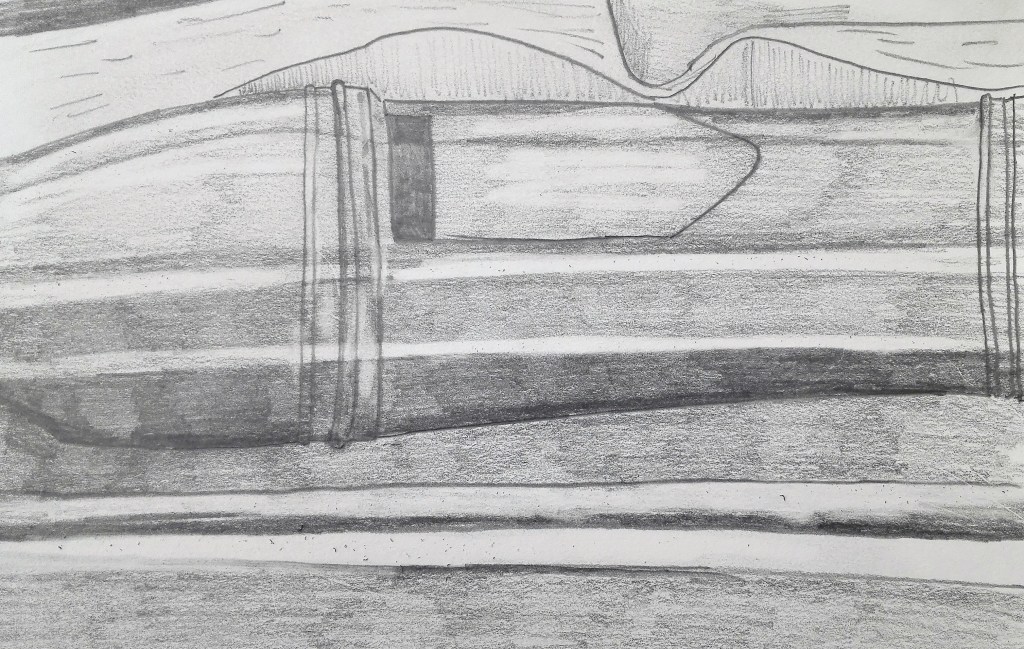
Observational Study 3

For the forth sketch I moved to colour and picked out a close study of the blue kazoo. I was also interested in the subtle tonal changes on the plastic surface and tried to capture these too.
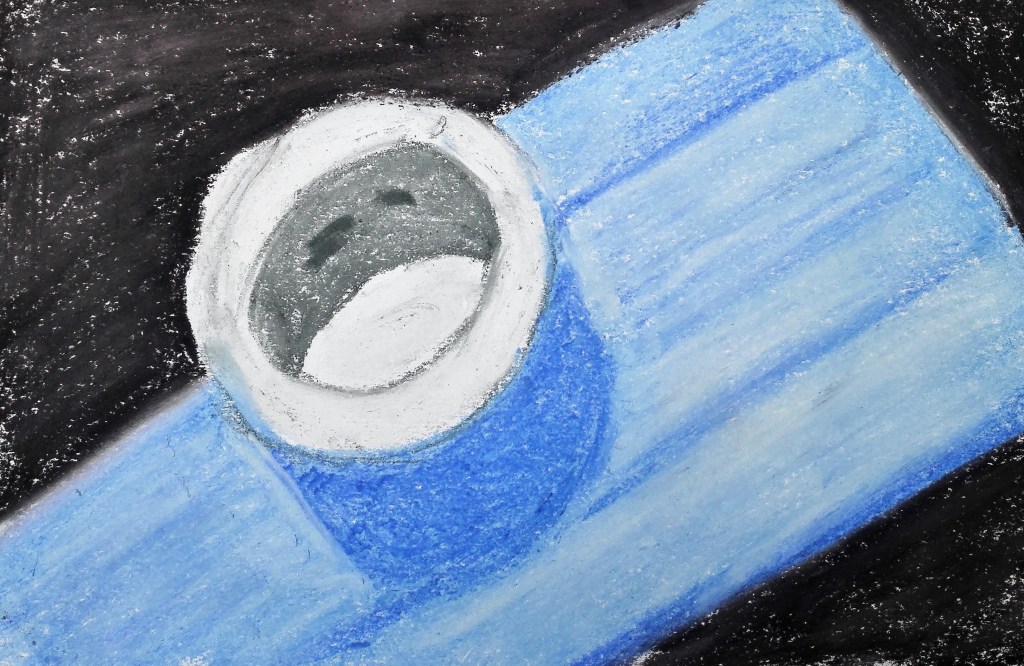
Observational Study 4

The fifth sketch focuses on the back of the Red Ukulele and the way the light is reflected on its surface. I didn’t have a red of similar intensity as the ukulele. however by adding orange and rubbing the red I was able to give an indication of the sheen.
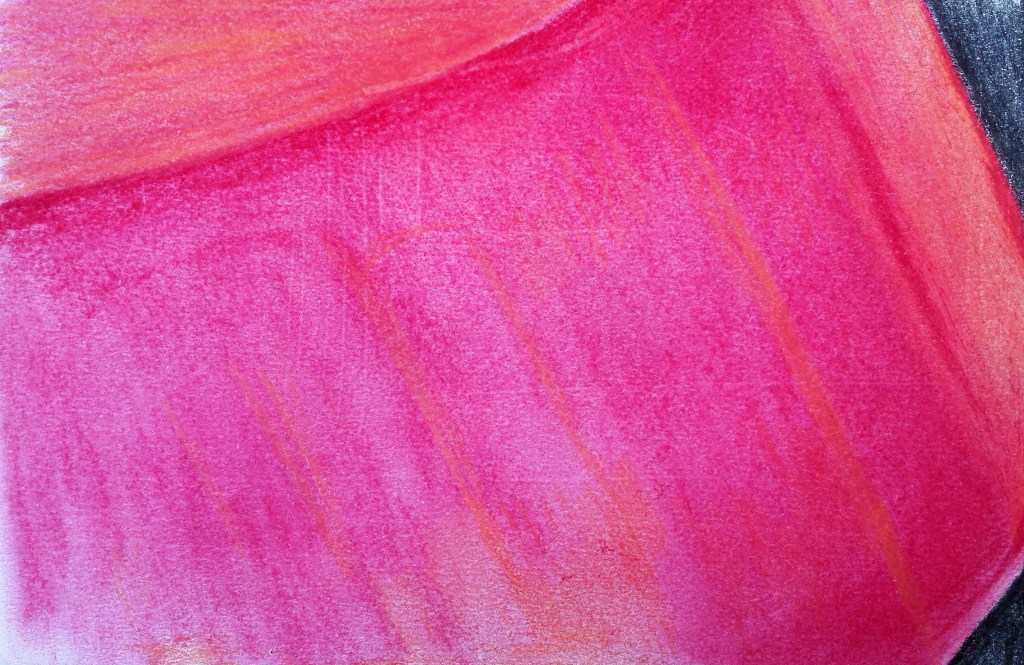
Observational Sketch 5

And lastly in the sixth sketch I was looking to capture the animal skin on the drum and contrast this with the lively colours of the maquette drum and the colours of the maraca.
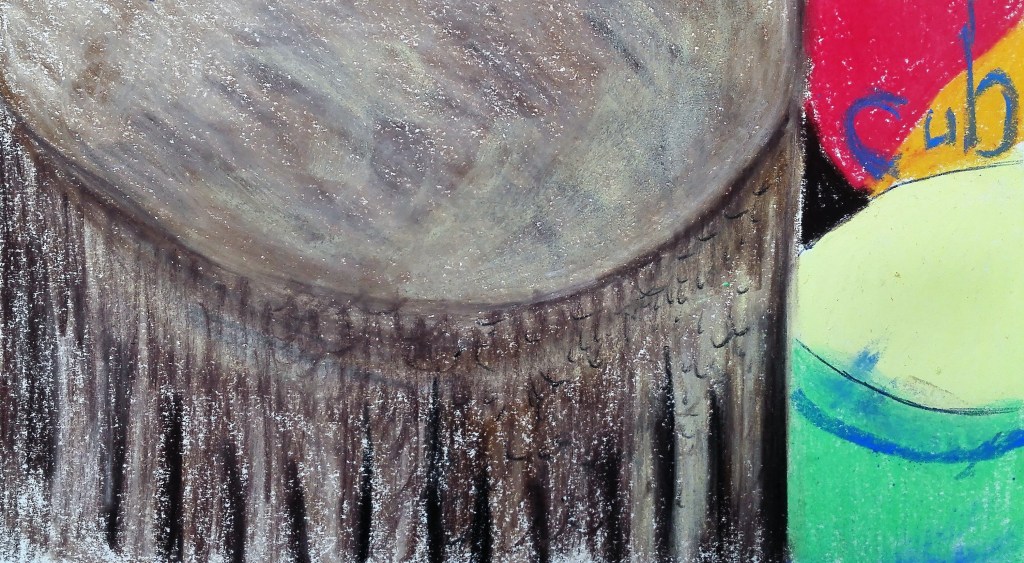
Observational Sketch 6

Reflection on Exercise 1.1

I was struck with how complicated and interlinked the objects had become. Yes it was my aim to try to make them into a coherent display and to reduce their appearance away from what the viewer knows them to be. In doing so I wanted to try to suggest an alternative view. It was when I began to observe the arrangement closely that I realised how entangled the objects had become and that it was now difficult to separate them. This was very apparent when attempting to draw the whole thing. There were so many different angles, lines, perspectives, foreshortening and tonal variations that it would be a difficult task to replicate the arrangement in a representational drawing. The most pleasing images were the photographs, in particular, the black and white ones. These took the focus away from the colours and made the eye concentrate on both the form of the objects, their relationship to each other and to the whole arrangement.

A final observation came to me when writing this review and that was that the maquette ukulele that I had made out of wire doesn’t feature prominently in either the photographs or the sketches. It is as if it becomes unseen but when looking at the whole display. I do feel that it helps to hold it the whole together and is an integral part of the arrangement.
Part Two – Research Point 1 – Gabriel Orozco

The short piece is Gabriel talking about his artwork entitled working tables. He explains the process whereby it is an accumulation of years of collecting using and discarding objects. The piece is the result of the left overs, the unused and he amusingly refers to the left overs of the left overs. This made me think that all workshops, work tables accumulate the detritus of the work being undertaken unless they are regularly tidied. I can remember making inspections of the engineering workshop when I used to work. The workshop contained evidence of what had been recently work on and what was currently being worked. Tools, nuts and bolts, debris and dirty work clothes would be laying in various states. It was a constant task to remind the engineers to clean up and tidy up. In hindsight it was evidence of work completed, a picture of their toil. As Gabriel put it “evidence of a process”.

There are parallels to the selection of objects that I made for Exercise 1. I chose to select musical instruments that I have accumulated over the years but that are not used. They are the leftovers.

Part Two – Project One – Exercise 1 – Collect / Make / Arrange

Collect

Empty Table Top

My first thought, and the one that I went with, was to make use of to make use of the various peripheral musical instruments that I have. The ones that I chose are those that I do not expect to use over the coming weeks. In fact most of them are never used. When I think about what unites them, their common language, is that predominantly they tend to be wooden objects that are either blown or hit. The choice of using these is an easy one for me but it is also one that will hold my interest due to my love of music and music making. I wonder whether I should also add guitars and ukuleles but refrain from doing so as these would be too big for the temporary table that I have constructed in my “studio”. This is in fact our conservatory but it is where I carry out most of my artwork. There is a table but this is usually cluttered with my day to day stuff, laptop, OCA course book, notepad, ipad, pens, mobile, magazines and other paraphernalia. There are many similarities with George Perec’s description with objects on his work-table. I guess that this is the same for millions of work-spaces. My work-table was de-cluttered as part of the preparation for part two and I did consider using it. As I write this blog it is fast accumulating more stuff and will continue to do so until the next tidy up session.

Back to the collection of objects for the table the so far I have:

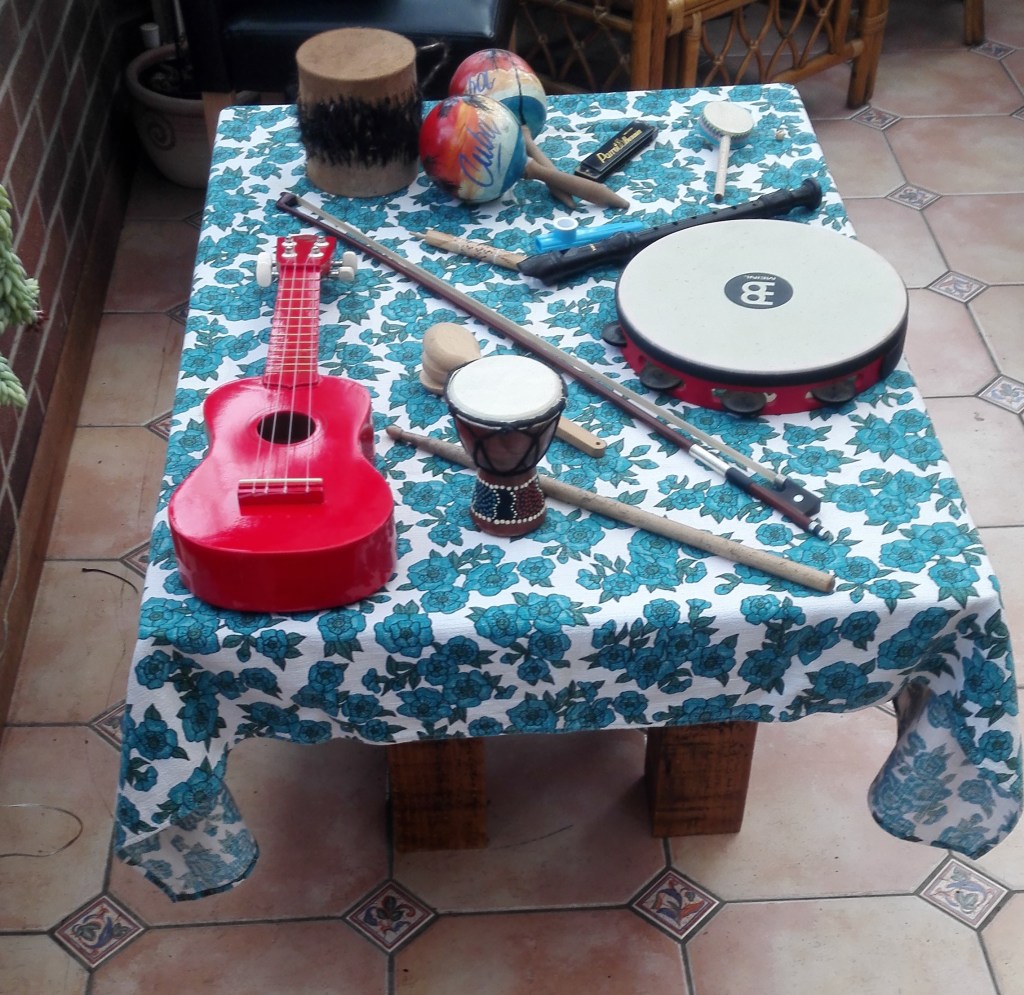
A tambourine, maracas, a violin bow, a harmonica, a kazoo, a drum stick, a red (toy) ukulele, a small African drum, a whistle, Spanish clackers, Morrocan swivel drum, an African bongo and a recorder.

Some photographs.

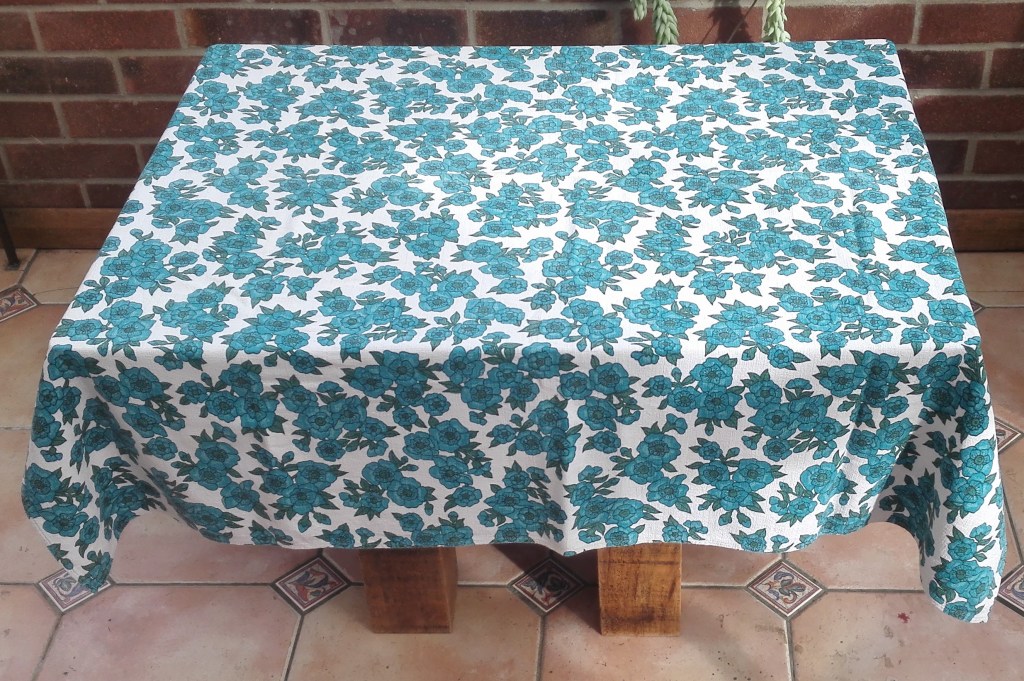
I have already noted that the pattern on the tablecloth for the table top is distracting. It will be changed.

Make

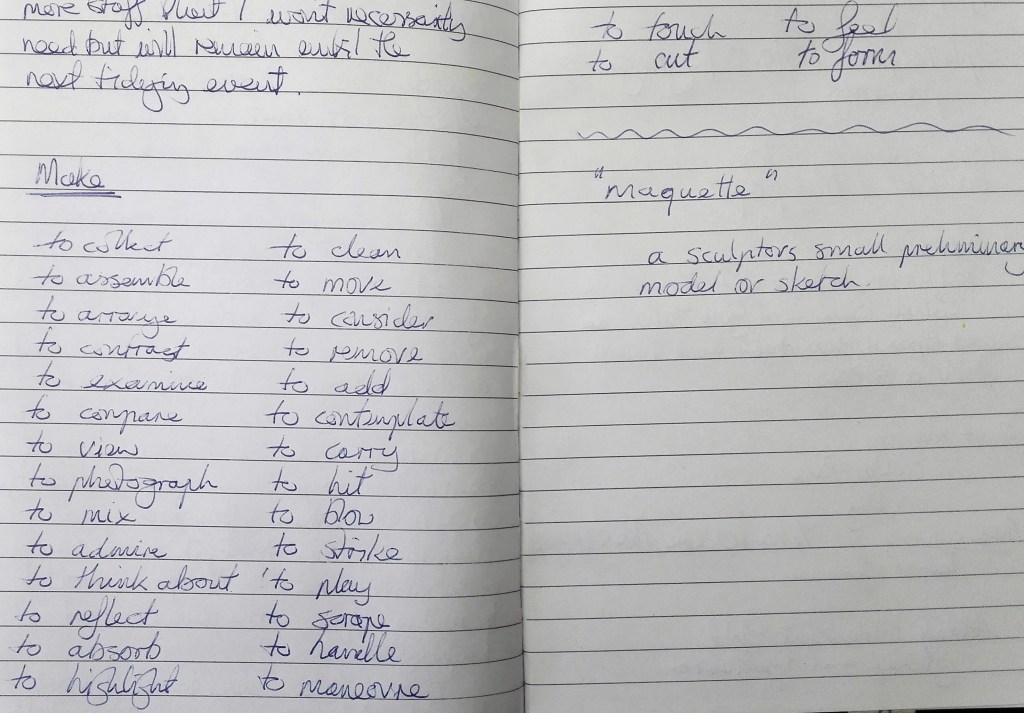
I made an list of actions in my note book inspired by Richard Serras’ ‘Verb list’

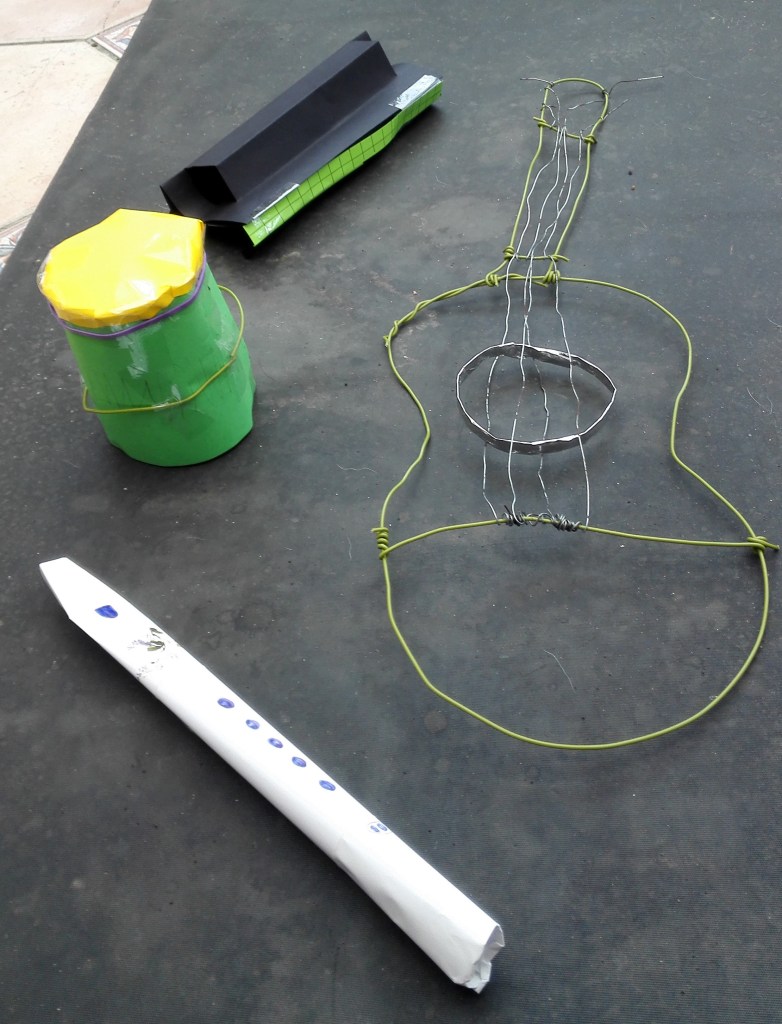
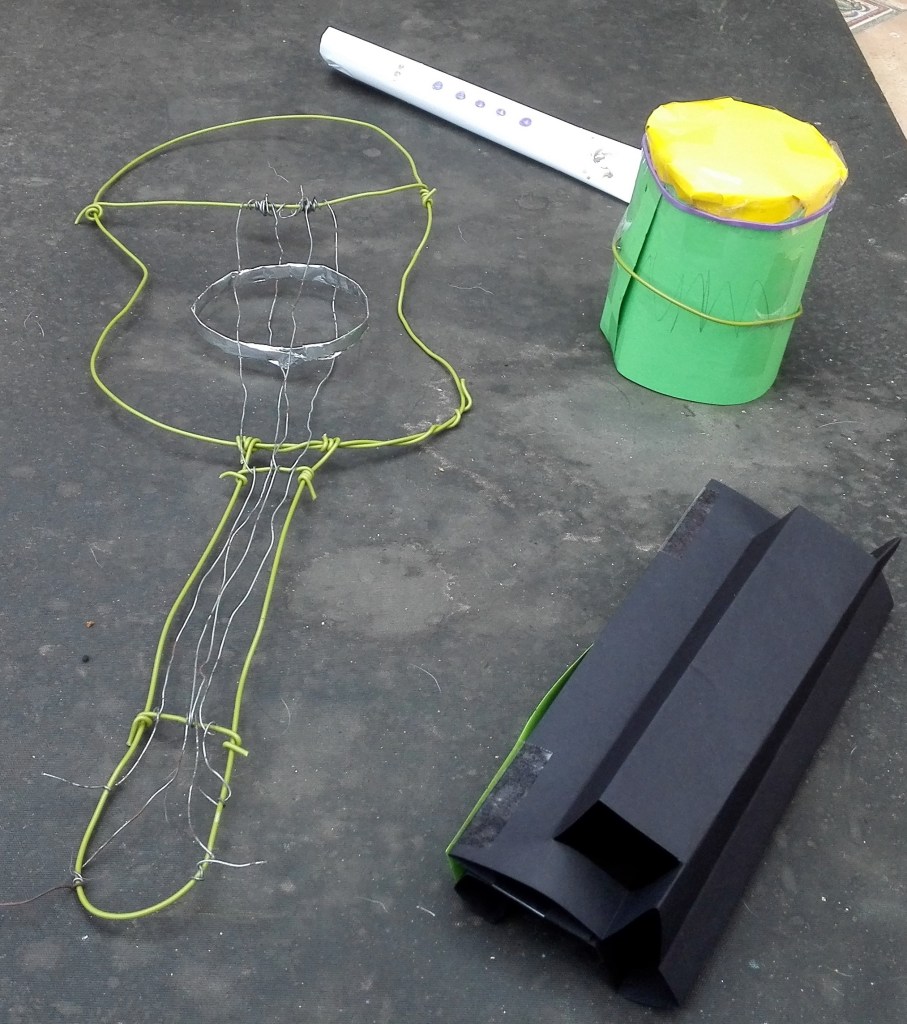
Next step creating some maquettes, not a word that I had come across before. Using paper, sellotape, elastic bands and wire I fashioned four models to add to the collection. These are photographed before being added to the table collection. The most interesting piece is the wire ukulele, it is very primitive in look but has a bizarre charm. The paper recorder or flute also has merits the harmonica less so.

Arrange

I made a couple of arrangements where I placed the objects on the table without too much consideration as to their relationship with each other or their shapes and colours. The main consideration was fitting them all on the surface.

Having read Declan Long’s article on Uri Aran’s mysterious work-tables and listened to Gabriel Orozco I set about thinking how I could look at the objects differently, how they might interlock and perhaps convey something else. Their size and shape and colours rather than their function. Note that the tablecloth has changed from the patterned cover to plain black. I feel that this helps to focus the eye on the objects.

My first two attempts at some sort of considered arrangement are shown below. For the first I was looking to try to group the objects by shape and size to try to express their commonality and at the same time pick out their differences. It occurred to me that basically I had a collection of objects that were either basically round or straight, circles and lines.

The second attempt was to look to interlock the objects by laying them on top of each other or by placing them against each other.

In both arrangements I became increasingly aware of the edge of the table. In the second arrangement I deliberately tried to extend the arrangement over the edges of the table. The limitations of the table became even more apparent when photographing the arrangements as it was not possible to get a photograph without having at least a hint of their surroundings.

There were aspects of each arrangement that had positive points. The flow of the first vs the cluttered, claustrophobic feel of the second. I considered both by looking repeatedly at the photographs. My next and final arrangement would be to try and combine the strengths of each. To start with a cluttered arrangement which flows outwards. I would also aim to keep all the objects within the frame of the table in such a way as I could get at least one photograph that eliminated the surroundings.

The final arrangement is shown below. Firstly the arrangement from several angles and then two photographs where the surroundings have been eliminated, one from behind and the second from above.

Final arrangement from behind
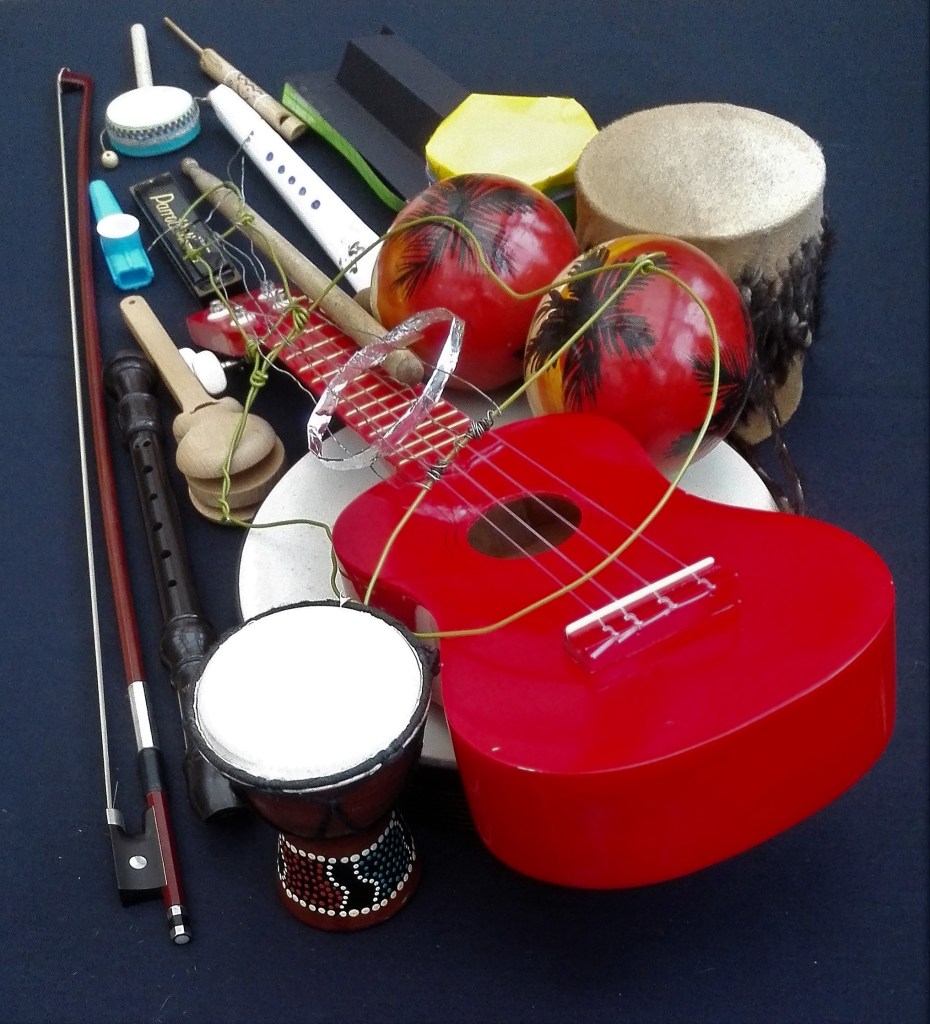
Final arrangement from above

It is noticeable in the photograph from above that the objects have a coherence and create their own object. From behind there is a hint of them falling away and leading into the distance.

To look at the arrangement in a slightly difference way I changed the filter on the photographs to Vanilla. In doing this I was trying to focus on tone, light and shade.

Final arrangement from above – Vanilla

By eliminating colour the shapes are more apparent at there is even more cohesiveness in the arrangement.
Assignment One – Reflection on learnings and experiences during Part One

I found a number of parallels with the start of ‘Studio Practice’ to elements of ‘Concepts in Practice’ where the emphasis was on breaking out of traditional notions of what painting is. The focus is towards the experimental, to challenge the student, to open up new possibilities and challenges.

Some of the exercises required me to think in ways about painting that I have previously only given passing consideration. An example of this is extent that although painting is a physical act I have always thought of it as mainly a mental or cerebral pursuit. Being required to question and think about my physical movements, constraining them and then asked to create works within these limitations was enlightening. To experience painting as an action or event rather than just a mode of communication was enjoyable. As was trying to encompass the part played by chance endurance and time. Whether the outcomes were successful or not was not the point. I would like to try to include a sense of my physical presence in my work. Similarly the attempting to employ alternative ways of applying materials in mechanical or non participative ways forced me to address issues that I had not previously explored in any considered manner. These projects and exercises opened up new possibilities which I must try to employ when thinking and engaging in my own practice. That isn’t to say that I will necessarily produce works using these techniques but will let them and the thought processes involved influence how I approach my work.

One of the interesting discoveries I made was when trying to work collaboratively on one of the exercises. I found it difficult to allow others to influence what I considered to be my work. This is in opposition to allowing materials to react to each other to create chance outcomes where I am happy for this to happen. This discovery made me think about my attachment to what influences the outcome of the work and my ownership of the result. In many ways I consider the act of painting to be an individual act, a personal document of myself and my responses to life. In saying this, which is in danger of sounding pretentious, I realise that I have a long way to go in really being able to truly and honestly say that my paintings represent me. The start of this course has given me opportunities to consider and explore more possibilities.

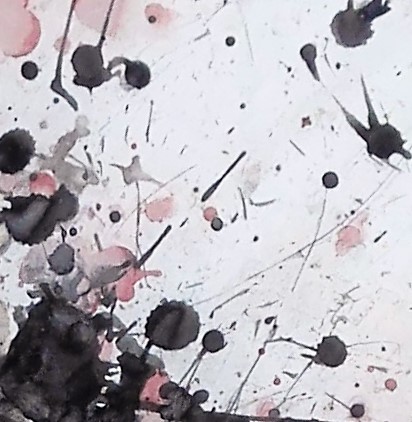
Wind Painting (Random close up)

Assignment One – Final Piece

The final piece that I worked on for Part One was a further attempt to try to remove as much of me from the process creating as possible. This got me to think about how much I can remove myself from the act of creating. At some point there is an interaction which results in a decision that what I am presenting is a piece of work.

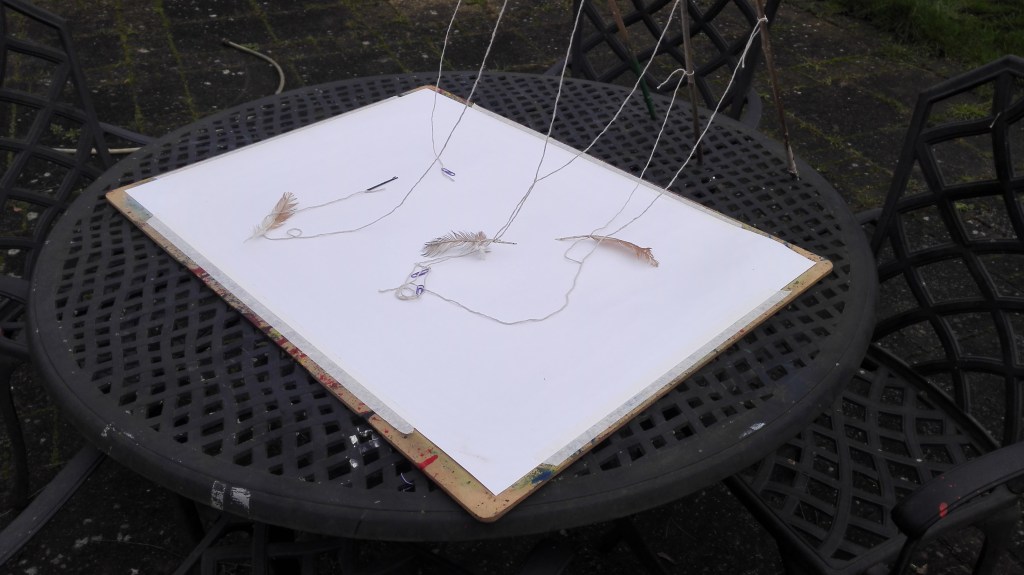
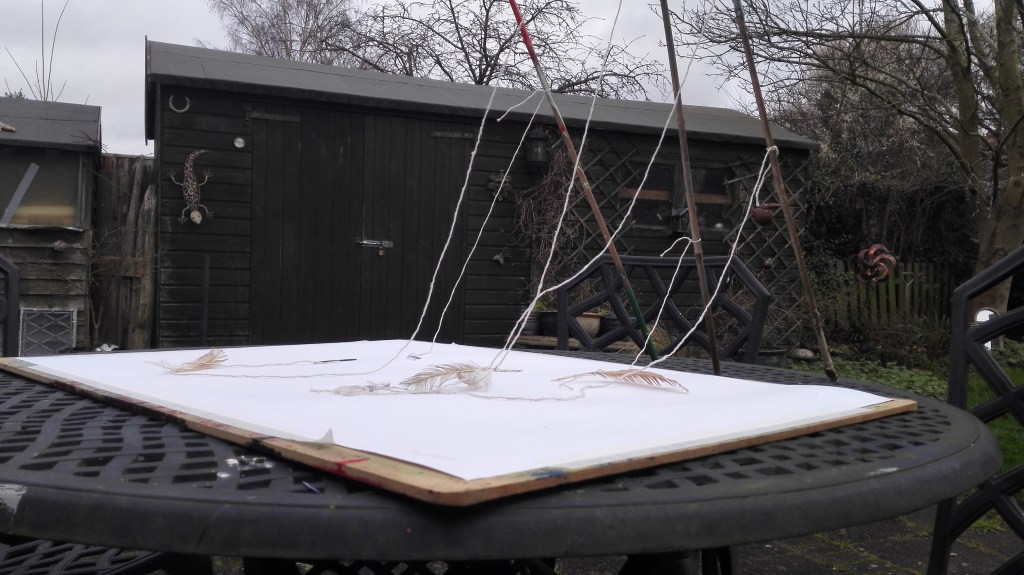
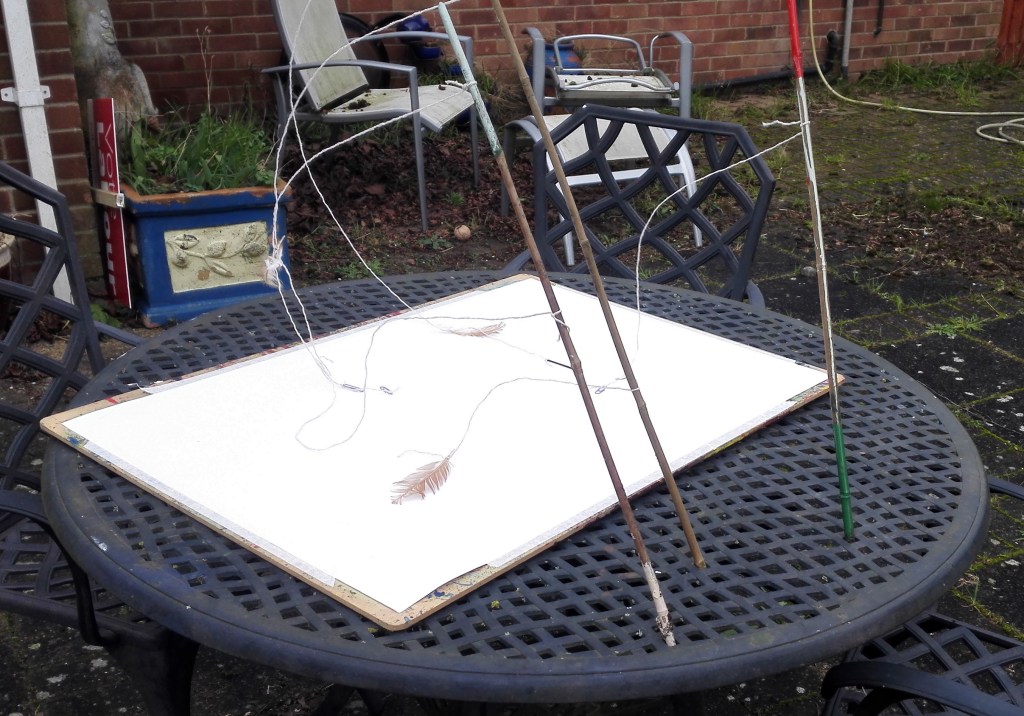
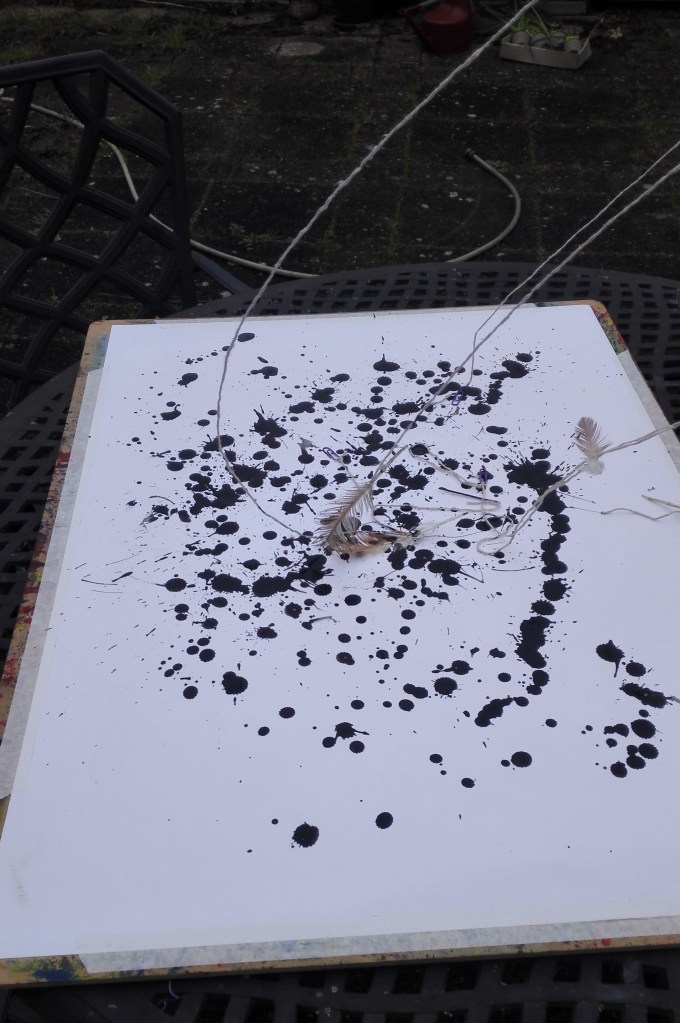
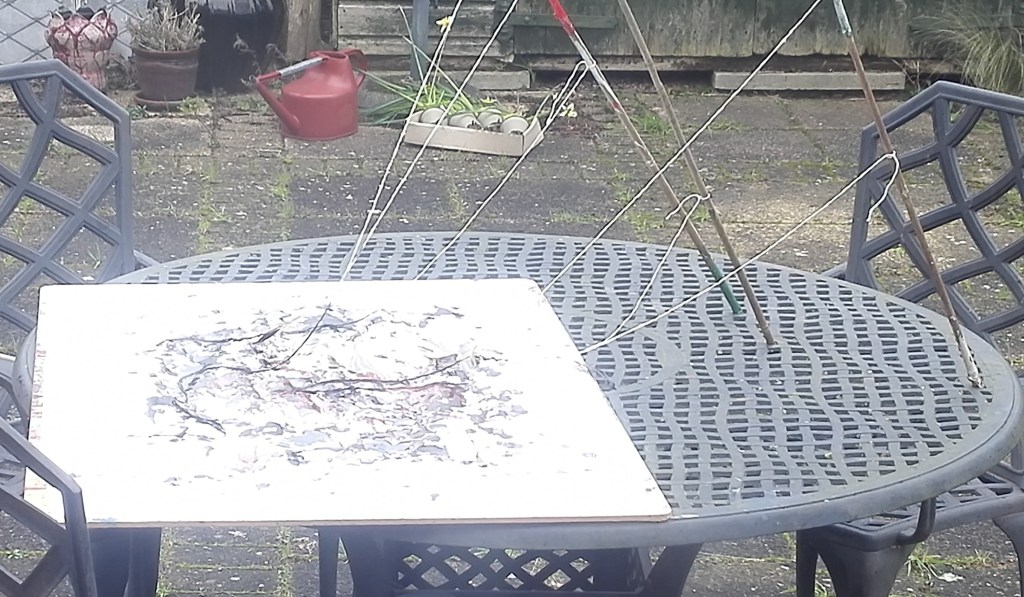
My aim in trying to create this work would be try to utilise the wind to create the marks. The weather over the past few weeks had been particularly windy due to two storms that had hit the UK, named Ciara and Dennis. I would work outside and set up a series of tools that would react with the wind. My starting point was to tie string to garden canes. Some of the strings were weighed down with hair clips or paper clips. These seemed to move reasonably well in the wind but the movement was a little limited. I would later try to increase to movement with the addition of bird feathers. The bird feathers would also be used to create marks.

Below are pictures of the set up.

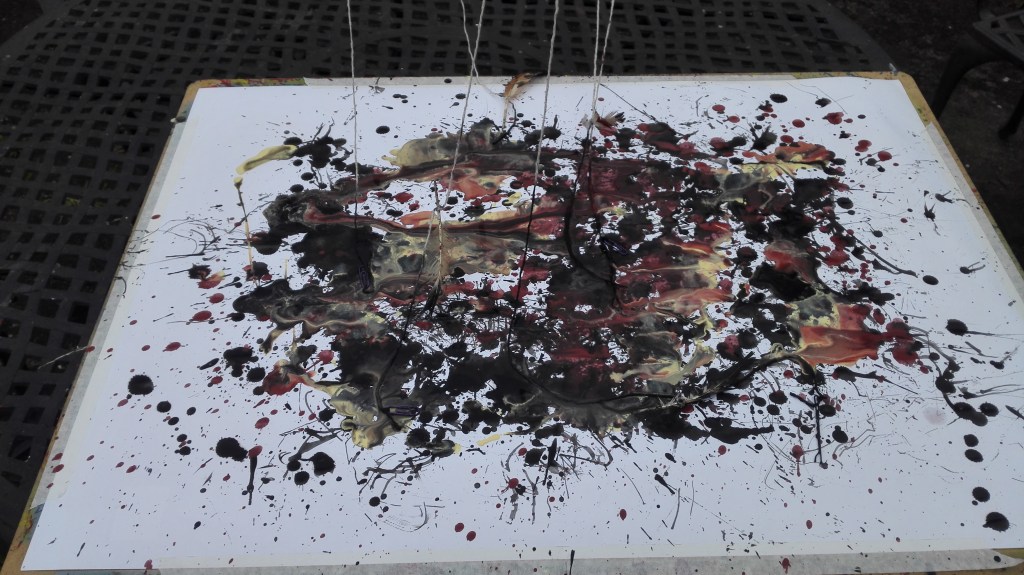
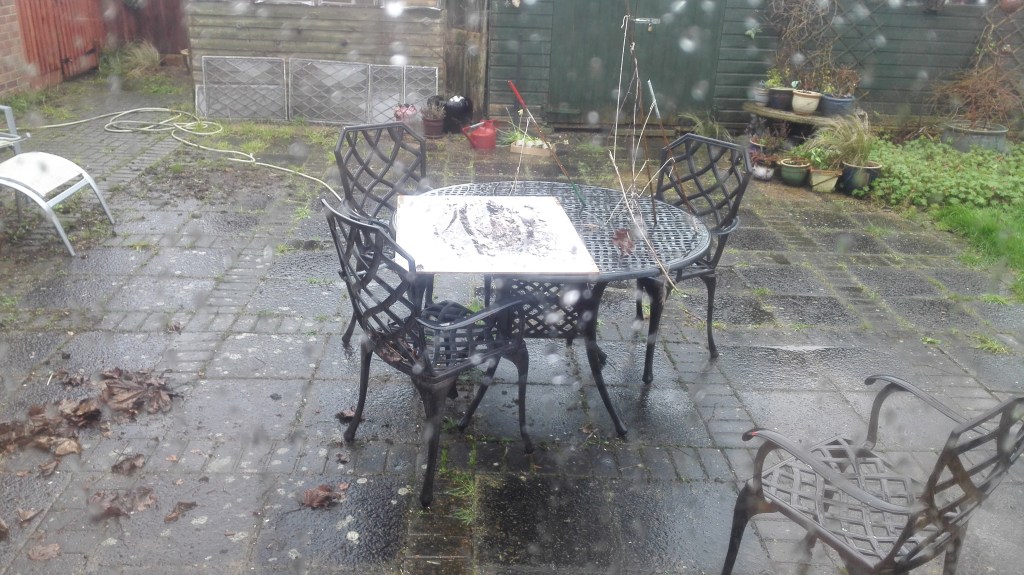
The issue that I struggled with was how to get the ink and paint onto the paper. I didn’t want to be involved but I couldn’t think of a way of removing myself from the process other than some sort of dripping mechanism. In the end I decided that I would apply the ink and paint by tipping and dripping it onto the surface. I was disappointed with the marks that the dripping made but hopeful that these would be removed, altered by the mark making. Initially I applied black drawing ink, this would be the dominant material. Later I would add diluted Acrylic paint using two colours Red Ochre and Naples Yellow.

Some photographs and a video of the process in action below:

Painting in progress – Video

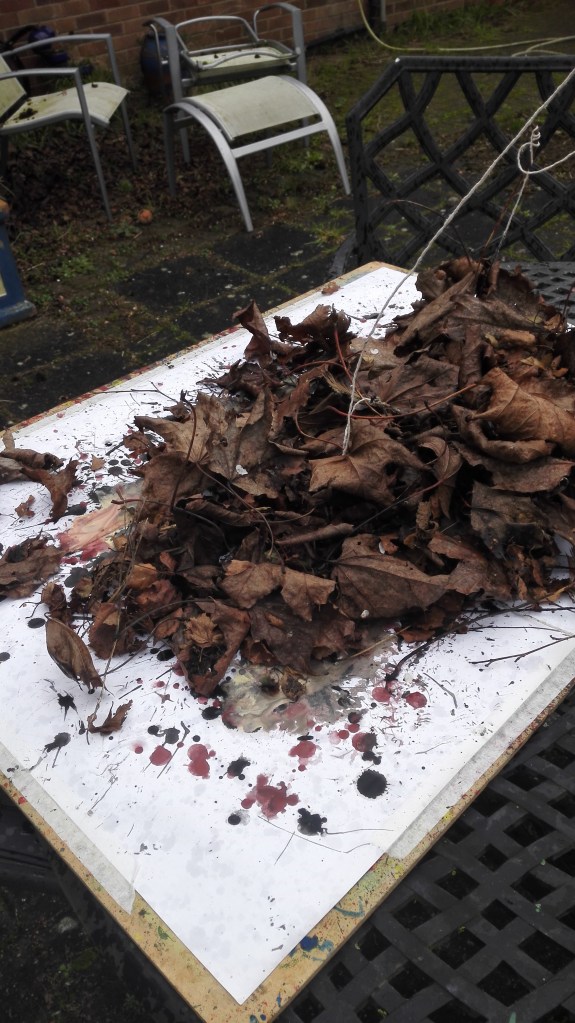
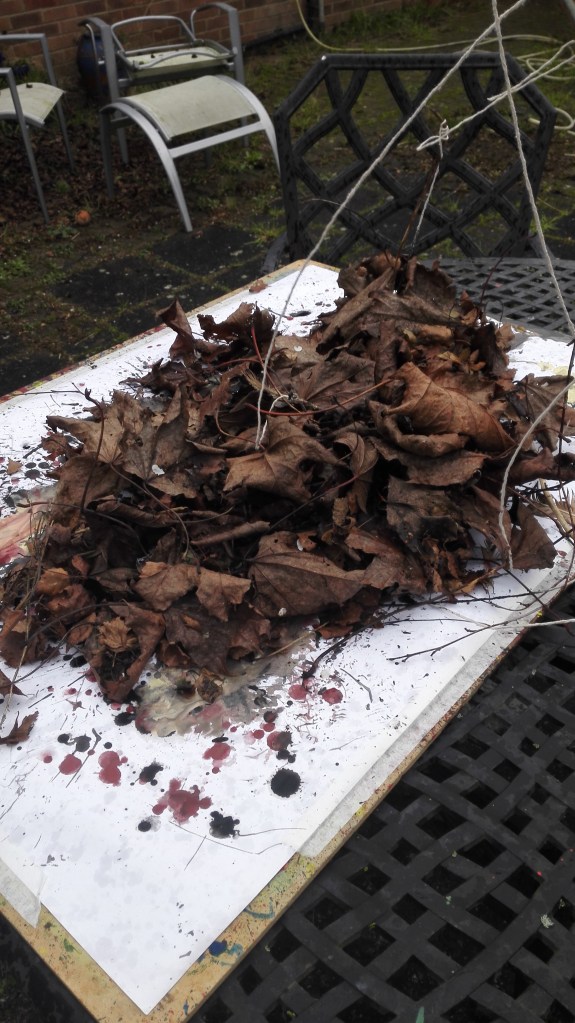
To try to increase and vary the marks I added some twigs to the string and covered the support with dead leaves. These would get blown over and off the support.

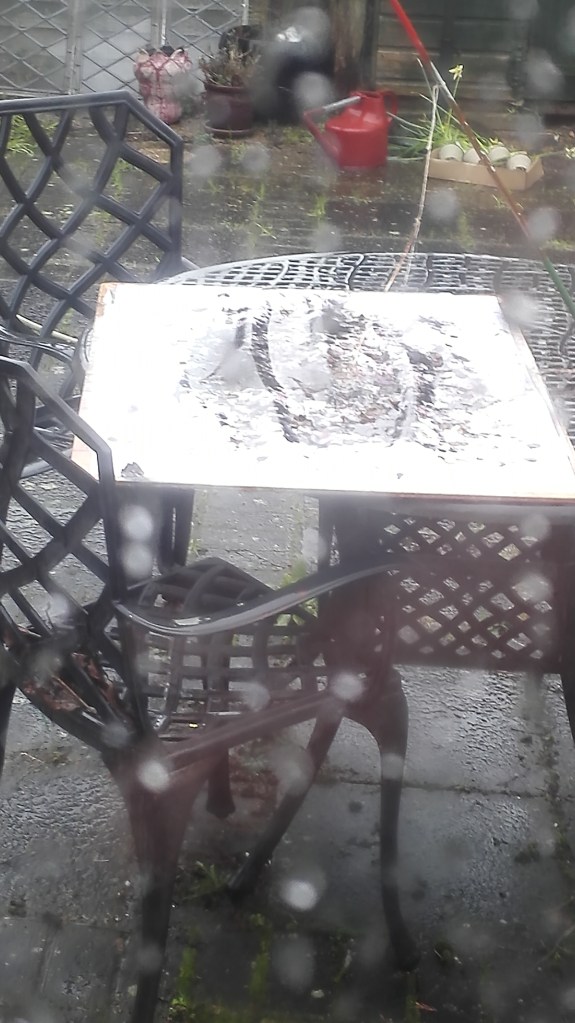
I intended to let the process run for several hours and this was confirmed when unsurprisingly it started to rain. I hoped that this would help the paint and ink to remain wet and allow more marks to be made. However it seems that the main impact was to wash the paper and allow watermarks to accrue.

It rained for approximately three hours. I left the painting outside to dry but it was further assaulted with more heavy rain and some hail too. It remained outside overnight before being bought in the following day to slowly dry in the shower.

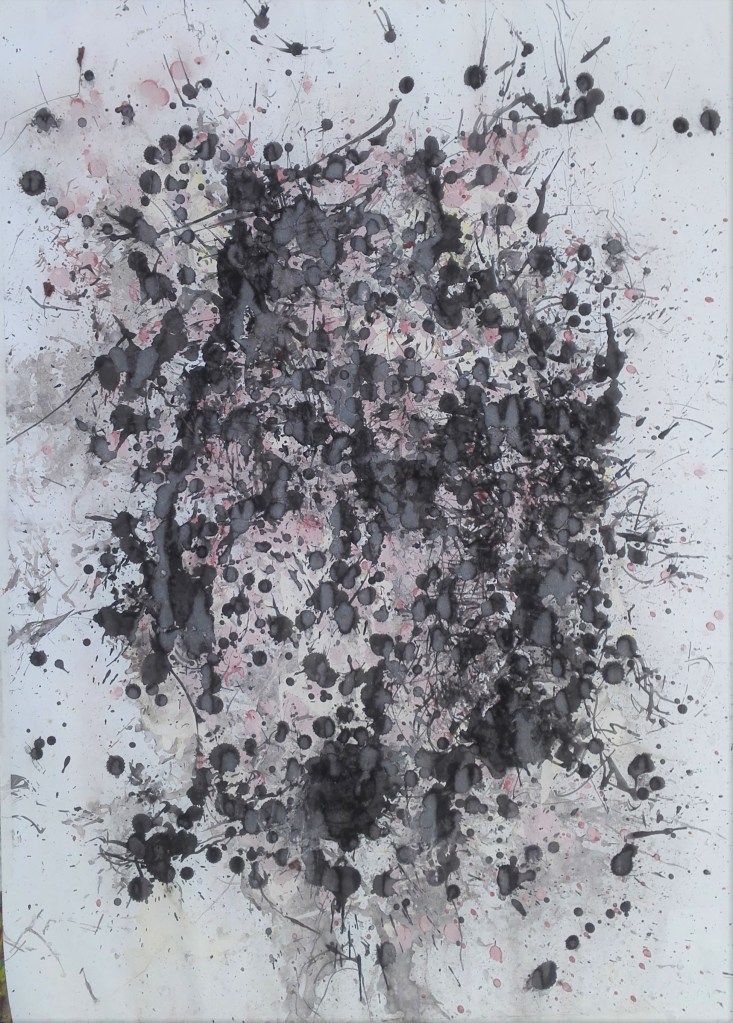
What would the final painting be like? Would it reflect the process that it had been through to suggest its creation?

My initial reaction was one of disappointment. It appeared to me to be a washed out version of some of the other action paintings that I had created for earlier projects.
Final Painting

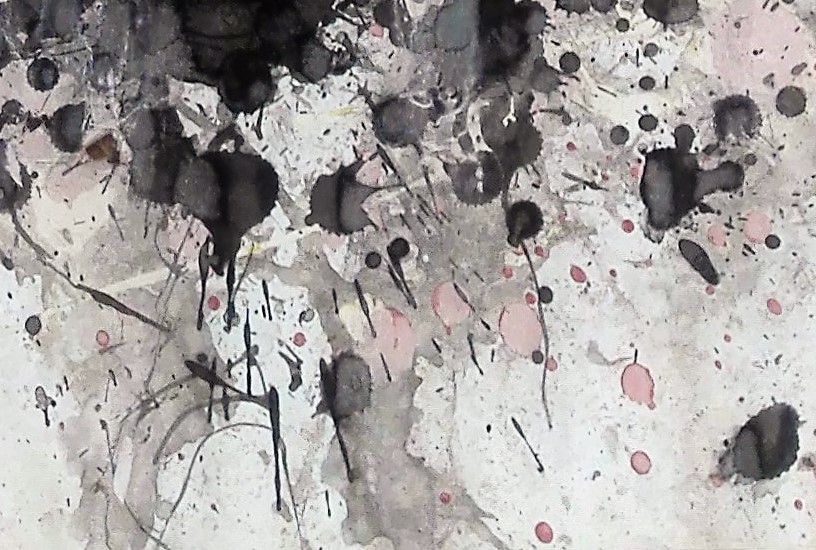
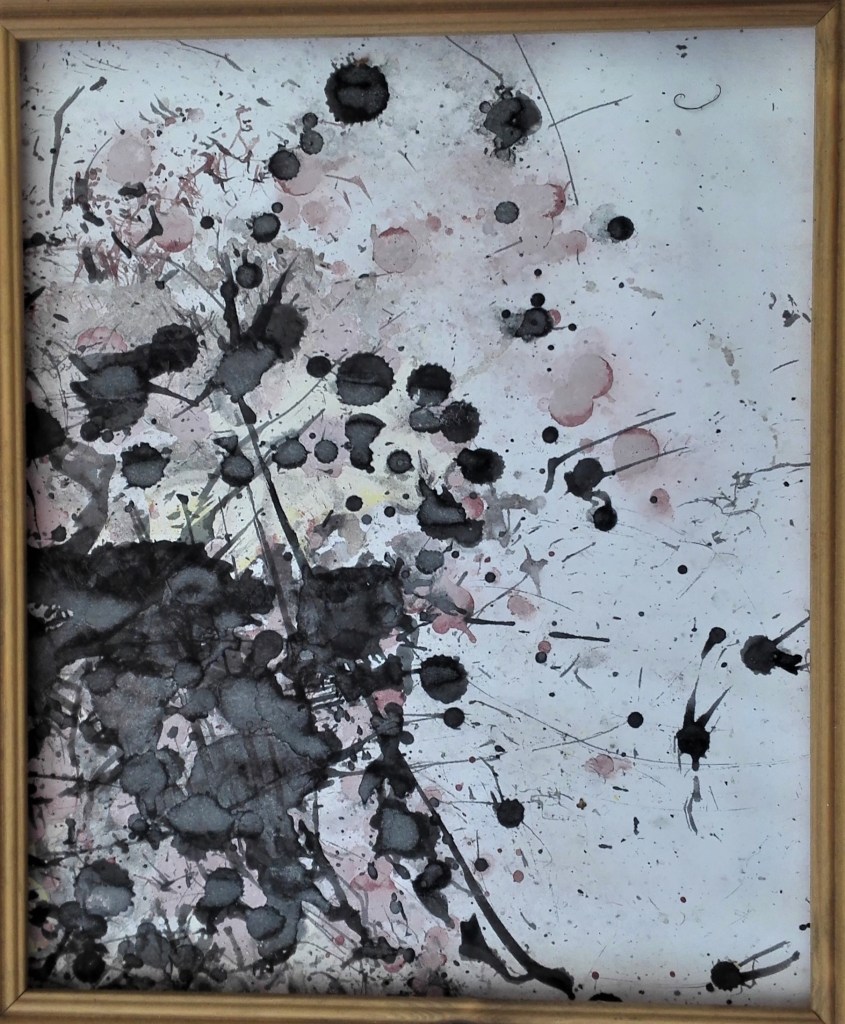
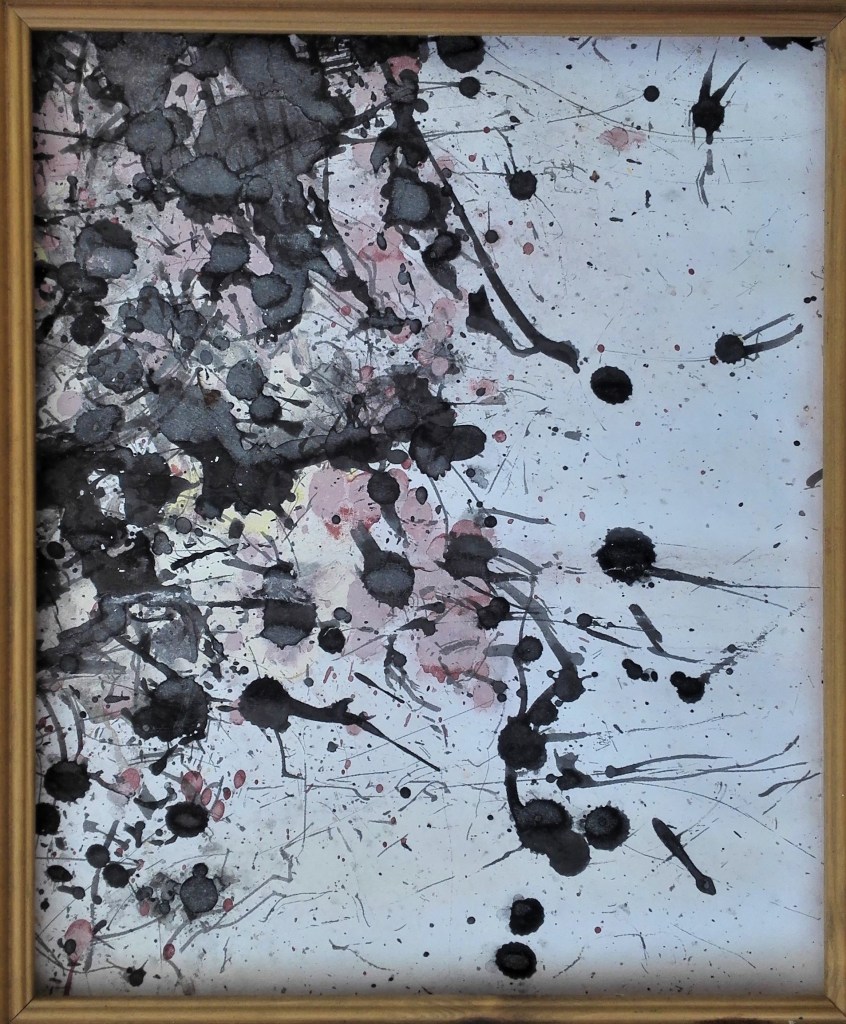
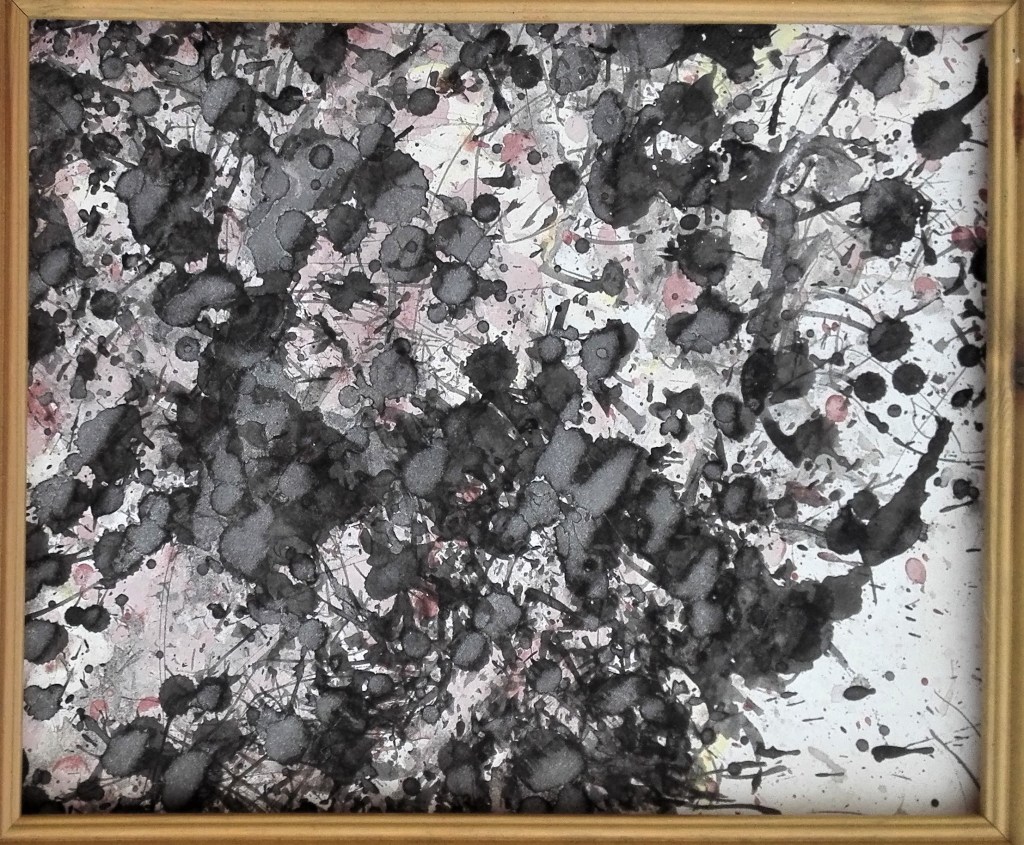
It was after closer observation that the subtleties of the work started to reveal themselves. The small marks and washed out colours were seen better in sections of the painting. Firstly I cropped and zoomed in on the painting using a photo editing tool. This process reminded me, a little, of the Sea Paintings of Jessica Warboys. As part of the process the canvases she had made were cut up, edited and reassembled to create the final piece.

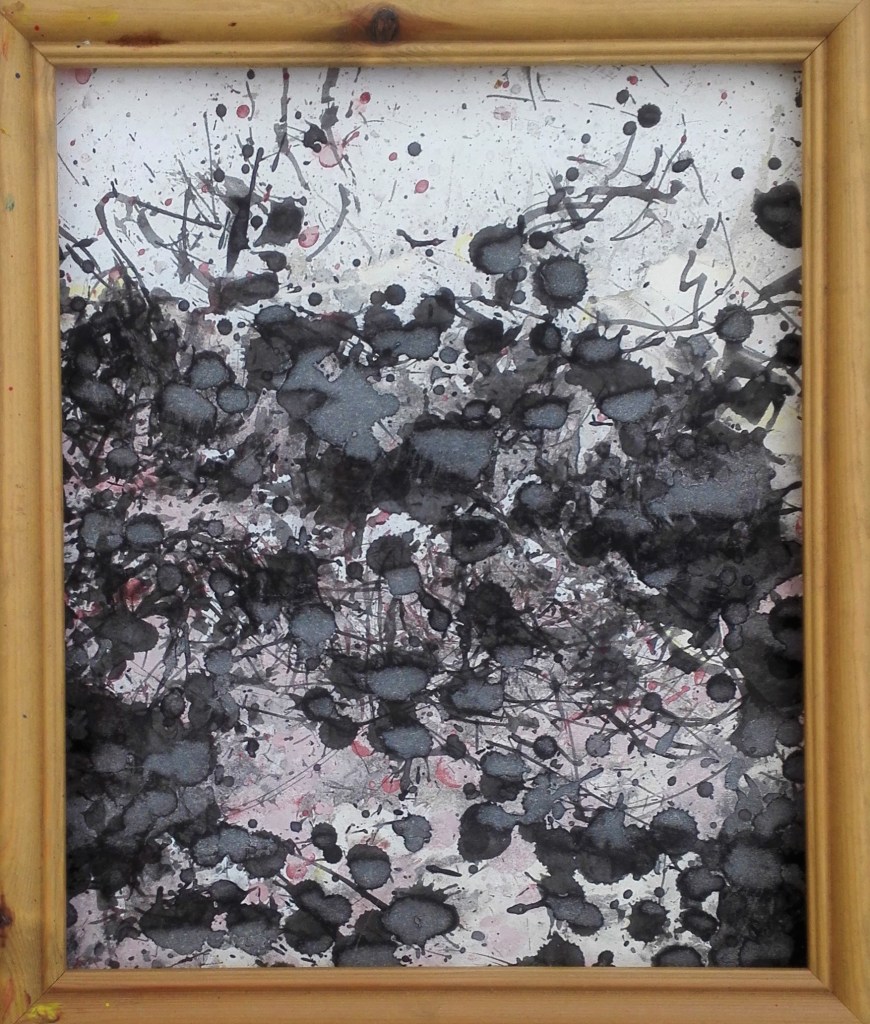
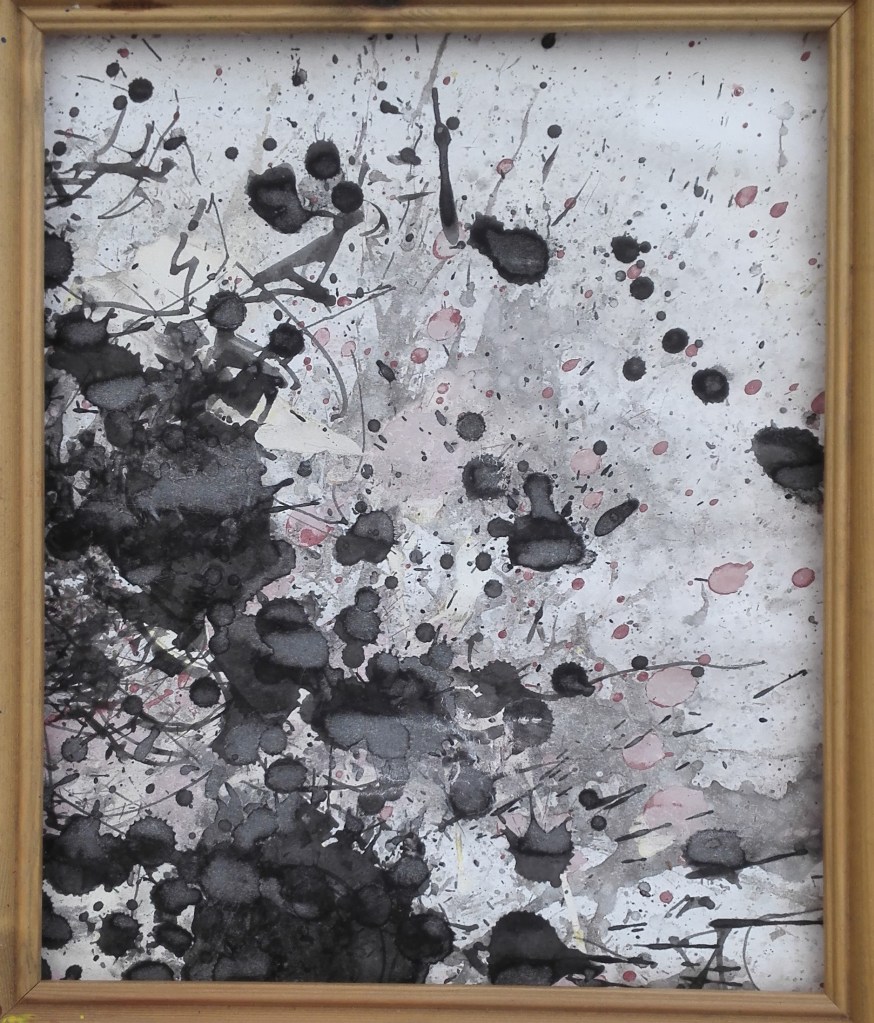
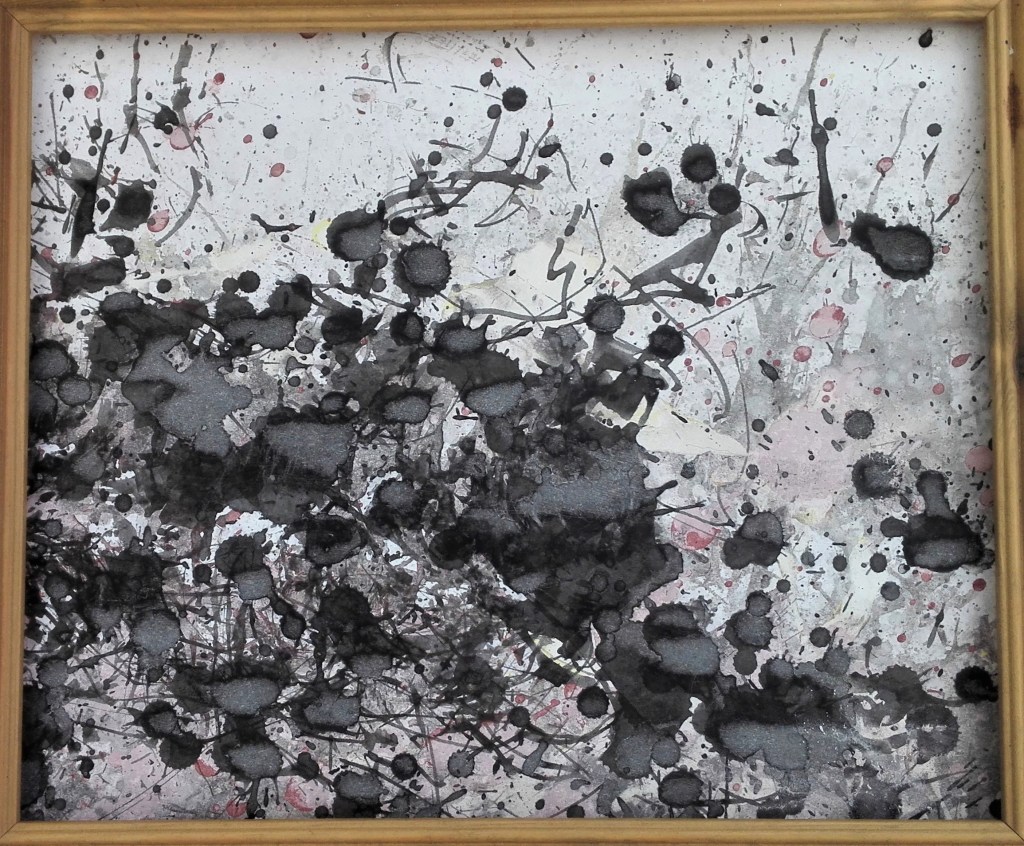
Next I used and old picture frame and moved this around the painting noting the different views that this gave me of the work. Two of these are shown below.

My final action was to decide whether I should cut up the painting and create a series of smaller paintings. At this time I have desisted from this and have kept the painting intact. The main rationale for this was to keep the work whole and for the editing not to be initiated by myself. The picture frame can be moved, by myself or others, to create different views which can then be captured by being photographed and an endless series of images created.

I tested this by asking Marian, my wife, to create three views that she liked and I also created two myself by placing the frame randomly on the painting. These five images are shown below.

Marian’s view 1

These smaller images do suggest the process and the time taken. In summary the painting process has been reversed whereby the viewer creates the painting from the combined actions of the weather and its impact on the materials.

Project 5 – Considering Painting – Exercise 1.4 Contextual Focus

The scope of this essay was considerable, the questions asked were: What do I feel painting is and what it isn’t? The purpose of painting and what it is for? Starting and finishing a work: where does an artwork begin and end? Knowing what I am doing: Is it unhelpful to know what I’m doing and is it possible to know when I’ve done?

To set the tone a to provoke questions it was suggested that I read a text by Lee Ufan entitled ‘Robots and Painters’. This discussed how, with the ever increasing of sophistication of robotics and computer generated graphics, robots can paint. The question that arises is, Is this really painting? Or Is it the production of a predetermined result? The robot can be made to carry out precise actions beyond the most technically gifted artist. However these actions have to be given, programmed, there is no learning or critical assessment. How does the robot know what to paint? Can it have an emotional involvement in the work? In breaking down the process of painting into data the emotional connection is lost. The act of painting is, I believe, more than a series of commands. There is an interaction between the artist and his materials. To quote from the text “the art of painting belongs in a different dimension from the system of knowledge” There are not a set of rules but an infinite range of possibilities and possible outcomes”. Robots and computers only reduce the possibilities.
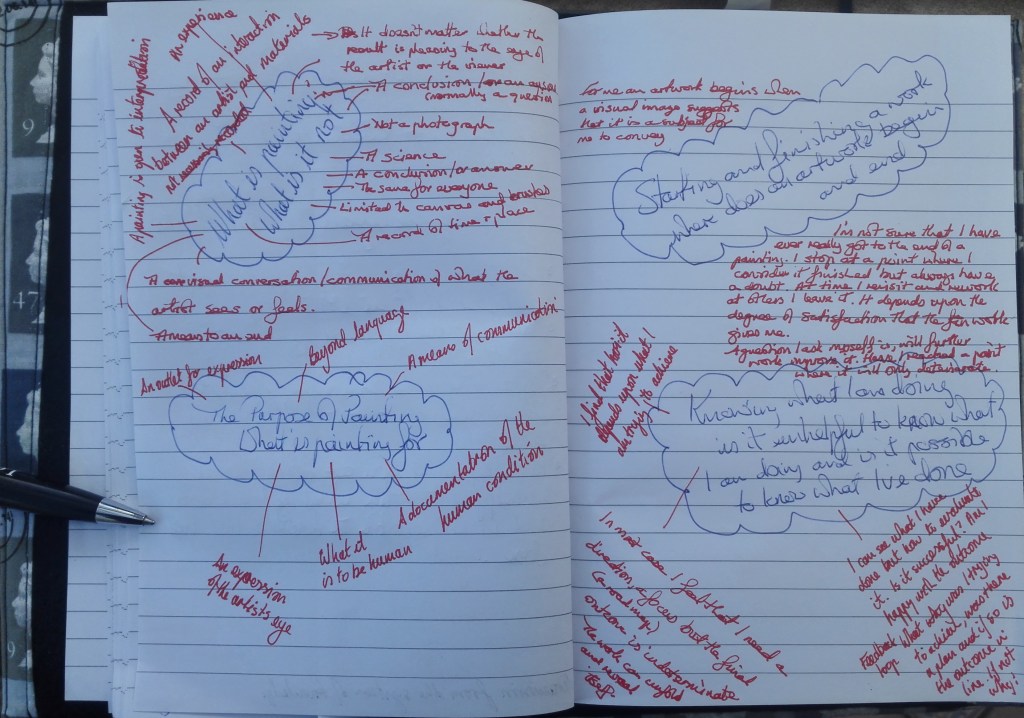
To try to condense my thoughts and also to structure them in such a way that I could write a coherent piece I draw up a simple mind map and proceeded to document my thoughts on each of the questions.

What do I feel painting is and what it isn’t?

In simple terms painting is a record of an interaction between artists and their materials. It doesn’t matter whether the results are pleasing to the artist or the viewer. The finished work is the result of a number of actions, thought processes and decisions. Painting is open to interpretation it is a visual conversation between the artist and the viewer. It is what the artists sees or feels.

It is not a conclusion or answer. More often than not it asks questions. It is not limited to canvas and brushes. There are many different ways that an artist can paint, many supports that can be painted on and many ways materials can be applied. Painting is not photography but can be a record of a time or place. Painting is not a science there are no rules. Painting is not the same for everyone.

The purpose of painting: what is it for?

It is a means of communication. What the artist was thinking or feeling. An outlet for expression. It is beyond language. A documentation of the human condition. A representation of the artists thoughts.

Starting and finishing a work: where does an artwork begin and end?

For me an artwork starts with an idea. This can be suggested by an image, a scene, a feeling and the desire to try to communicate this. The inspiration can be fleeting, a certain light momentarily caught, or a growing urge to convey something about what I see.

Finishing a work is always more problematic. I am not sure that I have ever really got to the end of a painting. I reach a point where I stop working on it but is this the end, is it finished? I always have a doubt. Sometimes I will revisit a work and rework sections. at other times I leave it. It depends on the level of satisfaction that the work gives me. A question I ask myself is, will further work improve it, have I reached a point where further work will only detract and the work will deteriorate? The answer to these questions is never fully resolved but at some point I stop.

Knowing what I am doing: Is it helpful to know what I am doing and what I have done?

To answer this question I have to ask myself what I was, am, trying to achieve with the work. In most cases I feel that I need a direction, a focus, a route towards what I want to communicate. The final outcome will be indeterminate and the work will unfold as I proceed. I will make decisions as the work progresses.

At some point during the process I will try to evaluate what I have done. Is it successful, what were my intentions, what was I trying to achieve? This is a feedback loop that goes round and round until I reach the point where I stop. The internal questioning is easier when I have some concept of where I was heading. This is more difficult with experimental works as the outcome is not defined. The question remains the same am I happy with the outcome if not what needs to be done.

Part One – Research point 3: Jessica Warboys, Rebecca Horn & Akira Kanayama. Comparisons to my own explorations

Sea Paintings

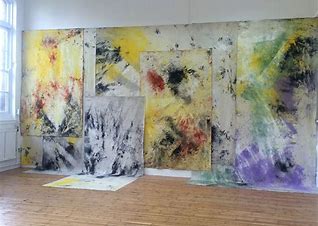
The paintings shown above are part of the Sea Paintings by Jessica Warboys. The creation process involves soaking the large canvases in the sea at different locations around the UK. The resultant marks and textures provide a record of both place and time. Jessica manipulates the canvases, sometimes removing part of them to create an overall composition.

I can see a link from my explorations with dripping and splattering paint that I completed in Exercise 1. Jessica has moved past the limitations that I had to allow the movement of the sea to create the work.

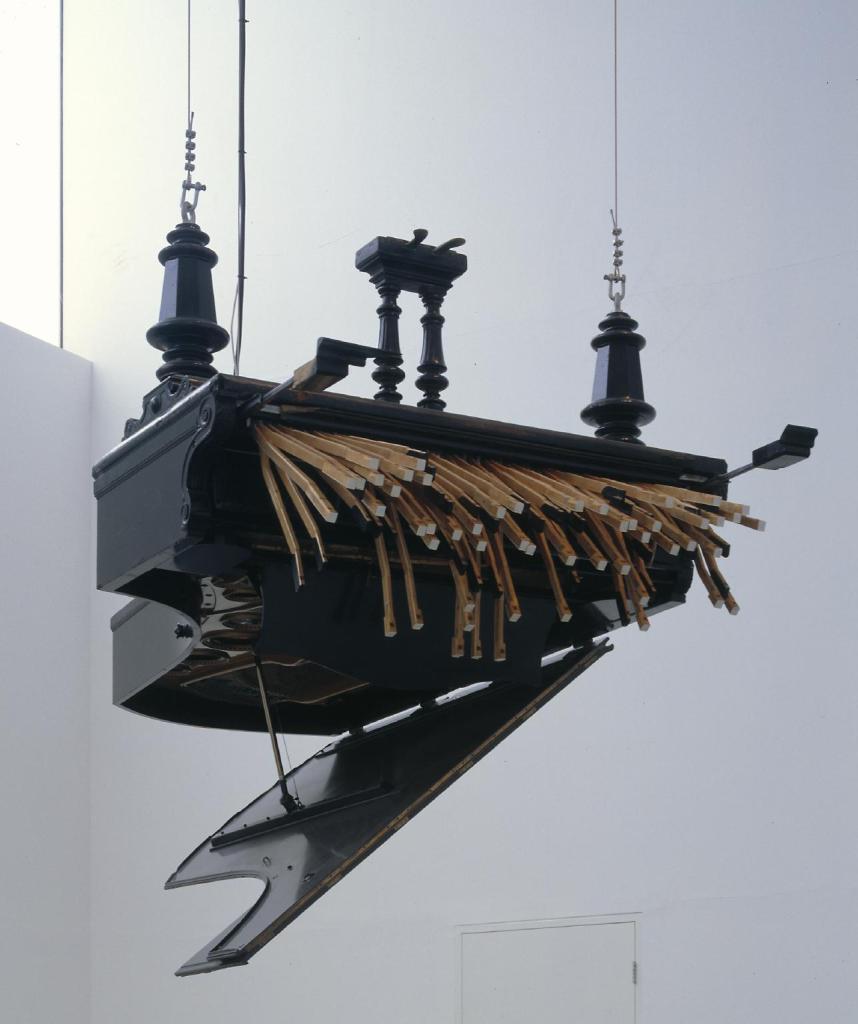
Rebecca Horn, a German visual artist born 24/3/1944 creates Installation art along with Film directing and body modification. I was interested by one of the pieces that is at Tate Modern. The work is called ‘Concert for Anarchy’ it is an upside-down piano which occasionally comes to life in a noisy outburst. An excerpt from the display caption states “The instrument was used as prop in Horn’s feature film ‘Buster’s Bedroom, 1990’ Horn has described how ‘having freed itself from the psychiatric clinic (the piano) is now composing its own music. The piano acts like a living thing: it gets upset and slowly regains its composure. this might mirror own experience of being startled by the sculpture.”

I have not tried anything remotely similar and therefor any comparisons to my explorations are not valid.

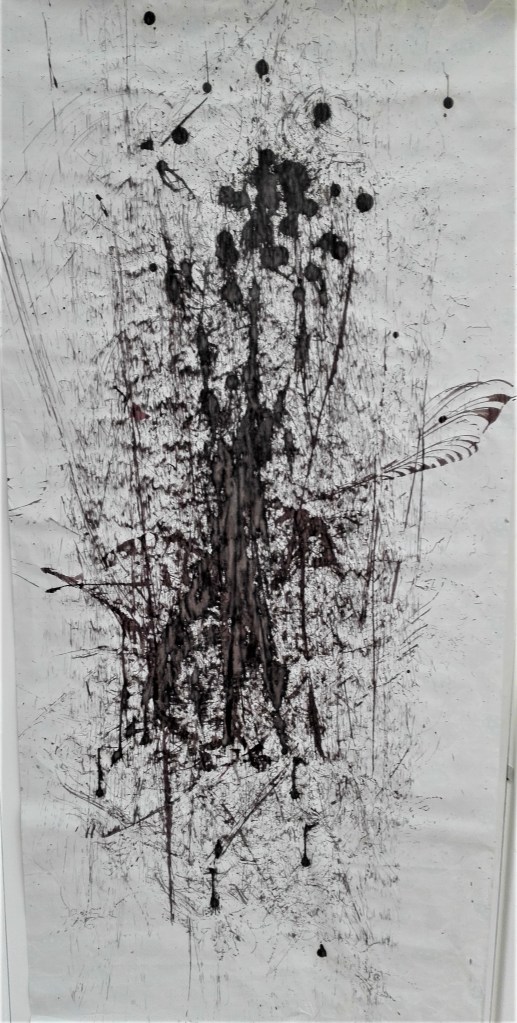
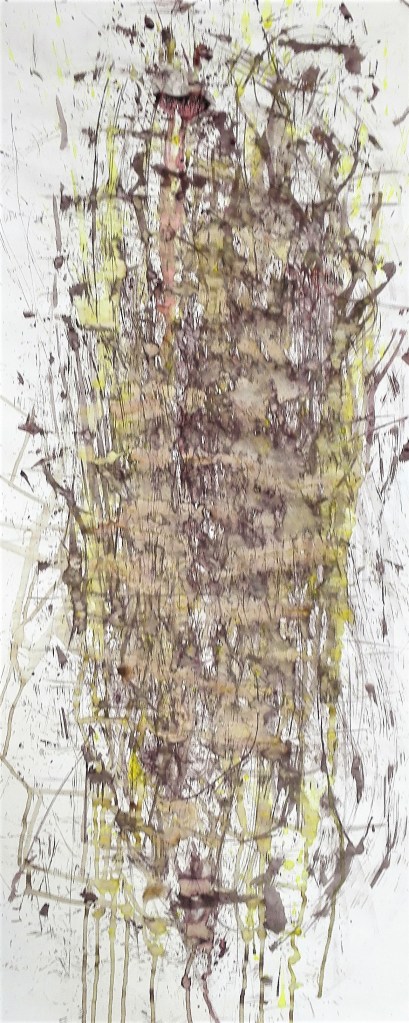
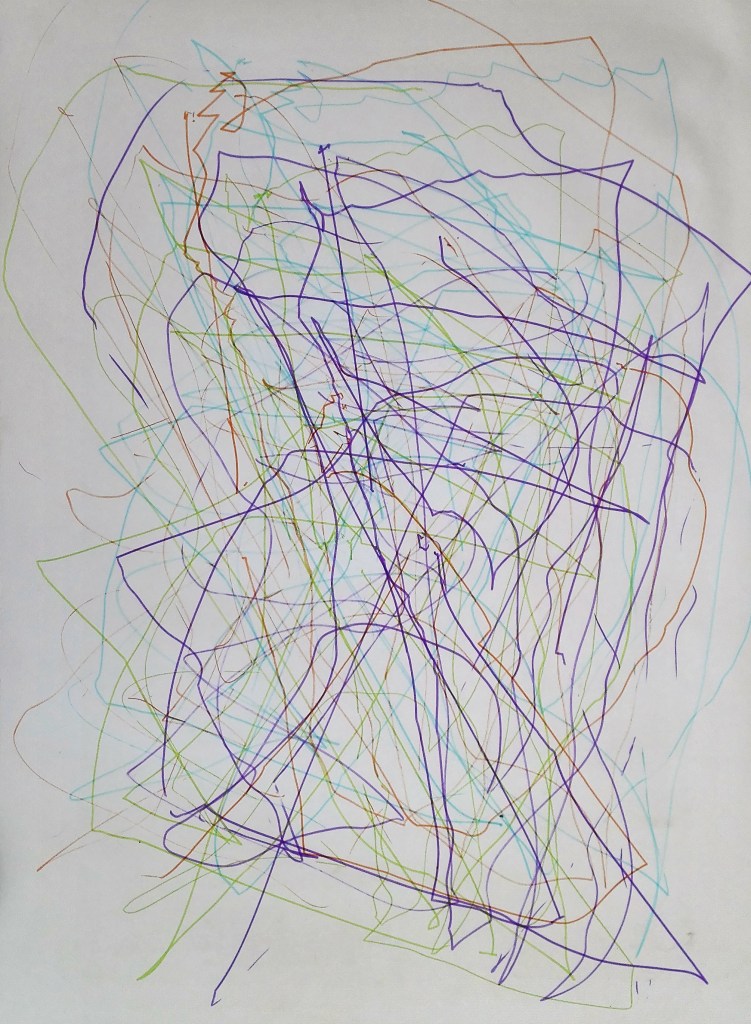
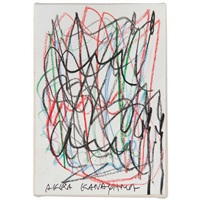
Moving onto Akira Kanayama, 1924 – 2006, one of the Japanese Gutai group I can immediately see connections with some of my experimental drawing and paintings that I have completed as part of the exercises in Part One. The first example is the coloured line drawing that I made using the drawing contraption. Below is my work on the left and Kanayama’s on the right.

There is a sense of random marks made in an undisciplined manner to both drawings.

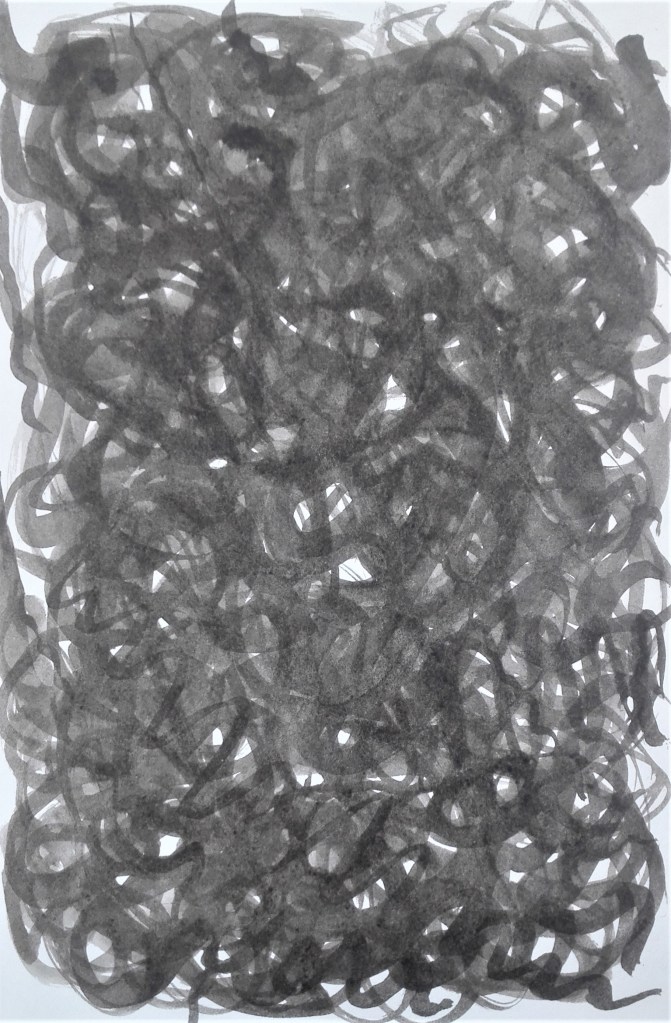
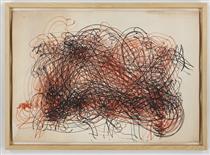
Further examples, see below, show similar mark making. In both examples my explorative work is shown on the left. In both examples my work looks more primitive in its conception and outcome.

Project 3 – Visual reflection – Exercise 1.2 Mapping / Diagram

Although I had a number of ideas I struggled to get going with this exercise. I had already moved past this exercise and completed Project 4 Exercise 1.3 which I have already documented in this blog. Finally I decided to try and get my thoughts down in a diagrammatic and visual form.

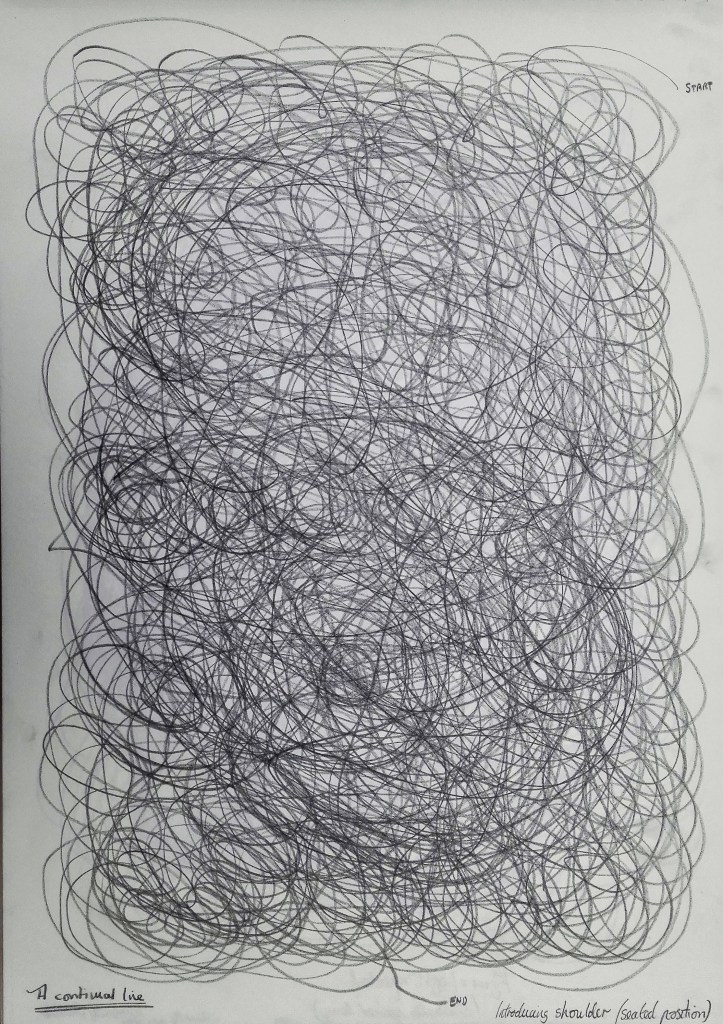
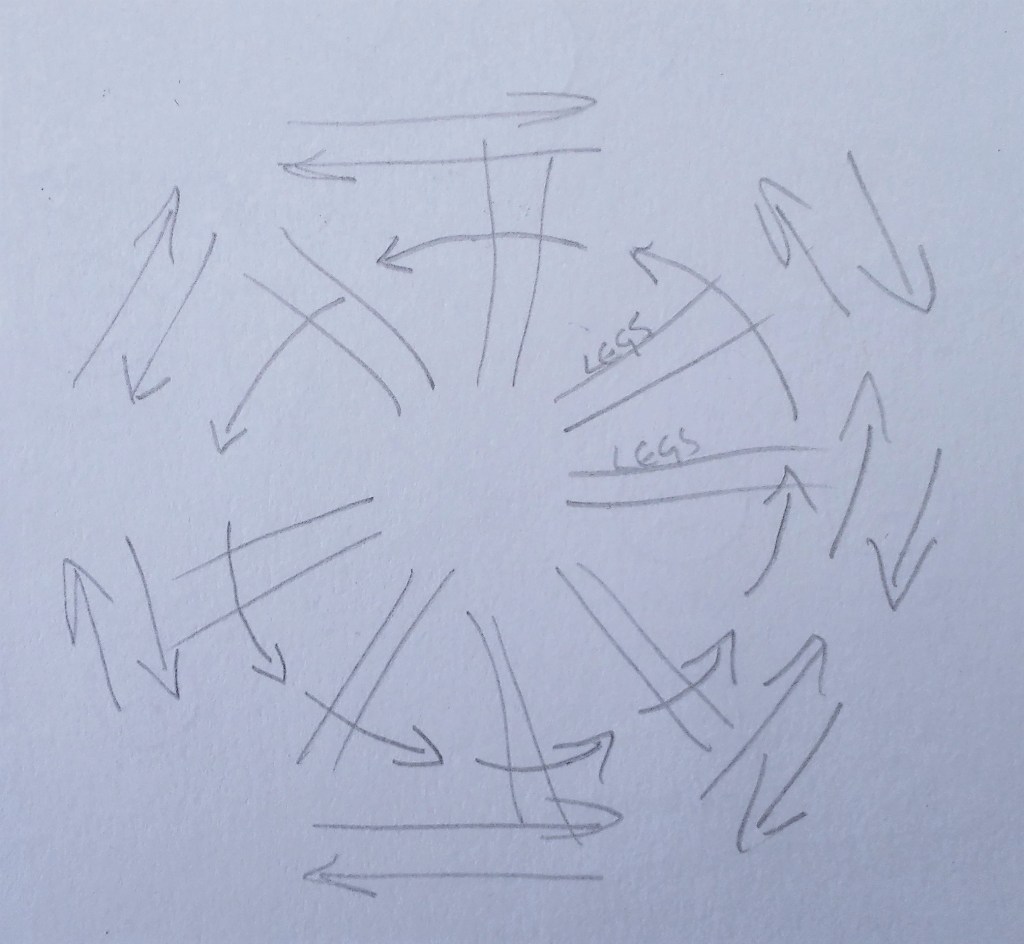
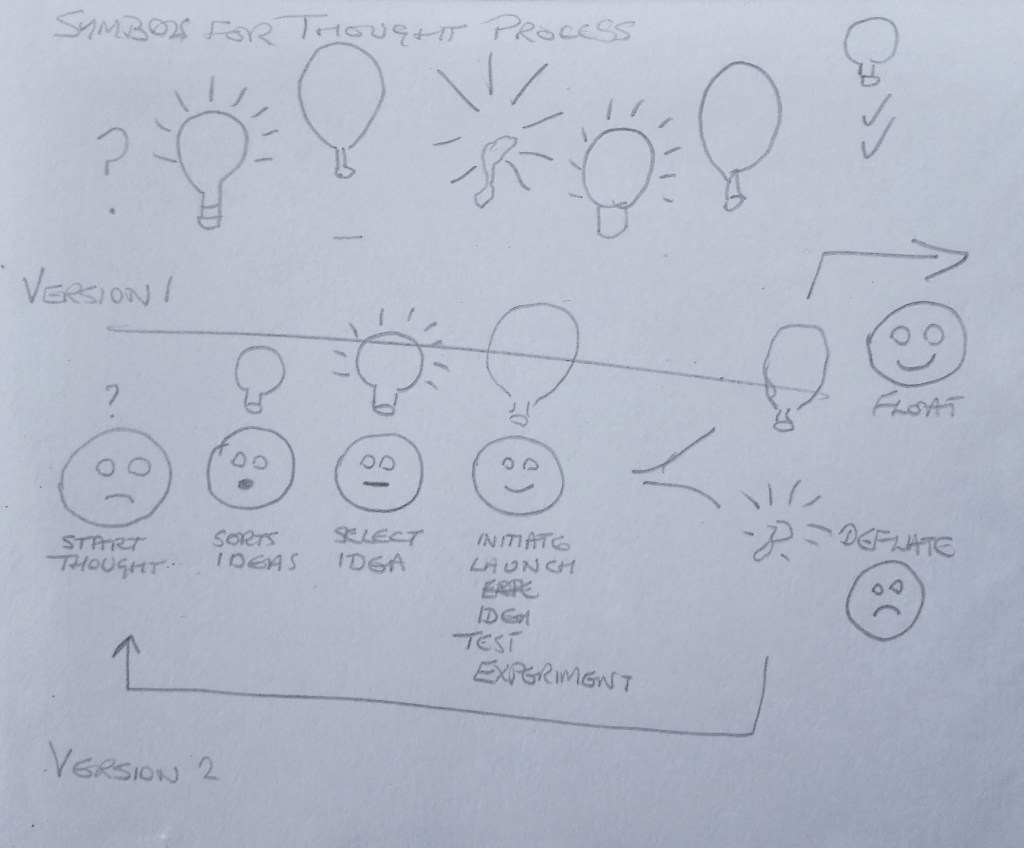
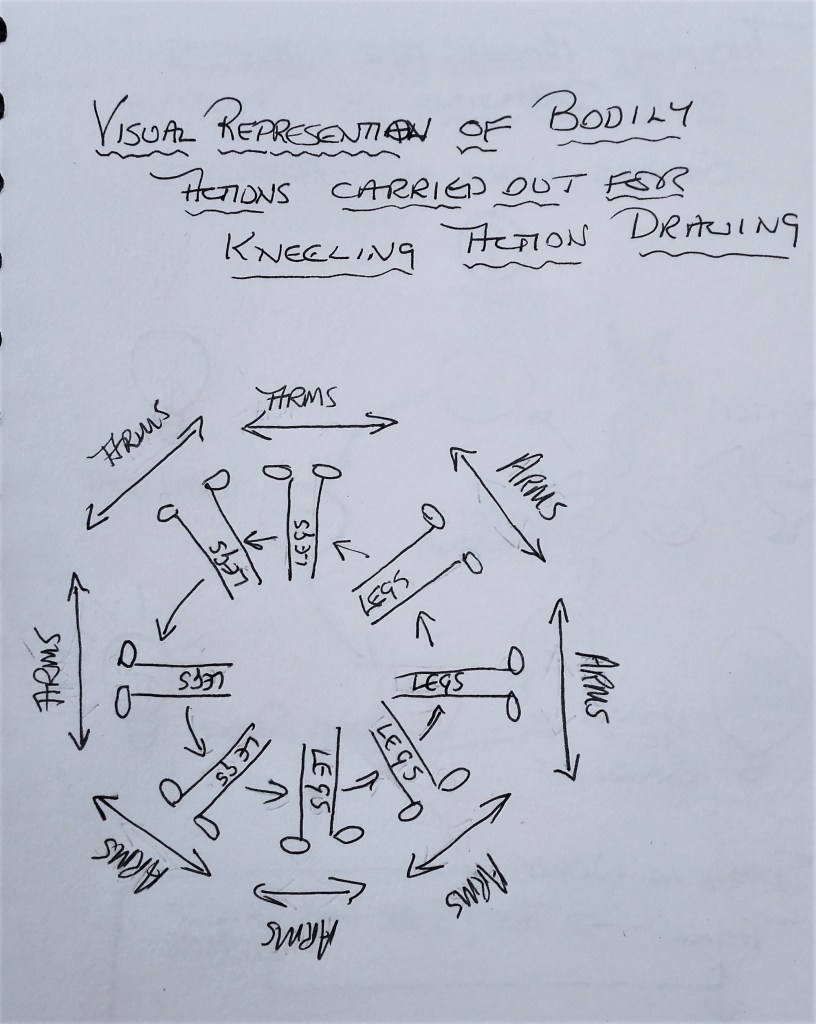
I started by thinking about the Kneeling Drawing exercise that I completed and tried to put down my actions in a diagrammatic form. By using a series of line and arrows I represented the movements of my legs and hands. Quickly following on from this I tried to show in symbol form the thought process that I usually go through when thinking about commencing a painting or drawing. Lastly I thought about the process of thinking itself and the physical act of drawing or painting.

The initial diagrammatic drawings and sketches that I produced are shown below.

I had already taken note of the mention to record my thoughts and to the end I made a mental and physical note to regularly do this when I walk Fred, our dog.

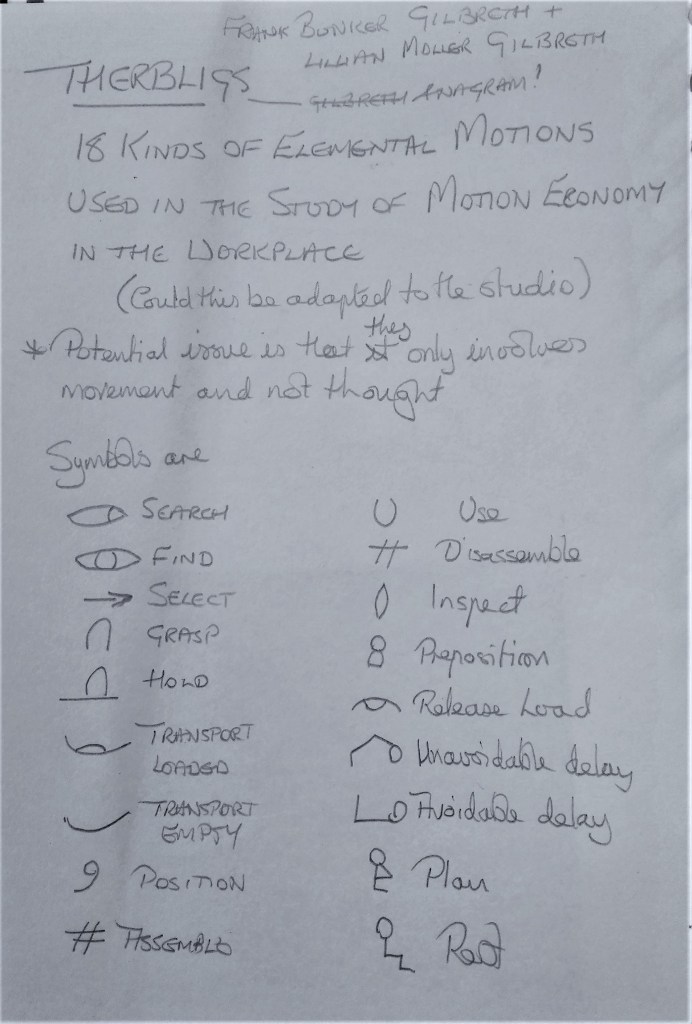
It was whilst thinking about how to record human movements that I remembered a technique called THERBLIGS. I had come across this whilst completing my Accountancy studies many years ago. It is a system developed by Frank Bunker Gilbreth & Lilian Moller Gilbreth to record movements in time and motion studies. Therblig is an anagram of Gilbreth.

I looked up Therbligs on Google and noted that it consists of 18 kinds of Elemental motions used in the study of motion economy in the workplace. I wondered whether I could adapt this to the actions used in the studio. I’m sure that it could be adapted but even if successful it would only record the physical movements of the artist and not the thought process which is equally if not more important.
Therbligs

I further developed the physical diagram for the bodily actions carried out during the kneeling drawing.

What does this tell me about the drawing or the process? It gives an idea of the how the drawing was created but not the why or any evaluation of the outcome. In this respect I find it unsatisfactory.

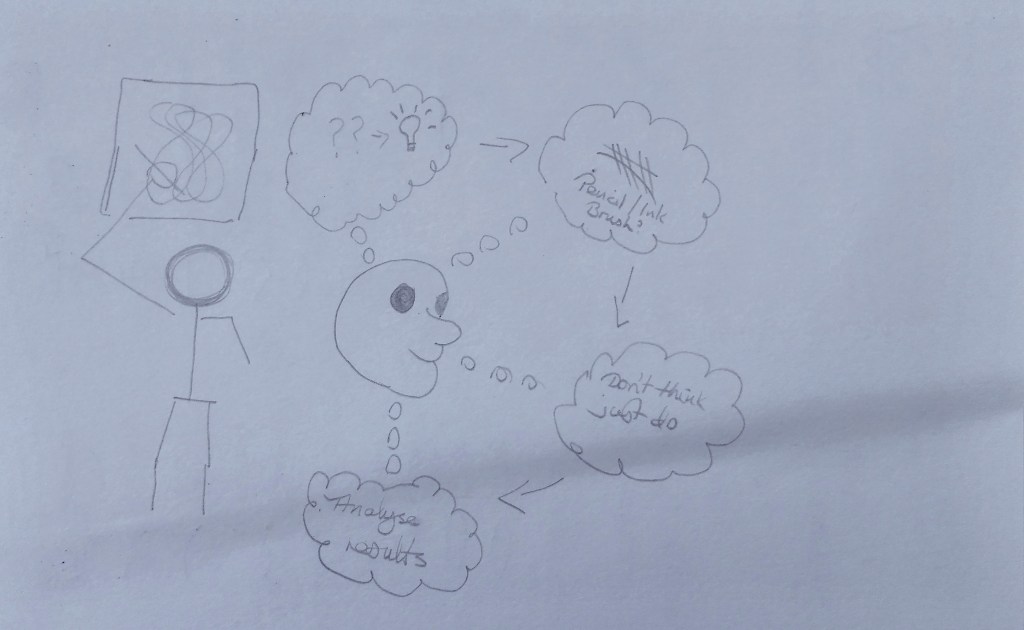
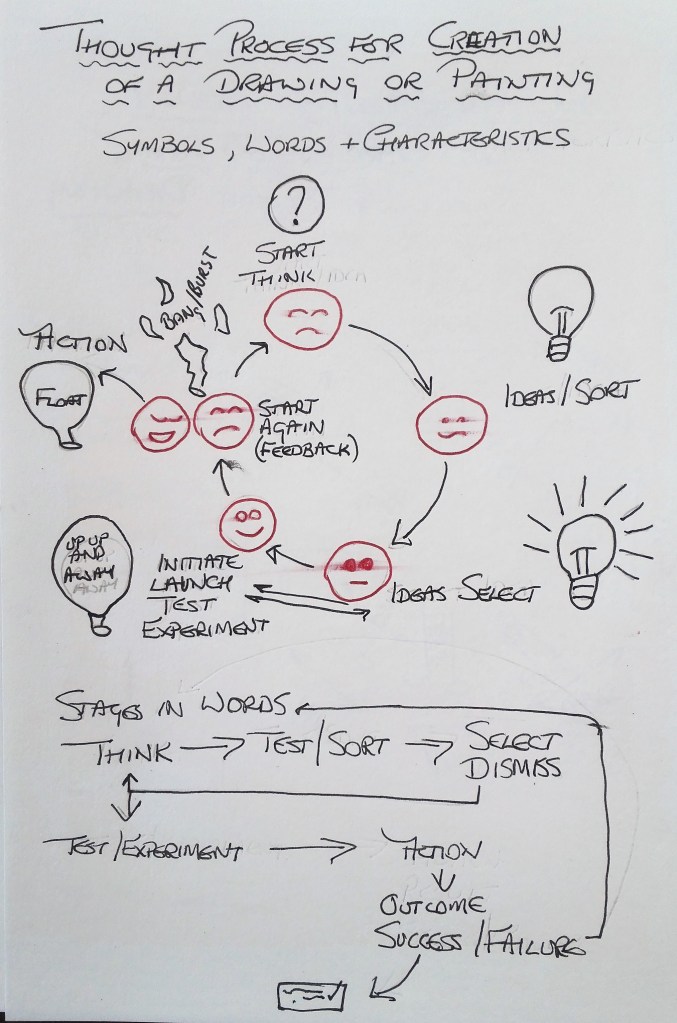
Moving onto the thought process I developed the symbols, words and facial characteristics of the process that I go through when trying to create a drawing or painting. In some cases this process is more or less instantaneous at other times it can be drawn out over days, weeks or months. The process is the same. I have represented it in the diagram below in two separate ways. In the first instance I used a combination of symbols, words and facial characteristics in a circular flow diagram and for the second I used words only.

Could this be helpful to me. In a fairly basic way I believe that it could as it could point out where I am in th2 creative process. I feel I could develop the “ideas / thought” , ” ideas / select” and “experimental” phases further. To me this is the taking of an idea through the sketchbook phase to the embarking on a final piece. I suspect that I will refer to the processes documented in the diagram in my head rather than noting them down. However I will try to use the process when reflecting on completed work. Will it give me an indication as to where the successes and failures were?

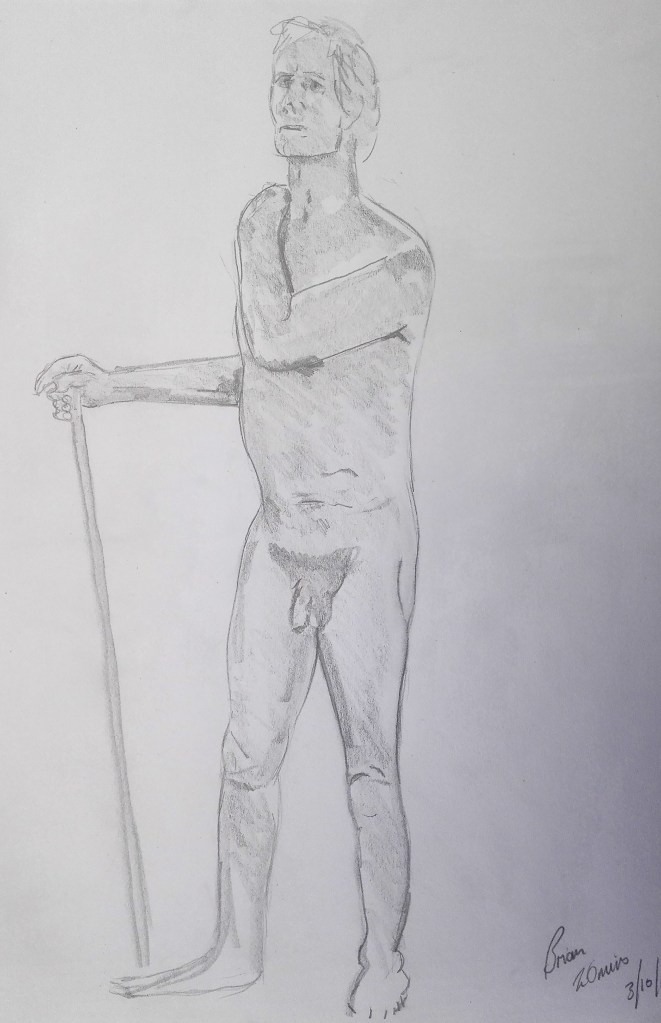
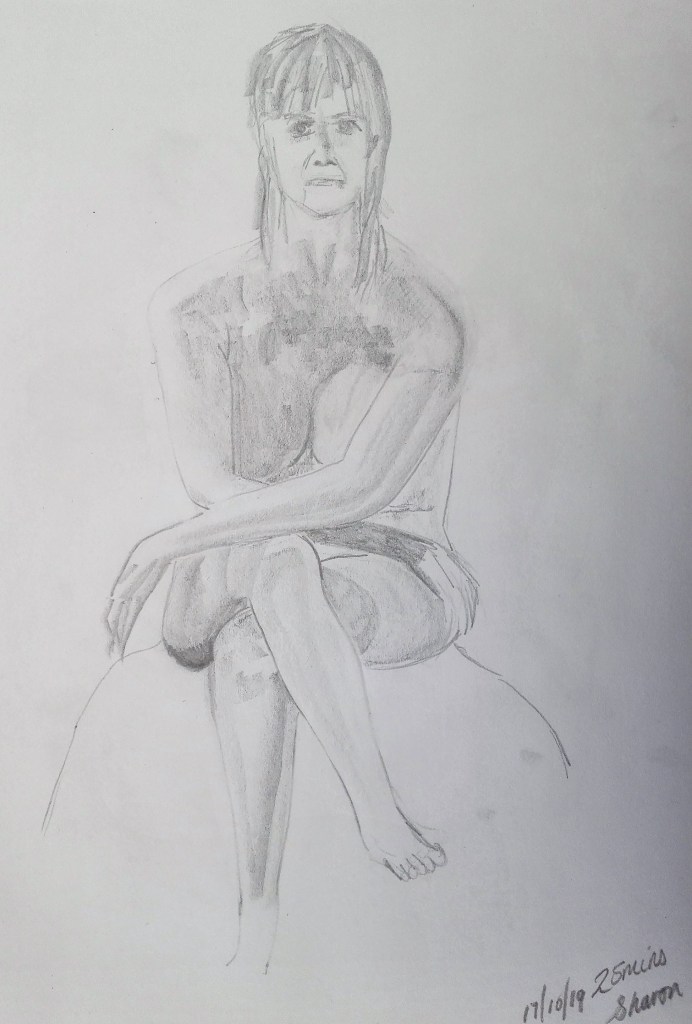
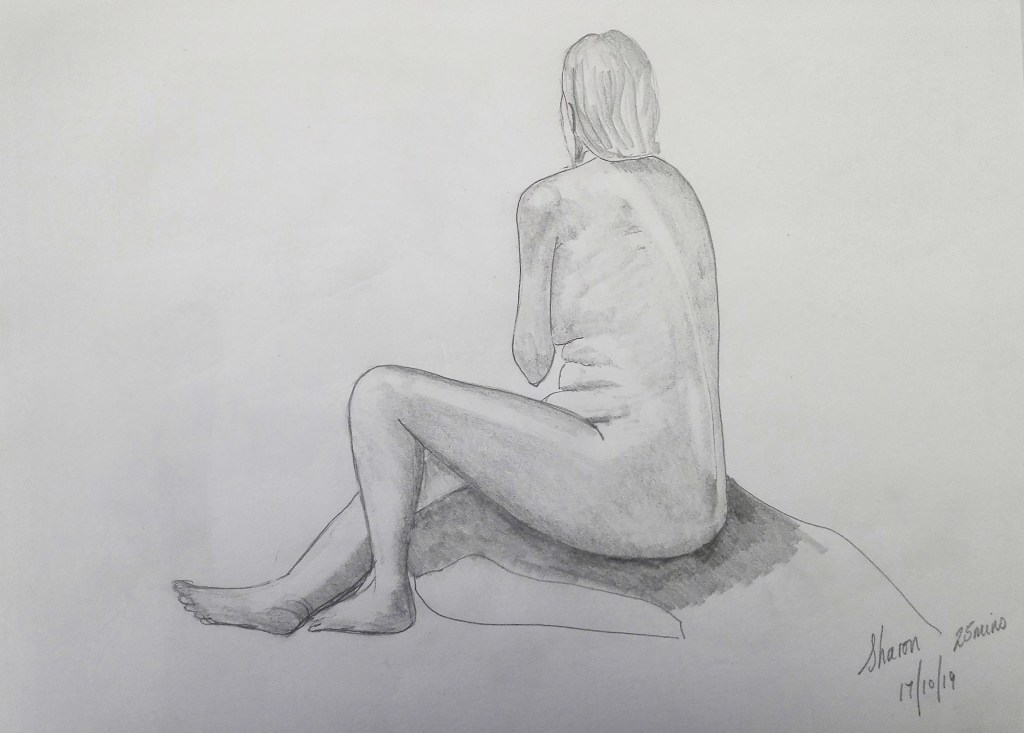
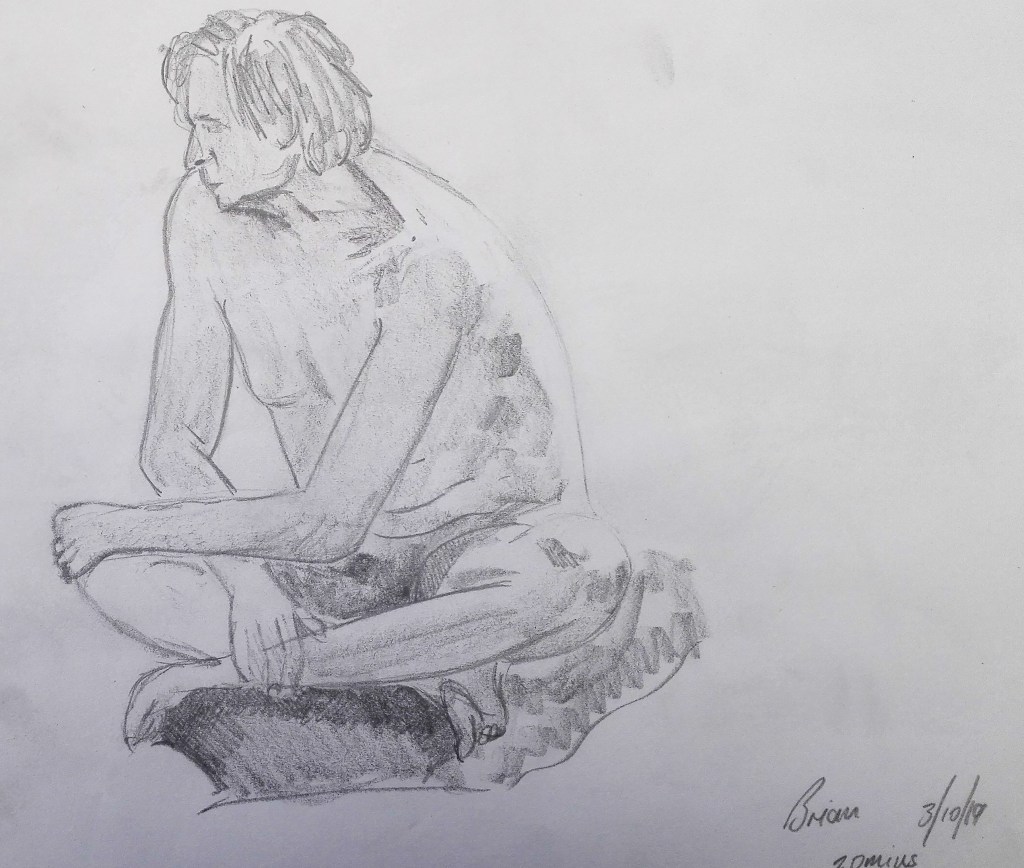
Life Drawing “Autumn Term 2019”

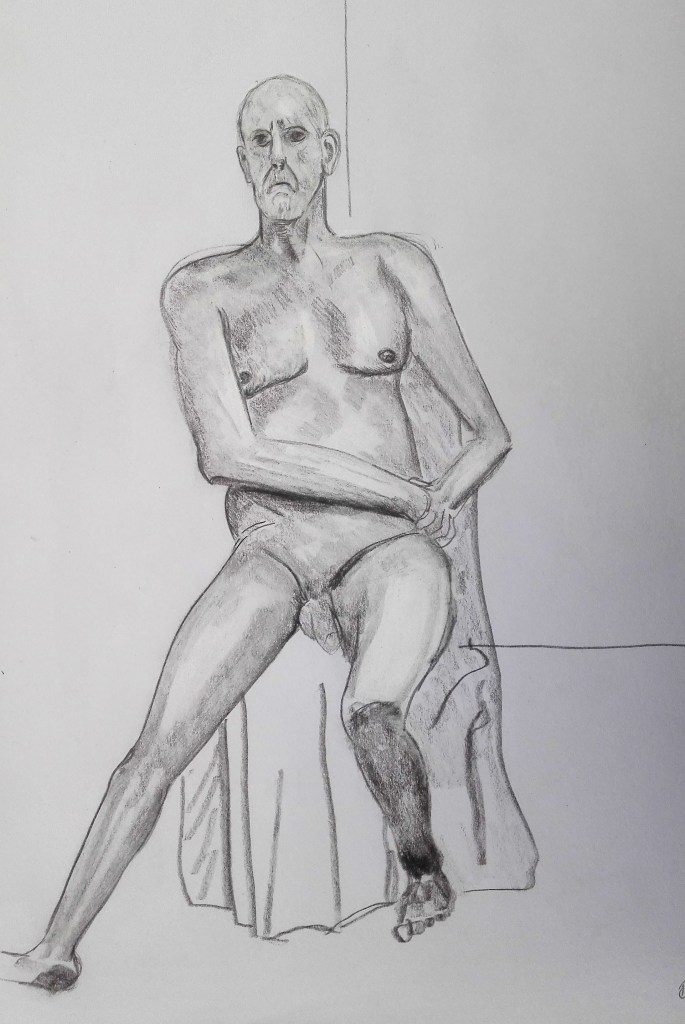
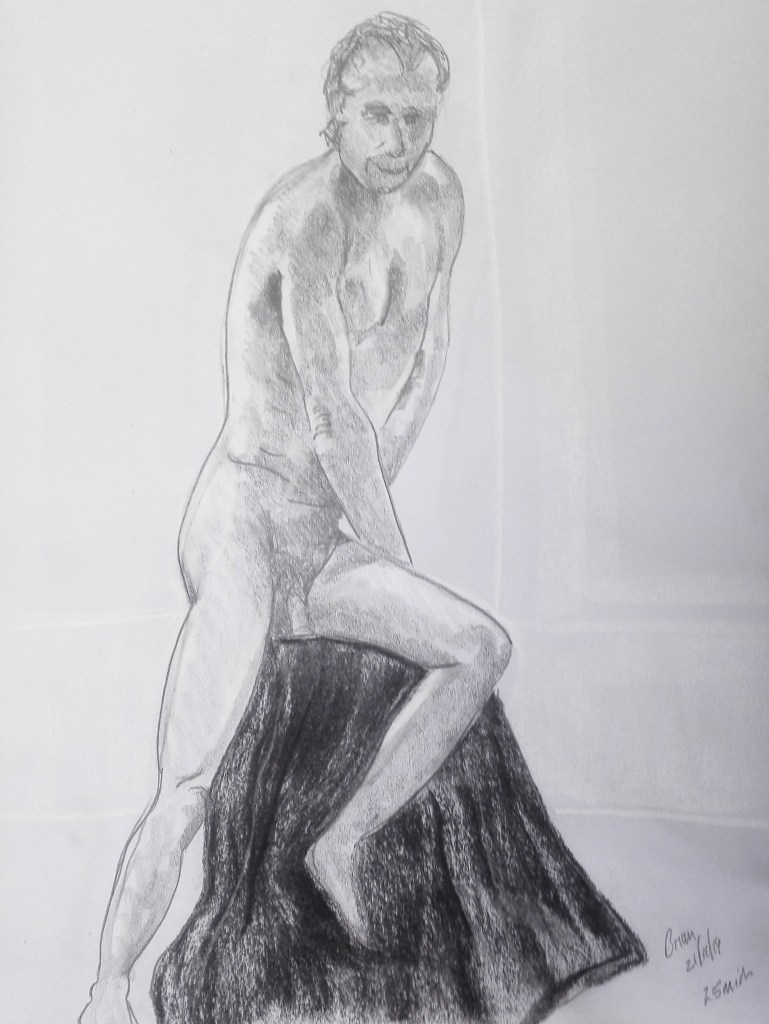
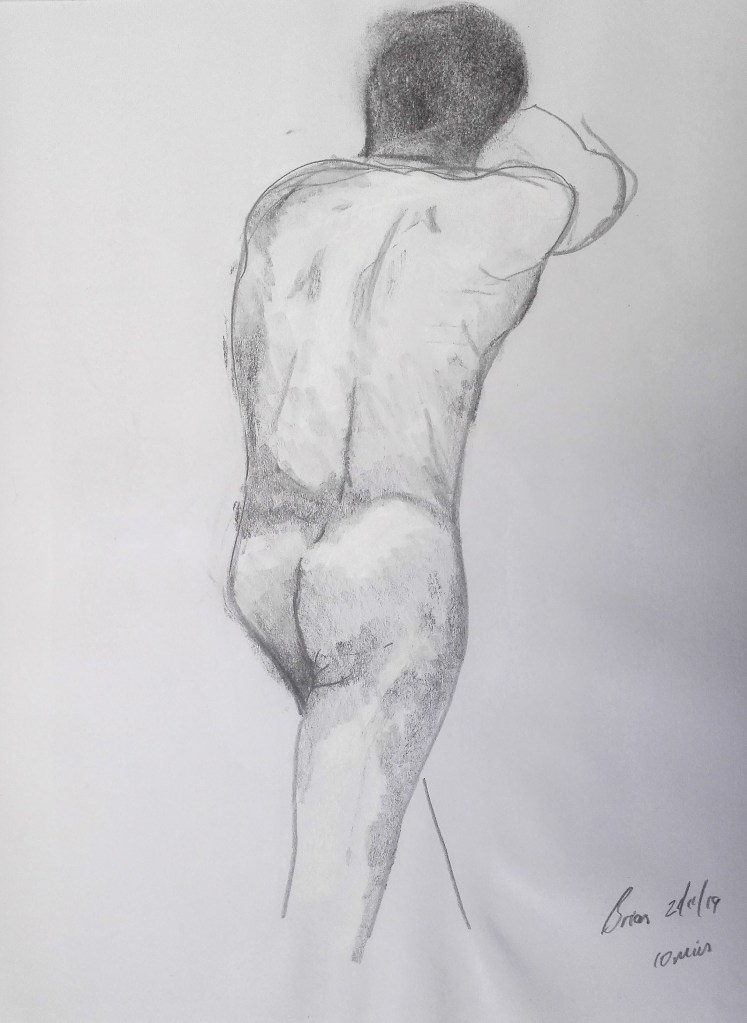
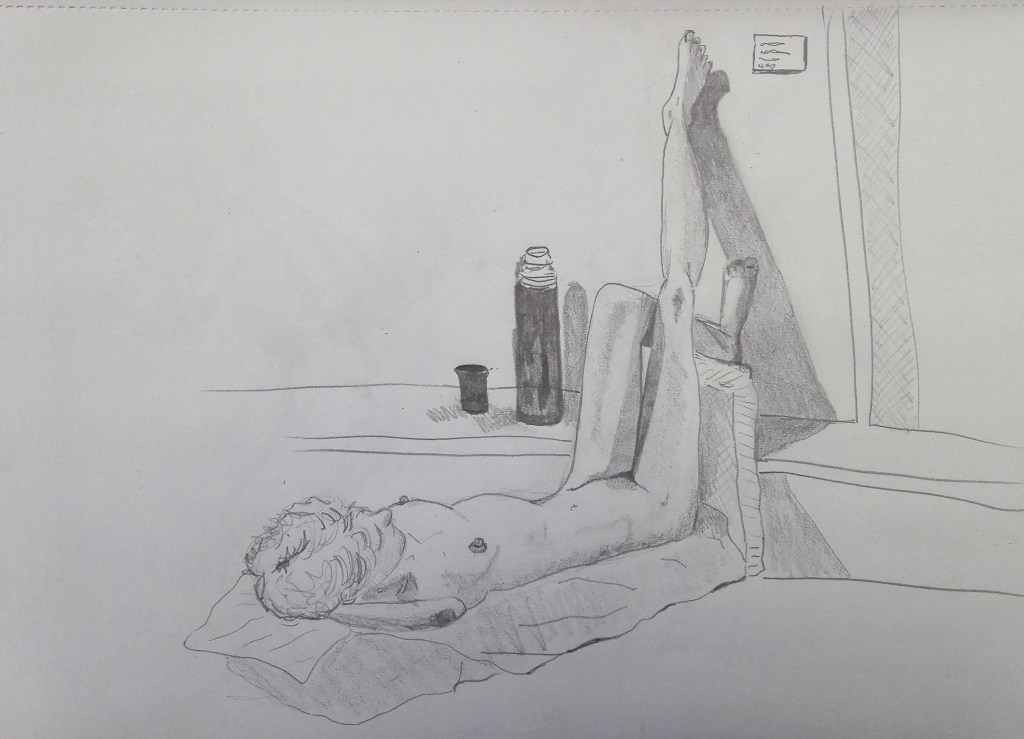
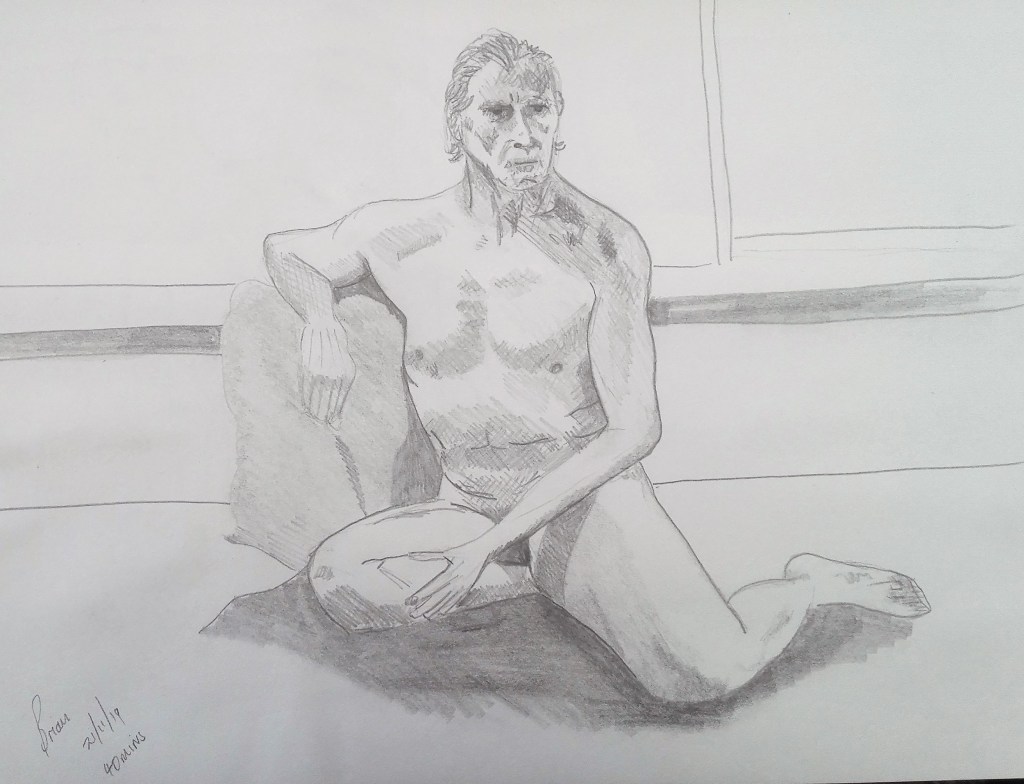
I continue to attend a Life Drawing Group in Ely. We meet every week for three eight weeks sessions each year. The sessions are from 6:30pm to 9pm. The usual format is for the models to pose for three 5 minutes poses, two 20-25 minutes poses and one 45 minute pose. This sometimes changes depending upon requests within the group. Currently we have a roster of four models, Brian, Dexter, Sharon & Eva and they will normally have two sessions each over the eight week period. Since I started with the group during Drawing 1, which I completed in 2017, I have posted some of the better drawings in my blogs. I will do the same again during this course. The first set of drawings were from the Autumn 2019 term which was after I had sent my work and completed my blog for ‘Concepts in practice’

Brian

Part One – Research point 2: Performance Art / Action Painting

My notes and thoughts on the research that I carried out on Performance Art and action painting.

The starting point was Jackson Pollock, reading the blog by Kirsty Beavan I noted the reference to Pollock moving around the canvas in a kind of dance and the painting acting as a record of his movement and gesture as much as the finished works themselves.

This can be observed in Hans Namuth’s film of Jackson Pollock which depicts Pollock at work using random but controlled actions and gesture, flicks of paint in lots of layers. I particularly noted a comment that Pollock made when working on a painting on glass, “I lost contact with the painting”. I can relate to this comment as I have found on numerous occasions that my enthusiasm for a painting that I have been working on wanes when the outcomes are less than expected. I find that I then become unengaged with the work and it becomes a chore to complete it. Perhaps I should adopt Pollock’s approach and abandon the work.
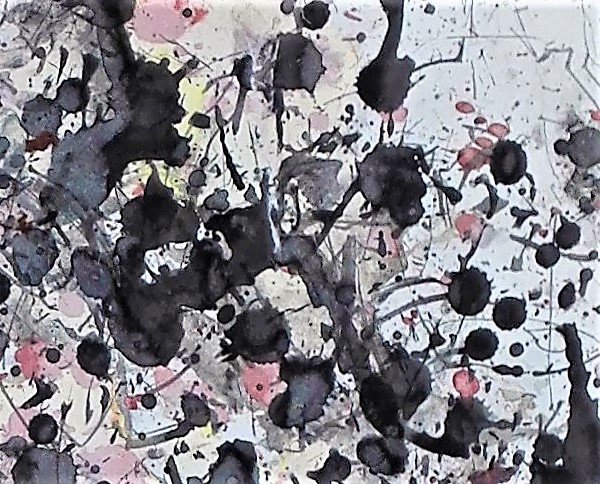
The term action was first used by Harold Rosenberg however he wasn’t the first to suggest the idea of painting as a site of spontaneous action. It was not only Western art that was looking at different ways of painting. In 1954 Japan the ‘Gutai Movement of Concrete Art’ took these ideas and explored some of the possibilities. An example of which is Shiraga’s ‘Challenge to the mud’ 1955 in which the artists rolled half naked in a pile of mud. In another painting he used his feet. The Gutai artists also created painting using actions removed from the body including smashing bottles of paint or firing paint at the canvas using small hand made canons.

Back in America Jim Dine in a piece called ‘ The Smiling workman’ he dressed himself in Joker like make up, drank from pots paint whilst painting the words, ‘I love what I am on a canvas’ Finally he poured the remaining paint over himself and jumped through the canvas.

Robert Rauschenberg took to appearing on stage with a band ironing a shirt and later towards the end of the tour he would produce a different painting each night. Yves Klein reduced painting down to a single monochromatic colour, his favourite being Blue and produced canvases of this single colour. In other works he used naked female bodies to paint with. The events were attended by an audience creating and accompanied by a single note composition.

Most, but not all, of this art was from a male perspective and therefore a female response was needed. Amongst those that did were Carolee Schneemanns who used naked female bodies as living paint brushes, she saw her body as an integral material. Niki de Saint-Phalle experimented with shooting paintings whereby she fired a shotgun at paint filled balloons which were attached to a large assemblage. The Japanese artist Shigeko Kubota took a more intimate approach whereby she pinned a paintbrush to het knickers and squatted on a large piece of paper to create gestural marks. Janine Antoni’s ‘Loving Care’ was created by the artist soaking her hair in dye and proceeding to mop the floor of the gallery.

A snippet of a commentary on performance art is replicated below.

“In considering the materiality of paint, the artist referenced previously, creatively explored its potential as a medium, beyond its capacity to visually render representative imagery. Simultaneously the very act of painting was explored as a means of creative expression in its own right. these artists and there artworks therefore speak to the complicated ways in which paint, and painting, serves not only as a visual medium, but as a performative one.”

In her piece “The Curse of the brush” Shozo Shimanoto points to the liberation of paint as an entity in its own right.

Considering this statement and the impacts of the artists and work mentioned above I would summarise in my own words.

“The brush is seen as a slave master forcing the paint to act and behave in strict conventional ways. Let the paint break free of these chains and reveal its own identity.”