Author: swampymark

Critical Review – An investigation into how the subject of memory is explored within the paintings of George Shaw and Peter Doig

Paintings have the power to transport us through time, and they can act as a vehicle for our memory. These memories can be accompanied by a multitude of different feelings. A painting can act as a reminder of a time, a place or a shared experience, creating a bond between the artist and the observer. However both parties do not necessarily have had to have lived through the exact same experiences however. A common connection could be found in the subject of the painting, the place or the atmosphere that it evokes, for example the image of a dark austere looking building where the emotions that such an image conjures will be dependent upon our individual experiences. For some it will be foreboding or fear, for others it will be comfort and security. Whatever the emotion is, it is a part of our being, a memory. Additionally the feeling doesn’t need to have been experienced first-hand, it could, perhaps, be a scene from a film or a photograph, and however the emotion is no less real.

In this essay I will use the paintings of George Shaw and Peter Doig as my reference. Both have documented key periods of their lives in their paintings, in so doing they created a link to a shared past, not between them, but to us. 

A consistent topic of George Shaw’s paintings has been the place where he grew up, Tile Hill, a suburb on the outskirts of Coventry, a subject with which he has been obsessed since he started painting. Whilst on a personal level I have no experience of Tile Hill the scenes that he paints are familiar to me, as suburban landscapes, similar to Tile Hill, exist all over the UK. His paintings portray the place as it was and is, with drizzly depictions of lock-up garages, muddy playing fields and uniform looking terraced houses on dull streets. These are the real images that are recalled by many that grew up in the UK in the late 20th century. His paintings are infused with memories of childhood and adolescence, of growing up, trying to fit in but remaining on the outside. His paintings do not reflect memory through rose tinted glasses but a realism that is at the same time nostalgic but refrains from being sentimental. What is it about these paintings that elicits these notions?
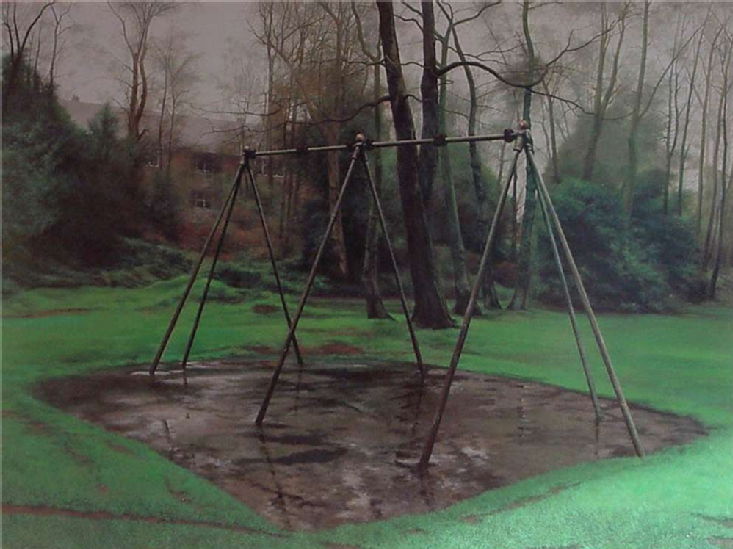
1. George Shaw, Scenes from the passion – The Swing, Enamel on canvas, 70 x 101cm, 2002/03, University of Warwick Art collection

As an example, in the painting above Shaw has depicted a scene that could be found in suburban locations across the country. It is late autumn on a dull dank day and it appears that it has been raining. The frame structure for the swings takes centre stage but the swings themselves are missing. There is no fun to be had here today. The scene is framed by dark green foliage and leafless trees through which a row of identical terraced houses are just visible.

By contrast the paintings of Peter Doig draw on a wider range of influences. Which is predominantly due to his family’s constant moving house and location. Born in Scotland in 1959 his family moved to Trinidad in 1962 and then in 1966 to Canada. He then lived, studied and worked in London for 25 years before returning to Trinidad in 2002. All of these locations have informed his work. To quote Doig ‘When I was growing up, I never felt that I belonged anywhere because we never lived in a house for more than three months. That’s all I knew, and that’s why I don’t really belong anywhere.’ (i)

 I have chosen to concentrate on the paintings inspired by his childhood and adolescence in Quebec, Canada. The reason for choosing this body of work is because they resonate with the imagery of childhood, houses viewed through trees in snowy landscapes. These paintings are not literal depictions of locations but are remembered scenes, many of which are seen through a veil of snow which acts in part as a filter representing the impact that the passing of time has on the memory, as it slowly becomes obscured from view. Similar to Shaw these paintings treat the subject without sentimentality.

As I delved deeper into the work of both artists I gained insight into how they have both been influenced by where they lived, grew up, the cultural influences of the time and the way that this is reflected in their paintings.

Starting with George Shaw and his depictions of Tile Hill there is an almost documentary appearance to the paintings, it is as if they are photographs taken on a Polaroid camera. The colours are muted, slightly faded, giving them a melancholic look which echo the passing of time. Tim Jonze in an article in the Guardian referenced a photograph of George trying to squeeze himself into a Joy Division T-shirt that he bought when he was 14 he stated that, ‘It’s a silly photograph, but also a moving one that explores, the passing of time, the roots of who we are and the melancholy of approaching middle age’ (ii). Shaw has also talked extensively about his pop culture influences, vinyl by The Fall, Two Tone pin badges, pulpy skinhead novels and Ladybird books about trees. The Ladybird books offer an insight into Shaw’s paintings in that they are illustrated with a similar lack of flamboyance. The pop culture references become clear when, referring to the additional artefacts on display at his exhibition at The Paul Mellon Centre in 2019, Shaw states that ‘I thought showing people these influences might be more interesting than everyone thinking it all came from Constable or Turner. My entry level into Romanticism was (Factory Records designer) Peter Saville. It wasn’t the National Gallery’ (iii). Additionally when talking about his visits to galleries, with his Dad, he states that the paintings they constantly painted said ‘nothing to him about his life’ (iv) referencing lyrics from a song by The Smiths.

Two further quotes by Shaw which I feel indicate what his Tile Hill paintings are about. The first from an interview with Sue Hubbard, Shaw states that his paintings reflect ‘a dream of Britain, an island I have come to know as a landscape of ghosts and haunted houses, of fair to middling weather and stony prehistory but also a backdrop for injustice, criminality, humour, suspicion and sparse grace’(v) The second commenting on his hometown in an article by Lydia Figes in Art UK ‘I don’t think it has ever left me, that sense of possibility and familiarity and possible danger lurking out there somewhere beyond. I haunted the place and now it haunts me.'(vi)

Peter Doig’s adolescence and upbringing is a stark contrast to George Shaw’s and this is apparent in his paintings that reference this time in his life. Looking at his paintings of the Canadian landscape they are less about place and more about atmosphere and feeling, an interesting comment by Doig which illustrates this point was referenced in an article exploring his key works, ‘Progression of Art’. Reflecting on his Canadian tree-scape paintings Doig said ‘The tree line is a mixture of what I could see from my working space in my parent’s barn, where I made sketches of northern-looking pines and dying trees.’(vii) This is further reinforced by Katherine Arnold of London auction house, Christies, who stated ‘In taking up archetypal images of Canada’s landscape, Doig sought to distance himself from its specifics. These were not paintings of Canada in a literal sense, but rather explorations of the process of memory. For Doig, snow was not simply a souvenir of his childhood, but a conceptual device that could simulate the way our memories may be transformed and distorted over time.’(viii) The cultural references in Doig’s paintings of Canada are also informed by cinematic and theatrical devices which he uses to create nostalgia, ambiguity and mystery. An example of this, which was touched upon in the extract from Katherine Arnold, is the use of snow in these paintings. “Snow draws you inwards” Doig once said. A technique that has been used in numerous films to indicate the blurring of memory is the use of snow to create a barrier between the viewer and the subject. This use of snow to create a barrier becomes a signal of the gap between the past and now. The buildings in Doig’s Canadian paintings are often viewed through a tree-scape, his technique is to paint the houses through the trees rather than paint the house put the trees over it. As he comments in an interview with Robert Enright in 2006 ’it was more about looking and picking out bits with the eyes.’ (ix) As with memory we pick out what we remember and piece it together.
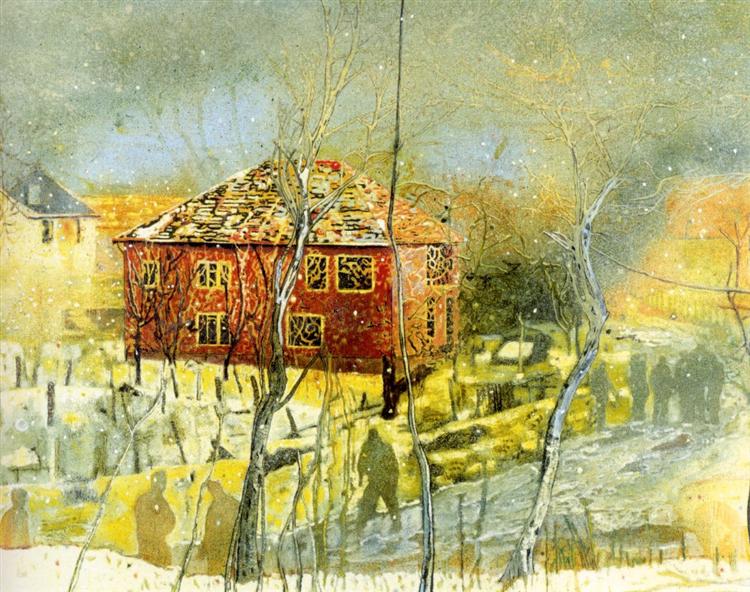
2. Peter Doig, Red House, Oil on canvas, 200 x 249.8 cm, 1995/06

In the painting above the Red House dominates the scene with its solid form and strong colour. It is surrounded by images that seem to shift and fade in and out of view. There are shadowy figures, a frozen pond, wispy trees and a shimmering white house all of which are diffused by a soft light and falling flakes of snow. The painting indicating a strong memory that has become dislocated due to the passing of time.

In trying to draw conclusions and comparisons in how both artists approach the subject of memory in their paintings I am conscious that we all experience the world in our own way, we have different lenses and a multitude of varying experiences. The ability to be able to highlight and communicate the commonality that is shared is what draws the observer into these paintings and holds their attention. These paintings create a shared connection which resonates beyond the image.

With Shaw’s paintings of Tile Hill it is more than simply the image itself. The pop culture references, which are not implicit in his paintings, draw on a certain Britishness that runs from the Kitchen Sink dramas of the 1960’s to the anger of Punk, the intellectual writing lyrics and imagery of Post Punk through to Two Tone. A connection is made to the dystopian mournfulness of Joy Division, the rantings and imagery of The Fall through to the poetry of The Smiths and the despair but optimism of The Specials. All of these performers are born from the same sense of wanting to communicate what it was like to live through this time. They pull the same strings in our collective memory, evoking the bleakness of these times. Thatcherism was wreaking havoc with working class lives and was decimating traditional industry. Despite this, it is the beauty found in the familiar and seemingly mundane scenes that invoke our collective memory, especially since clear parallels can be drawn to the present. Shaw was reticent to make further paintings of Tile Hill but after visiting his mother, who still lives there, he once again captured images using photography for his reference. He toyed with his emotions for some time, reluctant to return to the subject, but unable to resist, he made a further series of paintings. One of which ‘The man who would be king’ depicts an English flag draped in the window of a block of flats which sums up the depression, desolation and xenophobia that drove the UK to Brexit.
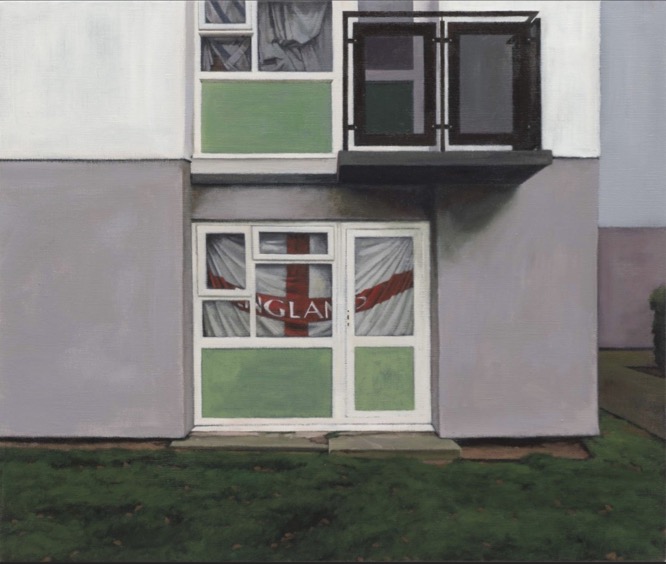
3. George Shaw, The man who would be king, Enamel on canvas, 46 x 55 cm, 2017

Peter Doig’s paintings don’t exist in any particular time or place. They inhabit their own space. The transient nature of Doig’s time in Canada, never putting down roots, is represented in the way that the paintings seemingly exist in their own space. Unlike Shaw the specific location of the images can’t be identified, instead they appear as a dreamlike mixture of references which make connections to us. They are made up of new places, far off places, forgotten places. Where Shaw’s paintings draw direct references, Doig’s references are ambiguous, these are fictional places in which we can imagine we might inhabit. The shadowy figures, that are often present, represent ourselves, these figures help to draw you into Doig’s world. With Shaw’s paintings the observer is placed on the outside looking in, however with Doig’s we are located within the painting.
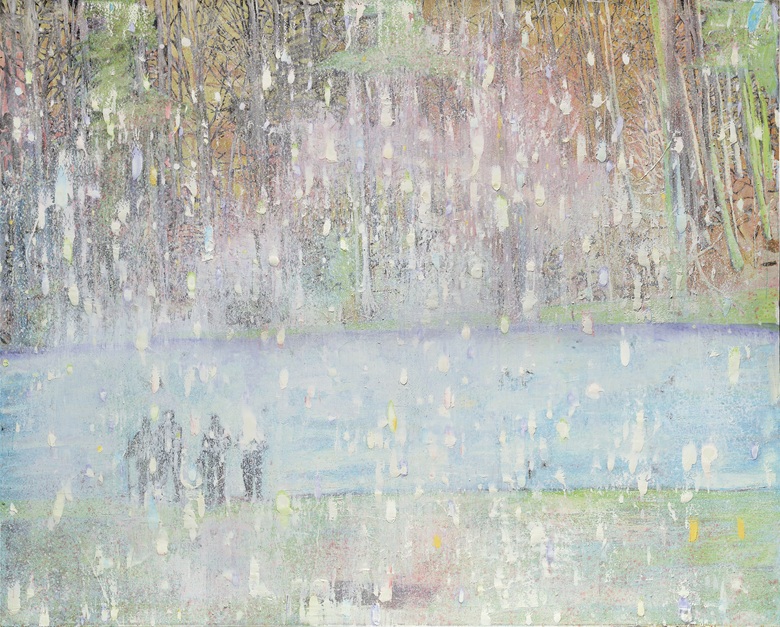
4. Peter Doig, Cobourg 3 + 1 more, Oil on canvas, 200 x 250 cm,1994

In the painting above we are taken back to a specific place and memory in Doig’s childhood. The title indicates the location, Cobourg is a town in the Canadian province of Ontario however there is nothing in the painting to specifically identify the town. The figures, 3 + 1 more, blurred from our direct gaze by the falling snow, must be Doig and his family looking out at us from the past. The plus one being Doig himself indicating his feeling of not quite belonging.

The two artists explored here involve memory to make the connection to us, however the way that they do so is entirely different, but both harness nostalgia without being sentimental. It is for the observer to locate their personal response to the paintings, to let the images take them back to their memories. The approach of Shaw and Doig to the subject of memory are different, in that George Shaw’s paintings are about a time and place whereas Peter Doig’s paintings have a more timeless quality. Both approaches are valid, it is for the observer to infer their own personal response.

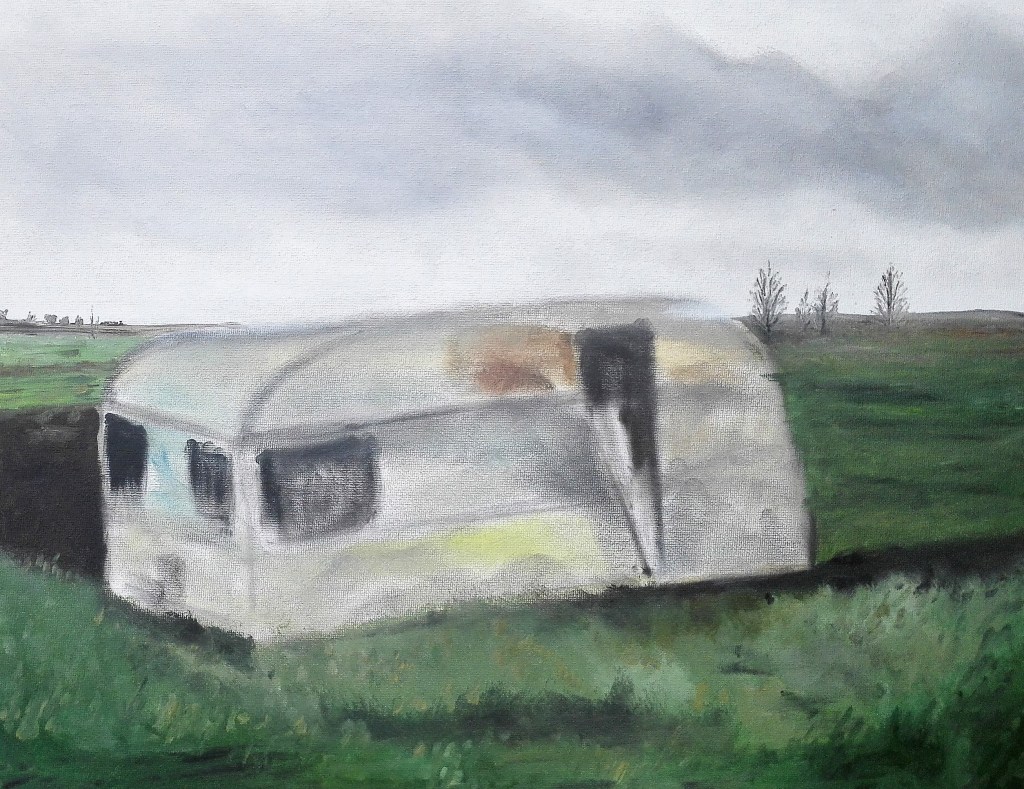
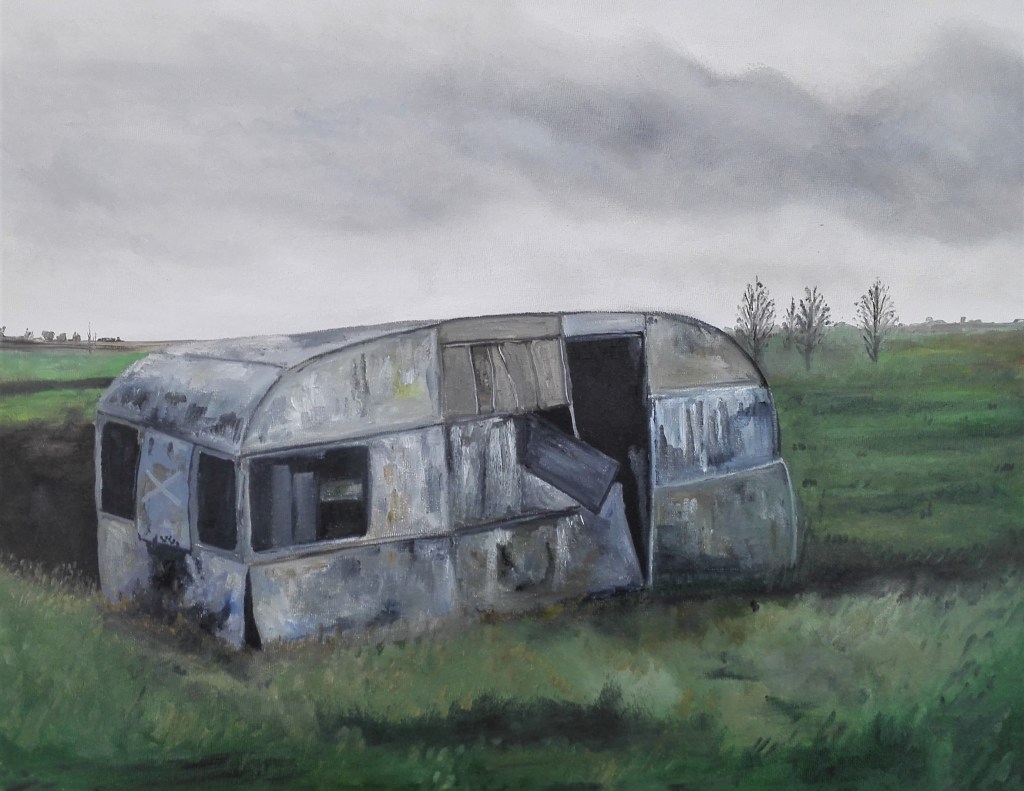
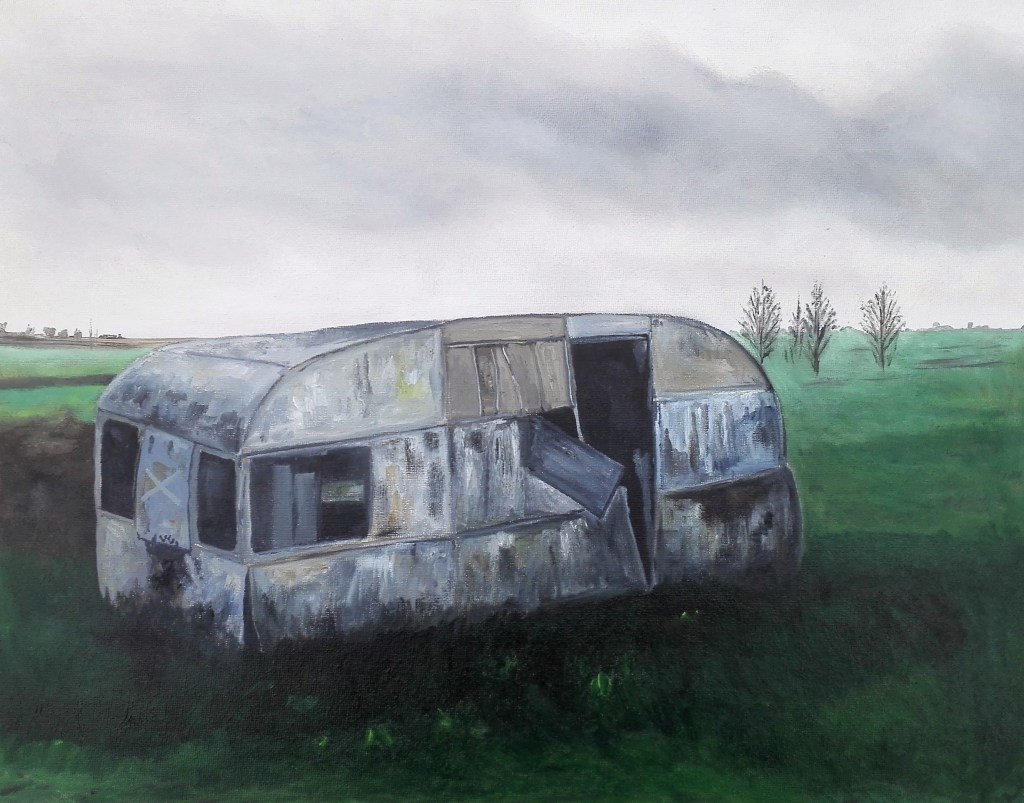
In my own practice I am trying to capture the impact of passing of time and the effect that it has on man-made objects and their place in the landscape. I am interested in the transition from fully functional to disregard and the memories that attach themselves to the stages of this process. I imagine the stories that these objects have witnessed, what have they seen? Where they have been? In the example below my painting ‘Winter break’ shows an abandoned caravan. It has seen better days but is now in a state of poor repair. The elements are in the process of finally reducing it to nothing. At some point it was loved, a place of security and rest, but what was it used for? Perhaps initially for holidays at the coast then in its latter stages as a seasonal farmworkers temporary dwelling. It exists as a memorial to the events and lives lived slowly fading as the caravan transitions and imperceptibly disintegrates in to the past.
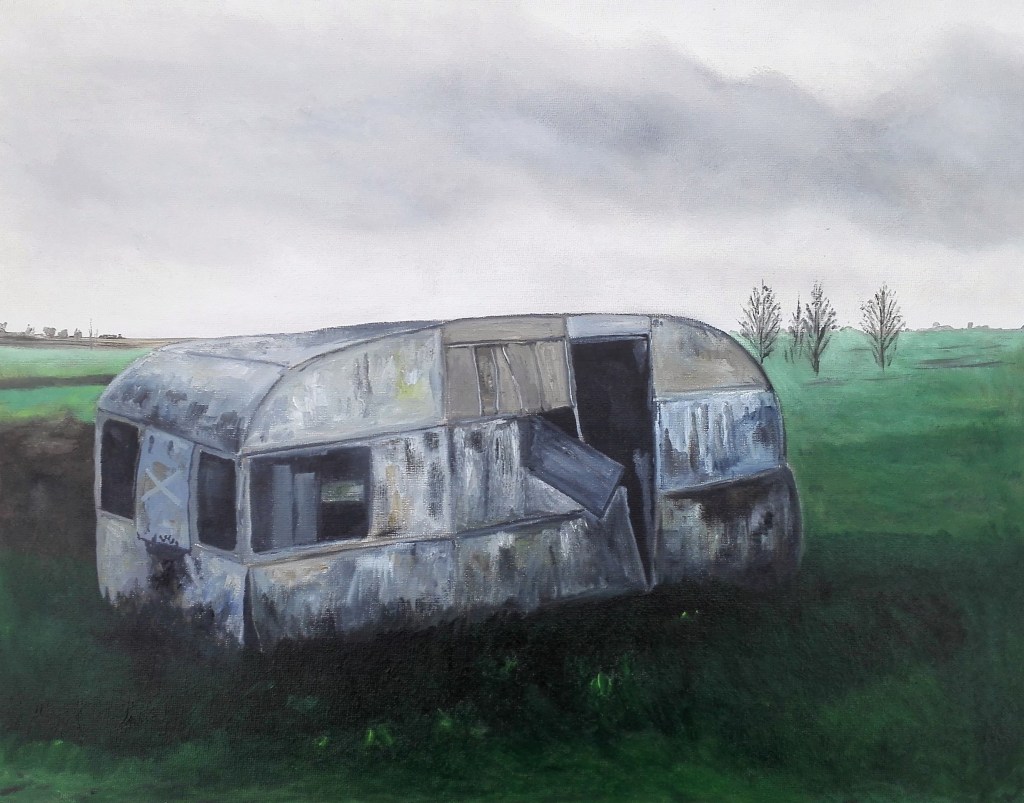
5. Mark A Taylor, Winter break, Aqua oil on canvas, 16 x 20 inches, 2020

List of illustrations:

  1. George Shaw, Scenes from the passion – The Swing, Enamel on canvas, 70 x 101cm, 2002/03, University of Warwick Art collection
  2. Peter Doig, Red House, Oil on canvas, 200 x 249.8 cm, 1995/06
  3. George Shaw, The man who would be king, Enamel on canvas, 46 x 55 cm, 2017
  4. Peter Doig, Cobourg 3 + 1 more, Oil on canvas, 200 x 250 cm,1994
  5. Mark A Taylor, Distant holidays, Aqua oil on canvas, 16 x 20 inches, 2020

Bibliography:

‘i, Peter Doig quote source unknown

‘ii, Tim Jonze , Guardian article 13/2/2019, Anarchy in Coventry: George Shaw’s greatest hits | George Shaw | The Guardian

‘iii, Tim Jonze , Guardian article 13/2/2019, , Anarchy in Coventry: George Shaw’s greatest hits | George Shaw | The Guardian

 ‘iv, Tim Jonze , Guardian article 13/2/2019, , Anarchy in Coventry: George Shaw’s greatest hits | George Shaw | The Guardian

and         Morrissey, Marr (1986), Panic. In: The world won’t listen (1987), Rough Trade

‘v, Sue Hubbard, 4/12/2018, George Shaw’s Homely and Unsettling Vision of Great Britain,  George Shaw’s Homely and Unsettling Vision of Great Britain – ELEPHANT

‘vi, Lydia Figes in Art UK, 23/3/2020, The paintings of George Shaw: an unconscious foreshadowing of Britain during quarantine, The paintings of George Shaw: an unconscious foreshadowing of Britain during quarantine | Art UK

‘vii, Peter Doig quote when discussing his 1989/90 painting ‘Milky Way’ ,  Peter Doig Artworks & Famous Paintings | TheArtStory

‘viii, Katherine Arnold, Christies Auction House, quoted when discussing 1991 painting ‘Charley’s space’  Peter Doig Artworks & Famous Paintings | TheArtStory

‘ix, Robert Enright, Border Crossings Magazine June 2006, The Eye of the Painting: An Interview with Peter Doig
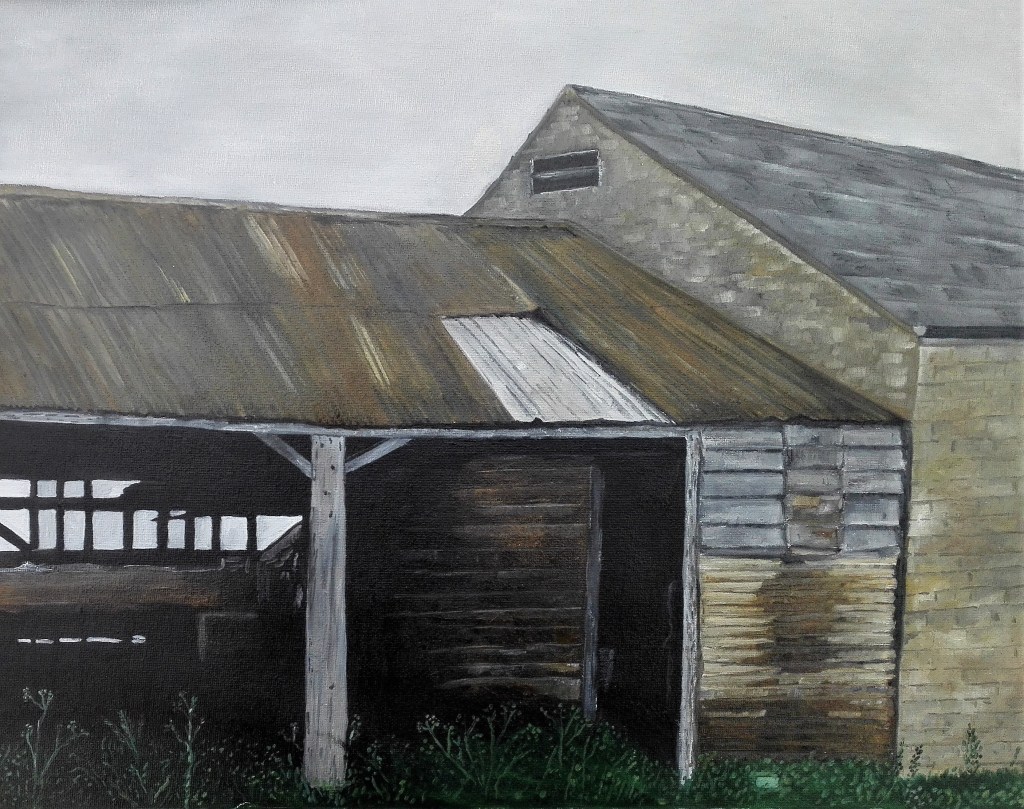
Painting 24 – Barn Dance invitation

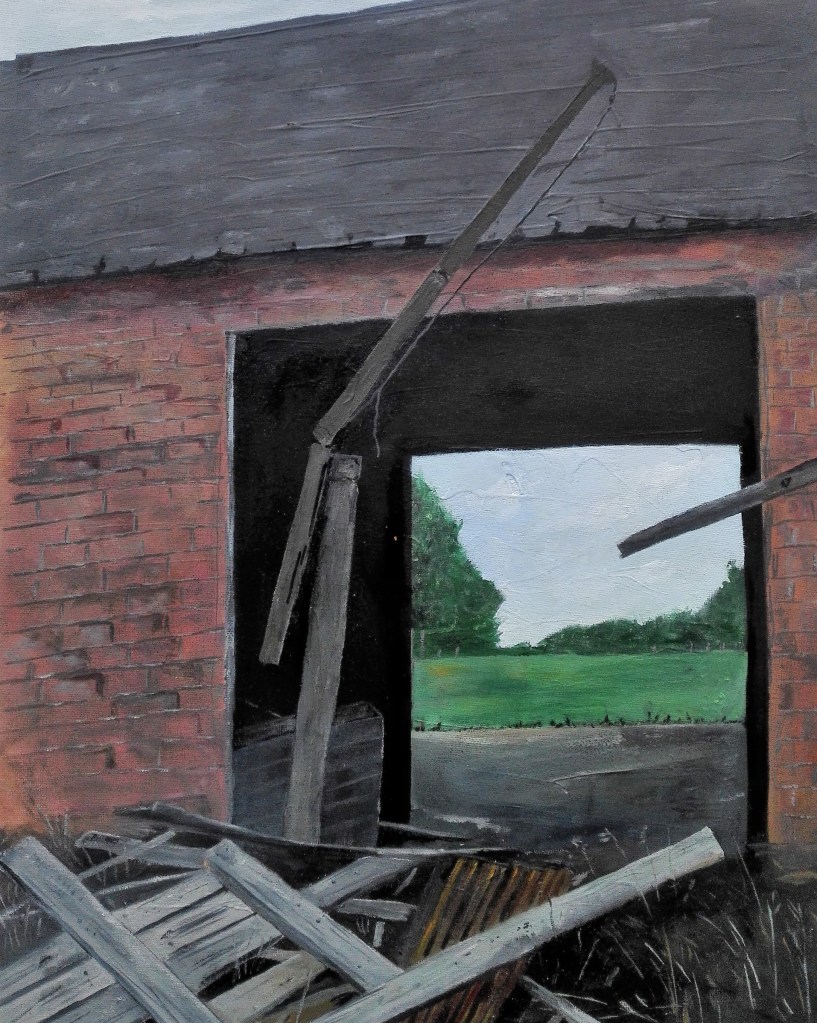
Another painting in my series of works towards my Parallel project. This one is part of the landscape series. I have used the device of light visible at the back of the building. I enjoy the way that this gives the interior of the building depth and draws the eye into the painting. The title hints at a possible past.

Barn Dance invitation, Aqua oil on canvas, 16 x 20 inches, 2020

I expect that this painting will be a part of my Assessment portfolio.

Painting 21

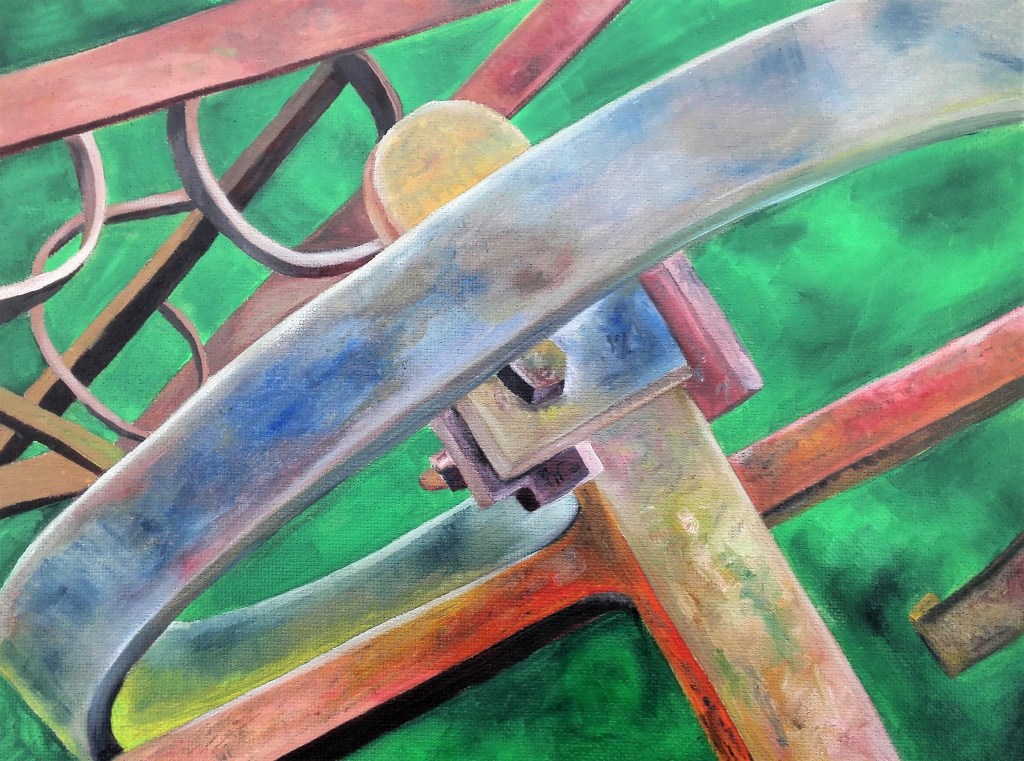
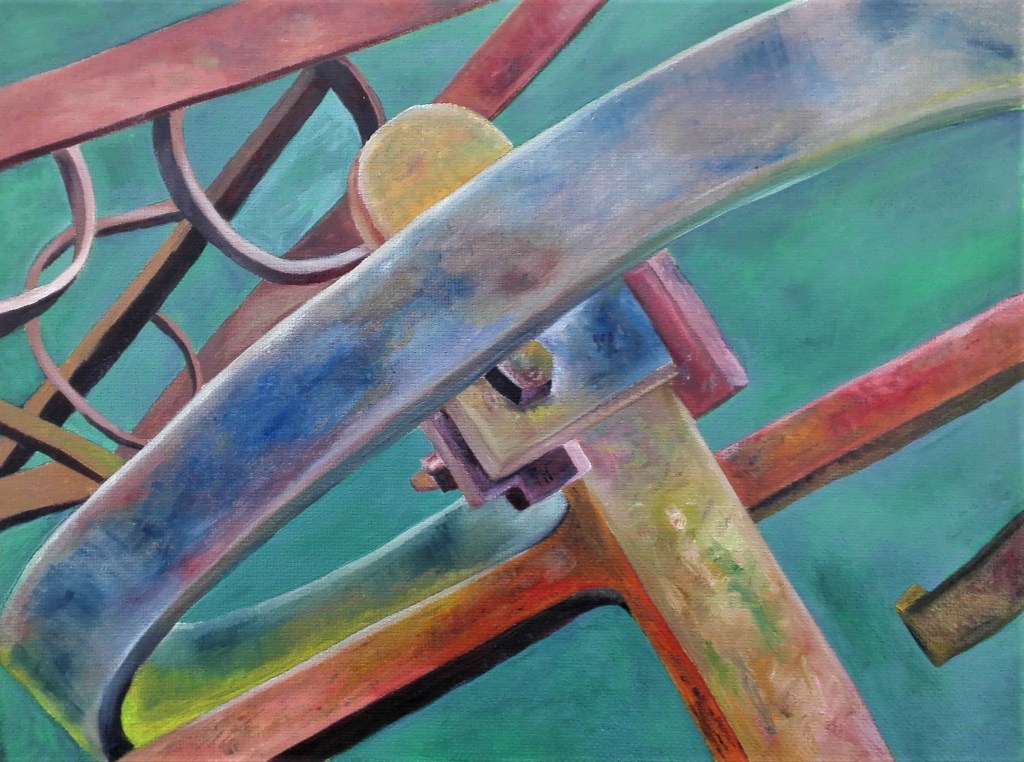
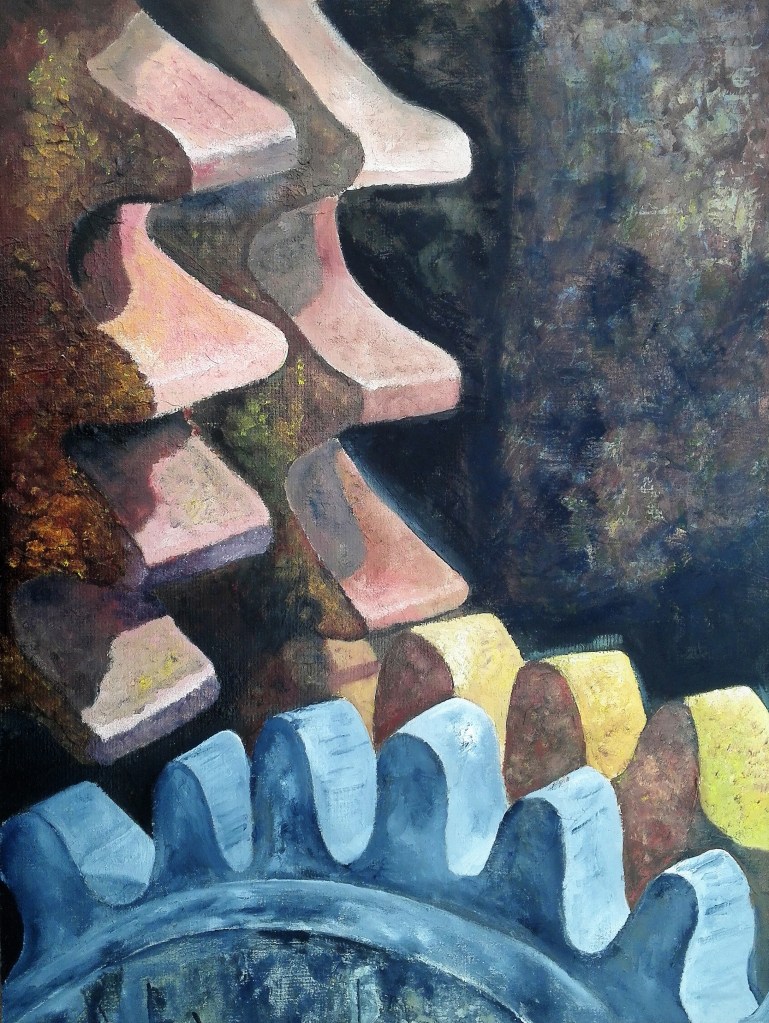
This is the next instalment in the ambiguous equipment paintings. I have yet to settle on a title for this painting. Possible options are ‘Details of the plough’, ‘Wrought iron’, ‘The rusty iron plough’ or ‘Detailed study of Farm equipment, North Yorkshire Summer 2020’.

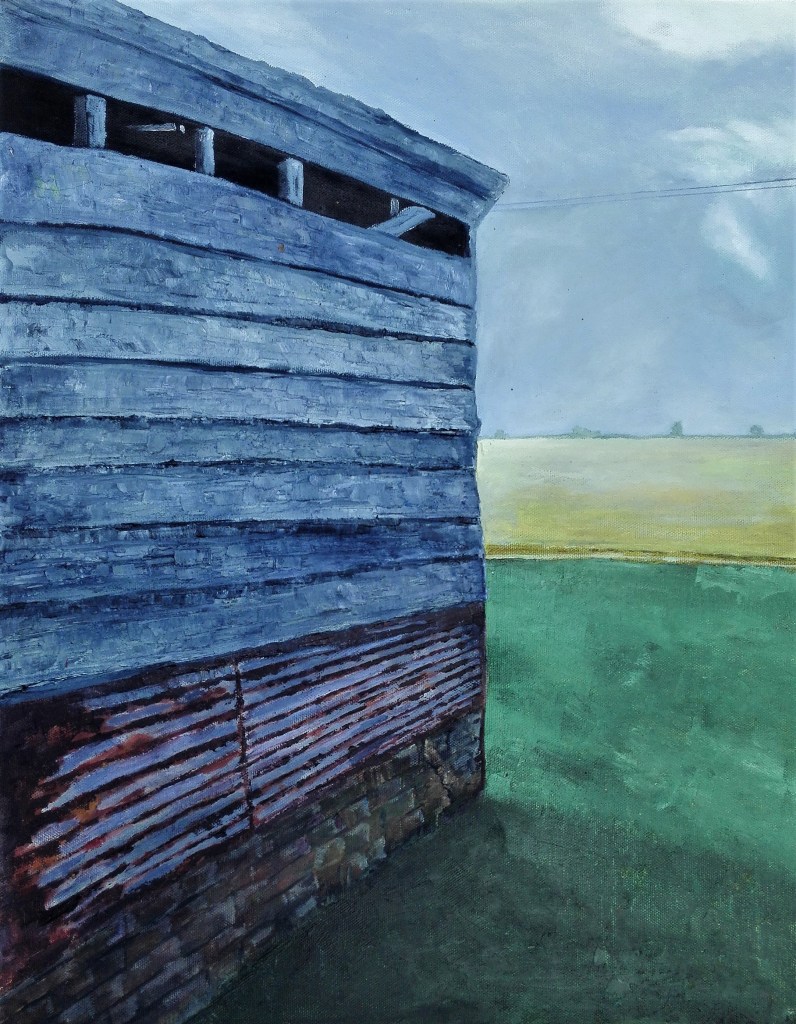
The contrast between the fading bluish iron and the rust is what drew me to the subject which I have replicated and enhanced in this painting.

Having discussed this painting, as part of the review process for potential Assessment submissions for my Parallel project, it was felt that the bright green background was too overpowering. Having considered this I have toned it down by overpainting with a fairly thick greyish wash. This has resulted in a more cohesive painting where the focus is now on the colours on the metalwork.

‘Detailed study of Farm equipment, North Yorkshire Summer 2020’.

Artist’s statement

This statement will be used in conjunction with my Assessment submission. I feel that it represents the work that I intend to submit and what my practice is currently focusing on.

============================================================

My fascination lies in documenting the effects of the passing of time on the Fenland landscape in my locale. I try to show the landscape as it is today and the impact that the elements have had on man-made objects, documenting their slow imperceptible deterioration. Highlighting the cycle of development and decay of man-made structures in the landscape against the passing of time and the seasons.  

I approach the subject in two distinct ways. The first, is to try to convey what I see when I walk within it; to record the features, the buildings, structures and the space they occupy in this often austere environment. As I do this I imagine the stories that may have been played out during the lifetime of the buildings.

The second approach is to examine objects close up; to focus on detail and features that may be overlooked by the casual observer. This approach tends to produce paintings that are ambiguous in nature and hard to identify.

============================================================

Reflection on Formative feedback on Part 5

A positive discussion on the work that I completed during Part 5 and my assignment pieces. The main points that I reflect upon are:

The use of titles: look to apply engaging titles. An idea would be to use specific place/ time to my abstract paintings and use abstract or ambiguous title to the figurative paintings.

Artists’ statement: Rewrite / reorder my statement so that the more engaging section is at the start of the statement. In addition look to include a more poetic description of what I do. The challenge to do this without it sounding pretentious. Example that was given was a section from the artist’s statement of Joanna Whittle which I have replicated below

“The tent paintings represent fragile and temporary structures constructed within these notions of the ruin and time passing. Canvas sits in water; ropes are pegged in to the fluid land. Time sits still and moments brush against each other – canvas rots and weeds scramble over surfaces, but some lights remain on or have just been lit. They hold their own histories, ideas of vanished circuses or fairgrounds – events once frenetic now silenced and ominous in dusk or rain. concealing their internal space whilst their exposed surfaces weather and rot, they are hostile in their refusal to reveal their secrets. The still light ossifies both tents and trees, like a petrified forest, whilst liquid, motile elements pool around them making these worlds almost static, yet they seem to be slowly moving towards an uncertain or foreboding conclusion.”

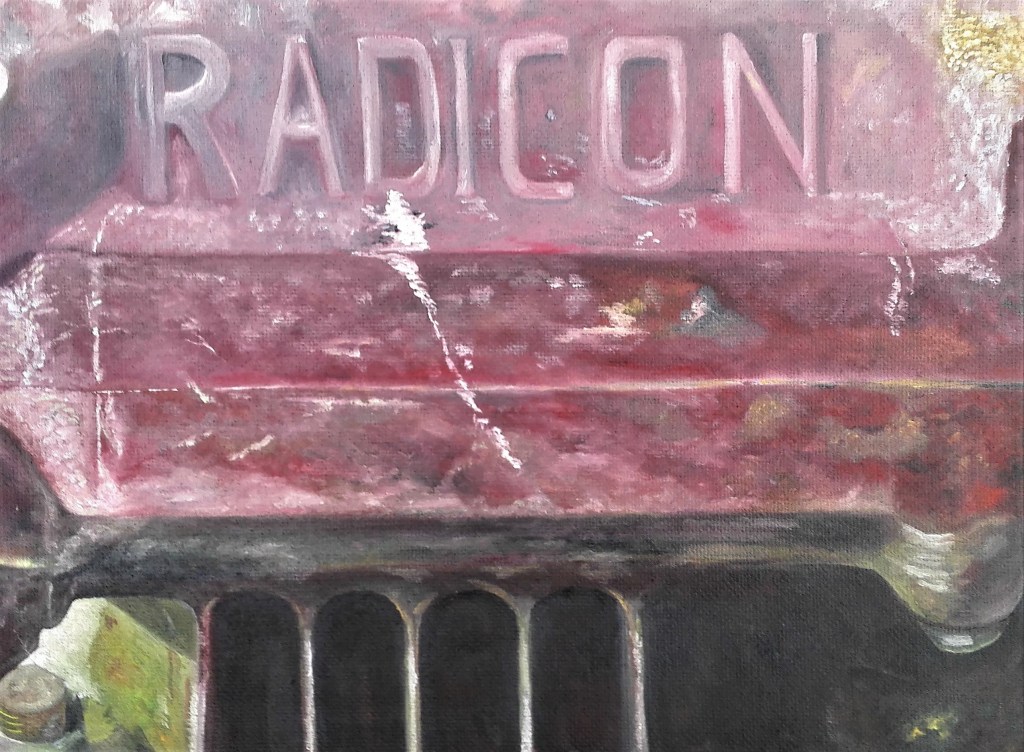
Assignment work: Positive feedback on painting titled ‘Radicon’ “lower section works well suggesting depth / entry point. curious / ambiguous structure that fits in with parallel project work.

Critical review: a good first draft further exploration using specific paintings from each of the two artists saying something about the work. Also include one of my own paintings and how it relates to memory. Include references at the end of the review.

Parallel project: a good selection of paintings already completed which convey the idea that I have about place. Improvement rework ideas discussed which will be implemented and demonstrated in a separate blog. I will also complete some further paintings. The final selection will be discussed at the next feedback session.

Painting 19 – Abandoned Caravan – New title 26/11/2020 ‘Winter break’

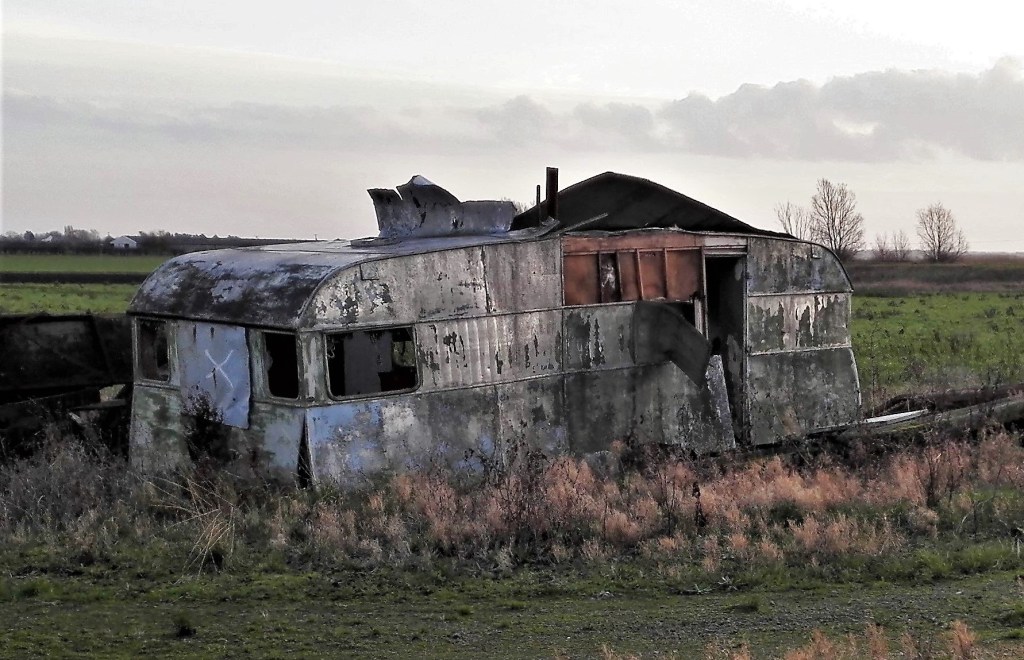
This was a painting that I had looked to undertake for some time. The photograph was taken a few years back but had remained an image that I knew that I would try to paint. The subject itself, the caravan, has now gone as it completely deteriorated therefor my photographs and this painting is probably the only record of its existence.

The photograph

For the painting I wanted to capture the sombre atmosphere which adds to the bleak nature of the image. I do wonder about the history of this caravan. Given where it is located I suspect that it was once used as temporary dwelling for farm labourer(s) perhaps brought in to assist the harvest. It is hard to imagine it looking all pristine and new. Over the the years as it got older I guess that its importance and usage dwindled until it was used as a storage facility and then ultimately abandoned and left to disintegrate. It is with these thoughts in mind that I set about completing the painting.

This is a photograph taken approximately halfway through the work.

Abandoned caravan – Work in progress

I wasn’t too concerned about getting an exact likeness of the caravan and decided to leave out the damage to the roof as I felt it would look wrong. I also looked to soften the vegetation and landscape to create an atmospheric scene.

The finished painting achieves my goals although I am tempted to add more detail to the vegetation in front of the caravan but have resisted from doing so. Whilst I am content with the result I feel that the composition is safe and the painting doesn’t excite.

The painting is below.

Winter break, Aqua oil on canvas, 16 x 20 inches.

Following the Part Five Formative feedback review the paintings has been reworked to try to introduce more drama and mystery into the work. A darker more foreboding painting has resulted from the rework.

Winter break, Aqua oils on canvas, 16 x 20 inches

Painting 20 – Machinery

This painting was completed after completing Part Five and before the review meeting. I had planned two paintings, numbers 19 & 20, which I didn’t complete in numerical order. Therefore painting 20 appears before painting 19 in this blog.

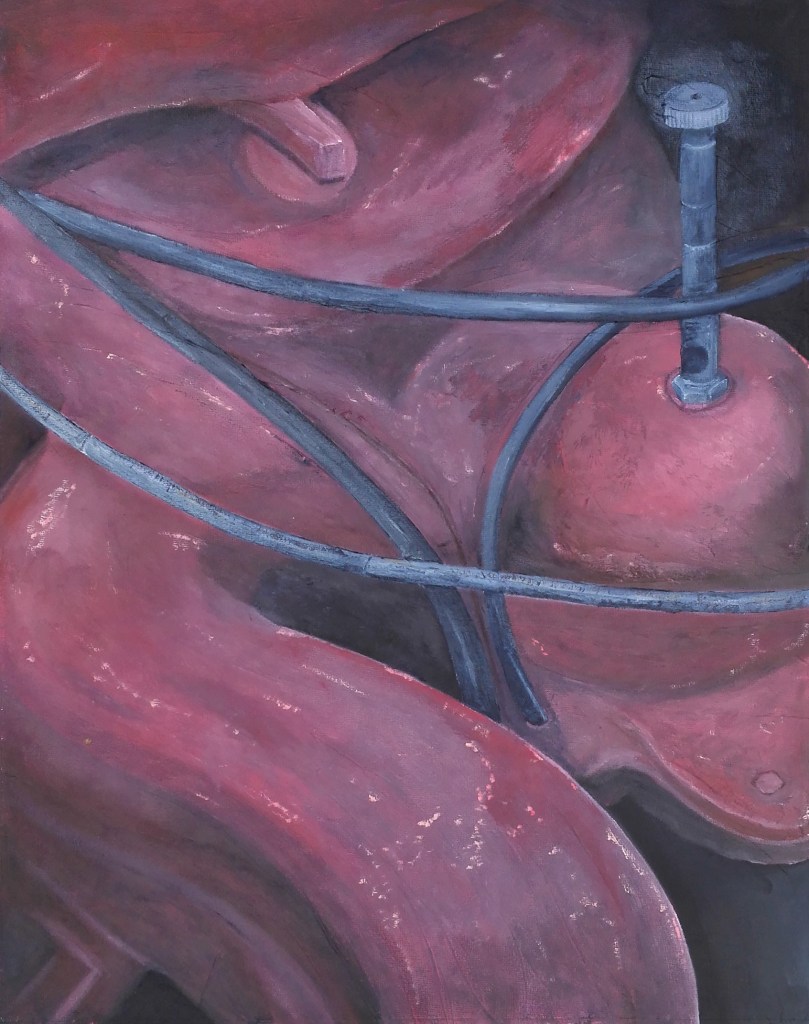
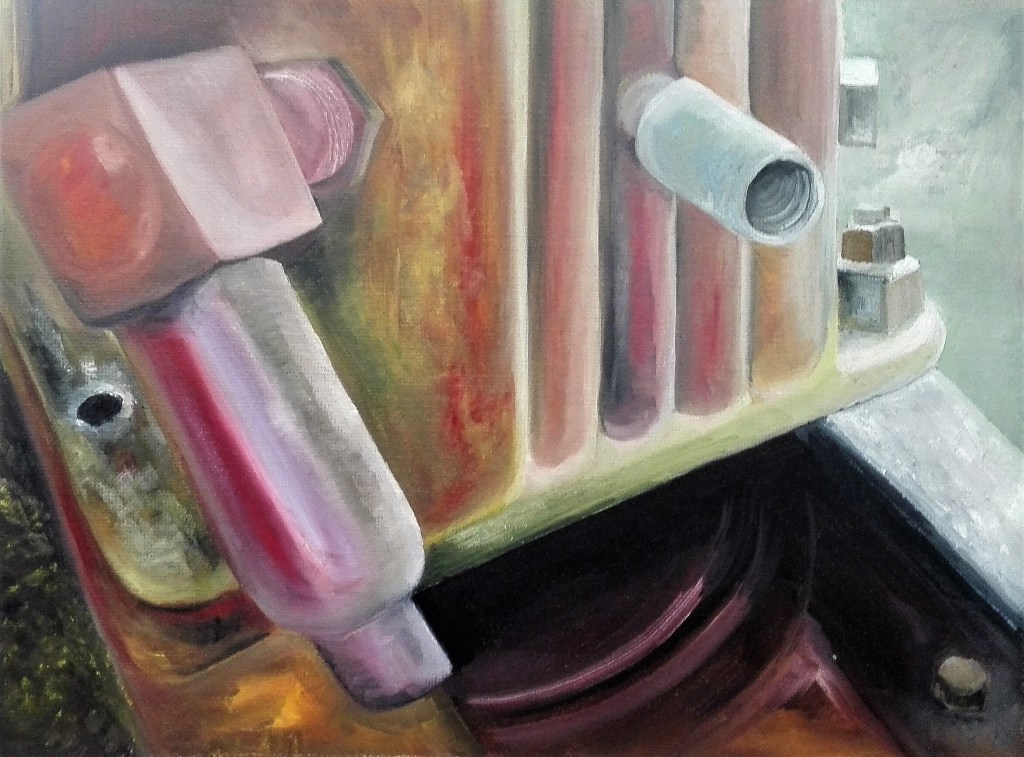
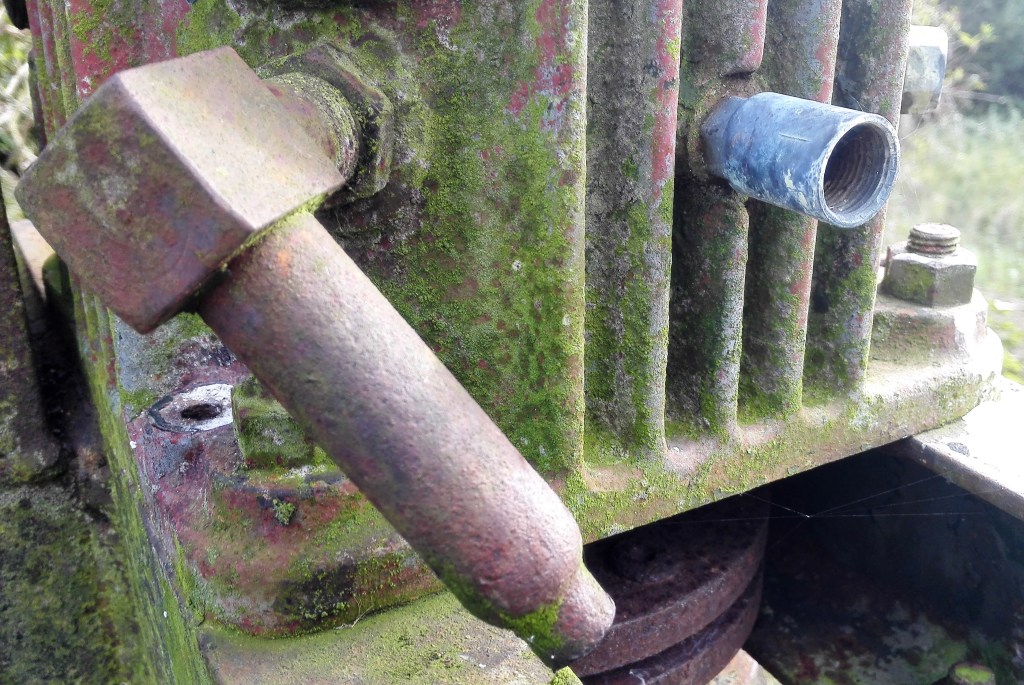
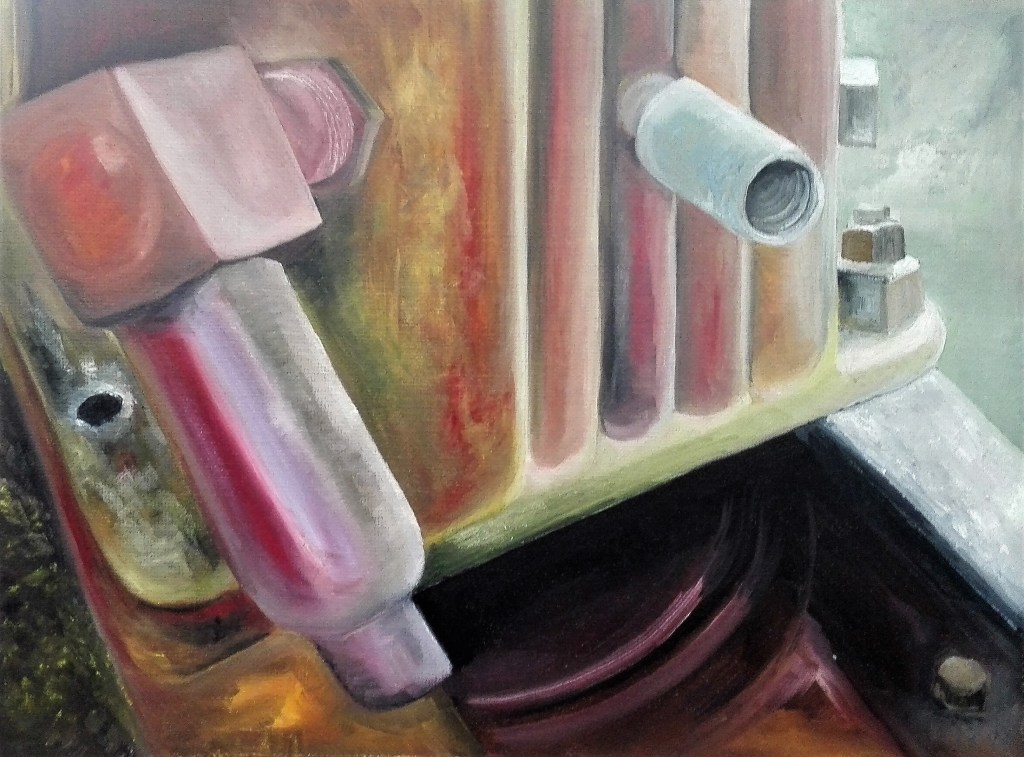
The painting is part of the series of close ups of abandoned machinery which I have found. As with the previous paintings in this series I used a photograph as the guide. The subject is the same as Painting 17 ‘Radicon’ but taken from a different angle. For this particular painting I chose to depart from the colour palette of the photograph and be a little more creative with the colours that I used.

Photograph for Painting 20

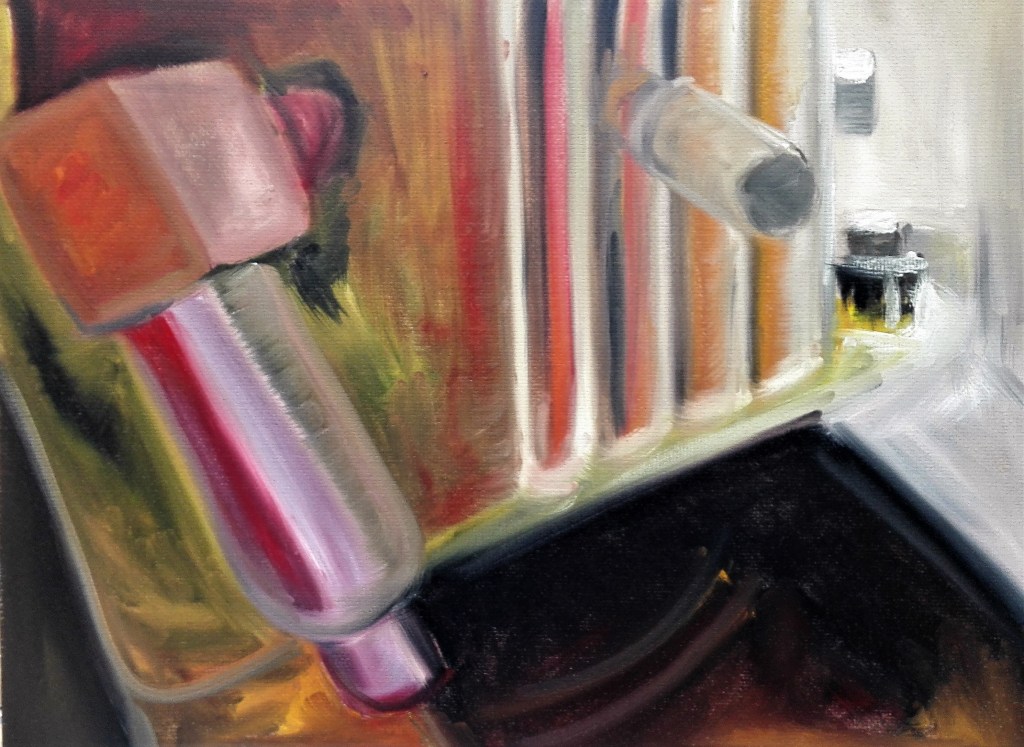
The approach I undertook to tackling the painting was that which I have used for previous. Starting with blocking in the main colours and tones and defining the basic shapes I gradually build up the detail by working, predominantly, from dark to light.

The work in progress.

Painting 20 – Work in progress

This work is a good addition to the series which now consists of three finished pieces. What I particularly like about this painting the contrast between the darkest and lightest areas and how these are balance by the mid tones with their vibrant colours.

Painting 20 – Machinery, Aqua oils on linen board, 30 x 40 cms

Regular artist review: Contemporary British Artists Nos 41 – 50. A new approach

As I having been working through Parts 4 & 5 of this course I have been reading / studying ‘How to write about Contemporary Art by Gilda Williams’. The book was recommended a essential reading by Level 3 (HE6) students on a Zoom meeting. An extract from this book was part of the reading for Exercise 4 in Part Five.

In section 2 three questions are recommended as an approach to adopt when writing about an artwork. These are:

  1. What is it? What does the artwork look like?
  2. What might the work mean?
  3. What does it matter to the world at large?

I shall use this framework for the next ten reviews where I will pick a single painting and attempt to answer these three questions. The approach will be to select one painting from the next ten artists in the Contemporary British artists website. One a day for the next ten days. My rationale is to practice this technique until it becomes engrained. Additionally my aim is to improve my analytical and writing skills.

For the first few I have adopted a regimented format, asking the three questions and answering them. I will modify this as I progress through the ten reviews.

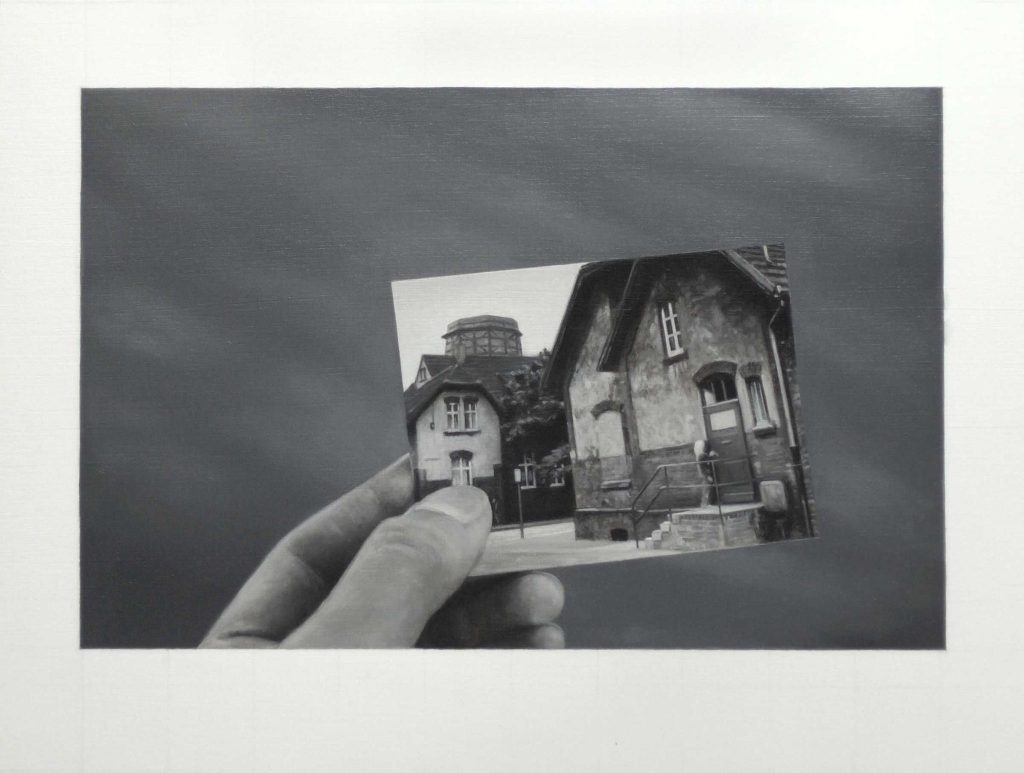
No 41, Nicholas Middleton,

A moment of true feeling, oil on paper, 25x30cm, 2018

What is it? What does it look like?

The painting is photorealistic study in black and white which shows the fingers of some ones left hand holding a black and white photograph or perhaps it is a postcard. The background to the hand and the photograph is grey, slightly undulating in tone. The photograph or postcard depicts a town scene which is set in what appears to be a suburban setting in the 1950’s – 60’s. In the foreground is a building, probably a house with a short set of steps leading to a door. This house is situated on the corner of a street. The middle ground is occupied by another house above which, in the distance, is another building which I’m not able to determine what it is.

What might the work mean?

The way that the photograph is being held suggests that it is being compared to what the holder is seeing. It is as if there is a search going on. Have I found what I am looking for? What has changed around here?

The painting about memory. A search for a past that is fading away.

What does it matter to the world at large?

From a artistic perspective the painting is an example of the photorealism technique. The clever use of a photograph within a painting make this reference clear. The artist is adding his work to this particular genre.

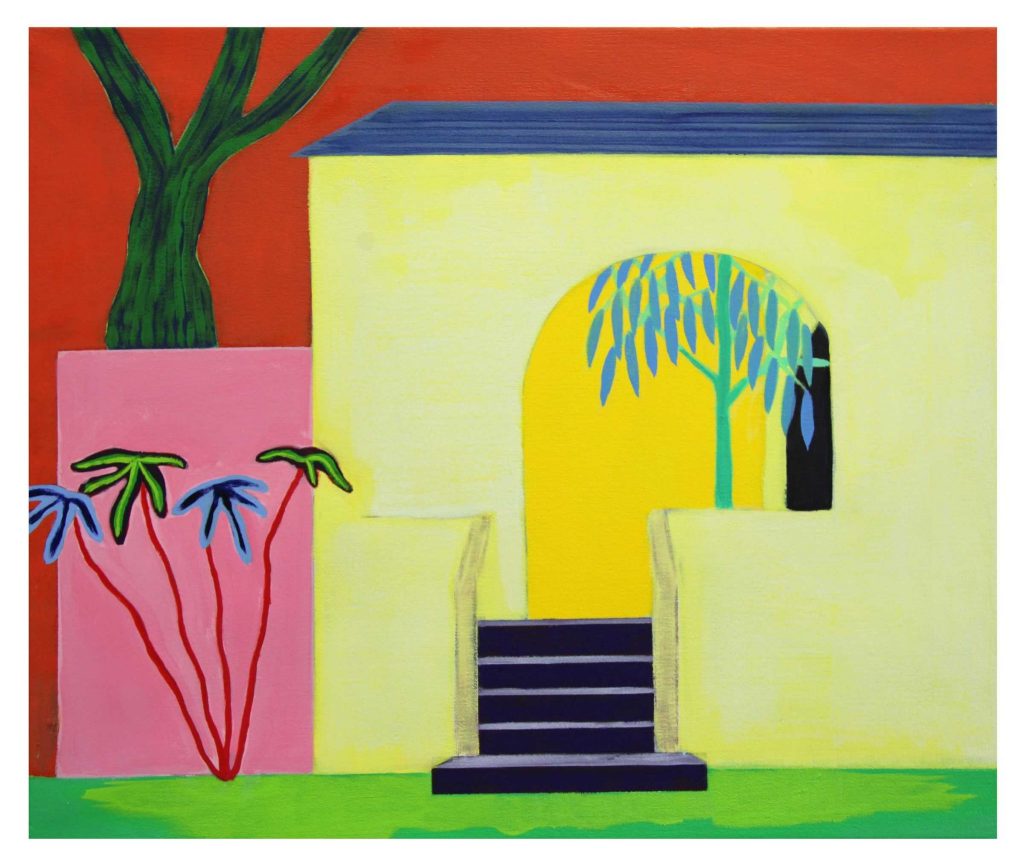
No 42, Cara Nahaul,

Cara Nahaul, Luna House, 50 x 60cm, 2019

What is it? What does it look like?

In this painting which looks like it has been painted using acrylics we are shown a bright lemon yellow building, five steps are leading us into the interior which is a warm yellow. An ornamental tree is visible inside. The building and surroundings have a middle eastern or African appearance. To the right of the yellow building in the semi shadow of a pink coloured wall is a four stemmed plant with four large leaves, two are blue, two are green. The background is a dark orange nearly red which suggests sunset. The trunk of a large tree breaks up the background above the pink wall. The composition has been simplified into geometric shapes and the paint has been applied in large slabs of colour with slight tonal variations

What might the work mean?

The painting evokes a sense of calm. It is a tranquil scene in which the observer is enticed into the warm interior of the building. The artist is showing us where they feel safe.

What does it matter to the world at large?

It is a statement that there is safe place, a home for us all. The warmth that we all cherish can be found in the simple pleasures. Look beyond the uncertainties, discard what is not needed.

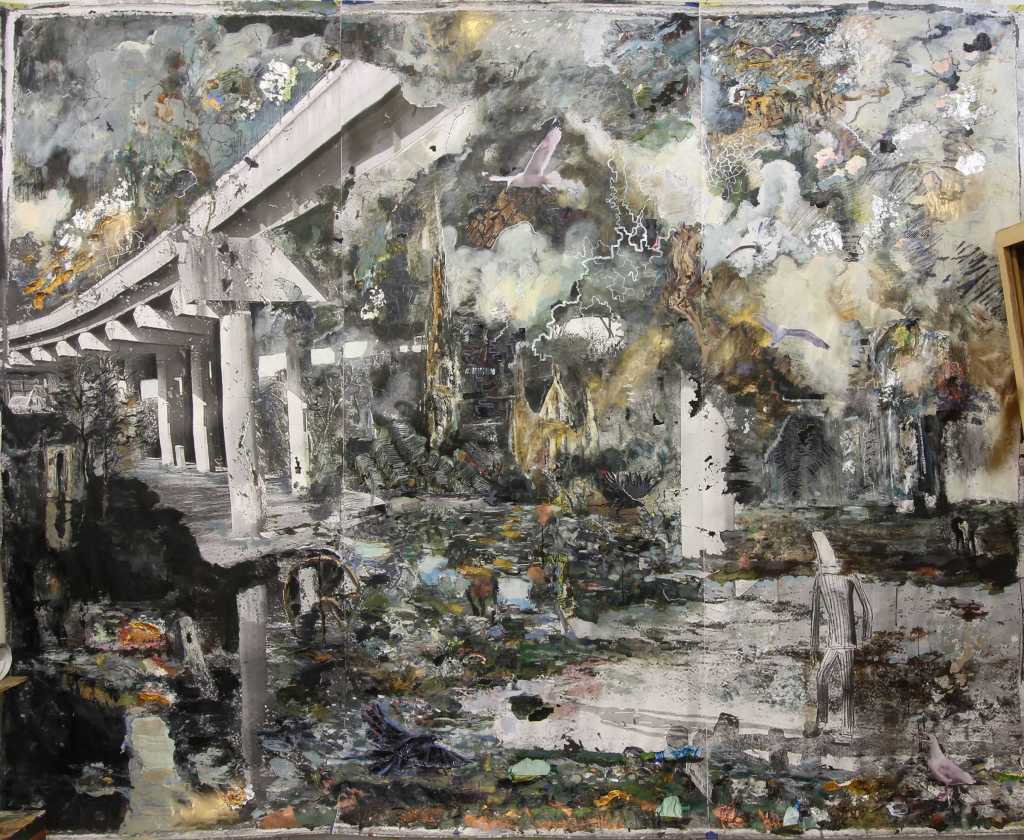
No 43, Paul Newman,

It’s not the end of the world, Mixed media, 190 x 260cm, 2016-19

This is a large work in mixed media. It depicts an apocalyptic cityscape. Set under a raised concrete bridge the remnants of buildings which appear to have been destroyed by fire or bombing are barely visible. Rubble and a pool of leaked water dominates the foreground in which a figure, human like, is present. The scene is rendered in a cold palette of colours, predominantly greys and white with raw sienna and small highlights of light blue. The work has obviously been, changed, reworked and added to over a period of time as it took three years to complete.

It is a comment on the human destruction of the world which we have created. How we create, build and ultimately destroy these creations, making our planet uninhabitable.

I see links to the paintings J. M. W. Turner in this work in the way that the composition is presented.

No 44, Stephen Newton,

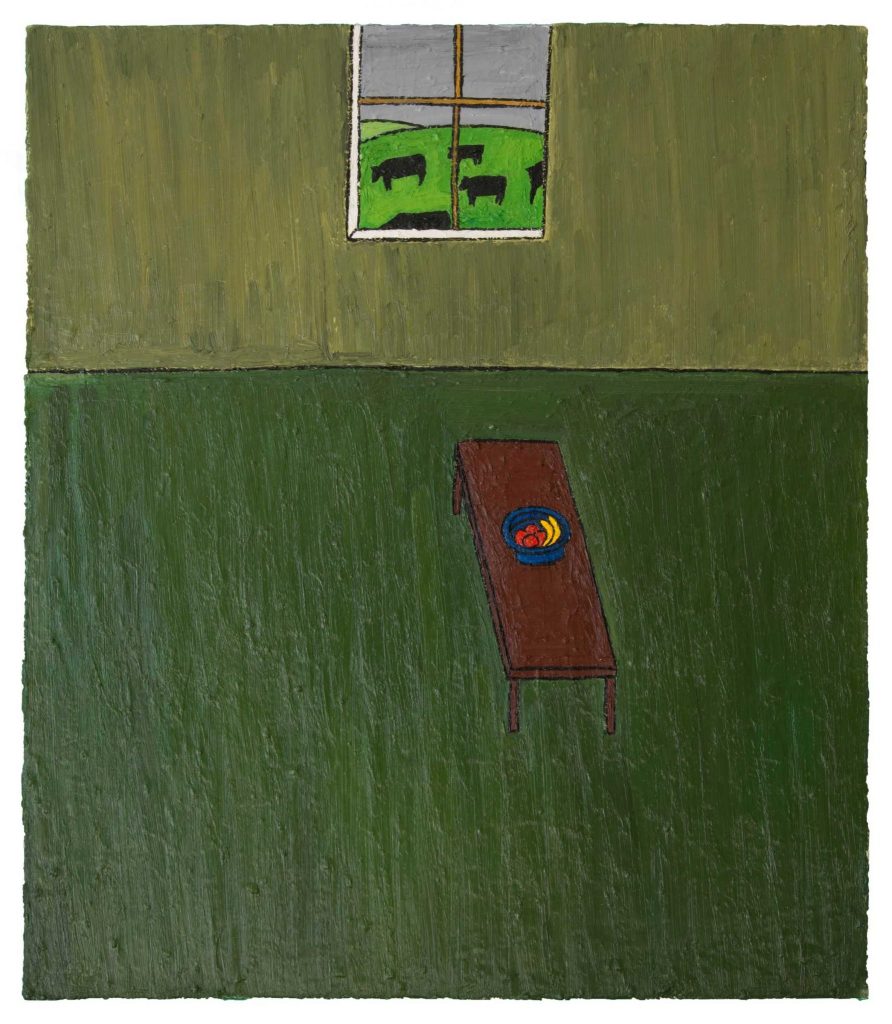
Bowl of Fruit on a table, Oil on ??, 102 x 86 cm, 2013

The title of this painting does indeed indicate the subject matter. However it is how the subject is portrayed and how the paint has been applied that is of more importance. The bowl of fruit consists of four oranges and two bananas, the bowl is blue. These are painted as simple shapes as is the brown table on which the bowl is placed, which is in a room. The table with the bowl is located just off centre both horizontally and vertically taking up only a small proportion of the painting. The main part of the painting, two thirds is taken up by the dark olive green carpet on which the table sits. The remaining third is a pale olive wall with a window through which a simple landscape of sky, two hills with five cows can be viewed. The paint, which looks like oil paint, the description doesn’t tell us, is applied thickly with only minor tonal variations.

There is a sense of space, but dark space which indicates loneliness and a sense of longing. This is amplified by the view which is suggesting an idea of freedom.

I see echoes in this painting to the work of Vincent Van Gogh and his depictions of his room in Arles.

No 45, Kirsty O’Leary Leeson

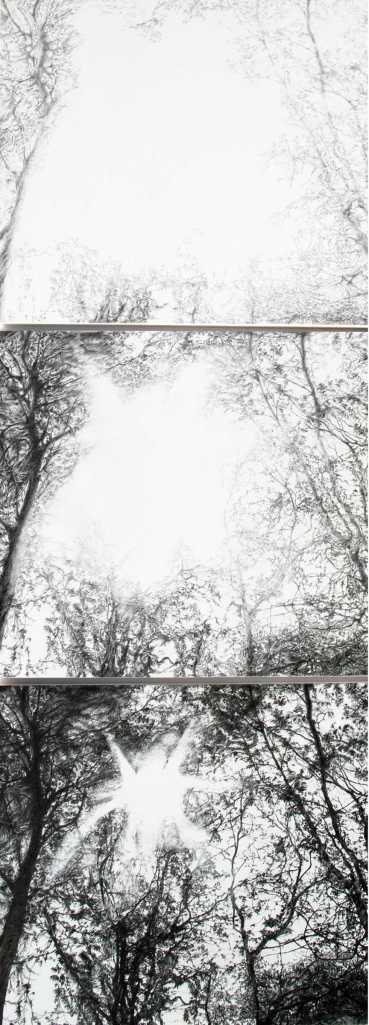
Lost from view, Pencil on gesso primed wood, 30 x 100, 2016

This work is presented as a triptych in which the three pencil drawings are stacked vertically one above the other. The scene is a tree-scape where the observer is placed looking up through the trees towards the sky. The viewpoint for each drawing is exactly the same. The trees have some leaves, suggesting either early spring or more likely autumn. The sun is piercing through the tree-scape directly into the observers eyes. In the first drawing the sun is penetrating the uppermost canopy. In the second the penetration of the sun is stronger and in the third it is at the point where eyes need to be averted.

The three drawings work together to form a dialogue with each other in a series which explores the movement of time and space. Whichever order the drawings are observed in, bottom to top or, top to bottom, they create a linear narrative in which the sun is either emerging from or receding into a cloud. I prefer the option that the sun is emerging as this creates the series of events in which we are looking at the trees, admiring them until the point where it becomes unbearable.

There is a connection in the experience of looking into the sun that is common to us all.

No 46, Sikelela Owen,

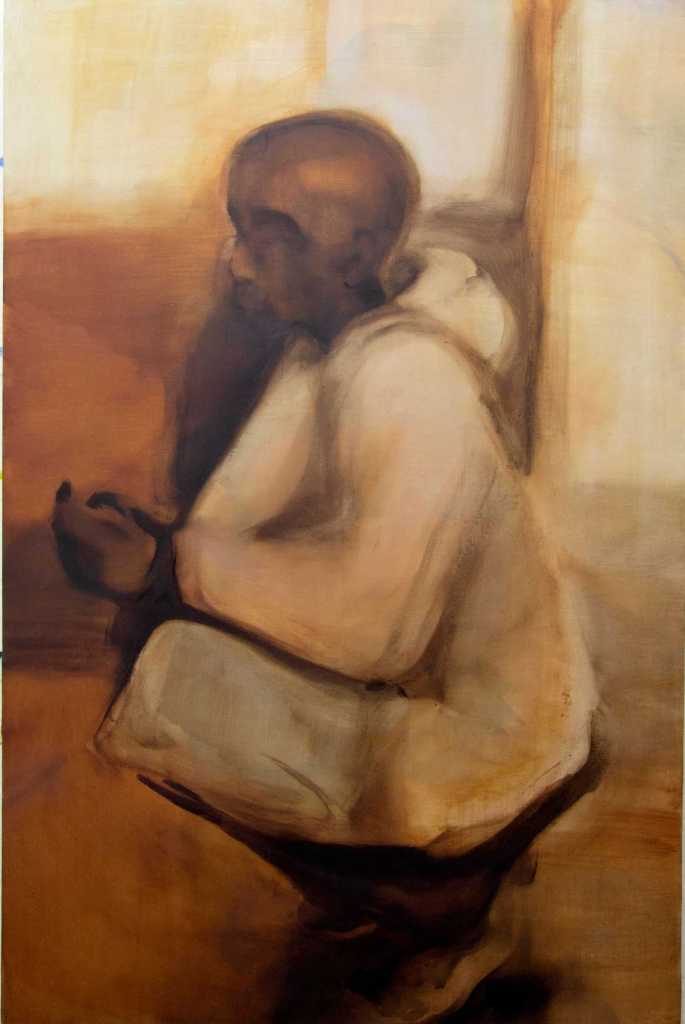
The Thinker, Oil on canvas, 150 x 100 cm, 2018

The title of this painting, ‘The Thinker’ immediately suggests some connection to the famous sculpture by August Rodin, which is an iconic work, universally recognised. To name a painting ‘The Thinker’ is to invite comparison which in turn risks unfavourable comparison. In this case I feel that there is enough space between the two works to allow the comparisons to be dismissed. Sikelela Owen’s ‘The Thinker’ is a portrait, full body, of what appears to be a young black man, crouching down and resting his body weight on his heels. His arms are resting on his knees with his hands held close together in front of him. His face, although not detailed, is looking into the middle distance focussing on nothing in particular and hence gives the appearance that he is deep in thought. The painting is a tonal study in brown hues which range from the dark brown shadows around his feet to near white on the wall behind him and on the top of his clothed shoulders. The whole painting is rendered in a soft, blurred, shimmering style which complements the contemplative mood.

No 47, Joe Packer,

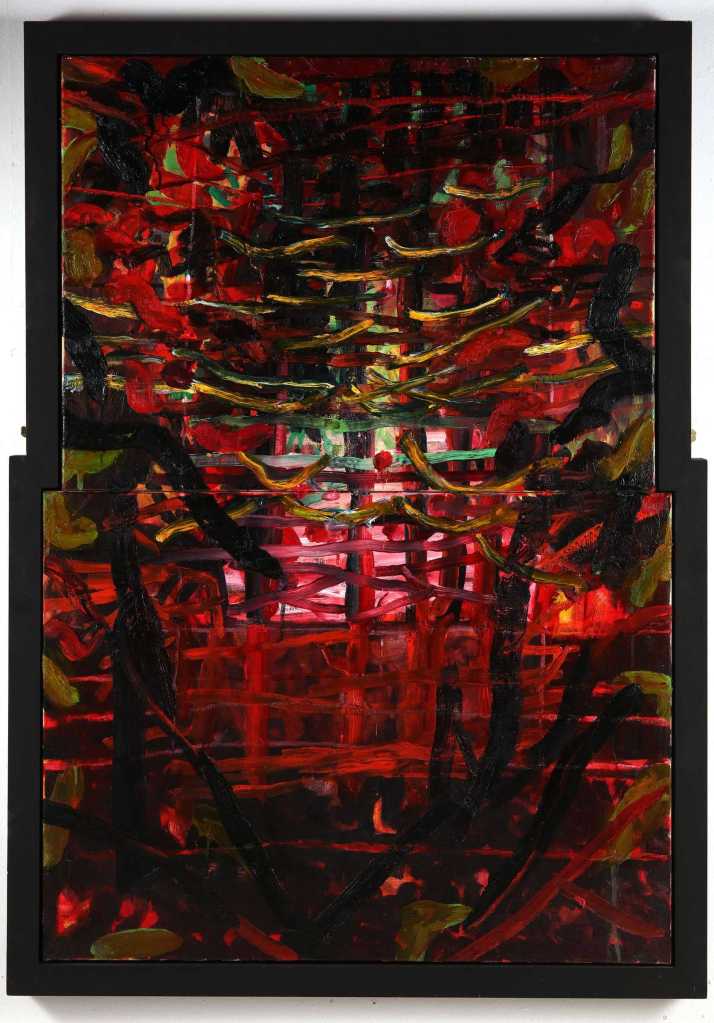
Heartland, Oil on canvas, 127 x 86 cm, 2017

This painting is an abstract work which seems to have been painted on two canvases. The colour is predominantly dark, nearly black, reds, with streaks of orange and green with hints of a white background. The brightest sections are to be found in the centre of the painting. It is at the centre where the brushstrokes are more apparent. These area number of strong vertical and horizontal lines which have been applied in a gestural manner. Flicks of orange and green create the colour interest to the painting.

The horizontal and vertical lines create a barrier to a potentially brighter place beyond. Are we looking out or looking in, and at what? That is for the observer to contemplate.

No 48, Gideon Pain,

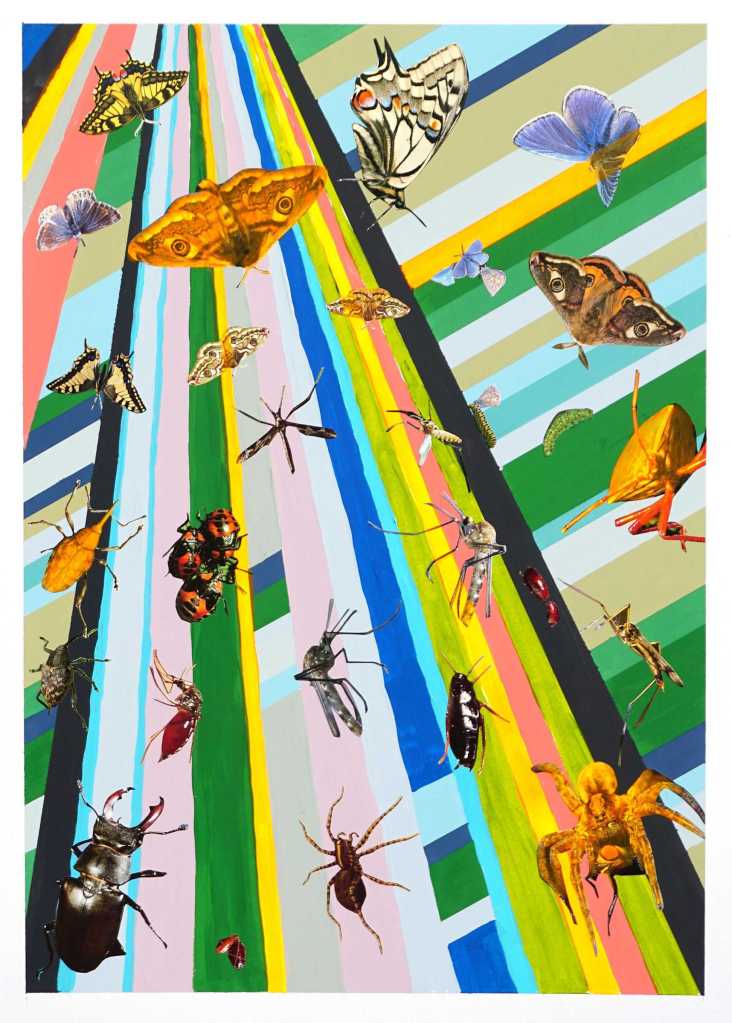
Bug Crush, Acrylic and collage on paper, 74 x 53 cm, 2020

This is a mixed media piece which has been using acrylic paint and cut out photographs. A paint has been applied in an offset linear array of vertical and horizontal line in a riot of colours. These lines recede towards a vanishing point outside of the painting. They suggest a high rise building upon which an array of bugs and insects are ascending. These bugs and insects are photographs of beetles, spiders, fleas, ladybirds, caterpillars, butterflies and moths. It is a reminder of how we share our world and how much we rely on them.

No 49, Stephen Palmer,

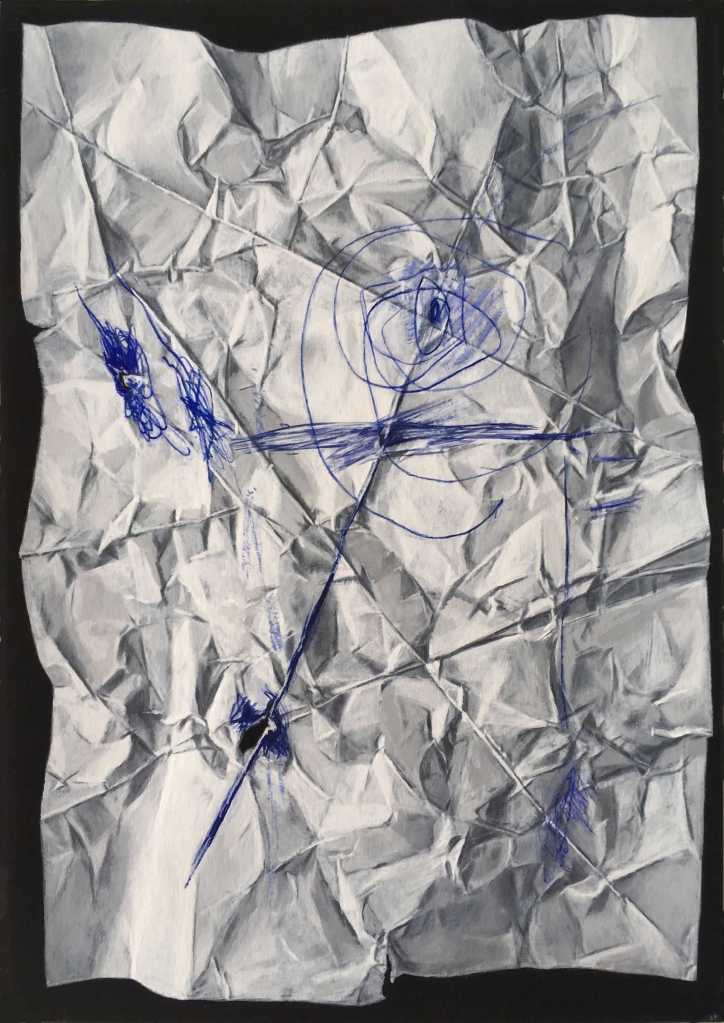
Doing the best that I can, Gouache on paper, 29.7.x 21 cm, 2018

This painting is part of a series of works whereby the artist takes a piece of black or white A4 paper which he then defaces by drawing on it, screwing it up and ripping it. It is then reconstructed or repaired as far as possible. This process is performed a number of times with most of the paper being discarded until one is deemed to be suitable for a painting or drawing. A new sheet of A4 paper is then used to make a photorealistic painting or drawing.

The resulting paintings challenge the conception of what constitutes a painting as the formal geometry, grid systems, mark making are made redundant.

No 50, Mandy Payne,

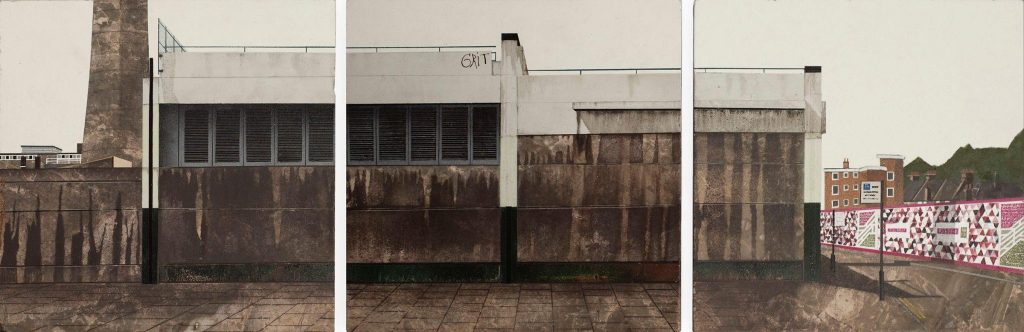
For the many not the few, Spray paint and oil on marble, (Triptych), 19 x 19 cms each piece, 2019

The paintings of Mandy Payne are about place, in particular her focus, for six years, was on Park Hill in Sheffield. This has now broadened out to include London, the North West and the North East. I am reminded of George Shaw’s depiction of Tile Hill in Coventry. Both artists paintings focus on the underbelly of these locations. The subjects are the dark side of buildings, stained by the weather, defaced by graffiti and seemingly unloved. Similar to George Shaw there is an absence of humans in the paintings of Mandy Payne, however the impact of human presence is implicit.

Payne brings her work close to the locations that she paints by using materials that have a direct physical connection to the place, concrete, marble and spray paints. The painting that I selected from her work for closer inspection is a triptych which has been painted on marble using oil and spray paints. The colour palette is muted greys and muddy washed out browns. The paintings concentrate on the side of a modern building, it could be a sports hall, school or small factory, however its purpose is not important. The building is all straight lines, rectangles and weather stained concrete. Reading from left to right the first painting gives an indication of where the building is situated. To the right, in the distance, are mores similar looking buildings and in the middle rising above and outside the painting is a large concrete tower. The middle, 2nd, painting concentrates on the next part of the building, it follows on from the previous one. In this painting the eye is drawn to some graffiti which has been sprayed on the side of the building near the top. The graffiti artist has used the flat roof to gain access to this vantage point. The third painting completes the right side of the building. To the right of it is a road which leads off into the distance. On the far side of the road is a wall which has been built incorporating mosaic designs and words. I guess that these are meant to brighten the location but have the opposite effect of amplifying the dourness of the surrounding area. Behind the wall, just visible, are the roofs of housing and a block of flats.

The title of the triptych is ‘For the many not the few’ which was a strapline used by the Labour party during its 2019 election campaign. A connection is being made between the place, who it is occupied by, and the hope for a better future.

Review of work completed in Part Five in relation to assessment criteria

Demonstration of Technical and Visual skills

I have taken a similar approach to the ones I completed for Parts three and four. The review has been broken down into the four key assessment criteria and where appropriate into the key sections within these criteria.

Materials: 

Part Five differed from the previous Parts of the course in that there was less scope for creating artwork. The two exercises for which there was this opportunity were: Exercise 1.0 Cut up technique and Exercise 3.1. For Exercise 1.0 I responded with paper and scissors to complete the exercise and for Exercise 3.1 I used technology to create a triptych using paintings and words. Neither of these were particularly ground-breaking.

Techniques: 

I feel that it is worth documenting here that my approach tackling a painting has evolved. I have a methodology which can be applied to different types of painting. In essence the technique is not dissimilar to working from dark to light but with my own personal tweaks. Most, if not all, of my painting during this part of the course has been directed toward the Parallel project where I have completed a number of paintings which I feel meet my criteria for submission for Assessment.

Observational skills: 

This is the area where I believe that I have made the biggest improvements. This has been in two distinct areas. The first is in respect of how I am approaching my paintings where I am continuing to develop my own language which is informing how I respond to subjects. The second is with regard to my contextual capabilities where they have needed to improve in order to complete the first draft of my Critical review. A major factor in assisting my improvement has been reading ‘How to write about contemporary art by Gilda Williams’. The tips, do’s and don’ts contained in the book have assisted my ability to respond to a painting in writing. I’m aware that this is a skill that needs to be practiced.

Visual awareness: 

Not an area where I have made any significant steps forward over the duration of Part five other than those mentioned above.

Design and compositional skills: 

Similar to visual awareness this was not an area that was particularly addressed during Part five.

Quality of Outcome

The paintings that I have completed for my Parallel project are, I feel, amongst my most accomplished to date. There are aspects where I see areas for improvement and believe that these are within my reach.

Demonstration of Creativity

There has been less opportunity to be as creative in Part five than there has been in previous parts of the course. Therefore my main focus has been on the completion of the exercises, creating a first draft of my critical review and more work towards my Parallel project.

Context

The contextual focus was the most important aspect of Part five. In trying to write a brief artists statement I needed to reflect on my practice, what it is, what drives me and why it is important to me. Trying to get that into a short statement that made sense and was, I hope, interesting was a challenge. This was followed by my first draft of my critical review in which I have completed detailed research, pulled this research into an essay where I have reflected on the research and generated my own opinions.

Summary

At this stage of the course I need to reflect on the progress that I have made, the key learning points and how to pull these together so that I am successful at Assessment.