As I having been working through Parts 4 & 5 of this course I have been reading / studying ‘How to write about Contemporary Art by Gilda Williams’. The book was recommended a essential reading by Level 3 (HE6) students on a Zoom meeting. An extract from this book was part of the reading for Exercise 4 in Part Five.
In section 2 three questions are recommended as an approach to adopt when writing about an artwork. These are:
- What is it? What does the artwork look like?
- What might the work mean?
- What does it matter to the world at large?
I shall use this framework for the next ten reviews where I will pick a single painting and attempt to answer these three questions. The approach will be to select one painting from the next ten artists in the Contemporary British artists website. One a day for the next ten days. My rationale is to practice this technique until it becomes engrained. Additionally my aim is to improve my analytical and writing skills.
For the first few I have adopted a regimented format, asking the three questions and answering them. I will modify this as I progress through the ten reviews.
No 41, Nicholas Middleton,
What is it? What does it look like?
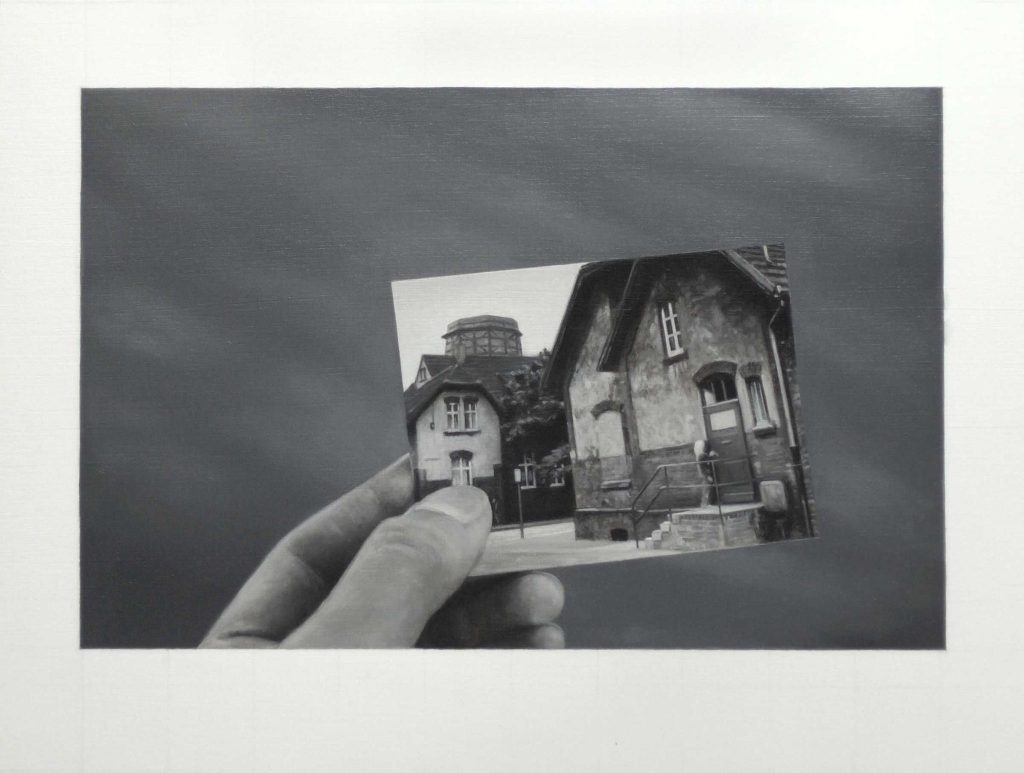
The painting is photorealistic study in black and white which shows the fingers of some ones left hand holding a black and white photograph or perhaps it is a postcard. The background to the hand and the photograph is grey, slightly undulating in tone. The photograph or postcard depicts a town scene which is set in what appears to be a suburban setting in the 1950’s – 60’s. In the foreground is a building, probably a house with a short set of steps leading to a door. This house is situated on the corner of a street. The middle ground is occupied by another house above which, in the distance, is another building which I’m not able to determine what it is.
What might the work mean?
The way that the photograph is being held suggests that it is being compared to what the holder is seeing. It is as if there is a search going on. Have I found what I am looking for? What has changed around here?
The painting about memory. A search for a past that is fading away.
What does it matter to the world at large?
From a artistic perspective the painting is an example of the photorealism technique. The clever use of a photograph within a painting make this reference clear. The artist is adding his work to this particular genre.
No 42, Cara Nahaul,
What is it? What does it look like?
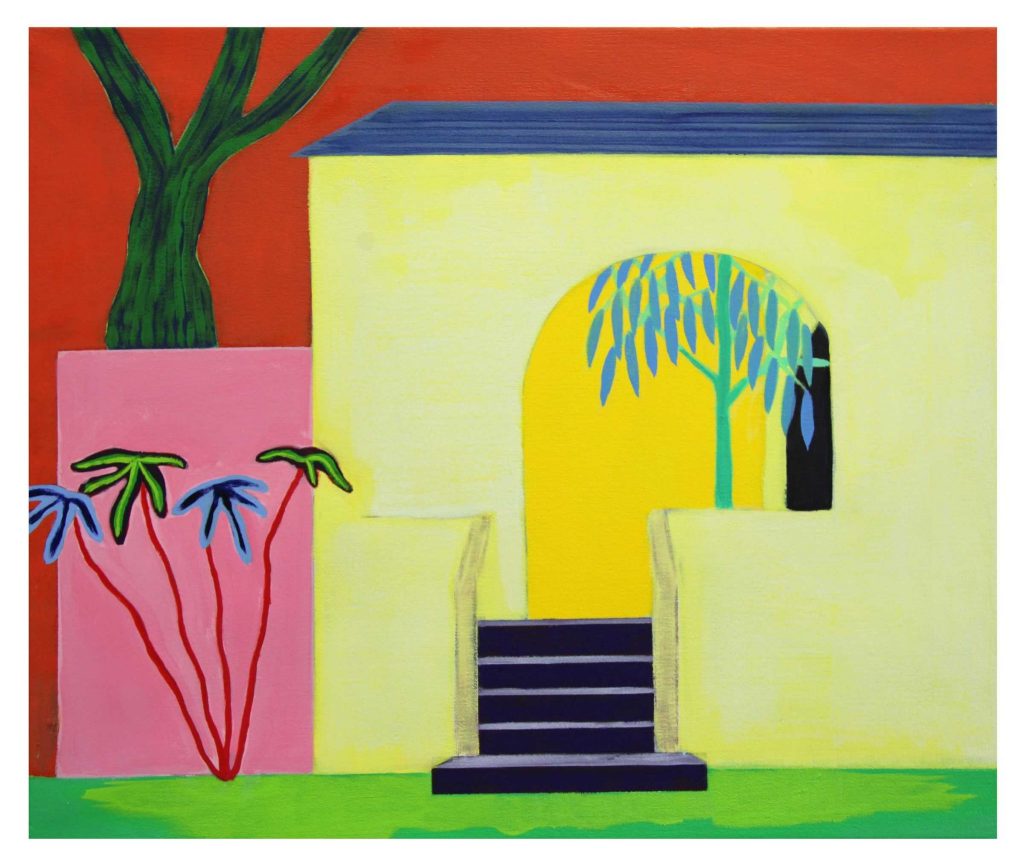
In this painting which looks like it has been painted using acrylics we are shown a bright lemon yellow building, five steps are leading us into the interior which is a warm yellow. An ornamental tree is visible inside. The building and surroundings have a middle eastern or African appearance. To the right of the yellow building in the semi shadow of a pink coloured wall is a four stemmed plant with four large leaves, two are blue, two are green. The background is a dark orange nearly red which suggests sunset. The trunk of a large tree breaks up the background above the pink wall. The composition has been simplified into geometric shapes and the paint has been applied in large slabs of colour with slight tonal variations
What might the work mean?
The painting evokes a sense of calm. It is a tranquil scene in which the observer is enticed into the warm interior of the building. The artist is showing us where they feel safe.
What does it matter to the world at large?
It is a statement that there is safe place, a home for us all. The warmth that we all cherish can be found in the simple pleasures. Look beyond the uncertainties, discard what is not needed.
No 43, Paul Newman,
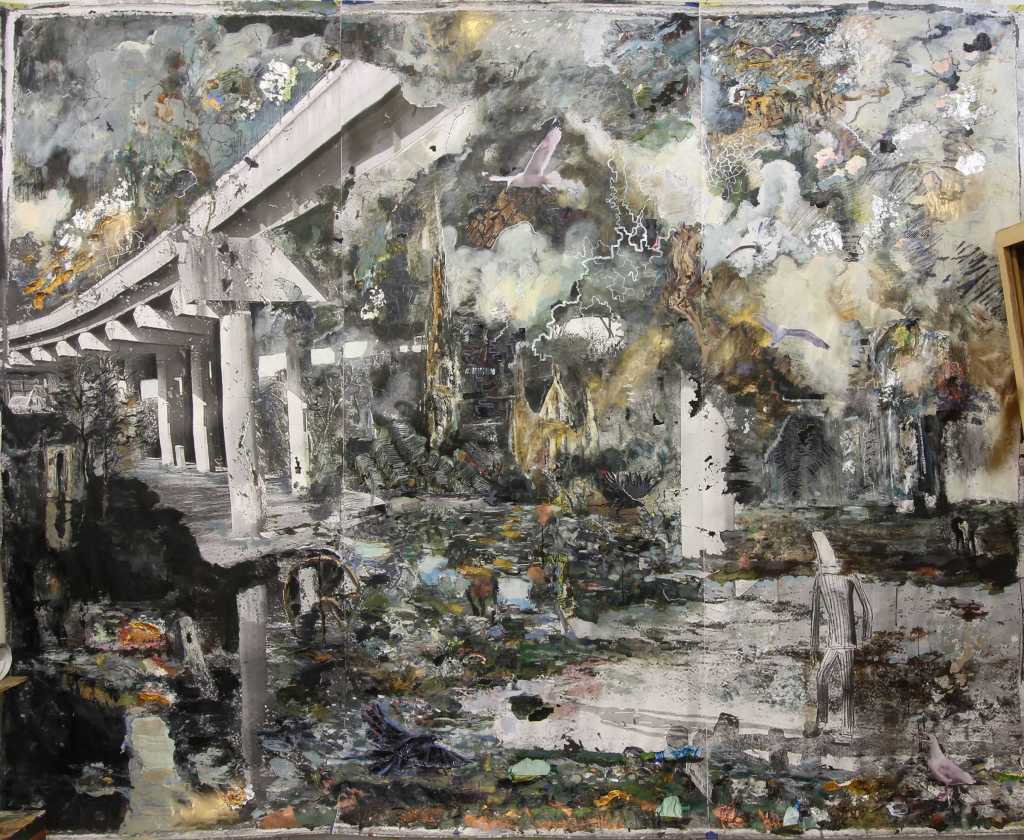
This is a large work in mixed media. It depicts an apocalyptic cityscape. Set under a raised concrete bridge the remnants of buildings which appear to have been destroyed by fire or bombing are barely visible. Rubble and a pool of leaked water dominates the foreground in which a figure, human like, is present. The scene is rendered in a cold palette of colours, predominantly greys and white with raw sienna and small highlights of light blue. The work has obviously been, changed, reworked and added to over a period of time as it took three years to complete.
It is a comment on the human destruction of the world which we have created. How we create, build and ultimately destroy these creations, making our planet uninhabitable.
I see links to the paintings J. M. W. Turner in this work in the way that the composition is presented.
No 44, Stephen Newton,
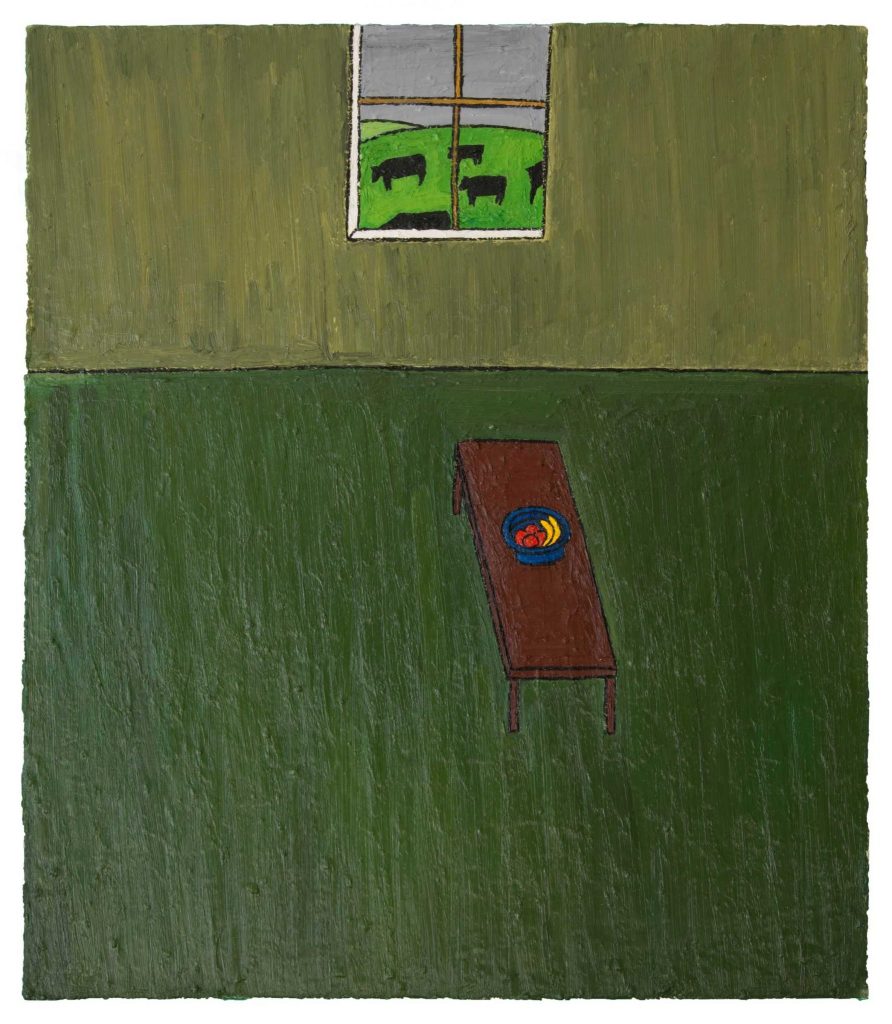
The title of this painting does indeed indicate the subject matter. However it is how the subject is portrayed and how the paint has been applied that is of more importance. The bowl of fruit consists of four oranges and two bananas, the bowl is blue. These are painted as simple shapes as is the brown table on which the bowl is placed, which is in a room. The table with the bowl is located just off centre both horizontally and vertically taking up only a small proportion of the painting. The main part of the painting, two thirds is taken up by the dark olive green carpet on which the table sits. The remaining third is a pale olive wall with a window through which a simple landscape of sky, two hills with five cows can be viewed. The paint, which looks like oil paint, the description doesn’t tell us, is applied thickly with only minor tonal variations.
There is a sense of space, but dark space which indicates loneliness and a sense of longing. This is amplified by the view which is suggesting an idea of freedom.
I see echoes in this painting to the work of Vincent Van Gogh and his depictions of his room in Arles.
No 45, Kirsty O’Leary Leeson
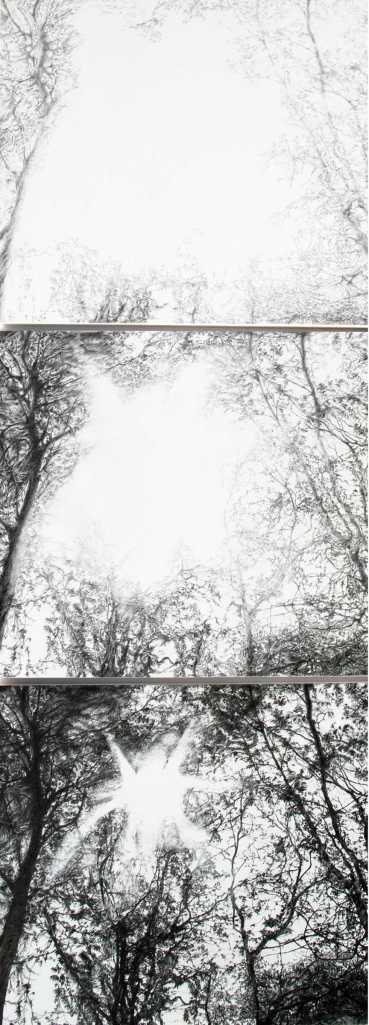
This work is presented as a triptych in which the three pencil drawings are stacked vertically one above the other. The scene is a tree-scape where the observer is placed looking up through the trees towards the sky. The viewpoint for each drawing is exactly the same. The trees have some leaves, suggesting either early spring or more likely autumn. The sun is piercing through the tree-scape directly into the observers eyes. In the first drawing the sun is penetrating the uppermost canopy. In the second the penetration of the sun is stronger and in the third it is at the point where eyes need to be averted.
The three drawings work together to form a dialogue with each other in a series which explores the movement of time and space. Whichever order the drawings are observed in, bottom to top or, top to bottom, they create a linear narrative in which the sun is either emerging from or receding into a cloud. I prefer the option that the sun is emerging as this creates the series of events in which we are looking at the trees, admiring them until the point where it becomes unbearable.
There is a connection in the experience of looking into the sun that is common to us all.
No 46, Sikelela Owen,
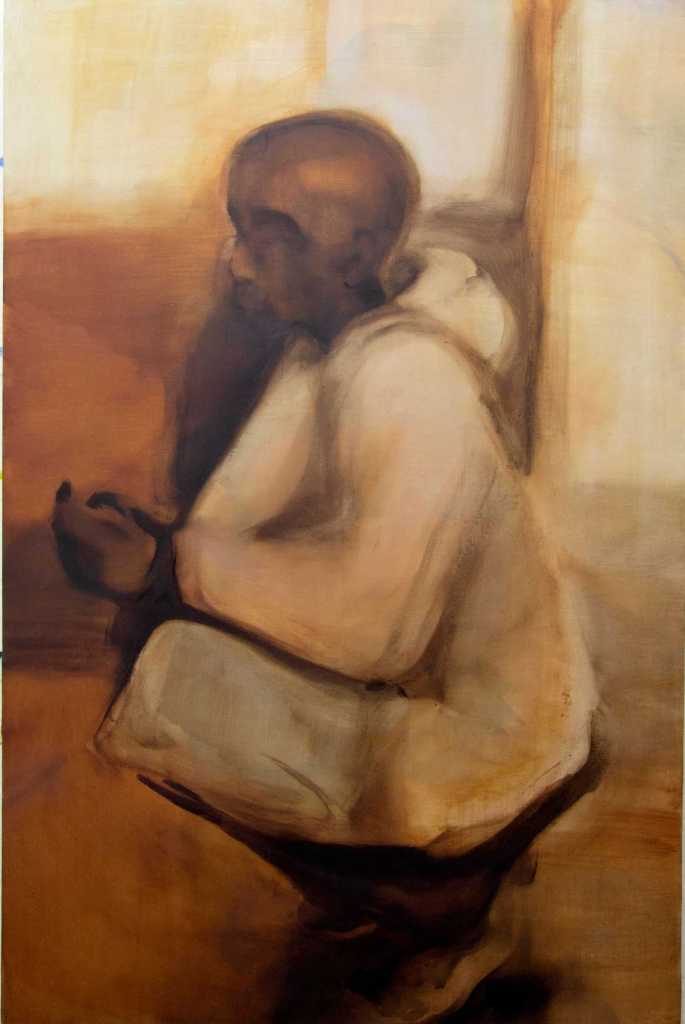
The title of this painting, ‘The Thinker’ immediately suggests some connection to the famous sculpture by August Rodin, which is an iconic work, universally recognised. To name a painting ‘The Thinker’ is to invite comparison which in turn risks unfavourable comparison. In this case I feel that there is enough space between the two works to allow the comparisons to be dismissed. Sikelela Owen’s ‘The Thinker’ is a portrait, full body, of what appears to be a young black man, crouching down and resting his body weight on his heels. His arms are resting on his knees with his hands held close together in front of him. His face, although not detailed, is looking into the middle distance focussing on nothing in particular and hence gives the appearance that he is deep in thought. The painting is a tonal study in brown hues which range from the dark brown shadows around his feet to near white on the wall behind him and on the top of his clothed shoulders. The whole painting is rendered in a soft, blurred, shimmering style which complements the contemplative mood.
No 47, Joe Packer,
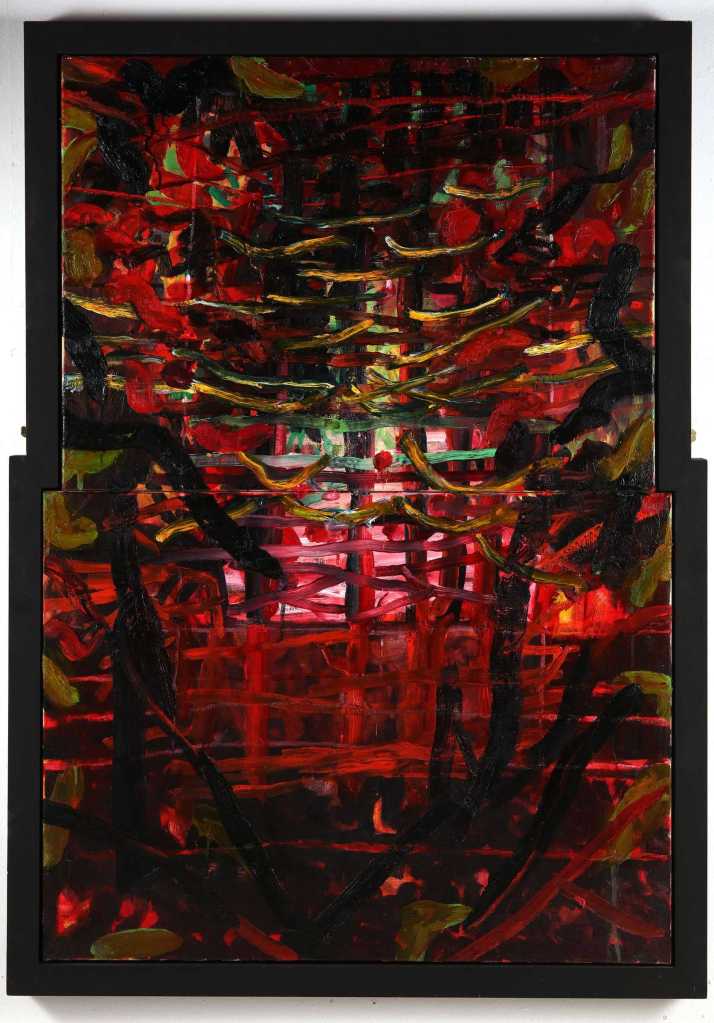
This painting is an abstract work which seems to have been painted on two canvases. The colour is predominantly dark, nearly black, reds, with streaks of orange and green with hints of a white background. The brightest sections are to be found in the centre of the painting. It is at the centre where the brushstrokes are more apparent. These area number of strong vertical and horizontal lines which have been applied in a gestural manner. Flicks of orange and green create the colour interest to the painting.
The horizontal and vertical lines create a barrier to a potentially brighter place beyond. Are we looking out or looking in, and at what? That is for the observer to contemplate.
No 48, Gideon Pain,
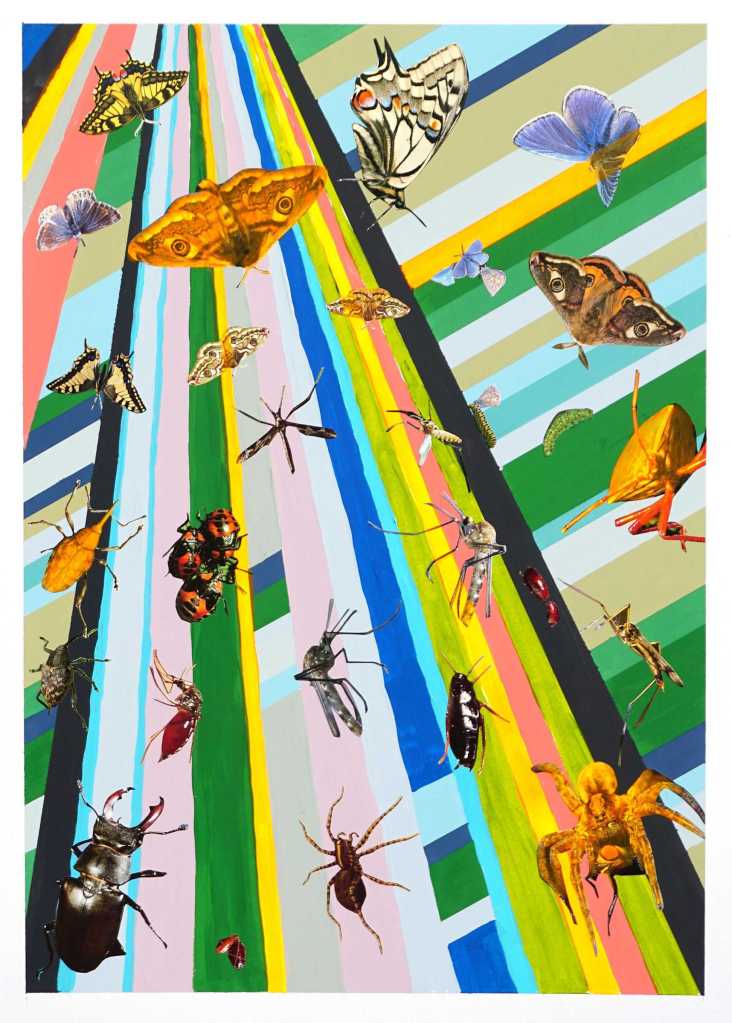
This is a mixed media piece which has been using acrylic paint and cut out photographs. A paint has been applied in an offset linear array of vertical and horizontal line in a riot of colours. These lines recede towards a vanishing point outside of the painting. They suggest a high rise building upon which an array of bugs and insects are ascending. These bugs and insects are photographs of beetles, spiders, fleas, ladybirds, caterpillars, butterflies and moths. It is a reminder of how we share our world and how much we rely on them.
No 49, Stephen Palmer,
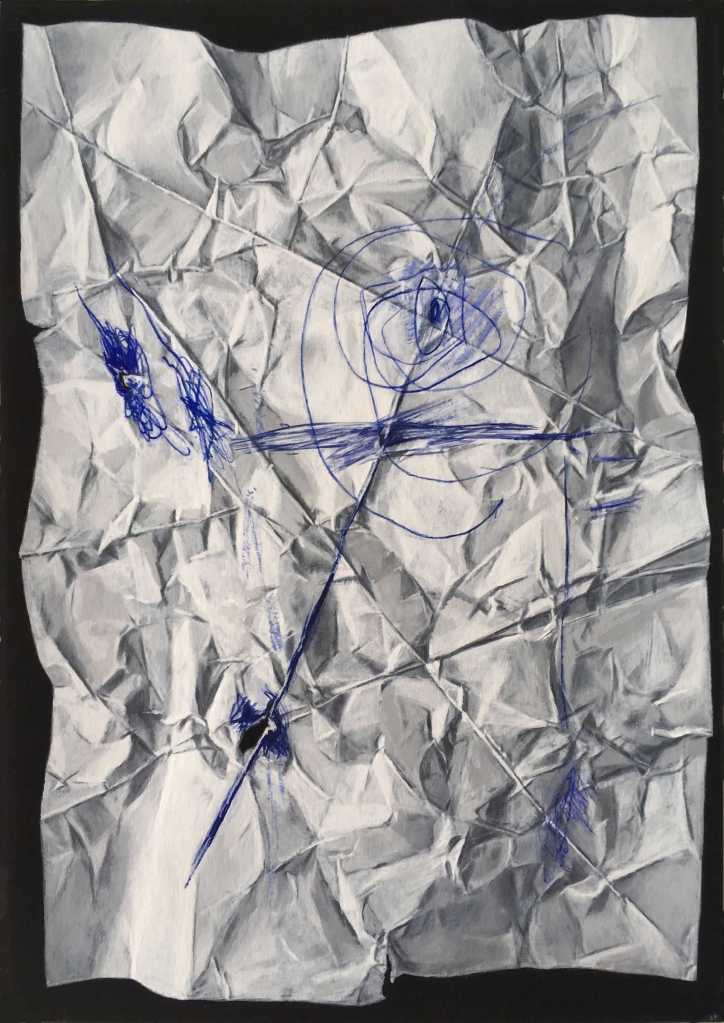
This painting is part of a series of works whereby the artist takes a piece of black or white A4 paper which he then defaces by drawing on it, screwing it up and ripping it. It is then reconstructed or repaired as far as possible. This process is performed a number of times with most of the paper being discarded until one is deemed to be suitable for a painting or drawing. A new sheet of A4 paper is then used to make a photorealistic painting or drawing.
The resulting paintings challenge the conception of what constitutes a painting as the formal geometry, grid systems, mark making are made redundant.
No 50, Mandy Payne,
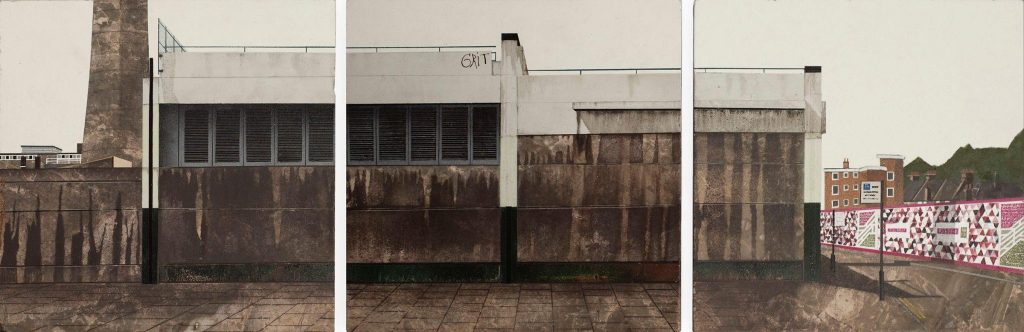
The paintings of Mandy Payne are about place, in particular her focus, for six years, was on Park Hill in Sheffield. This has now broadened out to include London, the North West and the North East. I am reminded of George Shaw’s depiction of Tile Hill in Coventry. Both artists paintings focus on the underbelly of these locations. The subjects are the dark side of buildings, stained by the weather, defaced by graffiti and seemingly unloved. Similar to George Shaw there is an absence of humans in the paintings of Mandy Payne, however the impact of human presence is implicit.
Payne brings her work close to the locations that she paints by using materials that have a direct physical connection to the place, concrete, marble and spray paints. The painting that I selected from her work for closer inspection is a triptych which has been painted on marble using oil and spray paints. The colour palette is muted greys and muddy washed out browns. The paintings concentrate on the side of a modern building, it could be a sports hall, school or small factory, however its purpose is not important. The building is all straight lines, rectangles and weather stained concrete. Reading from left to right the first painting gives an indication of where the building is situated. To the right, in the distance, are mores similar looking buildings and in the middle rising above and outside the painting is a large concrete tower. The middle, 2nd, painting concentrates on the next part of the building, it follows on from the previous one. In this painting the eye is drawn to some graffiti which has been sprayed on the side of the building near the top. The graffiti artist has used the flat roof to gain access to this vantage point. The third painting completes the right side of the building. To the right of it is a road which leads off into the distance. On the far side of the road is a wall which has been built incorporating mosaic designs and words. I guess that these are meant to brighten the location but have the opposite effect of amplifying the dourness of the surrounding area. Behind the wall, just visible, are the roofs of housing and a block of flats.
The title of the triptych is ‘For the many not the few’ which was a strapline used by the Labour party during its 2019 election campaign. A connection is being made between the place, who it is occupied by, and the hope for a better future.
 Mark Taylor 'Studio Practice'