Overall the meeting and subsequent comments were positive. In an earlier blog on my personal assessment I rated my work against the assessment criteria. In this I explained how I had adapted the exercises to allow myself to explore the topics via painting. In so doing it had allowed a freedom to express myself and respond to the challenges. The resultant work varied in style and technique and used a variety of sources to create inspiration. In amongst these were some specific pieces which were singled out for positive comment.
In Exercise 1.0 where I created a series of four sketchy paintings it was one where despite there being obvious issues with the perspective it was felt that the background wall texture and the chair was well rendered. The composition was tonally balanced.

For Exercise 1.1 ‘Body as canvas’ the way I had interpreted the exercise was interesting. Of the paintings it was commented that the smaller blue painting had a better body shape than than the larger one where the right side of the body, the left side of the painting, appeared to be squeezed in to fit the canvas.
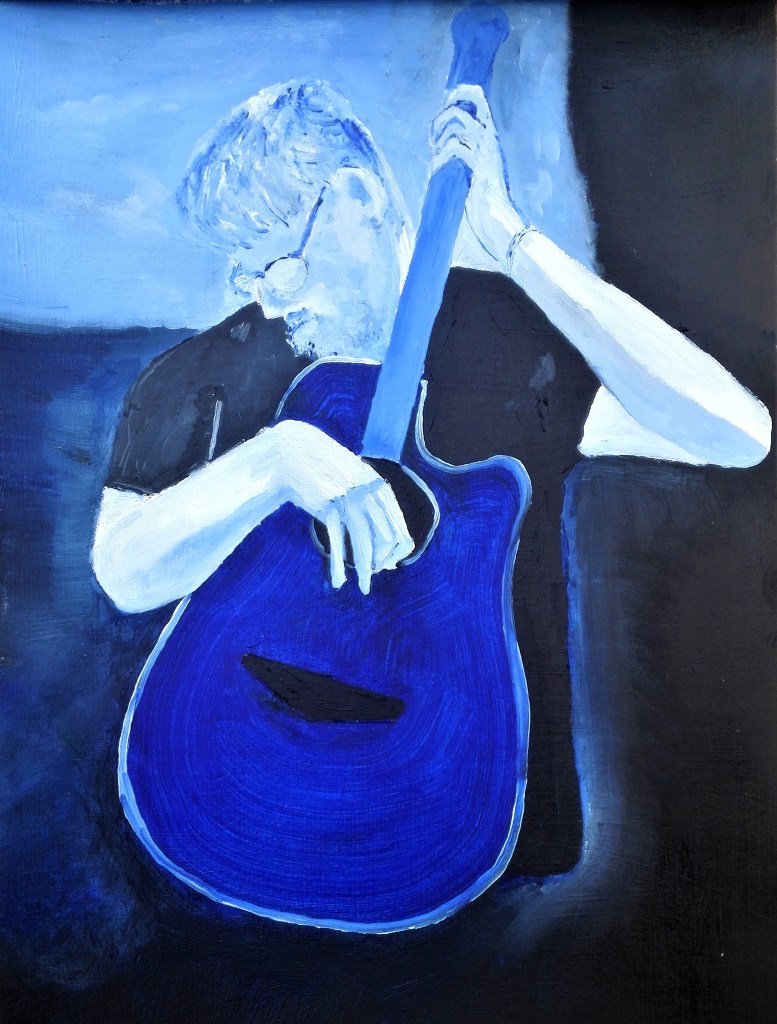
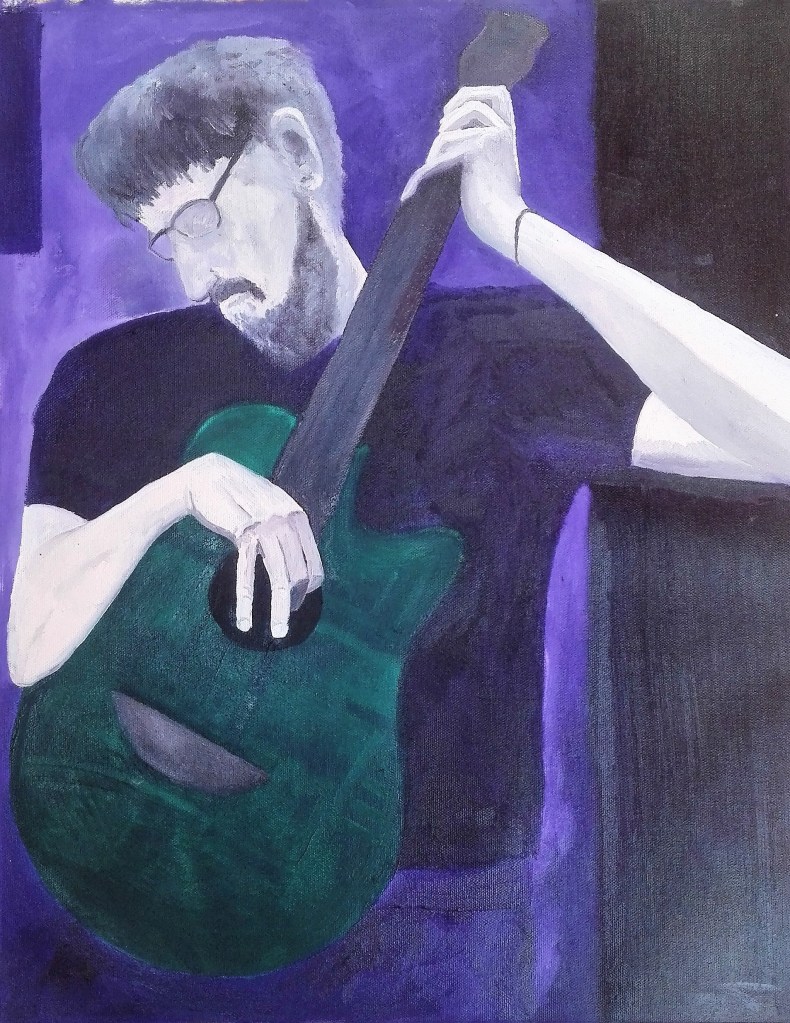
Whilst I agree with the observation I feel that the tenderness, the caressing of the instrument, is better observed in the second painting.
The series of paintings completed for Exercise 1.2 ‘Before and after’ were commented on a having a charming and playful quality that was found to be amusing. The main learning points from this exercise, for me, was the requirement to keep a consistent format and style across the pieces. this had necessitated planning, organising and not plunging into the work which, at times, I am prone to do. It was suggested that I research George Shaw’s Payne’s Grey paintings as a source of inspiration as to how to create narrative over several works by the consistent use of a limited palette.
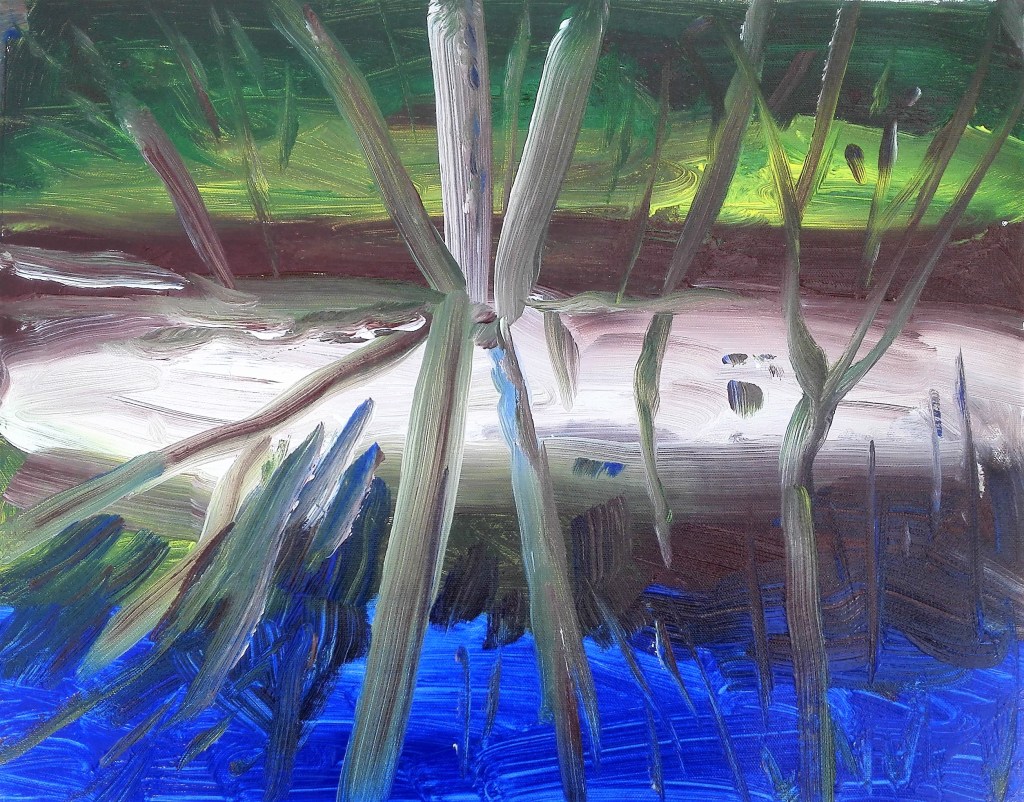
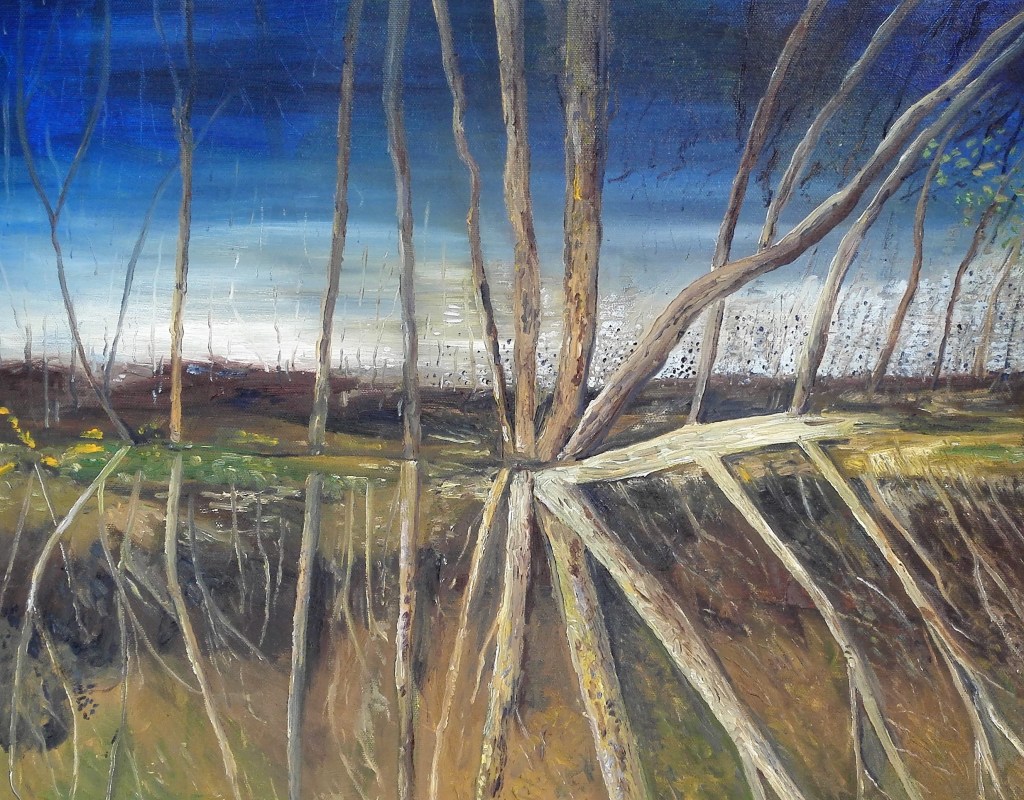
The exercise for which I created the most work and made the most investigations was Exercise 1.3 ‘The mirror as a stage’. It was this exercise where the most in depth conversations and comments were directed. The overriding comment that I highlighted from the feedback was the possibility to start making more connections between subject and process. How can I integrate some of the more successful experiments and techniques into my parallel project of exploring aspects of Fenland landscapes.
Some of the more successful paintings were:
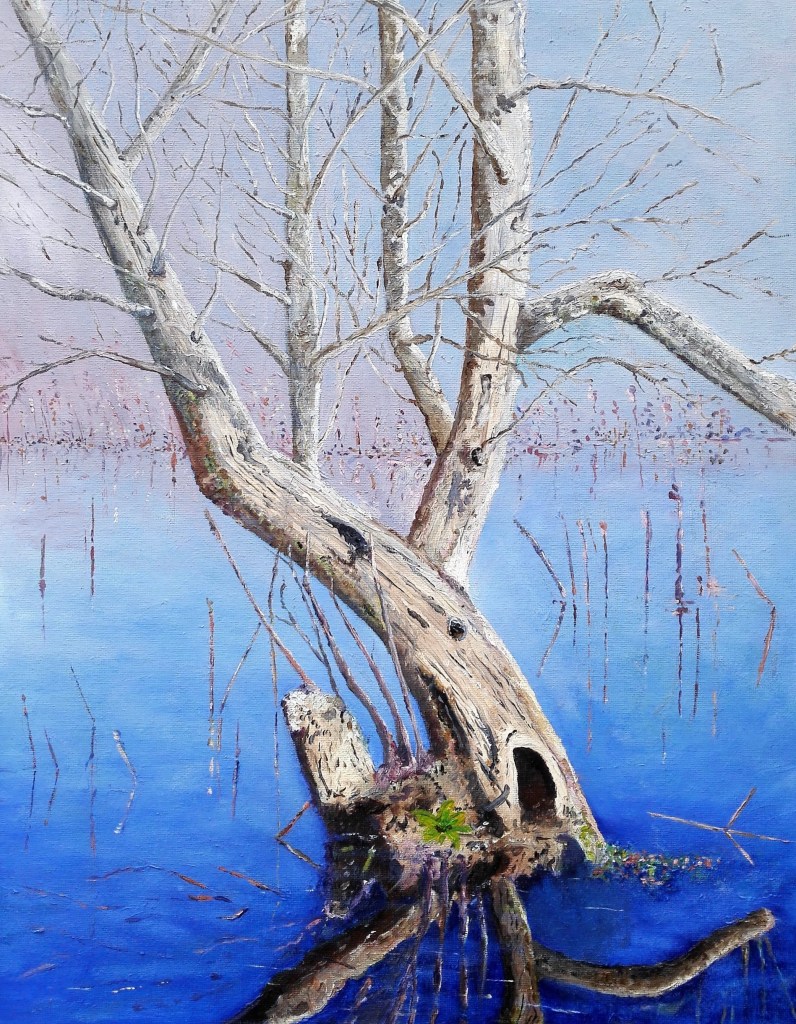
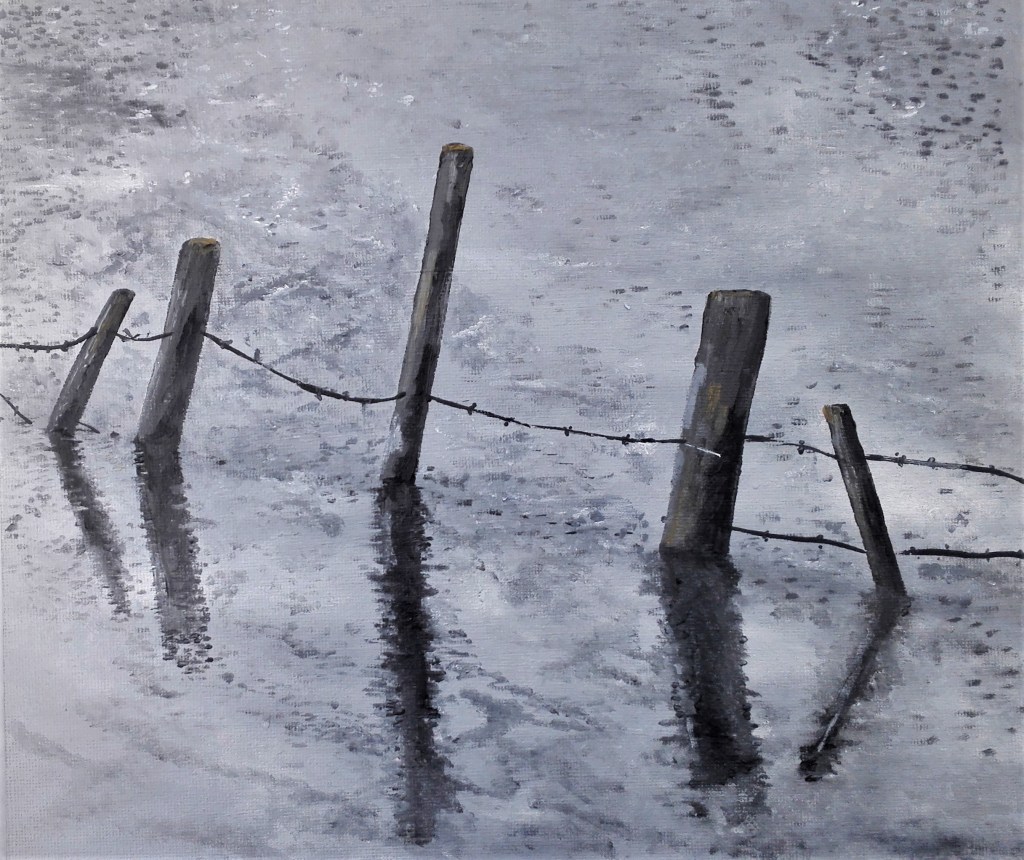
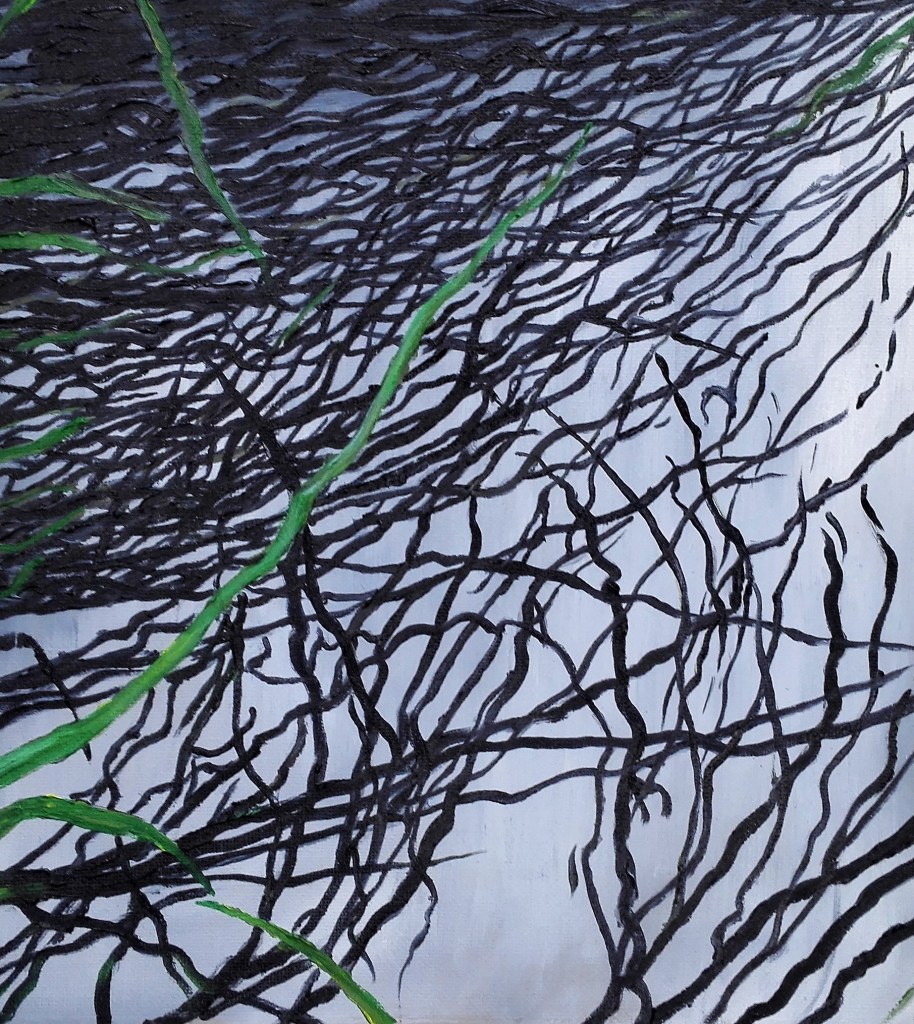
For my Assignment piece I had selected an image from a photograph which, it was felt, had created difficulties, for myself. The photograph didn’t have sufficient tonal variations and the focal point lacked emphasis. The result was that the final piece became overworked. The quicker study was preferred to the final painting. The alternative orientation of displaying the final piece upside down from its intentional orientation has now become my preferred way of hanging the painting. It was commented that it reminded of exposed tree roots along a river bank. I also feel the it has a dark, gloomy quality in which the landscape looks desolate under an foreboding sky.
The final part of the review concentrated upon my ideas for both the Parallel project and the Critical Review. I outlined my ideas to create a series of painting where I would explore abandoned, run down, decaying Fenland farm buildings looking for unusual angles and perspectives. The idea included a comparison to and inspiration from the suburban landscape paintings of George Shaw. I would also use George Shaw as the main topic for my critical review where I will look to examine his paintings of the mundane, the discarded, the back alleys and the familiar sights of our day to day existence. This would be compared to other artists working in similar fields both in painting and other artistic fields.
A number of artists were suggested for research which I will do in due course and will write up my thoughts and reflections in my blog. In this I will endeavour to increase the depth into which I investigate.
 Mark Taylor 'Studio Practice'