I started my blog on Exercise 1.4 with a few words regarding the Rauschenberg exhibition that I had attended at Tate Modern in 2017.
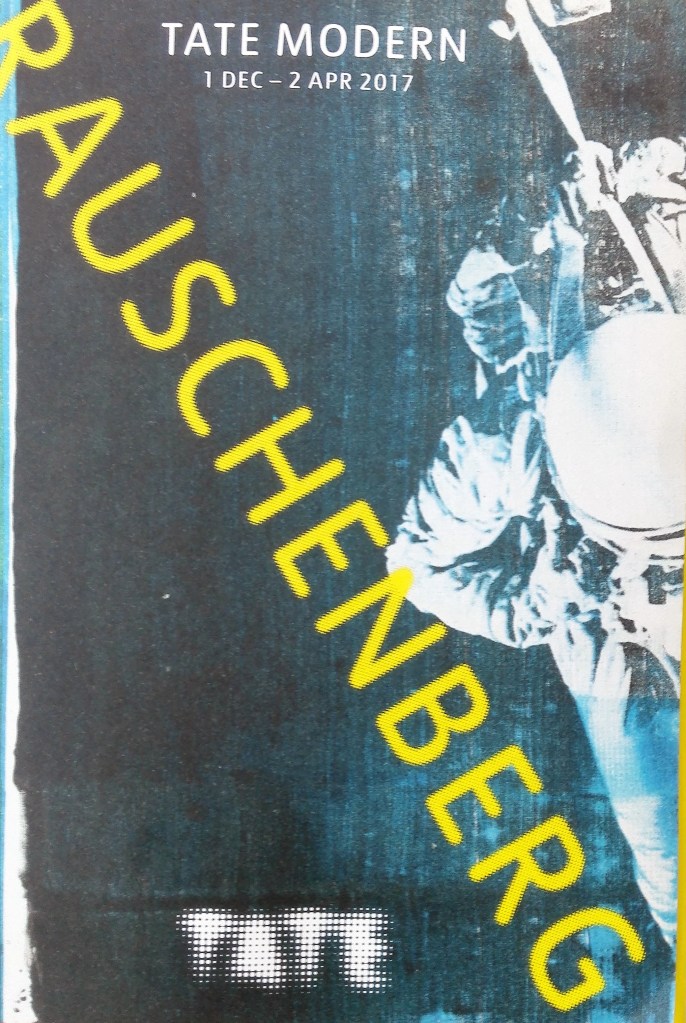
Prior to this exhibition I had confronted Abstract art, installations, and avant-garde sculpture but had not confronted Combines. The exhibition covered all of Rauschenberg’s career and only a part, room 3, included the Combines. This room along with ‘Material Abstraction’ were the two largest rooms. The Combines were different. They seemed to be about painting but had other aspects to them which at the time I didn’t come to terms with. I couldn’t make sense of them. As I recall the one that made most sense was ‘Bed’ which was completed in 1955 at the beginning of his Combine period.
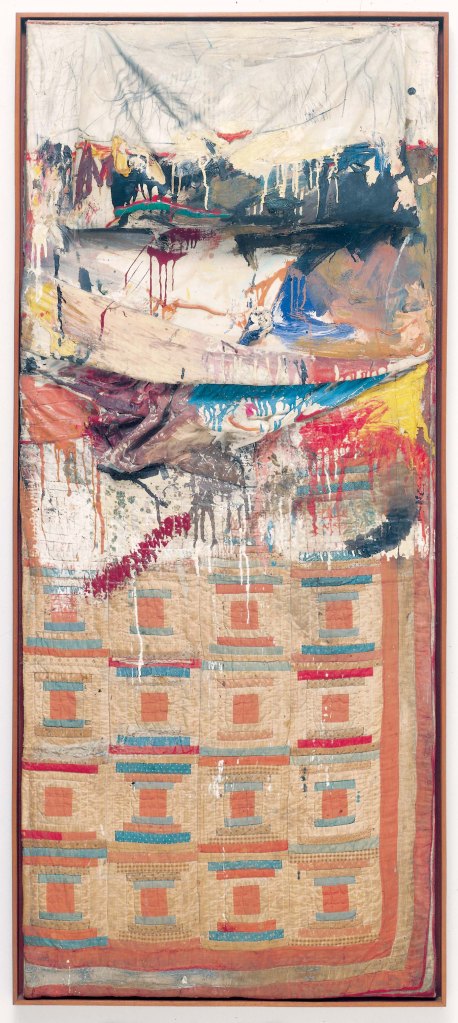
It was obvious what it was but why was it contained with a frame with paint. It was a painting that utilised oil paint and pencil on pillow, quilt and sheet. It now makes more sense having worked on my own Combine and also having read more about Combines. The bed itself is an ordinary object. It is usually confronted as horizontal. Here it is presented to the viewer vertically within a frame. this was the intention to endow ordinary objects with a new significance. This topic is explored further in the article ‘On Rauschenberg – Art Theory 1900-2000’ which is similar in content with the Exhibition guide. The guide walks through Rauschenberg’s artistic life in a chronological order and explains his development. The many collaborations, the challenge to conceptions and continual experimentation with the art form.
Returning to the Combine’s they started to make more sense after reading Leo Steinberg’s lecture piece on ‘Other Criteria – The Flatbed picture plane’ in which he explains how the picture plane
“was moved from the Renaissance picture plane, which are experienced in the normal erect posture, to the work of Rauschenberg whose work challenged and overcame this so that the pictures no longer simulate vertical fields but opaque flatbed horizontals. They no more depend on head to toe correspondence with human posture than a newspaper does.“
Having read these pieces and reflected upon them I returned to Link 21 and looked to explore a couple more Combines. I selected two which are reproduced below along with my comments.
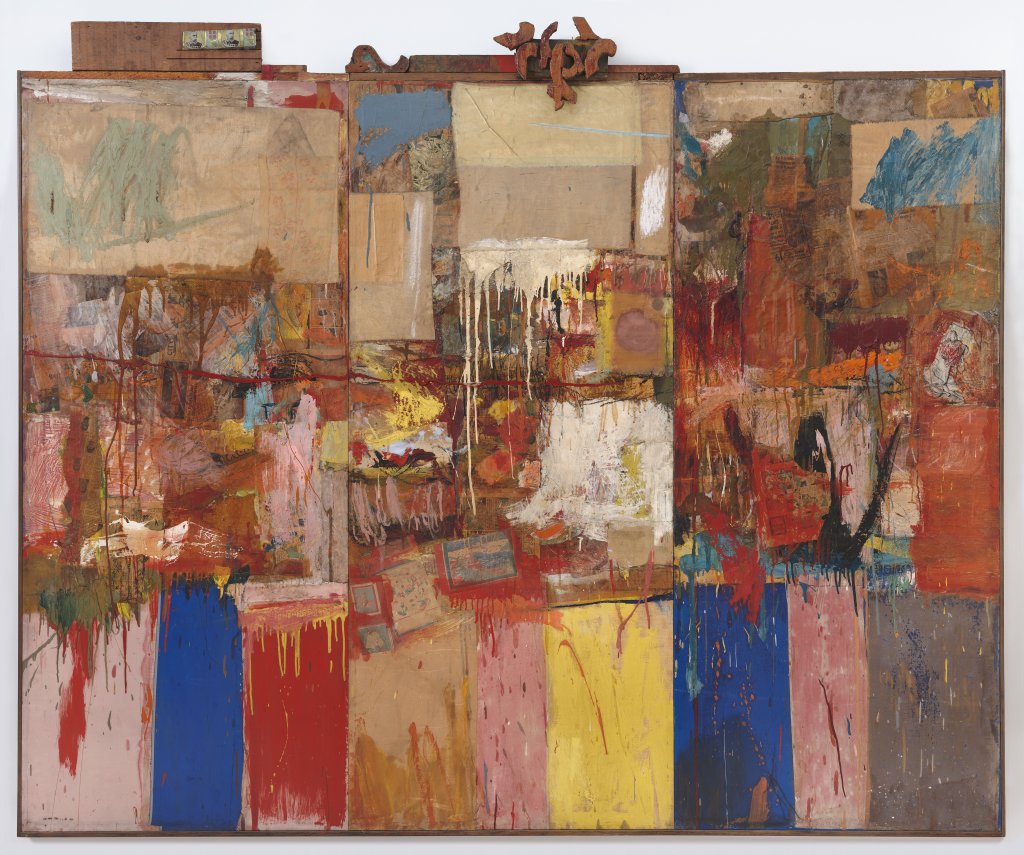
Rauschenberg’s Combine painting ‘Collection’ looks on first glance to be just what its title suggests, a collection of coloured shapes on which paint and been very loosely applied and allowed to run and mix. It is only when it is viewed close up that it starts to reveal a greater collection of materials and information.
On closer examination the support appears to be made up of three wood panels. However the painting is described as being on canvas. Is this a play with the idea of the triptych or another use of the title word ‘Connection’? To the frame of the paintings further wooden pieces have been added along the top. These pieces of wood have paint and fabric attached to them. Were they found like this or have they been added by the artist? The painting is made up of pieces of fabric and cloth, torn pieces of newspapers, magazines and comics which have been randomly adhered to the support. Hardly any of these have been placed in a position to be read naturally, often they are upside down or at various haphazard angles. Paint of many different colours and texture has been loosely applied by daubing, dripping and painting. Much of this paint has been allowed to run and to be absorbed into the fabric. The paint partly obscures the paper, some of it is translucent allowing the viewer to look behind. The whole painting looks faded. To me it is a collection of ideas, materials and, paints.
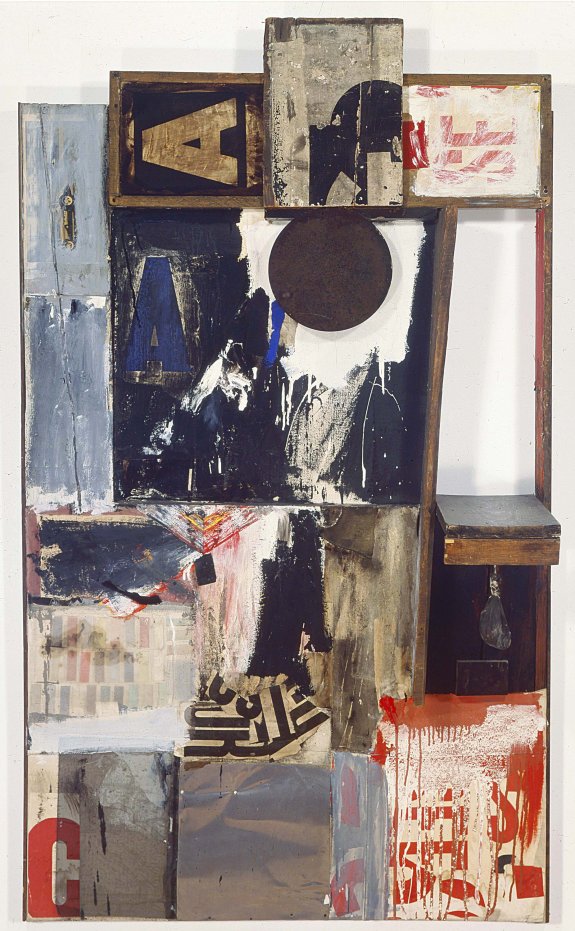
Oil, fabric, wood, printed paper, printed reproductions and metal on canvas with fabric pouch and string.
I find this painting very difficult to read. The techniques involved are similar to that used for ‘Collection’ but to me it is more refined. I guess that this is mainly due to it being painted 4/5 years later. The paint is more restrained, more refined and the whole composition is more coherent. However although I can observe this attributes I struggle to make an association between the painting and its title. Is there meant to be one? I note that there is another painting titled ‘Magician II’ which was painted two year later in 1961. Is this a companion piece or perhaps a follow on piece. There appears to be little connection between the two. I will return to these paintings and I hope over time some more of their secrets will reveal themselves.
Lastly I found it pertinent given the global crisis currently being endured that the strapline at the top of the Rauschenberg website is
“Artists always have been the first to rally around any national or international problem, acting as a conscience.”
 Mark Taylor 'Studio Practice'