Gertrude Stein – Tender Buttons & The Cubists
Initially I found this difficult to read. It took me some time to adjust to how the words and phrases were put together and I had to change how I read. In many respects the work felt like a long poem. Images were placed in my mind that made me think about why they had been written. Where was the connection? Often I found that Stein was describing what something isn’t and at other times describing an aspect of an object that would not immediately be what I would choose to describe it. As an example of this I choose the following extract
A PURSE
A purse was not green, it was not straw colour, it was hardly seen and it had a use a long use and the chain, the chain was never missing, it was not misplaced, it showed that it was open, that is all it showed.
From this I take that it was an empty purse and that would be the only aspect of the purse that would be observed. All other information being superfluous. It doesn’t matter what colour it is. Its use is of no importance. That it had a chain and the fact that the chain wasn’t missing was only an afterthought. The salient point was that it was open and that was all it showed. It contained nothing.
We are used to language giving us information that we take for granted. It has how we have been conditioned to see and respond to the world around us. A representational language that describes what we see. To me there are obvious parallels to how the cubists represented the visual world. They challenged the conventional representational art. They painted multiple views of objects from many angles and perspectives. Different facets and multiple views can all be seen at the same time. This is how the eye sees the world before the brain processes it a makes sense of it. You are able to move around the an object or see a view and relate to it by moving around it or through it.
A S Byatt discusses Henri Matisse’s ‘The Red Studio’
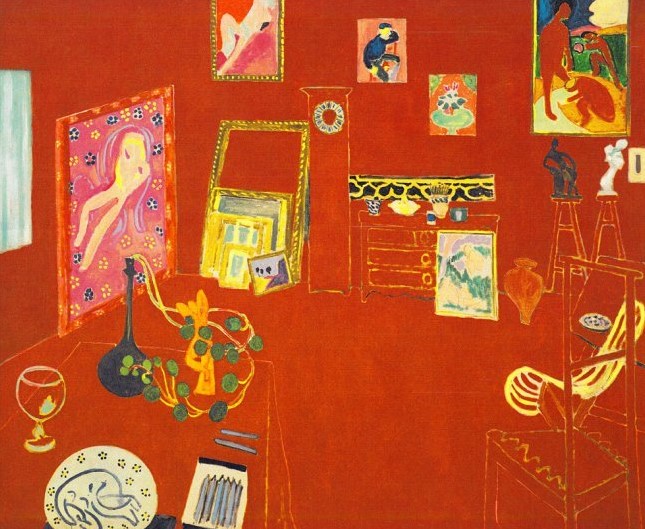
In this discussion A S Byatt describes her fascination and admiration for the paintings of Henri Matisse and in particular ‘The Red Studio’. She describes how every aspect of the composition from its collection of objects, how they are described and painted the colours used has been carefully considered. Everything is where it is supposed to be, its form, its perspective and their relationship to each other and the spaces between the objects. The eye can wander around and through the studio. The red colour carefully chosen exudes a feeling of warmth.
 Mark Taylor 'Studio Practice'