It strikes me that Western art had been stuck within the confines of perspective, whether linear or atmospheric, since its inception. The artist has always had the challenge of facing a two dimensional plane and attempting to convey a three dimensional view. Cubism took this challenge further by suggesting that the view of an object is seen from different viewpoints as our eyes move across it. We can move around an object and see it from a number of perspectives and the relationship between it and other objects that are in proximity to it alter as we move around. The challenge was to dissect the subject and present it viewpoint by viewpoint presenting a fragmented image of multiple viewpoints. The first exponents of Cubism were Georges Braque and Pablo Picasso. An example of an early cubist work is shown below.

In this example the eye can move over the painting and explore the subject from different viewpoints. The colours are simplified so as not to distract from structure and form and are painted in flat slabs. Initially the paintings look confusing and challenging but by looking harder and longer they start to make sense.
Cubism developed and can be split into two distinct phases, Analytical Cubism 1908-12, and Synthetic Cubism 1912-14. The examples above are from the analytical cubism period. Synthetic Cubism developed as artists started adding more texture and pattern to their paintings and also started experimenting with collage. An example of Synthetic cubism is shown below.

Synthetic Cubism swept away the last traces of illusion of a three dimensional space by flattening out the image. Synthetic Cubism painting often included the use of collaged real elements, papier collie, a French term which translates as pasted paper. A further example of this is Juan Gris’s, The Sunblind, shown below.

Cubism opened the way for many later abstract styles such as constructivism, neo-plasticism, constructivism and Automatism (example below).

As a conclusion to this blog I have reproduced a photograph cut up that I produced as part of my work during the ‘Concepts in Practice’ course.
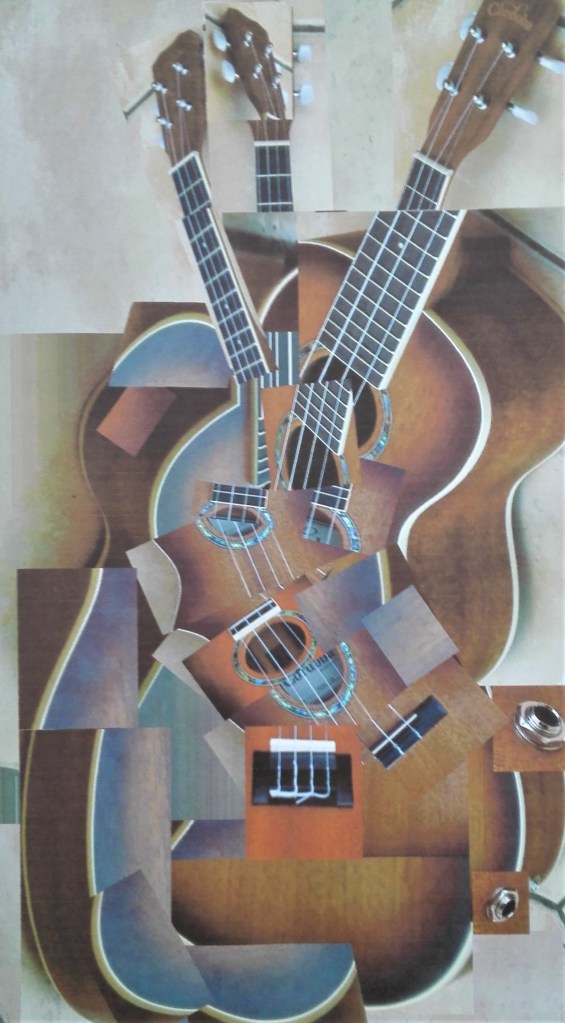
 Mark Taylor 'Studio Practice'